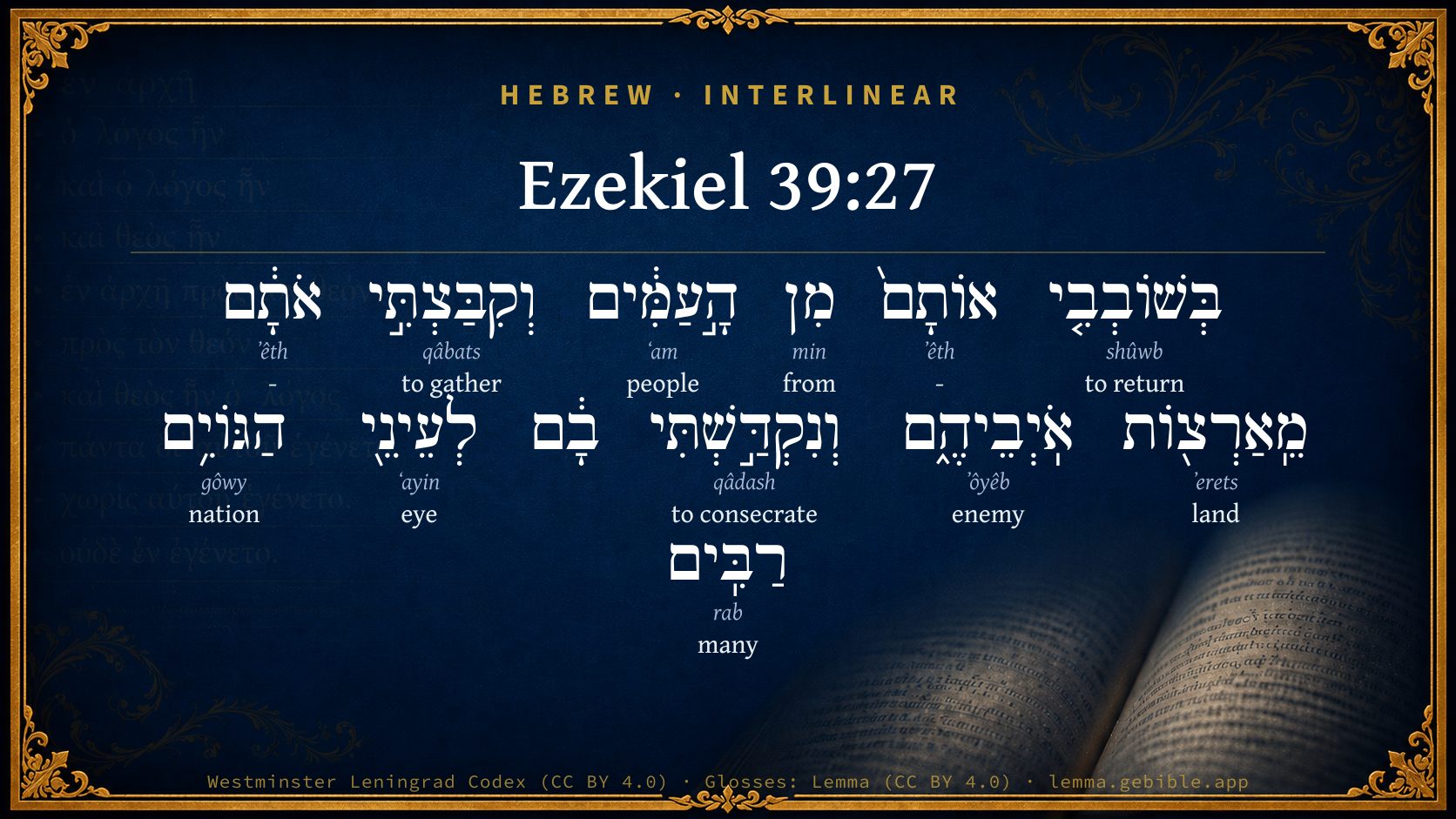
Ezekiel 39:27

Hebrew (Westminster Leningrad Codex) Ezekiel 39:27 appears in the Hebrew Old Testament. The text above is from the Westminster Leningrad Codex. Each word links to its Strong’s number, a concise gloss, and parsing drawn from the Open Scriptures Hebrew Bible morphology. Click any word for its full Brown-Driver-Briggs (BDB) entry.
Download image
Cite this verse

Ezekiel 39:27 (World English Bible). Public Domain. Lemma interlinear Bible study tool, https://lemma.gebible.app/v/ezekiel/39/27.

Show BibTeX & RIS
BibTeX
RIS
English Translation
when I have brought them back from the peoples, and gathered them out of their enemies' lands, and am sanctified in them in the sight of many nations.
World English Bible · Public Domain
Download a study sheet

One document with this verse’s original text, its word-by-word gloss line, the meaning frame, cross-references with their text, attributed commentary, and full source and license credits — printable, and it pastes into notes with its structure intact.

This verse Autodidact and up

Study sheet (.html) Plain text (.txt)

A passage Seminary Student

Up to 50 verses in one chapter. A passage sheet keeps up to 6 commentary sources and 12 cross-references per verse, in the order this page ranks them, and says so on the sheet whenever that leaves anything out. Ask for a single verse and you get the Autodidact verse sheet above.

Everything on this page stays free to read, with no account — the sheet is a download of what is already on screen, not access to it.

Want to remove ads? Support Godless Engineer
Compare translations 3

The same verse in 3 English versions, stacked beneath the original-language interlinear above. Click any original word for its lexicon entry.

Each is an independent rendering of the whole verse — the interlinear is not word-aligned to these translations.

Highlighted words mark where these versions differ — a whole-verse word diff, not a word-by-word alignment.

  • World English Bible Public Domain
    when I have brought them back from the peoples, and gathered them out of their enemies' lands, and am sanctified in them in the sight of many nations.
  • King James Version Public Domain
    When I have brought them again from the people, and gathered them out of their enemies' lands, and am sanctified in them in the sight of many nations;
  • unfoldingWord Literal Text CC BY-SA 4.0
    When I restore them from the peoples and gather them from the lands of their enemies, I will show myself to be holy in the sight of many nations.

unfoldingWord Literal Text — © unfoldingWord, licensed CC BY-SA 4.0. Word-aligned USFM3 via Door43 (git.door43.org/unfoldingWord/en_ult).

Versions to compare (up to 4)

3 of 4 selected

Show all 18 translations

Every available English version of this verse, each an independent rendering of the whole verse.

  • World English Bible Public Domain
    when I have brought them back from the peoples, and gathered them out of their enemies' lands, and am sanctified in them in the sight of many nations.
  • Berean Standard Bible Public Domain
    When I bring them back from the peoples and gather them out of the lands of their enemies, I will show My holiness in them in the sight of many nations.
  • Majority Standard Bible Public Domain
    When I bring them back from the peoples and gather them out of the lands of their enemies, I will show My holiness in them in the sight of many nations.
  • King James Version Public Domain
    When I have brought them again from the people, and gathered them out of their enemies' lands, and am sanctified in them in the sight of many nations;
  • American Standard Version (1901) Public Domain
    when I have brought them back from the peoples, and gathered them out of their enemies' lands, and am sanctified in them in the sight of many nations.
  • Revised Version (1885) Public Domain
    when I have brought them again from the peoples, and gathered them out of their enemies’ lands, and am sanctified in them in the sight of many nations.
  • Geneva Bible (1599) Public Domain
    When I haue brought them againe from the people, and gathered them out of their enemies landes, and am sanctified in them in the sight of many nations,
  • Douay-Rheims (1899) Public Domain
    And I shall have brought them back from among the nations, and shall have gathered them together out of the lands of their enemies, and shall be sanctified in them, in the sight of many nations.
  • Young's Literal Translation Public Domain
    In My bringing them back from the peoples, I have assembled them from the lands of their enemies, And I have been sanctified in them before the eyes of the many nations,
  • Literal Standard Version CC BY-SA 4.0
    In My bringing them back from the peoples, || I have assembled them from the lands of their enemies, || And I have been sanctified in them before the eyes of the many nations,
  • Unlocked Literal Bible CC BY-SA 4.0
    When I restore them from the peoples and gather them from the lands of their enemies, I will show myself to be holy in the sight of many nations.
  • unfoldingWord Literal Text CC BY-SA 4.0
    When I restore them from the peoples and gather them from the lands of their enemies, I will show myself to be holy in the sight of many nations.
  • Darby Bible Public Domain
    when I have brought them again from the peoples, and gathered them out of their enemies' lands, and am hallowed in them in the sight of many nations.
  • World Messianic Bible Public Domain
    when I have brought them back from the peoples, gathered them out of their enemies’ lands, and am shown holy among them in the sight of many nations.
  • Webster's Bible Public Domain
    When I have brought them again from the people, and gathered them out of the lands of their enemies, and am sanctified in them in the sight of many nations;
  • Free Bible Version CC BY-SA 4.0
    When I bring them home from the nations, gathering them from the countries of their enemies, I will reveal my holiness as many nations watch.
  • Bible in Basic English Public Domain
    When I have taken them back from among the peoples and got them together out of the lands of their haters, and have made myself holy in them before the eyes of a great number of nations.
  • JPS Tanakh (1917) Public Domain
    when I have brought them back from the peoples, and gathered them out of their enemies' lands, and am sanctified in them in the sight of many nations.

Literal Standard Version (2020), Covenant Press — licensed CC BY-SA 4.0. Text via the HelloAO Bible API (eBible.org). Unlocked Literal Bible (unfoldingWord) — licensed CC BY-SA 4.0. Text via the HelloAO Bible API (eBible.org). unfoldingWord Literal Text — © unfoldingWord, licensed CC BY-SA 4.0. Word-aligned USFM3 via Door43 (git.door43.org/unfoldingWord/en_ult). Free Bible Version, Dr. Jonathan Gallagher — licensed CC BY-SA 4.0. Text via the HelloAO Bible API (eBible.org).

Word by word

More ways to search: Search by grammar → Find every occurrence → Compare this word →

Practice this passage: Drill this verse → Learn its vocabulary →

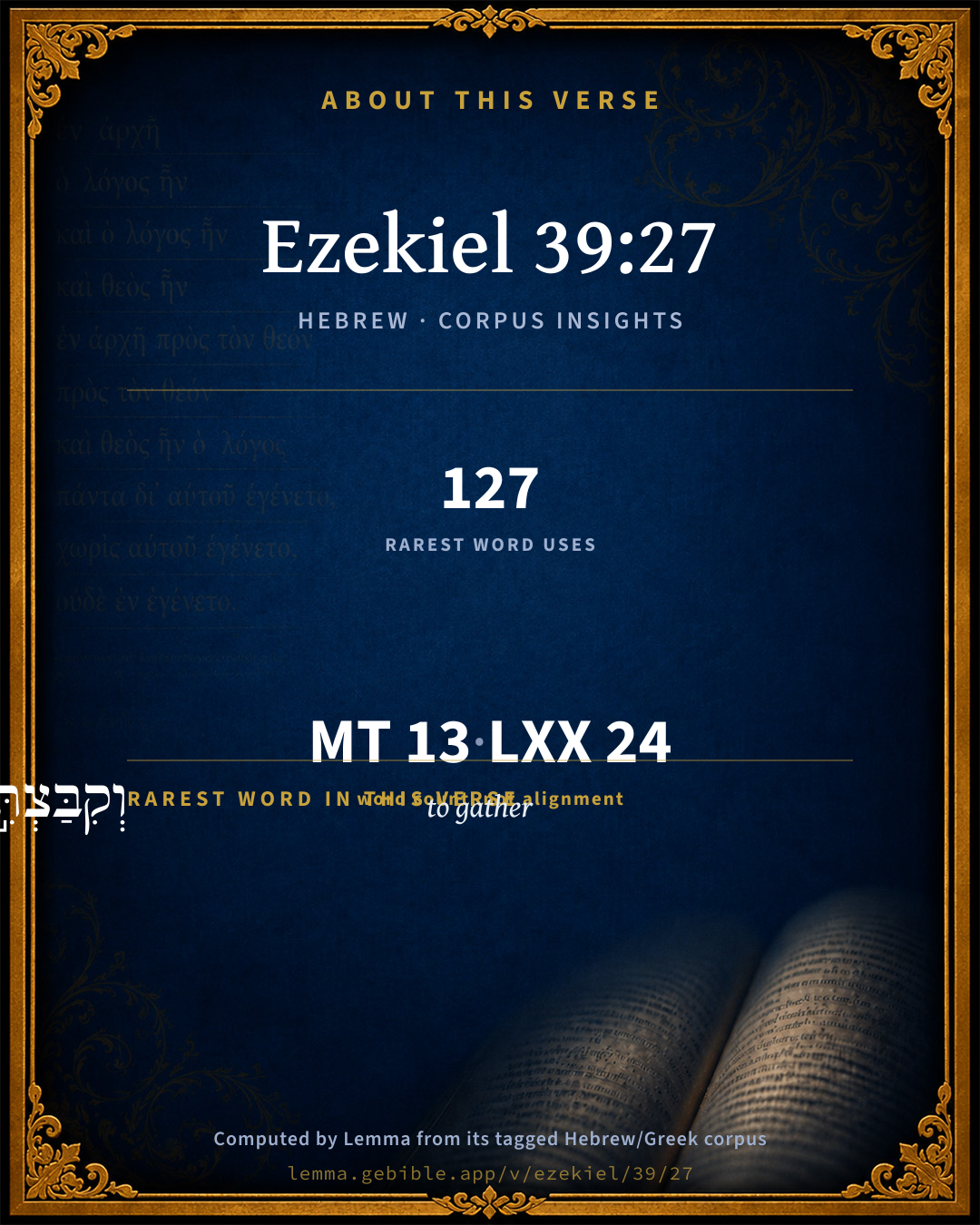
וְקִבַּצְתִּ֣י
qâbats
H6908
“and · to gather”
Conjunction + Verb, Piel, Sequential Perfect, 1st Person, Common, Singular
Part of Speech
Conjunction + Verb
Stem
Piel
Form
Sequential Perfect
Person
1st Person
Gender
Common
Number
Singular
Full BDB Definition

Origin: a primitive root

TWOT: 1983

to gather, assemble - (Qal) to gather, collect, assemble - (Niphal) - to assemble, gather - to be gathered - (Piel) to gather, gather together, take away - (Pual) to be gathered together - (Hithpael) to gather together, be gathered together
  1. בְּשׁוֹבְבִ֤י shûwb H7725 “in/at · to return · me” Preposition + Verb, Polel, Infinitive Construct + Suffix, Personal, 1st Person, Common, Singular
  2. אוֹתָם֙ ʼêth H853 “- · them” Particle, Direct Object + Suffix, Personal, 3rd Person, Masculine, Plural
  3. מִן min H4480 “from” Preposition
  4. הָ֣עַמִּ֔ים ʻam H5971 “the · peoples” Particle, Definite Article + Noun, Common, Masculine, Plural, Absolute
  5. אֹתָ֔ם ʼêth H853 “- · them” Particle, Direct Object + Suffix, Personal, 3rd Person, Masculine, Plural
  6. מֵֽאַרְצ֖וֹת ʼerets H776 “from · lands of” Preposition + Noun, Common, Both, Plural, Construct
  7. אֹֽיְבֵיהֶ֑ם ʼôyêb H341 “enemy · them” Verb, Qal, Participle Active, Masculine, Plural, Construct + Suffix, Personal, 3rd Person, Masculine, Plural
  8. וְנִקְדַּ֣שְׁתִּי qâdash H6942 “and · to consecrate” Conjunction + Verb, Niphal, Sequential Perfect, 1st Person, Common, Singular
  9. לְעֵינֵ֖י ʻayin H5869 “to/for · eyes of” Preposition + Noun, Common, Both, Dual, Construct
  10. הַגּוֹיִ֥ם gôwy H1471 “the · nations” Particle, Definite Article + Noun, Common, Masculine, Plural, Absolute
  11. רַבִּֽים rab H7227 “many” Adjective, Adjective, Masculine, Plural, Absolute

About this verse

These counts appear in no published source. They are computed here, from the morphology-tagged text and Lemma’s own curated glosses. What Lemma adds →

13
words
11
distinct lemmas
Prophets
section

Grammatical profile

  • 4 verbs
  • 4 nouns
  • 1 adjective
  • 2 prepositions
  • 2 particles

Verb forms

  • בְּשׁוֹבְבִ֤י Polel · Infinitive Construct
  • וְקִבַּצְתִּ֣י Piel · Sequential Perfect
  • אֹֽיְבֵיהֶ֑ם Qal · Participle Active
  • וְנִקְדַּ֣שְׁתִּי Niphal · Sequential Perfect

Hebrew & Septuagint length

In English translation the verse runs 28 words from the Hebrew and 32 from the Septuagint (LXX English) — closely comparable.

A rough comparison of the two English renderings, which tokenize alike — not a word-level alignment.

Word counts can differ between the Hebrew and the Greek without any difference in meaning — e.g. the Hebrew direct-object marker אֵת has no separate Greek word, and Greek often adds the article ὁ.

In the original languages it is 13 Hebrew tokens and 24 Greek tokens — but the two are counted differently (Hebrew bundles its prefixes and suffixes into one token; the Greek is in lemma form), so that isn’t a like-for-like length.

Cross-references

9

Topical passages linked to Ezekiel 39:27 in the Treasury of Scripture Knowledge — connected by theme and wording, ordered by reader-vote popularity; previews shown in the World English Bible.

  • Ezekiel 36:23–24 I will sanctify my great name, which has been profaned among the nations, which you have profaned in the midst of them; and the nations shall know that I am Yahweh, says the Lord Yahweh, when I shall be sanctified in you before their eyes.
  • Ezekiel 38:16 and you shall come up against my people Israel, as a cloud to cover the land: it shall happen in the latter days, that I will bring you against my land, that the nations may know me, when I shall be sanctified in you, Gog, before their eyes.
  • Ezekiel 38:23 I will magnify myself, and sanctify myself, and I will make myself known in the eyes of many nations; and they shall know that I am Yahweh.
  • Leviticus 10:3 Then Moses said to Aaron, "This is what Yahweh spoke of, saying, "'I will show myself holy to those who come near me, And before all the people I will be glorified.'" Aaron held his peace.
  • Isaiah 5:16 But Yahweh of Hosts is exalted in justice, And God the Holy One is sanctified in righteousness.
  • Ezekiel 28:25–26 Thus says the Lord Yahweh: When I shall have gathered the house of Israel from the peoples among whom they are scattered, and shall be sanctified in them in the sight of the nations, then shall they dwell in their own land which I gave to my servant Jacob.
  • Ezekiel 37:21 Say to them, Thus says the Lord Yahweh: Behold, I will take the children of Israel from among the nations, where they are gone, and will gather them on every side, and bring them into their own land:
  • Ezekiel 39:25 Therefore thus says the Lord Yahweh: Now will I bring back the captivity of Jacob, and have mercy on the whole house of Israel; and I will be jealous for my holy name.
  • Ezekiel 39:13 Yes, all the people of the land shall bury them; and it shall be to them a renown in the day that I shall be glorified, says the Lord Yahweh.

Cross-references courtesy of OpenBible.info (CC BY 4.0).

Hebrew and Greek witnesses Masoretic Hebrew ↔ Greek Septuagint

The same verse in the two great witnesses to the Old Testament, shown verse-for-verse.

These are two independent witnesses, not word-aligned to each other, and the Septuagint is shown in lemma (dictionary) form.

Hebrew Ezekiel 39:27 Masoretic · Westminster Leningrad Codex

בְּשׁוֹבְבִ֤י אוֹתָם֙ מִן הָ֣עַמִּ֔ים וְקִבַּצְתִּ֣י אֹתָ֔ם מֵֽאַרְצ֖וֹת אֹֽיְבֵיהֶ֑ם וְנִקְדַּ֣שְׁתִּי בָ֔ם לְעֵינֵ֖י הַגּוֹיִ֥ם רַבִּֽים

when I have brought them back from the peoples, and gathered them out of their enemies' lands, and am sanctified in them in the sight of many nations.

World English Bible · Public Domain

Greek LXX Ezekiel 39:27 Septuagint · lemma form

ἐν ὁ ἀποστρέφω ἐγώ αὐτός ἐκ ὁ ἔθνος καί συνἄγω ἐγώ αὐτός ἐκ ὁ χώρα ὁ ἔθνος καί ἁγιάζω ἐν αὐτός ἐνώπιον ὁ ἔθνος

when I have brought them back from the nations, and gathered them out of the countries of the nations: and I will be sanctified among them in the presence of the nations.

LXX2012 (modern English Septuagint) · Public Domain

Hebrew: Westminster Leningrad Codex (CC BY 4.0). Greek: Septuagint (public domain); English from LXX2012 (modern English Septuagint) (Public Domain). How the Septuagint differs from the Hebrew →

Targum (Aramaic paraphrase)

1

The Targum is the ancient Jewish Aramaic paraphrase of the Hebrew Scriptures — an interpretive translation, not the Hebrew text itself. Onkelos (literal) and Pseudo-Jonathan (expansive) render the Torah, and Jonathan the Prophets. Coverage is partial: where no permissively-licensed English translation exists for a verse, only the Aramaic is shown. This is verse-level text, not a word-by-word alignment to the Hebrew.

  1. Targum Jonathan Prophets (Joshua–Malachi)
    כַּד אֲתִיב יַתְהוֹן מִבֵּינֵי עַמְמַיָא וְאַכְנֵישׁ יַתְהוֹן מִן מְדִינְתָא בַּעֲלֵי דְבָבֵיכוֹן וְאִתְקַדַשׁ בְּהוֹן לְעֵינֵי עַמְמִין סַגִיאִין:

    (no public-domain English translation for this verse)

    Targum Jonathan — Aramaic: “Mikraot Gedolot” (public domain). English: “Sefaria Community Translation” (CC0 1.0 (public-domain dedication)); “London "Chaldee Paraphrase," 1871” (public domain). Text via Sefaria.

Commentary

Notes on Ezekiel 39:27 from classic Christian and Jewish commentators (each source and its license shown beneath its notes). The classic Christian expositions comment on the surrounding passage and are grouped to its opening verse, so a note may address several verses; the Jewish commentaries on the Tanakh (Rashi and others) are per-verse, so they appear only where the commentator wrote on this verse.

Lemma curates 59 commentaries, every one of them public domain or Creative Commons licensed, each selected and text-cleaned for this edition rather than reprinted as found. About our sources →

Trapp's Complete Commentary

John Trapp

Eze 39:27 When I have brought them again from the people, and gathered them out of their enemies’ lands, and am sanctified in them in the sight of many nations;

Ver. 27. And am sanctified in them,] i.e., Have fully shown my sanctity and majesty, both by their punishment and by their deliverance.

John Trapp, A Commentary or Exposition upon All the Books of the Old and New Testament (1647–1656) — public domain. Text from a community e-Sword module.

Joseph Benson's Commentary

Eze 39:27-28. When I have brought them again from the people —

According to my promises; and gathered them out of their enemies’ lands — Wherever they were scattered; and am sanctified in them — By their patiently accepting punishment, repenting of sin, loathing their former ways, and themselves on account of them, acknowledging me to be holy, just, and good, and dedicating themselves unreservedly to my service; when I am thus sanctified among them, and in the sight of the nations who shall see that the furnace has purified them; then shall they know — On the fullest experience and clearest evidence; that I am the Lord their God — And that I have never ceased to exercise a paternal care over them; and in all my chastisements of them, as well as my benefits conferred on them, have had their good in view: see notes on Eze 39:22, and Eze 34:30. Observe, reader, by the variety of events through which God brings us in the course of his providence, if we look up to him in them all, we shall become better acquainted, both with his divine perfections, and his various designs in all his dispensations toward us.

Joseph Benson's Commentary on the Old and New Testaments (1811–1818) — public domain. Text from a community e-Sword module.

Whedon's Commentary on the Bible

Daniel D. Whedon

27-29. When the new Israel shall be brought back from their captivity among the “peoples” (Eze_39:25; Eze_39:27), filled with the new spirit of shame for their past sins and with a joy in God’s presence which makes them forget their dismal past (Eze_39:26), and “shall dwell securely” in their own land, where none “shall make them afraid” (Eze_39:26, R.V.), and thus Jehovah shall have been sanctified in them (Eze_39:27; Eze_20:41; Eze_36:20; Eze_36:23-24) — then shall they know as never before “that I am the Lord their God, in that I caused them to go into captivity… and have gathered them… and will leave none of them,… neither will I hide my face [compare Eze_39:23; Isa_54:8]… for I have poured out my spirit.” (Compare Eze_36:25-31; Eze_37:14; Isa_59:21; Joe_2:28.) “No historical Church, Jewish or Gentile, has ever yet realized the picture here sketched by Ezekiel.… Will it ever be realized on earth? or must we only look for it in the heavenly city, whose Builder and Maker is God?” — Plumptre. If the conflict (chapter 38) is to be on this earth, as it surely will be, then the victory and the peace which follows must also be looked for here. The promise is to be fulfilled truly, though not literally. (See introduction chapter Ezekiel 40) It has already received a partial fulfillment (compare Joe_2:28; Act_2:17); yet the foes of the new Israel, the true children of Abraham (Luk_3:8; Joh_8:39; Gal_3:7; Gal_3:9; Gal_3:29), are still active, and Gog — the Old Testament “Antichrist” — if indeed he has yet put on his armor, has certainly not yet been left dead upon the field. It must always be borne in mind that it is not a literal conflict described in this chapter between men armed with bows and arrows who shall be killed by bolts of lightning, but a spiritual battle between God’s people and the powers of evil. Like Bunyan’s Pilgrim’s Progress, it depicts figuratively that which is everlastingly true, and what may perhaps be often repeated in different individuals and in different ages.

Daniel D. Whedon (gen. ed.), Commentary on the Old and New Testaments (1874–1909) — public domain. Text from a community e-Sword module.

Jamieson, Fausset & Brown

Robert Jamieson, A. R. Fausset & David Brown

sanctified in them--vindicated as holy in My dealings with them.

Jamieson, Fausset & Brown — Commentary Critical and Explanatory on the Whole Bible (1871) — public domain (CC PDM 1.0). Text via the HelloAO Bible API.

Adam Clarke's Commentary

Verse 27. When I have - gathered them] Antiochus had before captured many of the Jews, and sold them for slaves; see Da 11:33.

Adam Clarke's Commentary on the Bible (1810–1826) — public domain. Text from a community e-Sword/MySword module.

The Cambridge Bible for Schools and Colleges

gen. ed. J. J. S. Perowne

27. The verse is closely connected with the preceding: none maketh them afraid; when I have brought … and have been sanctified in (or, through) them. Cf. Eze_36:23-24, Eze_38:16. For people, peoples.

The Cambridge Bible for Schools and Colleges (gen. ed. J. J. S. Perowne; Cambridge University Press, 1878–1918) — public domain. Text from a community e-Sword module.

John Gill's Exposition

When I have brought them again from the people,.... That is, then shall they be ashamed, and repent of all their trespasses and sins:

and gathered them out of their enemies lands; from the provinces of their enemies, as the Targum; when they are collected together in a body out of each of the nations where they are now dispersed, and brought to their own land:

and am sanctified in them in the sight of many nations; when they shall publicly repent of their sins, and forsake them, and seek the Lord their God, and the King Messiah, and embrace and profess him, and acknowledge that God has been righteous and holy in all his dispensations towards them.

John Gill's Exposition of the Whole Bible (1746–1763) — public domain (CC PDM 1.0). Text via the HelloAO Bible API.

Matthew Poole's English Annotations

When I have brought them: see the phrase Eze 28:25. The persons here are not the two tribes only, but the ten with them, as Eze 39:25.

Out of their enemies’ lands; wherever they were, they were among enemies, out of their own country.

Sanctified; by their accepting punishment, repenting for sin, loathing their former ways, and themselves for them, acknowledging God to be holy, his law holy, and his worship holy, and engaging themselves in covenant of perpetual obedience to God, and keeping it; by these things God will be sanctified among the Israelites, and in sight of the nations, when they see the furnace hath purified them.

Matthew Poole's English Annotations on the Holy Bible (1683–1685) — public domain. Text from a community e-Sword/MySword module.

Lesson kit

Teaching starters — assembled from the data on this page, not authored interpretation. Every prompt links to the verse data it draws on. Edit before teaching.

Ezekiel, in the Prophets, opens this verse with 13 words (11 distinct Hebrew lemmas). Its most distinctive word is qâbats (“to gather”). A historical commentator’s framing appears above. Read the whole chapter for the surrounding context.

Discussion questions

  1. What does “to gather” (qâbats) contribute to the verse as a whole?
  2. Ezekiel 36:23–24 shares this passage’s theme. How do the two illuminate each other?
  3. These translations render this verse differently; the difference is in the English rendering, not the original. What questions does that raise?
  4. The verb «בְּשׁוֹבְבִ֤י» is Polel Infinitive Construct. How does its form color the action?
  5. Reading how Trapp's Complete Commentary and Joseph Benson's Commentary read this verse, where do the two commentators agree and where do they part?

Things to notice

Reading settings

Reading text

Shown beneath each verse's original-language words.

Old Testament
Old Testament edition

Read the OT as the Masoretic Hebrew (MT) or the Greek Septuagint (LXX).

English shown for the Greek Septuagint (in the Hebrew ↔ Greek comparison).

Comparing translations? Open the Compare panel on any verse page to stack up to four side by side.