
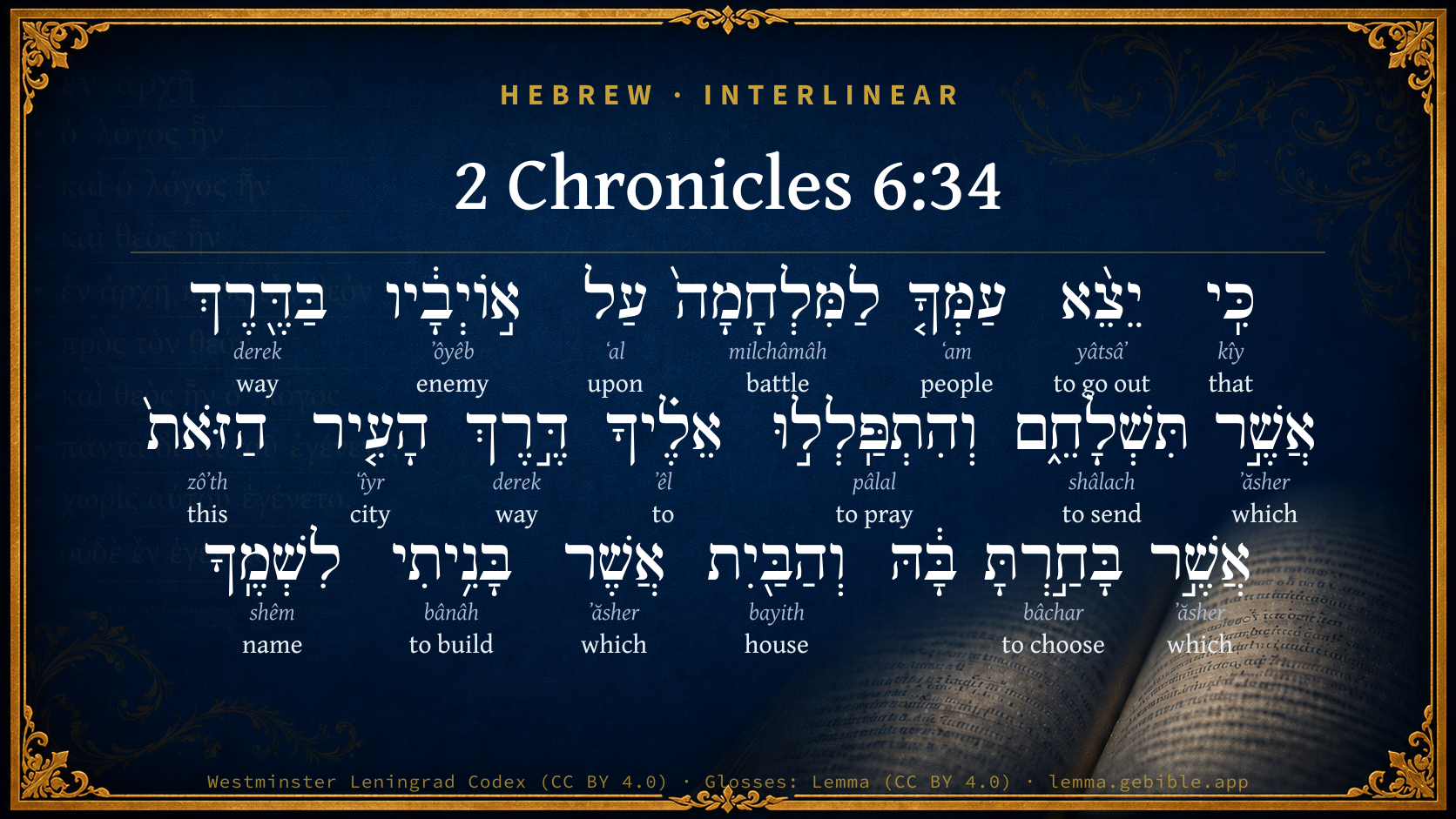
2 Chronicles 6:34

Hebrew (Westminster Leningrad Codex) 2 Chronicles 6:34 appears in the Hebrew Old Testament. The text above is from the Westminster Leningrad Codex. Each word links to its Strong’s number, a concise gloss, and parsing drawn from the Open Scriptures Hebrew Bible morphology. Click any word for its full Brown-Driver-Briggs (BDB) entry.
Download image
Cite this verse

2 Chronicles 6:34 (World English Bible). Public Domain. Lemma interlinear Bible study tool, https://lemma.gebible.app/v/2-chronicles/6/34.

Show BibTeX & RIS
BibTeX
RIS
English Translation
If your people go out to battle against their enemies, by whatever way you shall send them, and they pray to you toward this city which you have chosen, and the house which I have built for your name;
World English Bible · Public Domain
Download a study sheet

One document with this verse’s original text, its word-by-word gloss line, the meaning frame, cross-references with their text, attributed commentary, and full source and license credits — printable, and it pastes into notes with its structure intact.

This verse Autodidact and up

Study sheet (.html) Plain text (.txt)

A passage Seminary Student

Up to 50 verses in one chapter. A passage sheet keeps up to 6 commentary sources and 12 cross-references per verse, in the order this page ranks them, and says so on the sheet whenever that leaves anything out. Ask for a single verse and you get the Autodidact verse sheet above.

Everything on this page stays free to read, with no account — the sheet is a download of what is already on screen, not access to it.

Want to remove ads? Support Godless Engineer
Compare translations 3

The same verse in 3 English versions, stacked beneath the original-language interlinear above. Click any original word for its lexicon entry.

Each is an independent rendering of the whole verse — the interlinear is not word-aligned to these translations.

Highlighted words mark where these versions differ — a whole-verse word diff, not a word-by-word alignment.

  • World English Bible Public Domain
    If your people go out to battle against their enemies, by whatever way you shall send them, and they pray to you toward this city which you have chosen, and the house which I have built for your name;
  • King James Version Public Domain
    If thy people go out to war against their enemies by the way that thou shalt send them, and they pray unto thee toward this city which thou hast chosen, and the house which I have built for thy name;
  • unfoldingWord Literal Text CC BY-SA 4.0
    When your people go out to battle against their enemies in the way which you send them, and they pray to you toward the way of this city that you have chosen it and the house that I have built for your name,

unfoldingWord Literal Text — © unfoldingWord, licensed CC BY-SA 4.0. Word-aligned USFM3 via Door43 (git.door43.org/unfoldingWord/en_ult).

Versions to compare (up to 4)

3 of 4 selected

Show all 18 translations

Every available English version of this verse, each an independent rendering of the whole verse.

  • World English Bible Public Domain
    If your people go out to battle against their enemies, by whatever way you shall send them, and they pray to you toward this city which you have chosen, and the house which I have built for your name;
  • Berean Standard Bible Public Domain
    When Your people go to war against their enemies, wherever You send them, and when they pray to You in the direction of the city You have chosen and the house I have built for Your Name,
  • Majority Standard Bible Public Domain
    When Your people go to war against their enemies, wherever You send them, and when they pray to You in the direction of this city You have chosen and the house I have built for Your Name,
  • King James Version Public Domain
    If thy people go out to war against their enemies by the way that thou shalt send them, and they pray unto thee toward this city which thou hast chosen, and the house which I have built for thy name;
  • American Standard Version (1901) Public Domain
    If thy people go out to battle against their enemies, by whatsoever way thou shalt send them, and they pray unto thee toward this city which thou hast chosen, and the house which I have built for thy name;
  • Revised Version (1885) Public Domain
    If thy people go out to battle against their enemies, by whatsoever way thou shalt send them, and they pray unto thee toward this city which thou hast chosen, and the house which I have built for thy name:
  • Geneva Bible (1599) Public Domain
    When thy people shall goe out to battell against their enemies, by the way that thou shalt send them, and they pray to thee, in the way towarde this citie, which thou hast chosen, euen toward the house which I haue built to thy Name,
  • Douay-Rheims (1899) Public Domain
    If thy people go out to war against their enemies, by the way that thou shalt send them, and adore thee towards the way of this city, which thou hast chosen, and the house which I have built to thy name:
  • Young's Literal Translation Public Domain
    `When Thy people doth go out to battle against its enemies in the way that Thou dost send them, and they have prayed unto Thee the way of this city that Thou hast fixed on, and the house that I have built for Thy name:
  • Literal Standard Version CC BY-SA 4.0
    When Your people go out to battle against its enemies in the way that You send them, and they have prayed to You [in] the way of this city that You have fixed on, and the house that I have built for Your Name—
  • Unlocked Literal Bible CC BY-SA 4.0
    Suppose that your people go out to battle against their enemies, by whatever way you may send them, and suppose that they pray to you toward this city that you have chosen, and toward the house that I have built for your name.
  • unfoldingWord Literal Text CC BY-SA 4.0
    When your people go out to battle against their enemies in the way which you send them, and they pray to you toward the way of this city that you have chosen it and the house that I have built for your name,
  • Darby Bible Public Domain
    If thy people go out to battle against their enemies by the way that thou shalt send them, and they pray unto thee toward this city that thou hast chosen, and the house that I have built unto thy name;
  • World Messianic Bible Public Domain
    “If your people go out to battle against their enemies, by whatever way you send them, and they pray to you toward this city which you have chosen, and the house which I have built for your name;
  • Webster's Bible Public Domain
    If thy people go out to war against their enemies by the way that thou shalt send them, and they pray to thee towards this city which thou hast chosen, and the house which I have built for thy name;
  • Free Bible Version CC BY-SA 4.0
    When your people go to fight against their enemies, wherever you send them, and when they pray to you towards the city you have chosen and the house I have built to honor you,
  • Bible in Basic English Public Domain
    If your people go out to war against their attackers, by whatever way you may send them, if they make their prayers to you turning their faces to this town of yours and to this house which I have put up for your name:
  • JPS Tanakh (1917) Public Domain
    If Thy people go out to battle against their enemies, by whatsoever way Thou shalt send them, and they pray unto Thee toward this city which Thou hast chosen, and the house which I have built for Thy name;

Literal Standard Version (2020), Covenant Press — licensed CC BY-SA 4.0. Text via the HelloAO Bible API (eBible.org). Unlocked Literal Bible (unfoldingWord) — licensed CC BY-SA 4.0. Text via the HelloAO Bible API (eBible.org). unfoldingWord Literal Text — © unfoldingWord, licensed CC BY-SA 4.0. Word-aligned USFM3 via Door43 (git.door43.org/unfoldingWord/en_ult). Free Bible Version, Dr. Jonathan Gallagher — licensed CC BY-SA 4.0. Text via the HelloAO Bible API (eBible.org).

Word by word

More ways to search: Search by grammar → Find every occurrence → Compare this word →

Practice this passage: Drill this verse → Learn its vocabulary →

וְהִתְפַּֽלְל֣וּ
pâlal
H6419
“and · to pray”
Conjunction + Verb, Hithpael, Sequential Perfect, 3rd Person, Common, Plural
Part of Speech
Conjunction + Verb
Stem
Hithpael
Form
Sequential Perfect
Person
3rd Person
Gender
Common
Number
Plural
Full BDB Definition

Origin: a primitive root

TWOT: 1776

to intervene, interpose, pray - (Piel) to mediate, judge - (Hithpael) - to intercede - to pray
  1. כִּֽי kîy H3588 “that” Conjunction
  2. יֵצֵ֨א yâtsâʼ H3318 “to go out” Verb, Qal, Imperfect, 3rd Person, Masculine, Singular
  3. עַמְּךָ֤ ʻam H5971 “people · your” Noun, Common, Masculine, Singular, Construct + Suffix, Personal, 2nd Person, Masculine, Singular
  4. לַמִּלְחָמָה֙ milchâmâh H4421 “to/for the · battle” Preposition, Determined + Noun, Common, Feminine, Singular, Absolute
  5. עַל ʻal H5921 “upon” Preposition
  6. א֣וֹיְבָ֔יו ʼôyêb H341 “enemy · him” Verb, Qal, Participle Active, Masculine, Plural, Construct + Suffix, Personal, 3rd Person, Masculine, Singular
  7. בַּדֶּ֖רֶךְ derek H1870 “in/at the · way” Preposition, Determined + Noun, Common, Both, Singular, Absolute
  8. אֲשֶׁ֣ר ʼăsher H834 “which” Particle, Relative
  9. תִּשְׁלָחֵ֑ם shâlach H7971 “to send · them” Verb, Qal, Imperfect, 2nd Person, Masculine, Singular + Suffix, Personal, 3rd Person, Masculine, Plural
  10. אֵלֶ֗יךָ ʼêl H413 “to · you” Preposition + Suffix, Personal, 2nd Person, Masculine, Singular
  11. דֶּ֣רֶךְ derek H1870 “way of” Noun, Common, Both, Singular, Construct
  12. הָעִ֤יר ʻîyr H5892 “the · city” Particle, Definite Article + Noun, Common, Feminine, Singular, Absolute
  13. הַזֹּאת֙ zôʼth H2063 “the · this” Particle, Definite Article + Pronoun, Demonstrative, Feminine, Singular
  14. אֲשֶׁ֣ר ʼăsher H834 “which” Particle, Relative
  15. בָּחַ֣רְתָּ bâchar H977 “to choose” Verb, Qal, Perfect, 2nd Person, Masculine, Singular
  16. וְהַבַּ֖יִת bayith H1004 “and · the · house” Conjunction + Particle, Definite Article + Noun, Common, Masculine, Singular, Absolute
  17. אֲשֶׁר ʼăsher H834 “which” Particle, Relative
  18. בָּנִ֥יתִי bânâh H1129 “to build” Verb, Qal, Perfect, 1st Person, Common, Singular
  19. לִשְׁמֶֽךָ shêm H8034 “to/for · name · your” Preposition + Noun, Common, Masculine, Singular, Construct + Suffix, Personal, 2nd Person, Masculine, Singular

About this verse

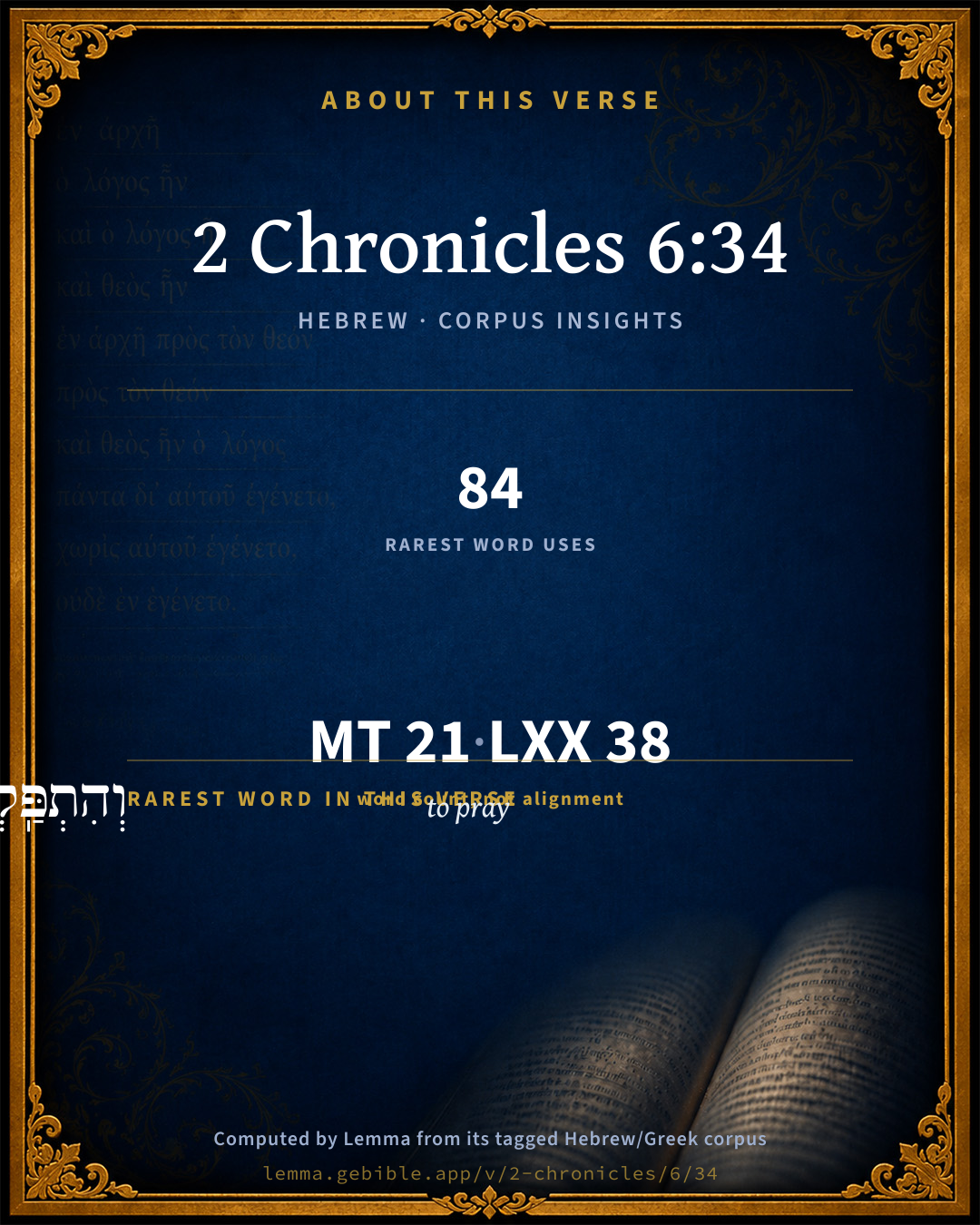
These counts appear in no published source. They are computed here, from the morphology-tagged text and Lemma’s own curated glosses. What Lemma adds →

21
words
17
distinct lemmas
Historical
section

Grammatical profile

  • 6 verbs
  • 7 nouns
  • 1 pronoun
  • 3 prepositions
  • 1 conjunction
  • 3 particles

Verb forms

  • יֵצֵ֨א Qal · Imperfect
  • א֣וֹיְבָ֔יו Qal · Participle Active
  • תִּשְׁלָחֵ֑ם Qal · Imperfect
  • וְהִתְפַּֽלְל֣וּ Hithpael · Sequential Perfect
  • בָּחַ֣רְתָּ Qal · Perfect
  • בָּנִ֥יתִי Qal · Perfect

Repetition

Words recur within this verse — often emphatic in Hebrew:

  • בַּדֶּ֖רֶךְ way H1870 ×2
  • אֲשֶׁ֣ר which H834 ×3

Hebrew & Septuagint length

In English translation the verse runs 39 words from the Hebrew and 44 from the Septuagint (LXX English) — closely comparable.

A rough comparison of the two English renderings, which tokenize alike — not a word-level alignment.

Word counts can differ between the Hebrew and the Greek without any difference in meaning — e.g. the Hebrew direct-object marker אֵת has no separate Greek word, and Greek often adds the article ὁ.

In the original languages it is 21 Hebrew tokens and 38 Greek tokens — but the two are counted differently (Hebrew bundles its prefixes and suffixes into one token; the Greek is in lemma form), so that isn’t a like-for-like length.

Cross-references

17

Topical passages linked to 2 Chronicles 6:34 in the Treasury of Scripture Knowledge — connected by theme and wording, ordered by reader-vote popularity; previews shown in the World English Bible.

  • 2 Chronicles 20:6–13 and he said, Yahweh, the God of our fathers, aren't you God in heaven? and aren't you ruler over all the kingdoms of the nations? and in your hand is power and might, so that none is able to withstand you.
  • Numbers 31:2–6 Avenge the children of Israel of the Midianites: afterward you shall be gathered to your people.
  • Deuteronomy 20:1–4 When you go forth to battle against your enemies, and see horses, and chariots, [and] a people more than you, you shall not be afraid of them; for Yahweh your God is with you, who brought you up out of the land of Egypt.
  • Joshua 1:2–5 Moses my servant is dead; now therefore arise, go over this Jordan, you, and all this people, to the land which I do give to them, even to the children of Israel.
  • Joshua 8:1–8 Yahweh said to Joshua, Don't be afraid, neither be dismayed: take all the people of war with you, and arise, go up to Ai; behold, I have given into your hand the king of Ai, and his people, and his city, and his land;
  • Judges 1:1–2 It happened after the death of Joshua, the children of Israel asked of Yahweh, saying, Who shall go up for us first against the Canaanites, to fight against them?
  • 1 Samuel 15:3 Now go and strike Amalek, and utterly destroy all that they have, and don't spare them; but kill both man and woman, infant and suckling, ox and sheep, camel and donkey.
  • 1 Samuel 15:18 and Yahweh sent you on a journey, and said, 'Go, and utterly destroy the sinners the Amalekites, and fight against them until they are consumed.'
  • 1 Kings 8:13 I have surely built you a house of habitation, a place for you to dwell in forever.
  • 1 Kings 8:44–45 If your people go out to battle against their enemy, by whatever way you shall send them, and they pray to Yahweh toward the city which you have chosen, and toward the house which I have built for your name;
  • 2 Chronicles 6:6 but I have chosen Jerusalem, that my name might be there; and have chosen David to be over my people Israel.
  • 2 Chronicles 14:9–12 There came out against them Zerah the Ethiopian with an army of a million troops, and three hundred chariots; and he came to Mareshah.
  • 2 Chronicles 18:31 It happened, when the captains of the chariots saw Jehoshaphat, that they said, It is the king of Israel. Therefore they turned about to fight against him: but Jehoshaphat cried out, and Yahweh helped him; and God moved them [to depart] from him.
  • 2 Chronicles 20:4 Judah gathered themselves together, to seek [help] of Yahweh: even out of all the cities of Judah they came to seek Yahweh.
  • 2 Chronicles 32:20–21 Hezekiah the king, and Isaiah the prophet the son of Amoz, prayed because of this, and cried to heaven.
  • Isaiah 14:32 What then shall one answer the messengers of the nation? That Yahweh has founded Zion, and in her shall the afflicted of his people take refuge.
  • Daniel 6:10 When Daniel knew that the writing was signed, he went into his house (now his windows were open in his chamber toward Jerusalem) and he kneeled on his knees three times a day, and prayed, and gave thanks before his God, as he did before.

Cross-references courtesy of OpenBible.info (CC BY 4.0).

Hebrew and Greek witnesses Masoretic Hebrew ↔ Greek Septuagint

The same verse in the two great witnesses to the Old Testament, shown verse-for-verse.

These are two independent witnesses, not word-aligned to each other, and the Septuagint is shown in lemma (dictionary) form.

Hebrew 2 Chronicles 6:34 Masoretic · Westminster Leningrad Codex

כִּֽי יֵצֵ֨א עַמְּךָ֤ לַמִּלְחָמָה֙ עַל א֣וֹיְבָ֔יו בַּדֶּ֖רֶךְ אֲשֶׁ֣ר תִּשְׁלָחֵ֑ם וְהִתְפַּֽלְל֣וּ אֵלֶ֗יךָ דֶּ֣רֶךְ הָעִ֤יר הַזֹּאת֙ אֲשֶׁ֣ר בָּחַ֣רְתָּ בָּ֔הּ וְהַבַּ֖יִת אֲשֶׁר בָּנִ֥יתִי לִשְׁמֶֽךָ

If your people go out to battle against their enemies, by whatever way you shall send them, and they pray to you toward this city which you have chosen, and the house which I have built for your name;

World English Bible · Public Domain

Greek LXX 2 Chronicles 6:34 Septuagint · lemma form

ἐάν δέ ἐκἔρχομαι ὁ λαός σύ εἰς πόλεμος ἐπί ὁ ἐχθρός αὐτός ἐν ὁδός ὅς ἀποστέλλω αὐτός καί προςεὔχομαι πρός σύ κατά ὁ ὁδός ὁ πόλις οὗτος ὅς ἐκλέγω ἐν αὐτός καί οἶκος ὅς οἰκοδομέω ὁ ὄνομα σύ

And if your people shall go forth to war against their enemies by the way by which you shall send them, and shall pray to you toward this city which you have chosen, and toward the house which I have built to your name;

LXX2012 (modern English Septuagint) · Public Domain

Hebrew: Westminster Leningrad Codex (CC BY 4.0). Greek: Septuagint (public domain); English from LXX2012 (modern English Septuagint) (Public Domain). How the Septuagint differs from the Hebrew →

Commentary

Notes on 2 Chronicles 6:34 from classic Christian and Jewish commentators (each source and its license shown beneath its notes). The classic Christian expositions comment on the surrounding passage and are grouped to its opening verse, so a note may address several verses; the Jewish commentaries on the Tanakh (Rashi and others) are per-verse, so they appear only where the commentator wrote on this verse.

Lemma curates 59 commentaries, every one of them public domain or Creative Commons licensed, each selected and text-cleaned for this edition rather than reprinted as found. About our sources →

The Biblical Illustrator

Joseph S. Exell

2Ch_6:34-35

If Thy people go out to war.

The lawfulness of war

I shall take these words as a political maxim and moral precept comprehending these two propositions.

I. That here is couched a supposition, that upon just grounds and lawful causes any nation may declare and make war upon another, implied in the expression, If they go out to war against their enemies, by the way that God should send them. The just grounds of war according to the Laws of Nations and Arms are--

1. Those that concern the maintaining the public faith.

2. Those that respect the vindication of the honour of the Crown.

3. Those that relate to the prevention of the great and apparent dangers that threaten the general peace.

II. The positive duty and obligation that all nations lie under, in case of the declaration of such a war, to seek God with a solemn humiliation and repentance, for His assistance and succour to maintain their cause or right.

1. Because war is an appeal to God for the justice of a national cause.

2. Because of the great dangers and uncertainties that attend war. How many armies have their designs and themselves ruined by the little advantage of ground, the pass of a river, a sudden surprise, an undermining stratagem, the alteration of the weather, the fall of snow or rain, the misunderstanding of a word given, the spreading a false rumour or alarm; nay, the start of a horse, the mere error of the eye, or the information of a deserter! Which has overturned all policy, made power impotent, and victory unexpected. How many fleets have been dissipated with a mist, broken and sunk with a storm, and blown up with a spark of fire! (Ecc_9:11; chap, 14:11; Lev_26:8).

3. Because it will engage God to be on our side, and to vindicate our cause.

4. Because this solemn invocation of the Divine assistance, joined with a public humiliation and repentance, will be a means to avert those judgments that were otherwise due to our sins, and which we should have reason to fear might prevent the success of our arms, and provoke God to give us up to the will of our enemies.

5. Because prayer is an absolutely necessary and conditional means to success in war. (Henry Sacheverell, D. D.)

The wise mans prayer for the warrior

(preached on a day of general humiliation on account of war):--Under most of the ordinary occurrences of life, there is the strongest tendency to overlook the relationship subsisting between ourselves as human beings and the providence of God. In many instances it is only on extraordinary occasions that individuals are first led to a practical recognition of the supremacy of God. It is when sickness produces its enfeebling effects on the frame; or when the angel of death gains admittance to their dwellings; or when adversity demonstrates to them the vanity of centring their affections on earthly treasures; or when pestilence extends its ravages throughout the land, or when war, with its horrors, thins their armies at home or abroad; it is often under such circumstances that men are primarily led to think of their souls and their Maker. An occurrence which shall generate in the minds of any a fitting sense of their dependence for succour on the Lord of heaven and earth, in whatever way that occurrence may have originated, must at least be, overruled by Providence for good.

I. That when a people are engaged in the chastisement of their enemies it is required that they should have recourse to united supplication, that their efforts might be crowned with victory. Men are as much bound as ever to make national entreaties for the bestowal of national mercies, and for the successful issue of legitimate national movements.

II. The spirit in which our united supplications should be offered. We should pray, as penitents for pardon; as sinners for salvation; as patriots for our country; and as followers of Him who has taught us to love our enemies, for those enemies themselves. (H. B. Moffat, M.A.)

The Biblical Illustrator, edited by Joseph S. Exell (c. 1880s–1900s) — public domain. Text from a community e-Sword module.

Tyndale Open Study Notes

Tyndale Open Resources

6:34-35 Petition 6: Solomon asked God to hear the prayers of the people when they went out at God’s command to fight their enemies.

Tyndale Open Study Notes — © Tyndale Open Resources, licensed CC BY-SA 4.0. Text via the HelloAO Bible API.

Geneva Bible (1599)

Geneva Bible translators

Meaning, that none ought to enterprise any war, but at the Lord’s commandment, that is, which is lawful by his word.

Or, according to the manner of this city.

Geneva Bible (1599) marginal notes — public domain. Text via Bolls.life.

Ellicott's Commentary for English Readers

(34) Toward this city.—Literally, the way of this city. So in 2Ch_6:38, “the way of their land.”

A Bible Commentary for English Readers, edited by Charles John Ellicott (1878–1897) — public domain. Text from a community e-Sword module.

The Pulpit Commentary

Vers. 34, 35. The different supposition of these verses, compared with vers. 24, 25, is plain. Here we are reminded how right it is to implore a blessing before we go out to our allotted labour, or even on some specially and divinely appointed enterprise.

The Pulpit Commentary (1880–1919), ed. H.D.M. Spence-Jones & Joseph S. Exell — public domain. Text from a community e-Sword module.

unfoldingWord translationNotes

Door43 World Missions Community

Connecting Statement:

King Solomon continues praying.

Suppose that your people go out ... suppose that they pray

When Solomon was speaking, these hypothetical situations had not happened, but Solomon knew that they might happen in the future. Use the form in your language for talking about events that have not happened but might happen in the future. (See: Hypothetical Situations)

they pray to you toward this city ... and toward the house

Praying toward Jerusalem and the temple shows that they are praying to Yahweh. (See: Symbolic Action)

the house that I have built

Solomon speaks of commanding the people to build the temple and telling them how to do it as if he himself had built it. AT: "this house that your people have built under my leadership" or "this house that I and your people have built" (See: Synecdoche)

for your name

Possible meanings are 1) Yahweh's name represents himself. AT: "for you" or 2) Yahweh's name represents his reputation. AT: "for your reputation" (See: Metonymy)

to their prayer, their request

The abstract nouns "prayer" and "request" can be stated as verbs. AT: "to what they request when they pray to you" (See: Doublet)

help their cause

This refers to helping them fight against their enemies.

translationWords

people of God

pray

unfoldingWord translationNotes — © Distant Shores Media and the Door43 World Missions Community, licensed CC BY-SA 4.0. Source: git.door43.org/Door43/en_tn.

Rashi

Rabbi Shlomo Yitzchaki (Rashi)

toward the city With their faces toward Jerusalem.

Rashi on the Tanakh — English translations: “The Judaica Press complete Tanach with Rashi, translated by A. J. Rosenberg” (CC BY 4.0); “Pentateuch with Rashi's commentary by M. Rosenbaum and A.M. Silbermann, 1929-1934” (public domain); “The Metsudah Tanach series, Lakewood, N.J” (CC BY 4.0); and “The Book of Joshua, Metsudah Publications, 1997” (CC BY 4.0). Text via Sefaria.

Lesson kit

Teaching starters — assembled from the data on this page, not authored interpretation. Every prompt links to the verse data it draws on. Edit before teaching.

2 Chronicles, in the Historical, opens this verse with 21 words (17 distinct Hebrew lemmas). Its most distinctive word is pâlal (“to pray”). A historical commentator’s framing appears above. Read the whole chapter for the surrounding context.

Discussion questions

  1. What does “to pray” (pâlal) contribute to the verse as a whole?
  2. How does 2 Chronicles 20:6–13, which shares this passage’s theme, read alongside this verse?
  3. What does the repetition of “way” (2× in this one verse) do in this verse?
  4. These translations render this verse differently. What is at stake in choosing one wording over another?
  5. «יֵצֵ֨א» is a Qal Imperfect verb. How does that grammatical form shape the action described?
  6. Compare how The Biblical Illustrator and Tyndale Open Study Notes read this verse. Where do they agree or differ?

Things to notice

Reading settings

Reading text

Shown beneath each verse's original-language words.

Old Testament
Old Testament edition

Read the OT as the Masoretic Hebrew (MT) or the Greek Septuagint (LXX).

English shown for the Greek Septuagint (in the Hebrew ↔ Greek comparison).

Comparing translations? Open the Compare panel on any verse page to stack up to four side by side.