
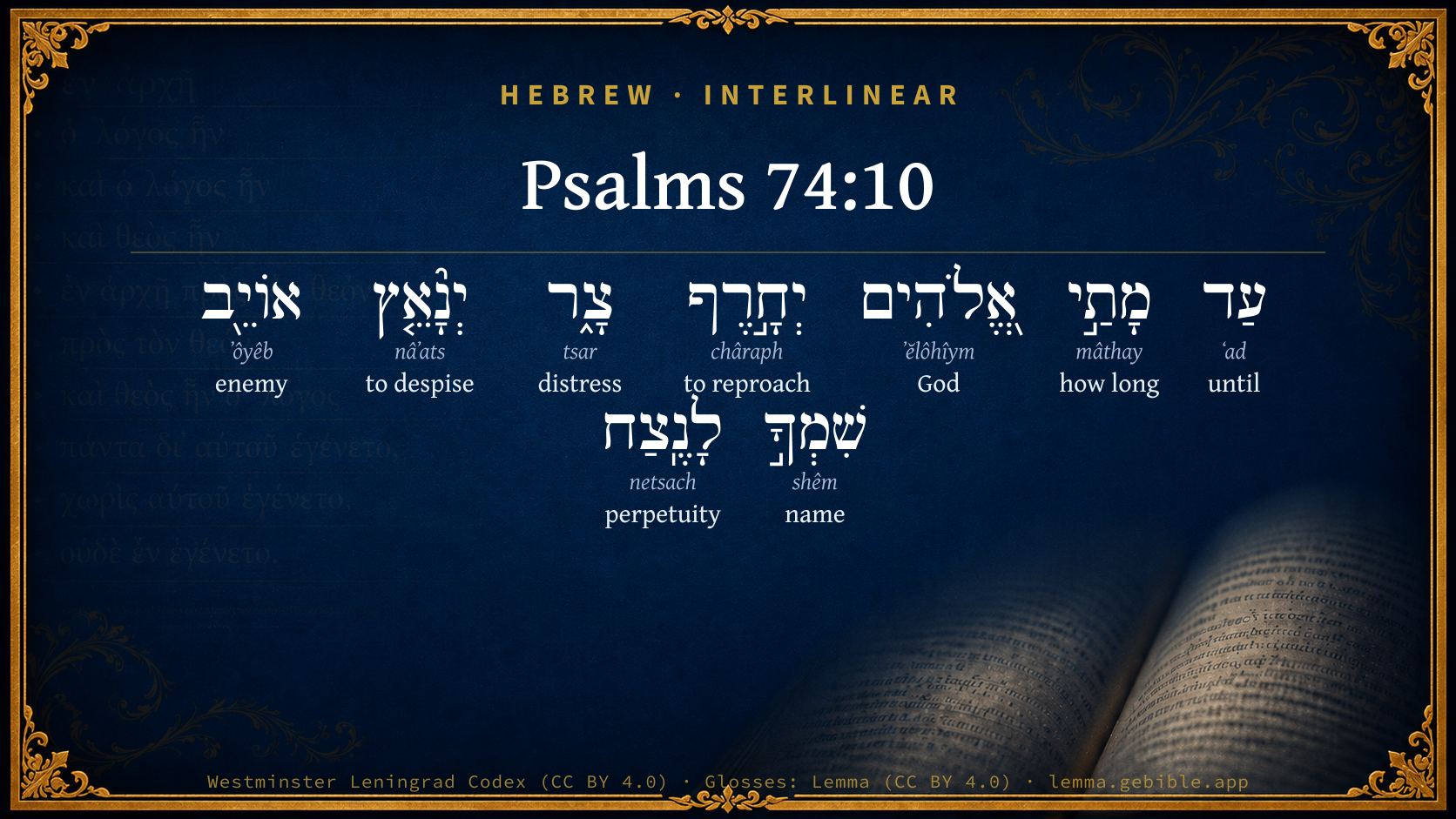
Psalms 74:10

Hebrew (Westminster Leningrad Codex) Psalms 74:10 appears in the Hebrew Old Testament. The text above is from the Westminster Leningrad Codex. Each word links to its Strong’s number, a concise gloss, and parsing drawn from the Open Scriptures Hebrew Bible morphology. Click any word for its full Brown-Driver-Briggs (BDB) entry.
Download image
Cite this verse

Psalms 74:10 (World English Bible). Public Domain. Lemma interlinear Bible study tool, https://lemma.gebible.app/v/psalms/74/10.

Show BibTeX & RIS
BibTeX
RIS
English Translation
How long, God, shall the adversary reproach? Shall the enemy blaspheme your name forever?
World English Bible · Public Domain
Download a study sheet

One document with this verse’s original text, its word-by-word gloss line, the meaning frame, cross-references with their text, attributed commentary, and full source and license credits — printable, and it pastes into notes with its structure intact.

This verse Autodidact and up

Study sheet (.html) Plain text (.txt)

A passage Seminary Student

Up to 50 verses in one chapter. A passage sheet keeps up to 6 commentary sources and 12 cross-references per verse, in the order this page ranks them, and says so on the sheet whenever that leaves anything out. Ask for a single verse and you get the Autodidact verse sheet above.

Everything on this page stays free to read, with no account — the sheet is a download of what is already on screen, not access to it.

Want to remove ads? Support Godless Engineer
Compare translations 3

The same verse in 3 English versions, stacked beneath the original-language interlinear above. Click any original word for its lexicon entry.

Each is an independent rendering of the whole verse — the interlinear is not word-aligned to these translations.

Highlighted words mark where these versions differ — a whole-verse word diff, not a word-by-word alignment.

  • World English Bible Public Domain
    How long, God, shall the adversary reproach? Shall the enemy blaspheme your name forever?
  • King James Version Public Domain
    O God, how long shall the adversary reproach? shall the enemy blaspheme thy name for ever?
  • unfoldingWord Literal Text CC BY-SA 4.0
    Until when, God, will the adversary reproach? Will the enemy despise your name forever?

unfoldingWord Literal Text — © unfoldingWord, licensed CC BY-SA 4.0. Word-aligned USFM3 via Door43 (git.door43.org/unfoldingWord/en_ult).

Versions to compare (up to 4)

3 of 4 selected

Show all 18 translations

Every available English version of this verse, each an independent rendering of the whole verse.

  • World English Bible Public Domain
    How long, God, shall the adversary reproach? Shall the enemy blaspheme your name forever?
  • Berean Standard Bible Public Domain
    How long, O God, will the enemy taunt You? Will the foe revile Your name forever?
  • Majority Standard Bible Public Domain
    How long, O God, will the enemy taunt You? Will the foe revile Your name forever?
  • King James Version Public Domain
    O God, how long shall the adversary reproach? shall the enemy blaspheme thy name for ever?
  • American Standard Version (1901) Public Domain
    How long, O God, shall the adversary reproach? Shall the enemy blaspheme thy name for ever?
  • Revised Version (1885) Public Domain
    How long, O God, shall the adversary reproach? shall the enemy blaspheme thy name for ever?
  • Geneva Bible (1599) Public Domain
    O God, howe long shall the aduersarie reproche thee? shall the enemie blaspheme thy Name for euer?
  • Douay-Rheims (1899) Public Domain
    How long, O God, shall the enemy reproach: is the adversary to provoke thy name for ever?
  • Young's Literal Translation Public Domain
    Till when, O God, doth an adversary reproach? Doth an enemy despise thy name for ever?
  • Literal Standard Version CC BY-SA 4.0
    Until when, O God, does an adversary reproach? Does an enemy despise Your Name forever?
  • Unlocked Literal Bible CC BY-SA 4.0
    How long, God, will the enemy throw insults at you? Will the enemy blaspheme your name forever?
  • unfoldingWord Literal Text CC BY-SA 4.0
    Until when, God, will the adversary reproach? Will the enemy despise your name forever?
  • Darby Bible Public Domain
    How long, O God, shall the adversary reproach? Shall the enemy contemn thy name for ever?
  • World Messianic Bible Public Domain
    How long, God, shall the adversary reproach? Shall the enemy blaspheme your name forever?
  • Webster's Bible Public Domain
    O God, how long shall the adversary reproach? shall the enemy blaspheme thy name for ever?
  • Free Bible Version CC BY-SA 4.0
    How long will the enemy ridicule you, God? Will they insult your character forever?
  • Bible in Basic English Public Domain
    O God, how long will those who are against us say cruel things? will the hater go on looking down on your name for ever?
  • JPS Tanakh (1917) Public Domain
    How long, O God, shall the adversary reproach? Shall the enemy blaspheme Thy name for ever?

Literal Standard Version (2020), Covenant Press — licensed CC BY-SA 4.0. Text via the HelloAO Bible API (eBible.org). Unlocked Literal Bible (unfoldingWord) — licensed CC BY-SA 4.0. Text via the HelloAO Bible API (eBible.org). unfoldingWord Literal Text — © unfoldingWord, licensed CC BY-SA 4.0. Word-aligned USFM3 via Door43 (git.door43.org/unfoldingWord/en_ult). Free Bible Version, Dr. Jonathan Gallagher — licensed CC BY-SA 4.0. Text via the HelloAO Bible API (eBible.org).

Word by word

More ways to search: Search by grammar → Find every occurrence → Compare this word →

Practice this passage: Drill this verse → Learn its vocabulary →

About this verse

These counts appear in no published source. They are computed here, from the morphology-tagged text and Lemma’s own curated glosses. What Lemma adds →

9
words
9
distinct lemmas
Wisdom
section

Notable vocabulary

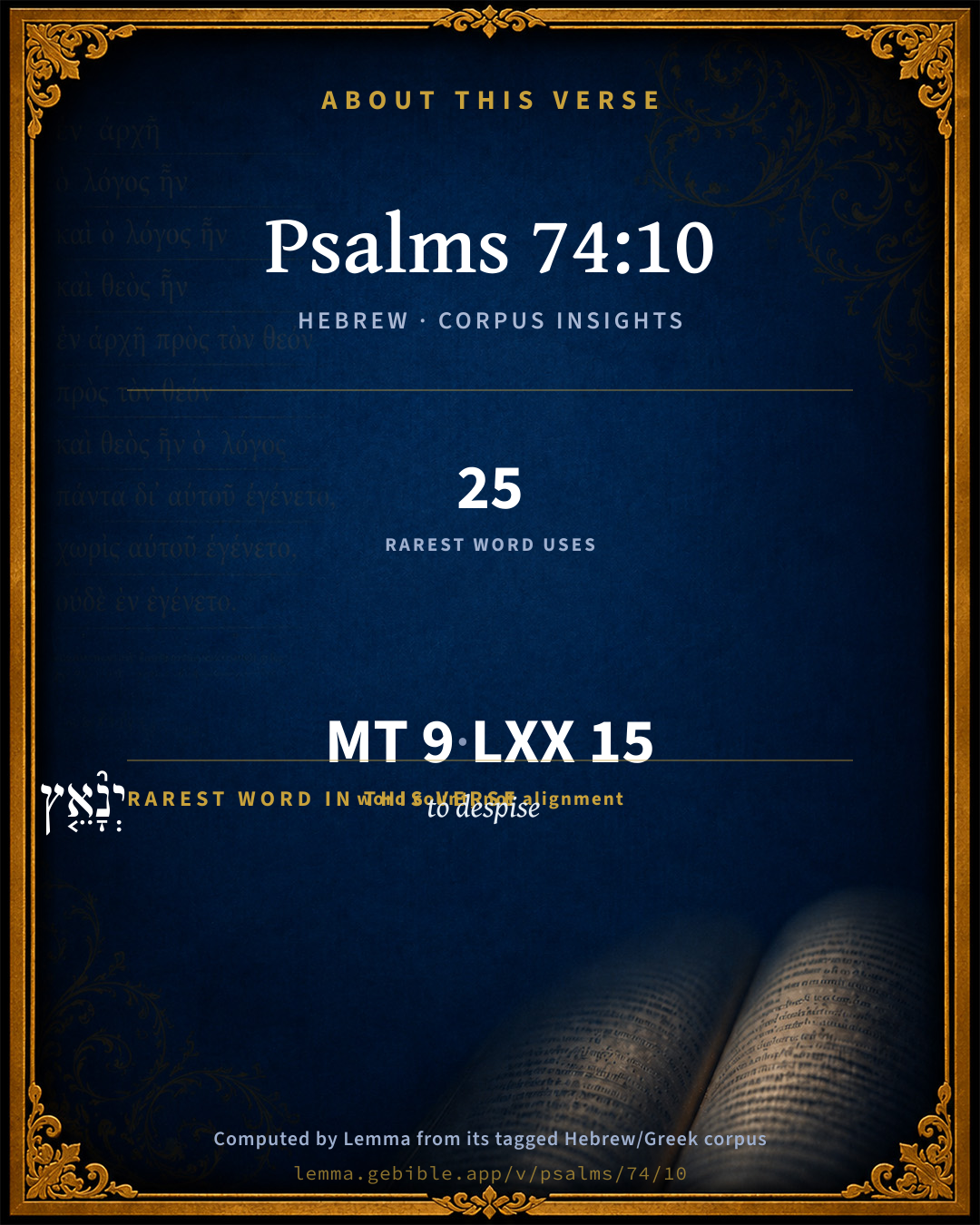
The rarest word here is יְנָ֘אֵ֤ץ to despise H5006 — appearing just 25 times in the whole Hebrew Bible.

Shared distinctive vocabulary

יְנָ֘אֵ֤ץ to despise H5006 occurs in 24 verses of the Hebrew Bible. Also found in:

Grammatical profile

  • 3 verbs
  • 4 nouns
  • 1 preposition
  • 1 particle

Verb forms

  • יְחָ֣רֶף Piel · Imperfect
  • יְנָ֘אֵ֤ץ Piel · Imperfect
  • אוֹיֵ֖ב Qal · Participle Active

Hebrew & Septuagint length

In English translation the verse runs 14 words from the Hebrew and 15 from the Septuagint (LXX English) — closely comparable.

A rough comparison of the two English renderings, which tokenize alike — not a word-level alignment.

Word counts can differ between the Hebrew and the Greek without any difference in meaning — e.g. the Hebrew direct-object marker אֵת has no separate Greek word, and Greek often adds the article ὁ.

In the original languages it is 9 Hebrew tokens and 15 Greek tokens — but the two are counted differently (Hebrew bundles its prefixes and suffixes into one token; the Greek is in lemma form), so that isn’t a like-for-like length.

Cross-references

8

Topical passages linked to Psalms 74:10 in the Treasury of Scripture Knowledge — connected by theme and wording, ordered by reader-vote popularity; previews shown in the World English Bible.

  • Psalms 89:50–51 Remember, Lord, the reproach of your servants, How I bear in my heart the taunts of all the mighty peoples,
  • Psalms 13:1–2 How long, Yahweh? Will you forget me forever? How long will you hide your face from me?
  • Psalms 44:16 At the taunt of one who reproaches and verbally abuses, Because of the enemy and the avenger.
  • Psalms 79:4–5 We have become a reproach to our neighbors, A scoffing and derision to those who are around us.
  • Psalms 79:12 Pay back to our neighbors seven times into their bosom Their reproach with which they have reproached you, Lord.
  • Psalms 89:46 How long, Yahweh? Will you hide yourself forever? Will your wrath burn like fire?
  • Daniel 12:6 One said to the man clothed in linen, who was above the waters of the river, How long shall it be to the end of these wonders?
  • Revelation 6:10 They cried with a loud voice, saying, "How long, Master, the holy and true, until you judge and avenge our blood on those who dwell on the earth?"

Cross-references courtesy of OpenBible.info (CC BY 4.0).

Hebrew and Greek witnesses Masoretic Hebrew ↔ Greek Septuagint

The same verse in the two great witnesses to the Old Testament, shown verse-for-verse.

You’re reading Greek Psalm 73 (Hebrew Psalm 74). The Septuagint counts the superscription, so verse numbers can differ from the Hebrew — chapter-level alignment, not verse-by-verse. Numbering follows Rahlfs.

These are two independent witnesses, not word-aligned to each other, and the Septuagint is shown in lemma (dictionary) form.

Hebrew Psalms 74:10 Masoretic · Westminster Leningrad Codex

עַד מָתַ֣י אֱ֭לֹהִים יְחָ֣רֶף צָ֑ר יְנָ֘אֵ֤ץ אוֹיֵ֖ב שִׁמְךָ֣ לָנֶֽצַח

How long, God, shall the adversary reproach? Shall the enemy blaspheme your name forever?

World English Bible · Public Domain

Greek LXX Greek Psalm 73:10 Septuagint · lemma form

ἕως πότε ὁ θεός ὀνειδίζω ὁ ἐχθρός παραὀξύνω ὁ ὑπεναντίος ὁ ὄνομα σύ εἰς τέλος

How long, O God, shall the enemy reproach? shall the enemy provoke your name forever?

LXX2012 (modern English Septuagint) · Public Domain

Hebrew: Westminster Leningrad Codex (CC BY 4.0). Greek: Septuagint (public domain); English from LXX2012 (modern English Septuagint) (Public Domain). How the Septuagint differs from the Hebrew →

Commentary

Notes on Psalms 74:10 from classic Christian and Jewish commentators (each source and its license shown beneath its notes). The classic Christian expositions comment on the surrounding passage and are grouped to its opening verse, so a note may address several verses; the Jewish commentaries on the Tanakh (Rashi and others) are per-verse, so they appear only where the commentator wrote on this verse.

Lemma curates 59 commentaries, every one of them public domain or Creative Commons licensed, each selected and text-cleaned for this edition rather than reprinted as found. About our sources →

Trapp's Complete Commentary

John Trapp

Psa 74:10 O God, how long shall the adversary reproach? shall the enemy blaspheme thy name for ever?

Ver. 10. O God, how long shall the adversary reproach?] When they had none to tell them how long their miseries should last, they could turn them to God to inquire (such is the boldness of faith), and withal to require of him speedy help, since himself else were likely to suffer in his glory, as a God not able to help and befriend his people.

John Trapp, A Commentary or Exposition upon All the Books of the Old and New Testament (1647–1656) — public domain. Text from a community e-Sword module.

The Biblical Illustrator

Joseph S. Exell

Psa_74:10-11

O God, how long shall the adversary reproach?

shall the enemy blaspheme Thy name for ever?

The long forbearance of God

1. Mens patience is much short of Gods longsuffering and forbearance; for here it is the speech of a suffering people: O God, how long shall the adversary reproach? when with God it is not yet time to fall upon them.

2. The Lords longsuffering patience doth greatly harden the adversaries in their insolent mocking of Gods people; for instead of saying, Lord, how long wilt Thou bear with them? he saith, O God, how long shall the adversaries reproach?

3. The truly godly can endure their own troubles better than they can bear the open dishonouring and blaspheming of God by occasion of their trouble. Therefore this expression, from the deepest sense of his heart, doth break forth, Shall the enemy blaspheme Thy name for ever?

4. Albeit tentations from carnal sense do represent God as if He were idle when He suffers His enemies to trample on His people, and on His glorious Name; yet faith will not admit of such a thought, but dealeth with God by prayer, to let His strength and power be so manifest, that the world may not think His hand is in His bosom; Why withdrawest thou thy hand? etc. This he believeth the Lord shall do, and giveth reasons for his hope, in that which followeth. (D. Dickson.)

The Biblical Illustrator, edited by Joseph S. Exell (c. 1880s–1900s) — public domain. Text from a community e-Sword module.

Joseph Benson's Commentary

Psa 74:10-12. How long shall the adversary reproach — Namely, thy name, (which is expressed in the next clause,) by saying that thou art either unkind to thy people, or unfaithful in thy covenant, or unable to deliver us out of our miseries. Why withdrawest thou thy hand? — Why dost thou suspend or forbear the exercise of that power which thou hast so often exerted in behalf of thy people? Pluck it out of thy bosom — In which thou now seemest to hide it, as idle persons used to do. This is spoken after the manner of men. It means, Why art thou an inactive spectator of our miseries? Why dost thou not put forth thy power and deliver us? For God is my king of old — In a singular manner. It belongs to thine office to protect and save us; working salvation in the midst of the earth — In the view of the world: saving thy people so eminently and gloriously, that all the nations around observed and admired it.

Joseph Benson's Commentary on the Old and New Testaments (1811–1818) — public domain. Text from a community e-Sword module.

J. A. Alexander on Psalms

Joseph Addison Alexander

Psa 74:10. Till when, 0 God, shall the foe revile, the enemy contemn thy name for ever? By making the last clause a distinct interrogation (shall the enemy despise thy name for ever?) we avoid the solecism of combining how long and for ever; but this can occasion no more difficulty here than in Psa 74:1, and in Psa 13:1). The verb in the last clause means to treat contemptuously, to shew contempt by word or deed. Blaspheme expresses only one mode of doing this, and that too strongly.

Joseph Addison Alexander, The Psalms Translated and Explained (1850) — public domain. Text from a community e-Sword module.

John Calvin's Commentaries

10. How long, O God! shall the adversary reproach? Here it is intimated that nothing inflicted upon them greater anguish than when they saw the name of God blasphemed by the ungodly. By this manner of praying, the object of the inspired writer was to kindle in our hearts a zeal for maintaining the Divine glory. We are naturally too delicate and tender for bearing calamities; but it is a decided proof of genuine godliness, when the contumely which is cast upon God grieves and disquiets our minds more than all our own personal sufferings. The poor Jews, there can be no doubt, were assailed with more kinds of reproach than one under a most cruel tyrant, and amongst a barbarous nation. But the prophet, speaking in the person of the whole Church, makes almost no account of the reproaches cast upon the people in comparison of the execrable blasphemies directed against God; according to the statement contained in Psalm 69:9, “The reproaches of them that reproached thee are fallen upon me.” The phrase for ever is again added; for when the ungodly continue long unpunished, this has a hardening effect, and renders them more audacious, especially when the revilings which they pour forth against God seem to pass unnoticed by him. It is, therefore, added immediately after in the 11th verse,

John Calvin's Commentaries (1540-1563) — public domain. Text from the Calvin Translation Society English edition (1840s-50s) via the Christian Classics Ethereal Library (ccel.org). Calvin's coverage is partial (roughly two-thirds of the Bible); uncommented books and verses are honest gaps, never fabricated. The 19th-century editor's footnotes and remarks are omitted so the notes are faithfully Calvin's own voice.

Ellicott's Commentary for English Readers

(10-15) ln the true prophetic spirit, as Moses brought the cries of distress “by reason of their bondage” from the oppressed Israelites to God (Exo_5:22), so this poet carries to the same God the pathos of this later cry, How long? how long? In answer, the deliverances of old rush into his mind. He recalls the right hand once stretched out to save (now thrust in inaction into the bosom), the wonders at the Red Sea, and all the long-continued providential guiding. Surely the same God will do the same wonders now!

A Bible Commentary for English Readers, edited by Charles John Ellicott (1878–1897) — public domain. Text from a community e-Sword module.

The Cambridge Bible for Schools and Colleges

gen. ed. J. J. S. Perowne

10. How long] Taking up the last words of Psa_74:9, the Psalmist begins the second division of the Psalm with an appeal parallel to that in Psa_74:1-3. There he entreats God to have pity on His people’s need, here to have regard to His own honour.

reproach … blaspheme] In act and word. Like the Assyrians, Isa_10:7 ff; Isa_37:23 ff.; and Syrians, Dan_7:8; Dan_7:25; Dan_11:36; 1Ma_2:6.

10, 11. Once more the Psalmist expostulates with God for His inaction.

The Cambridge Bible for Schools and Colleges (gen. ed. J. J. S. Perowne; Cambridge University Press, 1878–1918) — public domain. Text from a community e-Sword module.

John Gill's Exposition

Why withdrawest thou thy hand, even that right hand?.... By which is meant the power of God; by which he made the heavens and the earth, and all things therein, and supports them in their beings; by which the work of his grace is wrought in the hearts of his people, and they are upheld; and by which he conquers their enemies, and saves them: this may be said to be withdrawn when he denies his people the help and succour they have had from him; when he seems to have forsaken the work of his hands; when there is not that success in the ministry of the word there formerly was, his arm being not revealed and made bare; and when the enemies of religion prosper and get ground; and when the Lord seems to be altogether inactive and unconcerned, like a man that folds up his arms under his arm holes, or hides his hands in his bosom, see Psa 44:23 wherefore it follows:

pluck it out of thy bosom; as he will one day, and strike with a home blow, antichrist and his followers, and destroy them with his rod of iron, with which he will break them in shivers as a potter's vessel; and all his enemies shall feel the lighting down of his arm with the indignation of his anger; and then this request will be fulfilled: the word used signifies to "consume" (a); and Kimchi interprets it, consume the enemy out of thy bosom, which is the house of the sanctuary; his secret place, as the bosom is to man; but both senses of the word maybe retained, and the meaning be, pluck it out of thy bosom to consume them (b): also it signifies to restrain (c); and the sense may be, as the above writer observes, restrain it, that it may not return to thy bosom, till thou hast executed judgment on the wicked.

(a) "consume", Montanus, Gejerus. (b) So some in Vatablus. (c) "Cohibe", Junius & Tremellius.

John Gill's Exposition of the Whole Bible (1746–1763) — public domain (CC PDM 1.0). Text via the HelloAO Bible API.

Albert Barnes' Notes on the Bible

O God, how long shall the adversary reproach?... - How long shall this state of things be allowed to continue? Is there to be no end to it? Are these desolations never to be repaired - these ruins never to be rebuilt? It “seemed” so; and hence, this earnest appeal. So to us it often appears as if our trials were never to come to an end. One calamity succeeds another; and there comes no relief. Yet there is relief. Deliverance may come, and soon come, in the present life; or if not in the present life, yet to all those who are the children of God it will soon come by their removal to a world where trial will be forever unknown.

Albert Barnes' Notes on the Bible (1834–1885) — public domain. Text from a community e-Sword/MySword module.

Matthew Poole's English Annotations

Reproach; understand here thy name, which is expressed in the next clause of the verse, by saying that thou art either unkind to thy people, or unfaithful in thy covenant, or unable to deliver thine out of their miseries.

Matthew Poole's English Annotations on the Holy Bible (1683–1685) — public domain. Text from a community e-Sword/MySword module.

The Treasury of David

Charles H. Spurgeon

Ver. 10. O God, how long shall the adversary reproach? Though we know not how long yet thou dost. The times and seasons are with thee. When God is reproached, there is hope for us, for it may be he will hearken and avenge his dishonoured name. Wickedness has great license allowed it, and justice lingers on the road; God has his reasons for delay, and his seasons for action, and in the end it shall be seen that he is not slack concerning his promise as some men count slackness.

Shall the enemy blaspheme thy name for ever? He will do so for ever, unless thou dost give him his quietus. Wilt thou never defend thyself, and stop slanderous tongues? Wilt thou always endure the jeers of the profane? Is there to be no end to all this sacrilege and cursing? Yes, it shall all be ended, but not by and by. There is a time for the sinner to rage, and a time in which patience bears with him; yet it is but a time, and then, ah, then!

Ver. 10. Shall the enemy blaspheme the name for ever? The sinner never leaves his sin till sin first leaves him: did not death put a stop to his sin, he would never cease from sin. This may be illustrated by a similitude thus: A company of gamesters resolve to play all night, and accordingly they sit down to chess tables, or some other game; their candle, accidentally or unexpectedly, goes out, or is put out, or burnt out; their candle being out, they are forced to give over their game, and go to bed in the dark; but had the candle lasted all night, they would have played all night. This is every sinner's case in regard of sin: did not death put out the candle of life, the sinner would sin still. Should the sinner live for ever, he would sin for ever; and, therefore, it is a righteous thing with God to punish him for ever in hellish torments. Every impenitent sinner would sin to the days of eternity, if he might live to the days of eternity. O God, how long shall the adversary reproach? shall the enemy blaspheme thy name for ever? For ever, and evermore; or for ever and yet--for so the Hebrew loves to exaggerate: as if the sinner, the blasphemer, would set a term of duration longer than eternity to sin in. The psalmist implicitly saith, Lord, if thou dost but let them alone for ever, they will certainly blaspheme thy name for ever and ever. I have read of the crocodile, that he knows no maximum quod sic, he is always growing bigger and bigger, and never comes to a certain pitch of monstrosity so long as he lives. Quamdiu vivit crescit. Every habituated sinner would, if he were let alone, be such a monster, perpetually growing worse and worse. Thomas Brooks.

Ver. 10. A prayer for revival.

I. How God is reproached.

II. What are the ill effects of it.

III. When we may expect him to arise.

Psalms 74:11*

Charles H. Spurgeon's The Treasury of David (1869–1885) — public domain. Psalms only. Text from a community e-Sword/MySword module.

Whedon's Commentary on the Bible

Daniel D. Whedon

10. See note under Psa_74:4

Daniel D. Whedon (gen. ed.), Commentary on the Old and New Testaments (1874–1909) — public domain. Text from a community e-Sword module.

The Pulpit Commentary

O God, how long shall the adversary reproach? shall the enemy blaspheme thy Name forever? There is no contradiction between these two clauses. The psalmist wishes to ask two things:

1. Is the present distress to continue forever?

2. And if not, how long is it to endure? It is true that he inverts the natural order of the questions; but this is so common a mode of speech, that grammarians have given it a name, and call it usteron proteron ..

The Pulpit Commentary (1880–1919), ed. H.D.M. Spence-Jones & Joseph S. Exell — public domain. Text from a community e-Sword module.

Lesson kit

Teaching starters — assembled from the data on this page, not authored interpretation. Every prompt links to the verse data it draws on. Edit before teaching.

Psalms, in the Wisdom, opens this verse with 9 words (9 distinct Hebrew lemmas). Its most distinctive word is nâʼats (“to despise”). A historical commentator’s framing appears above. Read the whole chapter for the surrounding context.

Discussion questions

  1. What does “to despise” (nâʼats) contribute to the verse as a whole?
  2. Numbers 14:11 shares the word «to despise» with this verse. How do the two illuminate each other?
  3. These translations render this verse differently. What is at stake in choosing one wording over another?
  4. The verb «יְחָ֣רֶף» is Piel Imperfect. How does its form color the action?
  5. Reading how Trapp's Complete Commentary and The Biblical Illustrator read this verse, where do the two commentators agree and where do they part?

Things to notice

Reading settings

Reading text

Shown beneath each verse's original-language words.

Old Testament
Old Testament edition

Read the OT as the Masoretic Hebrew (MT) or the Greek Septuagint (LXX).

English shown for the Greek Septuagint (in the Hebrew ↔ Greek comparison).

Comparing translations? Open the Compare panel on any verse page to stack up to four side by side.