Psalms 41:2

Hebrew (Westminster Leningrad Codex) Psalms 41:2 appears in the Hebrew Old Testament. The text above is from the Westminster Leningrad Codex. Each word links to its Strong’s number, a concise gloss, and parsing drawn from the Open Scriptures Hebrew Bible morphology. Click any word for its full Brown-Driver-Briggs (BDB) entry.
Download image
Cite this verse

Psalms 41:2 (World English Bible). Public Domain. Lemma interlinear Bible study tool, https://lemma.gebible.app/v/psalms/41/2.

Show BibTeX & RIS
BibTeX
RIS
English Translation
Yahweh will preserve him, and keep him alive, He shall be blessed on the earth, And he will not surrender him to the will of his enemies.
World English Bible · Public Domain
Download a study sheet

One document with this verse’s original text, its word-by-word gloss line, the meaning frame, cross-references with their text, attributed commentary, and full source and license credits — printable, and it pastes into notes with its structure intact.

This verse Autodidact and up

Study sheet (.html) Plain text (.txt)

A passage Seminary Student

Up to 50 verses in one chapter. A passage sheet keeps up to 6 commentary sources and 12 cross-references per verse, in the order this page ranks them, and says so on the sheet whenever that leaves anything out. Ask for a single verse and you get the Autodidact verse sheet above.

Everything on this page stays free to read, with no account — the sheet is a download of what is already on screen, not access to it.

Want to remove ads? Support Godless Engineer
Compare translations 3

The same verse in 3 English versions, stacked beneath the original-language interlinear above. Click any original word for its lexicon entry.

Each is an independent rendering of the whole verse — the interlinear is not word-aligned to these translations.

Highlighted words mark where these versions differ — a whole-verse word diff, not a word-by-word alignment.

  • World English Bible Public Domain
    Yahweh will preserve him, and keep him alive, He shall be blessed on the earth, And he will not surrender him to the will of his enemies.
  • King James Version Public Domain
    The LORD will preserve him, and keep him alive; and he shall be blessed upon the earth: and thou wilt not deliver him unto the will of his enemies.
  • unfoldingWord Literal Text CC BY-SA 4.0
    Yahweh will guard him and will keep him alive, and he will be called happy in the land; so do not give him into the soul of his enemies.

unfoldingWord Literal Text — © unfoldingWord, licensed CC BY-SA 4.0. Word-aligned USFM3 via Door43 (git.door43.org/unfoldingWord/en_ult).

Versions to compare (up to 4)

3 of 4 selected

Show all 18 translations

Every available English version of this verse, each an independent rendering of the whole verse.

  • World English Bible Public Domain
    Yahweh will preserve him, and keep him alive, He shall be blessed on the earth, And he will not surrender him to the will of his enemies.
  • Berean Standard Bible Public Domain
    The LORD will protect and preserve him; He will bless him in the land and refuse to surrender him to the will of his foes.
  • Majority Standard Bible Public Domain
    The LORD will protect and preserve him; He will bless him in the land and refuse to give him over to the will of his foes.
  • King James Version Public Domain
    The LORD will preserve him, and keep him alive; and he shall be blessed upon the earth: and thou wilt not deliver him unto the will of his enemies.
  • American Standard Version (1901) Public Domain
    Jehovah will preserve him, and keep him alive, And he shall be blessed upon the earth; And deliver not thou him unto the will of his enemies.
  • Revised Version (1885) Public Domain
    The LORD will preserve him, and keep him alive, and he shall be blessed upon the earth; and deliver not thou him unto the will of his enemies.
  • Geneva Bible (1599) Public Domain
    The Lord will keepe him, and preserue him aliue: he shalbe blessed vpon the earth, and thou wilt not deliuer him vnto the will of his enemies.
  • Douay-Rheims (1899) Public Domain
    Blessed is he that understandeth concerning the needy and the poor: the Lord will deliver him in the evil day.
  • Young's Literal Translation Public Domain
    Jehovah doth preserve him and revive him, He is happy in the land, And Thou givest him not into the will of his enemies.
  • Literal Standard Version CC BY-SA 4.0
    YHWH preserves him and revives him, || He is blessed in the land, || And You do not give him into the will of his enemies.
  • Unlocked Literal Bible CC BY-SA 4.0
    Yahweh will preserve him and keep him alive, and he will be blessed on the earth; Yahweh will not turn him over to the will of his enemies.
  • unfoldingWord Literal Text CC BY-SA 4.0
    Yahweh will guard him and will keep him alive, and he will be called happy in the land; so do not give him into the soul of his enemies.
  • Darby Bible Public Domain
    Jehovah will preserve him, and keep him alive; he shall be made happy in the land; and thou wilt not deliver him to the will of his enemies.
  • World Messianic Bible Public Domain
    The LORD will preserve him, and keep him alive. He shall be blessed on the earth, and he will not surrender him to the will of his enemies.
  • Webster's Bible Public Domain
    \\41:1\\To the chief Musician, A Psalm of David. Blessed is he that considereth the poor: the LORD will deliver him in the time of trouble.
  • Free Bible Version CC BY-SA 4.0
    The Lord protects them and keeps them alive. They will live happily in the land, and they will not be handed over to their enemies.
  • Bible in Basic English Public Domain
    The Lord will keep him safe, and give him life; the Lord will let him be a blessing on the earth, and will not give him into the hand of his haters.
  • JPS Tanakh (1917) Public Domain
    (41-3) The LORD preserve him, and keep him alive, let him be called happy in the land; and deliver not Thou him unto the greed of his enemies.

Literal Standard Version (2020), Covenant Press — licensed CC BY-SA 4.0. Text via the HelloAO Bible API (eBible.org). Unlocked Literal Bible (unfoldingWord) — licensed CC BY-SA 4.0. Text via the HelloAO Bible API (eBible.org). unfoldingWord Literal Text — © unfoldingWord, licensed CC BY-SA 4.0. Word-aligned USFM3 via Door43 (git.door43.org/unfoldingWord/en_ult). Free Bible Version, Dr. Jonathan Gallagher — licensed CC BY-SA 4.0. Text via the HelloAO Bible API (eBible.org).

Word by word

More ways to search: Search by grammar → Find every occurrence → Compare this word →

Practice this passage: Drill this verse → Learn its vocabulary →

יאשר
ʼâshar
H833
“to go straight”
Particle, Interrogative
Part of Speech
Particle
Type
Interrogative
Full BDB Definition

Origin: a primitive root

TWOT: 183

to go straight, walk, go on, advance, make progress - (Qal) to go straight on, make progress - (Piel) - to go straight on, advance - to lead on (causative) - to set right, righten - to pronounce happy, call blessed - (Pual) - to be advanced, be led on - to be made happy, be blessed
  1. יְהוָ֤ה Yᵉhôvâh H3068 “LORD” Noun, Proper
  2. יִשְׁמְרֵ֣הוּ shâmar H8104 “to keep · him” Verb, Qal, Imperfect, 3rd Person, Masculine, Singular + Suffix, Personal, 3rd Person, Masculine, Singular
  3. וִֽ֭יחַיֵּהוּ châyâh H2421 “and · to live · him” Conjunction + Verb, Piel, Imperfect, 3rd Person, Masculine, Singular + Suffix, Personal, 3rd Person, Masculine, Singular
  4. וְאֻשַּׁ֣ר ʼâshar H833 “and · to go straight” Conjunction + Verb, Pual, Sequential Perfect, 3rd Person, Masculine, Singular
  5. בָּאָ֑רֶץ ʼerets H776 “in/at the · land” Preposition, Determined + Noun, Common, Both, Singular, Absolute
  6. וְאַֽל ʼal H408 “and · not” Conjunction + Particle, Negative
  7. תִּ֝תְּנֵ֗הוּ nâthan H5414 “to give · him” Verb, Qal, Jussive, 2nd Person, Masculine, Singular + Suffix, Personal, 3rd Person, Masculine, Singular
  8. בְּנֶ֣פֶשׁ nephesh H5315 “in/at · soul of” Preposition + Noun, Common, Both, Singular, Construct
  9. אֹיְבָֽיו ʼôyêb H341 “enemy · him” Verb, Qal, Participle Active, Masculine, Plural, Construct + Suffix, Personal, 3rd Person, Masculine, Singular

About this verse

These counts appear in no published source. They are computed here, from the morphology-tagged text and Lemma’s own curated glosses. What Lemma adds →

10
words
9
distinct lemmas
Wisdom
section

Notable vocabulary

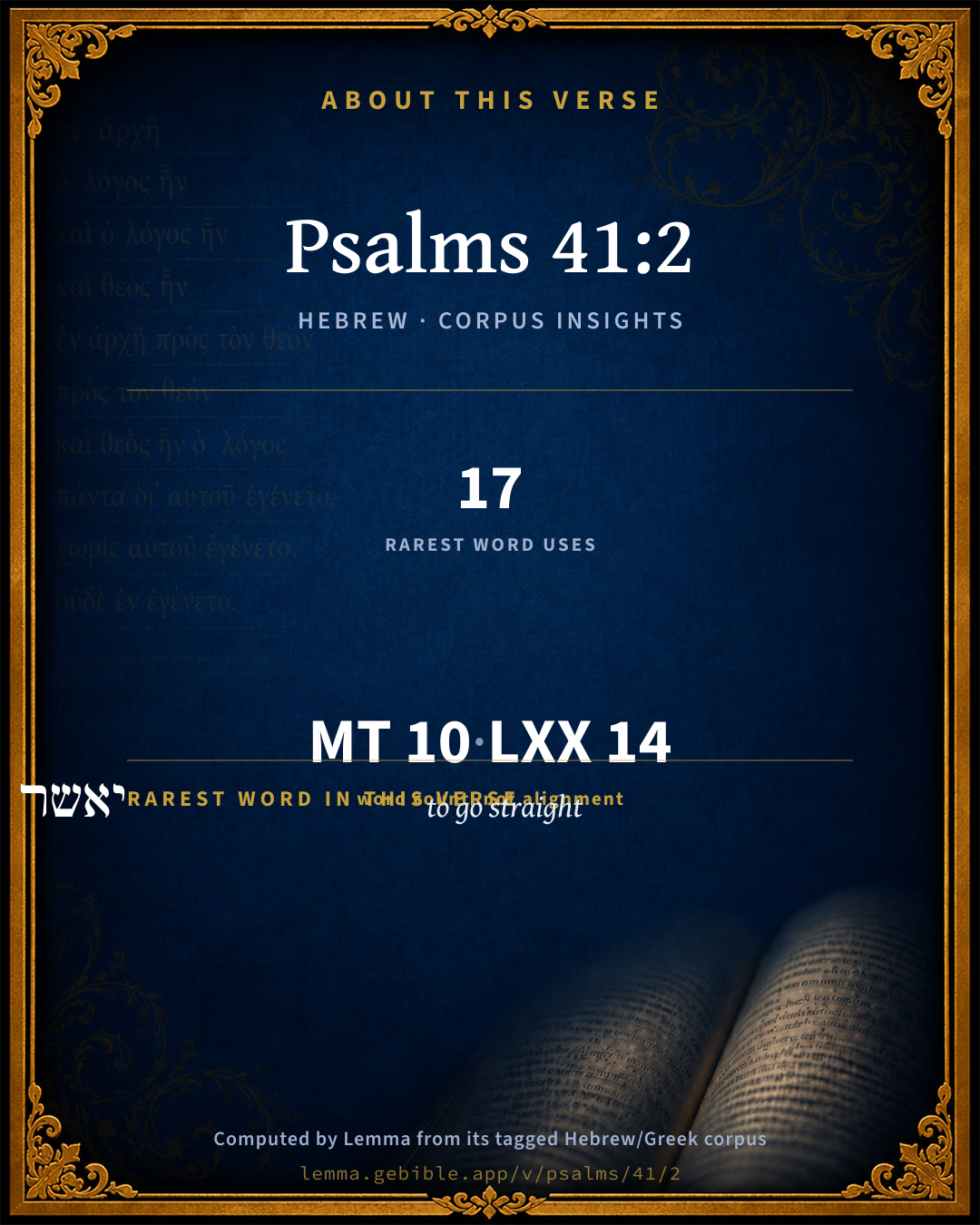
The rarest word here is יאשר to go straight H833 — appearing just 17 times in the whole Hebrew Bible.

Shared distinctive vocabulary

יאשר to go straight H833 occurs in 15 verses of the Hebrew Bible. Also found in:

Grammatical profile

  • 5 verbs
  • 3 nouns
  • 2 particles

Verb forms

  • יִשְׁמְרֵ֣הוּ Qal · Imperfect
  • וִֽ֭יחַיֵּהוּ Piel · Imperfect
  • וְאֻשַּׁ֣ר Pual · Sequential Perfect
  • תִּ֝תְּנֵ֗הוּ Qal · Jussive
  • אֹיְבָֽיו Qal · Participle Active

Repetition

A word recurs within this verse — often emphatic in Hebrew:

  • יאשר to go straight H833 ×2

Hebrew & Septuagint length

In English translation the verse runs 27 words from the Hebrew and 25 from the Septuagint (LXX English) — closely comparable.

A rough comparison of the two English renderings, which tokenize alike — not a word-level alignment.

Word counts can differ between the Hebrew and the Greek without any difference in meaning — e.g. the Hebrew direct-object marker אֵת has no separate Greek word, and Greek often adds the article ὁ.

In the original languages it is 10 Hebrew tokens and 14 Greek tokens — but the two are counted differently (Hebrew bundles its prefixes and suffixes into one token; the Greek is in lemma form), so that isn’t a like-for-like length.

Cross-references

9

Topical passages linked to Psalms 41:2 in the Treasury of Scripture Knowledge — connected by theme and wording, ordered by reader-vote popularity; previews shown in the World English Bible.

  • Jeremiah 45:4–5 Thus shall you tell him, Thus says Yahweh: Behold, that which I have built will I break down, and that which I have planted I will pluck up; and this in the whole land.
  • Psalms 27:12 Don't deliver me over to the desire of my adversaries, For false witnesses have risen up against me, Such as breathe out cruelty.
  • 1 Timothy 4:8 For bodily exercise has some value, but godliness has value for all things, having the promise of the life which is now, and of that which is to come.
  • Psalms 33:19 To deliver their soul from death, To keep them alive in famine.
  • Psalms 37:32–33 The wicked watches the righteous, And seeks to kill him.
  • Psalms 37:22 For such as are blessed by him shall inherit the land. Those who are cursed by him shall be cut off.
  • Psalms 91:3–7 For he will deliver you from the snare of the fowler, And from the deadly pestilence.
  • Psalms 128:1–6 Blessed is everyone who fears Yahweh, Who walks in his ways.
  • Psalms 140:8–9 Yahweh, don't grant the desires of the wicked. Don't let their evil plans succeed, or they will become proud. Selah.

Cross-references courtesy of OpenBible.info (CC BY 4.0).

Hebrew and Greek witnesses Masoretic Hebrew ↔ Greek Septuagint

The same verse in the two great witnesses to the Old Testament, shown verse-for-verse.

You’re reading Greek Psalm 40 (Hebrew Psalm 41). The Septuagint counts the superscription, so verse numbers can differ from the Hebrew — chapter-level alignment, not verse-by-verse. Numbering follows Rahlfs.

These are two independent witnesses, not word-aligned to each other, and the Septuagint is shown in lemma (dictionary) form.

Hebrew Psalms 41:2 Masoretic · Westminster Leningrad Codex

יְהוָ֤ה יִשְׁמְרֵ֣הוּ וִֽ֭יחַיֵּהוּ יאשר וְאֻשַּׁ֣ר בָּאָ֑רֶץ וְאַֽל תִּ֝תְּנֵ֗הוּ בְּנֶ֣פֶשׁ אֹיְבָֽיו

Yahweh will preserve him, and keep him alive, He shall be blessed on the earth, And he will not surrender him to the will of his enemies.

World English Bible · Public Domain

Greek LXX Greek Psalm 40:2 Septuagint · lemma form

μακάριος ὁ συνἵημι ἐπί πτωχός καί πένης ἐν ἡμέρα πονηρός ῥύομαι αὐτός ὁ κύριος

May the Lord preserve him and keep him alive, and bless him on the earth, and not deliver him into the hands of his enemy.

LXX2012 (modern English Septuagint) · Public Domain

Hebrew: Westminster Leningrad Codex (CC BY 4.0). Greek: Septuagint (public domain); English from LXX2012 (modern English Septuagint) (Public Domain). How the Septuagint differs from the Hebrew →

Commentary

Notes on Psalms 41:2 from classic Christian and Jewish commentators (each source and its license shown beneath its notes). The classic Christian expositions comment on the surrounding passage and are grouped to its opening verse, so a note may address several verses; the Jewish commentaries on the Tanakh (Rashi and others) are per-verse, so they appear only where the commentator wrote on this verse.

Lemma curates 59 commentaries, every one of them public domain or Creative Commons licensed, each selected and text-cleaned for this edition rather than reprinted as found. About our sources →

Trapp's Complete Commentary

John Trapp

Psa 41:2 The LORD will preserve him, and keep him alive; [and] he shall be blessed upon the earth: and thou wilt not deliver him unto the will of his enemies.

Ver. 2. The Lord will preserve him, and keep him alive] Life in any sense is a singular mercy. "Why is a living man sorrowful?" Lam 3:39; if he be alive, though afflicted, he hath cause to be thankful; how much more if alive to righteousness! The Arabic here interpreteth it, dabit illi filios in quibus post mortem vivat, he will give him children, in whom he may live after his death.

And he shall be blessed upon the earth] With wealth, and other accommodations; so that the world shall look upon him as every way blessed.

And thou wilt not deliver him into the hands of his enemies] Heb. Do not thou deliver him. This maketh Kimchi conclude, that all this is but oratio visitantis consolatoria, the prayer of him that visiteth the sick man, for his comfort.

John Trapp, A Commentary or Exposition upon All the Books of the Old and New Testament (1647–1656) — public domain. Text from a community e-Sword module.

Joseph Benson's Commentary

Psa 41:2-3. The Lord will keep him alive — Hebrew, Will quicken him, that is, revive and restore him. God will either preserve him from trouble, or, if he see that trouble is necessary, or will be useful for him, and therefore suffers him to fall into it, he will raise him out of it. Thou wilt not deliver him, &c. — To the destruction which his enemies earnestly desire and endeavour to effect. Wilt make all his bed in his sickness — Wilt give him ease and comfort, which sick men receive by the help of those who turn and stir up their bed, to make it soft and easy for them.

Joseph Benson's Commentary on the Old and New Testaments (1811–1818) — public domain. Text from a community e-Sword module.

J. A. Alexander on Psalms

Joseph Addison Alexander

3. (Psa 41:2.) Jehovah will keep him and save him alive; he shall be prospered in the land; and do not thou give him up to the will of his enemies. What he has done for others the Lord will do for him. Save him alive: the same verb occurs above in Psa 22:30 (29). Prospered: the Hebrew verb used here orignally means led straight, or in a straight path. See above, on Psa 23:3. But here it has the same sense as in Pro 3:18. The marginal reading in the Hebrew Bible only differs from the text by introducing the conjunction and. In the land, i.e. the land of promise. See above, on Psa 25:13; Psa 37:3; Psa 37:9; Psa 37:11; Psa 37:22; Psa 37:29; Psa 37:34. These are generally propositions, but are evidently meant to be applied specifically to himself. His solicitude respecting the event is betrayed by his sudden transi tion from prediction to petition. Give him up to the will, literally into the soul, here put for the desire or appetite. See above, on Psa 27:12, and compare Psa 17:9.

Joseph Addison Alexander, The Psalms Translated and Explained (1850) — public domain. Text from a community e-Sword module.

Jamieson, Fausset & Brown

Robert Jamieson, A. R. Fausset & David Brown

shall be blessed--literally, "led aright," or "safely," prospered (Psa 23:3).

upon the earth--or land of promise (Psa 25:13; Psa 27:3-9, &c.).

Jamieson, Fausset & Brown — Commentary Critical and Explanatory on the Whole Bible (1871) — public domain (CC PDM 1.0). Text via the HelloAO Bible API.

Adam Clarke's Commentary

Verse 2. The Lord will preserve him, and keep him alive] It is worthy of remark, that benevolent persons, who consider the poor, and especially the sick poor; who search cellars, garrets, back lanes, and such abodes of misery, to find them out, (even in the places where contagion keeps its seat,) very seldom fall a prey to their own benevolence. The Lord, in an especial manner, keeps them alive, and preserves them; while many, who endeavour to keep far from the contagion, are assailed by it, and fall victims to it. God loves the merciful man.

Adam Clarke's Commentary on the Bible (1810–1826) — public domain. Text from a community e-Sword/MySword module.

John Calvin's Commentaries

2. Jehovah will keep him, and preserve him in life. Here David follows out the same sentiment expressed in the preceding verse, when he says that the Lord will keep the afflicted, whose destruction cruel and unjust men represent as inevitable. It is likewise necessary always to bear in mind the contrast which is stated between the day of evil and the blessing of deliverance. In this verse the expressions denoting restoration to life, and blessedness on the earth, are of similar import. By these expressions, David means to show that although he had been to all appearance a dead man, yet the hope of life both for himself and for all the faithful had not been extinguished. There might, it is true, appear some inconsistency in his promising himself a happy life in this world, seeing our condition here would be miserable indeed if we had not the expectation of a better state in the world to come. But the answer to this is, that as many had despaired of his recovery, he expressly declares that he will yet be restored to his former state, and will continue alive, nay, that in him there will be seen manifest tokens of the favor of God. He does not in the least exclude by these expressions the hope of a better life after death. What follows concerning the bed of sorrow has led some to form a conjecture which, in my opinion, is not at all probable. What David says of affliction in general, without determining what kind of affliction, they regard as applicable exclusively to sickness. But it is no uncommon thing for those who are sorrowful and grieved in their minds to throw themselves upon their bed, and to seek repose; for the hearts of men are sometimes more distressed by grief than by sickness. It is, certainly, highly probable that David was at that time afflicted with some very heavy calamity, which might be a token that God was not a little displeased with him. In the second clause of the verse there is some obscurity. Some understand the expression, turning the bed, in the same sense as if God, in order to give some alleviation to his servant in the time of trouble, had made his bed and arranged it, as we are wont to do to those who are sick, that they may lay themselves more softly. Others hold, and, in my opinion, more correctly, that when David was restored to health, his bed, which had formerly served him as a sick couch, was turned, that is to say, changed. Thus the sense would be, that although he now languish in sorrow, whilst the Lord is chastening him and training him by means of affliction, yet in a little while he will experience relief by the hand of the same God, and thus recover his strength.

John Calvin's Commentaries (1540-1563) — public domain. Text from the Calvin Translation Society English edition (1840s-50s) via the Christian Classics Ethereal Library (ccel.org). Calvin's coverage is partial (roughly two-thirds of the Bible); uncommented books and verses are honest gaps, never fabricated. The 19th-century editor's footnotes and remarks are omitted so the notes are faithfully Calvin's own voice.

Ellicott's Commentary for English Readers

(2) And he shall be blessed.—Not as in margin Isa_9:16, and in Symmachus “called happy,” but with deeper meaning, as in Pro_3:18. Another derivation is possible, giving the meaning, “he shall be led aright,” i.e., shall have right moral guidance. The context, however, does not favour this.

Upon the earth.—Rather, in the land, i.e., of Canaan.

A Bible Commentary for English Readers, edited by Charles John Ellicott (1878–1897) — public domain. Text from a community e-Sword module.

The Cambridge Bible for Schools and Colleges

gen. ed. J. J. S. Perowne

2, 3. It is possible to render as in P.B.V. and R.V. marg., The Lord perserve him … the Lord support him: but it is more natural to regard these clauses as descriptive of the blessings which await the compassionate man, rather than as a prayer on his behalf.

he shall be blessed upon the earth] He shall be made prosperous, or more probably, counted happy (Job_29:11; Psa_72:17), in the land. Cp. Psa_37:3 ff.

and thou wilt not deliver him] Rather, as R.V., and deliver not thou him. Cp. Psa_27:12. The language of promise passes into that of prayer, doubtless with a tacit reference to the Psalmist’s own need.

The Cambridge Bible for Schools and Colleges (gen. ed. J. J. S. Perowne; Cambridge University Press, 1878–1918) — public domain. Text from a community e-Sword module.

John Gill's Exposition

The Lord will preserve him and keep him alive,.... Amidst a thousand deaths, to which he is exposed for making a profession of his faith in Christ; see Co2 1:10; or this may refer to his spiritual life, which is hid and preserved in Christ, in whom he believes; and is safe and secure; because Christ lives he shall live also, and shall never die the second death, nor be hurt by it, but shall have everlasting life;

and he shall be blessed upon the earth; with temporal blessings; for whatever he has, be it more or less, he has it with the blessing of God, and as a blessing of the covenant, and in love, and so is a blessing indeed: and with spiritual blessings; with peace, pardon, righteousness, and a right and title to eternal glory and happiness; and he will be blessed in the new earth, in which righteousness will dwell, and where he will dwell, live, and reign with Christ a thousand years;

and thou wilt not deliver him into the will of his enemies; not into the will of Satan, that roaring lion who would devour him if he might; nor of wicked men, and furious persecutors, whose wrath the Lord makes to praise him; and the remainder of it is restrained by him; some read these words as a prayer, "do not thou deliver him", &c. see Psa 27:12; so Pagninus, Montanus, Junius and Tremellius, Ainsworth, and others.

John Gill's Exposition of the Whole Bible (1746–1763) — public domain (CC PDM 1.0). Text via the HelloAO Bible API.

Albert Barnes' Notes on the Bible

The Lord will preserve him, and keep him alive - This is a farther statement of the same principle, and it refers to a general, not a universal rule in the divine administration, that acts of piety will be partially rewarded on the earth; or that the divine favor will be shown to those who deal kindly with others. This principle is often referred to in the Scriptures. See Psa 1:3, note; Psa 37:3-4, note; Psa 37:11, note; Psa 37:23-26, note; Psa 37:37, note; compare Mat 5:5; 1Ti 4:8. The par ticular application here is, that if any one showed kindness to him that was sick or enfeebled by disease, he might expect that God would interpose in his case under similar circumstances, and would “preserve” him, or “keep him alive.” Of course this is to be regarded as a statement made under the general principle. It is not to be interpreted as teaching that this would be universally true, or that he who did this would never die, but the meaning is, that he might look for special divine aid and favor, when he in turn should be sick.

And he shall be blessed upon the earth - This is in accordance with the doctrine noticed above, and so often referred to in the Psalms and elsewhere, that the effect of religion will be to promote happiness and prosperity in this life.

And thou wilt not deliver him unto the will of his enemies - Margin: “Do not thou deliver.” The margin, perhaps, expresses most correctly the sense of the original, but still it is an expression of the confident belief of the psalmist that this will not occur; a belief expressed here rather in the form of a prayer than of a direct assertion. The idea is, that he would find God to be a defender and a helper when he was attacked by his foes.

Albert Barnes' Notes on the Bible (1834–1885) — public domain. Text from a community e-Sword/MySword module.

Matthew Poole's English Annotations

Keep him alive, Heb. quicken him, i.e. revive and restore him. Either he will preserve him from trouble; or if God see trouble necessary or fit for him, and therefore suffer him to fall into it, he will raise him out of it.

Unto the will of his enemies, i.e. to destruction, which they earnestly desire and endeavour to procure.

Matthew Poole's English Annotations on the Holy Bible (1683–1685) — public domain. Text from a community e-Sword/MySword module.

The Treasury of David

Charles H. Spurgeon

Ver. 2. The Lord will preserve him, and keep him alive. His noblest life shall be immortal, and even his mortal life shall be sacredly guarded by the power of Jehovah. Jesus lived on till his hour came, nor could the devices of crafty Herod take away his life till the destined hour had struck; and even then no man took his life from him, but he laid it down of himself, to take it again. Here is the portion of all those who are made like their Lord, they bless and they shall be blessed, they preserve and shall be preserved, they watch over the lives of others and they themselves shall be precious in the sight of the Lord. The miser like the hog is of no use till he is deadthen let him die; the righteous like the ox is of service during lifethen let him live. And he shall be blessed upon the earth. Prosperity shall attend him. His cruse of oil shall not be dried up because he fed the poor prophet. He shall cut from his roll of cloth and find it longer at both ends.

"There was a man, and some did count him mad,

The more he gave away the more he had."

If temporal gains be not given him, spirituals shall be doubled to him. His little shall be blessed, bread and water shall be a feast to him. The liberal are and must be blessed even here; they have a present as well as a future portion. Our Lord's real blessedness of heart in the joy that was set before him is a subject worthy of earnest thought, especially as it is the picture of the blessing which all liberal saints may look for. And thou wilt not deliver him unto the will of his enemies. He helped the distressed, and now he shall find a champion in his God. What would not the good man's enemies do to him if they had him at their disposal? Better be in a pit with vipers than to be at the mercy of persecutors. This sentence sets before us a sweet negative, and yet it were not easy to have seen how it could be true of our Lord Jesus, did we not know that although he was exempted from much of blessing, being made a curse for us, yet even he was not altogether nor for ever left of God, but in due time was exalted above all his enemies.

Ver. 2. The Lord will preserve him, and keep him alive. It is worthy of remark, that benevolent persons, who "consider the poor, "and especially the sick poor; who search cellars, garrets, back lanes, and such abodes of misery, to find them out (even in the places where contagion keeps its seat), very seldom fall a prey to their own benevolence. The Lord, in an especial manner, keeps them alive, and preserves them; while many, who endeavour to keep far from the contagion, are assailed by it, and fall victims to it. God loves the merciful man. Adam Clarke.

Ver. 2. He shall be blessed upon the earth. None of the godly man's afflictions shall hinder or take away his begun blessedness, even in this world. David Dickson.

Ver. 2. Blessed upon the earth. What blessings of an earthly character godly character secures, and in general what it is to be blessed with regard to this life.

Ver. 2. (second clause). What it is to be delivered in trouble. From impatience, from despair, from sinful expedients, from violent attacks, from losing fellowship with God.

Psalms 41:3*

Charles H. Spurgeon's The Treasury of David (1869–1885) — public domain. Psalms only. Text from a community e-Sword/MySword module.

Whedon's Commentary on the Bible

Daniel D. Whedon

2. Preserve him—Namely, from destruction and from the hurtfulness of adversity.

Keep him alive—Restore him to health, raise him up.

Blessed upon the earth—He shall be happy, prosperous in the land.

Wilt not deliver him unto the will of his enemies—They shall gain no advantage over him on account of his sickness.

Daniel D. Whedon (gen. ed.), Commentary on the Old and New Testaments (1874–1909) — public domain. Text from a community e-Sword module.

The Pulpit Commentary

The Lord will preserve him, and keep him alive. Continuance in life is always regarded as a blessing in the Old Testament; it is only in the New that to "depart, and be with Christ," is pronounced "far better". (Php_1:23) And he shall be blessed upon the earth; i.e. his long life shall be a happy one. And thou wilt not deliver him unto the will of his enemies; rather, as in the margin, do not thou deliver him . (comp. Psa_27:12 Psa_74:19) The psalmist changes from dogmatic assertion to prayer, not, however, intending to express any doubt that his prayer will be granted.

The Pulpit Commentary (1880–1919), ed. H.D.M. Spence-Jones & Joseph S. Exell — public domain. Text from a community e-Sword module.

Rashi

Rabbi Shlomo Yitzchaki (Rashi)

the poor Heb. דל, the ill, to visit him, as the matter that is stated (in II Sam. 13:4): “Why are you so poor (דל)...?” mentioned in reference to Amnon.

on a day of calamity This is Gehinnom (Ned. 40a). And in this world, what is his [the visitor’s] reward?...

Rashi on the Tanakh — English translations: “The Judaica Press complete Tanach with Rashi, translated by A. J. Rosenberg” (CC BY 4.0); “Pentateuch with Rashi's commentary by M. Rosenbaum and A.M. Silbermann, 1929-1934” (public domain); “The Metsudah Tanach series, Lakewood, N.J” (CC BY 4.0); and “The Book of Joshua, Metsudah Publications, 1997” (CC BY 4.0). Text via Sefaria.

Lesson kit

Teaching starters — assembled from the data on this page, not authored interpretation. Every prompt links to the verse data it draws on. Edit before teaching.

Psalms, in the Wisdom, opens this verse with 10 words (9 distinct Hebrew lemmas). Its most distinctive word is ʼâshar (“to go straight”). A historical commentator’s framing appears above. Read the whole chapter for the surrounding context.

Discussion questions

  1. How does “to go straight” (ʼâshar) shape what this verse is saying?
  2. How does Genesis 30:13, which shares the word «to go straight», read alongside this verse?
  3. What does the repetition of “to go straight” (2× in this one verse) do in this verse?
  4. The translations on this page render this verse differently — a whole-verse word diff, not a word-by-word alignment. What might account for the different wordings?
  5. «יִשְׁמְרֵ֣הוּ» is a Qal Imperfect verb. How does that grammatical form shape the action described?
  6. Compare how Trapp's Complete Commentary and Joseph Benson's Commentary read this verse. Where do they agree or differ?

Things to notice

Reading settings

Reading text

Shown beneath each verse's original-language words.

Old Testament
Old Testament edition

Read the OT as the Masoretic Hebrew (MT) or the Greek Septuagint (LXX).

English shown for the Greek Septuagint (in the Hebrew ↔ Greek comparison).

Comparing translations? Open the Compare panel on any verse page to stack up to four side by side.