Zephaniah 3:15

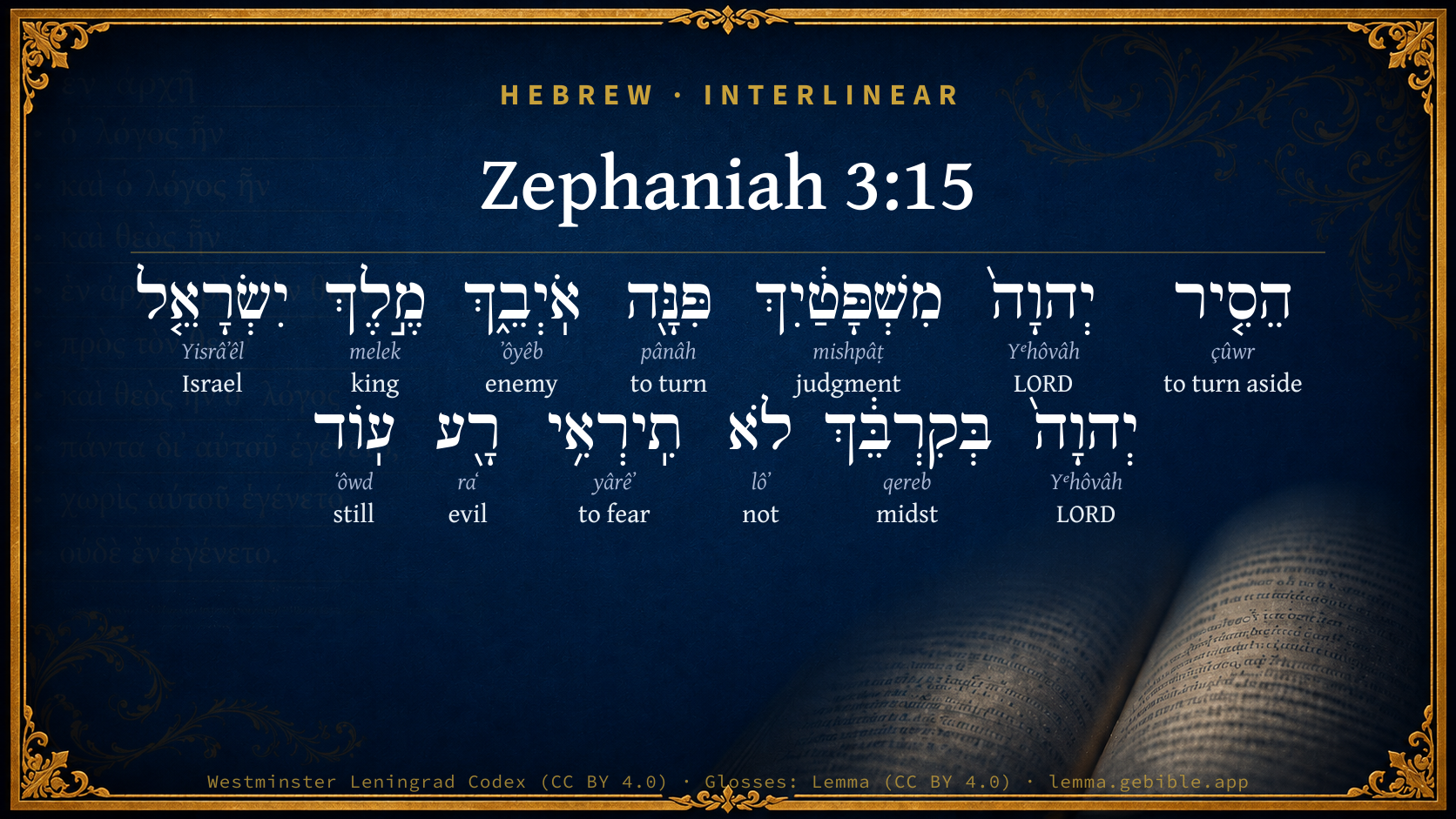
Hebrew (Westminster Leningrad Codex) Zephaniah 3:15 appears in the Hebrew Old Testament. The text above is from the Westminster Leningrad Codex. Each word links to its Strong’s number, a concise gloss, and parsing drawn from the Open Scriptures Hebrew Bible morphology. Click any word for its full Brown-Driver-Briggs (BDB) entry.
Download image
Cite this verse

Zephaniah 3:15 (World English Bible). Public Domain. Lemma interlinear Bible study tool, https://lemma.gebible.app/v/zephaniah/3/15.

Show BibTeX & RIS
BibTeX
RIS
English Translation
Yahweh has taken away your judgments. He has thrown out your enemy. The King of Israel, Yahweh, is in the midst of you. You will not be afraid of evil any more.
World English Bible · Public Domain
Download a study sheet

One document with this verse’s original text, its word-by-word gloss line, the meaning frame, cross-references with their text, attributed commentary, and full source and license credits — printable, and it pastes into notes with its structure intact.

This verse Autodidact and up

Study sheet (.html) Plain text (.txt)

A passage Seminary Student

Up to 50 verses in one chapter. A passage sheet keeps up to 6 commentary sources and 12 cross-references per verse, in the order this page ranks them, and says so on the sheet whenever that leaves anything out. Ask for a single verse and you get the Autodidact verse sheet above.

Everything on this page stays free to read, with no account — the sheet is a download of what is already on screen, not access to it.

Want to remove ads? Support Godless Engineer
Compare translations 3

The same verse in 3 English versions, stacked beneath the original-language interlinear above. Click any original word for its lexicon entry.

Each is an independent rendering of the whole verse — the interlinear is not word-aligned to these translations.

Highlighted words mark where these versions differ — a whole-verse word diff, not a word-by-word alignment.

  • World English Bible Public Domain
    Yahweh has taken away your judgments. He has thrown out your enemy. The King of Israel, Yahweh, is in the midst of you. You will not be afraid of evil any more.
  • King James Version Public Domain
    The LORD hath taken away thy judgments, he hath cast out thine enemy: the king of Israel, even the LORD, is in the midst of thee: thou shalt not see evil any more.
  • unfoldingWord Literal Text CC BY-SA 4.0
    Yahweh has taken away your judgments; he has turned back your enemy. The king of Israel, Yahweh, in your midst. You will not fear harm again!

unfoldingWord Literal Text — © unfoldingWord, licensed CC BY-SA 4.0. Word-aligned USFM3 via Door43 (git.door43.org/unfoldingWord/en_ult).

Versions to compare (up to 4)

3 of 4 selected

Show all 18 translations

Every available English version of this verse, each an independent rendering of the whole verse.

  • World English Bible Public Domain
    Yahweh has taken away your judgments. He has thrown out your enemy. The King of Israel, Yahweh, is in the midst of you. You will not be afraid of evil any more.
  • Berean Standard Bible Public Domain
    The LORD has taken away your punishment; He has turned back your enemy. Israel’s King, the LORD, is among you; no longer will you fear any harm.
  • Majority Standard Bible Public Domain
    The LORD has taken away your punishment; He has turned back your enemy. Israel’s King, the LORD, is among you; no longer will you fear any harm.
  • King James Version Public Domain
    The LORD hath taken away thy judgments, he hath cast out thine enemy: the king of Israel, even the LORD, is in the midst of thee: thou shalt not see evil any more.
  • American Standard Version (1901) Public Domain
    Jehovah hath taken away thy judgments, he hath cast out thine enemy: the King of Israel, even Jehovah, is in the midst of thee; thou shalt not fear evil any more.
  • Revised Version (1885) Public Domain
    The LORD hath taken away thy judgments, he hath cast out thine enemy: the king of Israel, even the LORD, is in the midst of thee: thou shalt not fear evil any more.
  • Geneva Bible (1599) Public Domain
    The Lord hath taken away thy iudgements: hee hath cast out thine enemie: the King of Israel, euen the Lord is in the middes of thee: thou shalt see no more euill.
  • Douay-Rheims (1899) Public Domain
    The Lord hath taken away thy judgment, he hath turned away thy enemies: the king of Israel the Lord is in the midst of thee, thou shalt fear evil no more.
  • Young's Literal Translation Public Domain
    Jehovah hath turned aside thy judgments, He hath faced thine enemy, The king of Israel, Jehovah, `is' in thy midst, Thou seest evil no more.
  • Literal Standard Version CC BY-SA 4.0
    YHWH has turned aside your judgments, || He has faced your enemy, || The King of Israel, YHWH, [is] in your midst, || You see evil no more.
  • Unlocked Literal Bible CC BY-SA 4.0
    Yahweh has taken away your punishment; he has driven out your enemies! Yahweh is the king of Israel among you. You will never again fear evil!
  • unfoldingWord Literal Text CC BY-SA 4.0
    Yahweh has taken away your judgments; he has turned back your enemy. The king of Israel, Yahweh, in your midst. You will not fear harm again!
  • Darby Bible Public Domain
    Jehovah hath taken away thy judgments, he hath cast out thine enemy; the King of Israel, Jehovah, is in the midst of thee; thou shalt not see evil any more.
  • World Messianic Bible Public Domain
    The LORD has taken away your judgments. He has thrown out your enemy. The King of Israel, the LORD, is among you. You will not be afraid of evil any more.
  • Webster's Bible Public Domain
    The LORD hath taken away thy judgments, he hath cast out thy enemy: the King of Israel, even the LORD, is in the midst of thee: thou shalt not see evil any more.
  • Free Bible Version CC BY-SA 4.0
    For the Lord has turned aside from punishing you, and he has turned back your enemies. The Lord, the king of Israel, is with you, and you will never again have to fear disaster.
  • Bible in Basic English Public Domain
    The Lord has taken away those who were judging you, he has sent your haters far away: the King of Israel, even the Lord, is among you: you will have no more fear of evil.
  • JPS Tanakh (1917) Public Domain
    The LORD hath taken away thy judgments, He hath cast out thine enemy; The King of Israel, even the LORD, is in the midst of thee; thou shalt not fear evil any more.

Literal Standard Version (2020), Covenant Press — licensed CC BY-SA 4.0. Text via the HelloAO Bible API (eBible.org). Unlocked Literal Bible (unfoldingWord) — licensed CC BY-SA 4.0. Text via the HelloAO Bible API (eBible.org). unfoldingWord Literal Text — © unfoldingWord, licensed CC BY-SA 4.0. Word-aligned USFM3 via Door43 (git.door43.org/unfoldingWord/en_ult). Free Bible Version, Dr. Jonathan Gallagher — licensed CC BY-SA 4.0. Text via the HelloAO Bible API (eBible.org).

Word by word

More ways to search: Search by grammar → Find every occurrence → Compare this word →

Practice this passage: Drill this verse → Learn its vocabulary →

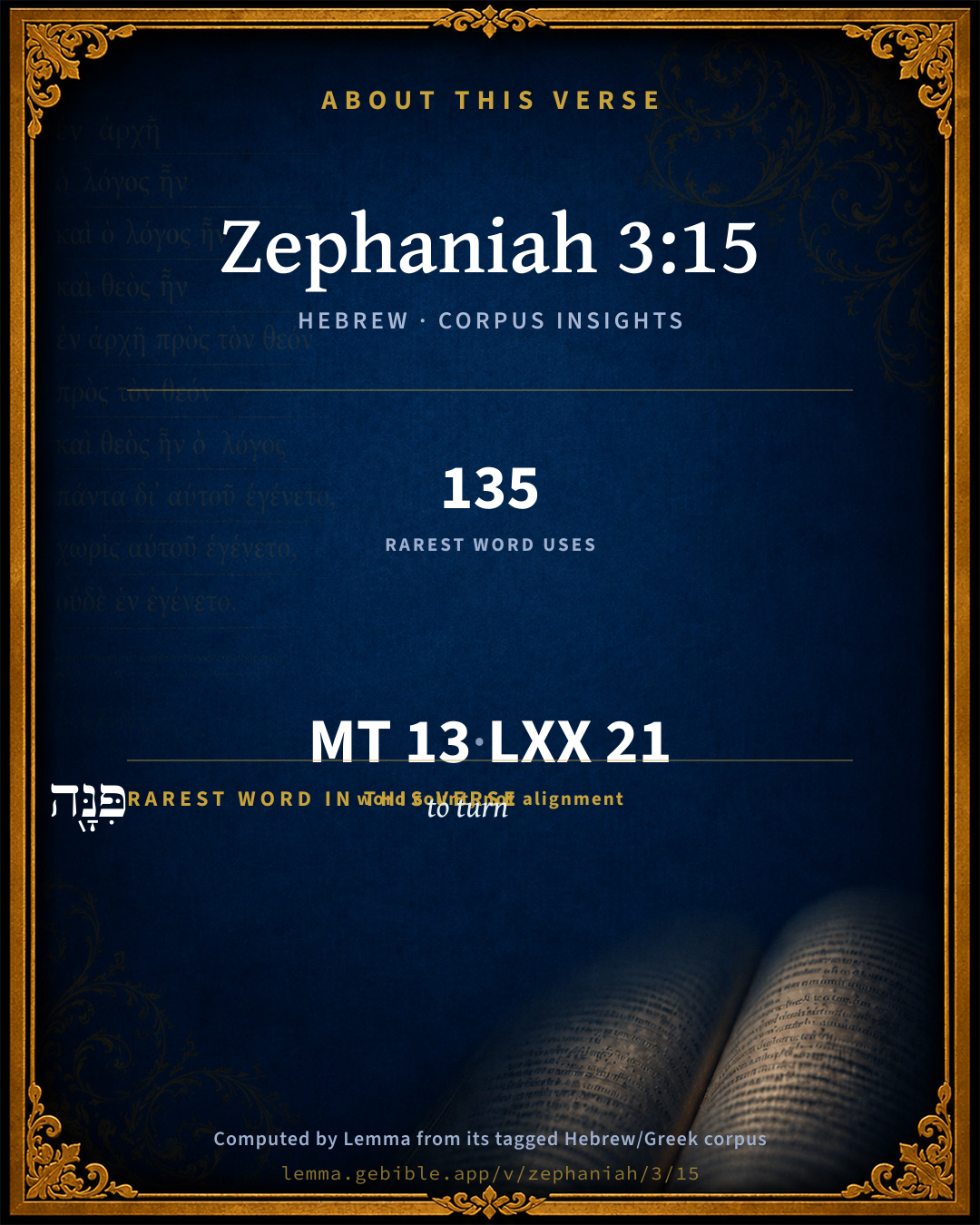
פִּנָּ֖ה
pânâh
H6437
“to turn”
Verb, Piel, Perfect, 3rd Person, Masculine, Singular
Part of Speech
Verb
Stem
Piel
Form
Perfect
Person
3rd Person
Gender
Masculine
Number
Singular
Full BDB Definition

Origin: a primitive root

TWOT: 1782

to turn - (Qal) - to turn toward or from or away - to turn and do - to turn, decline (of day) - to turn toward, approach (of evening) - to turn and look, look, look back or at or after or for - (Piel) to turn away, put out of the way, make clear, clear away - (Hiphil) - to turn - to make a turn, show signs of turning, turn back - (Hophal) to be turned back
  1. הֵסִ֤יר çûwr H5493 “to turn aside” Verb, Hiphil, Perfect, 3rd Person, Masculine, Singular
  2. יְהוָה֙ Yᵉhôvâh H3068 “LORD” Noun, Proper
  3. מִשְׁפָּטַ֔יִךְ mishpâṭ H4941 “judgments · your” Noun, Common, Masculine, Plural, Construct + Suffix, Personal, 2nd Person, Feminine, Singular
  4. אֹֽיְבֵ֑ךְ ʼôyêb H341 “enemy · you” Verb, Qal, Participle Active, Masculine, Singular, Construct + Suffix, Personal, 2nd Person, Feminine, Singular
  5. מֶ֣לֶךְ melek H4428 “king of” Noun, Common, Masculine, Singular, Construct
  6. יִשְׂרָאֵ֤ל Yisrâʼêl H3478 “Israel” Noun, Proper
  7. יְהוָה֙ Yᵉhôvâh H3068 “LORD” Noun, Proper
  8. בְּקִרְבֵּ֔ךְ qereb H7130 “in/at · midst · your” Preposition + Noun, Common, Masculine, Singular, Construct + Suffix, Personal, 2nd Person, Feminine, Singular
  9. לֹא lôʼ H3808 “not” Particle, Negative
  10. תִֽירְאִ֥י yârêʼ H3372 “to fear” Verb, Qal, Imperfect, 2nd Person, Feminine, Singular
  11. רָ֖ע raʻ H7451 “evil” Adjective, Adjective, Masculine, Singular, Absolute
  12. עֽוֹד ʻôwd H5750 “still” Adverb

About this verse

These counts appear in no published source. They are computed here, from the morphology-tagged text and Lemma’s own curated glosses. What Lemma adds →

13
words
12
distinct lemmas
Prophets
section

Grammatical profile

  • 4 verbs
  • 6 nouns
  • 1 adjective
  • 1 adverb
  • 1 particle

Verb forms

  • הֵסִ֤יר Hiphil · Perfect
  • פִּנָּ֖ה Piel · Perfect
  • אֹֽיְבֵ֑ךְ Qal · Participle Active
  • תִֽירְאִ֥י Qal · Imperfect

Repetition

A word recurs within this verse — often emphatic in Hebrew:

  • יְהוָה֙ LORD H3068 ×2

Hebrew & Septuagint length

In English translation the verse runs 32 words from the Hebrew and 36 from the Septuagint (LXX English) — closely comparable.

A rough comparison of the two English renderings, which tokenize alike — not a word-level alignment.

Word counts can differ between the Hebrew and the Greek without any difference in meaning — e.g. the Hebrew direct-object marker אֵת has no separate Greek word, and Greek often adds the article ὁ.

In the original languages it is 13 Hebrew tokens and 21 Greek tokens — but the two are counted differently (Hebrew bundles its prefixes and suffixes into one token; the Greek is in lemma form), so that isn’t a like-for-like length.

Cross-references

39

Topical passages linked to Zephaniah 3:15 in the Treasury of Scripture Knowledge — connected by theme and wording, ordered by reader-vote popularity; previews shown in the World English Bible.

  • Isaiah 51:22 Thus says your Lord Yahweh, and your God who pleads the cause of his people, Behold, I have taken out of your hand the cup of staggering, even the bowl of the cup of my wrath; you shall no more drink it again:
  • Isaiah 60:18 Violence shall no more be heard in your land, desolation nor destruction within your borders; but you shall call your walls Salvation, and your gates Praise.
  • Zephaniah 3:5 Yahweh, in the midst of her, is righteous. He will do no wrong. Every morning he brings his justice to light. He doesn't fail, but the unjust know no shame.
  • Genesis 30:23 She conceived, bore a son, and said, "God has taken away my reproach."
  • Isaiah 40:1–2 Comfort you, comfort you my people, says your God.
  • Ezekiel 39:29 neither will I hide my face any more from them; for I have poured out my Spirit on the house of Israel, says the Lord Yahweh.
  • Amos 9:15 I will plant them on their land, And they will no more be plucked up out of their land which I have given them," says Yahweh your God.
  • Isaiah 25:8 He has swallowed up death forever; and the Lord Yahweh will wipe away tears from off all faces; and the reproach of his people will he take away from off all the earth: for Yahweh has spoken it.
  • Isaiah 33:22 For Yahweh is our judge, Yahweh is our lawgiver, Yahweh is our king; he will save us.
  • Ezekiel 37:24–28 My servant David shall be king over them; and they all shall have one shepherd: they shall also walk in my ordinances, and observe my statutes, and do them.
  • Joel 3:20–21 But Judah will be inhabited forever, And Jerusalem from generation to generation.
  • Zechariah 14:11 Men will dwell therein, and there will be no more curse; but Jerusalem will dwell safely.
  • Psalms 85:3 You have taken away all your wrath. You have turned from the fierceness of your anger.
  • Micah 7:16–20 The nations will see and be ashamed of all their might. They will lay their hand on their mouth. Their ears will be deaf.
  • Zechariah 2:8–9 For thus says Yahweh of hosts: 'For honor he has sent me to the nations which plundered you; for he who touches you touches the apple of his eye.
  • Zechariah 10:6–7 "I will strengthen the house of Judah, And I will save the house of Joseph, And I will bring them back; For I have mercy on them; And they will be as though I had not cast them off: For I am Yahweh their God, and I will hear them.
  • Zechariah 12:3 It will happen in that day, that I will make Jerusalem a burdensome stone for all the peoples. All who burden themselves with it will be severely wounded, and all the nations of the earth will be gathered together against it.
  • John 1:49 Nathanael answered him, "Rabbi, you are the Son of God! You are King of Israel!"
  • Isaiah 13:1–14 The burden of Babylon, which Isaiah the son of Amoz did see.
  • Isaiah 54:14 In righteousness shall you be established: you shall be far from oppression, for you shall not be afraid; and from terror, for it shall not come near you.
  • Isaiah 65:19 I will rejoice in Jerusalem, and joy in my people; and there shall be heard in her no more the voice of weeping and the voice of crying.
  • Ezekiel 48:35 It shall be eighteen thousand [reeds] round about: and the name of the city from that day shall be, Yahweh is there.
  • Joel 3:17 "So you will know that I am Yahweh, your God, Dwelling in Zion, my holy mountain. Then Jerusalem will be holy, And no strangers will pass through her any more.
  • Micah 7:10 Then my enemy will see it, And shame will cover her who said to me, Where is Yahweh your God? Then my enemy will see me and will cover her shame. Now she will be trodden down like the mire of the streets.
  • Habakkuk 2:17 For the violence done to Lebanon will overwhelm you, and the destruction of the animals, which made them afraid; because of men's blood, and for the violence done to the land, to every city and to those who dwell in them.
  • Zephaniah 3:17 Yahweh, your God, is in the midst of you, a mighty one who will save. He will rejoice over you with joy. He will rest in his love. He will rejoice over you with singing.
  • Zechariah 1:14–16 So the angel who talked with me said to me, "Proclaim, saying, 'Thus says Yahweh of Hosts: "I am jealous for Jerusalem and for Zion with a great jealousy.
  • Zechariah 8:13–15 It shall come to pass that, as you were a curse among the nations, house of Judah and house of Israel, so will I save you, and you shall be a blessing. Don't be afraid. Let your hands be strong."
  • Zechariah 9:9 Rejoice greatly, daughter of Zion! Shout, daughter of Jerusalem! Behold, your king comes to you! He is righteous, and having salvation; Lowly, and riding on a donkey, Even on a colt, the foal of a donkey.
  • John 12:15 "Don't be afraid, daughter of Zion. Behold, your King comes, sitting on a donkey's colt."
  • John 19:19 Pilate wrote a title also, and put it on the cross. There was written, "JESUS OF NAZARETH, THE KING OF THE JEWS."
  • Romans 8:33–34 Who could bring a charge against God's chosen ones? It is God who justifies.
  • Revelation 7:15 Therefore they are before the throne of God, they serve him day and night in his temple. He who sits on the throne will spread his tent over them.
  • Revelation 12:10 I heard a loud voice in heaven, saying, "Now is come the salvation, the power, and the Kingdom of our God, and the authority of his Christ; for the accuser of our brothers has been thrown down, who accuses them before our God day and night.
  • Revelation 21:3–4 I heard a loud voice out of heaven saying, "Behold, God's dwelling is with people, and he will dwell with them, and they will be his people, and God himself will be with them as their God.
  • Isaiah 35:10 and the ransomed of Yahweh shall return, and come with singing to Zion; and everlasting joy shall be on their heads: they shall obtain gladness and joy, and sorrow and sighing shall flee away.
  • Jeremiah 50:1–46 The word that Yahweh spoke concerning Babylon, concerning the land of the Chaldeans, by Jeremiah the prophet.
  • Habakkuk 2:8 Because you have plundered many nations, all the remnant of the peoples will plunder you, because of men's blood, and for the violence done to the land, to the city and to all who dwell in it.
  • Revelation 19:16 He has on his garment and on his thigh a name written, "KING OF KINGS, AND LORD OF LORDS."

Cross-references courtesy of OpenBible.info (CC BY 4.0).

Hebrew and Greek witnesses Masoretic Hebrew ↔ Greek Septuagint

The same verse in the two great witnesses to the Old Testament, shown verse-for-verse.

These are two independent witnesses, not word-aligned to each other, and the Septuagint is shown in lemma (dictionary) form.

Hebrew Zephaniah 3:15 Masoretic · Westminster Leningrad Codex

הֵסִ֤יר יְהוָה֙ מִשְׁפָּטַ֔יִךְ פִּנָּ֖ה אֹֽיְבֵ֑ךְ מֶ֣לֶךְ יִשְׂרָאֵ֤ל יְהוָה֙ בְּקִרְבֵּ֔ךְ לֹא תִֽירְאִ֥י רָ֖ע עֽוֹד

Yahweh has taken away your judgments. He has thrown out your enemy. The King of Israel, Yahweh, is in the midst of you. You will not be afraid of evil any more.

World English Bible · Public Domain

Greek LXX Zephaniah 3:15 Septuagint · lemma form

περιαἱρέω κύριος ὁ ἀδίκημα σύ λυτρόω σύ ἐκ χείρ ἐχθρός σύ βασιλεύς ἰσραήλ κύριος ἐν μέσος σύ οὐ ὁράω κακός οὐκέτι

The Lord has taken away your iniquities, he has ransomed you from the hand of your enemies: the Lord, the King of Israel, is in the midst of you: you shall not see evil any more.

LXX2012 (modern English Septuagint) · Public Domain

On this verse, Whedon's Commentary on the Bible discusses the Septuagint’s reading. Read the note in Commentary ↓

Hebrew: Westminster Leningrad Codex (CC BY 4.0). Greek: Septuagint (public domain); English from LXX2012 (modern English Septuagint) (Public Domain). How the Septuagint differs from the Hebrew →

Targum (Aramaic paraphrase)

1

The Targum is the ancient Jewish Aramaic paraphrase of the Hebrew Scriptures — an interpretive translation, not the Hebrew text itself. Onkelos (literal) and Pseudo-Jonathan (expansive) render the Torah, and Jonathan the Prophets. Coverage is partial: where no permissively-licensed English translation exists for a verse, only the Aramaic is shown. This is verse-level text, not a word-by-word alignment to the Hebrew.

  1. Targum Jonathan Prophets (Joshua–Malachi)
    אַגְלֵי יְיָ דַיָנֵי שִׁקְרָא מִגַוִיךְ פַּלֵי בַּעֲלֵי דְבָבֵיךְ מַלְכֵיהּ דְיִשְׂרָאֵל יְיָ אֲמֵר לְאַשְׁרָאָה שְׁכִנְתֵּיהּ בְּגַוֵיךְ לָא תִדְחֲלִין מִן קֳדָם בִּישָׁא עוֹד:

    (no public-domain English translation for this verse)

    Targum Jonathan — Aramaic: “Mikraot Gedolot” (public domain). English: “Sefaria Community Translation” (CC0 1.0 (public-domain dedication)); “London "Chaldee Paraphrase," 1871” (public domain). Text via Sefaria.

Commentary

Notes on Zephaniah 3:15 from classic Christian and Jewish commentators (each source and its license shown beneath its notes). The classic Christian expositions comment on the surrounding passage and are grouped to its opening verse, so a note may address several verses; the Jewish commentaries on the Tanakh (Rashi and others) are per-verse, so they appear only where the commentator wrote on this verse.

Lemma curates 59 commentaries, every one of them public domain or Creative Commons licensed, each selected and text-cleaned for this edition rather than reprinted as found. About our sources →

Trapp's Complete Commentary

John Trapp

Zep 3:15 The LORD hath taken away thy judgments, he hath cast out thine enemy: the king of Israel, [even] the LORD, [is] in the midst of thee: thou shalt not see evil any more.

Ver. 15. The Lord hath taken away thy Judgments] i.e. He hath remitted thy sins, removed thy punishments, turned again thy captivity as the streams in the south, commanded his prophets, saying, "Comfort ye, comfort ye my people," &c., Isa 40:1-2; tell her that all accusations and actions laid against her in the court of heaven are non-suited, and God’s wrath appeased. This is the sum of all the good news in the world; this is a short gospel.

He hath cast out thine enemy] As rubbish and sweepings of the house are cast out ( פכה repurgare everrere significat); so hath God dealt by thine enemies corporal and spiritual; that thou being delivered out of the hands of both, might serve him without fear, in holiness and righteousness before him all thy days, Luk 1:74-75.

The king of Israel, even the Lord, is in the midst of thee] In the many testimonies of his powerful and gracious presence; yea, he hath set him up a mercy seat, a throne of grace, and bidden thee come boldly thereunto, Heb 4:16.

Thou shalt not see evil any more] sc. So long as thou retainest God with thee, who is both a sun and a shield, Psa 84:11, and children have a place of refuge, Pro 14:26.

John Trapp, A Commentary or Exposition upon All the Books of the Old and New Testament (1647–1656) — public domain. Text from a community e-Sword module.

Whedon's Commentary on the Bible

Daniel D. Whedon

15-17. The reason for the exultation is found in the fullness of the redemption wrought.

Hath taken away thy judgments — He has made an end of the judgments which have come upon the nation again and again on account of sin (compare Isa_40:2). Since these have come to an end, Zion may live in peace and contentment. A change in the vocalization would change “thy judgments” into “thine adversaries,” which is favored by the presence of “thine enemy” or “enemies” (LXX.) in the parallel clause. Those who in the past have troubled the chosen people are swept away.

The king of Israel — In the Messianic age north and south will be reunited (Hos_1:11), and over the united people Jehovah will rule as king (Oba_1:21; Mic_4:7), with Jerusalem as his royal residence (see on Joe_2:27; compare Mic_4:7; Isa_2:2-4). Marti proposes the omission of “of Israel” and the change of “king” into a verb form, “has become king,” so that the entire clause would read, “Jehovah has become king in the midst of thee.”

Thou shalt not see evil any more — R.V., “fear.” Evil is not moral evil, but calamity or misfortune. Some ancient authorities favor A.V., others R.V.; the difference between the two words “fear” and “see” is so slight in Hebrew that confusion might easily occur. See in the sense of experience (compare Psa_90:15; Pro_27:12) is the more suitable.

So marked will be the transformation that others will observe it and encourage Jerusalem. R.V. offers a more accurate reproduction of the original: “Fear thou not; O Zion, let not thy hands be slack.”

Fear thou not — Because Jehovah is near, ready to help.

Let not thine hands be slack — Or, hang down inactive, which is a sign of despair and despondency (compare Isa_13:7; Jer_6:24).

Zep_3:17 states why there is no ground for despondency. 17a should be rendered with R.V., “Jehovah thy God is in the midst of thee, a mighty one who will save.” For the first part compare Zep_3:15, and see reference there. A mighty one (R.V.) — Who has power to render assistance in every need and to save from all difficulties.

He will rejoice over thee with joy;… joy over thee with singing — Because uncleanness has been swept away and the community consists only of those who are obedient to his will (compare Isa_65:19; Jer_32:41). Between the two clauses calling attention to the joy of Jehovah stands a rather obscure clause.

He will rest in his love — Literally, he will be silent in his love. If this is the original text the meaning can only be that Jehovah’s love will be too tender and strong for expression. LXX. renders, “he will renew thee,” but this does not suit the context. One would expect a verb expressing joyful emotion, and one that would lend itself to the formation of a climax. A verb containing the same consonants as the Hebrew word translated “rest,” but in different order, occurs in Psa_45:2 (Eng. Zep_3:1) in the sense of “overflow.” This would not be inappropriate here, “he will overflow (with joy) in his love”; it would also produce a climax. Jehovah will joy inwardly, but cannot contain the joy, he will overflow with it, and finally burst into a song of rejoicing.

Daniel D. Whedon (gen. ed.), Commentary on the Old and New Testaments (1874–1909) — public domain. Text from a community e-Sword module.

Tyndale Open Study Notes

Tyndale Open Resources

3:15 The true King of Israel was always to be the Lord (Num 23:21; 1 Sam 8:7; Isa 44:6). • will live among you: See also Isa 54:4-8; 57:14-19; 62:10-12; Ezek 48:35; Joel 3:17, 21.

Tyndale Open Study Notes — © Tyndale Open Resources, licensed CC BY-SA 4.0. Text via the HelloAO Bible API.

Geneva Bible (1599)

Geneva Bible translators

That is, the punishment for thy sin.

As the Assyrians, Chaldeans, Egyptians and other nations.

To defend thee as by thy sins thou hast put him away, and left thyself naked, as Exod. 32:25.

Geneva Bible (1599) marginal notes — public domain. Text via Bolls.life.

Jamieson, Fausset & Brown

Robert Jamieson, A. R. Fausset & David Brown

The cause for joy: "The Lord hath taken away thy judgments," namely, those sent by Him upon thee. After the taking away of sin (Zep 3:13) follows the taking away of trouble. When the cause is removed, the effect will cease. Happiness follows in the wake of holiness.

the Lord is in the midst of thee--Though He seemed to desert thee for a time, He is now present as thy safeguard (Zep 3:17).

not see evil any more--Thou shalt not experience it (Jer 5:12; Jer 44:17).

Jamieson, Fausset & Brown — Commentary Critical and Explanatory on the Whole Bible (1871) — public domain (CC PDM 1.0). Text via the HelloAO Bible API.

Adam Clarke's Commentary

Verse 15. The King of Israel, even the Lord, is in the midst of thee] They have never had a king since the death of Zedekiah, and never shall have one till they have the King Messiah to reign among them; and this promise refers to that event.

Adam Clarke's Commentary on the Bible (1810–1826) — public domain. Text from a community e-Sword/MySword module.

Ellicott's Commentary for English Readers

(15) Taken away thy judgments.—i.e., removed what He had “appointed concerning them” (Zep_3:7) in the way of punishments.

The king of Israel.—The recognition of Jehovah as king is elsewhere a prominent feature in the portraiture of the extended dispensation. Thus we have, “Say among the heathen that Jehovah is king” (Psa_96:10). “Jehovah is king” (Psa_93:1; Psa_97:1; Psa_99:1). “The kingdom shall be Jehovah’s” (Oba_1:21).

A Bible Commentary for English Readers, edited by Charles John Ellicott (1878–1897) — public domain. Text from a community e-Sword module.

The Cambridge Bible for Schools and Colleges

gen. ed. J. J. S. Perowne

15. taken away thy judgments] The prophet transports himself and his people forward into the time of their final restoration and blessedness. The “judgments” of Zion are all those that have fallen on her during her chequered history; her warfare is accomplished, her iniquity pardoned (Isa_40:2).

The king of Israel] Isa_41:21, “produce your cause, saith the Lord, bring forth your strong reasons, saith the King of Jacob.” Comp. Isa_6:5; Isa_44:6.

The Cambridge Bible for Schools and Colleges (gen. ed. J. J. S. Perowne; Cambridge University Press, 1878–1918) — public domain. Text from a community e-Sword module.

John Gill's Exposition

The Lord hath taken away thy judgments Both outward and inward; not only exile, poverty, contempt and reproach among the nations of the earth; but hardness of heart, blindness of mind, impenitence and unbelief, to which the Jews are now given up, in a judicial way; but at this time these shall be removed, through the goodness of God unto them, and the power of divine grace upon them: they will be brought to a sense of sin, and an acknowledgment of it; their iniquities will be pardoned; and, the cause being removed, the effects will cease; and all calamities, corrections and punishment, will end; and they will be put into the possession of their own land, and enjoy all the privileges of the church of God; and so will have just reason to sing, shout, and rejoice: he hath cast out thine enemy; that is, the Lord has removed the enemy that was in possession of their land, and so made way, and prepared it for them; he has swept him away, as the word F16 signifies, with great force, with much ease, and like so much dirt and filth; he stood in their way, nor could they have easily removed him; but the Lord did it, or will do it; though it may be by instruments, by means of the Christian princes. This is to be understood of the eastern antichrist, the Turk, now in possession of the land of Israel F15; but shall be obliged to depart from it, when this prophecy shall take place, for a reason following: the King of Israel, [even] the Lord, [is] in the midst of thee; that is, the Lord Jesus Christ, the true Messiah; one of whose titles is the King of Israel, of the spiritual Israel, King of saints, both Jews and Gentiles; in whose hearts he rules by his Spirit and grace; and to this passage the Jews in Christ's time seem to have respect, allowing this to be the character of the Messiah, ( Matthew 27:42 ) and also Nathanael, ( John 1:49 ) now at this time Christ will be in the midst of the converted Jews, by his spiritual and gracious presence, as their King, to reign over them, to whom they will be subject; and to protect and defend them, and deliver them out of the hands of all their enemies; and so he is in all his churches, and will be to the end of the world: thou shalt not see evil any more; the evil of affliction or punishment; the evil of captivity, disgrace, and contempt. This shows that this prophecy does not respect the Babylonish captivity, and deliverance from that; for, since that time, they have seen evil by Antiochus Epiphanes, in the times of the Maccabees; and by the Romans; and have had a large and long experience of it; but when they are converted, and returned to their own land in the latter day, all their afflictions and troubles will be at an end, they will know them no more. The Vulgate Latin version renders it, "thou shalt not fear evil any more". So the Targum, ``thou shalt not be afraid from before evil any more.'' In the same sense Aben Ezra understands it, ``thou shalt not be afraid of the enemy any more;'' taking the word to come from another root F17. FOOTNOTES: F15 Written about 1750. Editor. F16 (hnp) "everrit", Drusius; so Ben Melech; see Gen. xxiv. 31. "evacuerit", Cocceius. F17 A (ary) "timuit", so V. L. "non timebis", Pagninus, Piscator; "fore ut non timeas", Junius & Tremellius; "hinc non erit quod timeas amplius quicquam mali", Burkius.

John Gill's Exposition of the Whole Bible (1746–1763) — public domain (CC PDM 1.0). Text via the HelloAO Bible API.

Albert Barnes' Notes on the Bible

The Lord hath taken away thy judgments - Her own, because brought upon her by her sins. But when God takes away the chastisements in mercy, He removes and forgives the sin too. Else, to remove “the judgments” only, would be to abandon the sinner. “He hath cast out,” literally, “cleared quite away” , as a man clears away all hindrances, all which stands in the way, so that there should be none whatever left - “thine enemy;” the one enemy, from whom every hindrance to our salvation comes, as He saith, “Now shall the prince of this world be cast out. The King of Israel, even the Lord” Joh 12:31, Christ the Lord, “is in the midst of thee,” of whom it is said, “He that sitteth on the throne shall dwell among them” Rev 7:15, and who Himself saith, “Lo I am with you always unto the end of the world” Mat 28:20. “Where two or three are gathered together in My Name, there am I in the midst of you” Mat 18:20.

He who had removed “from the midst of her” the proud, Who had left “in the midst of her” those with whom He dwelleth, shall Himself dwell “in the midst of her” in mercy, as He had before in judgment Mat 18:11-12, Mat 18:15, Mat 18:5. He cleanseth the soul for His indwelling, and so dwelleth in the mansion which He had prepared for Himself. “Thou shalt not see evil anymore.” For even the remains of evil, while we are yet in the flesh, are overruled, and “work together to good to those who love God” Rom 8:28. They cannot separate between the soul and Christ. Rather, He is nearer to her in them. We are bidden to “count it all joy when we fall into divers temptations” Jam 1:2, for all sorrows are but medicine from a father’s hand. : “And truly our way to eternal joy is to suffer here with Christ, and our door to enter into eternal life is gladly to die with Christ, that we may rise again from death and dwell with Him in everlasting life.”

So in the Revelation, it is first said that God should dwell with His people, and then that all pain shall cease. “Behold the tabernacle of God is with men, and He will dwell with them and be their God. And God shall wipe all tears from their eyes; and there shall be no more death, neither sorrow nor crying, neither shall there be anymore pain, for the former things are passed away” Rev 21:3-4. Cyril: “In the inmost meaning of the words, he could not but bid her rejoice and be exceeding glad and rejoice with her whole heart, her sins being done away through Christ. For the holy and spiritual Zion, the Church, the multitude of believers, is justified in Christ alone, and we are saved by Him and from Him, escaping the harms of our invisible enemies, and having in the midst of us the King and God of all, Who appeared in our likeness, the Word from God the Father, through whom we see not evil, that is, are freed from all who could do us evil. For He is the worker of our acceptableness, our peace, our wall, the bestower of incorruption, the dispenser of crowns, Who lighteneth the assaults of devils, Who giveth us to ‘tread on serpents and scorpions and all the power of the enemy’ Luk 10:19 - through whom we are in good hope of immortality and life, adoption and glory, through whom we shall not see evil anymore.”

Albert Barnes' Notes on the Bible (1834–1885) — public domain. Text from a community e-Sword/MySword module.

Haydock's Catholic Bible Commentary

CHAPTER III.

Judgment, or "condemnation." Septuagint, "iniquities," (Calmet) nailing to the cross the handwriting that was against thee. (Haydock) --- God does not treat thee with rigour. He will be thy king. The Jews had no king for a long time. But the true Israel, of whom the prophet speaks, is continually ruled and fed by Jesus Christ, who imparts his graces abundantly. (Calmet)

George Leo Haydock (1774–1849), Haydock's Catholic Family Bible and Commentary, 1859 edition — public domain. Excludes Psalms (Douay-Rheims chapter numbering differs from Protestant) and Deuterocanonical books (Catholic canon only).

Matthew Poole's English Annotations

The Lord; who kills and makes alive, acquits or condemns, and none can reverse the judgment.

Hath taken away thy judgments; abolished and put an end to thy sufferings, the judgments thy sins brought upon thee; he hath pardoned thy sins and ended thy sorrows.

He hath cast out; cast the Babylonian out of the throne, and placed the Persian in it.

Thine enemy; the Babylonian who held thee captive; and placed in his room Cyrus mine anointed, and thy friend, who shall let thee go free, Ezr 1:1.

The King of Israel, even the Lord, is in the midst of thee: thus it is evident that the Lord, who is thy King, O Israel, is with thee; that he taketh thy part, is returned to redeem and govern thee.

Thou shalt not see evil any more; no more such great evil as thou hast seen; whilst thy carriage is as becometh thy mercy received, and my presence with thee, thou shalt neither fear nor feel like evils.

Matthew Poole's English Annotations on the Holy Bible (1683–1685) — public domain. Text from a community e-Sword/MySword module.

The Pulpit Commentary

In this and following verses the prop. hot gives the reasons why Zion should rejoice. Thy judgments. The chastisements inflicted on thee in judgment, rendered necessary by thy iniquity. (Eze_5:8) These God has removed; this is the first ground for rejoicing. Septuagint, ta adikhmata sou , "thine iniquities." When God removes the punishments, he forgives the sin. He hath cast out (cleared quite away) thine enemy. The enemies who executed the judgment are utterly dispersed. The King of Israel, even the Lord, is in the midst of thee. (Oba_1:21) The theocracy is restored. Under the judgments which fell upon Israel, Jehovah seemed to have left his people; now he is in the midst of them as their icing. (Isa_12:6 Isa_52:7 Hos_11:9) The perpetual presence of Christ in the Church is here adumbrated. Thou shalt not see evil any more. So the Septuagint. Another reading adopted by Jerome is, "Thou shalt not fear." In view of the following verse, this seems rather tautological. With God in their midst, the people shall see, i.e. experience, (Jer_5:12) no evil. (Rev_21:3, Rev_21:4)

The abiding presence of God with his Church.

"The King of Israel, even the Lord, is in the midst of thee." This truth was constantly affirmed in the Old Testament with reference to the Jewish Church; and as the Church of God through all ages is one Church, we may take the promises of God to Israel of old as having their application to his Church still. So may we apply to her today those assurances contained in the Hebrew Scriptures, (Ps 46 Ps 48) or that contained in the text, or, turning to the New Testament, we may grasp the gracious promise of the God-Man, "Lo, I am with you alway, even unto the end of the world". (Mat_28:20)

I INDICATE SOME OF THE WAYS IN WHICH GOD HAS ESTABLISHED THIS TRUTH OF HIS ABIDING PRESENCE WITH HIS CHURCH IN ALL AGES.

1. By having "a remnant" to his praise even in the darkest times. It is an undoubted fact that, whatever dark clouds of persecution, or indifference, or declension may have arisen, God has had all through the season of darkness a people to show forth his praise. These Hebrew prophets, amidst their emphatic testimony against the iniquity prevailing in their times, constantly recognize with thankfulness "a remnant" as remaining true to God and to righteousness. Elijah at Horeb thought himself to be the only servant of Heaven remaining in his corrupt day; but God removed the veil concealing from his view the secret and hidden Church, and, lo, he beheld "an exceeding great army," where he had supposed himself to be the solitary warrior for the truth. "Yet have I left me seven thousand in Israel,". (1Ki_19:18) In "the dark ages," when the light of Christian truth had become well nigh extinguished, there were not wanting those who dared to maintain the truth of God in its simplicity and purity. Even within the pale of the Church of Rome in those days there were some who deplored the prevailing corruptions, and who longed for a return to the simplicity in teaching and the purity of life by which the early Christians were characterized; whilst outside her communion were associations of Free Christian societies, as in Lombardy and in the Alps, who were as lights shining in dark places. The Nestorians, "the Protestants of Asia," referred to by Mr. Layard, serve as another illustration, and who, away in the remote valleys of Kurdistan, and entirely separated from intercourse with other Christian communities, have preserved through so many centuries a knowledge of the Christian faith in the purity of its character and the simplicity of its worship. There has ever been "a remnant" true to God, and serving as a clear token of his abiding presence with his Church.

2. By raising up in her midst, and qualifying, men for special service. Whilstwe may not "glory in men," we may magnify God"s grace and power in them; and it is intensely interesting to note how he has in every emergency raised up his agents to do his work. Moses and Joshua, in relation to the deliverance of the Israelites and their settlement in Canaan; Ezra and Nehemiah, in connection with the return from the Captivity in Babylon; the faithful prophets raised up to declare the judgments of Heaven against idolatrous nations; Luther, Melancthon, Zwingle, called by him to take part in the work of the Reformation; and Owen, Howe, Bunyan, Baxter, Flavel, and others, following, to wield the pen effectively in support of the truth, and so to confirm and to consolidate the work of their predecessors. And by thus raising up men and endowing them with gifts for special service, God has confirmed to his Church the assurance of his abiding presence.

3. By frustrating and bringing to nought the evil designs of her enemies. He has repeatedly proved that "no weapon directed against his Church can prosper," and has made manifest the folly of those who have sought to overthrow the kingdom of truth and righteousness. "The wrath of man shall praise him," etc. (Psa_76:10)

4. By opening up new fields for the extension of her influence. India has been placed under British rule, and the opportunity given of making known to its teeming millions "the unsearchable riches of Christ." The exclusiveness chat prevented access to the empire of China has passed away, so that the missionary may go through the length and breadth of the land. The heart of Africa has been penetrated, and there is now the prospect of her sable tribes becoming elevated and blessed through Christian influence. And in thus opening up the world for Christian enterprise to bestow upon it all its energy and zeal, God has shown himself as being still with his Church. "The King of Israel," etc. (ver. 15).

II THE ENCOURAGEMENT THIS THOUGHT OF GOD"S ABIDING PRESENCE WITH HIS PEOPLE IS CALCULATED TO AFFORD TO THEIR HEARTS,

1. In view of the character of the age in which we live, as related to Christian truth. Many are seeking to restore that papal supremacy which has proved such a blight in ages that are past; many are cherishing the spirit of scepticism, and would have us even banish God himself from his universe; and there is also a widespread spirit of indifference abroad in relation to the highest spiritual realities. Yet still we will not despond, for "the Lord of hosts is with us," and as he caused the light to burn and to prevail even in the darkest ages, so he will still work until the light shall shine in every land, and all flesh see together the revealed glory of the Lord.

2. In view of apathy, coldness, and declension in holy service. Such seasons do occur, and such lifelessness and deadness at times falls upon the Church of God and upon Christian communities. Yet God does not forsake us even when we thus grow lukewarm in his service. He is with us still, and will grant us renewal and revival if we will but turn to him with all our hearts.

3. In view of the losses the Church of God is called upon to sustain through the ravages of death. The last foe is ever active. Beneath his unsparing hand the useful as well as the useless fall the true-hearted worker for God as well as the idler whose life is altogether barren of good. But amidst these changes the chief Shepherd liveth; all holy gifts and heavenly graces are his bestowments, and he will not fail his Church, but will raise up a bright succession of devoted servants to do his bidding and to help on the grand consummation. Hence we will not despair; for "God is in the midst of her; she shall not be moved: God shall help her, and that right early". (Psa_46:4)

The Pulpit Commentary (1880–1919), ed. H.D.M. Spence-Jones & Joseph S. Exell — public domain. Text from a community e-Sword module.

John Wesley's Explanatory Notes

Taken away - Abolished, and put an end to the judgments thy sins brought upon thee. Thine enemy - The Babylonian. Is in the midst - He is returned to redeem and govern thee. Any more - While thy carriage is as becomes my presence with thee, thou shalt neither fear, nor feel the like evils.

John Wesley, Explanatory Notes Upon the Whole Bible (1754–1765) — public domain. Text via the GEBible commentary corpus.

Scofield Reference Notes

C. I. Scofield

the midst of thee

That this, and all like passages in the Prophets (see "Kingdom (O.T.)," Gen 1:26; Zec 12:8 cannot refer to anything which occurred at the first coming of Christ is clear from the context. The precise reverse was true. (See Scofield "Isa 11:1") .

The Scofield Reference Bible (1917 edition), notes by C. I. Scofield — public domain. Text from a community e-Sword module.

Rashi

Rabbi Shlomo Yitzchaki (Rashi)

your afflictions justice in French.

Rashi on the Tanakh — English translations: “The Judaica Press complete Tanach with Rashi, translated by A. J. Rosenberg” (CC BY 4.0); “Pentateuch with Rashi's commentary by M. Rosenbaum and A.M. Silbermann, 1929-1934” (public domain); “The Metsudah Tanach series, Lakewood, N.J” (CC BY 4.0); and “The Book of Joshua, Metsudah Publications, 1997” (CC BY 4.0). Text via Sefaria.

Lesson kit

Teaching starters — assembled from the data on this page, not authored interpretation. Every prompt links to the verse data it draws on. Edit before teaching.

Zephaniah, in the Prophets, opens this verse with 13 words (12 distinct Hebrew lemmas). Its most distinctive word is pânâh (“to turn”). A historical commentator’s framing appears above. Read the whole chapter for the surrounding context.

Discussion questions

  1. The word pânâh carries the sense “to turn.” How does it shape the verse?
  2. How does Isaiah 51:22, which shares this passage’s theme, read alongside this verse?
  3. What does the repetition of “LORD” (2× in this one verse) do in this verse?
  4. These translations render this verse differently; the difference is in the English rendering, not the original. What questions does that raise?
  5. «הֵסִ֤יר» is a Hiphil Perfect verb. How does that grammatical form shape the action described?
  6. Compare how Trapp's Complete Commentary and Whedon's Commentary on the Bible read this verse. Where do they agree or differ?

Things to notice

Reading settings

Reading text

Shown beneath each verse's original-language words.

Old Testament
Old Testament edition

Read the OT as the Masoretic Hebrew (MT) or the Greek Septuagint (LXX).

English shown for the Greek Septuagint (in the Hebrew ↔ Greek comparison).

Comparing translations? Open the Compare panel on any verse page to stack up to four side by side.