
Isaiah 62:8

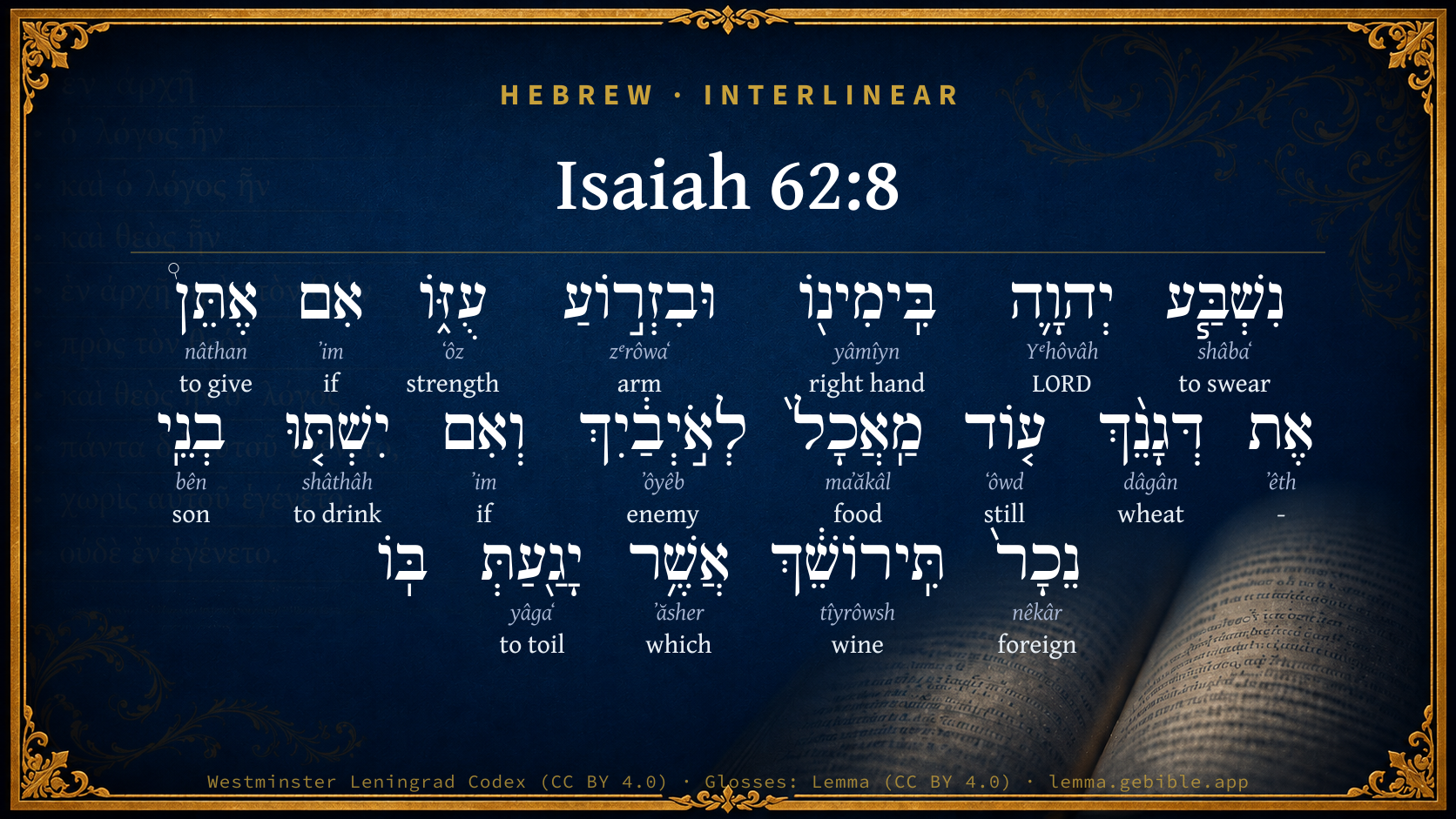
Hebrew (Westminster Leningrad Codex) Isaiah 62:8 appears in the Hebrew Old Testament. The text above is from the Westminster Leningrad Codex. Each word links to its Strong’s number, a concise gloss, and parsing drawn from the Open Scriptures Hebrew Bible morphology. Click any word for its full Brown-Driver-Briggs (BDB) entry.
Download image
Cite this verse

Isaiah 62:8 (World English Bible). Public Domain. Lemma interlinear Bible study tool, https://lemma.gebible.app/v/isaiah/62/8.

Show BibTeX & RIS
BibTeX
RIS
English Translation
Yahweh has sworn by his right hand, and by the arm of his strength, Surely I will no more give your grain to be food for your enemies; and foreigners shall not drink your new wine, for which you have labored:
World English Bible · Public Domain
Download a study sheet

One document with this verse’s original text, its word-by-word gloss line, the meaning frame, cross-references with their text, attributed commentary, and full source and license credits — printable, and it pastes into notes with its structure intact.

This verse Autodidact and up

Study sheet (.html) Plain text (.txt)

A passage Seminary Student

Up to 50 verses in one chapter. A passage sheet keeps up to 6 commentary sources and 12 cross-references per verse, in the order this page ranks them, and says so on the sheet whenever that leaves anything out. Ask for a single verse and you get the Autodidact verse sheet above.

Everything on this page stays free to read, with no account — the sheet is a download of what is already on screen, not access to it.

Want to remove ads? Support Godless Engineer
Compare translations 3

The same verse in 3 English versions, stacked beneath the original-language interlinear above. Click any original word for its lexicon entry.

Each is an independent rendering of the whole verse — the interlinear is not word-aligned to these translations.

Highlighted words mark where these versions differ — a whole-verse word diff, not a word-by-word alignment.

  • World English Bible Public Domain
    Yahweh has sworn by his right hand, and by the arm of his strength, Surely I will no more give your grain to be food for your enemies; and foreigners shall not drink your new wine, for which you have labored:
  • King James Version Public Domain
    The LORD hath sworn by his right hand, and by the arm of his strength, Surely I will no more give thy corn to be meat for thine enemies; and the sons of the stranger shall not drink thy wine, for the which thou hast laboured:
  • unfoldingWord Literal Text CC BY-SA 4.0
    Yahweh has sworn by his right hand and by the arm of his strength, “If I should give your grain anymore food to your enemies, and if the sons of foreignness should drink your new wine, for which you have labored!

unfoldingWord Literal Text — © unfoldingWord, licensed CC BY-SA 4.0. Word-aligned USFM3 via Door43 (git.door43.org/unfoldingWord/en_ult).

Versions to compare (up to 4)

3 of 4 selected

Show all 18 translations

Every available English version of this verse, each an independent rendering of the whole verse.

  • World English Bible Public Domain
    Yahweh has sworn by his right hand, and by the arm of his strength, Surely I will no more give your grain to be food for your enemies; and foreigners shall not drink your new wine, for which you have labored:
  • Berean Standard Bible Public Domain
    The LORD has sworn by His right hand and by His mighty arm: “Never again will I give your grain to your enemies for food, nor will foreigners drink the new wine for which you have toiled.
  • Majority Standard Bible Public Domain
    The LORD has sworn by His right hand and by His mighty arm: “Never again will I give your grain to your enemies for food, nor will foreigners drink the new wine for which you have toiled.
  • King James Version Public Domain
    The LORD hath sworn by his right hand, and by the arm of his strength, Surely I will no more give thy corn to be meat for thine enemies; and the sons of the stranger shall not drink thy wine, for the which thou hast laboured:
  • American Standard Version (1901) Public Domain
    Jehovah hath sworn by his right hand, and by the arm of his strength, Surely I will no more give thy grain to be food for thine enemies; and foreigners shall not drink thy new wine, for which thou hast labored:
  • Revised Version (1885) Public Domain
    The LORD hath sworn by his right hand, and by the arm of his strength, Surely I will no more give thy corn to be meat for thine enemies; and strangers shall not drink thy wine, for the which thou hast laboured:
  • Geneva Bible (1599) Public Domain
    The Lord hath sworne by his right hand and by his strong arme, Surely I wil no more giue thy corne to be meate for thine enemies, and surely the sonnes of the strangers shall not drinke thy wine, for the which thou hast laboured.
  • Douay-Rheims (1899) Public Domain
    The Lord hath sworn by his right hand, and by the arm of his strength: Surely I will no more give thy corn to be meat for thy enemies: and the sons of the strangers shall not drink thy wine, for which thou hast laboured.
  • Young's Literal Translation Public Domain
    Sworn hath Jehovah by His right hand, Even by the arm of His strength: `I give not thy corn any more `as' food for thine enemies, Nor do sons of a stranger drink thy new wine, For which thou hast laboured.
  • Literal Standard Version CC BY-SA 4.0
    YHWH has sworn by His right hand, || Even by the arm of His strength: “I do not give your grain anymore [as] food for your enemies, || Nor do sons of a stranger drink your new wine, || For which you have labored.
  • Unlocked Literal Bible CC BY-SA 4.0
    Yahweh has sworn by his right hand and by the arm of his strength, “Surely I will no longer give your grain as food for your enemies. Foreigners will not drink your new wine, for which you have worked.
  • unfoldingWord Literal Text CC BY-SA 4.0
    Yahweh has sworn by his right hand and by the arm of his strength, “If I should give your grain anymore food to your enemies, and if the sons of foreignness should drink your new wine, for which you have labored!
  • Darby Bible Public Domain
    Jehovah hath sworn by his right hand and by the arm of his strength, I will indeed no more give thy corn [to be] food for thine enemies; and the sons of the alien shall not drink thy new wine, for which thou hast laboured;
  • World Messianic Bible Public Domain
    The LORD has sworn by his right hand, and by the arm of his strength, “Surely I will no more give your grain to be food for your enemies, and foreigners will not drink your new wine, for which you have labored,
  • Webster's Bible Public Domain
    The LORD hath sworn by his right hand, and by the arm of his strength, Surely I will no more give thy corn to be food for thy enemies; and the sons of the stranger shall not drink thy wine, for which thou hast labored:
  • Free Bible Version CC BY-SA 4.0
    The Lord has made a solemn promise, swearing by his power and might: I won't ever again let your enemies have your grain to eat, or let foreigners drink the new wine you worked hard for.
  • Bible in Basic English Public Domain
    The Lord has taken an oath by his right hand, and by the arm of his strength, Truly, I will no longer give your grain to be food for your haters; and men of strange countries will not take the wine for which your work has been done:
  • JPS Tanakh (1917) Public Domain
    The LORD hath sworn by His right hand, and by the arm of His strength: Surely I will no more give thy corn to be food for thine enemies; and strangers shall not drink thy wine, for which thou hast laboured;

Literal Standard Version (2020), Covenant Press — licensed CC BY-SA 4.0. Text via the HelloAO Bible API (eBible.org). Unlocked Literal Bible (unfoldingWord) — licensed CC BY-SA 4.0. Text via the HelloAO Bible API (eBible.org). unfoldingWord Literal Text — © unfoldingWord, licensed CC BY-SA 4.0. Word-aligned USFM3 via Door43 (git.door43.org/unfoldingWord/en_ult). Free Bible Version, Dr. Jonathan Gallagher — licensed CC BY-SA 4.0. Text via the HelloAO Bible API (eBible.org).

Word by word

More ways to search: Search by grammar → Find every occurrence → Compare this word →

Practice this passage: Drill this verse → Learn its vocabulary →

יָגַ֖עַתְּ
yâgaʻ
H3021
“to toil”
Verb, Qal, Perfect, 2nd Person, Feminine, Singular
Part of Speech
Verb
Stem
Qal
Form
Perfect
Person
2nd Person
Gender
Feminine
Number
Singular
Full BDB Definition

Origin: a primitive root

TWOT: 842

to toil, labour, grow weary, be weary - (Qal) - to toil, labour - to grow weary, be weary - (Piel) to weary, make weary, cause to go toilsomely - (Hiphil) to make to toil, make weary, cause to be weary
  1. נִשְׁבַּ֧ע shâbaʻ H7650 “to swear” Verb, Niphal, Perfect, 3rd Person, Masculine, Singular
  2. יְהוָ֛ה Yᵉhôvâh H3068 “LORD” Noun, Proper
  3. בִּֽימִינ֖וֹ yâmîyn H3225 “in/at · right hand · his” Preposition + Noun, Common, Feminine, Singular, Construct + Suffix, Personal, 3rd Person, Masculine, Singular
  4. וּבִזְר֣וֹעַ zᵉrôwaʻ H2220 “and · in/at · arm of” Conjunction + Preposition + Noun, Common, Both, Singular, Construct
  5. עֻזּ֑וֹ ʻôz H5797 “strength · his” Noun, Common, Masculine, Singular, Construct + Suffix, Personal, 3rd Person, Masculine, Singular
  6. אִם ʼim H518 “if” Conjunction
  7. אֶתֵּן֩ nâthan H5414 “to give” Verb, Qal, Imperfect, 1st Person, Common, Singular
  8. אֶת ʼêth H853 “-” Particle, Direct Object
  9. דְּגָנֵ֨ךְ dâgân H1715 “wheat · your” Noun, Common, Masculine, Singular, Construct + Suffix, Personal, 2nd Person, Feminine, Singular
  10. ע֤וֹד ʻôwd H5750 “still” Adverb
  11. מַֽאֲכָל֙ maʼăkâl H3978 “food” Noun, Common, Masculine, Singular, Absolute
  12. לְאֹ֣יְבַ֔יִךְ ʼôyêb H341 “to/for · enemy · you” Preposition + Verb, Qal, Participle Active, Masculine, Plural, Construct + Suffix, Personal, 2nd Person, Feminine, Singular
  13. וְאִם ʼim H518 “and · if” Conjunction + Conjunction
  14. יִשְׁתּ֤וּ shâthâh H8354 “to drink” Verb, Qal, Imperfect, 3rd Person, Masculine, Plural
  15. בְנֵֽי bên H1121 “sons of” Noun, Common, Masculine, Plural, Construct
  16. נֵכָר֙ nêkâr H5236 “foreign” Noun, Common, Masculine, Singular, Absolute
  17. תִּֽירוֹשֵׁ֔ךְ tîyrôwsh H8492 “wine · your” Noun, Common, Masculine, Singular, Construct + Suffix, Personal, 2nd Person, Feminine, Singular
  18. אֲשֶׁ֥ר ʼăsher H834 “which” Particle, Relative

About this verse

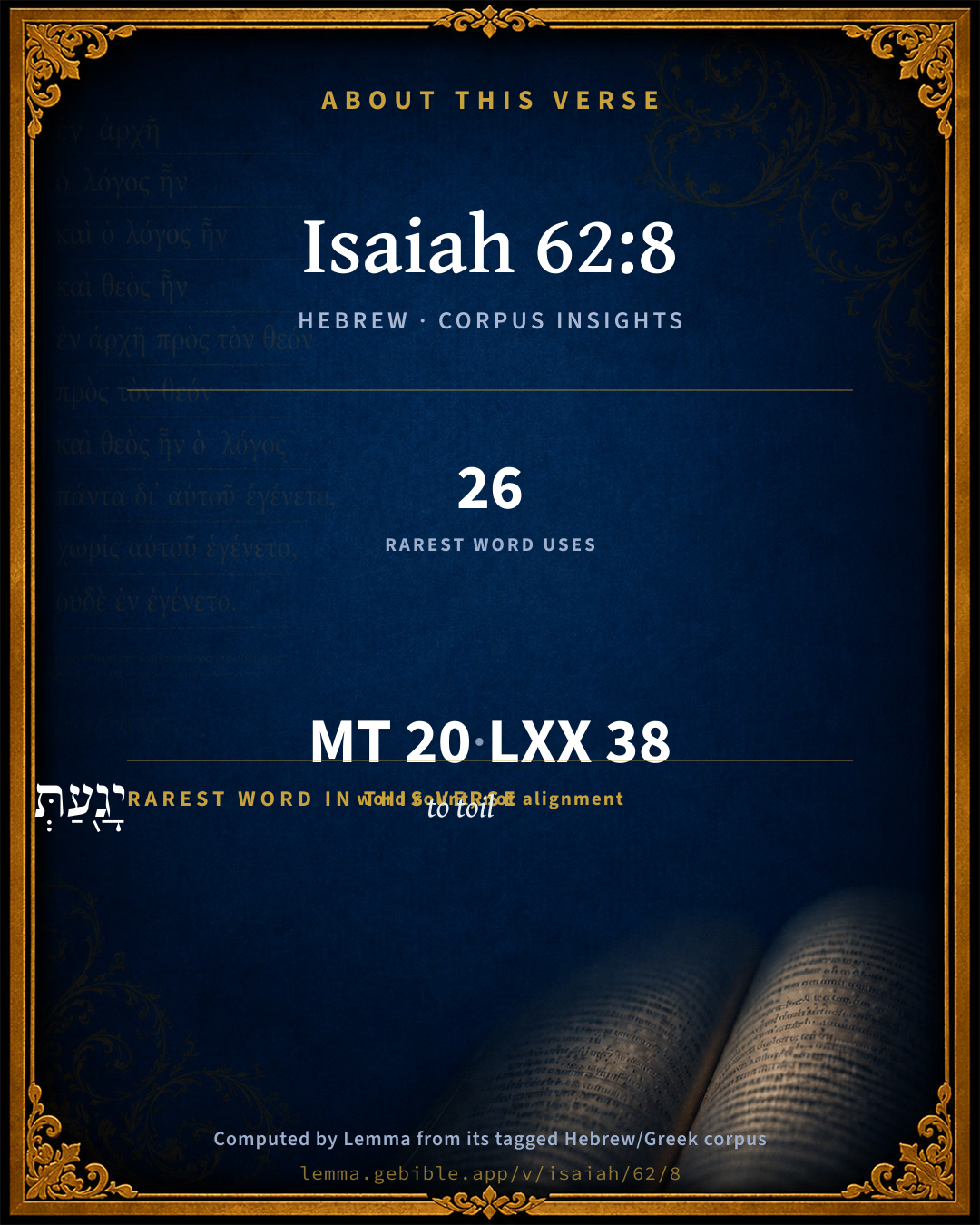
These counts appear in no published source. They are computed here, from the morphology-tagged text and Lemma’s own curated glosses. What Lemma adds →

20
words
18
distinct lemmas
Prophets
section

Shared distinctive vocabulary

יָגַ֖עַתְּ to toil H3021 occurs in 25 verses of the Hebrew Bible. Also found in:

Grammatical profile

  • 5 verbs
  • 9 nouns
  • 1 preposition
  • 2 conjunctions
  • 1 adverb
  • 2 particles

Verb forms

  • נִשְׁבַּ֧ע Niphal · Perfect
  • אֶתֵּן֩ Qal · Imperfect
  • לְאֹ֣יְבַ֔יִךְ Qal · Participle Active
  • יִשְׁתּ֤וּ Qal · Imperfect
  • יָגַ֖עַתְּ Qal · Perfect

Repetition

A word recurs within this verse — often emphatic in Hebrew:

  • אִם if H518 ×2

Hebrew & Septuagint length

In English translation the verse runs 41 words from the Hebrew and 41 from the Septuagint (LXX English) — the same length.

A rough comparison of the two English renderings, which tokenize alike — not a word-level alignment.

Word counts can differ between the Hebrew and the Greek without any difference in meaning — e.g. the Hebrew direct-object marker אֵת has no separate Greek word, and Greek often adds the article ὁ.

In the original languages it is 20 Hebrew tokens and 38 Greek tokens — but the two are counted differently (Hebrew bundles its prefixes and suffixes into one token; the Greek is in lemma form), so that isn’t a like-for-like length.

Cross-references

9

Topical passages linked to Isaiah 62:8 in the Treasury of Scripture Knowledge — connected by theme and wording, ordered by reader-vote popularity; previews shown in the World English Bible.

  • Isaiah 65:21–23 They shall build houses, and inhabit them; and they shall plant vineyards, and eat the fruit of them.
  • Judges 6:3–6 So it was, when Israel had sown, that the Midianites came up, and the Amalekites, and the children of the east; they came up against them;
  • Deuteronomy 28:33 The fruit of your ground, and all your labors, shall a nation which you don't know eat up; and you shall be only oppressed and crushed always;
  • Deuteronomy 28:31 Your ox shall be slain before your eyes, and you shall not eat of it: your donkey shall be violently taken away from before your face, and shall not be restored to you: your sheep shall be given to your enemies, and you shall have none to save you.
  • Ezekiel 20:5 and tell them, Thus says the Lord Yahweh: In the day when I chose Israel, and swore to the seed of the house of Jacob, and made myself known to them in the land of Egypt, when I swore to them, saying, I am Yahweh your God;
  • Leviticus 26:16 I also will do this to you: I will appoint terror over you, even consumption and fever, that shall consume the eyes, and make the soul to pine away; and you will sow your seed in vain, for your enemies will eat it.
  • Deuteronomy 32:40 For I lift up my hand to heaven, And say, As I live forever,
  • Isaiah 1:7 Your country is desolate. Your cities are burned with fire. Strangers devour your land in your presence, And it is desolate, As overthrown by strangers.
  • Jeremiah 5:17 They shall eat up your harvest, and your bread, [which] your sons and your daughters should eat; they shall eat up your flocks and your herds; they shall eat up your vines and your fig trees; they shall beat down your fortified cities, in which you trust, with the sword.

Cross-references courtesy of OpenBible.info (CC BY 4.0).

Hebrew and Greek witnesses Masoretic Hebrew ↔ Greek Septuagint

The same verse in the two great witnesses to the Old Testament, shown verse-for-verse.

These are two independent witnesses, not word-aligned to each other, and the Septuagint is shown in lemma (dictionary) form.

Hebrew Isaiah 62:8 Masoretic · Westminster Leningrad Codex

נִשְׁבַּ֧ע יְהוָ֛ה בִּֽימִינ֖וֹ וּבִזְר֣וֹעַ עֻזּ֑וֹ אִם אֶתֵּן֩ אֶת דְּגָנֵ֨ךְ ע֤וֹד מַֽאֲכָל֙ לְאֹ֣יְבַ֔יִךְ וְאִם יִשְׁתּ֤וּ בְנֵֽי נֵכָר֙ תִּֽירוֹשֵׁ֔ךְ אֲשֶׁ֥ר יָגַ֖עַתְּ בּֽוֹ

Yahweh has sworn by his right hand, and by the arm of his strength, Surely I will no more give your grain to be food for your enemies; and foreigners shall not drink your new wine, for which you have labored:

World English Bible · Public Domain

Greek LXX Isaiah 62:8 Septuagint · lemma form

ὄμνυμι κύριος κατά ὁ δεξιός αὐτός καί κατά ὁ ἰσχύς ὁ βραχίων αὐτός εἰ ἔτι δίδωμι ὁ σῖτος σύ καί ὁ βρῶμα σύ ὁ ἐχθρός σύ καί εἰ ἔτι πίνω υἱός ἀλλότριος ὁ οἶνος σύ ἐπί ὅς μοχθέω

For the Lord has sworn by his glory, and by the might of his arm, I will no more give your corn and your provisions to your enemies; nor shall strangers any more drink your wine, for which you have laboured.

LXX2012 (modern English Septuagint) · Public Domain

Hebrew: Westminster Leningrad Codex (CC BY 4.0). Greek: Septuagint (public domain); English from LXX2012 (modern English Septuagint) (Public Domain). How the Septuagint differs from the Hebrew →

Targum (Aramaic paraphrase)

1

The Targum is the ancient Jewish Aramaic paraphrase of the Hebrew Scriptures — an interpretive translation, not the Hebrew text itself. Onkelos (literal) and Pseudo-Jonathan (expansive) render the Torah, and Jonathan the Prophets. Coverage is partial: where no permissively-licensed English translation exists for a verse, only the Aramaic is shown. This is verse-level text, not a word-by-word alignment to the Hebrew.

  1. Targum Jonathan Prophets (Joshua–Malachi)
    קַיָם יְיָ בִּימִינֵהּ וּבִדְרַע תּוּקְפֵהּ אִם אֶתֵּן יַת עִבּוּרִיךְ עוֹד מֵיכַל לְבַעֲלֵי דְבָבֵיךְ וְאִם יִשְׁתּוּן בְּנֵי עַמְמַיָא חַמְרִיךְ דִלְאֵית בֵּיהּ:

    The Lord hath sworn by His right hand, and by the arm of His strength, I will no more give thy corn to be food for thy enemies; and the sons of the Gentiles shall not drink thy wine, for the which thou hast laboured.

    Targum Jonathan — Aramaic: “Mikraot Gedolot” (public domain). English: “Sefaria Community Translation” (CC0 1.0 (public-domain dedication)); “London "Chaldee Paraphrase," 1871” (public domain). Text via Sefaria.

Commentary

Notes on Isaiah 62:8 from classic Christian and Jewish commentators (each source and its license shown beneath its notes). The classic Christian expositions comment on the surrounding passage and are grouped to its opening verse, so a note may address several verses; the Jewish commentaries on the Tanakh (Rashi and others) are per-verse, so they appear only where the commentator wrote on this verse.

Lemma curates 59 commentaries, every one of them public domain or Creative Commons licensed, each selected and text-cleaned for this edition rather than reprinted as found. About our sources →

Trapp's Complete Commentary

John Trapp

Isa 62:8 The LORD hath sworn by his right hand, and by the arm of his strength, Surely I will no more give thy corn [to be] meat for thine enemies; and the sons of the stranger shall not drink thy wine, for the which thou hast laboured:

Ver. 8. The Lord hath sworn by his right hand,] i.e., By his almighty power, or, as Oecolampadius holdeth, by his Son, "by whom he made the world," and "upholdeth all things." {Heb 1:2-3}

Surely, I will no more give thy corn to be meat for thine enemies.] Or, If I do, yet I will give you to "suffer with joy the spoiling of your goods, as knowing in yourselves that ye have in heaven a better and an enduring substance." {Heb 10:34} Spiritual security and safety, from the devil and all the enemies of our souls, is also signified by this similitude of protection against corporal enemies and plunderers, saith Piscator.

John Trapp, A Commentary or Exposition upon All the Books of the Old and New Testament (1647–1656) — public domain. Text from a community e-Sword module.

Joseph Benson's Commentary

Isa 62:8-9. The Lord hath sworn by his right hand — “Lifting up the hand was a ceremony used in swearing, Deu 32:40; Eze 20:5; Eze 20:15. And here God swears by that very hand which used to be held up at the taking of an oath; that is, he swears by his power and might, as it follows, that the enemies of his people should not interrupt that peace and plenty which he should give them, but that they should quietly enjoy his blessings with hearts full of thankfulness for them. This must relate to some happier condition than the Jews enjoyed after their return from captivity, when their enemies frequently invaded them, and, at last, the Romans destroyed both their temple and nation.” — Lowth. The passage is undoubtedly metaphorical; and is to be understood of the free and undisturbed enjoyment of the spiritual blessings of religion, which God will grant the Christian Church in the latter days: and “the oath which ushers in this promise proves that it will be exactly and punctually performed.” See Joe 2:24; and Joe 3:18; Jer 31:12; Zec 9:17. The expressions in the next verse, particularly in the latter part of it, allude to the ordinances of the law, which required the people to spend their first-fruits, and other hallowed things, at the temple, in a thankful acknowledgment to God for his blessings, Deu 12:11; and Deu 14:23; Deu 14:26.

Joseph Benson's Commentary on the Old and New Testaments (1811–1818) — public domain. Text from a community e-Sword module.

Tyndale Open Study Notes

Tyndale Open Resources

62:8 The Lord swore an oath just as he did when he had sworn an oath to Noah (Gen 8:20–9:17), to Abraham (Gen 22:16; see also Luke 1:73; Heb 6:13), and to David (Ps 89:3). • I will never again hand you over: In order to punish and purge a remnant from his people, God had intentionally brought in the Assyrians and Babylonians to decimate them (see Isa 6:12-13). He would never do this again.

Tyndale Open Study Notes — © Tyndale Open Resources, licensed CC BY-SA 4.0. Text via the HelloAO Bible API.

Jamieson, Fausset & Brown

Robert Jamieson, A. R. Fausset & David Brown

sworn by . . . right hand--His mighty instrument of accomplishing His will (compare Isa 45:23; Heb 6:13).

sons of . . . stranger--Foreigners shall no more rob thee of the fruit of thy labors (compare Isa 65:21-22).

Jamieson, Fausset & Brown — Commentary Critical and Explanatory on the Whole Bible (1871) — public domain (CC PDM 1.0). Text via the HelloAO Bible API.

Ellicott's Commentary for English Readers

(8) The Lord hath sworn . . .—The principle of the Epistle to the Hebrews (Heb_6:13) is recognised here. Jehovah can swear by nothing less than that which is the symbol of His own greatness, identified with Himself.

I will no more give thy corn . . .—The words throw us back upon the early history of Israel, subject at any time to the desolating attacks of Midianites (Jdg_6:4; Jdg_6:11), Assyrians (Isa_16:9), and Philistines (2Ch_28:18). The new blessing stands in special contrast with the curse of Deu_28:33; Deu_28:51.

A Bible Commentary for English Readers, edited by Charles John Ellicott (1878–1897) — public domain. Text from a community e-Sword module.

The Cambridge Bible for Schools and Colleges

gen. ed. J. J. S. Perowne

8. The Lord hath sworn by his right hand &c.] i.e. so surely as He has the power to help. Cf. ch. Isa_45:23, Isa_54:9.

the sons of the stranger] R.V. strangers.

thy wine] Lit. “new wine,” must.

8, 9. Jehovah has sworn that the Israelites shall no longer be spoiled by their enemies, but shall be secured in the peaceful enjoyment of the fruits of the ground. The phrase “no longer” seems to imply that at the time of writing the community was exposed to the depredations of its hostile neighbours. This would be an additional indication of post-exilic authorship, which is confirmed by the mention of the Temple courts in the end of Isa_62:9.

The Cambridge Bible for Schools and Colleges (gen. ed. J. J. S. Perowne; Cambridge University Press, 1878–1918) — public domain. Text from a community e-Sword module.

John Gill's Exposition

The Lord hath sworn by his right hand, and by the arm of his strength,.... By Christ, say some, who is the arm of the Lord, the power of God, by whom he made the world, and upholds all things; but though he sometimes is said to swear unto him, and concerning him, yet is never said to swear by him; rather the attribute of omnipotence is here designed; as God is sometimes said to swear by his holiness, so here by his almighty power; the consideration of which itself is a great encouragement to faith, to believe the fulfilment of promises, because God is able; but his swearing by it is a further confirmation of it; it is as if he had said, let me not be thought to be the omnipotent God I am, if I do not do so and so; or as sure as I have such a right hand, and arm of strength, what follows shall certainly be accomplished:

surely I will no more give thy corn to be meat for thine enemies; and the sons of the strangers shall not drink thy wine, for the which thou hast laboured: this was threatened to the people of Israel, in case of sinning against God, and revolting from him; and was accomplished in the times of their captivity in Babylon, Deu 28:33 but here it is promised, and the strongest assurance given, it should be so no more; which cannot respect the deliverance of the Jews from the Babylonish captivity; for it is certain that after that their enemies did eat their corn, and drink their wine; the Romans came and took away their city and nation, as they feared, and all their good things; wherefore this must refer to future times, to times yet to come, when this people, being converted, shall be restored to their own land, and enjoy great plenty of good things, and never more be disturbed by their enemies: though all this may be understood in a spiritual sense of the "corn" and "wine" of the Gospel, and the ministration of it; which was first provided for them, and they were invited to partake of it; and in preparing which the apostles and first ministers of the word, being Jews, "laboured"; but they rejecting it, it was carried to the Gentiles, who had been their "enemies", and were "aliens" from the commonwealth of Israel, which they gladly received and fed upon; but now it is promised, that the Gospel, being again brought unto them, should no more be taken from them, but ever continue with them; even all the means of grace, and ordinances of the Gospel, for the comfort and refreshment of their souls.

John Gill's Exposition of the Whole Bible (1746–1763) — public domain (CC PDM 1.0). Text via the HelloAO Bible API.

Albert Barnes' Notes on the Bible

The Lord hath sworn by his right hand - An oath was taken in various forms among the ancients. It was usually done by lifting up the hand toward beaten and appealing to God. As God could swear by no greater Heb 6:13, he is represented as swearing by himself (see the notes at Isa 45:23). Here he is represented as swearing by his right hand and by his arm - the strong instrument by which he would accomplish his purposes to defend and save his people. The sense is, that he solemnly pledged the strength of his arm to deliver them, and restore them to their own land.

Surely I will no more give - Margin, as in Hebrew, ‘If I give.’ That is, I will not give.

Thy corn to be meat - The word ‘corn’ in the Scriptures means all kinds of grain - especially wheat, barley, etc. The word ‘meat’ was formerly used to denote all kinds of food, and was not restricted as it is now usually to animal food. The meaning is, that they should not be subjected to the evils of foreign invasion and conquest.

And the sons of the stranger - Foreigners, Isa 60:10.

Shall not drink thy wine - The productions of your toil shall be safe, and you shall enjoy them yourselves. All this denotes a state of safety and prosperity, such as there would be if they were allowed to cultivate the soil without interruption, and were permitted to enjoy the fruit of their labors.

Albert Barnes' Notes on the Bible (1834–1885) — public domain. Text from a community e-Sword/MySword module.

Haydock's Catholic Bible Commentary

Hand; inviolably, Deuteronomy xxxii. 40. The Persians deemed this oath most sacred. (Calmet) --- Darius just expiring, said to Polycrates, "By thee I give this right hand to Alexander," (Plut.[Plutarch?]) that he may revenge my death. --- Wine. The Church cannot be deprived of her faith or of her God.

George Leo Haydock (1774–1849), Haydock's Catholic Family Bible and Commentary, 1859 edition — public domain. Excludes Psalms (Douay-Rheims chapter numbering differs from Protestant) and Deuterocanonical books (Catholic canon only).

Matthew Poole's English Annotations

This and the next verse are much to the same purpose, wherein the prophet, to encourage them to their industrious endeavours, tells them that the Lord had

sworn to see to the prosperity of Jerusalem; and he names the

hand, to signify his faithfulness, as the giving of our hand notes our fidelity; and arm, to signify his power,

the arm of his strength, i.e. his strong arm: these being eminently to be engaged and put forth for his people, he swears by them.

Surely I will no more give; or, If I give; a usual aposiopesis; an abrupt form of swearing, implying something of an imprecation, as great as can be expressed: q.d. Never account me faithful or almighty, if I accomplish not this.

The sons of the stranger: see Isa 61:5.

Shall not drink thy wine, for the which thou hast laboured: the meaning is, That meat, and drink, and all necessaries that thou hast laboured for, the Babylonians took away from thee; but now it shall be so no more, he will not give thee up to the will of thine enemies.

Matthew Poole's English Annotations on the Holy Bible (1683–1685) — public domain. Text from a community e-Sword/MySword module.

Whedon's Commentary on the Bible

Daniel D. Whedon

8, 9. Sworn by… hand… arm — Possibly in answer to the foregoing provided-for intercessions, Jehovah swears by “hand” and “arm” — symbols of strength — pledging infinite power to fulfil his promise.

Possibly this wrought an effect which may be paraphrased as follows: “As I am the eternal Jehovah, I never more will suffer Zion’s enemies, near or far, home or foreign, within or without, to plunder or cut off her supplies of corn and wine, both of which herself alone shall forever enjoy in the spirit of praise… in the courts of my holiness.” Enemies, abroad or near at hand, may here represent Zion’s moral foes or hinderances, within or without; and “corn” and “wine” are symbols of abounding spiritual sustenance and joy.

Daniel D. Whedon (gen. ed.), Commentary on the Old and New Testaments (1874–1909) — public domain. Text from a community e-Sword module.

The Pulpit Commentary

The Lord hath sworn. In answer to the representations of the "remembrancers," God solemnly binds himself by an oath to come to the relief of the people, to restore them to their own land, and to give them the enjoyment of its fruits in peace. By his right hand. God commonly swears "by himself", (Gen_22:16 Isa_45:23 Jer_49:13 Amo_6:5) or "by his holiness". (Psa_89:35 Amo_4:2) Once he swears "by his great Name", (Jer_44:26) and once "by the excellency of Jacob". (Amo_8:7) There is no other place in Scripture where he swears "by his right hand and arm emblems of his power to act. Thy corn... thy wine; i.e. the fruits of thy land. Hitherto, even when Israel was in possession of Palestine, its fruits were constantly destroyed, or carried off, by the raids of hostile neighbours. Henceforth this plundering should cease.

Vers. 8, 9. The value of security, etc.

The principal lesson here is the inestimable advantage of national independence and consequent individual security. But other lessons also stand out from the passage, viz.

I THE REALITY OF NATIONAL RESPONSIBILITY. It is very clearly implied that Israel had suffered grievously in the past as a nation, because of God"s wrath. She had sinned and had been condemned, and she had paid the penalty of suffering from a cruel and rapacious invasion; so that her citizens ate not of the corn they had sown, and drank not of the wine they had planted. God makes nations as well as individuals to pay due penalty for their transgressions. Hence we have

II THE INDIVIDUAL OBLIGATION which this fact entails. It is impossible for any man to sever himself from the community of which he is a member; he is not at liberty to leave the national course, to be decided by other men, while he gives himself up to more congenial labours. No man can divest himself of his responsibilities as a citizen of his country; every man is bound to exert his influence on behalf of liberty, righteousness, peace, virtue, godliness.

III THE VALUE OF SECURITY. If it be uncertain whether men will reap what they sow, if it is probable that strangers will partake of the fruit of men"s toil, there will be a constantly and powerfully disturbing force at work. But security will promote:

1. Order and good government.

2. Industry occupation, enterprise, the useful arts.

3. Benevolence the origination and growth of philanthropic institutions.

4. Piety the erection of sacred structures and the establishment of religious organizations.

1. Let the prosperity which is the fruit of security be consecrated by gratitude and benevolence. "Eat and praise the Lord," bring the wine "into the courts or his holiness." Beware of a selfish and complacent spirit, (see Deu_6:12) and cultivate carefully and devoutly a spirit of gratitude toward God and kindness toward man.

2. Appreciate at its full worth and give God thanks for the national security which is enjoyed. It is not one of the smaller mercies we have received at his hand that we have no fear of being displaced by any "stranger," that we are so secure of the fruits of our toil. This sense of safety and stability has contributed largely to the resources at our command, and is adding incalculably to the best movements and measures of our time.

3. Rejoice in and bless God for the fact that even though we may not reap all that we sow here, there is a future in which the workman shall be amply and gloriously rewarded. C. (Psa_126:6 1Co_15:58)

The Pulpit Commentary (1880–1919), ed. H.D.M. Spence-Jones & Joseph S. Exell — public domain. Text from a community e-Sword module.

Keil & Delitzsch

C. F. Keil & F. Delitzsch

The following strophe expresses one side of the divine promise, on which the hope of that lofty and universally acknowledged glory of Jerusalem, for whose completion the watchers upon its walls so ceaselessly exert themselves, is founded. "Jehovah hath sworn by His right hand, and by His powerful arm, Surely I no more give thy corn for food to thine enemies; and foreigners will to drink thy must, for which thou hast laboured hard. No, they that gather it in shall eat it, and praise Jehovah; and they that store it, shall drink it in the courts of my sanctuary." The church will no more succumb to the tyranny of a worldly power. Peace undisturbed, and unrestricted freedom, reign there. With praise to Jehovah are the fruits of the land enjoyed by those who raised and reaped them. יגעתּ (with an auxiliary pathach, as in Isa 47:12, Isa 47:15) is applied to the cultivation of the soil, and includes the service of the heathen who are incorporated in Israel (Isa 61:5); whilst אסּף (whence מאספיו with ס raphatum) or אסף (poel, whence the reading מאספיו, cf., Psa 101:5, meloshnı̄; Psa 109:10, ve-dorshū, for which in some codd. and editions we find מאספיו, an intermediate form between piel and poel; see at Psa 62:4) and קבּץ stand in the same relation to one another as condere (horreo) and colligere (cf., Isa 11:12). The expression bechatsrōth qodshı̄, in the courts of my sanctuary, cannot imply that the produce of the harvest will never be consumed anywhere else than there (which is inconceivable), but only that their enjoyment of the harvest-produce will be consecrated by festal meals of worship, with an allusion to the legal regulation that two-tenths (ma‛ăsēr shēnı̄) should be eaten in a holy place (liphnē Jehovah) by the original possessor and his family, with the addition of the Levites and the poor (Deu 14:22-27 : see Saalschtz, Mosaisches Recht, cap. 42). Such thoughts, as that all Israel will then be a priestly nation, or that all Jerusalem will be holy, are not implied in this promise. All that it affirms is, that the enjoyment of the harvest-blessing will continue henceforth undisturbed, and be accompanied with the grateful worship of the giver, and therefore, because sanctified by thanksgiving, will become an act of worship in itself. This is what Jehovah has sworn "by His right hand," which He only lifts up with truth, and "by His powerful arm," which carries out what it promises without the possibility of resistance. The Talmud (b. Nazir 3b) understand by עזו זרוע the left arm, after Dan 12:7; but the ו of ובזרוע is epexegetical.

Keil & Delitzsch — Biblical Commentary on the Old Testament (1861–1891) — public domain (CC PDM 1.0). Text via the HelloAO Bible API. (Old Testament only.)

J. A. Alexander on Isaiah

Joseph Addison Alexander

“Sworn hath Jehovah by His right hand and by His arm of strength, If I give thy corn any more as food to thine enemies, and if the sons of the out-land shall drink thy new wine which thou hast labored in, (I am not God).” On the elliptical formula of swearing, see above, on Isa 22:14. The declaration though conditional in form is in fact an absolute negation. In swearing by His hand and arm, the usual symbols of strength, He pledges His omnipotence for the fulfillment of the promise. ‘As sure as I am almighty, thou shalt suffer this no more.’

Joseph Addison Alexander, The Prophecies of Isaiah (1846–1847; New York: Scribner, 1870–1878) — public domain. Text from a community e-Sword module.

unfoldingWord translationNotes

Door43 World Missions Community

by his right hand and by the arm of his strength

The right hand and arm represent power and authority. AT: "by his power and authority" (See: Metonymy)

Surely I will no longer give your grain as food for your enemies

This means Yahweh will not let enemies conquer the people of Israel and take their grain anymore. Perhaps enemies took the grain in the past as a tax or to feed their own armies.

I will no longer give your grain as food for your enemies ... Foreigners will not drink your new wine

These statements are set together for emphasis and completion. (See: Parallelism)

those who harvest the grain ... those who pick the grapes

These statements are set together for emphasis and completion. (See: Parallelism)

translationWords

right hand

grain

alien

wine

works

harvest

praise

grape

holy

sanctuary

unfoldingWord translationNotes — © Distant Shores Media and the Door43 World Missions Community, licensed CC BY-SA 4.0. Source: git.door43.org/Door43/en_tn.

Ibn Ezra

Rabbi Abraham ibn Ezra

The Lord hath sworn, etc. This verse also proves clearly, that this prophecy refers to the time yet to come; for the Lord hath sworn, that is, has made an unconditional decree. By His right hand. By His might, which is everlasting. The right hand is mentioned here to indicate His power of preventing enemies despoiling the Israelites of their corn, etc.

Ibn Ezra on the Tanakh — English translations: “Sefaria Community Translation” (CC0 1.0 (public-domain dedication)); “Yalkut, Sifsei Chachomim Chumash, Metsudah Publications, 2009” (CC BY 4.0); and “Commentary of Ibn Ezra on Isaiah - trans. by M. Friedlander, 1873” (public domain). Text via Sefaria.

Lesson kit

Teaching starters — assembled from the data on this page, not authored interpretation. Every prompt links to the verse data it draws on. Edit before teaching.

Isaiah, in the Prophets, opens this verse with 20 words (18 distinct Hebrew lemmas). Its most distinctive word is yâgaʻ (“to toil”). A historical commentator’s framing appears above. Read the whole chapter for the surrounding context.

Discussion questions

  1. How does “to toil” (yâgaʻ) shape what this verse is saying?
  2. How does Joshua 7:3, which shares the word «to toil», read alongside this verse?
  3. What does the repetition of “if” (2× in this one verse) do in this verse?
  4. These translations render this verse differently; the difference is in the English rendering, not the original. What questions does that raise?
  5. «נִשְׁבַּ֧ע» is a Niphal Perfect verb. How does that grammatical form shape the action described?
  6. Compare how Trapp's Complete Commentary and Joseph Benson's Commentary read this verse. Where do they agree or differ?

Things to notice

Reading settings

Reading text

Shown beneath each verse's original-language words.

Old Testament
Old Testament edition

Read the OT as the Masoretic Hebrew (MT) or the Greek Septuagint (LXX).

English shown for the Greek Septuagint (in the Hebrew ↔ Greek comparison).

Comparing translations? Open the Compare panel on any verse page to stack up to four side by side.