
1 Chronicles 14:11

Hebrew (Westminster Leningrad Codex) 1 Chronicles 14:11 appears in the Hebrew Old Testament. The text above is from the Westminster Leningrad Codex. Each word links to its Strong’s number, a concise gloss, and parsing drawn from the Open Scriptures Hebrew Bible morphology. Click any word for its full Brown-Driver-Briggs (BDB) entry.
Download image
Cite this verse

1 Chronicles 14:11 (World English Bible). Public Domain. Lemma interlinear Bible study tool, https://lemma.gebible.app/v/1-chronicles/14/11.

Show BibTeX & RIS
BibTeX
RIS
English Translation
So they came up to Baal Perazim, and David struck them there; and David said, God has broken my enemies by my hand, like the breach of waters. Therefore they called the name of that place Baal Perazim.
World English Bible · Public Domain
Download a study sheet

One document with this verse’s original text, its word-by-word gloss line, the meaning frame, cross-references with their text, attributed commentary, and full source and license credits — printable, and it pastes into notes with its structure intact.

This verse Autodidact and up

Study sheet (.html) Plain text (.txt)

A passage Seminary Student

Up to 50 verses in one chapter. A passage sheet keeps up to 6 commentary sources and 12 cross-references per verse, in the order this page ranks them, and says so on the sheet whenever that leaves anything out. Ask for a single verse and you get the Autodidact verse sheet above.

Everything on this page stays free to read, with no account — the sheet is a download of what is already on screen, not access to it.

Want to remove ads? Support Godless Engineer
Compare translations 3

The same verse in 3 English versions, stacked beneath the original-language interlinear above. Click any original word for its lexicon entry.

Each is an independent rendering of the whole verse — the interlinear is not word-aligned to these translations.

Highlighted words mark where these versions differ — a whole-verse word diff, not a word-by-word alignment.

  • World English Bible Public Domain
    So they came up to Baal Perazim, and David struck them there; and David said, God has broken my enemies by my hand, like the breach of waters. Therefore they called the name of that place Baal Perazim.
  • King James Version Public Domain
    So they came up to Baalperazim; and David smote them there. Then David said, God hath broken in upon mine enemies by mine hand like the breaking forth of waters: therefore they called the name of that place Baalperazim.
  • unfoldingWord Literal Text CC BY-SA 4.0
    And they went up Baal Perazim, and David struck them there. And David said, “God has broken through my enemies by my hand like the breaking through of waters.” Therefore they call the name of that place Baal Perazim.

unfoldingWord Literal Text — © unfoldingWord, licensed CC BY-SA 4.0. Word-aligned USFM3 via Door43 (git.door43.org/unfoldingWord/en_ult).

Versions to compare (up to 4)

3 of 4 selected

Show all 18 translations

Every available English version of this verse, each an independent rendering of the whole verse.

  • World English Bible Public Domain
    So they came up to Baal Perazim, and David struck them there; and David said, God has broken my enemies by my hand, like the breach of waters. Therefore they called the name of that place Baal Perazim.
  • Berean Standard Bible Public Domain
    So David and his men went up to Baal-perazim, where he defeated the Philistines and said, “Like a bursting flood, God has burst out against my enemies by my hand.” So they called that place Baal-perazim.
  • Majority Standard Bible Public Domain
    So David and his men went up to Baal-perazim, where he defeated the Philistines and said, “Like a bursting flood, God has burst out against my enemies by my hand.” So they called that place Baal-perazim.
  • King James Version Public Domain
    So they came up to Baalperazim; and David smote them there. Then David said, God hath broken in upon mine enemies by mine hand like the breaking forth of waters: therefore they called the name of that place Baalperazim.
  • American Standard Version (1901) Public Domain
    So they came up to Baal-perazim, and David smote them there; and David said, God hath broken mine enemies by my hand, like the breach of waters. Therefore they called the name of that place Baal-perazim.
  • Revised Version (1885) Public Domain
    So they came up to Baal-perazim, and David smote them there; and David said, God hath broken mine enemies by mine hand, like the breach of waters. Therefore they called the name of that place Baal-perazim.
  • Geneva Bible (1599) Public Domain
    So they came vp to Baal-perazim, and Dauid smote them there: and Dauid said, God hath deuided mine enemies with mine hande, as waters are deuided: therefore they called the name of that place, Baal-perazim.
  • Douay-Rheims (1899) Public Domain
    And when they were come to Baalpharasim, David defeated them there, and he said: God hath divided my enemies by my hand, as waters are divided: and therefore the name of that place was called Baalpharasim.
  • Young's Literal Translation Public Domain
    And they go up into Baal-Perazim, and David smiteth them there, and David saith, `God hath broken up mine enemies by my hand, like the breaking up of waters;' therefore they have called the name of that place Baal-Perazim.
  • Literal Standard Version CC BY-SA 4.0
    And they go up into Ba‘al-Perazim, and David strikes them there, and David says, “God has broken up my enemies by my hand, like the breaking up of waters”; therefore they have called the name of that place Ba‘al-Perazim.
  • Unlocked Literal Bible CC BY-SA 4.0
    So they came up to Baal Perazim, and there he defeated them. He commented, “God has burst through my enemies by my hand like a bursting flood of water.” So the name of that place became Baal Perazim.
  • unfoldingWord Literal Text CC BY-SA 4.0
    And they went up Baal Perazim, and David struck them there. And David said, “God has broken through my enemies by my hand like the breaking through of waters.” Therefore they call the name of that place Baal Perazim.
  • Darby Bible Public Domain
    And they came up to Baal-perazim, and David smote them there; and David said, God has broken in upon mine enemies by my hand, as the breaking forth of waters. Therefore they called the name of that place Baal-perazim.
  • World Messianic Bible Public Domain
    So they came up to Baal Perazim, and David defeated them there. David said, God has broken my enemies by my hand, like waters breaking out. Therefore they called the name of that place Baal Perazim.
  • Webster's Bible Public Domain
    So they came up to Baal-perazim; and David smote them there. Then David said, God hath broken in upon my enemies by my hand like the breaking forth of waters: therefore they called the name of that place Baal-perazim.
  • Free Bible Version CC BY-SA 4.0
    So David attacked and defeated them there at Baal-perazim. “God used me to defeat my enemies like a torrent of water that bursts out,” he declared. That's why the place was named Baal-perazim.
  • Bible in Basic English Public Domain
    So they went up to Baal-perazim, and David overcame them there, and David said, God has let the forces fighting against me be broken by my hand, as a wall is broken down by rushing water; so they gave that place the name of Baal-perazim.
  • JPS Tanakh (1917) Public Domain
    So they came up to Baal-perazim, and David smote them there; and David said: 'God hath broken mine enemies by my hand, like the breach of waters.' Therefore they called the name of that place Baal-perazim.

Literal Standard Version (2020), Covenant Press — licensed CC BY-SA 4.0. Text via the HelloAO Bible API (eBible.org). Unlocked Literal Bible (unfoldingWord) — licensed CC BY-SA 4.0. Text via the HelloAO Bible API (eBible.org). unfoldingWord Literal Text — © unfoldingWord, licensed CC BY-SA 4.0. Word-aligned USFM3 via Door43 (git.door43.org/unfoldingWord/en_ult). Free Bible Version, Dr. Jonathan Gallagher — licensed CC BY-SA 4.0. Text via the HelloAO Bible API (eBible.org).

Word by word

More ways to search: Search by grammar → Find every occurrence → Compare this word →

Practice this passage: Drill this verse → Learn its vocabulary →

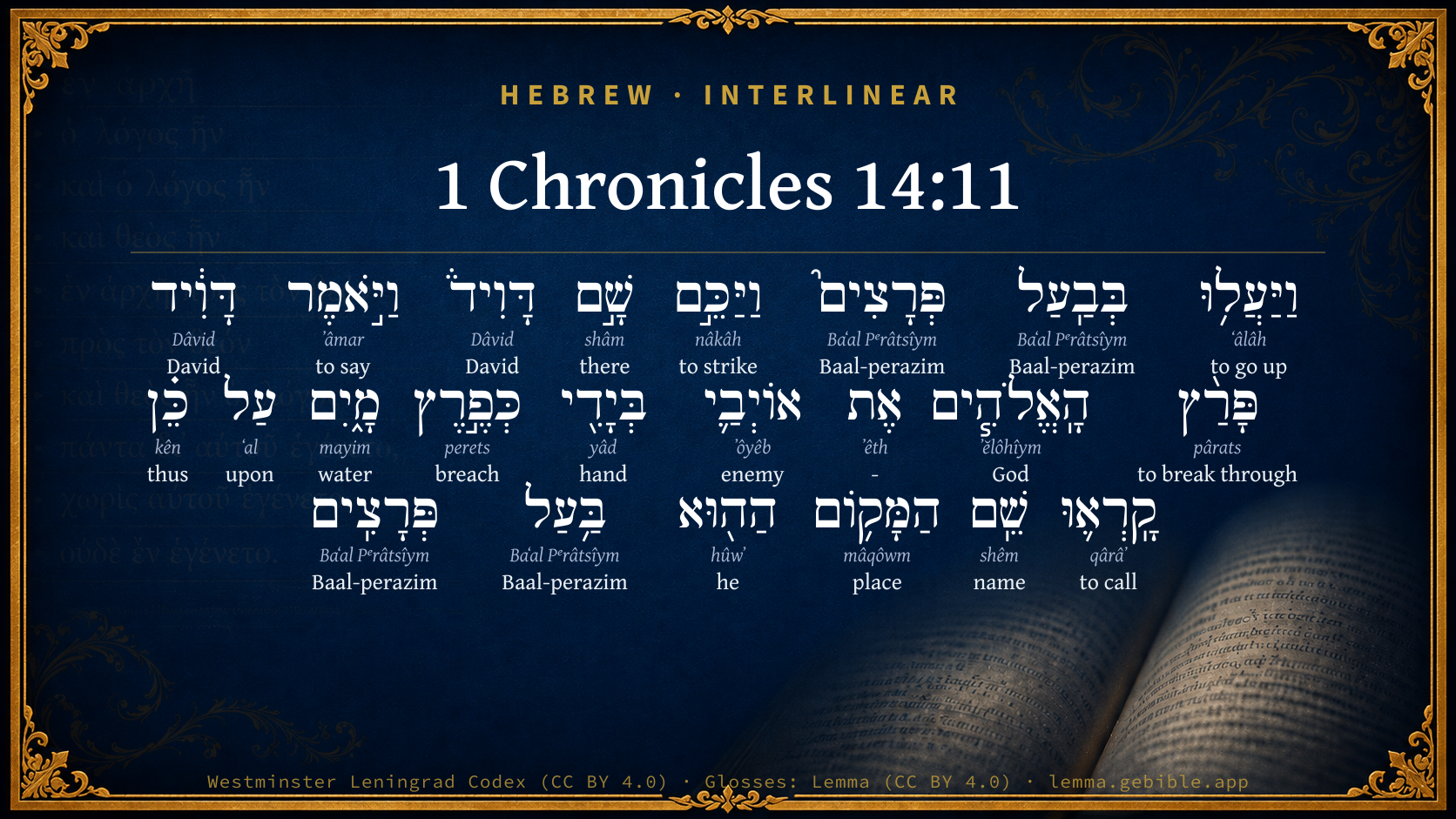
בְּבַֽעַל
Baʻal Pᵉrâtsîym
H1188
“in/at · Baal-perazim”
Preposition + Noun, Proper
Part of Speech
Preposition + Noun
Type
Proper
Full BDB Definition

Origin: from H1167 and the pl. of H6556

TWOT: None

Baal-perazim = "lord of the breaks" - the site of a victory of David over the Philistines, and of a great destruction of their images; also called 'Mount Perazim'
  1. וַיַּעֲל֥וּ ʻâlâh H5927 “and · to go up” Conjunction + Verb, Qal, Sequential Imperfect, 3rd Person, Masculine, Plural
  2. פְּרָצִים֮ Baʻal Pᵉrâtsîym H1188 “Baal-perazim” Noun, Proper
  3. וַיַּכֵּ֣ם nâkâh H5221 “and · to strike · them” Conjunction + Verb, Hiphil, Sequential Imperfect, 3rd Person, Masculine, Singular + Suffix, Personal, 3rd Person, Masculine, Plural
  4. שָׁ֣ם shâm H8033 “there” Adverb
  5. דָּוִיד֒ Dâvid H1732 “David” Noun, Proper
  6. וַיֹּ֣אמֶר ʼâmar H559 “and · to say” Conjunction + Verb, Qal, Sequential Imperfect, 3rd Person, Masculine, Singular
  7. דָּוִ֔יד Dâvid H1732 “David” Noun, Proper
  8. פָּרַ֨ץ pârats H6555 “to break through” Verb, Qal, Perfect, 3rd Person, Masculine, Singular
  9. הָֽאֱלֹהִ֧ים ʼĕlôhîym H430 “the · God(s)” Particle, Definite Article + Noun, Common, Masculine, Plural, Absolute
  10. אֶת ʼêth H853 “-” Particle, Direct Object
  11. אוֹיְבַ֛י ʼôyêb H341 “enemy · me” Verb, Qal, Participle Active, Masculine, Plural, Construct + Suffix, Personal, 1st Person, Common, Singular
  12. בְּיָדִ֖י yâd H3027 “in/at · hand · my” Preposition + Noun, Common, Both, Singular, Construct + Suffix, Personal, 1st Person, Common, Singular
  13. כְּפֶ֣רֶץ perets H6556 “like/as · breach of” Preposition + Noun, Common, Masculine, Singular, Construct
  14. מָ֑יִם mayim H4325 “water(s)” Noun, Common, Masculine, Plural, Absolute
  15. עַל ʻal H5921 “upon” Preposition
  16. כֵּ֗ן kên H3651 “thus” Particle, Demonstrative
  17. קָֽרְא֛וּ qârâʼ H7121 “to call” Verb, Qal, Perfect, 3rd Person, Common, Plural
  18. שֵֽׁם shêm H8034 “name of” Noun, Common, Masculine, Singular, Construct
  19. הַמָּק֥וֹם mâqôwm H4725 “the · place” Particle, Definite Article + Noun, Common, Masculine, Singular, Absolute
  20. הַה֖וּא hûwʼ H1931 “the · he” Particle, Definite Article + Pronoun, Personal, 3rd Person, Masculine, Singular
  21. בַּ֥עַל Baʻal Pᵉrâtsîym H1188 “Baal-perazim” Noun, Proper
  22. פְּרָצִֽים Baʻal Pᵉrâtsîym H1188 “Baal-perazim” Noun, Proper

About this verse

These counts appear in no published source. They are computed here, from the morphology-tagged text and Lemma’s own curated glosses. What Lemma adds →

23
words
19
distinct lemmas
Historical
section

Notable vocabulary

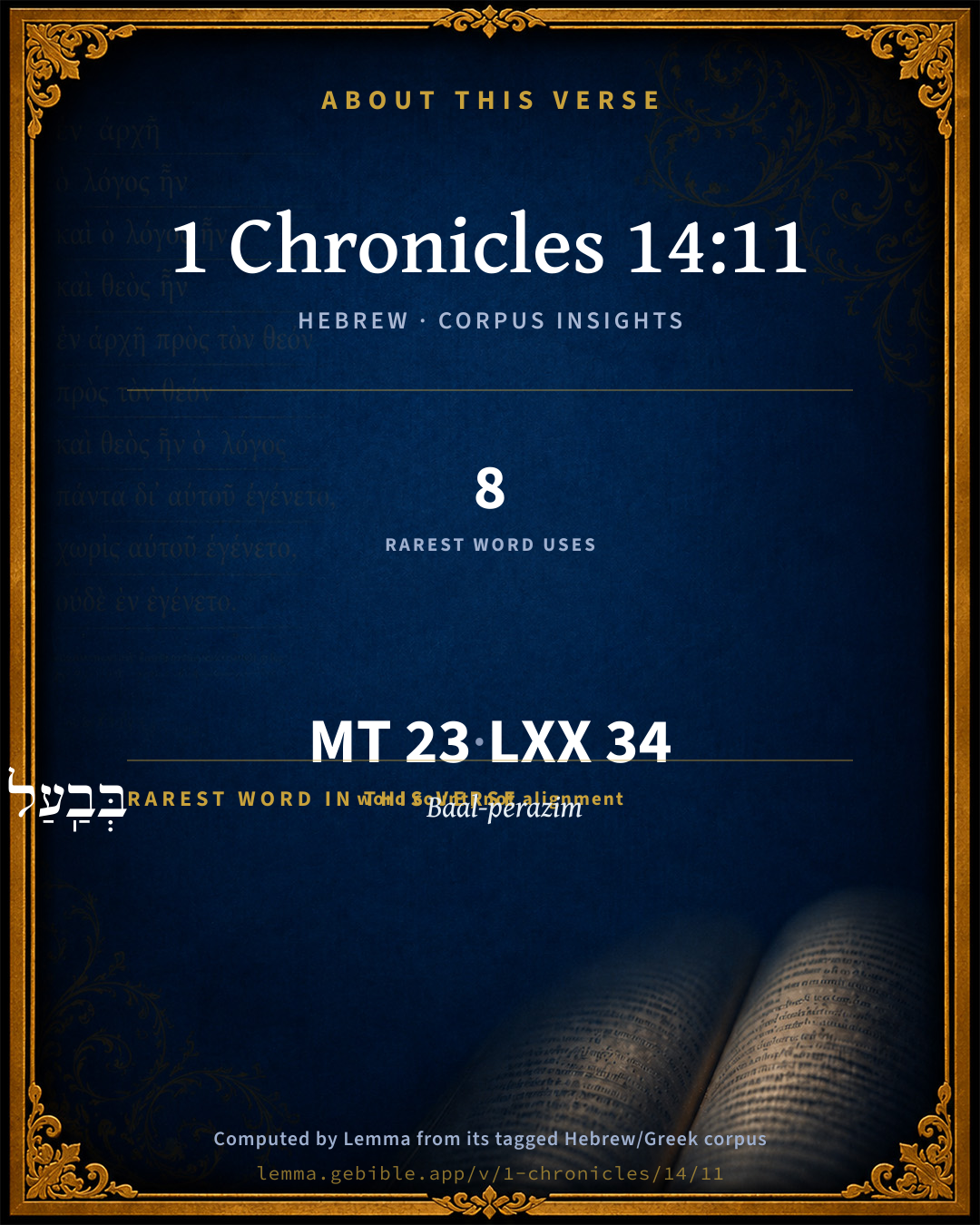
The rarest word here is בְּבַֽעַל Baal-perazim H1188 — appearing just 8 times in the whole Hebrew Bible.

Shared distinctive vocabulary

בְּבַֽעַל Baal-perazim H1188 occurs in 2 verses of the Hebrew Bible. Also found in:

Grammatical profile

  • 6 verbs
  • 12 nouns
  • 1 pronoun
  • 1 preposition
  • 1 adverb
  • 2 particles

Verb forms

  • וַיַּעֲל֥וּ Qal · Sequential Imperfect
  • וַיַּכֵּ֣ם Hiphil · Sequential Imperfect
  • וַיֹּ֣אמֶר Qal · Sequential Imperfect
  • פָּרַ֨ץ Qal · Perfect
  • אוֹיְבַ֛י Qal · Participle Active
  • קָֽרְא֛וּ Qal · Perfect

Repetition

Words recur within this verse — often emphatic in Hebrew:

  • בְּבַֽעַל Baal-perazim H1188 ×4
  • דָּוִיד֒ David H1732 ×2

Hebrew & Septuagint length

In English translation the verse runs 38 words from the Hebrew and 40 from the Septuagint (LXX English) — closely comparable.

A rough comparison of the two English renderings, which tokenize alike — not a word-level alignment.

Word counts can differ between the Hebrew and the Greek without any difference in meaning — e.g. the Hebrew direct-object marker אֵת has no separate Greek word, and Greek often adds the article ὁ.

In the original languages it is 23 Hebrew tokens and 34 Greek tokens — but the two are counted differently (Hebrew bundles its prefixes and suffixes into one token; the Greek is in lemma form), so that isn’t a like-for-like length.

Cross-references

9

Topical passages linked to 1 Chronicles 14:11 in the Treasury of Scripture Knowledge — connected by theme and wording, ordered by reader-vote popularity; previews shown in the World English Bible.

  • Isaiah 28:21 For Yahweh will rise up as on Mount Perazim, he will be angry as in the valley of Gibeon; that he may do his work, his strange work, and bring to pass his act, his strange act.
  • Exodus 14:28 The waters returned, and covered the chariots and the horsemen, even all Pharaoh's army that went in after them into the sea. There remained not so much as one of them.
  • 2 Samuel 5:20 David came to Baal Perazim, and David struck them there; and he said, Yahweh has broken my enemies before me, like the breach of waters. Therefore he called the name of that place Baal Perazim.
  • Psalms 144:10 You are he who gives salvation to kings, Who rescues David, his servant, from the deadly sword.
  • Matthew 7:27 The rain came down, the floods came, and the winds blew, and beat on that house; and it fell--and great was its fall."
  • Job 30:14 As through a wide breach they come, In the midst of the ruin they roll themselves in.
  • Psalms 18:13–15 Yahweh also thundered in the sky, The Most High uttered his voice: Hailstones and coals of fire.
  • Psalms 144:1 Blessed be Yahweh, my rock, Who teaches my hands to war, And my fingers to battle:
  • Psalms 44:3 For they didn't get the land in possession by their own sword, Neither did their own arm save them; But your right hand, and your arm, and the light of your face, Because you were favorable to them.

Cross-references courtesy of OpenBible.info (CC BY 4.0).

Hebrew and Greek witnesses Masoretic Hebrew ↔ Greek Septuagint

The same verse in the two great witnesses to the Old Testament, shown verse-for-verse.

These are two independent witnesses, not word-aligned to each other, and the Septuagint is shown in lemma (dictionary) form.

Hebrew 1 Chronicles 14:11 Masoretic · Westminster Leningrad Codex

וַיַּעֲל֥וּ בְּבַֽעַל פְּרָצִים֮ וַיַּכֵּ֣ם שָׁ֣ם דָּוִיד֒ וַיֹּ֣אמֶר דָּוִ֔יד פָּרַ֨ץ הָֽאֱלֹהִ֧ים אֶת אוֹיְבַ֛י בְּיָדִ֖י כְּפֶ֣רֶץ מָ֑יִם עַל כֵּ֗ן קָֽרְא֛וּ שֵֽׁם הַמָּק֥וֹם הַה֖וּא בַּ֥עַל פְּרָצִֽים

So they came up to Baal Perazim, and David struck them there; and David said, God has broken my enemies by my hand, like the breach of waters. Therefore they called the name of that place Baal Perazim.

World English Bible · Public Domain

Greek LXX 1 Chronicles 14:11 Septuagint · lemma form

καί ἀναβαίνω εἰς βααλφαρασιν καί πατάσσω αὐτός ἐκεῖ δαυίδ καί εἶπον δαυίδ διακόπτω ὁ θεός ὁ ἐχθρός ἐγώ ἐν χείρ ἐγώ ὡς διακοπή ὕδωρ διά οὗτος καλέω ὁ ὄνομα ὁ τόπος ἐκεῖνος διακοπή φαρασιν

And he went up to Baal Pharasin, and David struck them there; and David said, God has broken through enemies by my hand like a breach of water: therefore he called the name of that place, the Breach of Pharasin.

LXX2012 (modern English Septuagint) · Public Domain

Hebrew: Westminster Leningrad Codex (CC BY 4.0). Greek: Septuagint (public domain); English from LXX2012 (modern English Septuagint) (Public Domain). How the Septuagint differs from the Hebrew →

Commentary

Notes on 1 Chronicles 14:11 from classic Christian and Jewish commentators (each source and its license shown beneath its notes). The classic Christian expositions comment on the surrounding passage and are grouped to its opening verse, so a note may address several verses; the Jewish commentaries on the Tanakh (Rashi and others) are per-verse, so they appear only where the commentator wrote on this verse.

Lemma curates 59 commentaries, every one of them public domain or Creative Commons licensed, each selected and text-cleaned for this edition rather than reprinted as found. About our sources →

Trapp's Complete Commentary

John Trapp

1Ch 14:11 So they came up to Baalperazim; and David smote them there. Then David said, God hath broken in upon mine enemies by mine hand like the breaking forth of waters: therefore they called the name of that place Baalperazim.

Ver. 11. Like the breaking forth of waters.] That is, saith the Chaldee Paraphrast, As water runneth out of a broken earthen vessel.

John Trapp, A Commentary or Exposition upon All the Books of the Old and New Testament (1647–1656) — public domain. Text from a community e-Sword module.

Geneva Bible (1599)

Geneva Bible translators

That is, the valley of divisions, because the enemies were dispersed there like waters.

Geneva Bible (1599) marginal notes — public domain. Text via Bolls.life.

Jamieson, Fausset & Brown

Robert Jamieson, A. R. Fausset & David Brown

they came up to Baal-perazim; and David smote them there--In an engagement fought at Mount Perazim (Isa 28:21), in the valley of Rephaim, a few miles west of Jerusalem, the Philistines were defeated and put to flight.

Jamieson, Fausset & Brown — Commentary Critical and Explanatory on the Whole Bible (1871) — public domain (CC PDM 1.0). Text via the HelloAO Bible API.

Adam Clarke's Commentary

Verse 11. Like the breaking forth of waters] "And David said, The Lord hath broken the enemies of David like to the breaking of a potter's vessel full of water." - T.

Adam Clarke's Commentary on the Bible (1810–1826) — public domain. Text from a community e-Sword/MySword module.

Ellicott's Commentary for English Readers

(11) So they came up to Baal-perazύm.—And they: that is, David and his troops. Samuel, “And David came into Baal-perazim.” The locality is unknown. The prophet Isaiah (1Ch_28:21) refers to these two victories of David: “For Jehovah shall rise up as in Mount Perazim, he shall be wroth as in the valley of Gibeon, that he may do his work, his strange work; and bring to pass his act, his strange act.” Such a reference proves the great moment of the events so briefly chronicled here.

God hath broken in upon mine enemies.—Samuel has “Jehovah” here and in 1Ch_14:10 a, and again in 1Ch_14:14-15. (See Note, 1Ch_13:12.) True to his character, David owns the mighty hand of God in the results of his own valour. (Comp. 1Ch_17:16, sqq.) He is conscious of being God’s instrument. Contrast the haughty self-confidence of the Assyrian conqueror (Isa_10:5-15).

By mine hand.—Samuel, “before me;” and so the Syriac and Arabic here. The Hebrew phrases are probably synonymous. (Comp. 1Sa_21:14, “in their hand,” i.e., before them.) In Arabic, “between the hands” means before. Our text seems the more original here.

Like the breaking forth of waters.—David’s forces probably charged down the slopes of Mount Perazim (Isa_28:21), like a mountain torrent, sweeping all before it.

They called.—An explanation of Samuel, which has “he [i.e., one] called.” The remark indicates the antiquity of the narrative. (Comp. the frequent verbal plays of this kind in the stories of the Book of Genesis.)

Baal-perazim.—Lord, or owner, of breaches, or breakings forth. “Baal” may refer to Jehovah ( comp. 1Ch_9:33, Note); and perâzîm may have also meant the fissures or gullies on the mountain-side. It is the plural of the word perez (1Ch_13:11).

A Bible Commentary for English Readers, edited by Charles John Ellicott (1878–1897) — public domain. Text from a community e-Sword module.

The Cambridge Bible for Schools and Colleges

gen. ed. J. J. S. Perowne

11. Baal-perazim] probably to be identified with the Mount Perazim of Isa_28:21, but the situation is unknown.

like the breaking forth of waters] R.V. like the breach of waters, i.e. like the breach made by waters. Probably the scene of the victory was a hill deeply scarred with water-courses. The force with which God broke through the army of the Philistines is compared with that of a torrent breaking its way through all obstacles. Baal-perazim = the place of breakings forth (R.V. mg.).

The Cambridge Bible for Schools and Colleges (gen. ed. J. J. S. Perowne; Cambridge University Press, 1878–1918) — public domain. Text from a community e-Sword module.

Haydock's Catholic Bible Commentary

Baalpharasim, "the god or master of divisions." (Calmet) --- The place was so called afterwards. (Du Hamel)

George Leo Haydock (1774–1849), Haydock's Catholic Family Bible and Commentary, 1859 edition — public domain. Excludes Psalms (Douay-Rheims chapter numbering differs from Protestant) and Deuterocanonical books (Catholic canon only).

The Pulpit Commentary

Baal-perazim; literally, master of breaches. Gesenius traces this meaning, through the intermediate idea of "possessor," to that (in this case, that place), which "possesses," i.e. is the subject of such a signal overwhelming as is here described, the scene of overwhelming defeats, like the irresistible rush of waters, (Isa_28:21)

The Pulpit Commentary (1880–1919), ed. H.D.M. Spence-Jones & Joseph S. Exell — public domain. Text from a community e-Sword module.

Rashi

Rabbi Shlomo Yitzchaki (Rashi)

And they went up to Baal-Perazim which was later called Baal-Perazim because of the incident that occurred there. God has broken my enemies in my hand meaning that they fled and were broken off from one another.

like a breach of waters like waves of water that break from their place and fall somewhere else.

Rashi on the Tanakh — English translations: “The Judaica Press complete Tanach with Rashi, translated by A. J. Rosenberg” (CC BY 4.0); “Pentateuch with Rashi's commentary by M. Rosenbaum and A.M. Silbermann, 1929-1934” (public domain); “The Metsudah Tanach series, Lakewood, N.J” (CC BY 4.0); and “The Book of Joshua, Metsudah Publications, 1997” (CC BY 4.0). Text via Sefaria.

Lesson kit

Teaching starters — assembled from the data on this page, not authored interpretation. Every prompt links to the verse data it draws on. Edit before teaching.

1 Chronicles, in the Historical, opens this verse with 23 words (19 distinct Hebrew lemmas). Its most distinctive word is Baʻal Pᵉrâtsîym (“Baal-perazim”). A historical commentator’s framing appears above. Read the whole chapter for the surrounding context.

Discussion questions

  1. How does “Baal-perazim” (Baʻal Pᵉrâtsîym) shape what this verse is saying?
  2. 2 Samuel 5:20 shares the word «Baal-perazim» with this verse. How do the two illuminate each other?
  3. “Baal-perazim” occurs 4× in this one verse. What is the effect of the repetition?
  4. These translations render this verse differently; the difference is in the English rendering, not the original. What questions does that raise?
  5. The verb «וַיַּעֲל֥וּ» is Qal Sequential Imperfect. How does its form color the action?
  6. Reading how Trapp's Complete Commentary and Geneva Bible (1599) read this verse, where do the two commentators agree and where do they part?

Things to notice

Reading settings

Reading text

Shown beneath each verse's original-language words.

Old Testament
Old Testament edition

Read the OT as the Masoretic Hebrew (MT) or the Greek Septuagint (LXX).

English shown for the Greek Septuagint (in the Hebrew ↔ Greek comparison).

Comparing translations? Open the Compare panel on any verse page to stack up to four side by side.