
Deuteronomy 20:14

Hebrew (Westminster Leningrad Codex) Deuteronomy 20:14 appears in the Hebrew Old Testament. The text above is from the Westminster Leningrad Codex. Each word links to its Strong’s number, a concise gloss, and parsing drawn from the Open Scriptures Hebrew Bible morphology. Click any word for its full Brown-Driver-Briggs (BDB) entry.
Download image
Cite this verse

Deuteronomy 20:14 (World English Bible). Public Domain. Lemma interlinear Bible study tool, https://lemma.gebible.app/v/deuteronomy/20/14.

Show BibTeX & RIS
BibTeX
RIS
English Translation
but the women, and the little ones, and the cattle, and all that is in the city, even all the spoil of it, shall you take for a prey to yourself; and you shall eat the spoil of your enemies, which Yahweh your God has given you.
World English Bible · Public Domain
Download a study sheet

One document with this verse’s original text, its word-by-word gloss line, the meaning frame, cross-references with their text, attributed commentary, and full source and license credits — printable, and it pastes into notes with its structure intact.

This verse Autodidact and up

Study sheet (.html) Plain text (.txt)

A passage Seminary Student

Up to 50 verses in one chapter. A passage sheet keeps up to 6 commentary sources and 12 cross-references per verse, in the order this page ranks them, and says so on the sheet whenever that leaves anything out. Ask for a single verse and you get the Autodidact verse sheet above.

Everything on this page stays free to read, with no account — the sheet is a download of what is already on screen, not access to it.

Want to remove ads? Support Godless Engineer
Compare translations 3

The same verse in 3 English versions, stacked beneath the original-language interlinear above. Click any original word for its lexicon entry.

Each is an independent rendering of the whole verse — the interlinear is not word-aligned to these translations.

Highlighted words mark where these versions differ — a whole-verse word diff, not a word-by-word alignment.

  • World English Bible Public Domain
    but the women, and the little ones, and the cattle, and all that is in the city, even all the spoil of it, shall you take for a prey to yourself; and you shall eat the spoil of your enemies, which Yahweh your God has given you.
  • King James Version Public Domain
    But the women, and the little ones, and the cattle, and all that is in the city, even all the spoil thereof, shalt thou take unto thyself; and thou shalt eat the spoil of thine enemies, which the LORD thy God hath given thee.
  • unfoldingWord Literal Text CC BY-SA 4.0
    But the women and the children and the cattle and everything that is in the city, all its spoil, you shall plunder for yourself, and you shall consume the spoil of your enemies, whom Yahweh your God has given to you.

unfoldingWord Literal Text — © unfoldingWord, licensed CC BY-SA 4.0. Word-aligned USFM3 via Door43 (git.door43.org/unfoldingWord/en_ult).

Versions to compare (up to 4)

3 of 4 selected

Show all 18 translations

Every available English version of this verse, each an independent rendering of the whole verse.

  • World English Bible Public Domain
    but the women, and the little ones, and the cattle, and all that is in the city, even all the spoil of it, shall you take for a prey to yourself; and you shall eat the spoil of your enemies, which Yahweh your God has given you.
  • Berean Standard Bible Public Domain
    But the women, children, livestock, and whatever else is in the city—all its spoil—you may take as plunder, and you shall use the spoil of your enemies that the LORD your God gives you.
  • Majority Standard Bible Public Domain
    But the women, children, livestock, and whatever else is in the city—all its spoil—you may take as plunder, and you shall use the spoil of your enemies that the LORD your God gives you.
  • King James Version Public Domain
    But the women, and the little ones, and the cattle, and all that is in the city, even all the spoil thereof, shalt thou take unto thyself; and thou shalt eat the spoil of thine enemies, which the LORD thy God hath given thee.
  • American Standard Version (1901) Public Domain
    but the women, and the little ones, and the cattle, and all that is in the city, even all the spoil thereof, shalt thou take for a prey unto thyself; and thou shalt eat the spoil of thine enemies, which Jehovah thy God hath given thee.
  • Revised Version (1885) Public Domain
    but the women, and the little ones, and the cattle, and all that is in the city, even all the spoil thereof, shalt thou take for a prey unto thyself; and thou shalt eat the spoil of thine enemies, which the LORD thy God hath given thee.
  • Geneva Bible (1599) Public Domain
    Onely the women, and the children, and the cattel, and all that is in the citie, euen all the spoyle thereof shalt thou take vnto thy selfe, and shalt eate the spoyle of thine enemies, which the Lord thy God hath giuen thee.
  • Douay-Rheims (1899) Public Domain
    Excepting women and children, cattle and other things, that are in the city. And thou shalt divide all the prey to the army, and thou shalt eat the spoils of thy enemies, which the Lord thy God shall give thee.
  • Young's Literal Translation Public Domain
    Only, the women, and the infants, and the cattle, and all that is in the city, all its spoil, thou dost seize for thyself, and thou hast eaten the spoil of thine enemies which Jehovah thy God hath given to thee.
  • Literal Standard Version CC BY-SA 4.0
    Only, the women, and the infants, and the livestock, and all that is in the city, all its spoil, you seize for yourself, and you have eaten the spoil of your enemies which your God YHWH has given to you.
  • Unlocked Literal Bible CC BY-SA 4.0
    But the women, the little ones, the cattle, and everything that is in the city, and all its spoil, you will take as booty for yourself. You will consume the booty of your enemies, whom Yahweh your God has given to you.
  • unfoldingWord Literal Text CC BY-SA 4.0
    But the women and the children and the cattle and everything that is in the city, all its spoil, you shall plunder for yourself, and you shall consume the spoil of your enemies, whom Yahweh your God has given to you.
  • Darby Bible Public Domain
    only the women, and the little ones, and the cattle, and all that shall be in the city, all the spoil thereof, shalt thou take as booty for thyself; and thou shalt eat the spoil of thine enemies, which Jehovah thy God giveth thee
  • World Messianic Bible Public Domain
    but the women, the little ones, the livestock, and all that is in the city, even all its plunder, you shall take for plunder for yourself. You may use the plunder of your enemies, which the LORD your God has given you.
  • Webster's Bible Public Domain
    But the women, and the little ones, and the cattle, and all that is in the city, even all the spoil of it, shalt thou take to thyself: and thou shalt eat the spoil of thy enemies, which the LORD thy God hath given thee.
  • Free Bible Version CC BY-SA 4.0
    But you can take as plunder the women, children, livestock, and everything else in the town. You can take and use all your enemies' possessions the Lord your God gives you.
  • Bible in Basic English Public Domain
    But the women and the children and the cattle and everything in the town and all its wealth, you may take for yourselves: the wealth of your haters, which the Lord your God has given you, will be your food.
  • JPS Tanakh (1917) Public Domain
    but the women, and the little ones, and the cattle, and all that is in the city, even all the spoil thereof, shalt thou take for a prey unto thyself; and thou shalt eat the spoil of thine enemies, which the LORD thy God hath given thee.

Literal Standard Version (2020), Covenant Press — licensed CC BY-SA 4.0. Text via the HelloAO Bible API (eBible.org). Unlocked Literal Bible (unfoldingWord) — licensed CC BY-SA 4.0. Text via the HelloAO Bible API (eBible.org). unfoldingWord Literal Text — © unfoldingWord, licensed CC BY-SA 4.0. Word-aligned USFM3 via Door43 (git.door43.org/unfoldingWord/en_ult). Free Bible Version, Dr. Jonathan Gallagher — licensed CC BY-SA 4.0. Text via the HelloAO Bible API (eBible.org).

Word by word

More ways to search: Search by grammar → Find every occurrence → Compare this word →

Practice this passage: Drill this verse → Learn its vocabulary →

וְהַטַּ֨ף
ṭaph
H2945
“and · the · little children”
Conjunction + Particle, Definite Article + Noun, Common, Masculine, Singular, Absolute
Part of Speech
Conjunction + Particle + Noun
Type
Common
Gender
Masculine
Number
Singular
State
Absolute
Full BDB Definition

Origin: from H2952 (perhaps referring to the tripping gait of children)

TWOT: 821a

children, little children, little ones
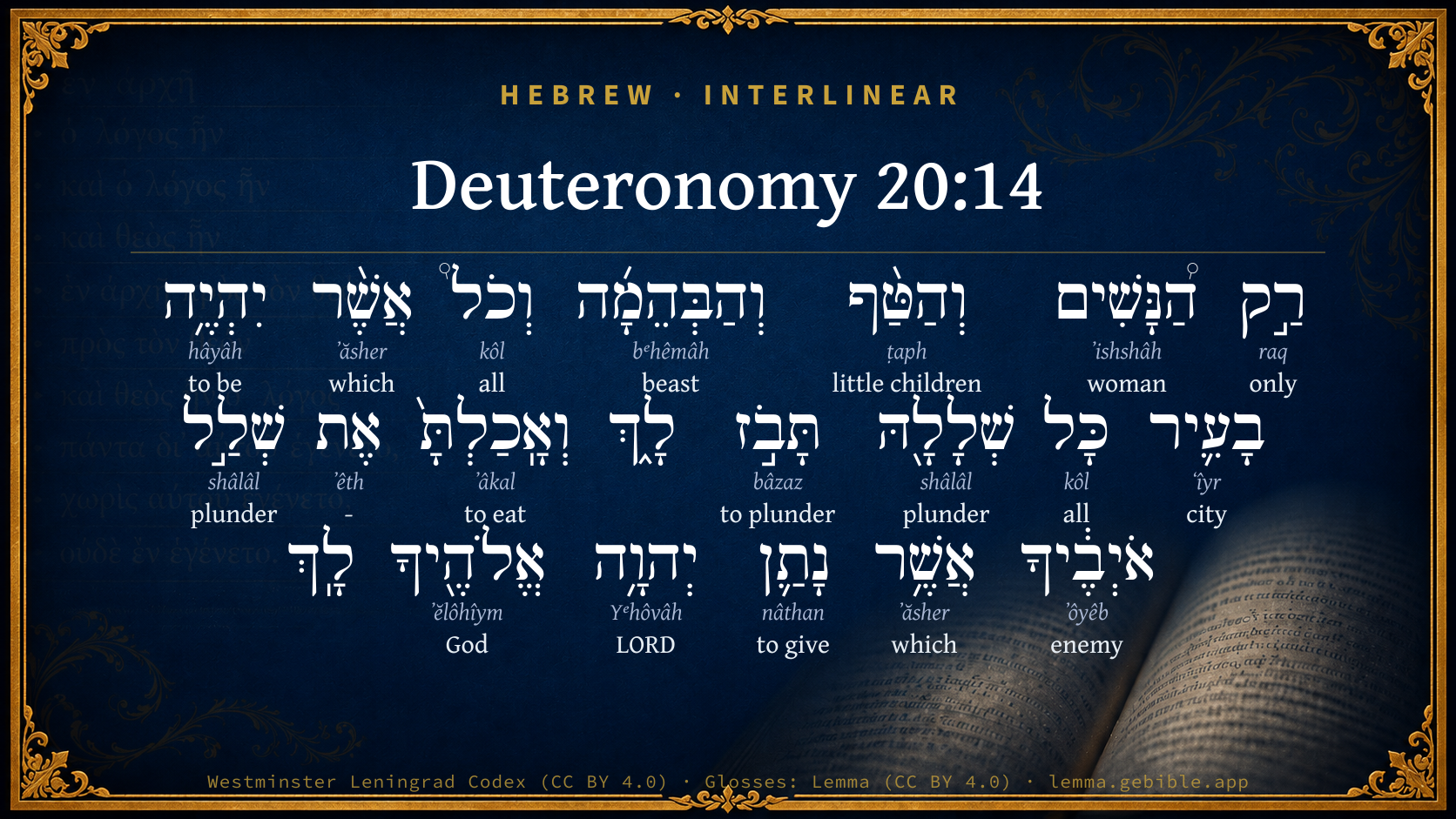
  1. רַ֣ק raq H7535 “only” Particle, Accusative
  2. הַ֠נָּשִׁים ʼishshâh H802 “the · women” Particle, Definite Article + Noun, Common, Feminine, Plural, Absolute
  3. וְהַבְּהֵמָ֜ה bᵉhêmâh H929 “and · the · beast” Conjunction + Particle, Definite Article + Noun, Common, Feminine, Singular, Absolute
  4. וְכֹל֩ kôl H3605 “and · all” Conjunction + Noun, Common, Masculine, Singular, Absolute
  5. אֲשֶׁ֨ר ʼăsher H834 “which” Particle, Relative
  6. יִהְיֶ֥ה hâyâh H1961 “to be” Verb, Qal, Imperfect, 3rd Person, Masculine, Singular
  7. בָעִ֛יר ʻîyr H5892 “in/at the · city” Preposition, Determined + Noun, Common, Feminine, Singular, Absolute
  8. כָּל kôl H3605 “all of” Noun, Common, Masculine, Singular, Construct
  9. שְׁלָלָ֖הּ shâlâl H7998 “plunder · her” Noun, Common, Masculine, Singular, Construct + Suffix, Personal, 3rd Person, Feminine, Singular
  10. תָּבֹ֣ז bâzaz H962 “to plunder” Verb, Qal, Imperfect, 2nd Person, Masculine, Singular
  11. וְאָֽכַלְתָּ֙ ʼâkal H398 “and · to eat” Conjunction + Verb, Qal, Sequential Perfect, 2nd Person, Masculine, Singular
  12. אֶת ʼêth H853 “-” Particle, Direct Object
  13. שְׁלַ֣ל shâlâl H7998 “plunder of” Noun, Common, Masculine, Singular, Construct
  14. אֹיְבֶ֔יךָ ʼôyêb H341 “enemy · you” Verb, Qal, Participle Active, Masculine, Plural, Construct + Suffix, Personal, 2nd Person, Masculine, Singular
  15. אֲשֶׁ֥ר ʼăsher H834 “which” Particle, Relative
  16. נָתַ֛ן nâthan H5414 “to give” Verb, Qal, Perfect, 3rd Person, Masculine, Singular
  17. יְהוָ֥ה Yᵉhôvâh H3068 “LORD” Noun, Proper
  18. אֱלֹהֶ֖יךָ ʼĕlôhîym H430 “God(s) · your” Noun, Common, Masculine, Plural, Construct + Suffix, Personal, 2nd Person, Masculine, Singular

About this verse

These counts appear in no published source. They are computed here, from the morphology-tagged text and Lemma’s own curated glosses. What Lemma adds →

21
words
16
distinct lemmas
Pentateuch
section

Shared distinctive vocabulary

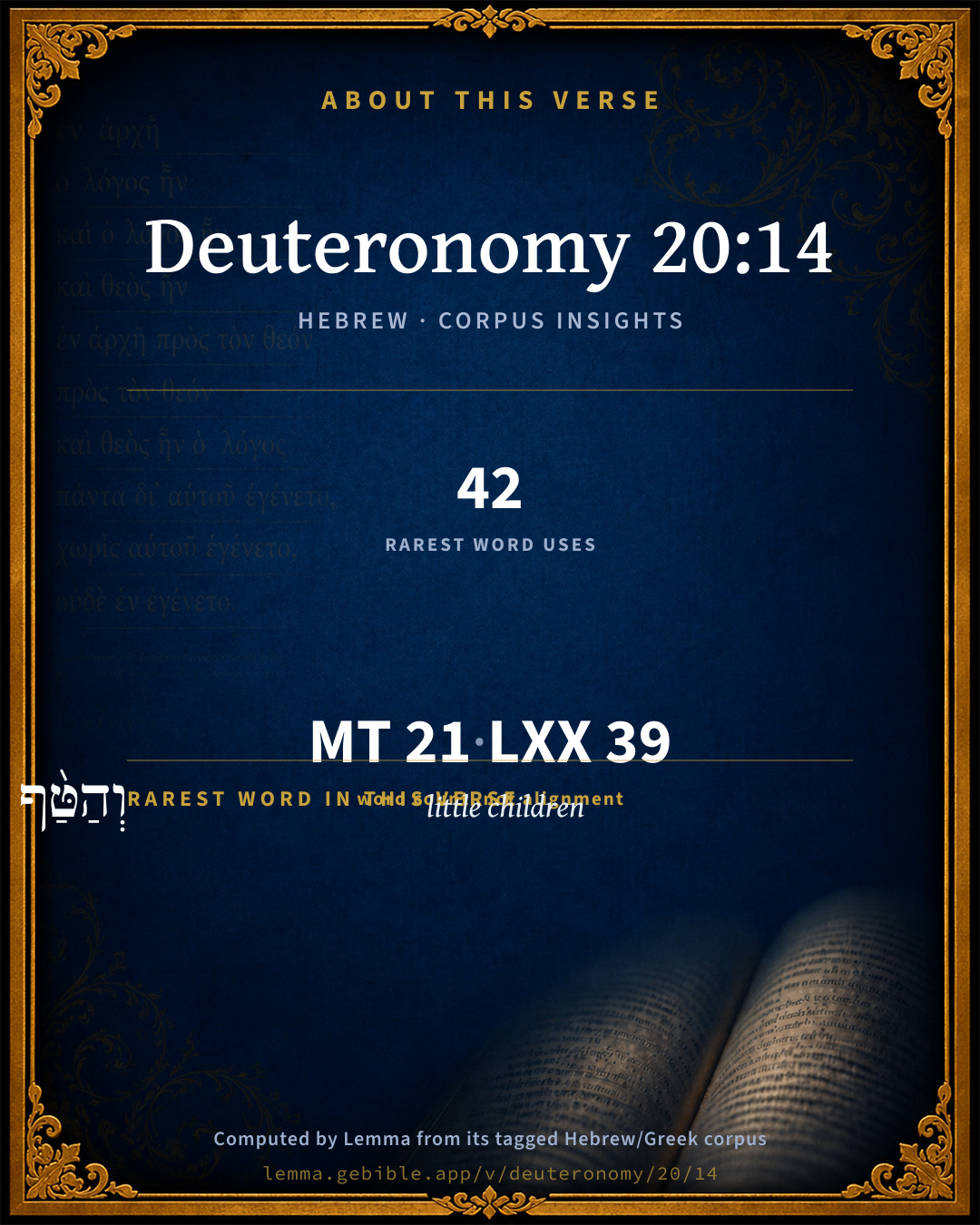
וְהַטַּ֨ף little children H2945 occurs in 42 verses of the Hebrew Bible. Also found in:

Grammatical profile

  • 5 verbs
  • 10 nouns
  • 2 prepositions
  • 4 particles

Verb forms

  • יִהְיֶ֥ה Qal · Imperfect
  • תָּבֹ֣ז Qal · Imperfect
  • וְאָֽכַלְתָּ֙ Qal · Sequential Perfect
  • אֹיְבֶ֔יךָ Qal · Participle Active
  • נָתַ֛ן Qal · Perfect

Repetition

Words recur within this verse — often emphatic in Hebrew:

  • וְכֹל֩ all H3605 ×2
  • שְׁלָלָ֖הּ plunder H7998 ×2
  • אֲשֶׁ֨ר which H834 ×2

Hebrew & Septuagint length

In English translation the verse runs 47 words from the Hebrew and 44 from the Septuagint (LXX English) — closely comparable.

A rough comparison of the two English renderings, which tokenize alike — not a word-level alignment.

Word counts can differ between the Hebrew and the Greek without any difference in meaning — e.g. the Hebrew direct-object marker אֵת has no separate Greek word, and Greek often adds the article ὁ.

In the original languages it is 21 Hebrew tokens and 39 Greek tokens — but the two are counted differently (Hebrew bundles its prefixes and suffixes into one token; the Greek is in lemma form), so that isn’t a like-for-like length.

Cross-references

11

Topical passages linked to Deuteronomy 20:14 in the Treasury of Scripture Knowledge — connected by theme and wording, ordered by reader-vote popularity; previews shown in the World English Bible.

  • Joshua 8:2 You shall do to Ai and her king as you did to Jericho and her king: only the spoil of it, and the cattle of it, shall you take for a prey to yourselves: set you an ambush for the city behind it.
  • Joshua 22:8 and spoke to them, saying, Return with much wealth to your tents, and with very much cattle, with silver, and with gold, and with brass, and with iron, and with very much clothing: divide the spoil of your enemies with your brothers.
  • Numbers 31:9 The children of Israel took captive the women of Midian and their little ones; and all their cattle, and all their flocks, and all their goods, they took for a prey.
  • Numbers 31:12 They brought the captives, and the prey, and the spoil, to Moses, and to Eleazar the priest, and to the congregation of the children of Israel, to the camp at the plains of Moab, which are by the Jordan at Jericho.
  • Numbers 31:18 But all the girls, who have not known man by lying with him, keep alive for yourselves.
  • Numbers 31:35–54 and thirty-two thousand persons in all, of the women who had not known man by lying with him.
  • Joshua 11:14 All the spoil of these cities, and the cattle, the children of Israel took for a prey to themselves; but every man they struck with the edge of the sword, until they had destroyed them, neither left they any who breathed.
  • 2 Chronicles 14:13–15 Asa and the people who were with him pursued them to Gerar: and there fell of the Ethiopians so many that they could not recover themselves; for they were destroyed before Yahweh, and before his host; and they carried away very much booty.
  • 2 Chronicles 20:25 When Jehoshaphat and his people came to take the spoil of them, they found among them in abundance both riches and dead bodies, and precious jewels, which they stripped off for themselves, more than they could carry away: and they were three days in taking the spoil, it was so much.
  • Psalms 68:12 "Kings of armies flee! They flee!" She who waits at home divides the spoil,
  • Romans 8:37 No, in all these things, we are more than conquerors through him who loved us.

Cross-references courtesy of OpenBible.info (CC BY 4.0).

Hebrew and Greek witnesses Masoretic Hebrew ↔ Greek Septuagint

The same verse in the two great witnesses to the Old Testament, shown verse-for-verse.

These are two independent witnesses, not word-aligned to each other, and the Septuagint is shown in lemma (dictionary) form.

Hebrew Deuteronomy 20:14 Masoretic · Westminster Leningrad Codex

רַ֣ק הַ֠נָּשִׁים וְהַטַּ֨ף וְהַבְּהֵמָ֜ה וְכֹל֩ אֲשֶׁ֨ר יִהְיֶ֥ה בָעִ֛יר כָּל שְׁלָלָ֖הּ תָּבֹ֣ז לָ֑ךְ וְאָֽכַלְתָּ֙ אֶת שְׁלַ֣ל אֹיְבֶ֔יךָ אֲשֶׁ֥ר נָתַ֛ן יְהוָ֥ה אֱלֹהֶ֖יךָ לָֽךְ

but the women, and the little ones, and the cattle, and all that is in the city, even all the spoil of it, shall you take for a prey to yourself; and you shall eat the spoil of your enemies, which Yahweh your God has given you.

World English Bible · Public Domain

Greek LXX Deuteronomy 20:14 Septuagint · lemma form

πλήν ὁ γυνή καί ὁ ἀποσκευή καί πᾶς ὁ κτῆνος καί πᾶς ὅσος ἄν ὑποἄρχω ἐν ὁ πόλις καί πᾶς ὁ ἀπαρτία προνομεύω σεαυτοῦ καί ἐσθίω πᾶς ὁ προνομή ὁ ἐχθρός σύ ὅς κύριος ὁ θεός σύ δίδωμι σύ

except the women and the stuff: and all the cattle, and whatever shall be in the city, and all the plunder you shall take as spoil for yourself, and shall eat all the plunder of your enemies whom the Lord your God gives you.

LXX2012 (modern English Septuagint) · Public Domain

Hebrew: Westminster Leningrad Codex (CC BY 4.0). Greek: Septuagint (public domain); English from LXX2012 (modern English Septuagint) (Public Domain). How the Septuagint differs from the Hebrew →

Targum (Aramaic paraphrase)

2

The Targum is the ancient Jewish Aramaic paraphrase of the Hebrew Scriptures — an interpretive translation, not the Hebrew text itself. Onkelos (literal) and Pseudo-Jonathan (expansive) render the Torah, and Jonathan the Prophets. Coverage is partial: where no permissively-licensed English translation exists for a verse, only the Aramaic is shown. This is verse-level text, not a word-by-word alignment to the Hebrew.

  1. Targum Onkelos Torah (Genesis–Deuteronomy)
    לְחוֹד נְשַׁיָא וְטַפְלָא וּבְעִירָא וְכֹל דִי יְהֵי בְקַרְתָּא כָּל עֲדָאַהּ תֵּבוֹז לָךְ וְתֵיכוּל יָת עֲדָאָה דְסַנְאָךְ דִי יְהַב יְיָ אֱלָהָךְ לָךְ

    (no public-domain English translation for this verse)

    Targum Onkelos — Aramaic: “Onkelos Genesis” (public domain); “Onkelos Exodus” (public domain); “Onkelos Leviticus” (public domain); “Onkelos Numbers” (public domain); “Onkelos Deuteronomy” (public domain). English: “Sefaria Community Translation” (CC0 1.0 (public-domain dedication)); “J.W. Etheridge. The Targums of Onkelos and Jonathan Ben Uzziel on the Pentateuch. London: Longmans, Green, 1862” (public domain). Text via Sefaria.

  2. Targum Pseudo-Jonathan Torah (Genesis–Deuteronomy)
    לְחוֹד נְשַׁיָא וְטַפְלָא וּבְעִירָא וְכָל דִּיהֵי בְקַרְתָּא כָּל עֲדָאָהּ תִּיבְזוּן לְכוֹן וְתֵיכְלוּן יַת עֲדֵי סַנְאֵיכוֹן דִּיהַב יְיָ אֱלָהָכוֹן לְכוֹן

    But the women, children, and cattle, and whatever is in the city, even all the spoil, you shall seize, and eat the spoil of your enemies which the Lord your God giveth you.

    Targum Pseudo-Jonathan — Aramaic: “Targum Jonathan on Genesis” (public domain); “Targum Jonathan on Exodus” (public domain); “Targum Jonathan on Leviticus” (public domain); “Targum Jonathan on Numbers” (public domain); “Targum Jonathan on Deuteronomy” (public domain). English: “The Targum of Jonathan ben Uzziel, trans. J. W. Etheridge, London, 1862” (public domain). Text via Sefaria.

Commentary

Notes on Deuteronomy 20:14 from classic Christian and Jewish commentators (each source and its license shown beneath its notes). The classic Christian expositions comment on the surrounding passage and are grouped to its opening verse, so a note may address several verses; the Jewish commentaries on the Tanakh (Rashi and others) are per-verse, so they appear only where the commentator wrote on this verse.

Lemma curates 59 commentaries, every one of them public domain or Creative Commons licensed, each selected and text-cleaned for this edition rather than reprinted as found. About our sources →

The Cambridge Bible for Schools and Colleges

gen. ed. J. J. S. Perowne

14. but] or only. Heb. rak, introducing exceptions. See on Deu_10:15.

the women, etc.] A mitigated form of the ḥerem—see on Deu_2:34—urged not only from motives of humanity but on utilitarian considerations.

take for a prey, etc.] Deu_2:35, Deu_3:7.

The Cambridge Bible for Schools and Colleges (gen. ed. J. J. S. Perowne; Cambridge University Press, 1878–1918) — public domain. Text from a community e-Sword module.

John Gill's Exposition

But the women, the little ones, and the cattle,.... These were to be spared; women, because of the weakness of their sex, and subjection to their husbands; and little ones, which take in males as well as females, as Jarchi observes, because of their tender age; and cattle because of their insensibility; all these having had no concern in holding out the siege:

and all that is in the city, even all the spoil thereof, shall thou take unto thyself; gold, silver, merchandise, household goods, utensils in trade, and whatever was of any worth and value to be found in their houses:

and thou shall eat the spoil of thine enemies, which the Lord thy God hath given thee; that is, enjoy all their wealth and riches, estates and possessions; for this is not to be restrained to things eatable only.

John Gill's Exposition of the Whole Bible (1746–1763) — public domain (CC PDM 1.0). Text via the HelloAO Bible API.

Haydock's Catholic Bible Commentary

Excepting women, &c. These were supposed incapable of making any resistance, or of carrying arms. Slaves also were excused, on account of their want of liberty to choose for themselves, and old men, unless the war was undertaken by their advice. "I am not accustomed to wage war with captives, nor with women," said Alexander. (Curtius 5.)

George Leo Haydock (1774–1849), Haydock's Catholic Family Bible and Commentary, 1859 edition — public domain. Excludes Psalms (Douay-Rheims chapter numbering differs from Protestant) and Deuterocanonical books (Catholic canon only).

Matthew Poole's English Annotations

The little ones, excused by their sex or age, as not involved in the guilt, nor being likely to revenge their quarrel.

Matthew Poole's English Annotations on the Holy Bible (1683–1685) — public domain. Text from a community e-Sword/MySword module.

The Pulpit Commentary

Shalt eat the spoil; consume it for thine own maintenance.

The Pulpit Commentary (1880–1919), ed. H.D.M. Spence-Jones & Joseph S. Exell — public domain. Text from a community e-Sword module.

unfoldingWord translationNotes

Door43 World Missions Community

the little ones

"the children"

all its spoil

"all the valuable things"

booty

These are the valuable things which people who win a battle take from the people they attacked.

all the cities

Here "cities" represents the people. AT: "all the people who live in cities" (See: Metonymy)

translationWords

cow

consume

nation

unfoldingWord translationNotes — © Distant Shores Media and the Door43 World Missions Community, licensed CC BY-SA 4.0. Source: git.door43.org/Door43/en_tn.

Rashi

Rabbi Shlomo Yitzchaki (Rashi)

והטף AND THE LITTLE ONES [… SHALT THOU TAKE UNTO THYSELF] — the male children, too. But how am I to understand (v. 13) “and thou shalt smite every male thereof”? As referring to the male adults (Sifrei Devarim 200:7).

Rashi on the Tanakh — English translations: “The Judaica Press complete Tanach with Rashi, translated by A. J. Rosenberg” (CC BY 4.0); “Pentateuch with Rashi's commentary by M. Rosenbaum and A.M. Silbermann, 1929-1934” (public domain); “The Metsudah Tanach series, Lakewood, N.J” (CC BY 4.0); and “The Book of Joshua, Metsudah Publications, 1997” (CC BY 4.0). Text via Sefaria.

Lesson kit

Teaching starters — assembled from the data on this page, not authored interpretation. Every prompt links to the verse data it draws on. Edit before teaching.

Deuteronomy, in the Pentateuch, opens this verse with 21 words (16 distinct Hebrew lemmas). Its most distinctive word is ṭaph (“little children”). A historical commentator’s framing appears above. Read the whole chapter for the surrounding context.

Discussion questions

  1. The word ṭaph carries the sense “little children.” How does it shape the verse?
  2. Genesis 34:29 shares the word «little children» with this verse. How do the two illuminate each other?
  3. “all” occurs 2× in this one verse. What is the effect of the repetition?
  4. These translations render this verse differently; the difference is in the English rendering, not the original. What questions does that raise?
  5. The verb «יִהְיֶ֥ה» is Qal Imperfect. How does its form color the action?
  6. Reading how The Cambridge Bible for Schools and Colleges and John Gill's Exposition read this verse, where do the two commentators agree and where do they part?

Things to notice

Reading settings

Reading text

Shown beneath each verse's original-language words.

Old Testament
Old Testament edition

Read the OT as the Masoretic Hebrew (MT) or the Greek Septuagint (LXX).

English shown for the Greek Septuagint (in the Hebrew ↔ Greek comparison).

Comparing translations? Open the Compare panel on any verse page to stack up to four side by side.