
1 Samuel 14:30

Hebrew (Westminster Leningrad Codex) 1 Samuel 14:30 appears in the Hebrew Old Testament. The text above is from the Westminster Leningrad Codex. Each word links to its Strong’s number, a concise gloss, and parsing drawn from the Open Scriptures Hebrew Bible morphology. Click any word for its full Brown-Driver-Briggs (BDB) entry.
Download image
Cite this verse

1 Samuel 14:30 (World English Bible). Public Domain. Lemma interlinear Bible study tool, https://lemma.gebible.app/v/1-samuel/14/30.

Show BibTeX & RIS
BibTeX
RIS
English Translation
How much more, if haply the people had eaten freely today of the spoil of their enemies which they found? for now has there been no great slaughter among the Philistines.
World English Bible · Public Domain
Download a study sheet

One document with this verse’s original text, its word-by-word gloss line, the meaning frame, cross-references with their text, attributed commentary, and full source and license credits — printable, and it pastes into notes with its structure intact.

This verse Autodidact and up

Study sheet (.html) Plain text (.txt)

A passage Seminary Student

Up to 50 verses in one chapter. A passage sheet keeps up to 6 commentary sources and 12 cross-references per verse, in the order this page ranks them, and says so on the sheet whenever that leaves anything out. Ask for a single verse and you get the Autodidact verse sheet above.

Everything on this page stays free to read, with no account — the sheet is a download of what is already on screen, not access to it.

Want to remove ads? Support Godless Engineer
Compare translations 3

The same verse in 3 English versions, stacked beneath the original-language interlinear above. Click any original word for its lexicon entry.

Each is an independent rendering of the whole verse — the interlinear is not word-aligned to these translations.

Highlighted words mark where these versions differ — a whole-verse word diff, not a word-by-word alignment.

  • World English Bible Public Domain
    How much more, if haply the people had eaten freely today of the spoil of their enemies which they found? for now has there been no great slaughter among the Philistines.
  • King James Version Public Domain
    How much more, if haply the people had eaten freely to day of the spoil of their enemies which they found? for had there not been now a much greater slaughter among the Philistines?
  • unfoldingWord Literal Text CC BY-SA 4.0
    How much more that if eating, the people had eaten today from the plunder of their enemies that they found! For now the striking against the Philistines has not been great.”

unfoldingWord Literal Text — © unfoldingWord, licensed CC BY-SA 4.0. Word-aligned USFM3 via Door43 (git.door43.org/unfoldingWord/en_ult).

Versions to compare (up to 4)

3 of 4 selected

Show all 18 translations

Every available English version of this verse, each an independent rendering of the whole verse.

  • World English Bible Public Domain
    How much more, if haply the people had eaten freely today of the spoil of their enemies which they found? for now has there been no great slaughter among the Philistines.
  • Berean Standard Bible Public Domain
    How much better it would have been if the troops had eaten freely today from the plunder they took from their enemies! Would not the slaughter of the Philistines have been much greater?”
  • Majority Standard Bible Public Domain
    How much better it would have been if the troops had eaten freely today from the plunder they took from their enemies! Would not the slaughter of the Philistines have been much greater?”
  • King James Version Public Domain
    How much more, if haply the people had eaten freely to day of the spoil of their enemies which they found? for had there not been now a much greater slaughter among the Philistines?
  • American Standard Version (1901) Public Domain
    How much more, if haply the people had eaten freely to-day of the spoil of their enemies which they found? for now hath there been no great slaughter among the Philistines.
  • Revised Version (1885) Public Domain
    How much more, if haply the people had eaten freely today of the spoil of their enemies which they found? for now hath there been no great slaughter among the Philistines.
  • Geneva Bible (1599) Public Domain
    Howe much more, if the people had eaten to day of the spoyle of their enemies which they found? for had there not bene nowe a greater slaughter among the Philistims?
  • Douay-Rheims (1899) Public Domain
    How much more if the people had eaten of the prey of their enemies, which they found? had there not been made a greater slaughter among the Philistines?
  • Young's Literal Translation Public Domain
    How much more if the people had well eaten to-day of the spoil of its enemies which it hath found, for now, the smiting hath not been great among the Philistines.'
  • Literal Standard Version CC BY-SA 4.0
    How much more if the people had well eaten today of the spoil of its enemies which it has found, for now the striking has not been great among the Philistines.”
  • Unlocked Literal Bible CC BY-SA 4.0
    How much better if the people had eaten freely today of the plunder from their enemies that they found? Because now the slaughter has not been great among the Philistines.”
  • unfoldingWord Literal Text CC BY-SA 4.0
    How much more that if eating, the people had eaten today from the plunder of their enemies that they found! For now the striking against the Philistines has not been great.”
  • Darby Bible Public Domain
    How much more, if the people had eaten freely to-day of the spoil of their enemies which they found? for would there not now have been a much greater slaughter among the Philistines?
  • World Messianic Bible Public Domain
    How much more, if perhaps the people had eaten freely today of the plunder of their enemies which they found? For now there has been no great slaughter among the Philistines.”
  • Webster's Bible Public Domain
    How much more, if haply the people had eaten freely to-day of the spoil of their enemies which they found? for had there not been now a much greater slaughter among the Philistines?
  • Free Bible Version CC BY-SA 4.0
    It would have been so much better if only the army had eaten plenty today from the plunder taken from their enemies! How many more Philistines would have been killed?”
  • Bible in Basic English Public Domain
    How much more if the people had freely taken their food from the goods of those who were fighting against them! would there not have been much greater destruction among the Philistines?
  • JPS Tanakh (1917) Public Domain
    How much more, if haply the people had eaten freely to-day of the spoil of their enemies which they found? had there not been then a much greater slaughter among the Philistines?'

Literal Standard Version (2020), Covenant Press — licensed CC BY-SA 4.0. Text via the HelloAO Bible API (eBible.org). Unlocked Literal Bible (unfoldingWord) — licensed CC BY-SA 4.0. Text via the HelloAO Bible API (eBible.org). unfoldingWord Literal Text — © unfoldingWord, licensed CC BY-SA 4.0. Word-aligned USFM3 via Door43 (git.door43.org/unfoldingWord/en_ult). Free Bible Version, Dr. Jonathan Gallagher — licensed CC BY-SA 4.0. Text via the HelloAO Bible API (eBible.org).

Word by word

More ways to search: Search by grammar → Find every occurrence → Compare this word →

Practice this passage: Drill this verse → Learn its vocabulary →

לוּא֩
lûwʼ
H3863
“if only”
Conjunction
Part of Speech
Conjunction
Full BDB Definition

Origin: a conditional particle

TWOT: 1085

if, oh that!, if only! - if (unlikely condition) - if only!, oh that!, would that!
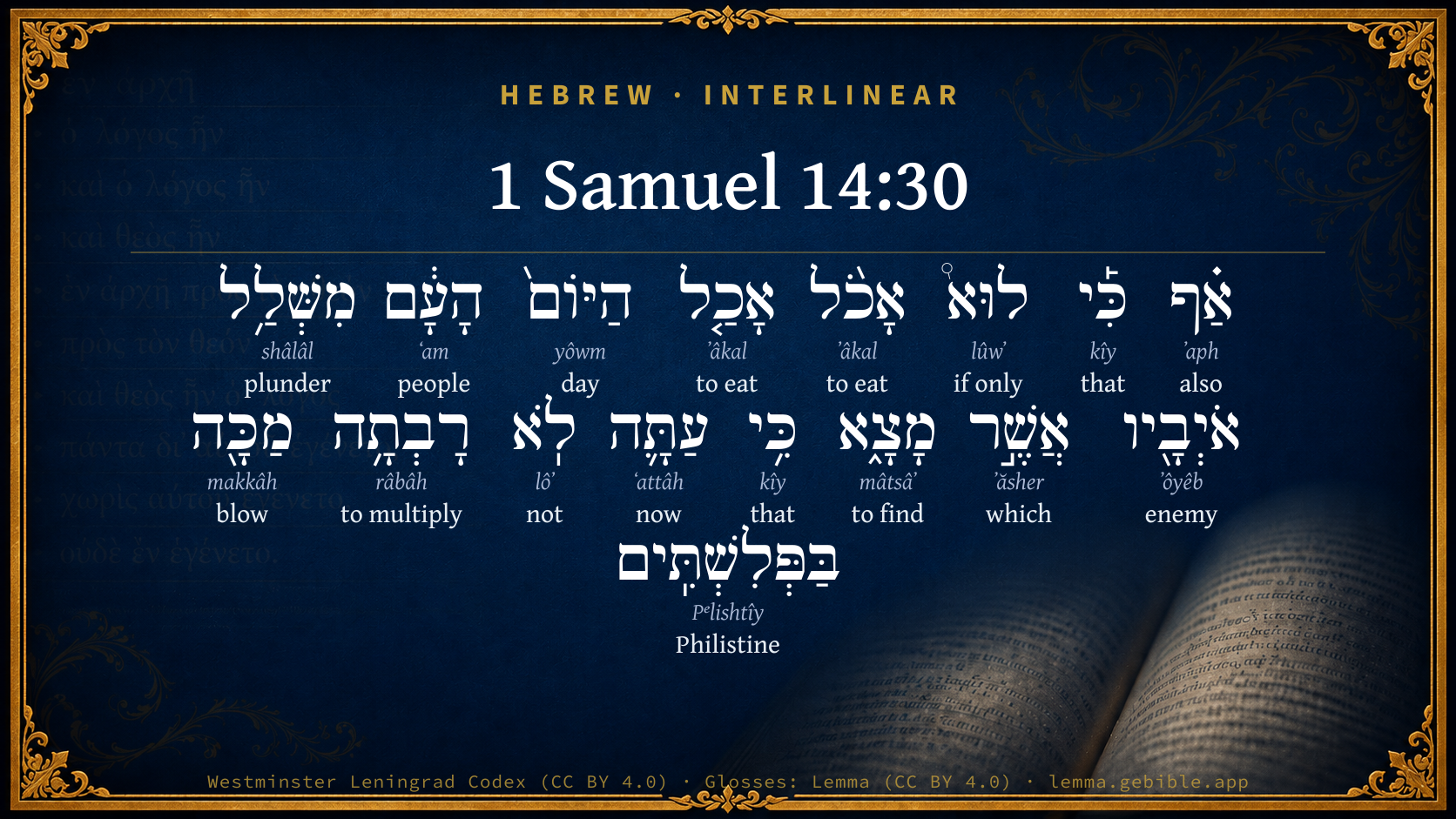
  1. אַ֗ף ʼaph H637 “also” Particle, Accusative
  2. כִּ֡י kîy H3588 “that” Conjunction
  3. אָכֹ֨ל ʼâkal H398 “to eat” Verb, Qal, Infinitive Absolute
  4. אָכַ֤ל ʼâkal H398 “to eat” Verb, Qal, Perfect, 3rd Person, Masculine, Singular
  5. הַיּוֹם֙ yôwm H3117 “the · day” Particle, Definite Article + Noun, Common, Masculine, Singular, Absolute
  6. הָעָ֔ם ʻam H5971 “the · people” Particle, Definite Article + Noun, Common, Masculine, Singular, Absolute
  7. מִשְּׁלַ֥ל shâlâl H7998 “from · plunder of” Preposition + Noun, Common, Masculine, Singular, Construct
  8. אֹיְבָ֖יו ʼôyêb H341 “enemy · him” Verb, Qal, Participle Active, Masculine, Plural, Construct + Suffix, Personal, 3rd Person, Masculine, Singular
  9. אֲשֶׁ֣ר ʼăsher H834 “which” Particle, Relative
  10. מָצָ֑א mâtsâʼ H4672 “to find” Verb, Qal, Perfect, 3rd Person, Masculine, Singular
  11. כִּ֥י kîy H3588 “that” Conjunction
  12. עַתָּ֛ה ʻattâh H6258 “now” Adverb
  13. לֹֽא lôʼ H3808 “not” Particle, Negative
  14. רָבְתָ֥ה râbâh H7235 “to multiply” Verb, Qal, Perfect, 3rd Person, Feminine, Singular
  15. מַכָּ֖ה makkâh H4347 “blow” Noun, Common, Feminine, Singular, Absolute
  16. בַּפְּלִשְׁתִּֽים Pᵉlishtîy H6430 “in/at the · Philistines” Preposition, Determined + Noun, Gentilic, Masculine, Plural, Absolute

About this verse

These counts appear in no published source. They are computed here, from the morphology-tagged text and Lemma’s own curated glosses. What Lemma adds →

17
words
15
distinct lemmas
Historical
section

Notable vocabulary

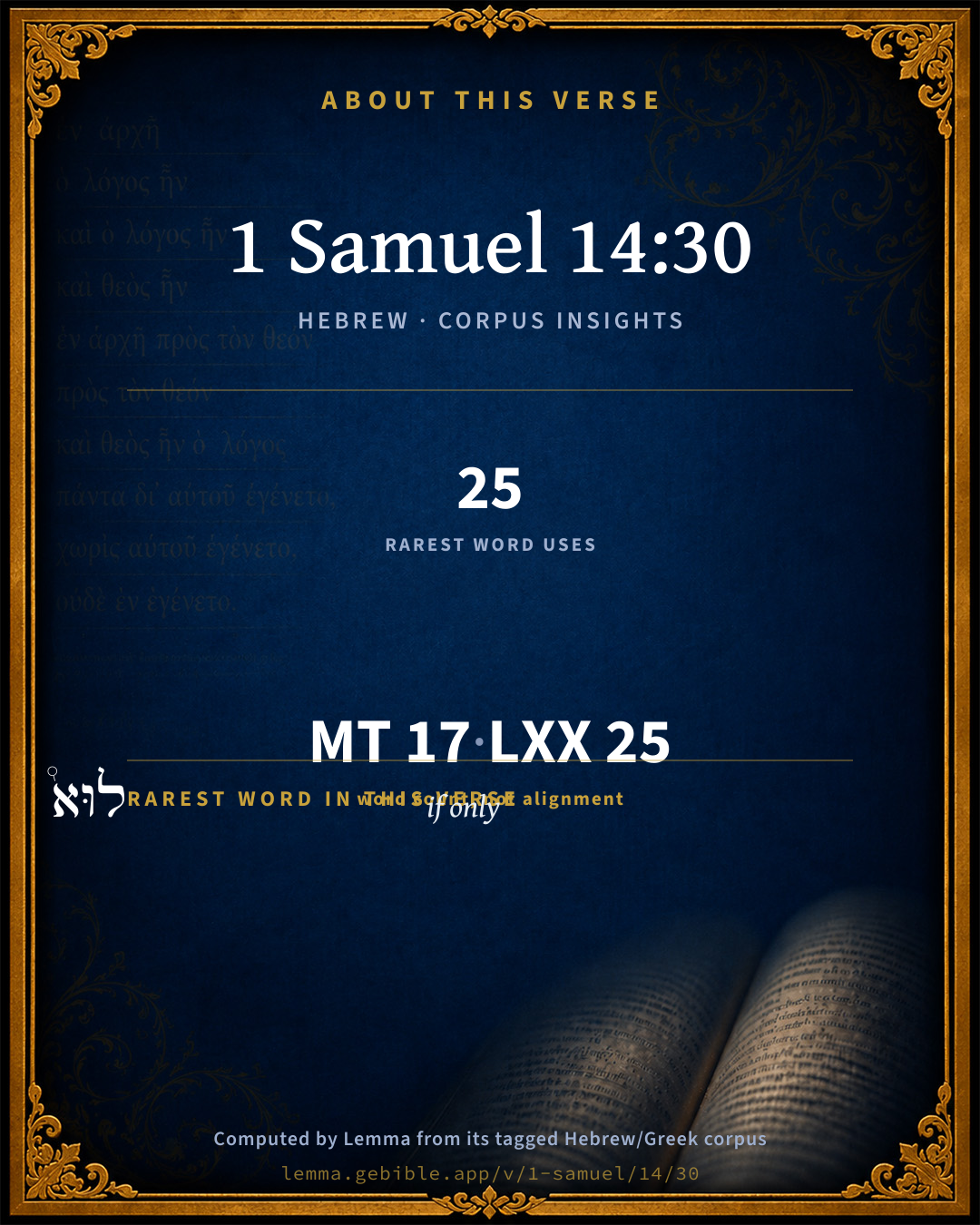
The rarest word here is לוּא֩ if only H3863 — appearing just 25 times in the whole Hebrew Bible.

Shared distinctive vocabulary

לוּא֩ if only H3863 occurs in 22 verses of the Hebrew Bible. Also found in:

Grammatical profile

  • 5 verbs
  • 5 nouns
  • 3 conjunctions
  • 1 adverb
  • 3 particles

Verb forms

  • אָכֹ֨ל Qal · Infinitive Absolute
  • אָכַ֤ל Qal · Perfect
  • אֹיְבָ֖יו Qal · Participle Active
  • מָצָ֑א Qal · Perfect
  • רָבְתָ֥ה Qal · Perfect

Repetition

Words recur within this verse — often emphatic in Hebrew:

  • אָכֹ֨ל to eat H398 ×2
  • כִּ֡י that H3588 ×2

Hebrew & Septuagint length

In English translation the verse runs 31 words from the Hebrew and 27 from the Septuagint (LXX English) — closely comparable.

A rough comparison of the two English renderings, which tokenize alike — not a word-level alignment.

Word counts can differ between the Hebrew and the Greek without any difference in meaning — e.g. the Hebrew direct-object marker אֵת has no separate Greek word, and Greek often adds the article ὁ.

In the original languages it is 17 Hebrew tokens and 25 Greek tokens — but the two are counted differently (Hebrew bundles its prefixes and suffixes into one token; the Greek is in lemma form), so that isn’t a like-for-like length.

Cross-references

1

Topical passages linked to 1 Samuel 14:30 in the Treasury of Scripture Knowledge — connected by theme and wording, ordered by reader-vote popularity; previews shown in the World English Bible.

  • Ecclesiastes 9:18 Wisdom is better than weapons of war; but one sinner destroys much good.

Cross-references courtesy of OpenBible.info (CC BY 4.0).

Hebrew and Greek witnesses Masoretic Hebrew ↔ Greek Septuagint

The same verse in the two great witnesses to the Old Testament, shown verse-for-verse.

These are two independent witnesses, not word-aligned to each other, and the Septuagint is shown in lemma (dictionary) form.

Hebrew 1 Samuel 14:30 Masoretic · Westminster Leningrad Codex

אַ֗ף כִּ֡י לוּא֩ אָכֹ֨ל אָכַ֤ל הַיּוֹם֙ הָעָ֔ם מִשְּׁלַ֥ל אֹיְבָ֖יו אֲשֶׁ֣ר מָצָ֑א כִּ֥י עַתָּ֛ה לֹֽא רָבְתָ֥ה מַכָּ֖ה בַּפְּלִשְׁתִּֽים

How much more, if haply the people had eaten freely today of the spoil of their enemies which they found? for now has there been no great slaughter among the Philistines.

World English Bible · Public Domain

Greek LXX 1 Samuel 14:30 Septuagint · lemma form

ἀλλά ὅτι εἰ ἐσθίω ἐσθίω ὁ λαός σήμερον ὁ σκῦλον ὁ ἐχθρός αὐτός ὅς εὑρίσκω ὅτι νῦν ἄν μέγας εἰμί ὁ πληγή ἐν ὁ ἀλλόφυλος

Surely if the people had this day eaten freely of the spoils of their enemies which they found, the slaughter among the Philistines would have been greater.

LXX2012 (modern English Septuagint) · Public Domain

Hebrew: Westminster Leningrad Codex (CC BY 4.0). Greek: Septuagint (public domain); English from LXX2012 (modern English Septuagint) (Public Domain). How the Septuagint differs from the Hebrew →

Targum (Aramaic paraphrase)

1

The Targum is the ancient Jewish Aramaic paraphrase of the Hebrew Scriptures — an interpretive translation, not the Hebrew text itself. Onkelos (literal) and Pseudo-Jonathan (expansive) render the Torah, and Jonathan the Prophets. Coverage is partial: where no permissively-licensed English translation exists for a verse, only the Aramaic is shown. This is verse-level text, not a word-by-word alignment to the Hebrew.

  1. Targum Jonathan Prophets (Joshua–Malachi)
    בְּרַם אִלוּ מֵיכַל אָכִיל יוֹמָא דֵין עַמָא מִבִּזַת בַּעֲלֵי דְבָבוֹהִי דְאִשְׁכַּח אֲרֵי כְעַן לָא סַגִיאַת מְחָתָא בִּפְלִשְׁתָּאֵי:

    (no public-domain English translation for this verse)

    Targum Jonathan — Aramaic: “Mikraot Gedolot” (public domain). English: “Sefaria Community Translation” (CC0 1.0 (public-domain dedication)); “London "Chaldee Paraphrase," 1871” (public domain). Text via Sefaria.

Commentary

Notes on 1 Samuel 14:30 from classic Christian and Jewish commentators (each source and its license shown beneath its notes). The classic Christian expositions comment on the surrounding passage and are grouped to its opening verse, so a note may address several verses; the Jewish commentaries on the Tanakh (Rashi and others) are per-verse, so they appear only where the commentator wrote on this verse.

Lemma curates 59 commentaries, every one of them public domain or Creative Commons licensed, each selected and text-cleaned for this edition rather than reprinted as found. About our sources →

Trapp's Complete Commentary

John Trapp

1Sa 14:30 How much more, if haply the people had eaten freely to day of the spoil of their enemies which they found? for had there not been now a much greater slaughter among the Philistines?

Ver. 30. How much more, if haply the people had eaten.] Here are his reasons wherefore he disliked his father’s act in restraining the people from eating till evening; which yet is much commended, but not so well, by Tertullian, Ambrose, Jerome, and Cajetan.

John Trapp, A Commentary or Exposition upon All the Books of the Old and New Testament (1647–1656) — public domain. Text from a community e-Sword module.

Joseph Benson's Commentary

1Sa 14:30. How much more if the people had eaten freely — They would have been able to pursue them more swiftly, and to have done greater execution upon them, than they could when they were faint. Thus men, by their rashness, hinder what they most desire.

Joseph Benson's Commentary on the Old and New Testaments (1811–1818) — public domain. Text from a community e-Sword module.

John Gill's Exposition

How much more, if haply the people had eaten freely today of the spoil of their enemies which they found?.... That is, had they been, allowed eat freely of the provisions, of bread, wine, &c. they found in the enemy's camp, they would have been much more refreshed and strengthened than it could be supposed he was with eating a little honey; if that had had such an effect upon him, of what service would a full meal have been to the people?

for had there not been now a much greater slaughter among the Philistines? the people would have had more strength to smite them, and would have pursued them with greater ardour and swiftness, and so have made a greater slaughter among them than they had; he intimates that Saul's end would have been better answered by suffering the people to eat, than by forbidding them.

John Gill's Exposition of the Whole Bible (1746–1763) — public domain (CC PDM 1.0). Text via the HelloAO Bible API.

The Pulpit Commentary

Vers. 30, 31. For had there not been now a much greater slaughter? This clause is really an indicative: "For now the slaughter of the Philistines is not very great." Nevertheless, the pursuit was continued as far as the pass of Aijalon, and though, owing to the increasing weariness of the people, but few of the Philistines were overtaken, nevertheless it would compel them to throw away their arms, and abandon all the booty which they had collected. For very faint the Hebrew has very weary, as in ver. 28.

The Pulpit Commentary (1880–1919), ed. H.D.M. Spence-Jones & Joseph S. Exell — public domain. Text from a community e-Sword module.

Rashi

Rabbi Shlomo Yitzchaki (Rashi)

Would it not now have been even greater—the blow. This is a question.

Rashi on the Tanakh — English translations: “The Judaica Press complete Tanach with Rashi, translated by A. J. Rosenberg” (CC BY 4.0); “Pentateuch with Rashi's commentary by M. Rosenbaum and A.M. Silbermann, 1929-1934” (public domain); “The Metsudah Tanach series, Lakewood, N.J” (CC BY 4.0); and “The Book of Joshua, Metsudah Publications, 1997” (CC BY 4.0). Text via Sefaria.

Lesson kit

Teaching starters — assembled from the data on this page, not authored interpretation. Every prompt links to the verse data it draws on. Edit before teaching.

1 Samuel, in the Historical, opens this verse with 17 words (15 distinct Hebrew lemmas). Its most distinctive word is lûwʼ (“if only”). A historical commentator’s framing appears above. Read the whole chapter for the surrounding context.

Discussion questions

  1. What does “if only” (lûwʼ) contribute to the verse as a whole?
  2. Genesis 17:18 shares the word «if only» with this verse. How do the two illuminate each other?
  3. “to eat” occurs 2× in this one verse. What is the effect of the repetition?
  4. The translations on this page render this verse differently — a whole-verse word diff, not a word-by-word alignment. What might account for the different wordings?
  5. The verb «אָכֹ֨ל» is Qal Infinitive Absolute. How does its form color the action?
  6. Reading how Trapp's Complete Commentary and Joseph Benson's Commentary read this verse, where do the two commentators agree and where do they part?

Things to notice

Reading settings

Reading text

Shown beneath each verse's original-language words.

Old Testament
Old Testament edition

Read the OT as the Masoretic Hebrew (MT) or the Greek Septuagint (LXX).

English shown for the Greek Septuagint (in the Hebrew ↔ Greek comparison).

Comparing translations? Open the Compare panel on any verse page to stack up to four side by side.