
Psalms 9:6

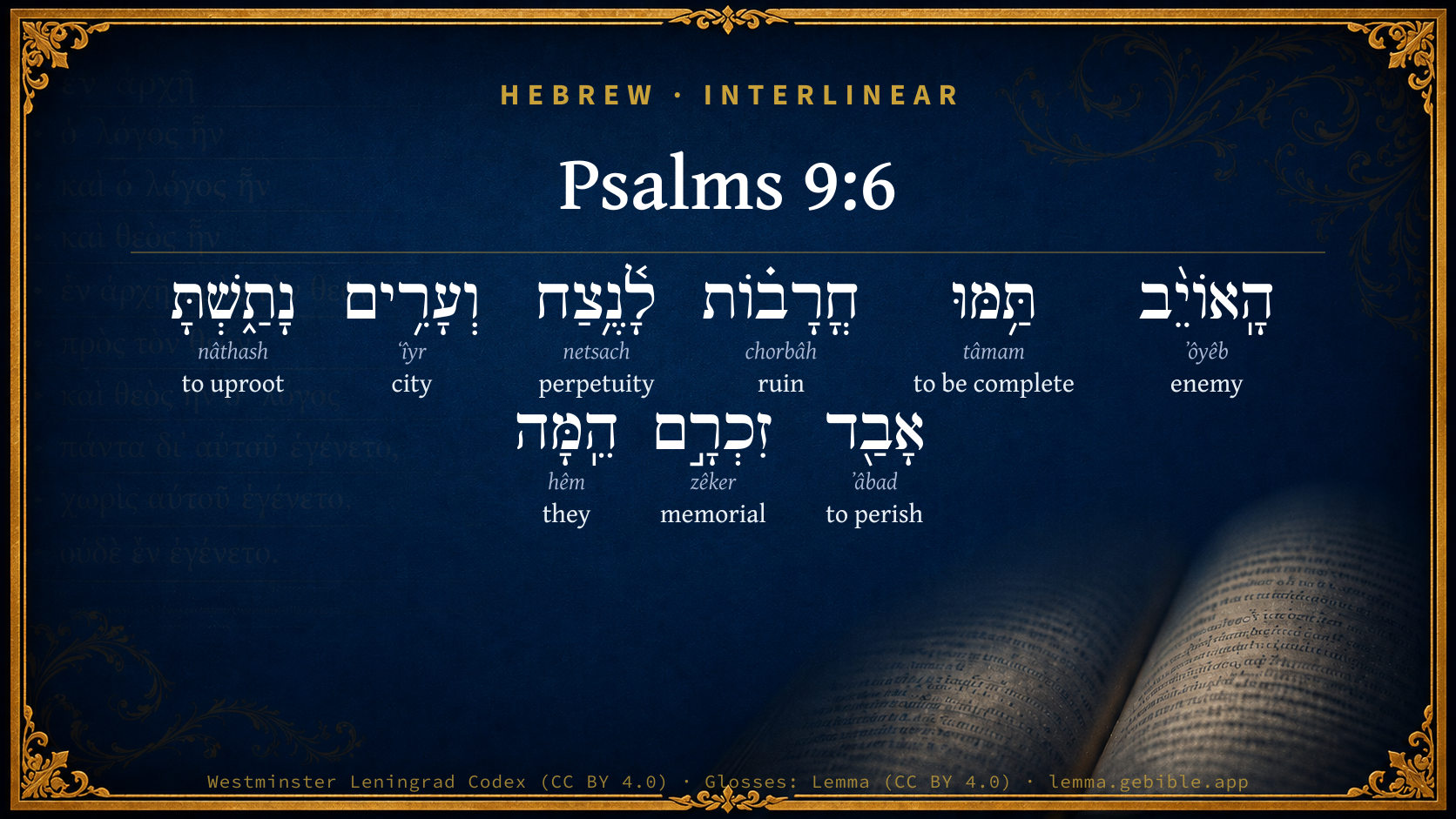
Hebrew (Westminster Leningrad Codex) Psalms 9:6 appears in the Hebrew Old Testament. The text above is from the Westminster Leningrad Codex. Each word links to its Strong’s number, a concise gloss, and parsing drawn from the Open Scriptures Hebrew Bible morphology. Click any word for its full Brown-Driver-Briggs (BDB) entry.
Download image
Cite this verse

Psalms 9:6 (World English Bible). Public Domain. Lemma interlinear Bible study tool, https://lemma.gebible.app/v/psalms/9/6.

Show BibTeX & RIS
BibTeX
RIS
English Translation
The enemy is overtaken by endless ruin. The very memory of the cities which you have overthrown has perished.
World English Bible · Public Domain
Download a study sheet

One document with this verse’s original text, its word-by-word gloss line, the meaning frame, cross-references with their text, attributed commentary, and full source and license credits — printable, and it pastes into notes with its structure intact.

This verse Autodidact and up

Study sheet (.html) Plain text (.txt)

A passage Seminary Student

Up to 50 verses in one chapter. A passage sheet keeps up to 6 commentary sources and 12 cross-references per verse, in the order this page ranks them, and says so on the sheet whenever that leaves anything out. Ask for a single verse and you get the Autodidact verse sheet above.

Everything on this page stays free to read, with no account — the sheet is a download of what is already on screen, not access to it.

Want to remove ads? Support Godless Engineer
Compare translations 3

The same verse in 3 English versions, stacked beneath the original-language interlinear above. Click any original word for its lexicon entry.

Each is an independent rendering of the whole verse — the interlinear is not word-aligned to these translations.

Highlighted words mark where these versions differ — a whole-verse word diff, not a word-by-word alignment.

  • World English Bible Public Domain
    The enemy is overtaken by endless ruin. The very memory of the cities which you have overthrown has perished.
  • King James Version Public Domain
    O thou enemy, destructions are come to a perpetual end: and thou hast destroyed cities; their memorial is perished with them.
  • unfoldingWord Literal Text CC BY-SA 4.0
    The enemy are finished—desolation forever, and you pulled up cities. them, their remembrance perished,

unfoldingWord Literal Text — © unfoldingWord, licensed CC BY-SA 4.0. Word-aligned USFM3 via Door43 (git.door43.org/unfoldingWord/en_ult).

Versions to compare (up to 4)

3 of 4 selected

Show all 18 translations

Every available English version of this verse, each an independent rendering of the whole verse.

  • World English Bible Public Domain
    The enemy is overtaken by endless ruin. The very memory of the cities which you have overthrown has perished.
  • Berean Standard Bible Public Domain
    The enemy has come to eternal ruin, and You have uprooted their cities; the very memory of them has vanished.
  • Majority Standard Bible Public Domain
    The enemy has come to eternal ruin, and You have uprooted their cities; the very memory of them has vanished.
  • King James Version Public Domain
    O thou enemy, destructions are come to a perpetual end: and thou hast destroyed cities; their memorial is perished with them.
  • American Standard Version (1901) Public Domain
    The enemy are come to an end, they are desolate for ever; And the cities which thou hast overthrown, The very remembrance of them is perished.
  • Revised Version (1885) Public Domain
    The enemy are come to an end, they are desolate for ever; and the cities which thou hast overthrown, their very memorial is perished.
  • Geneva Bible (1599) Public Domain
    O enemie, destructions are come to a perpetual end, and thou hast destroyed the cities: their memoriall is perished with them.
  • Douay-Rheims (1899) Public Domain
    Thou hast rebuked the Gentiles, and the wicked one hath perished: thou hast blotted out their name for ever and ever.
  • Young's Literal Translation Public Domain
    O thou Enemy, Finished have been destructions for ever, As to cities thou hast plucked up, Perished hath their memorial with them.
  • Literal Standard Version CC BY-SA 4.0
    The enemy—[your] destructions have been completed forever, || As for cities you have plucked up, || Their memorial has perished with them.
  • Unlocked Literal Bible CC BY-SA 4.0
    The enemy crumbled like ruins when you overthrew their cities. All remembrance of them has perished.
  • unfoldingWord Literal Text CC BY-SA 4.0
    The enemy are finished—desolation forever, and you pulled up cities. them, their remembrance perished,
  • Darby Bible Public Domain
    O enemy! destructions are ended for ever. -- Thou hast also destroyed cities, even the remembrance of them hath perished.
  • World Messianic Bible Public Domain
    The enemy is overtaken by endless ruin. The very memory of the cities which you have overthrown has perished.
  • Webster's Bible Public Domain
    \\9:5\\Thou hast rebuked the heathen, thou hast destroyed the wicked, thou hast put out their name for ever and ever.
  • Free Bible Version CC BY-SA 4.0
    The enemies are finished, ruined forever; their cities are destroyed—even the memory of them is gone.
  • Bible in Basic English Public Domain
    You have given their towns to destruction; the memory of them has gone; they have become waste for ever.
  • JPS Tanakh (1917) Public Domain
    (9-7) O thou enemy, the waste places are come to an end for ever; and the cities which thou didst uproot, their very memorial is perished.

Literal Standard Version (2020), Covenant Press — licensed CC BY-SA 4.0. Text via the HelloAO Bible API (eBible.org). Unlocked Literal Bible (unfoldingWord) — licensed CC BY-SA 4.0. Text via the HelloAO Bible API (eBible.org). unfoldingWord Literal Text — © unfoldingWord, licensed CC BY-SA 4.0. Word-aligned USFM3 via Door43 (git.door43.org/unfoldingWord/en_ult). Free Bible Version, Dr. Jonathan Gallagher — licensed CC BY-SA 4.0. Text via the HelloAO Bible API (eBible.org).

Word by word

More ways to search: Search by grammar → Find every occurrence → Compare this word →

Practice this passage: Drill this verse → Learn its vocabulary →

נָתַ֑שְׁתָּ
nâthash
H5428
“to uproot”
Verb, Qal, Perfect, 2nd Person, Masculine, Singular
Part of Speech
Verb
Stem
Qal
Form
Perfect
Person
2nd Person
Gender
Masculine
Number
Singular
Full BDB Definition

Origin: a primitive root

TWOT: 1451

to pull up, expel, root out, pluck up - (Qal) to pull or pluck up - (Niphal) to be plucked up - (Hophal) to be plucked up
  1. הָֽאוֹיֵ֨ב ʼôyêb H341 “the · enemy” Particle, Definite Article + Verb, Qal, Participle Active, Masculine, Singular, Absolute
  2. תַּ֥מּוּ tâmam H8552 “to be complete” Verb, Qal, Perfect, 3rd Person, Common, Plural
  3. חֳרָב֗וֹת chorbâh H2723 “ruins” Noun, Common, Feminine, Plural, Absolute
  4. לָ֫נֶ֥צַח netsach H5331 “to/for · perpetuity” Preposition + Noun, Common, Masculine, Singular, Absolute
  5. וְעָרִ֥ים ʻîyr H5892 “and · cities” Conjunction + Noun, Common, Feminine, Plural, Absolute
  6. אָבַ֖ד ʼâbad H6 “to perish” Verb, Qal, Perfect, 3rd Person, Masculine, Singular
  7. זִכְרָ֣ם zêker H2143 “memorial · their” Noun, Common, Masculine, Singular, Construct + Suffix, Personal, 3rd Person, Masculine, Plural
  8. הֵֽמָּה hêm H1992 “they” Pronoun, Personal, 3rd Person, Masculine, Plural

About this verse

These counts appear in no published source. They are computed here, from the morphology-tagged text and Lemma’s own curated glosses. What Lemma adds →

9
words
9
distinct lemmas
Wisdom
section

Notable vocabulary

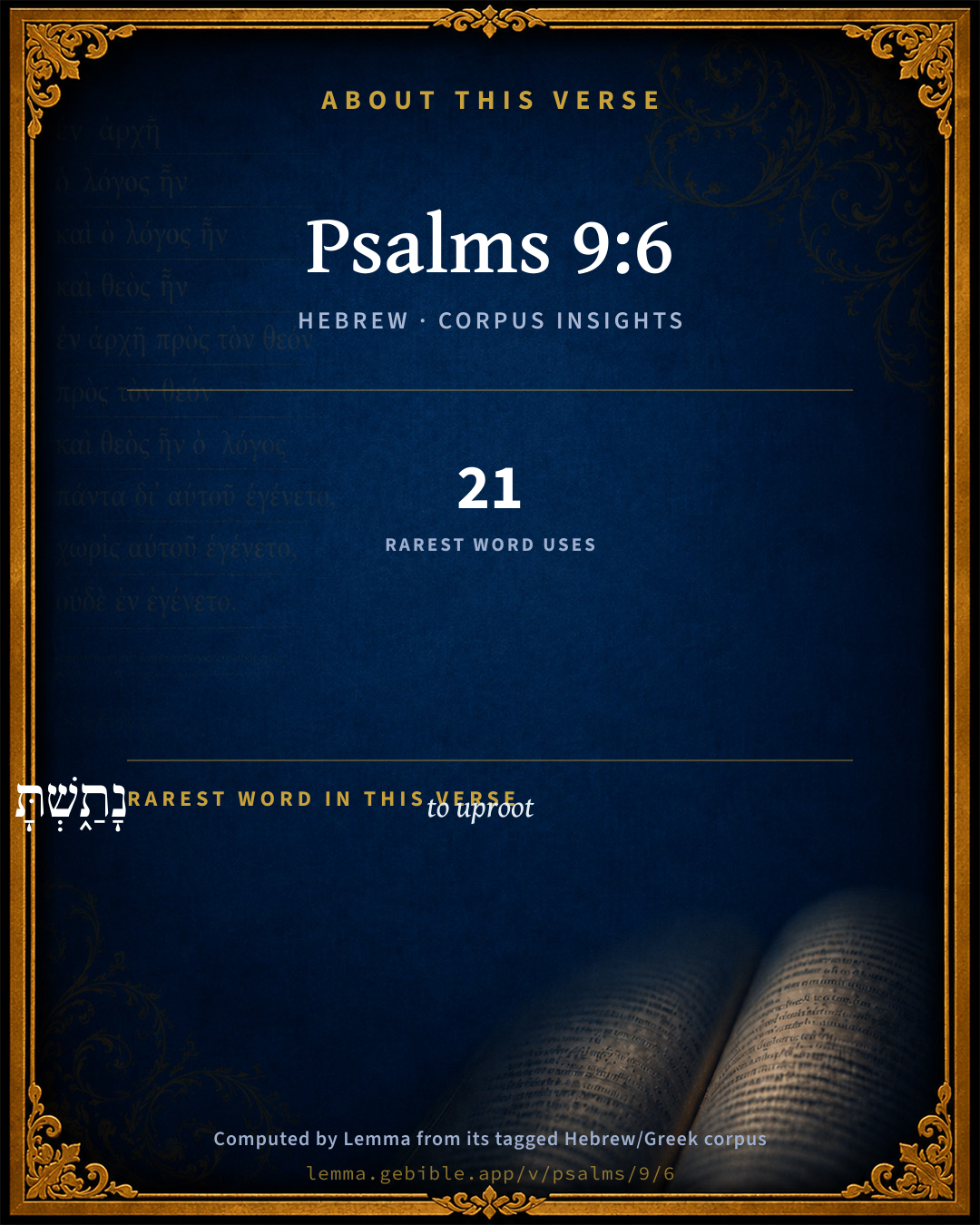
The rarest word here is נָתַ֑שְׁתָּ to uproot H5428 — appearing just 21 times in the whole Hebrew Bible.

Shared distinctive vocabulary

נָתַ֑שְׁתָּ to uproot H5428 occurs in 19 verses of the Hebrew Bible. Also found in:

Grammatical profile

  • 4 verbs
  • 4 nouns
  • 1 pronoun

Verb forms

  • הָֽאוֹיֵ֨ב Qal · Participle Active
  • תַּ֥מּוּ Qal · Perfect
  • נָתַ֑שְׁתָּ Qal · Perfect
  • אָבַ֖ד Qal · Perfect

Hebrew & Septuagint length

In English translation the verse runs 19 words from the Hebrew and 21 from the Septuagint (LXX English) — closely comparable.

A rough comparison of the two English renderings, which tokenize alike — not a word-level alignment.

Word counts can differ between the Hebrew and the Greek without any difference in meaning — e.g. the Hebrew direct-object marker אֵת has no separate Greek word, and Greek often adds the article ὁ.

Cross-references

24

Topical passages linked to Psalms 9:6 in the Treasury of Scripture Knowledge — connected by theme and wording, ordered by reader-vote popularity; previews shown in the World English Bible.

  • Exodus 14:13 Moses said to the people, "Don't be afraid. Stand still, and see the salvation of Yahweh, which he will work for you today: for the Egyptians whom you have seen today, you shall never see them again.
  • Isaiah 14:22–23 I will rise up against them, says Yahweh of Hosts, and cut off from Babylon name and remnant, and son and son's son, says Yahweh.
  • Micah 7:8 Don't rejoice against me, my enemy. When I fall, I will arise. When I sit in darkness, Yahweh will be a light to me.
  • 1 Corinthians 15:26 The last enemy that will be abolished is death.
  • Revelation 20:2 He seized the dragon, the old serpent, which is the devil and Satan, who deceives the whole inhabited earth, and bound him for a thousand years,
  • Exodus 15:16 Terror and dread falls on them. By the greatness of your arm they are as still as a stone; Until your people pass over, Yahweh, Until the people pass over who you have purchased.
  • 1 Samuel 31:7 When the men of Israel who were on the other side of the valley, and those who were beyond the Jordan, saw that the men of Israel fled, and that Saul and his sons were dead, they forsook the cities, and fled; and the Philistines came and lived in them.
  • 2 Kings 19:25 Haven't you heard how I have done it long ago, and formed it of ancient times? now have I brought it to pass, that it should be yours to lay waste fortified cities into ruinous heaps.
  • Psalms 7:5 Let the enemy pursue my soul, and overtake it; Yes, let him tread my life down to the earth, And lay my glory in the dust. Selah.
  • Psalms 8:2 From the lips of babes and infants you have established strength, Because of your adversaries, that you might silence the enemy and the avenger.
  • Psalms 34:16 Yahweh's face is against those who do evil, To cut off the memory of them from the earth.
  • Psalms 46:9 He makes wars cease to the end of the earth. He breaks the bow, and shatters the spear. He burns the chariots in the fire.
  • Isaiah 10:6–7 I will send him against a profane nation, and against the people of my wrath will I give him a charge, to take the spoil, and to take the prey, and to tread them down like the mire of the streets.
  • Isaiah 10:24–25 Therefore thus says the Lord, Yahweh of Hosts, my people who dwell in Zion, don't be afraid of the Assyrian, though he strike you with the rod, and lift up his staff against you, after the manner of Egypt.
  • Isaiah 14:6–8 who struck the peoples in wrath with a continual stroke, who ruled the nations in anger, with a persecution that none restrained.
  • Isaiah 14:17 who made the world as a wilderness, and overthrew the cities of it; who didn't let loose his prisoners to their home?"
  • Isaiah 37:26 Have you not heard how I have done it long ago, and formed it of ancient times? now have I brought it to pass, that it should be your to lay waste fortified cities into ruinous heaps.
  • Jeremiah 51:25 Behold, I am against you, destroying mountain, says Yahweh, which destroy all the earth; and I will stretch out my hand on you, and roll you down from the rocks, and will make you a burnt mountain.
  • Jeremiah 51:62–64 and say, Yahweh, you have spoken concerning this place, to cut it off, that none shall dwell therein, neither man nor animal, but that it shall be desolate forever.
  • Micah 7:10 Then my enemy will see it, And shame will cover her who said to me, Where is Yahweh your God? Then my enemy will see me and will cover her shame. Now she will be trodden down like the mire of the streets.
  • Nahum 1:9–13 What do you plot against Yahweh? He will make a full end. Affliction won't rise up the second time.
  • 1 Corinthians 15:54–57 But when this corruptible will have put on incorruption, and this mortal will have put on immortality, then what is written will happen: "Death is swallowed up in victory."
  • 1 Samuel 30:1 It happened, when David and his men were come to Ziklag on the third day, that the Amalekites had made a raid on the South, and on Ziklag, and had struck Ziklag, and burned it with fire,
  • Isaiah 10:13–14 For he has said, By the strength of my hand I have done it, and by my wisdom; for I have understanding: and I have removed the bounds of the peoples, and have robbed their treasures, and like a valiant man I have brought down those who sit [on thrones]:

Cross-references courtesy of OpenBible.info (CC BY 4.0).

Hebrew and Greek witnesses Masoretic Hebrew ↔ Greek Septuagint

The same verse in the two great witnesses to the Old Testament, shown verse-for-verse.

You’re reading Greek Psalm 9 (Hebrew Psalm 9). The Septuagint counts the superscription, so verse numbers can differ from the Hebrew — chapter-level alignment, not verse-by-verse. Numbering follows Rahlfs.

These are two independent witnesses, not word-aligned to each other, and the Septuagint is shown in lemma (dictionary) form.

Hebrew Psalms 9:6 Masoretic · Westminster Leningrad Codex

הָֽאוֹיֵ֨ב תַּ֥מּוּ חֳרָב֗וֹת לָ֫נֶ֥צַח וְעָרִ֥ים נָתַ֑שְׁתָּ אָבַ֖ד זִכְרָ֣ם הֵֽמָּה

The enemy is overtaken by endless ruin. The very memory of the cities which you have overthrown has perished.

World English Bible · Public Domain

Greek LXX Greek Psalm 9:6 Septuagint · lemma form

ἐπιτιμάω ἔθνος καί ἀποὀλλύω ὁ ἀσεβής ὁ ὄνομα αὐτός ἐκἀλείφω εἰς ὁ αἰών καί εἰς ὁ αἰών ὁ αἰών

The swords of the enemy have failed utterly; and you have destroyed cities: their memorial has been destroyed with a noise,

LXX2012 (modern English Septuagint) · Public Domain

On this verse, Ellicott's Commentary for English Readers discusses the Septuagint’s reading. Read the note in Commentary ↓

Hebrew: Westminster Leningrad Codex (CC BY 4.0). Greek: Septuagint (public domain); English from LXX2012 (modern English Septuagint) (Public Domain). How the Septuagint differs from the Hebrew →

Commentary

Notes on Psalms 9:6 from classic Christian and Jewish commentators (each source and its license shown beneath its notes). The classic Christian expositions comment on the surrounding passage and are grouped to its opening verse, so a note may address several verses; the Jewish commentaries on the Tanakh (Rashi and others) are per-verse, so they appear only where the commentator wrote on this verse.

Lemma curates 59 commentaries, every one of them public domain or Creative Commons licensed, each selected and text-cleaned for this edition rather than reprinted as found. About our sources →

The Cambridge Bible for Schools and Colleges

gen. ed. J. J. S. Perowne

6. The enemy are consumed, left desolate for ever;

And (their) cities thou didst uproot; the very remembrance of them is perished.

An address to the enemy (P.B.V. and A.V.) would be out of place here; and the word rendered destructions does not bear an active sense, but means ruins or desolations. It is best to regard the words as still addressed to Jehovah, continuing the description of His judgment on the enemies of Israel. The language of this and the preceding verse recalls that of the curse on Amalek: “I will utterly blot out the remembrance of Amalek from under heaven” (Exo_17:14; cp. Deu_25:19). ‘Their memorial’ or ‘remembrance’ refers grammatically to the enemy, not to the cities, and the pronoun is repeated in the original to emphasise the contrast between those who are thus destroyed and forgotten, and Jehovah who sits enthroned on high for ever.

Critical reasons however suggest a slight alteration of the text. If the emphatic pronoun is transferred from the end of Psa_9:6 to the beginning of Psa_9:7, and a verb supplied, we may render,

They are perished, but the Lord sitteth &c.

This emendation (approved by Delitzsch) marks the contrast still more strongly (cp. Psa_102:26), and moreover makes the pair of Psa_9:7-8 begin, as they should, with the letter Hç. There is also much to be said in favour of transposing the clauses of Psa_9:6 thus, as proposed by Nowack:

The enemy are consumed, the remembrance of them is perished:

And the cities thou didst uproot are desolate for ever.

The Cambridge Bible for Schools and Colleges (gen. ed. J. J. S. Perowne; Cambridge University Press, 1878–1918) — public domain. Text from a community e-Sword module.

Trapp's Complete Commentary

John Trapp

Psa 9:6 O thou enemy, destructions are come to a perpetual end: and thou hast destroyed cities; their memorial is perished with them.

Ver. 6. O thou enemy] The same whom he called wicked one in the former verse; where the word wicked is of the singular number: q.d. O thou implacable wretch, that wouldst never be reconciled till thou wast ruined; which now thou art, &c. Some read it interrogatively, and with it ironically, O enemy, are destructions come to an end? and cities so wasted that they can never be repaired? q.d. So indeed thou hast designed it, but art fairly disappointed. And the like befell Antiochus, Nero, Dioclesian, Philip II of Spain, Charles IX of France, and other bloody persecutors, with tbeir devilish thoughts and threats; which they could never effect and accomplish.

Their memorial is perished with them] Heb. Of them, of them (twice), for more vehemency. The Vulgate (alter the Greek) hath it cum sonitu, with a humming noise, so that the sound thereof ringeth all the world over. R. David rendereth it, Memoria eorum periit; suntne illi? Their memorial is perished; have they yet a being anywhere?

John Trapp, A Commentary or Exposition upon All the Books of the Old and New Testament (1647–1656) — public domain. Text from a community e-Sword module.

Joseph Benson's Commentary

Psa 9:6. O thou enemy, &c. — This is a sudden apostrophe to the enemies of God’s people, the Philistines, Amorites, or other nations which had formerly made great havoc and waste among them: Destructions are come to a perpetual end — Thou hast formerly wasted and destroyed the people of God, but those destructions have now come to an end, and shall cease. Thy power to annoy Israel is now broken. Christians, when repeating those words, “may take a retrospect view of the successive fall of those empires, with their capital cities, in which the enemy had, from time to time, fixed his residence, and which had vexed and persecuted the people of God in different ages. Such were the Assyrian or Babylonian, the Persian and the Grecian monarchies. All these vanished away, and came to nothing. Nay, the very memorial of the stupendous Nineveh and Babylon is so perished with them that the place where they once stood is now no more to be found. The Roman empire was the last of the pagan persecuting powers; and when the church saw that under her feet, well might she cry out, The destructions of the enemy are completed to the uttermost! How lovely will this song be in the day when the last enemy shall be destroyed, and the world itself shall become what Babylon is at present.” — Horne.

Joseph Benson's Commentary on the Old and New Testaments (1811–1818) — public domain. Text from a community e-Sword module.

J. A. Alexander on Psalms

Joseph Addison Alexander

7. (Psa 9:6). The enemy, or as to the enemy, a nominative absolute placed at the beginning of the sentence for the sake of emphasis—finished, completed, are (his) ruins, desolations, for ever; i. e. he is ruined or made desolate for ever. The construction of the first word as a vocative— O enemy, ended are (thy) desolations for ever, i. e. the desolations caused by thee—affords a good sense, but is neither so agreeable to usage nor to the context as the one first given. Still less so are the other versions which have been given of this difficult clause. E. g. The enemies are completely desolate for ever; —the enemies are consumed, (there are) ruins (or desolations) for ever, etc. The address is still to Jehovah, as in the preceding verse. And (their) cities, viz. those of the enemy, hast thou destroyed. According to the second construction above given, this would mean, thou (O enemy) hast destroyed us to prefer Jehovah as the object of address. Gone, perish, is their very memory. The idiomatic form of the original in this clause cannot be retained in a translation. The nearest approach to it would be, gone is their memory, themselves. This may either mean their memory, viz. (that of) themselves, i. e. their own; or, perished is their memory (and) themselves (with it). There seems to be an obvious allusion to the threatenings against Amalek in the books of Moses (Exo 17:14; Num 24:20; Deu 25:19), which received their literal fulfilment in the conquests of Saul and David (1Sa 15:3; 1Sa 15:7; 1Sa 27:8-9; 1Sa 30:1; 1Sa 30:17; 2Sa 8:12; 1Ch 4:43). But this is evidently here presented merely as a sample of other conquests over the surrounding nations (2Sa 8:11-14), and even these as only samples of the wonders wrought by God for his own people, and celebrated in Psa 9:2 (1) above.

Joseph Addison Alexander, The Psalms Translated and Explained (1850) — public domain. Text from a community e-Sword module.

Geneva Bible (1599)

Geneva Bible translators

A derision of the enemy, that mindeth nothing but destruction: but the Lord will deliver his, and bring him into judgment.

Geneva Bible (1599) marginal notes — public domain. Text via Bolls.life.

Jamieson, Fausset & Brown

Robert Jamieson, A. R. Fausset & David Brown

Literally, "As to the enemy finished are his ruins for ever. Thou [God] hast destroyed," &c. (Sa1 15:3, Sa1 15:7; Sa1 27:8-9). The wicked are utterly undone. Their ruins shall never be repaired.

Jamieson, Fausset & Brown — Commentary Critical and Explanatory on the Whole Bible (1871) — public domain (CC PDM 1.0). Text via the HelloAO Bible API.

Adam Clarke's Commentary

Verse 6. Destructions are come to a perpetual end] Rather, "The enemy is desolated for ever; for thou hast destroyed their cities, and their memory is perished with them." Multitudes of the cities of the Canaanites have perished so utterly that neither name nor vestige remains of them.

Adam Clarke's Commentary on the Bible (1810–1826) — public domain. Text from a community e-Sword/MySword module.

John Calvin's Commentaries

6. O thou enemy, desolations are come to an end for ever. This sixth verse is explained in different ways. Some read it interrogatively, viewing the letter ה, as a mark of interrogation, as if David, addressing his discourse to his enemies, asked whether they had completed their work of devastation, even as they had resolved to destroy every thing; for the verb תמם, tamam, signifies sometimes to complete, and sometimes to put an end to any thing. And if we here take it in this sense, David, in the language of sarcasm or irony, rebukes the foolish confidence of his enemies. Others, reading the verse without any interrogation, make the irony still more evident, and think that David describes, in these three verses, a twofold state of matters; that, in the first place, (verse 6,) he introduces his enemies persecuting him with savage violence, and persevering with determined obstinacy in their cruelty, so that it seemed to be their fixed purpose never to desist until the kingdom of David should be utterly destroyed; and that, in the second place, (verses 7, 8) he represents God as seated on his judgment-seat, directly over against them, to repress their outrageous attempts. If this sense is admitted, the copulative, in the beginning of the seventh verse, which we have translated and, must be rendered by the adversative particle but, in this way: Thou, O enemy, didst seek after nothing except slaughter and the destruction of cities; but, at length, God has shown that he sits in heaven on his throne as judge, to put into proper order the things which are in confusion on the earth. According to others, David gives thanks to God, because, when the ungodly were fully determined to spread universal ruin around them, he put an end to their devastations. Others understand the words in a more restricted sense, as meaning that the desolations of the ungodly were completed, because God, in his just judgment, had made to fall upon their own heads the calamities and ruin which they had devised against David. According to others, David, in the 6th verse, complains that God had, for a long time, silently suffered the miserable devastation of his people, so that the ungodly, being left unchecked, wasted and destroyed all things according to their pleasure; and in the seventh verse, they think he subjoins for his consolation that God, notwithstanding, presides over human affairs. I have no objection to the view, that there is first described ironically how dreadful the power of the enemy was, when they put forth their highest efforts; and next, that there is set in opposition to it the judgment of God, which suddenly brought their proceedings to an abrupt termination, contrary to their expectation. They anticipated no such issue; for we know that the ungodly, although they may not presume openly to deprive God of his authority and dominion, yet run headlong to every excess of wickedness, not less boldly than if he were bound with fetters. “Que s’il avait les pieds et mains liees.” — Fr. “Than if he were bound hand and foot.”

This contrast between the power of the enemies of God and his people, and the work of God in breaking up their proceedings, very well illustrates the wonderful character of the succor which he granted to his people. The ungodly had set to themselves no limit in the work of doing mischief, save in the utter destruction of all things, and at the commencement complete destruction seemed to be at hand; but when things were in this state of confusion, God seasonably made his appearance for the help of his people. “Dieu s’est montre bien a propos pour secourir les gens. — Fr.

“De quelque coste que nous-nous seachions tourner.” — Fr.

John Calvin's Commentaries (1540-1563) — public domain. Text from the Calvin Translation Society English edition (1840s-50s) via the Christian Classics Ethereal Library (ccel.org). Calvin's coverage is partial (roughly two-thirds of the Bible); uncommented books and verses are honest gaps, never fabricated. The 19th-century editor's footnotes and remarks are omitted so the notes are faithfully Calvin's own voice.

Ellicott's Commentary for English Readers

(6) O thou enemy . . .—This vocative gives no intelligible meaning. Translate, As for the enemy, they are made an utter wreck and perpetual ruin.

Destructions.—Properly, desolations, ruins, from a word meaning “to be dried up.”

Come to a perpetual end.—Properly, are completed for ever.

Thou hast destroyed.—Some understand the relative: “the cities which thou hast destroyed.”

Their memorial.—Better, their very memory is perished; literally, their memory, theirs. (Comp. “He cannot flatter, he”—Shakespeare, King Lear). The LXX. and Vulg. read, “with a sound,” referring to the crash of falling cities. Some would substitute enemies for cities, but they lose the emphasis of the passage, which points to the utter evanishment from history of great cities as a consequence and sign of Divine judgment. Probably the poet thinks of Sodom and Gomorrha, whose overthrow left such a signal mark on the thought of Israel. We think of the mounds of earth which alone represent Nineveh and Babylon.

“’Mid far sands,

The palm-tree cinctured city stands,

Bright white beneath, as heaven, bright blue,

Leans over it, while the years pursue

Their course, unable to abate

Its paradisal laugh at fate.

One morn the Arab staggers blind

O’er a new tract of earth calcined

To ashes, silence, nothingness,

And strives, with dizzy wits, to guess

Whence fell the blow.”—R. BROWNING: Easter Day.

A Bible Commentary for English Readers, edited by Charles John Ellicott (1878–1897) — public domain. Text from a community e-Sword module.

John Gill's Exposition

But the Lord shall endure for ever,.... When antichrist is entirely ruined, his cities destroyed, and the memorial of them perished, then "shall the Lord sit for ever" (g), as the words may be rendered; that is, as a Jewish writer (h) paraphrases them, in rest and quiet. The words may be expressive of the unchangeableness and eternity and power of God; the Chaldee paraphrase of them is, , "the Word of the Lord is for ever; his habitation is in the highest heavens". And they may very well be interpreted of Christ, the essential Word of God, who is the unchangeable, everlasting, and almighty God; and who sits King for ever, and must sit at God's right hand, in the highest heavens, until all his enemies are made his footstool; and to him most properly do the following things in this verse Psa 9:8 belong:

he hath prepared his throne for judgment; for the administration of judgment in this world, for the particular judgment after death, and for the general judgment after the resurrection of the dead; which seems by what follows to be chiefly meant, and which will come on after the destruction of antichrist; and all things are preparing for it; the day is appointed in which God will judge the world; Christ is ordained to be the Judge of quick and dead; devils and ungodly men are reserved to the judgment of the great day; the throne is ready, which will be a white one, Rev 20:11; denoting the purity, justice, and uprightness of the Judge, who himself is at the door.

(g) "sedebit", Montanus, Junius & Tremellius, Cocceius, Michaelis; so Ainsworth; "sedet", Vatablus, Musculus. (h) R. Abraham Seba in Tzeror Hammor, fol. 150. 2.

John Gill's Exposition of the Whole Bible (1746–1763) — public domain (CC PDM 1.0). Text via the HelloAO Bible API.

Albert Barnes' Notes on the Bible

O thou enemy! - This verse has been very variously rendered and explained. For an examination of the particular views entertained of it, see particularly Rosenmuller, in loc. The reference is doubtless to the enemies mentioned in the previous verses; and the idea is substantially the same - that they were completely overcome and subdued. The phrase, “O thou enemy,” is probably to be regarded as the nominative absolute. “The enemy - his destructions or desolations are finished forever. He will now no more engage in that work.” The attention of the writer is fixed on them, and on the fact that they will no more engage in the work of desolation. It is not, therefore, properly to be regarded, as it is rendered in the common translation, as an apostrophe to the enemy, but rather as indicating a state of mind in which the writer is meditating on his foes, and on the fact that they would no more engage in the work in which they had been occupied - of laying cities and towns in ruins.

Destructions are come to a perpetual end - That is, thy destructions are finished, completed, accomplished. There are to be no more of them. This may either refer to their acts causing destruction, or laying waste cities and towns, meaning that they would no more accomplish this work; or to the destruction or ruins which they had caused in laying waste cities - the ruins which marked their career - meaning that the number of such ruins was now complete, and that no more would be added, for they them. selves were overthrown. The word rendered “destructions” means properly desolations, waste places, ruins, and seem here to refer to the wastes or ruins which the enemy had made; and the true idea is, that such desolations were now complete, or that they would not be suffered to devastate anymore cities and fields. Prof. Alexander renders this, “finished, completed are (his) ruins, desolations, forever; that is, he is ruined or made desolate forever.”

And thou hast destroyed cities - That is, in thy desolating career. This, considered as an address to the enemy, would seem to refer to the career of some victor who had Carried fire and sword through the land, and whose course had been marked by smoking ruins. This was, however, now at an end, for God had interposed, and had given the author of the psalm a victory ever his foe. Prof. Alexander regards this, less properly, as an address to God, meaning that he had destroyed the cities of the enemy. The idea is, rather, that this enemy had been distinguised for spreading desolation and ruin, and that this career was now closed forever.

Their memorial is perished with them - The names of the cities, referring to their utter destruction, and to the character of the warfare which had been waged. It had been utterly barbarous and vicious; the enemy had left nothing to testify even what the city had been, and its name had ceased to be mentioned. See the notes at Psa 9:5. This seems to be mentioned as a justification of the warfare which the author of the psalm had waged against this enemy, and as showing why God had interposed and had given him the victory.

Albert Barnes' Notes on the Bible (1834–1885) — public domain. Text from a community e-Sword/MySword module.

Matthew Poole's English Annotations

This is a sudden apostrophe to the enemies of God’s people, Philistines, Amorites, or other nations, who had formerly made great havoc and waste among them.

Destructions are come to a perpetual end; thou hast destroyed the Israelitish nation utterly and irrecoverably, and, as it follows, their defenced cities, and their very name and memory, according to thy own desire. So it is a sarcasm or irony, a usual figure in Scripture and all authors, whereby the quite contrary is signified, to wit, that they were not only frustrated of their desires and hopes of destroying the Israelites, but were also subdued, and in a great part destroyed by them. Or this verse may be understood of the great waste and ruin which God’s enemies had brought upon Israel before this time; which is here remembered, to make the Israelites more thankful for their later or present deliverances. Or it may be taken as a prophecy of the future calamities which the enemies should by God’s permission bring upon Israel, of which he speaks as of a thing past and done, after the manner of the prophets. But this place is otherwise rendered in the margin of our Bibles, and by divers others, the destructions of the enemy which may be understood either,

1. Actively, which they caused; or,

2. Passively, which they felt

are come to a perpetual end, or, are fully and finally completed. Thou hast destroyed cities; either,

1. Thou, O God, who is oft understood and couched in a pronoun in this manner, thou hast destroyed their cities. Or rather,

2. Thou, O enemy; as may be gathered both from the foregoing clause, where it is so expressed; and from the next verse, where it follows by way of opposition to this, But the Lord, &c. Their memorial is perished with them; the places and people are utterly extinct.

Matthew Poole's English Annotations on the Holy Bible (1683–1685) — public domain. Text from a community e-Sword/MySword module.

The Treasury of David

Charles H. Spurgeon

Ver. 6. Here the Psalmist exults over the fallen foe. He bends as it were, over his prostrate form, and insults his once vaunted strength. He plucks the boaster's song out of his mouth, and sings it for him in derision. After this fashion doth our Glorious Redeemer ask of death, "Where is thy sting?" and of the grave, "Where is thy victory?" The spoiler is spoiled, and he who made captive is led into captivity himself. Let the daughters of Jerusalem go forth to meet their King, and praise him with timbrel and harp.

None.

Ver. 6.

1. The great enemy.

2. The destruction he has caused.

3. The means of his overthrow.

4. The rest which shall ensue.

In the light of the past the future is not doubtful. Since the same Almighty God fills the throne of power, we can with unhesitating confidence, exult in our security for all time to come.

Charles H. Spurgeon's The Treasury of David (1869–1885) — public domain. Psalms only. Text from a community e-Sword/MySword module.

The Pulpit Commentary

O thou enemy, destructions are come to a perpetual end. It is better to translate, with the Revised Version, The enemy are come to an end; they are desolate for ever a continuance of the hyperbole already noticed in the preceding verse. And thou hast destroyed cities; their memorial is perished with them; rather, and as for the cities thou hast destroyed, their very memory has perished. This could only be an anticipation. It was fulfilled in the complete disappearance from history of the names of Zoba, Beth-rehob, and Tob, after the victory described in 2Sa_10:13, 2Sa_10:14.

The Pulpit Commentary (1880–1919), ed. H.D.M. Spence-Jones & Joseph S. Exell — public domain. Text from a community e-Sword module.

Rashi

Rabbi Shlomo Yitzchaki (Rashi)

You rebuked nations [This alludes to Amalek, described in Num. 24:20 as] “Amalek is the first of the nations.”

You destroyed a wicked man Esau.

You erased their name “For I will surely erase the remembrance of Amalek” (Exod. 17:14).

Rashi on the Tanakh — English translations: “The Judaica Press complete Tanach with Rashi, translated by A. J. Rosenberg” (CC BY 4.0); “Pentateuch with Rashi's commentary by M. Rosenbaum and A.M. Silbermann, 1929-1934” (public domain); “The Metsudah Tanach series, Lakewood, N.J” (CC BY 4.0); and “The Book of Joshua, Metsudah Publications, 1997” (CC BY 4.0). Text via Sefaria.

Radak

Rabbi David Kimhi (Radak)

Thou hast rebuked the nations (גוִֹיִם גערת): – (The expression for) rebuke when used without the preposition beth has the meaning of destruction, as: “Rebuke the wild beast of the reed” (Ps. 68:31); and as, “Behold, I will rebuke the seed for your sake” (Mal. 2:3); and so Thou hast rebuked (the) nations here.

And he says, Thou hast rebuked the nations – these being the Philistines. Thou hast destroyed the wicked (man): – viz. Goliath the Philistine.

Thou hast blotted out their name: – speaking of the dead in the war, as it is said (1 Sam. 17:52), “And the despatched of the Philistines fell.”

for ever and aye (וָעֶד): – This word (וָעֶד) signifies a longer duration of time than עולם (for ever). Unless immediately before the end of a verse, it is pointed with pathah; (and so also) when without (the accent) ‘athnah, as (in the passage): “And do not for ever (לָעַד) remember iniquity” (Is. 64:8); and (even) with ’athnah, as (in the passage): “Knowest thou this from old time (מִנִּי־עַד)” (Job 20:4); but at the end of a verse (in the form) לעולם ועד, with seghol.

Radak on the Tanakh — English translations: “Sefaria Community Translation” (CC0 1.0 (public-domain dedication)); “Eliyahu Munk, HaChut Hameshulash” (CC BY 4.0); “Rabbi Mike Feuer, Jerusalem Anthology” (CC BY 4.0); and “R. David Kimhi on the first book of Psalms, Translated by R.G. Finch, London, 1919” (public domain). Text via Sefaria.

Lesson kit

Teaching starters — assembled from the data on this page, not authored interpretation. Every prompt links to the verse data it draws on. Edit before teaching.

Psalms, in the Wisdom, opens this verse with 9 words (9 distinct Hebrew lemmas). Its most distinctive word is nâthash (“to uproot”). A historical commentator’s framing appears above. Read the whole chapter for the surrounding context.

Discussion questions

  1. The word nâthash carries the sense “to uproot.” How does it shape the verse?
  2. How does Deuteronomy 29:28, which shares the word «to uproot», read alongside this verse?
  3. These translations render this verse differently; the difference is in the English rendering, not the original. What questions does that raise?
  4. «הָֽאוֹיֵ֨ב» is a Qal Participle Active verb. How does that grammatical form shape the action described?
  5. Compare how The Cambridge Bible for Schools and Colleges and Trapp's Complete Commentary read this verse. Where do they agree or differ?

Things to notice

Reading settings

Reading text

Shown beneath each verse's original-language words.

Old Testament
Old Testament edition

Read the OT as the Masoretic Hebrew (MT) or the Greek Septuagint (LXX).

English shown for the Greek Septuagint (in the Hebrew ↔ Greek comparison).

Comparing translations? Open the Compare panel on any verse page to stack up to four side by side.