
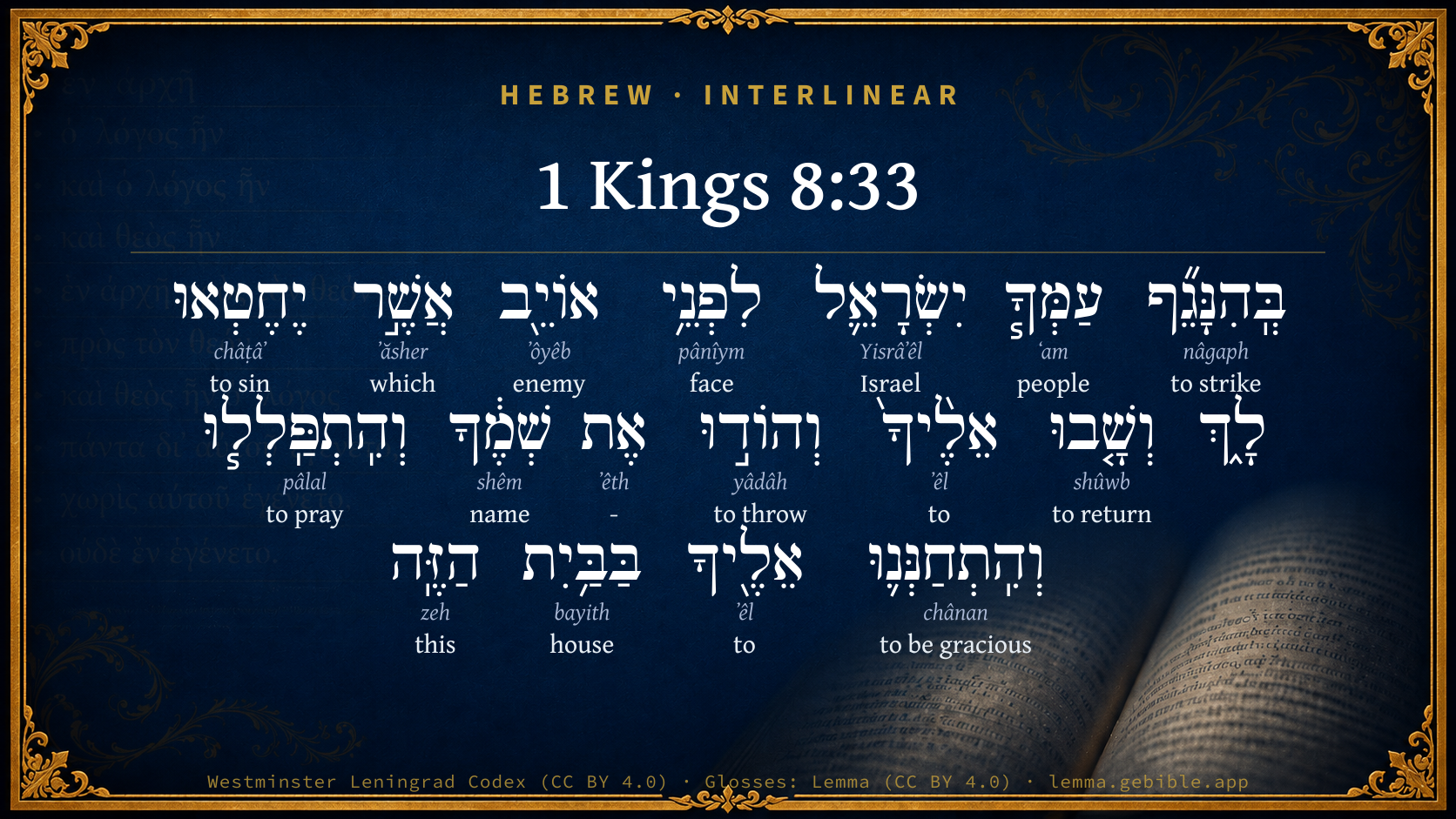
1 Kings 8:33

Hebrew (Westminster Leningrad Codex) 1 Kings 8:33 appears in the Hebrew Old Testament. The text above is from the Westminster Leningrad Codex. Each word links to its Strong’s number, a concise gloss, and parsing drawn from the Open Scriptures Hebrew Bible morphology. Click any word for its full Brown-Driver-Briggs (BDB) entry.
Download image
Cite this verse

1 Kings 8:33 (World English Bible). Public Domain. Lemma interlinear Bible study tool, https://lemma.gebible.app/v/1-kings/8/33.

Show BibTeX & RIS
BibTeX
RIS
English Translation
When your people Israel are struck down before the enemy, because they have sinned against you; if they turn again to you, and confess your name, and pray and make supplication to you in this house:
World English Bible · Public Domain
Download a study sheet

One document with this verse’s original text, its word-by-word gloss line, the meaning frame, cross-references with their text, attributed commentary, and full source and license credits — printable, and it pastes into notes with its structure intact.

This verse Autodidact and up

Study sheet (.html) Plain text (.txt)

A passage Seminary Student

Up to 50 verses in one chapter. A passage sheet keeps up to 6 commentary sources and 12 cross-references per verse, in the order this page ranks them, and says so on the sheet whenever that leaves anything out. Ask for a single verse and you get the Autodidact verse sheet above.

Everything on this page stays free to read, with no account — the sheet is a download of what is already on screen, not access to it.

Want to remove ads? Support Godless Engineer
Compare translations 3

The same verse in 3 English versions, stacked beneath the original-language interlinear above. Click any original word for its lexicon entry.

Each is an independent rendering of the whole verse — the interlinear is not word-aligned to these translations.

Highlighted words mark where these versions differ — a whole-verse word diff, not a word-by-word alignment.

  • World English Bible Public Domain
    When your people Israel are struck down before the enemy, because they have sinned against you; if they turn again to you, and confess your name, and pray and make supplication to you in this house:
  • King James Version Public Domain
    When thy people Israel be smitten down before the enemy, because they have sinned against thee, and shall turn again to thee, and confess thy name, and pray, and make supplication unto thee in this house:
  • unfoldingWord Literal Text CC BY-SA 4.0
    When your people Israel are struck to the face of an enemy because they have sinned against you, and they turn back to you and they confess your name and they pray and they supplicate toward you in this house,

unfoldingWord Literal Text — © unfoldingWord, licensed CC BY-SA 4.0. Word-aligned USFM3 via Door43 (git.door43.org/unfoldingWord/en_ult).

Versions to compare (up to 4)

3 of 4 selected

Show all 18 translations

Every available English version of this verse, each an independent rendering of the whole verse.

  • World English Bible Public Domain
    When your people Israel are struck down before the enemy, because they have sinned against you; if they turn again to you, and confess your name, and pray and make supplication to you in this house:
  • Berean Standard Bible Public Domain
    When Your people Israel are defeated before an enemy because they have sinned against You, and they return to You and confess Your name, praying and pleading with You in this temple,
  • Majority Standard Bible Public Domain
    When Your people Israel are defeated before an enemy because they have sinned against You, and they return to You and confess Your name, praying and pleading with You in this temple,
  • King James Version Public Domain
    When thy people Israel be smitten down before the enemy, because they have sinned against thee, and shall turn again to thee, and confess thy name, and pray, and make supplication unto thee in this house:
  • American Standard Version (1901) Public Domain
    When thy people Israel are smitten down before the enemy, because they have sinned against thee; if they turn again to thee, and confess thy name, and pray and make supplication unto thee in this house:
  • Revised Version (1885) Public Domain
    When thy people Israel be smitten down before the enemy, because they have sinned against thee; if they turn again to thee, and confess thy name, and pray and make supplication unto thee in this house:
  • Geneva Bible (1599) Public Domain
    When thy people Israel shall be ouerthrowen before the enemie, because they haue sinned against thee, and turne againe to thee, and confesse thy Name, and pray and make supplication vnto thee in this house,
  • Douay-Rheims (1899) Public Domain
    If thy people Israel shall fly before their enemies, (because they will sin against thee,) and doing penance, and confessing to thy name, shall come, and pray, and make supplications to thee in this house:
  • Young's Literal Translation Public Domain
    `In Thy people Israel being smitten before an enemy, because they sin against Thee, and they have turned back unto Thee, and have confessed Thy name, and prayed, and made supplication unto Thee in this house,
  • Literal Standard Version CC BY-SA 4.0
    In Your people Israel being struck before an enemy, because they sin against You, and they have turned back to You, and have confessed Your Name, and prayed, and made supplication to You in this house,
  • Unlocked Literal Bible CC BY-SA 4.0
    When your people Israel are defeated by an enemy because they have sinned against you, if they turn back to you, confess your name, pray, and request forgiveness from you in this temple—
  • unfoldingWord Literal Text CC BY-SA 4.0
    When your people Israel are struck to the face of an enemy because they have sinned against you, and they turn back to you and they confess your name and they pray and they supplicate toward you in this house,
  • Darby Bible Public Domain
    When thy people Israel are put to the worse before the enemy, because they have sinned against thee, and shall turn again to thee, and confess thy name, and pray, and make supplication unto thee in this house;
  • World Messianic Bible Public Domain
    “When your people Israel are struck down before the enemy because they have sinned against you, if they turn again to you and confess your name, and pray and make supplication to you in this house,
  • Webster's Bible Public Domain
    When thy people Israel shall be smitten before the enemy, because they have sinned against thee, and shall turn again to thee, and confess thy name, and pray, and make supplication to thee in this house:
  • Free Bible Version CC BY-SA 4.0
    When your people Israel are defeated by an enemy because they have sinned against you, and if they come back in repentance to you, praying for forgiveness in this Temple,
  • Bible in Basic English Public Domain
    When your people Israel are overcome in war, because of their sin against you; if they are turned to you again, honouring your name, making prayers to you and requesting your grace in this house:
  • JPS Tanakh (1917) Public Domain
    When Thy people Israel are smitten down before the enemy, when they do sin against Thee, if they turn again to Thee, and confess Thy name, and pray and make supplication unto Thee in this house;

Literal Standard Version (2020), Covenant Press — licensed CC BY-SA 4.0. Text via the HelloAO Bible API (eBible.org). Unlocked Literal Bible (unfoldingWord) — licensed CC BY-SA 4.0. Text via the HelloAO Bible API (eBible.org). unfoldingWord Literal Text — © unfoldingWord, licensed CC BY-SA 4.0. Word-aligned USFM3 via Door43 (git.door43.org/unfoldingWord/en_ult). Free Bible Version, Dr. Jonathan Gallagher — licensed CC BY-SA 4.0. Text via the HelloAO Bible API (eBible.org).

Word by word

More ways to search: Search by grammar → Find every occurrence → Compare this word →

Practice this passage: Drill this verse → Learn its vocabulary →

בְּֽהִנָּגֵ֞ף
nâgaph
H5062
“in/at · to strike”
Preposition + Verb, Niphal, Infinitive Construct
Part of Speech
Preposition + Verb
Stem
Niphal
Form
Infinitive Construct
Full BDB Definition

Origin: a primitive root

TWOT: 1294

to strike, smite - (Qal) to strike, smite - (Niphal) to be stricken, be smitten - (Hithpael) to stumble
  1. עַמְּךָ֧ ʻam H5971 “people · your” Noun, Common, Masculine, Singular, Construct + Suffix, Personal, 2nd Person, Masculine, Singular
  2. יִשְׂרָאֵ֛ל Yisrâʼêl H3478 “Israel” Noun, Proper
  3. לִפְנֵ֥י pânîym H6440 “to/for · face(s) of” Preposition + Noun, Common, Both, Plural, Construct
  4. אוֹיֵ֖ב ʼôyêb H341 “enemy” Verb, Qal, Participle Active, Masculine, Singular, Absolute
  5. אֲשֶׁ֣ר ʼăsher H834 “which” Particle, Relative
  6. יֶחֶטְאוּ châṭâʼ H2398 “to sin” Verb, Qal, Imperfect, 3rd Person, Masculine, Plural
  7. וְשָׁ֤בוּ shûwb H7725 “and · to return” Conjunction + Verb, Qal, Sequential Perfect, 3rd Person, Common, Plural
  8. אֵלֶ֨יךָ֙ ʼêl H413 “to · you” Preposition + Suffix, Personal, 2nd Person, Masculine, Singular
  9. וְהוֹד֣וּ yâdâh H3034 “and · to throw” Conjunction + Verb, Hiphil, Sequential Perfect, 3rd Person, Common, Plural
  10. אֶת ʼêth H853 “-” Particle, Direct Object
  11. שְׁמֶ֔ךָ shêm H8034 “name · your” Noun, Common, Masculine, Singular, Construct + Suffix, Personal, 2nd Person, Masculine, Singular
  12. וְהִֽתְפַּֽלְל֧וּ pâlal H6419 “and · to pray” Conjunction + Verb, Hithpael, Sequential Perfect, 3rd Person, Common, Plural
  13. וְהִֽתְחַנְּנ֛וּ chânan H2603 “and · to be gracious” Conjunction + Verb, Hithpael, Sequential Perfect, 3rd Person, Common, Plural
  14. אֵלֶ֖יךָ ʼêl H413 “to · you” Preposition + Suffix, Personal, 2nd Person, Masculine, Singular
  15. בַּבַּ֥יִת bayith H1004 “in/at the · house” Preposition, Determined + Noun, Common, Masculine, Singular, Absolute
  16. הַזֶּֽה zeh H2088 “the · this” Particle, Definite Article + Pronoun, Demonstrative, Masculine, Singular

About this verse

These counts appear in no published source. They are computed here, from the morphology-tagged text and Lemma’s own curated glosses. What Lemma adds →

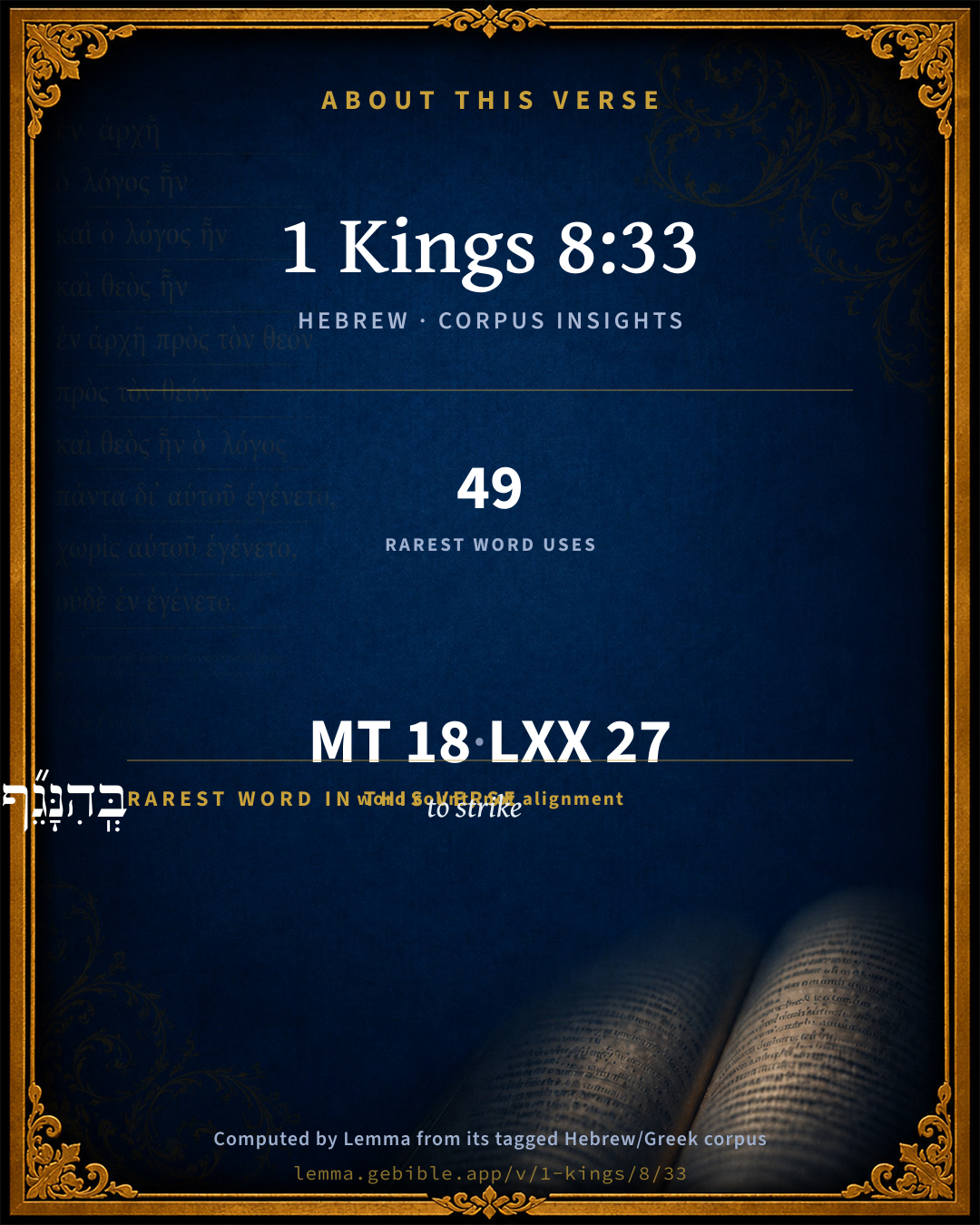
18
words
16
distinct lemmas
Historical
section

Shared distinctive vocabulary

בְּֽהִנָּגֵ֞ף to strike H5062 occurs in 46 verses of the Hebrew Bible. Also found in:

Grammatical profile

  • 7 verbs
  • 5 nouns
  • 1 pronoun
  • 3 prepositions
  • 2 particles

Verb forms

  • בְּֽהִנָּגֵ֞ף Niphal · Infinitive Construct
  • אוֹיֵ֖ב Qal · Participle Active
  • יֶחֶטְאוּ Qal · Imperfect
  • וְשָׁ֤בוּ Qal · Sequential Perfect
  • וְהוֹד֣וּ Hiphil · Sequential Perfect
  • וְהִֽתְפַּֽלְל֧וּ Hithpael · Sequential Perfect
  • וְהִֽתְחַנְּנ֛וּ Hithpael · Sequential Perfect

Repetition

A word recurs within this verse — often emphatic in Hebrew:

  • אֵלֶ֨יךָ֙ to H413 ×2

Hebrew & Septuagint length

In English translation the verse runs 36 words from the Hebrew and 31 from the Septuagint (LXX English) — closely comparable.

A rough comparison of the two English renderings, which tokenize alike — not a word-level alignment.

Word counts can differ between the Hebrew and the Greek without any difference in meaning — e.g. the Hebrew direct-object marker אֵת has no separate Greek word, and Greek often adds the article ὁ.

In the original languages it is 18 Hebrew tokens and 27 Greek tokens — but the two are counted differently (Hebrew bundles its prefixes and suffixes into one token; the Greek is in lemma form), so that isn’t a like-for-like length.

Cross-references

19

Topical passages linked to 1 Kings 8:33 in the Treasury of Scripture Knowledge — connected by theme and wording, ordered by reader-vote popularity; previews shown in the World English Bible.

  • Leviticus 26:17 I will set my face against you, and you will be struck before your enemies. Those who hate you will rule over you; and you will flee when no one pursues you.
  • Deuteronomy 28:25 Yahweh will cause you to be struck before your enemies; you shall go out one way against them, and shall flee seven ways before them: and you shall be tossed back and forth among all the kingdoms of the earth.
  • Leviticus 26:25 I will bring a sword upon you, that will execute the vengeance of the covenant; and you will be gathered together within your cities: and I will send the pestilence among you; and you will be delivered into the hand of the enemy.
  • Leviticus 26:39–42 Those of you who are left will pine away in their iniquity in your enemies' lands; and also in the iniquities of their fathers shall they pine away with them.
  • Deuteronomy 28:48 therefore shall you serve your enemies whom Yahweh shall send against you, in hunger, and in thirst, and in nakedness, and in want of all things: and he shall put a yoke of iron on your neck, until he have destroyed you.
  • 2 Chronicles 6:24–25 If your people Israel be struck down before the enemy, because they have sinned against you, and shall turn again and confess your name, and pray and make supplication before you in this house;
  • Jonah 3:10 God saw their works, that they turned from their evil way. God repented of the evil which he said he would do to them, and he didn't do it.
  • Joshua 7:8 Oh, Lord, what shall I say, after that Israel has turned their backs before their enemies!
  • Joshua 7:11–12 Israel has sinned; yes, they have even transgressed my covenant which I commanded them: yes, they have even taken of the devoted thing, and have also stolen, and dissembled also; and they have even put it among their own stuff.
  • Judges 6:1–2 The children of Israel did that which was evil in the sight of Yahweh: and Yahweh delivered them into the hand of Midian seven years.
  • 2 Kings 18:11–12 The king of Assyria carried Israel away to Assyria, and put them in Halah, and on the Habor, the river of Gozan, and in the cities of the Medes,
  • 2 Chronicles 36:14–17 Moreover all the chiefs of the priests, and the people, trespassed very greatly after all the abominations of the nations; and they polluted the house of Yahweh which he had made holy in Jerusalem.
  • Ezra 9:5–15 At the evening offering I arose up from my humiliation, even with my garment and my robe torn; and I fell on my knees, and spread out my hands to Yahweh my God;
  • Nehemiah 9:1–5 Now in the twenty-fourth day of this month the children of Israel were assembled with fasting, and with sackcloth, and earth on them.
  • Psalms 44:10 You make us turn back from the adversary. Those who hate us take spoil for themselves.
  • Daniel 9:3–19 I set my face to the Lord God, to seek by prayer and petitions, with fasting and sackcloth and ashes.
  • 2 Kings 17:7–18 It was so, because the children of Israel had sinned against Yahweh their God, who brought them up out of the land of Egypt from under the hand of Pharaoh king of Egypt, and had feared other gods,
  • Isaiah 63:15–64:12 Look down from heaven, and see from the habitation of your holiness and of your glory: where are your zeal and your mighty acts? the yearning of your heart and your compassion is restrained toward me.
  • Nehemiah 1:8–9 Remember, I beg you, the word that you commanded your servant Moses, saying, If you trespass, I will scatter you abroad among the peoples:

Cross-references courtesy of OpenBible.info (CC BY 4.0).

Hebrew and Greek witnesses Masoretic Hebrew ↔ Greek Septuagint

The same verse in the two great witnesses to the Old Testament, shown verse-for-verse.

These are two independent witnesses, not word-aligned to each other, and the Septuagint is shown in lemma (dictionary) form.

Hebrew 1 Kings 8:33 Masoretic · Westminster Leningrad Codex

בְּֽהִנָּגֵ֞ף עַמְּךָ֧ יִשְׂרָאֵ֛ל לִפְנֵ֥י אוֹיֵ֖ב אֲשֶׁ֣ר יֶחֶטְאוּ לָ֑ךְ וְשָׁ֤בוּ אֵלֶ֨יךָ֙ וְהוֹד֣וּ אֶת שְׁמֶ֔ךָ וְהִֽתְפַּֽלְל֧וּ וְהִֽתְחַנְּנ֛וּ אֵלֶ֖יךָ בַּבַּ֥יִת הַזֶּֽה

When your people Israel are struck down before the enemy, because they have sinned against you; if they turn again to you, and confess your name, and pray and make supplication to you in this house:

World English Bible · Public Domain

Greek LXX 1 Kings 8:33 Septuagint · lemma form

ἐν ὁ πταίω ὁ λαός σύ ἰσραήλ ἐνώπιον ἐχθρός ὅτι ἁμαρτάνω σύ καί ἐπιστρέφω καί ἐκὁμολογέω ὁ ὄνομα σύ καί προςεὔχομαι καί δέω ἐν ὁ οἶκος οὗτος

When your people Israel falls before enemies, because they shall sin against you, and they shall return and confess to your name, and they shall pray and supplicate in this house,

LXX2012 (modern English Septuagint) · Public Domain

Hebrew: Westminster Leningrad Codex (CC BY 4.0). Greek: Septuagint (public domain); English from LXX2012 (modern English Septuagint) (Public Domain). How the Septuagint differs from the Hebrew →

Targum (Aramaic paraphrase)

1

The Targum is the ancient Jewish Aramaic paraphrase of the Hebrew Scriptures — an interpretive translation, not the Hebrew text itself. Onkelos (literal) and Pseudo-Jonathan (expansive) render the Torah, and Jonathan the Prophets. Coverage is partial: where no permissively-licensed English translation exists for a verse, only the Aramaic is shown. This is verse-level text, not a word-by-word alignment to the Hebrew.

  1. Targum Jonathan Prophets (Joshua–Malachi)
    כַּד יִתְמְחוֹן עַמָךְ יִשְׂרָאֵל קֳדָם בַּעֲלֵי דְבָבֵיהוֹן דִיחוֹבוּן קֳדָמָךְ וִיתוּבוּן לְפוּלְחָנָךְ וְיוֹדוּן לִשְׁמָךְ וְיִצְלוּ וְיִבְעוּן מִן קֳדָמָךְ בְּבֵיתָא הָדֵין:

    (no public-domain English translation for this verse)

    Targum Jonathan — Aramaic: “Mikraot Gedolot” (public domain). English: “Sefaria Community Translation” (CC0 1.0 (public-domain dedication)); “London "Chaldee Paraphrase," 1871” (public domain). Text via Sefaria.

Commentary

Notes on 1 Kings 8:33 from classic Christian and Jewish commentators (each source and its license shown beneath its notes). The classic Christian expositions comment on the surrounding passage and are grouped to its opening verse, so a note may address several verses; the Jewish commentaries on the Tanakh (Rashi and others) are per-verse, so they appear only where the commentator wrote on this verse.

Lemma curates 59 commentaries, every one of them public domain or Creative Commons licensed, each selected and text-cleaned for this edition rather than reprinted as found. About our sources →

Trapp's Complete Commentary

John Trapp

1Ki 8:33 When thy people Israel be smitten down before the enemy, because they have sinned against thee, and shall turn again to thee, and confess thy name, and pray, and make supplication unto thee in this house:

Ver. 33. And confess thy name.] Submit to thy justice, and implore thy mercy.

John Trapp, A Commentary or Exposition upon All the Books of the Old and New Testament (1647–1656) — public domain. Text from a community e-Sword module.

The Biblical Illustrator

Joseph S. Exell

1Ki_8:33-34

When Thy people Israel be smitten down before the enemy.

Thy people England

I. The conditions of national unity. When any one desires to understand what is meant by a nation, he had better look unto Gods people Israel first of all, for they fulfilled the two great conditions of national unity. The first is faith in God, and no nation has ever risen to greatness, and no nation, having arisen, has ever maintained its greatness except so far as it believed in--and publicly as a nation, and privately by individuals--acknowledged Almighty God. There is this analogy between the individual and the nation, that an individual is not able to say I, with any intelligence of what I means, except in God; and an individual is not able to say I will, with any force in the will, except in God. It is in the Unseen and Eternal that we realise ourselves. The other condition of national unity with Israel was vocation. Therefore the prophets were perpetually telling the people that their fathers had been called and blessed not for their own sake--and there is no man ever blessed for his own sake, but for the sake of the man that is next him--that their fathers had not been called and blessed for their own sake, but for the sake of the world. They were the receptors of a Revelation, and received the touch of truth to pass it down from hand to hand, and every man to blow it brighter as it went from patriarch to prophet, from prophet to psalmist, from psalmist to martyr, till the day came when the nation could be sent out, each man a torch-bearer, unto the ends of the earth, carrying the light of eternal truth.

II. A message of righteousness. What was the message they were to carry to the world? The message they were to carry to the world was righteousness. As the Greek was raised up of God to give us the sense of beauty, so was the Jew raised up to give us what is far better than beauty, the sense of righteousness; and to write the ten words of Moses upon the conscience of the individual and the conscience of the nation. Comes then the question: Is there any nation to-day that has, as it were, succeeded to a great and world-wide mission, and a mission of the same practical and ethical nature as that which God gave to His people Israel? Is there any nation that has been secluded in its island home, and guarded round from other people so that the invader could not touch it; is there any nation that within its own home, being men of mixed blood, has gradually been welded together by common human sympathy and common faith in God; is there any nation that has gradually been led into a fuller sense of the truth of God; into political, and religious, and social liberty; is there any nation whose ordered and beneficent freedom is the admiration of every people, of its enemies and friends alike? Finally, is there any nation whose members have gone unto the ends of the earth, and wherever they have gone have been able to teach, to govern, to give justice unto the nations placed under their charge? There is only one nation of whom these things can be said; only one nation with whose history you can draw out this analogy to Israel, and that is the English people. Ought we not to ask ourselves whether as a nation--and having had this great favour of the Eternal--whether, as a nation we have borne ourselves like the servant of God? In one--in perhaps the most tender and beautiful passage in all the Old Testament, Isa_53:1-12.

there is a description of God s servant, which is supposed by some to be the Messiah, by some to be Gods people Israel; but the mark of Him is not only that He is the means of great blessing to the world, but His humility, His tenderness, His sympathy, His lowliness. Have we been, as a nation, courteous to foreign nations, as we go by individuals through their midst? Have we, in our Literature and in our tress, always done justice to foreign peoples, and never blown our trumpet, our brazen trumpet, loudly in their faces? Is our character such--the character which we have earned through centuries such--that a foreigner will at once appreciate the goodness that is in us?

III. The sin of materialism. The other sin which we always realise in a national crisis is the sin of Materialism, which also greatly beset Israel. While Israel was a handful of farmers, Israel was more or less spiritual. When Israel became rich and increased in goods, you have only to read the prophets to note how the race for wealth entered, and the power of the rich and the suffering of the poor made an unhappy and miserable nation. We have grown rich, and I am told--though you know better about these things than I do--that we were never richer than at the present day. Rich in goods? I pray you to define goods; and when we define goods, how are they defined? I think it is the money in the savings bank, which is very good so far as it represents thrift and intelligence; and the railways which we have made, which represent enterprise and the development of the country; these things and many other things. But these in themselves are not the goods of a nation. No, not exports and imports, and population and money--these are not the goods of a nation. The goods of a nation are its intelligence; the goods of a nation are its integrity; the goods of a nation are its charity; the goods of a nation are its high and just spirit before God. Wherefore be not too lifted up, but let us remember this, that if our nation ever decay, it will not be from any power from without, or any unfaithfulness on the part of our God. It will be because some men have too much money, and some other people-have too little; and the west end of a city is one place, and the east end is another, and the west and the east they come not together. (J. Watson, D. D.)

The Biblical Illustrator, edited by Joseph S. Exell (c. 1880s–1900s) — public domain. Text from a community e-Sword module.

Joseph Benson's Commentary

1Ki 8:33-34. When thy people be smitten — This is the second case he puts. If the people of Israel were in general groaning under any national calamity, he desires that the prayers which they should make in or toward that house might be heard and answered. Shall turn again to thee, and confess thy name — Not only shall acknowledge thee to be God alone, renouncing all false gods; but shall give glory to thy name by acknowledging their sins and thy justice; by accepting the punishment of their iniquity; and by trusting to thy power and goodness alone for deliverance. And make supplication to thee in this house — Trusting in thee, and expecting help from thee alone. Then hear, and bring them again, &c. — Deliver them out of the captivity into which their enemies may have carried them, and restore them to their own country.

Joseph Benson's Commentary on the Old and New Testaments (1811–1818) — public domain. Text from a community e-Sword module.

Tyndale Open Study Notes

Tyndale Open Resources

8:33-34 Solomon asked concerning future situations when the people of Israel sinned and God allowed the enemy to defeat them (see Lev 26:14-17; Deut 28:15, 25-26, 45, 49; Josh 7) and then the people genuinely repented. Solomon asked that God honor his covenant and forgive them (Lev 26:39-42).

Tyndale Open Study Notes — © Tyndale Open Resources, licensed CC BY-SA 4.0. Text via the HelloAO Bible API.

Geneva Bible (1599)

Geneva Bible translators

Acknowledge thy just judgment, and praise thee.

Geneva Bible (1599) marginal notes — public domain. Text via Bolls.life.

Adam Clarke's Commentary

Verse 33. When thy people Israel be smitten down, c.] The SECOND case. When their enemies make inroads upon them, and defeat them in battle, and lead them into captivity, because God, being displeased with their transgressions, has delivered them up then if they shall turn again, confess the name of God, which they had in effect denied, by either neglecting his worship, or becoming idolatrous; and pray and make supplication; then, says Solomon, hear thou in heaven-and bring them again unto the land which thou gavest unto their fathers.

Adam Clarke's Commentary on the Bible (1810–1826) — public domain. Text from a community e-Sword/MySword module.

Ellicott's Commentary for English Readers

(33, 34) When thy people.—From the individual, the prayer turns to those which touch the whole nation. It pictures various national calamities, and in each recognises not mere evils, but chastisements of God, who desires by them to teach, and is most ready to forgive. First it naturally dwells on disaster in battle, which, in the whole history of the Exodus, of the Conquest, of the troubled age of the Judges, and of the reigns of Saul and David, is acknowledged as a sign of unfaithfulness in Israel, either through sin or through idolatry, to the covenant of God, on which the victorious possession of the promised land depended. On that history the blessing and the curse of the Law (Lev_26:17; Lev_26:32-33; Deu_28:25) form a commentary of emphatic warning, and the Psalms again and again bring the same lesson home (Psa_44:1-3; Psa_44:9-17; Psa_60:9-11; Psa_89:42-46). With characteristic seriousness, Solomon looks back from his peaceful prosperity on the stormy past, and from it learns to pray for the future.

A Bible Commentary for English Readers, edited by Charles John Ellicott (1878–1897) — public domain. Text from a community e-Sword module.

The Cambridge Bible for Schools and Colleges

gen. ed. J. J. S. Perowne

33. When thy people Israel be smitten down before the enemy] Such an event is contemplated in the language of Leviticus (Lev_26:17) and Deuteronomy (Deu_28:25) as well as the restoration and delivery of the people on their repentance (see Lev_26:40-42).

because they have sinned against thee] From what follows it seems as if idolatry, to which the people were so prone, were noted as the special sin. They have turned away from God, and so are to turn to Him again. The penalty constantly threatened for serving strange gods was that they should be made to serve strangers in a land which was not theirs. Cf. Deu_28:47 seqq.

The Cambridge Bible for Schools and Colleges (gen. ed. J. J. S. Perowne; Cambridge University Press, 1878–1918) — public domain. Text from a community e-Sword module.

John Gill's Exposition

When thy people Israel shall be smitten down before the enemy,.... Beaten and routed, many slain, and others carried captive; which had been their case, and might be again, and was, though now a time of peace:

because they have sinned against thee; which always was the reason of their being given up into the hands of their enemies:

and shall turn again to thee; to thy worship, as the Targum, having fallen into idolatry, which was generally the case when they fell before their enemies:

and confess thy name; own him to be the true God, acknowledge his justice in their punishment, confess their sin, repent of it, and give him glory:

and pray and make supplication unto thee in this house; not the captives, unless it should be rendered, as it may, "toward this house" (f); but those that escaped, or their brethren that went not out to battle, who should pray for them here.

(f) So Pool and Patrick.

John Gill's Exposition of the Whole Bible (1746–1763) — public domain (CC PDM 1.0). Text via the HelloAO Bible API.

Matthew Poole's English Annotations

And confess thy name; give glory to thy name, by acknowledging their sins, and thy justice; and by accepting the punishment of their iniquity; and by trusting to thy power and goodness alone for their deliverance.

Matthew Poole's English Annotations on the Holy Bible (1683–1685) — public domain. Text from a community e-Sword/MySword module.

The Pulpit Commentary

When thy people Israel be smitten down before the enemy Lev_26:7, 17 Deu_28:25. There is a constant reference to these two chapters throughout this prayer, or, if no direct reference to them, there are unmistakeable reminiscences of them, because they have sinned against thee, and shall turn again to thee, and confess or praise. (Psa_54:7 Psa_106:47 Psa_122:4) thy name, and pray, and make supplication unto thee in this house. The marg. towards is a mistaken attempt at avoiding the difficulty which lies on the surface of the text, viz., that persons in a foreign land could not pray in the temple. But the king obviously is speaking here, not of those taken captive, but of the nation at large ("thy people Israel") by its representatives, (cf. Joe_2:17) supplicating after its defeat. The idea of captives does not come in until the next verse. Under the term house the courts are obviously included. (Act_2:46 Luk_18:10) Into the edifice the priests alone were admitted.

The Pulpit Commentary (1880–1919), ed. H.D.M. Spence-Jones & Joseph S. Exell — public domain. Text from a community e-Sword module.

John Wesley's Explanatory Notes

Confess - Give glory to thy name, by acknowledging their sins, and by justice; and by accepting the punishment of their iniquity; and by trusting to thy power and goodness alone, for their deliverance.

John Wesley, Explanatory Notes Upon the Whole Bible (1754–1765) — public domain. Text via the GEBible commentary corpus.

unfoldingWord translationNotes

Door43 World Missions Community

your people Israel are defeated by an enemy

This can be stated in active form. AT: "an enemy defeats your people Israel" (See: Active or Passive)

confess your name

Possible meanings are 1) "confess that they have sinned against you" or 2) "praise you" or 3) "say that they will obey you from now on."

request forgiveness from you

The abstract noun "forgiveness" can be translated as a verb. AT: "ask you to forgive them" (See: Abstract Nouns)

translationWords

people group

Israel

adversary

sin

turn

confess

name

pray

forgive

temple

heaven

unfoldingWord translationNotes — © Distant Shores Media and the Door43 World Missions Community, licensed CC BY-SA 4.0. Source: git.door43.org/Door43/en_tn.

Rashi

Rabbi Shlomo Yitzchaki (Rashi)

And praise Your Name. For a person is obliged to bless God for the bad.

Rashi on the Tanakh — English translations: “The Judaica Press complete Tanach with Rashi, translated by A. J. Rosenberg” (CC BY 4.0); “Pentateuch with Rashi's commentary by M. Rosenbaum and A.M. Silbermann, 1929-1934” (public domain); “The Metsudah Tanach series, Lakewood, N.J” (CC BY 4.0); and “The Book of Joshua, Metsudah Publications, 1997” (CC BY 4.0). Text via Sefaria.

Lesson kit

Teaching starters — assembled from the data on this page, not authored interpretation. Every prompt links to the verse data it draws on. Edit before teaching.

1 Kings, in the Historical, opens this verse with 18 words (16 distinct Hebrew lemmas). Its most distinctive word is nâgaph (“to strike”). A historical commentator’s framing appears above. Read the whole chapter for the surrounding context.

Discussion questions

  1. How does “to strike” (nâgaph) shape what this verse is saying?
  2. How does Exodus 8:2, which shares the word «to strike», read alongside this verse?
  3. What does the repetition of “to” (2× in this one verse) do in this verse?
  4. These translations render this verse differently; the difference is in the English rendering, not the original. What questions does that raise?
  5. «בְּֽהִנָּגֵ֞ף» is a Niphal Infinitive Construct verb. How does that grammatical form shape the action described?
  6. Compare how Trapp's Complete Commentary and The Biblical Illustrator read this verse. Where do they agree or differ?

Things to notice

Reading settings

Reading text

Shown beneath each verse's original-language words.

Old Testament
Old Testament edition

Read the OT as the Masoretic Hebrew (MT) or the Greek Septuagint (LXX).

English shown for the Greek Septuagint (in the Hebrew ↔ Greek comparison).

Comparing translations? Open the Compare panel on any verse page to stack up to four side by side.