
2 Chronicles 26:13

Hebrew (Westminster Leningrad Codex) 2 Chronicles 26:13 appears in the Hebrew Old Testament. The text above is from the Westminster Leningrad Codex. Each word links to its Strong’s number, a concise gloss, and parsing drawn from the Open Scriptures Hebrew Bible morphology. Click any word for its full Brown-Driver-Briggs (BDB) entry.
Download image
Cite this verse

2 Chronicles 26:13 (World English Bible). Public Domain. Lemma interlinear Bible study tool, https://lemma.gebible.app/v/2-chronicles/26/13.

Show BibTeX & RIS
BibTeX
RIS
English Translation
Under their hand was an army, three hundred thousand and seven thousand and five hundred, who made war with mighty power, to help the king against the enemy.
World English Bible · Public Domain
Download a study sheet

One document with this verse’s original text, its word-by-word gloss line, the meaning frame, cross-references with their text, attributed commentary, and full source and license credits — printable, and it pastes into notes with its structure intact.

This verse Autodidact and up

Study sheet (.html) Plain text (.txt)

A passage Seminary Student

Up to 50 verses in one chapter. A passage sheet keeps up to 6 commentary sources and 12 cross-references per verse, in the order this page ranks them, and says so on the sheet whenever that leaves anything out. Ask for a single verse and you get the Autodidact verse sheet above.

Everything on this page stays free to read, with no account — the sheet is a download of what is already on screen, not access to it.

Want to remove ads? Support Godless Engineer
Compare translations 3

The same verse in 3 English versions, stacked beneath the original-language interlinear above. Click any original word for its lexicon entry.

Each is an independent rendering of the whole verse — the interlinear is not word-aligned to these translations.

Highlighted words mark where these versions differ — a whole-verse word diff, not a word-by-word alignment.

  • World English Bible Public Domain
    Under their hand was an army, three hundred thousand and seven thousand and five hundred, who made war with mighty power, to help the king against the enemy.
  • King James Version Public Domain
    And under their hand was an army, three hundred thousand and seven thousand and five hundred, that made war with mighty power, to help the king against the enemy.
  • unfoldingWord Literal Text CC BY-SA 4.0
    And under their hand, an army of war 307,500 doers of battle with strength of power to help the king against the enemy.

unfoldingWord Literal Text — © unfoldingWord, licensed CC BY-SA 4.0. Word-aligned USFM3 via Door43 (git.door43.org/unfoldingWord/en_ult).

Versions to compare (up to 4)

3 of 4 selected

Show all 18 translations

Every available English version of this verse, each an independent rendering of the whole verse.

  • World English Bible Public Domain
    Under their hand was an army, three hundred thousand and seven thousand and five hundred, who made war with mighty power, to help the king against the enemy.
  • Berean Standard Bible Public Domain
    Under their authority was an army of 307,500 trained for war, a powerful force to support the king against his enemies.
  • Majority Standard Bible Public Domain
    Under their authority was an army of 307,500 trained for war, a powerful force to support the king against his enemies.
  • King James Version Public Domain
    And under their hand was an army, three hundred thousand and seven thousand and five hundred, that made war with mighty power, to help the king against the enemy.
  • American Standard Version (1901) Public Domain
    And under their hand was an army, three hundred thousand and seven thousand and five hundred, that made war with mighty power, to help the king against the enemy.
  • Revised Version (1885) Public Domain
    And under their hand was a trained army, three hundred thousand and seven thousand and five hundred, that made war with mighty power, to help the king against the enemy.
  • Geneva Bible (1599) Public Domain
    And vnder their hande was the armie for warre, three hundreth and seuen thousand, and fiue hundreth that fought valiantly to helpe the King against the enemie.
  • Douay-Rheims (1899) Public Domain
    And the whole army under them three hundred and seven thousand five hundred: who were fit for war, and fought for the king against the enemy.
  • Young's Literal Translation Public Domain
    and by their hand `is' the force of the host, three hundred thousand, and seven thousand, and five hundred warriors, with mighty power to give help to the king against the enemy.
  • Literal Standard Version CC BY-SA 4.0
    and by their hand [is] the force of the host—three hundred thousand and seven thousand and five hundred warriors, with mighty power to give help to the king against the enemy.
  • Unlocked Literal Bible CC BY-SA 4.0
    Under their hand was an army of 307,500 men that made war with mighty power to help the king against the enemy.
  • unfoldingWord Literal Text CC BY-SA 4.0
    And under their hand, an army of war 307,500 doers of battle with strength of power to help the king against the enemy.
  • Darby Bible Public Domain
    And under their hand was an army-host of three hundred and seven thousand five hundred, that made war with mighty power to help the king against the enemy.
  • World Messianic Bible Public Domain
    Under their hand was an army, three hundred seven thousand five hundred, who made war with mighty power, to help the king against the enemy.
  • Webster's Bible Public Domain
    And under their hand was an army, three hundred thousand and seven thousand and five hundred, that made war with mighty power, to help the king against the enemy.
  • Free Bible Version CC BY-SA 4.0
    Under their command was an army of 307,500 trained for battle, who had the power to help the king fight against the enemy.
  • Bible in Basic English Public Domain
    And under their orders was a trained army of three hundred and seven thousand, five hundred, of great strength in war, helping the king against any who came against him.
  • JPS Tanakh (1917) Public Domain
    And under their hand was a trained army, three hundred thousand and seven thousand and five hundred, that made war with mighty power, to help the king against the enemy.

Literal Standard Version (2020), Covenant Press — licensed CC BY-SA 4.0. Text via the HelloAO Bible API (eBible.org). Unlocked Literal Bible (unfoldingWord) — licensed CC BY-SA 4.0. Text via the HelloAO Bible API (eBible.org). unfoldingWord Literal Text — © unfoldingWord, licensed CC BY-SA 4.0. Word-aligned USFM3 via Door43 (git.door43.org/unfoldingWord/en_ult). Free Bible Version, Dr. Jonathan Gallagher — licensed CC BY-SA 4.0. Text via the HelloAO Bible API (eBible.org).

Word by word

More ways to search: Search by grammar → Find every occurrence → Compare this word →

Practice this passage: Drill this verse → Learn its vocabulary →

חֵ֨יל
chêyl
H2426
“fortress of”
Noun, Common, Masculine, Singular, Construct
Part of Speech
Noun
Type
Common
Gender
Masculine
Number
Singular
State
Construct
Full BDB Definition

Origin: a collateral form of H2428

TWOT: 623d

rampart, fortress, wall - rampart - fortress
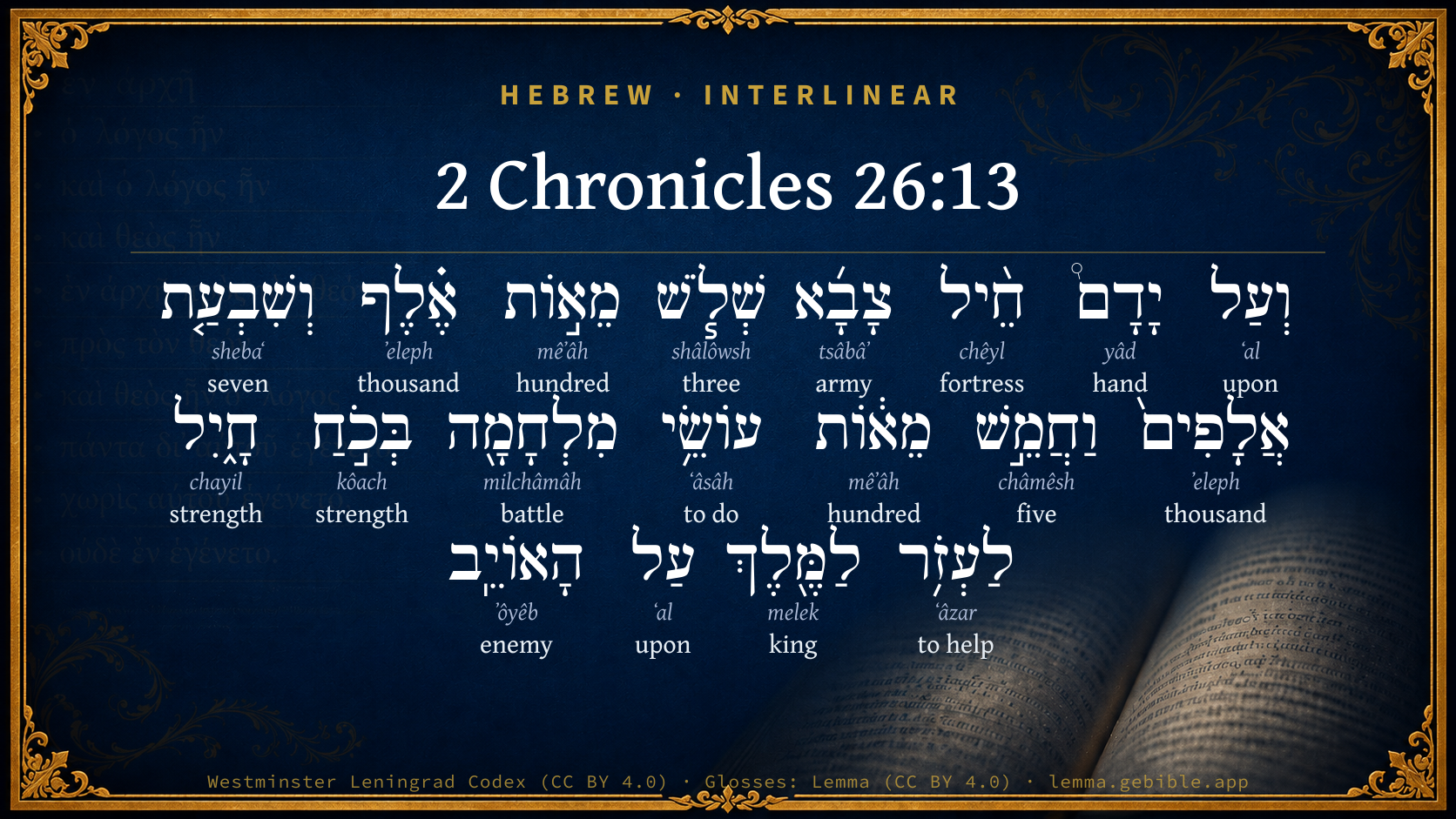
  1. וְעַל ʻal H5921 “and · upon” Conjunction + Preposition
  2. יָדָם֩ yâd H3027 “hand · their” Noun, Common, Both, Singular, Construct + Suffix, Personal, 3rd Person, Masculine, Plural
  3. צָבָ֜א tsâbâʼ H6635 “army” Noun, Common, Both, Singular, Absolute
  4. שְׁלֹ֧שׁ shâlôwsh H7969 “three” Adjective, Cardinal number, Feminine, Singular, Absolute
  5. מֵא֣וֹת mêʼâh H3967 “hundred” Adjective, Cardinal number, Both, Plural, Absolute
  6. אֶ֗לֶף ʼeleph H505 “thousand” Adjective, Cardinal number, Both, Singular, Absolute
  7. וְשִׁבְעַ֤ת shebaʻ H7651 “and · seven” Conjunction + Adjective, Cardinal number, Masculine, Singular, Construct
  8. אֲלָפִים֙ ʼeleph H505 “thousand” Adjective, Cardinal number, Both, Plural, Absolute
  9. וַחֲמֵ֣שׁ châmêsh H2568 “and · five” Conjunction + Adjective, Cardinal number, Feminine, Singular, Absolute
  10. מֵא֔וֹת mêʼâh H3967 “hundred” Adjective, Cardinal number, Both, Plural, Absolute
  11. עוֹשֵׂ֥י ʻâsâh H6213 “doing” Verb, Qal, Participle Active, Masculine, Plural, Construct
  12. מִלְחָמָ֖ה milchâmâh H4421 “battle” Noun, Common, Feminine, Singular, Absolute
  13. בְּכֹ֣חַ kôach H3581 “in/at · strength of” Preposition + Noun, Common, Masculine, Singular, Construct
  14. חָ֑יִל chayil H2428 “strength” Noun, Common, Masculine, Singular, Absolute
  15. לַעְזֹ֥ר ʻâzar H5826 “to help” Preposition + Verb, Qal, Infinitive Construct
  16. לַמֶּ֖לֶךְ melek H4428 “to/for the · king” Preposition, Determined + Noun, Common, Masculine, Singular, Absolute
  17. עַל ʻal H5921 “upon” Preposition
  18. הָאוֹיֵֽב ʼôyêb H341 “the · enemy” Particle, Definite Article + Verb, Qal, Participle Active, Masculine, Singular, Absolute

About this verse

These counts appear in no published source. They are computed here, from the morphology-tagged text and Lemma’s own curated glosses. What Lemma adds →

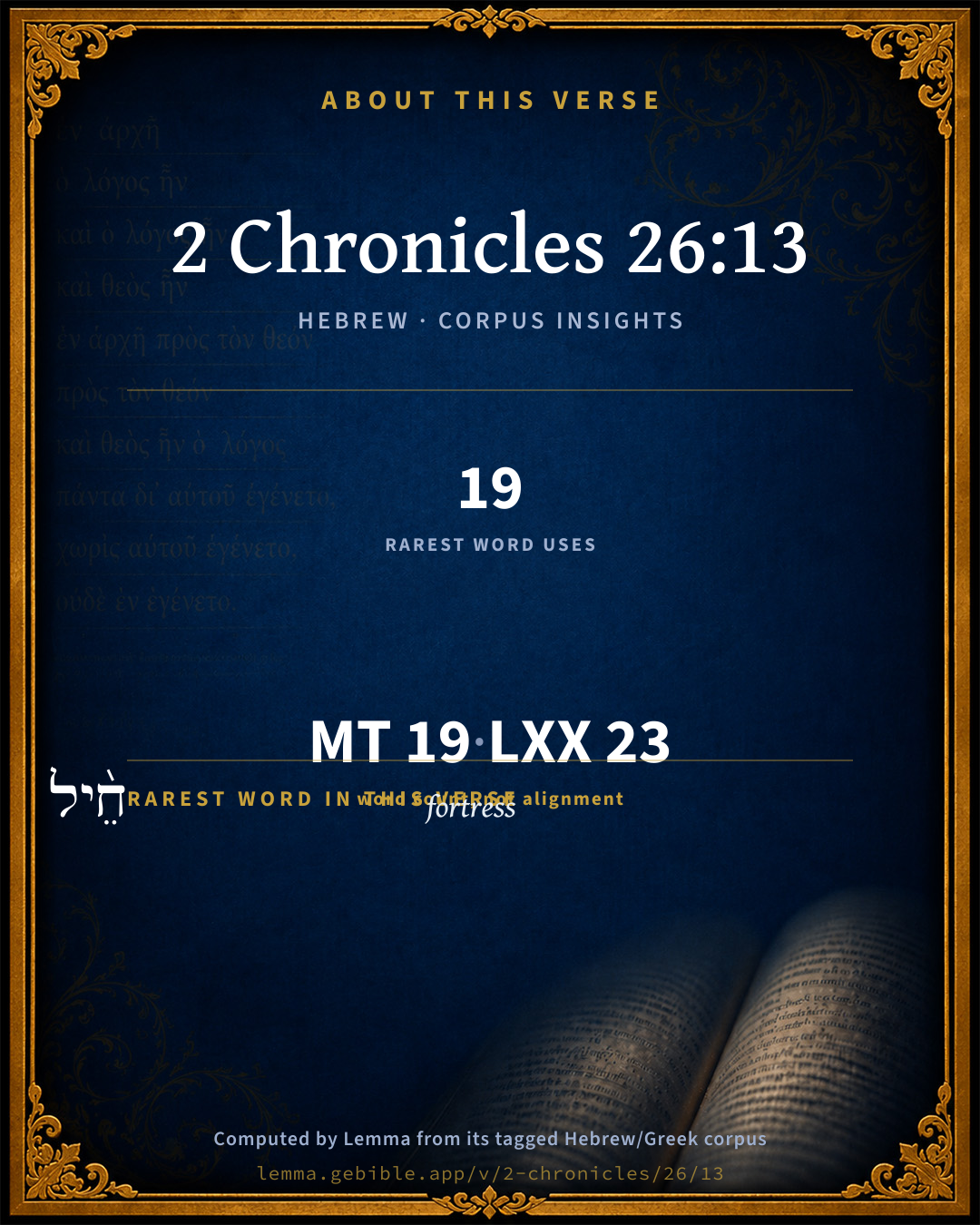
19
words
16
distinct lemmas
Historical
section

Notable vocabulary

The rarest word here is חֵ֨יל fortress H2426 — appearing just 19 times in the whole Hebrew Bible.

Shared distinctive vocabulary

חֵ֨יל fortress H2426 occurs in 19 verses of the Hebrew Bible. Also found in:

Grammatical profile

  • 3 verbs
  • 7 nouns
  • 7 adjectives
  • 2 prepositions

Verb forms

  • עוֹשֵׂ֥י Qal · Participle Active
  • לַעְזֹ֥ר Qal · Infinitive Construct
  • הָאוֹיֵֽב Qal · Participle Active

Repetition

Words recur within this verse — often emphatic in Hebrew:

  • וְעַל upon H5921 ×2
  • מֵא֣וֹת hundred H3967 ×2
  • אֶ֗לֶף thousand H505 ×2

Hebrew & Septuagint length

In English translation the verse runs 28 words from the Hebrew and 27 from the Septuagint (LXX English) — closely comparable.

A rough comparison of the two English renderings, which tokenize alike — not a word-level alignment.

Word counts can differ between the Hebrew and the Greek without any difference in meaning — e.g. the Hebrew direct-object marker אֵת has no separate Greek word, and Greek often adds the article ὁ.

In the original languages it is 19 Hebrew tokens and 23 Greek tokens — but the two are counted differently (Hebrew bundles its prefixes and suffixes into one token; the Greek is in lemma form), so that isn’t a like-for-like length.

Cross-references

5

Topical passages linked to 2 Chronicles 26:13 in the Treasury of Scripture Knowledge — connected by theme and wording, ordered by reader-vote popularity; previews shown in the World English Bible.

  • 2 Chronicles 11:1 When Rehoboam was come to Jerusalem, he assembled the house of Judah and Benjamin, one hundred eighty thousand chosen men, who were warriors, to fight against Israel, to bring the kingdom again to Rehoboam.
  • 2 Chronicles 13:3 Abijah joined battle with an army of valiant men of war, even four hundred thousand chosen men: and Jeroboam set the battle in array against him with eight hundred thousand chosen men, who were mighty men of valor.
  • 2 Chronicles 14:8 Asa had an army that bore bucklers and spears, out of Judah three hundred thousand; and out of Benjamin, that bore shields and drew bows, two hundred eighty thousand: all these were mighty men of valor.
  • 2 Chronicles 17:14–19 This was the numbering of them according to their fathers' houses: Of Judah, the captains of thousands: Adnah the captain, and with him mighty men of valor three hundred thousand;
  • 2 Chronicles 25:5 Moreover Amaziah gathered Judah together, and ordered them according to their fathers' houses, under captains of thousands and captains of hundreds, even all Judah and Benjamin: and he numbered them from twenty years old and upward, and found them three hundred thousand chosen men, able to go forth to war, who could handle spear and shield.

Cross-references courtesy of OpenBible.info (CC BY 4.0).

Hebrew and Greek witnesses Masoretic Hebrew ↔ Greek Septuagint

The same verse in the two great witnesses to the Old Testament, shown verse-for-verse.

These are two independent witnesses, not word-aligned to each other, and the Septuagint is shown in lemma (dictionary) form.

Hebrew 2 Chronicles 26:13 Masoretic · Westminster Leningrad Codex

וְעַל יָדָם֩ חֵ֨יל צָבָ֜א שְׁלֹ֧שׁ מֵא֣וֹת אֶ֗לֶף וְשִׁבְעַ֤ת אֲלָפִים֙ וַחֲמֵ֣שׁ מֵא֔וֹת עוֹשֵׂ֥י מִלְחָמָ֖ה בְּכֹ֣חַ חָ֑יִל לַעְזֹ֥ר לַמֶּ֖לֶךְ עַל הָאוֹיֵֽב

Under their hand was an army, three hundred thousand and seven thousand and five hundred, who made war with mighty power, to help the king against the enemy.

World English Bible · Public Domain

Greek LXX 2 Chronicles 26:13 Septuagint · lemma form

καί μετά αὐτός δύναμις πολεμικός τριακόσιοι χιλίας καί ἑπτακισχίλιοι πεντακόσιοι οὗτος ὁ ποιέω πόλεμος ἐν δύναμις ἰσχύς βοηθέω ὁ βασιλεύς ἐπί ὁ ὑπεναντίος

and with them was a warrior force, three hundred thousand and seven thousand and five hundred: these waged war mightily to help the king against his enemies.

LXX2012 (modern English Septuagint) · Public Domain

Hebrew: Westminster Leningrad Codex (CC BY 4.0). Greek: Septuagint (public domain); English from LXX2012 (modern English Septuagint) (Public Domain). How the Septuagint differs from the Hebrew →

Commentary

Notes on 2 Chronicles 26:13 from classic Christian and Jewish commentators (each source and its license shown beneath its notes). The classic Christian expositions comment on the surrounding passage and are grouped to its opening verse, so a note may address several verses; the Jewish commentaries on the Tanakh (Rashi and others) are per-verse, so they appear only where the commentator wrote on this verse.

Lemma curates 59 commentaries, every one of them public domain or Creative Commons licensed, each selected and text-cleaned for this edition rather than reprinted as found. About our sources →

Trapp's Complete Commentary

John Trapp

2Ch 26:13 And under their hand [was] an army, three hundred thousand and seven thousand and five hundred, that made war with mighty power, to help the king against the enemy.

Ver. 13. Three hundred thousand.] This was far short of Jehoshaphat’s eleven hundred thousand. {2Ch 17:14-18} Honestum est ei qui in primis non potest, in secundis tertiisve consistere. {a}

{a} Cicero.

John Trapp, A Commentary or Exposition upon All the Books of the Old and New Testament (1647–1656) — public domain. Text from a community e-Sword module.

Ellicott's Commentary for English Readers

(13) Under their hand.—Or, at their side, meaning, under their command.

An army.—See margin. An armed force, or, warlike host (chêl çâbâ’); an expression only found besides in 1Ch_20:1.

Three hundred thousand . . . five hundred.—This fairly agrees with the statement respecting the total of Amaziah’s army (300,000) in 2Ch_25:5.

That made war with mighty power.—Literally, a doer of battle with strength of might (sturdy strength, kôach chayil, a unique phrase). Each chief was thus at the head of about a hundred and twenty men, who formed his troop (gedûd, 2Ch_26:11). (Comp. the expression, “captains of hundreds.”) The actual number in each century may have varied, as in the Roman army.

A Bible Commentary for English Readers, edited by Charles John Ellicott (1878–1897) — public domain. Text from a community e-Sword module.

The Cambridge Bible for Schools and Colleges

gen. ed. J. J. S. Perowne

13. an army] R.V. a trained army.

three hundred thousand and seven thousand and five hundred] This total corresponds roughly with the 300,000 men who formed Amaziah’s army; 2Ch_25:5. Cp. note on 2Ch_14:8 (the forces of Asa and of Jehoshaphat).

The Cambridge Bible for Schools and Colleges (gen. ed. J. J. S. Perowne; Cambridge University Press, 1878–1918) — public domain. Text from a community e-Sword module.

John Gill's Exposition

And he made in Jerusalem engines, invented by cunning men, to be on the towers, and upon the bulwarks, to shoot arrows and great stones withal,.... Such as with the Romans were called "catapultae", "ballistae" (u), "scorpiones" (w), &c. and by this it appears that these were not first invented in Greece and Rome, but in Judea. It is said (x), that the Romans received the machine to batter cities from the Greeks, and that the Trojan horse was no other than a battering ram; but if they did, the invention of them must be ascribed, not to them, but rather to the Syrians and Phoenicians, according to Pliny (y); though others (z) suppose the Carthaginians, who were a colony of theirs, to be the inventors of them; yet, after all, they seem to be the device of some skilful men among the Jews, in the times of Uzziah; according to Diodorus Siculus (a), they were not found out when Nineveh was besieged in the times of Sardanapalus:

and his name spread far abroad; in distant countries, for his warlike dispositions and preparations, which made them stand in fear of him:

for he was helped until he was strong; he was wonderfully helped by the Lord to build fortified places, raise a numerous army, and provide all sorts of armour for them, and invent such machines as would greatly annoy the enemy, whereby he became very potent, and injected dread round about him.

(u) Cicero. Tusculan. Quaest. l. 2. Tacit. Hist. l. 3. c. 23. (w) Ammian. Marcellin. l. 23. (x) Vid. Valtrinum de re militari Roman. l. 5. c. 6. (y) Nat. Hist. l. 7. c. 56. (z) Vitruvius de Architectura, l. 10. c. 19. Tertullian. de Pallio, c. 1. & Salmasius in ib. Vid. Turnebi Adversaria, l. 29. c. 18. (a) Bibliothec. l. 2. p. 113.

John Gill's Exposition of the Whole Bible (1746–1763) — public domain (CC PDM 1.0). Text via the HelloAO Bible API.

Albert Barnes' Notes on the Bible

Compare 2Ch 25:5. It will be seen that Uzziah had not added much to the military strength of the nation by his conquests. His army exceeds that of his father Amaziah by 7,500 men only.

Albert Barnes' Notes on the Bible (1834–1885) — public domain. Text from a community e-Sword/MySword module.

The Pulpit Commentary

An army; Hebrew, abx lyje. "A force of host" would render this expression, though by an ambiguous use of the word lyje, construct state of lyij. This verse gives the number of the body of the army proper, which shows it seven thousand five hundred more than that of Amaziah in the foregoing chapter (ver. 5).

The Pulpit Commentary (1880–1919), ed. H.D.M. Spence-Jones & Joseph S. Exell — public domain. Text from a community e-Sword module.

Lesson kit

Teaching starters — assembled from the data on this page, not authored interpretation. Every prompt links to the verse data it draws on. Edit before teaching.

2 Chronicles, in the Historical, opens this verse with 19 words (16 distinct Hebrew lemmas). Its most distinctive word is chêyl (“fortress”). A historical commentator’s framing appears above. Read the whole chapter for the surrounding context.

Discussion questions

  1. The word chêyl carries the sense “fortress.” How does it shape the verse?
  2. 2 Samuel 8:9 shares the word «fortress» with this verse. How do the two illuminate each other?
  3. “upon” occurs 2× in this one verse. What is the effect of the repetition?
  4. The translations on this page render this verse differently — a whole-verse word diff, not a word-by-word alignment. What might account for the different wordings?
  5. The verb «עוֹשֵׂ֥י» is Qal Participle Active. How does its form color the action?
  6. Reading how Trapp's Complete Commentary and Ellicott's Commentary for English Readers read this verse, where do the two commentators agree and where do they part?

Things to notice

Reading settings

Reading text

Shown beneath each verse's original-language words.

Old Testament
Old Testament edition

Read the OT as the Masoretic Hebrew (MT) or the Greek Septuagint (LXX).

English shown for the Greek Septuagint (in the Hebrew ↔ Greek comparison).

Comparing translations? Open the Compare panel on any verse page to stack up to four side by side.