
Judges 2:14

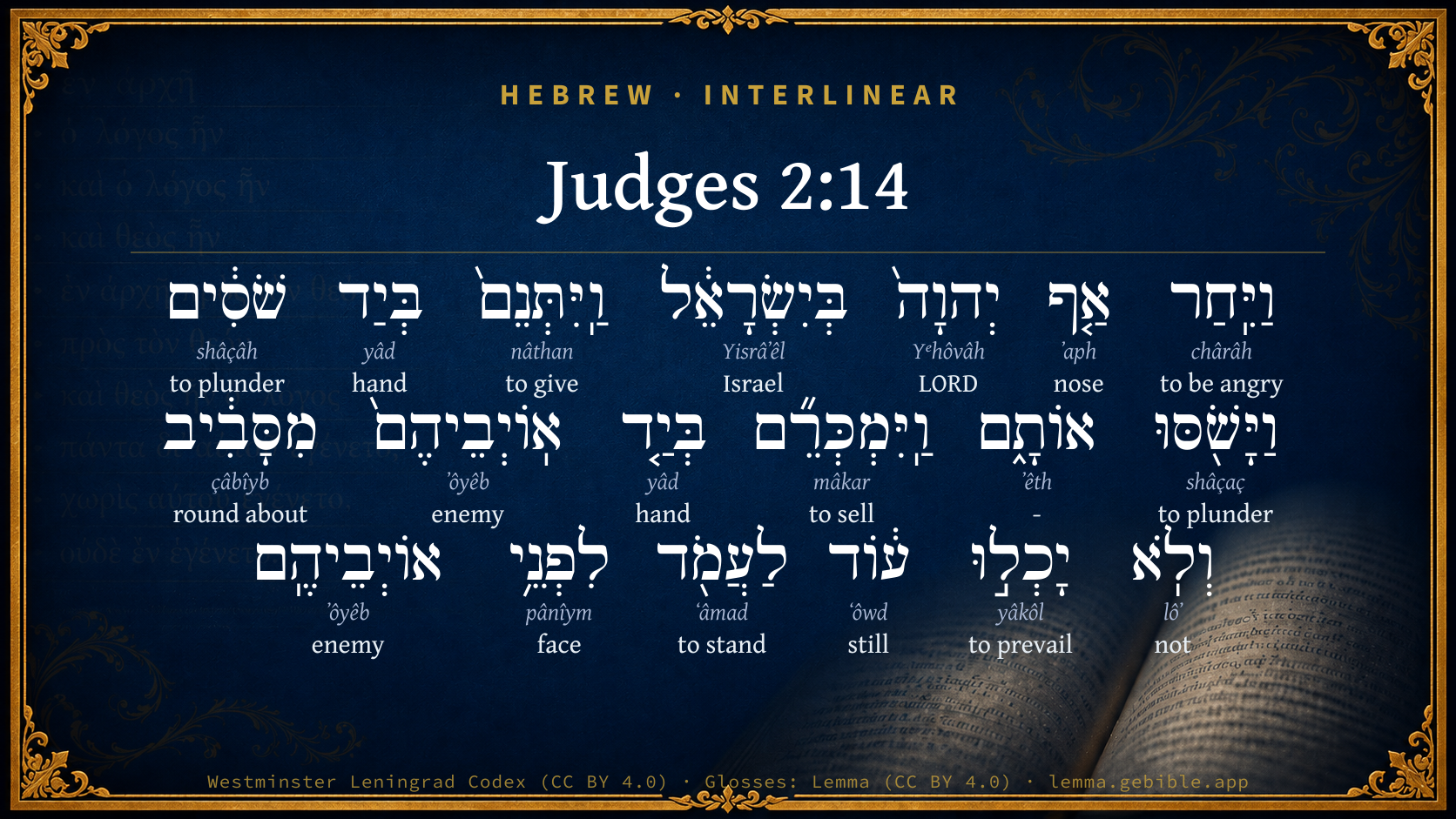
Hebrew (Westminster Leningrad Codex) Judges 2:14 appears in the Hebrew Old Testament. The text above is from the Westminster Leningrad Codex. Each word links to its Strong’s number, a concise gloss, and parsing drawn from the Open Scriptures Hebrew Bible morphology. Click any word for its full Brown-Driver-Briggs (BDB) entry.
Download image
Cite this verse

Judges 2:14 (World English Bible). Public Domain. Lemma interlinear Bible study tool, https://lemma.gebible.app/v/judges/2/14.

Show BibTeX & RIS
BibTeX
RIS
English Translation
The anger of Yahweh was kindled against Israel, and he delivered them into the hands of spoilers who despoiled them; and he sold them into the hands of their enemies round about, so that they could not any longer stand before their enemies.
World English Bible · Public Domain
Highlights
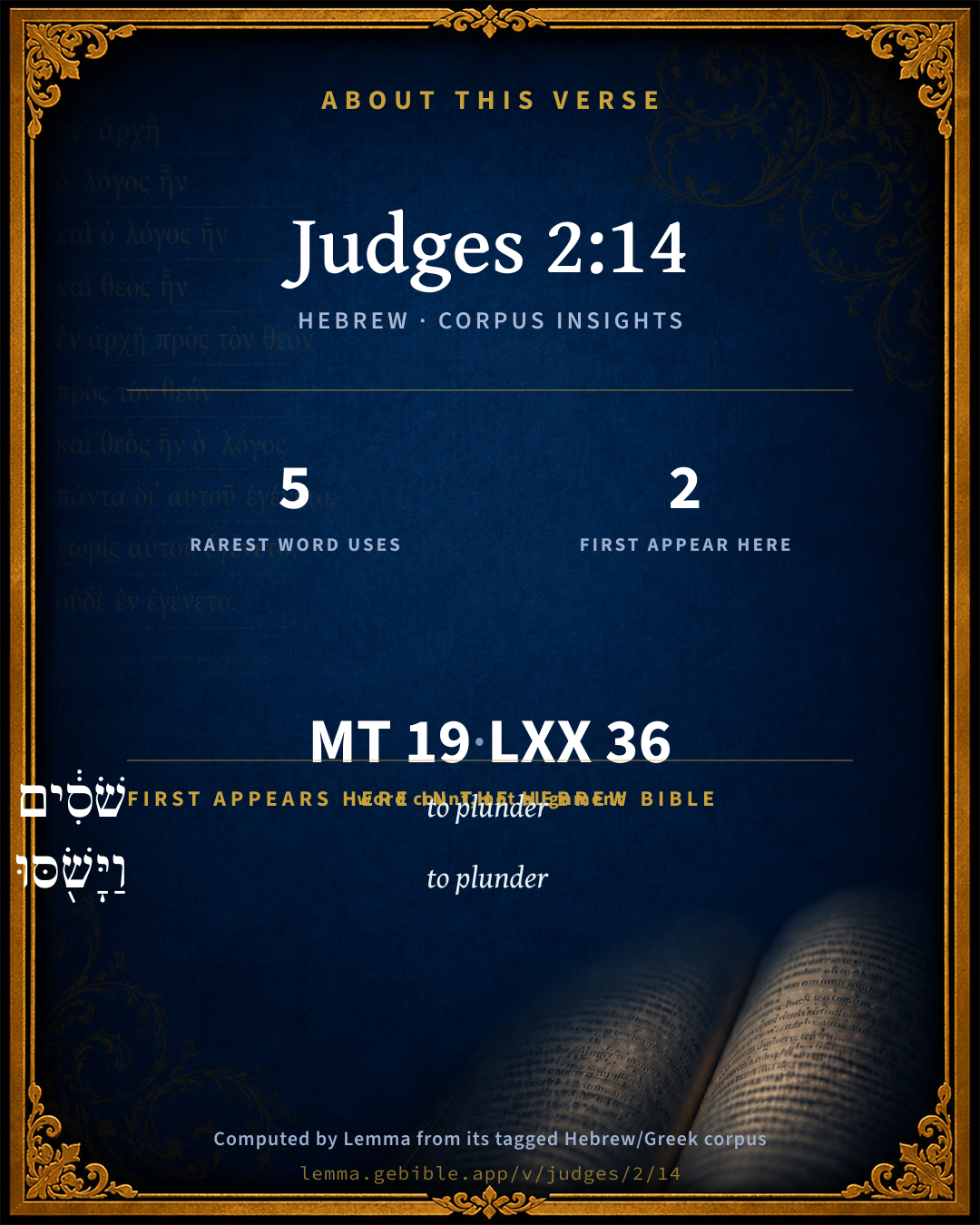
  • 2 first appearances in the Hebrew Bible
Full analysis ↓
Download a study sheet

One document with this verse’s original text, its word-by-word gloss line, the meaning frame, cross-references with their text, attributed commentary, and full source and license credits — printable, and it pastes into notes with its structure intact.

This verse Autodidact and up

Study sheet (.html) Plain text (.txt)

A passage Seminary Student

Up to 50 verses in one chapter. A passage sheet keeps up to 6 commentary sources and 12 cross-references per verse, in the order this page ranks them, and says so on the sheet whenever that leaves anything out. Ask for a single verse and you get the Autodidact verse sheet above.

Everything on this page stays free to read, with no account — the sheet is a download of what is already on screen, not access to it.

Want to remove ads? Support Godless Engineer
Compare translations 3

The same verse in 3 English versions, stacked beneath the original-language interlinear above. Click any original word for its lexicon entry.

Each is an independent rendering of the whole verse — the interlinear is not word-aligned to these translations.

Highlighted words mark where these versions differ — a whole-verse word diff, not a word-by-word alignment.

  • World English Bible Public Domain
    The anger of Yahweh was kindled against Israel, and he delivered them into the hands of spoilers who despoiled them; and he sold them into the hands of their enemies round about, so that they could not any longer stand before their enemies.
  • King James Version Public Domain
    And the anger of the LORD was hot against Israel, and he delivered them into the hands of spoilers that spoiled them, and he sold them into the hands of their enemies round about, so that they could not any longer stand before their enemies.
  • unfoldingWord Literal Text CC BY-SA 4.0
    Then the nose of Yahweh burned against Israel, and he gave them into the hand of plunderers, and they plundered them. And he sold them into the hand of their enemies from around, and they were not able anymore to stand to the face of their enemies.

unfoldingWord Literal Text — © unfoldingWord, licensed CC BY-SA 4.0. Word-aligned USFM3 via Door43 (git.door43.org/unfoldingWord/en_ult).

Versions to compare (up to 4)

3 of 4 selected

Show all 18 translations

Every available English version of this verse, each an independent rendering of the whole verse.

  • World English Bible Public Domain
    The anger of Yahweh was kindled against Israel, and he delivered them into the hands of spoilers who despoiled them; and he sold them into the hands of their enemies round about, so that they could not any longer stand before their enemies.
  • Berean Standard Bible Public Domain
    Then the anger of the LORD burned against Israel, and He delivered them into the hands of those who plundered them. He sold them into the hands of their enemies all around, whom they were no longer able to resist.
  • Majority Standard Bible Public Domain
    Then the anger of the LORD burned against Israel, and He delivered them into the hands of those who plundered them. He sold them into the hands of their enemies all around, whom they were no longer able to resist.
  • King James Version Public Domain
    And the anger of the LORD was hot against Israel, and he delivered them into the hands of spoilers that spoiled them, and he sold them into the hands of their enemies round about, so that they could not any longer stand before their enemies.
  • American Standard Version (1901) Public Domain
    And the anger of Jehovah was kindled against Israel, and he delivered them into the hands of spoilers that despoiled them; and he sold them into the hands of their enemies round about, so that they could not any longer stand before their enemies.
  • Revised Version (1885) Public Domain
    And the anger of the LORD was kindled against Israel, and he delivered them into the hands of spoilers that spoiled them, and he sold them into the hands of their enemies round about, so that they could not any longer stand before their enemies.
  • Geneva Bible (1599) Public Domain
    And the wrath of the Lord was hote against Israel, and he deliuered them into the hands of spoylers, that spoyled them, and he sold them into the handes of their enemies rounde about them, so that they could no longer stande before their enemies.
  • Douay-Rheims (1899) Public Domain
    And the Lord being angry against Israel, delivered them into the hands of plunderers: who took them and sold them to their enemies, that dwelt round about: neither could they stand against their enemies:
  • Young's Literal Translation Public Domain
    And the anger of Jehovah burneth against Israel, and He giveth them into the hand of spoilers, and they spoil them, and He selleth them into the hand of their enemies round about, and they have not been able any more to stand before their enemies;
  • Literal Standard Version CC BY-SA 4.0
    And the anger of YHWH burns against Israel, and He gives them into the hand of spoilers, and they spoil them, and He sells them into the hand of their surrounding enemies, and they have not been able to stand before their enemies anymore;
  • Unlocked Literal Bible CC BY-SA 4.0
    The anger of Yahweh burned against Israel, and he gave them to the raiders who stole their possessions from them. He sold them as slaves who were held by the strength of their enemies around them, so they could no longer defend themselves against their enemies.
  • unfoldingWord Literal Text CC BY-SA 4.0
    Then the nose of Yahweh burned against Israel, and he gave them into the hand of plunderers, and they plundered them. And he sold them into the hand of their enemies from around, and they were not able anymore to stand to the face of their enemies.
  • Darby Bible Public Domain
    So the anger of the LORD was kindled against Israel, and he gave them over to plunderers, who plundered them; and he sold them into the power of their enemies round about, so that they could no longer withstand their enemies.
  • World Messianic Bible Public Domain
    The LORD’s anger burned against Israel, and he delivered them into the hands of raiders who plundered them. He sold them into the hands of their enemies all around, so that they could no longer stand before their enemies.
  • Webster's Bible Public Domain
    And the anger of the LORD was hot against Israel, and he delivered them into the hands of spoilers that spoiled them, and he sold them into the hands of their enemies around, so that they could not any longer stand before their enemies.
  • Free Bible Version CC BY-SA 4.0
    Because the Lord was angry with Israel he handed them over to invaders who plundered them. He sold them to their enemies all around—enemies they could no longer resist.
  • Bible in Basic English Public Domain
    And the wrath of the Lord was burning against Israel, and he gave them up into the hands of those who violently took their property, and into the hands of their haters all round them, so that they were forced to give way before them.
  • JPS Tanakh (1917) Public Domain
    And the anger of the LORD was kindled against Israel, and He delivered them into the hands of spoilers that spoiled them, and He gave them over into the hands of their enemies round about, so that they could not any longer stand before their enemies.

Literal Standard Version (2020), Covenant Press — licensed CC BY-SA 4.0. Text via the HelloAO Bible API (eBible.org). Unlocked Literal Bible (unfoldingWord) — licensed CC BY-SA 4.0. Text via the HelloAO Bible API (eBible.org). unfoldingWord Literal Text — © unfoldingWord, licensed CC BY-SA 4.0. Word-aligned USFM3 via Door43 (git.door43.org/unfoldingWord/en_ult). Free Bible Version, Dr. Jonathan Gallagher — licensed CC BY-SA 4.0. Text via the HelloAO Bible API (eBible.org).

Word by word

More ways to search: Search by grammar → Find every occurrence → Compare this word →

Practice this passage: Drill this verse → Learn its vocabulary →

וַיָּשֹׁ֖סּוּ
shâçaç
H8155
“and · to plunder”
Conjunction + Verb, Qal, Sequential Imperfect, 3rd Person, Masculine, Plural
Part of Speech
Conjunction + Verb
Stem
Qal
Form
Sequential Imperfect
Person
3rd Person
Gender
Masculine
Number
Plural
Full BDB Definition

Origin: a primitive root

TWOT: 2426

to plunder, spoil - (Qal) to plunder - (Niphal) to be plundered, be rifled
  1. וַיִּֽחַר chârâh H2734 “and · to be angry” Conjunction + Verb, Qal, Sequential Imperfect, 3rd Person, Masculine, Singular
  2. אַ֤ף ʼaph H639 “nose” Particle, Accusative
  3. יְהוָה֙ Yᵉhôvâh H3068 “LORD” Noun, Proper
  4. בְּיִשְׂרָאֵ֔ל Yisrâʼêl H3478 “in/at · Israel” Preposition + Noun, Proper
  5. וַֽיִּתְּנֵם֙ nâthan H5414 “and · to give · them” Conjunction + Verb, Qal, Sequential Imperfect, 3rd Person, Masculine, Singular + Suffix, Personal, 3rd Person, Masculine, Plural
  6. בְּיַד yâd H3027 “in/at · hand of” Preposition + Noun, Common, Both, Singular, Construct
  7. שֹׁסִ֔ים shâçâh H8154 “plundering” Verb, Qal, Participle Active, Masculine, Plural, Absolute
  8. אוֹתָ֑ם ʼêth H853 “- · them” Particle, Direct Object + Suffix, Personal, 3rd Person, Masculine, Plural
  9. וַֽיִּמְכְּרֵ֞ם mâkar H4376 “and · to sell · them” Conjunction + Verb, Qal, Sequential Imperfect, 3rd Person, Masculine, Singular + Suffix, Personal, 3rd Person, Masculine, Plural
  10. בְּיַ֤ד yâd H3027 “in/at · hand of” Preposition + Noun, Common, Both, Singular, Construct
  11. אֽוֹיְבֵיהֶם֙ ʼôyêb H341 “enemy · them” Verb, Qal, Participle Active, Masculine, Plural, Construct + Suffix, Personal, 3rd Person, Masculine, Plural
  12. מִסָּבִ֔יב çâbîyb H5439 “from · round about” Preposition + Noun, Common, Both, Singular, Absolute
  13. וְלֹֽא lôʼ H3808 “and · not” Conjunction + Particle, Negative
  14. יָכְל֣וּ yâkôl H3201 “to prevail” Verb, Qal, Perfect, 3rd Person, Common, Plural
  15. ע֔וֹד ʻôwd H5750 “still” Adverb
  16. לַעֲמֹ֖ד ʻâmad H5975 “to stand” Preposition + Verb, Qal, Infinitive Construct
  17. לִפְנֵ֥י pânîym H6440 “to/for · face(s) of” Preposition + Noun, Common, Both, Plural, Construct
  18. אוֹיְבֵיהֶֽם ʼôyêb H341 “enemy · them” Verb, Qal, Participle Active, Masculine, Plural, Construct + Suffix, Personal, 3rd Person, Masculine, Plural

About this verse

These counts appear in no published source. They are computed here, from the morphology-tagged text and Lemma’s own curated glosses. What Lemma adds →

19
words
17
distinct lemmas
Historical
section

Notable vocabulary

The rarest word here is וַיָּשֹׁ֖סּוּ to plunder H8155 — appearing just 5 times in the whole Hebrew Bible.

First appearance in Scripture

These words make their first canonical appearance in the Hebrew Bible here:

  • שֹׁסִ֔ים to plunder H8154
  • וַיָּשֹׁ֖סּוּ to plunder H8155

Shared distinctive vocabulary

וַיָּשֹׁ֖סּוּ to plunder H8155 occurs in 5 verses of the Hebrew Bible. Also found in:

Grammatical profile

  • 9 verbs
  • 6 nouns
  • 1 adverb
  • 3 particles

Verb forms

  • וַיִּֽחַר Qal · Sequential Imperfect
  • וַֽיִּתְּנֵם֙ Qal · Sequential Imperfect
  • שֹׁסִ֔ים Qal · Participle Active
  • וַיָּשֹׁ֖סּוּ Qal · Sequential Imperfect
  • וַֽיִּמְכְּרֵ֞ם Qal · Sequential Imperfect
  • אֽוֹיְבֵיהֶם֙ Qal · Participle Active
  • יָכְל֣וּ Qal · Perfect
  • לַעֲמֹ֖ד Qal · Infinitive Construct
  • אוֹיְבֵיהֶֽם Qal · Participle Active

Repetition

Words recur within this verse — often emphatic in Hebrew:

  • בְּיַד hand H3027 ×2
  • אֽוֹיְבֵיהֶם֙ enemy H341 ×2

Hebrew & Septuagint length

In English translation the verse runs 43 words from the Hebrew and 43 from the Septuagint (LXX English) — the same length.

A rough comparison of the two English renderings, which tokenize alike — not a word-level alignment.

Word counts can differ between the Hebrew and the Greek without any difference in meaning — e.g. the Hebrew direct-object marker אֵת has no separate Greek word, and Greek often adds the article ὁ.

In the original languages it is 19 Hebrew tokens and 36 Greek tokens — but the two are counted differently (Hebrew bundles its prefixes and suffixes into one token; the Greek is in lemma form), so that isn’t a like-for-like length.

Cross-references

23

Topical passages linked to Judges 2:14 in the Treasury of Scripture Knowledge — connected by theme and wording, ordered by reader-vote popularity; previews shown in the World English Bible.

  • 2 Kings 17:20 Yahweh rejected all the seed of Israel, and afflicted them, and delivered them into the hand of spoilers, until he had cast them out of his sight.
  • Psalms 106:40–42 Therefore Yahweh burned with anger against his people. He abhorred his inheritance.
  • Deuteronomy 32:30 How should one chase a thousand, Two put ten thousand to flight, Except their Rock had sold them, Yahweh had delivered them up?
  • Deuteronomy 31:17–18 Then my anger shall be kindled against them in that day, and I will forsake them, and I will hide my face from them, and they shall be devoured, and many evils and troubles shall come on them; so that they will say in that day, Haven't these evils come on us because our God is not among us?
  • Leviticus 26:37 They will stumble over one another, as it were before the sword, when no one pursues: and you will have no power to stand before your enemies.
  • Joshua 7:12–13 Therefore the children of Israel can't stand before their enemies; they turn their backs before their enemies, because they are become accursed: I will not be with you any more, except you destroy the devoted thing from among you.
  • Judges 3:7–8 The children of Israel did that which was evil in the sight of Yahweh, and forgot Yahweh their God, and served the Baals and the Asheroth.
  • Judges 4:2 Yahweh sold them into the hand of Jabin king of Canaan, who reigned in Hazor; the captain of whose host was Sisera, who lived in Harosheth of the Gentiles.
  • Judges 10:7 The anger of Yahweh was kindled against Israel, and he sold them into the hand of the Philistines, and into the hand of the children of Ammon.
  • 2 Chronicles 36:16 but they mocked the messengers of God, and despised his words, and scoffed at his prophets, until the wrath of Yahweh arose against his people, until there was no remedy.
  • Deuteronomy 28:25 Yahweh will cause you to be struck before your enemies; you shall go out one way against them, and shall flee seven ways before them: and you shall be tossed back and forth among all the kingdoms of the earth.
  • Leviticus 26:28 then I will walk contrary to you in wrath; and I also will chastise you seven times for your sins.
  • Numbers 32:14 Behold, you are risen up in your fathers' place, an increase of sinful men, to augment yet the fierce anger of Yahweh toward Israel.
  • Deuteronomy 28:20 Yahweh will send on you cursing, confusion, and rebuke, in all that you put your hand to do, until you are destroyed, and until you perish quickly; because of the evil of your doings, by which you have forsaken me.
  • Deuteronomy 28:58 If you will not observe to do all the words of this law that are written in this book, that you may fear this glorious and fearful name, YAHWEH YOUR GOD;
  • Deuteronomy 29:19–20 and it happen, when he hears the words of this curse, that he bless himself in his heart, saying, I shall have peace, though I walk in the stubbornness of my heart, to destroy the moist with the dry.
  • Judges 1:19 Yahweh was with Judah; and drove out [the inhabitants of] the hill-country; for he could not drive out the inhabitants of the valley, because they had chariots of iron.
  • Judges 1:34 The Amorites forced the children of Dan into the hill-country; for they would not allow them to come down to the valley;
  • 2 Chronicles 15:5 In those times there was no peace to him who went out, nor to him who came in; but great vexations were on all the inhabitants of the lands.
  • Psalms 44:9–10 But now you rejected us, and brought us to dishonor, And don't go out with our armies.
  • Psalms 44:12 You sell your people for nothing, And have gained nothing from their sale.
  • Isaiah 50:1 Thus says Yahweh, Where is the bill of your mother's divorce, with which I have put her away? or which of my creditors is it to whom I have sold you? Behold, for your iniquities were you sold, and for your transgressions was your mother put away.
  • Jeremiah 37:10 For though you had struck the whole army of the Chaldeans who fight against you, and there remained but wounded men among them, yes would they rise up every man in his tent, and burn this city with fire.

Cross-references courtesy of OpenBible.info (CC BY 4.0).

Hebrew and Greek witnesses Masoretic Hebrew ↔ Greek Septuagint

The same verse in the two great witnesses to the Old Testament, shown verse-for-verse.

These are two independent witnesses, not word-aligned to each other, and the Septuagint is shown in lemma (dictionary) form.

Hebrew Judges 2:14 Masoretic · Westminster Leningrad Codex

וַיִּֽחַר אַ֤ף יְהוָה֙ בְּיִשְׂרָאֵ֔ל וַֽיִּתְּנֵם֙ בְּיַד שֹׁסִ֔ים וַיָּשֹׁ֖סּוּ אוֹתָ֑ם וַֽיִּמְכְּרֵ֞ם בְּיַ֤ד אֽוֹיְבֵיהֶם֙ מִסָּבִ֔יב וְלֹֽא יָכְל֣וּ ע֔וֹד לַעֲמֹ֖ד לִפְנֵ֥י אוֹיְבֵיהֶֽם

The anger of Yahweh was kindled against Israel, and he delivered them into the hands of spoilers who despoiled them; and he sold them into the hands of their enemies round about, so that they could not any longer stand before their enemies.

World English Bible · Public Domain

Greek LXX Judges 2:14 Septuagint · lemma form

καί ὀργίζω θυμός κύριος ἐν ὁ ἰσραήλ καί παραδίδωμι αὐτός εἰς χείρ προνομεύω καί κατα προνομεύω αὐτός καί ἀποδίδωμι αὐτός ἐν χείρ ὁ ἐχθρός αὐτός κυκλόθεν καί οὐ δύναμαι ἔτι ἀντιἵστημι κατά πρόσωπον ὁ ἐχθρός αὐτός

And the Lord was very angry with Israel; and he gave them into the hands of the spoilers, and they spoiled them; and he sold them into the hands of their enemies round about, and they could not any longer resist their enemies,

LXX2012 (modern English Septuagint) · Public Domain

Hebrew: Westminster Leningrad Codex (CC BY 4.0). Greek: Septuagint (public domain); English from LXX2012 (modern English Septuagint) (Public Domain). How the Septuagint differs from the Hebrew →

Targum (Aramaic paraphrase)

1

The Targum is the ancient Jewish Aramaic paraphrase of the Hebrew Scriptures — an interpretive translation, not the Hebrew text itself. Onkelos (literal) and Pseudo-Jonathan (expansive) render the Torah, and Jonathan the Prophets. Coverage is partial: where no permissively-licensed English translation exists for a verse, only the Aramaic is shown. This is verse-level text, not a word-by-word alignment to the Hebrew.

  1. Targum Jonathan Prophets (Joshua–Malachi)
    וּתְקֵף רוּגְזָא דַייָ בְּיִשְׂרָאֵל וּמַסְרִינוּן בְּיַד בוֹזְזֵיהֶן וּבְזוֹ יַתְהוֹן וּמַסְרִינוּן בְּיַד בַּעֲלֵי דְבָבֵיהוֹן מִסְחוֹר סְחוֹר וְלָא יָכִילוּ עוֹד לְמֵיקָם קֳדָם בַּעֲלֵי דְבָבֵיהוֹן:

    (no public-domain English translation for this verse)

    Targum Jonathan — Aramaic: “Mikraot Gedolot” (public domain). English: “Sefaria Community Translation” (CC0 1.0 (public-domain dedication)); “London "Chaldee Paraphrase," 1871” (public domain). Text via Sefaria.

Commentary

Notes on Judges 2:14 from classic Christian and Jewish commentators (each source and its license shown beneath its notes). The classic Christian expositions comment on the surrounding passage and are grouped to its opening verse, so a note may address several verses; the Jewish commentaries on the Tanakh (Rashi and others) are per-verse, so they appear only where the commentator wrote on this verse.

Lemma curates 59 commentaries, every one of them public domain or Creative Commons licensed, each selected and text-cleaned for this edition rather than reprinted as found. About our sources →

Trapp's Complete Commentary

John Trapp

Jdg 2:14 And the anger of the LORD was hot against Israel, and he delivered them into the hands of spoilers that spoiled them, and he sold them into the hands of their enemies round about, so that they could not any longer stand before their enemies.

Ver. 14. And he delivered them.] The next effect of wrath is revenge, both improperly attributed to God. "Fury is not in me." {Isa 27:4}

He sold them into the hands.] {a} He renounced his right in them, as it were, casting off all further care of them, and then they must needs do full ill.

{a} In Georg., lib. i.

John Trapp, A Commentary or Exposition upon All the Books of the Old and New Testament (1647–1656) — public domain. Text from a community e-Sword module.

Matthew Poole's English Annotations

Sold them, i.e. delivered them up, as the seller doth, his commodities unto the buyer. This the same phrase is used Jdg 3:8; 4:9, compared with Jdg 2:14; Psa 44:12.

Matthew Poole's English Annotations on the Holy Bible (1683–1685) — public domain. Text from a community e-Sword/MySword module.

Joseph Benson's Commentary

Jdg 2:14-15. Sold them — That is, delivered them up, as the seller doth his commodities, unto the buyer. Whithersoever they went out — That is, whatsoever expedition or business they undertook, which is equally signified by going out and coming in; the hand of the Lord was against them for evil — Disappointing their expectations, opposing and thwarting their designs, and blasting all their prospects. They were greatly distressed — Thus is sin uniformly followed by suffering.

Joseph Benson's Commentary on the Old and New Testaments (1811–1818) — public domain. Text from a community e-Sword module.

Jamieson, Fausset & Brown

Robert Jamieson, A. R. Fausset & David Brown

the anger of the Lord was hot against Israel, and he delivered them into the hands of spoilers that spoiled them--Adversities in close and rapid succession befell them. But all these calamities were designed only as chastisements--a course of correctional discipline by which God brought His people to see and repent of their errors; for as they returned to faith and allegiance, He "raised up judges" (Jdg 2:16).

Jamieson, Fausset & Brown — Commentary Critical and Explanatory on the Whole Bible (1871) — public domain (CC PDM 1.0). Text via the HelloAO Bible API.

Adam Clarke's Commentary

Verse 14. The hands of spoilers] Probably marauding parties of the Canaanites, making frequent incursions in their lands, carrying away cattle, spoiling their crops, &c.

Adam Clarke's Commentary on the Bible (1810–1826) — public domain. Text from a community e-Sword/MySword module.

Ellicott's Commentary for English Readers

(14) The anger of the Lord was hot.—(Psa_78:59.) The language of the sad summary which follows should be compared with that of very similar passages which we find in various parts of the Bible (Psa_106:34-45; Deuteronomy 32; 2 Kings 17; 2Ki_24:2-4; 2Ch_36:11-21; Jer_11:2-10).

He sold them.—We find the same expression in Jdg_3:8; Jdg_4:2; Jdg_10:7; Deu_32:33; Psa_44:12; Isa_1:1; comp. 2Ki_17:20.

So that they could not any longer stand.—Comp. Lev_26:17, “Ye shall be slain before your enemies”; Deu_28:15-68.

A Bible Commentary for English Readers, edited by Charles John Ellicott (1878–1897) — public domain. Text from a community e-Sword module.

The Cambridge Bible for Schools and Colleges

gen. ed. J. J. S. Perowne

14. delivered them into the hands of spoilers] So 2Ki_17:20. The Dtc. compiler summarizes in general terms the various nations who were allowed to chastise Israel; there were spoilers (Jdg_2:16) such as the Midianites, oppressors (Jdg_2:18) such as the Philistines. Spoilers, Hebr. shôsim, is the same word as the Egyptian name, borrowed from Semitic, for the robber Bedouin of the desert, shasu; Müller, Asien u. Europa, p. 131.

sold them] One of the compiler’s phrases, Jdg_3:8, Jdg_4:2; Judges cf. Jdg_2:9, Jdg_10:7; cf. Deu_28:68; Deu_32:30, 1Sa_12:9, Eze_30:12. Perhaps it was suggested by Jdg_4:9, though its use in that older narrative is not quite the same as here.

their enemies round about] Cf. Jdg_8:34; Deu_12:10; Deu_25:19; 1Sa_12:11. The enemies are those on the frontiers of Israel; contrast Jdg_2:21 (from E), where the enemies are the nations in the midst of Israel.

The Cambridge Bible for Schools and Colleges (gen. ed. J. J. S. Perowne; Cambridge University Press, 1878–1918) — public domain. Text from a community e-Sword module.

John Gill's Exposition

And the anger of the Lord was hot against Israel,.... For the idolatries they were guilty of; it burned within him, it broke forth, and was poured out like fire on them, and consumed them; see Nah 1:6,

and he delivered them into the hands of spoilers that spoiled them; that rifled their houses, and plundered them of their goods and substance:

and he sold them into the hands of their enemies round about; the is, delivered them into their hands, who carried them captive, where they were as men sold for slaves; see Psa 44:12; and this was in just retaliation, that as they had said themselves to work wickedness, the Lord sold them into the hands of their enemies for their wickedness; and, as they had followed the gods of the people round about them, so he delivered them up, into the hands of their enemies round about them, as the Mesopotamians, Moabites, Midianites, Philistines, and Ammonites:

so that they could not any longer stand before their enemies; but turned their backs on them, and fled whenever engaged in war with them.

John Gill's Exposition of the Whole Bible (1746–1763) — public domain (CC PDM 1.0). Text via the HelloAO Bible API.

Albert Barnes' Notes on the Bible

Consult the marginal references. The phrase, “he sold them into the hands etc.,” is first found in Deu 32:30.

Albert Barnes' Notes on the Bible (1834–1885) — public domain. Text from a community e-Sword/MySword module.

Haydock's Catholic Bible Commentary

Who took. Hebrew, "that spoiled them, and he sold" or abandoned them, &c. (Calmet)

George Leo Haydock (1774–1849), Haydock's Catholic Family Bible and Commentary, 1859 edition — public domain. Excludes Psalms (Douay-Rheims chapter numbering differs from Protestant) and Deuterocanonical books (Catholic canon only).

Whedon's Commentary on the Bible

Daniel D. Whedon

14. The anger of the Lord was hot — Anger and love are feelings of the Divine as well as of the human mind, but not irregular and misdirected, as they so often appear in men. They are not evil in themselves, and can only become so by becoming uncontrolled or directed towards wrong objects. Infinite Wisdom never errs in either of these ways, and God’s essential antagonism against sin and sinners is one of the perfections of his holy nature. And such righteous indignation the Scriptures properly call anger. Our God is a consuming fire to all the workers of iniquity, and his holy wrath burns with greater or less intensity according to the sinfulness of the sinner. See note on Rom_1:18.

Spoilers — Predatory hordes, ruthless robbers, and hostile armies, who plundered their possessions and made merchandise of their persons.

And he sold them — This term sell is used in a broad sense for renouncing ownership, and delivering over into the hands of an enemy. The punishment involved in being sold was a payment to the divine justice. They failed to render due service to their only true Lord, and he, their rightful owner, sold them into a miserable slavery. Thus he vindicated the righteousness of his government, and for lack of service enforced a penalty.

Daniel D. Whedon (gen. ed.), Commentary on the Old and New Testaments (1874–1909) — public domain. Text from a community e-Sword module.

The Pulpit Commentary

Vers. 14, 15. The anger of the Lord, etc. These verses contain an awful view of the wrath of God excited by wilful sin, and are a practical illustration of Exo_20:5: I am a jealous God." Compare Psa_79:5, which shows how closely allied the notions of anger and jealousy are in Hebrew. He sold them. A forcible expression, implying the handing over of the people into the hands of their enemies, as if God had no more any property in them or concern about them; as if he said, "Ye are not my people, and I am not your God;" as if he said to the heathen, "Take them, and do as you will with them; they are yours, not mine" (see Leviticus 26 and Deuteronomy 28). As the Lord had sworn, etc. , showing that God fulfilled his threatenings as well as his promises.

Vers. 14-23. The goodness and severity of God.

To know God as he is relatively to man not as the absolute, which is impossible to be known, but such as he is relatively to man is the highest of all knowledge which man can attain, and the most important for him to possess. Accordingly, one main purpose of revelation is to give us such knowledge. And this is given in two ways. One is by descriptions of God"s character, as, e.g. , that in Exo_34:6, 7: "The Lord God, merciful and gracious, long-suffering, and abundant in goodness and truth, keeping mercy for thousands, forgiving iniquity and transgression and sin, and that will by no means clear the guilty; visiting the iniquity of the fathers upon the children," etc. The other is by the authentic record of God"s acts, specially in the gift of his only begotten Son to be the Saviour of the world, and in the Saviour"s work as related in the Gospels, and also generally in his providential dealings with his people Israel, as set forth in the Old Testament. Of the latter method the Book of Judges, of which this section is an epitome, is a striking and instructive specimen. In it we have represented to us in vivid colours two characteristic features of the mind of God.

I GOD"S HATRED OF SIN. With the usual anthropomorphism of Holy Scripture, we are told that when the children of Israel did evil in the sight of the Lord, they "provoked the Lord to anger." "The anger of the Lord was hot "against them," it is twice repeated, and "his hand was against them for evil." Here, then, we see God"s hatred of sin. And if God is infinitely good and holy, and if he knows the full misery that sin has brought into his creation, with what other sentiment can he regard sin but with that of hatred and indignation? Sin excites a holy anger in his mind, and his hand must be stretched out to punish and to check. If we reflect calmly, we must see that both of these are inevitable. God must look upon sin with displeasure, and he must ACT upon that displeasure. Evil must excite displeasure in one that is perfectly good; and in the moral Governor of the universe such displeasure cannot be quiescent and impotent, it must be active and effective. Reason teaches us so, and revelation sanctions, enlarges, and enforces the lesson.

II GOD"S EXCEEDING AND TENDER MERCY. TO use the same anthropomorphism as before, we see God ever relenting, ever yearning over the miseries of his people, ever repenting of the evil that he had brought upon them, when he heard their groanings, ever forgetting their provocations and offences, and stepping forward to deliver them. It is impossible to have mercy, forgiveness, benevolence, and love, depicted in more vivid colours. Anything more remote from the idea of a vindictive, hard, unforgiving nature it is impossible to conceive. And when we go on to inquire what are the conditions in man which, so to speak, draw out these not opposite, but different sides of the Divine character, we find that it is against persistent sin that the wrath of God burns, and upon which his heavy hand falls to smite; and that it is to the contrite and penitent who forsake their sins that his quick and willing mercy is extended. And then a little further reflection seems to show that just as in nature different forces are found ultimately to resolve themselves into one common force, so these two attributes of God, hatred of sin, and mercy, may really be expressed by one term goodness, or love. Goodness or love relatively to persistent sin is righteous punishment; relatively to penitent sorrow it is mercy and forgiveness. And the reason of this is plain. Sin involves the misery of all who are subject to it, and of all God"s creation, if it is suffered to continue and grow in it. It must therefore be the part of a good and loving God to extirpate sin, and that doubtless is the purpose of punishment, which is only another way of saying that punishment is remedial: remedial, if possible, to the being punished, that is, if it brings him to repentance; but anyhow remedial to creation, which in the continued punishment of the impenitent sees the evil of sin, and avoids it. The further doctrine of the ATONEMENT does not arise here, but it may just be observed how entirely it agrees with what we see here of God"s character, since in it, as made by the death of the only begotten Son upon the cross, the two attributes of hatred of sin, and ineffable mercy, stand out with marvellous force and brightness. We conclude then that while mercy is goodness acting towards those who are not beyond the reach of goodness, severity is goodness acting with a view as far as possible to the happiness of the whole creation. And we see in the atonement a provision of infinite wisdom, by which the risk of injury to the many by mercy to the few is removed and done away with, and by which the severity and the mercy infinitely enhance and magnify each other. Sin when it is finished bringeth forth death. Other important lessons of the DEADLY FRUIT OF SIN, and of the INVETERATE PERVERSENESS OF MAN, recurring to sin again and again, in spite of bitter experience, like a moth flying into the candle, and of the BARRIERS which man"s stubborn disobedience sets up against the coming in of all the good things which God"s love had prepared for him, flow spontaneously from the narrative in this section. So also does the lesson of the use of trouble as THE TRIAL OF FAITH (1Pe_1:7) and the test of obedience. In fact it opens a large and comprehensive chapter on the providential government of the Church and of the world.

HOMILIES BY A.F. MUIR. Vers. 14-18. Mercy is the midst of judgment.

As the sin of Israel continues and multiplies, the anger of the Lord waxes hot. As the misery of his people deepens, his compassions fail not. There is no contradiction in this. The mercy of God is not a weakness, it is the minister and honourer of his law. The judges, who represented the mercy of God, by whom they were raised up in faithless times, were also witnesses of his righteousness, and living embodiments of his kingdom amongst men.

I THE MERCY OF GOD DOES NOT CONSIST IN ALTERING THE LAWS OF HIS KINGDOM, BUT IN LEADING MEN TO CONFORM MORE PERFECTLY TO THEM. The covenant is still felt as a living power even when it is ignored. The evils foretold come to pass, and in ever-increasing force. But God pursues a plan of restoration. This plan is never one of destruction or reversal. Not one jot or tittle of the law has to pass in order that the gospel may have effect. God seeks to change the hearts of his erring children, and by the punitive operation of the laws of his kingdom to make them loyal subjects. The law that curses will also, when obeyed, be found to bless. The judges were a continuous witness to righteousness and protest against sin, and by the prestige of their mighty acts and the constant influence of their lives they led men back again to God and goodness. They were the embodiments of his mercy.

II THE VICTORIES OF SIN ARE NEVER CONSIDERED BY HIM AS IRREVERSIBLE. It was said in praise of English soldiers that they did rot know when they were beaten. How much truer is this of God and his people! The most appalling apostasy has not daunted our Heavenly Father, or driven him utterly away from his world. "Where sin abounded, there did grace much more abound." Some of the best of men and most comforting of doctrines were born in ages of spiritual darkness. He has never left himself without a witness. The course of revelation is never stopped. The succession of prophets, apostles, and martyrs is never interrupted. The servants of God in Old Testament times might be driven away or destroyed, but they, being dead, yet speak, and in the fulness of time he sends his Son; he, too, may be crucified, but nevertheless the Father will send the Comforter in his name. And so in the individual life this law will be found to operate. The darkest conscience has not been without its light.

III ON THE WHOLE THE SPIRITUAL GAINS OVER THE CARNAL IN THE PROGRESS OF THE KINGDOM OF GOD AMONGST MEN. One judge passes away and another rises. The apostasies which they have to correct may become darker and more terrible; but greater deeds are forthcoming. The testimony is more and more emphatic. The principles of God"s kingdom are illustrated and honoured, and Israel gradually emancipated from its ignorance and inexperience. M.

The Pulpit Commentary (1880–1919), ed. H.D.M. Spence-Jones & Joseph S. Exell — public domain. Text from a community e-Sword module.

John Wesley's Explanatory Notes

Sold them - That is, delivered them up, as the seller doth his commodities unto the buyer.

John Wesley, Explanatory Notes Upon the Whole Bible (1754–1765) — public domain. Text via the GEBible commentary corpus.

Keil & Delitzsch

C. F. Keil & F. Delitzsch

On account of this idolatrous worship, the anger of the Lord burned against Israel, so that He gave them up into the hands of spoilers that spoiled them, and sold them into the hands of their enemies. שׁסים from שׁסה, alternated with שׁסס in ישׁסּוּ, to plunder. This word is not met with in the Pentateuch, whereas מכר, to sell, occurs in Deu 32:30, in the sense of giving helplessly up to the foe. "They could no longer stand before their enemies," as they had done under Joshua, and in fact as long as Israel continued faithful to the Lord; so that now, instead of the promise contained in Lev 26:7-8, being fulfilled, the threat contained in Lev 26:17 was carried into execution. "Whithersoever they went out," i.e., in every expedition, every attack that they made upon their enemies, "the hand of Jehovah was against them for evil, as He had said" (Lev 26:17, Lev 26:36; Deu 28:25), and "had sworn unto them." There is no express oath mentioned either in Lev 26 or Deut 28; it is implied therefore in the nature of the case, or in virtute verborum, as Seb. Schmidt affirms, inasmuch as the threats themselves were words of the true and holy God. מאד להם ויּצר, "and it became to them very narrow," i.e., they came into great straits.

Keil & Delitzsch — Biblical Commentary on the Old Testament (1861–1891) — public domain (CC PDM 1.0). Text via the HelloAO Bible API. (Old Testament only.)

unfoldingWord translationNotes

Door43 World Missions Community

The anger of Yahweh burned against Israel

The anger of Yahweh is described as burning like a fire. AT: "Yahweh became very angry with the people of Israel" (See: Metaphor)

he gave them to the raiders who stole their possessions from them

"he let raiders steal their possessions"

He sold them as slaves who were held by the strength of their enemies around them, so they could no longer defend themselves against their enemies

Yahweh allowing the enemies to take the Israelites as slaves is spoken of as if he sold them into slavery. The phrase "who were held by" can be stated in active form. AT: "He allowed their enemies to conquer them and take them as slaves, and they could no longer resist their powerful enemies" (See: Metaphor and Active or Passive)

Yahweh's hand was against them to defeat them

Here "hand" represents Yahweh's power. AT: "Yahweh helped their enemies defeat them" (See: Metonymy)

they were in terrible distress

"they were suffering terribly"

translationWords

anger

Yahweh

Israel

possess

servant

adversary

hand

oath

unfoldingWord translationNotes — © Distant Shores Media and the Door43 World Missions Community, licensed CC BY-SA 4.0. Source: git.door43.org/Door43/en_tn.

Lesson kit

Teaching starters — assembled from the data on this page, not authored interpretation. Every prompt links to the verse data it draws on. Edit before teaching.

Judges, in the Historical, opens this verse with 19 words (17 distinct Hebrew lemmas). Its most distinctive word is shâçaç (“to plunder”). A historical commentator’s framing appears above. Read the whole chapter for the surrounding context.

Discussion questions

  1. The word shâçaç carries the sense “to plunder.” How does it shape the verse?
  2. 2 words make their first appearance in Scripture here. What does this debut establish?
  3. How does 1 Samuel 17:53, which shares the word «to plunder», read alongside this verse?
  4. What does the repetition of “hand” (2× in this one verse) do in this verse?
  5. These translations render this verse differently; the difference is in the English rendering, not the original. What questions does that raise?
  6. «וַיִּֽחַר» is a Qal Sequential Imperfect verb. How does that grammatical form shape the action described?
  7. Compare how Trapp's Complete Commentary and Matthew Poole's English Annotations read this verse. Where do they agree or differ?

Things to notice

Reading settings

Reading text

Shown beneath each verse's original-language words.

Old Testament
Old Testament edition

Read the OT as the Masoretic Hebrew (MT) or the Greek Septuagint (LXX).

English shown for the Greek Septuagint (in the Hebrew ↔ Greek comparison).

Comparing translations? Open the Compare panel on any verse page to stack up to four side by side.