
Esther 9:16

Hebrew (Westminster Leningrad Codex) Esther 9:16 appears in the Hebrew Old Testament. The text above is from the Westminster Leningrad Codex. Each word links to its Strong’s number, a concise gloss, and parsing drawn from the Open Scriptures Hebrew Bible morphology. Click any word for its full Brown-Driver-Briggs (BDB) entry.
Download image
Cite this verse

Esther 9:16 (World English Bible). Public Domain. Lemma interlinear Bible study tool, https://lemma.gebible.app/v/esther/9/16.

Show BibTeX & RIS
BibTeX
RIS
English Translation
The other Jews who were in the king's provinces gathered themselves together, and stood for their lives, and had rest from their enemies, and killed of those who hated them seventy-five thousand; but they didn't lay their hand on the spoil.
World English Bible · Public Domain
Download a study sheet

One document with this verse’s original text, its word-by-word gloss line, the meaning frame, cross-references with their text, attributed commentary, and full source and license credits — printable, and it pastes into notes with its structure intact.

This verse Autodidact and up

Study sheet (.html) Plain text (.txt)

A passage Seminary Student

Up to 50 verses in one chapter. A passage sheet keeps up to 6 commentary sources and 12 cross-references per verse, in the order this page ranks them, and says so on the sheet whenever that leaves anything out. Ask for a single verse and you get the Autodidact verse sheet above.

Everything on this page stays free to read, with no account — the sheet is a download of what is already on screen, not access to it.

Want to remove ads? Support Godless Engineer
Compare translations 3

The same verse in 3 English versions, stacked beneath the original-language interlinear above. Click any original word for its lexicon entry.

Each is an independent rendering of the whole verse — the interlinear is not word-aligned to these translations.

Highlighted words mark where these versions differ — a whole-verse word diff, not a word-by-word alignment.

  • World English Bible Public Domain
    The other Jews who were in the king's provinces gathered themselves together, and stood for their lives, and had rest from their enemies, and killed of those who hated them seventy-five thousand; but they didn't lay their hand on the spoil.
  • King James Version Public Domain
    But the other Jews that were in the king's provinces gathered themselves together, and stood for their lives, and had rest from their enemies, and slew of their foes seventy and five thousand, but they laid not their hands on the prey,
  • unfoldingWord Literal Text CC BY-SA 4.0
    And the rest of the Jews who were in the provinces of the king assembled themselves and stood for their lives, and they rested from their enemies, and they slaughtered 75, 000 of those who hated them. But they did not stretch out their hand to the plunder.

unfoldingWord Literal Text — © unfoldingWord, licensed CC BY-SA 4.0. Word-aligned USFM3 via Door43 (git.door43.org/unfoldingWord/en_ult).

Versions to compare (up to 4)

3 of 4 selected

Show all 18 translations

Every available English version of this verse, each an independent rendering of the whole verse.

  • World English Bible Public Domain
    The other Jews who were in the king's provinces gathered themselves together, and stood for their lives, and had rest from their enemies, and killed of those who hated them seventy-five thousand; but they didn't lay their hand on the spoil.
  • Berean Standard Bible Public Domain
    The rest of the Jews in the royal provinces also assembled to defend themselves and rid themselves of their enemies. They killed 75,000 who hated them, but they did not lay a hand on the plunder.
  • Majority Standard Bible Public Domain
    The rest of the Jews in the royal provinces also assembled to defend themselves and rid themselves of their enemies. They killed 75,000 who hated them, but they did not lay a hand on the plunder.
  • King James Version Public Domain
    But the other Jews that were in the king's provinces gathered themselves together, and stood for their lives, and had rest from their enemies, and slew of their foes seventy and five thousand, but they laid not their hands on the prey,
  • American Standard Version (1901) Public Domain
    And the other Jews that were in the king's provinces gathered themselves together, and stood for their lives, and had rest from their enemies, and slew of them that hated them seventy and five thousand; but on the spoil they laid not their hand.
  • Revised Version (1885) Public Domain
    And the other Jews that were in the king’s provinces gathered themselves together, and stood for their lives, and had rest from their enemies, and slew of them that hated them seventy and five thousand; but on the spoil they laid not their hand.
  • Geneva Bible (1599) Public Domain
    And the rest of the Iewes that were in the Kings prouinces assembled themselues, and stood for their liues, and had rest from their enemies, and slewe of them that hated them, seuentie and fiue thousand: but they layd not their hand on the spoyle.
  • Douay-Rheims (1899) Public Domain
    Moreover through all the provinces which were subject to the king's dominion the Jews stood for their lives, and slew their enemies and persecutors: insomuch that the number of them that were Billed amounted to seventy-five thousand, and no man took any of their goods.
  • Young's Literal Translation Public Domain
    And the rest of the Jews, who `are' in the provinces of the king, have been assembled, even to stand for their life, and to rest from their enemies, and to slay among those hating them five and seventy thousand, and on the prey they have not put forth their hand;
  • Literal Standard Version CC BY-SA 4.0
    And the rest of the Jews, who [are] in the provinces of the king, have been assembled, even to stand for their life, and to rest from their enemies, and to slay seventy-five thousand among those hating them, and they have not put forth their hand on the prey;
  • Unlocked Literal Bible CC BY-SA 4.0
    The rest of the Jews who were in the king's provinces came together to defend their lives, and they got relief from their enemies and killed seventy-five thousand of those who hated them, but they did not lay their hands on the valuables of those they killed.
  • unfoldingWord Literal Text CC BY-SA 4.0
    And the rest of the Jews who were in the provinces of the king assembled themselves and stood for their lives, and they rested from their enemies, and they slaughtered 75, 000 of those who hated them. But they did not stretch out their hand to the plunder.
  • Darby Bible Public Domain
    And the other Jews that were in the king's provinces gathered themselves together, and stood for their life, and had rest from their enemies; and they slew of them that hated them seventy-five thousand (but they laid not their hand on the prey),
  • World Messianic Bible Public Domain
    The other Jews who were in the king’s provinces gathered themselves together, defended their lives, had rest from their enemies, and killed seventy-five thousand of those who hated them; but they didn’t lay their hand on the plunder.
  • Webster's Bible Public Domain
    But the other Jews that were in the king's provinces assembled, and stood for their lives, and had rest from their enemies, and slew of their foes seventy and five thousand, (but they laid not their hands on the prey.)
  • Free Bible Version CC BY-SA 4.0
    The other Jews in the king's provinces also gathered to defend themselves and get rid of their enemies. They killed 75,000 who hated them, but did not touch their possessions.
  • Bible in Basic English Public Domain
    And the other Jews in every division of the kingdom came together, fighting for their lives, and got salvation from their haters and put seventy-five thousand of them to death; but they did not put a hand on their goods.
  • JPS Tanakh (1917) Public Domain
    And the other Jews that were in the king's provinces gathered themselves together, and stood for their lives, and had rest from their enemies, and slew of them that hated them seventy and five thousand — but on the spoil they laid not their hand —

Literal Standard Version (2020), Covenant Press — licensed CC BY-SA 4.0. Text via the HelloAO Bible API (eBible.org). Unlocked Literal Bible (unfoldingWord) — licensed CC BY-SA 4.0. Text via the HelloAO Bible API (eBible.org). unfoldingWord Literal Text — © unfoldingWord, licensed CC BY-SA 4.0. Word-aligned USFM3 via Door43 (git.door43.org/unfoldingWord/en_ult). Free Bible Version, Dr. Jonathan Gallagher — licensed CC BY-SA 4.0. Text via the HelloAO Bible API (eBible.org).

Word by word

More ways to search: Search by grammar → Find every occurrence → Compare this word →

Practice this passage: Drill this verse → Learn its vocabulary →

וְנ֨וֹחַ֙
nûwach
H5118
“and · resting place”
Conjunction + Verb, Qal, Infinitive Absolute
Part of Speech
Conjunction + Verb
Stem
Qal
Form
Infinitive Absolute
Full BDB Definition

Origin: from H5117

TWOT: 1323 ?

resting place
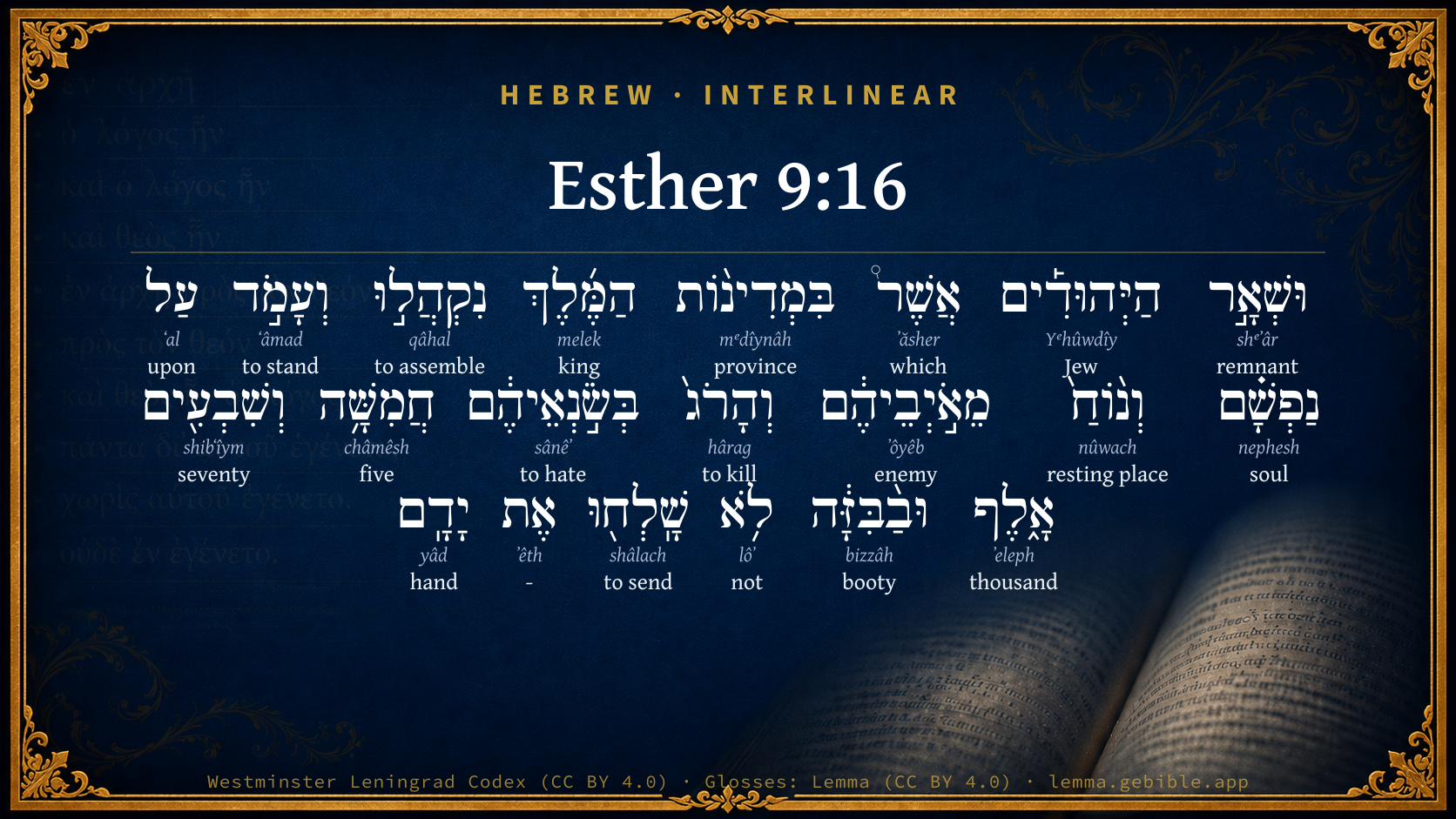
  1. וּשְׁאָ֣ר shᵉʼâr H7605 “and · remnant of” Conjunction + Noun, Common, Masculine, Singular, Construct
  2. הַיְּהוּדִ֡ים Yᵉhûwdîy H3064 “the · Jews” Particle, Definite Article + Noun, Gentilic, Masculine, Plural, Absolute
  3. אֲשֶׁר֩ ʼăsher H834 “which” Particle, Relative
  4. בִּמְדִינ֨וֹת mᵉdîynâh H4082 “in/at · provinces of” Preposition + Noun, Common, Feminine, Plural, Construct
  5. הַמֶּ֜לֶךְ melek H4428 “the · king” Particle, Definite Article + Noun, Common, Masculine, Singular, Absolute
  6. נִקְהֲל֣וּ qâhal H6950 “to assemble” Verb, Niphal, Perfect, 3rd Person, Common, Plural
  7. וְעָמֹ֣ד ʻâmad H5975 “and · to stand” Conjunction + Verb, Qal, Infinitive Absolute
  8. עַל ʻal H5921 “upon” Preposition
  9. נַפְשָׁ֗ם nephesh H5315 “soul · their” Noun, Common, Both, Singular, Construct + Suffix, Personal, 3rd Person, Masculine, Plural
  10. מֵאֹ֣יְבֵיהֶ֔ם ʼôyêb H341 “from · enemy · them” Preposition + Verb, Qal, Participle Active, Masculine, Plural, Construct + Suffix, Personal, 3rd Person, Masculine, Plural
  11. וְהָרֹג֙ hârag H2026 “and · to kill” Conjunction + Verb, Qal, Infinitive Absolute
  12. בְּשֹׂ֣נְאֵיהֶ֔ם sânêʼ H8130 “in/at · hating · them” Preposition + Verb, Qal, Participle Active, Masculine, Plural, Construct + Suffix, Personal, 3rd Person, Masculine, Plural
  13. חֲמִשָּׁ֥ה châmêsh H2568 “five” Adjective, Cardinal number, Masculine, Singular, Absolute
  14. וְשִׁבְעִ֖ים shibʻîym H7657 “and · seventy” Conjunction + Adjective, Cardinal number, Both, Plural, Absolute
  15. אָ֑לֶף ʼeleph H505 “thousand” Adjective, Cardinal number, Both, Singular, Absolute
  16. וּבַ֨בִּזָּ֔ה bizzâh H961 “and · in/at the · booty” Conjunction + Preposition, Determined + Noun, Common, Feminine, Singular, Absolute
  17. לֹ֥א lôʼ H3808 “not” Particle, Negative
  18. שָֽׁלְח֖וּ shâlach H7971 “to send” Verb, Qal, Perfect, 3rd Person, Common, Plural
  19. אֶת ʼêth H853 “-” Particle, Direct Object
  20. יָדָֽם yâd H3027 “hand · their” Noun, Common, Both, Singular, Construct + Suffix, Personal, 3rd Person, Masculine, Plural

About this verse

These counts appear in no published source. They are computed here, from the morphology-tagged text and Lemma’s own curated glosses. What Lemma adds →

21
words
21
distinct lemmas
Historical
section

Notable vocabulary

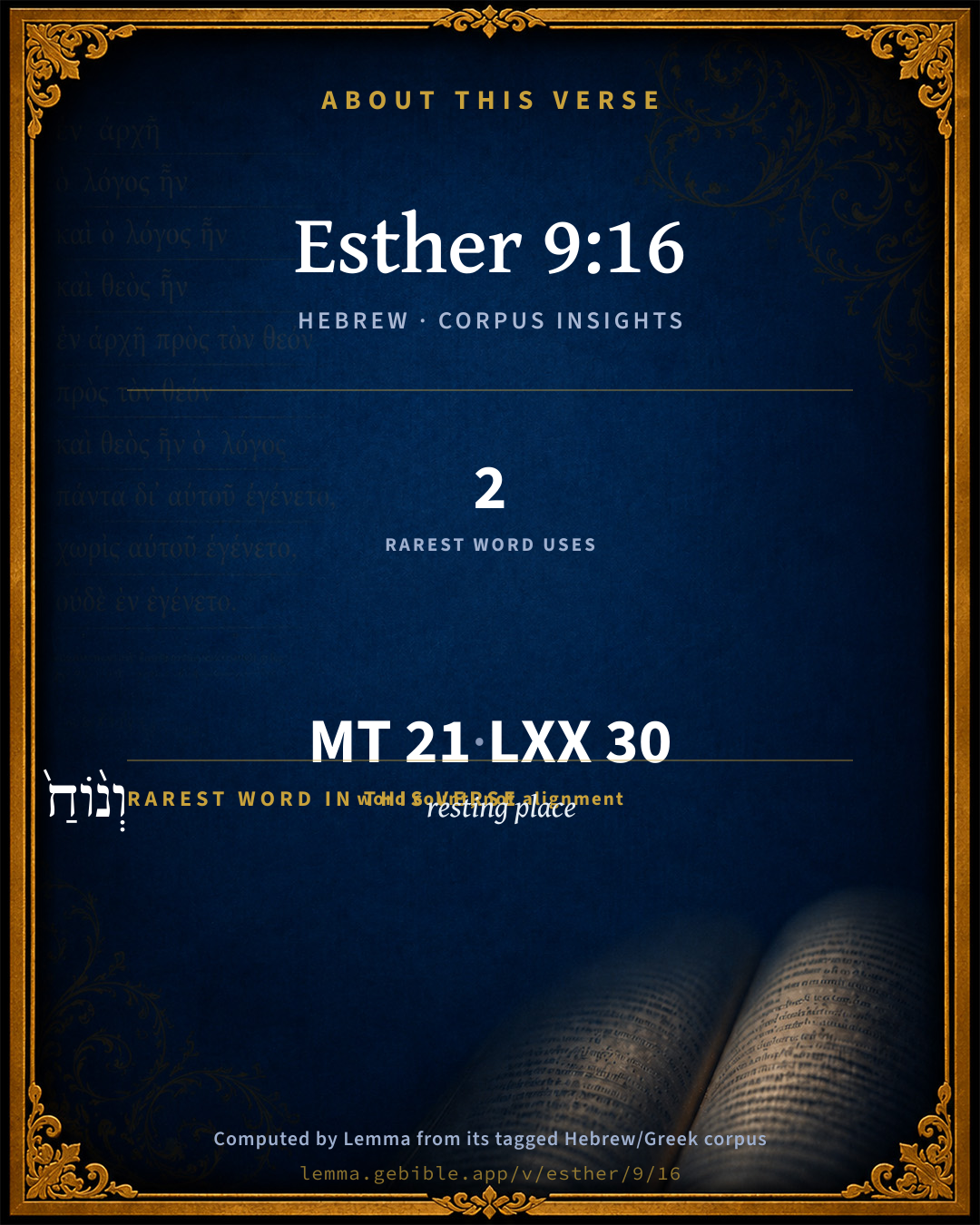
The rarest word here is וְנ֨וֹחַ֙ resting place H5118 — appearing just 2 times in the whole Hebrew Bible.

Shared distinctive vocabulary

וְנ֨וֹחַ֙ resting place H5118 occurs in 2 verses of the Hebrew Bible. Also found in:

Grammatical profile

  • 7 verbs
  • 7 nouns
  • 3 adjectives
  • 1 preposition
  • 3 particles

Verb forms

  • נִקְהֲל֣וּ Niphal · Perfect
  • וְעָמֹ֣ד Qal · Infinitive Absolute
  • וְנ֨וֹחַ֙ Qal · Infinitive Absolute
  • מֵאֹ֣יְבֵיהֶ֔ם Qal · Participle Active
  • וְהָרֹג֙ Qal · Infinitive Absolute
  • בְּשֹׂ֣נְאֵיהֶ֔ם Qal · Participle Active
  • שָֽׁלְח֖וּ Qal · Perfect

Hebrew & Septuagint length

In English translation the verse runs 41 words from the Hebrew and 39 from the Septuagint (LXX English) — closely comparable.

A rough comparison of the two English renderings, which tokenize alike — not a word-level alignment.

Word counts can differ between the Hebrew and the Greek without any difference in meaning — e.g. the Hebrew direct-object marker אֵת has no separate Greek word, and Greek often adds the article ὁ.

In the original languages it is 21 Hebrew tokens and 30 Greek tokens — but the two are counted differently (Hebrew bundles its prefixes and suffixes into one token; the Greek is in lemma form), so that isn’t a like-for-like length.

Cross-references

3

Topical passages linked to Esther 9:16 in the Treasury of Scripture Knowledge — connected by theme and wording, ordered by reader-vote popularity; previews shown in the World English Bible.

  • Esther 8:11 in which the king granted the Jews who were in every city to gather themselves together, and to stand for their life, to destroy, to kill, and to cause to perish, all the power of the people and province that would assault them, [their] little ones and women, and to take the spoil of them for a prey,
  • Esther 9:2 the Jews gathered themselves together in their cities throughout all the provinces of the king Ahasuerus, to lay hand on such as sought their hurt: and no man could withstand them; for the fear of them was fallen on all the peoples.
  • Leviticus 26:7–8 You shall chase your enemies, and they shall fall before you by the sword.

Cross-references courtesy of OpenBible.info (CC BY 4.0).

Hebrew and Greek witnesses Masoretic Hebrew ↔ Greek Septuagint

The same verse in the two great witnesses to the Old Testament, shown verse-for-verse.

These are two independent witnesses, not word-aligned to each other, and the Septuagint is shown in lemma (dictionary) form.

Hebrew Esther 9:16 Masoretic · Westminster Leningrad Codex

וּשְׁאָ֣ר הַיְּהוּדִ֡ים אֲשֶׁר֩ בִּמְדִינ֨וֹת הַמֶּ֜לֶךְ נִקְהֲל֣וּ וְעָמֹ֣ד עַל נַפְשָׁ֗ם וְנ֨וֹחַ֙ מֵאֹ֣יְבֵיהֶ֔ם וְהָרֹג֙ בְּשֹׂ֣נְאֵיהֶ֔ם חֲמִשָּׁ֥ה וְשִׁבְעִ֖ים אָ֑לֶף וּבַ֨בִּזָּ֔ה לֹ֥א שָֽׁלְח֖וּ אֶת יָדָֽם

The other Jews who were in the king's provinces gathered themselves together, and stood for their lives, and had rest from their enemies, and killed of those who hated them seventy-five thousand; but they didn't lay their hand on the spoil.

World English Bible · Public Domain

Greek LXX Esther 9:16 Septuagint · lemma form

ὁ δέ λοιπός ὁ ἰουδαῖος ὁ ἐν ὁ βασιλεία συνἄγω καί ἑαυτοῦ βοηθέω καί ἀναπαύω ἀπό ὁ πολέμιος ἀποὀλλύω γάρ αὐτός μύριοι πεντακισχίλιοι ὁ τρισκαιδέκατος ὁ αδαρ καί οὐδείς διαἁρπάζω

And the rest of the Jews who were in the kingdom assembled, and helped one another, and obtained rest from their enemies: for they destroyed fifteen thousand of them on the thirteenth day of Adar, but took no spoil.

LXX2012 (modern English Septuagint) · Public Domain

On this verse, Ellicott's Commentary for English Readers discusses the Septuagint’s reading. Read the note in Commentary ↓

Hebrew: Westminster Leningrad Codex (CC BY 4.0). Greek: Septuagint (public domain); English from LXX2012 (modern English Septuagint) (Public Domain). How the Septuagint differs from the Hebrew →

Commentary

Notes on Esther 9:16 from classic Christian and Jewish commentators (each source and its license shown beneath its notes). The classic Christian expositions comment on the surrounding passage and are grouped to its opening verse, so a note may address several verses; the Jewish commentaries on the Tanakh (Rashi and others) are per-verse, so they appear only where the commentator wrote on this verse.

Lemma curates 59 commentaries, every one of them public domain or Creative Commons licensed, each selected and text-cleaned for this edition rather than reprinted as found. About our sources →

Trapp's Complete Commentary

John Trapp

Est 9:16 But the other Jews that [were] in the king’s provinces gathered themselves together, and stood for their lives, and had rest from their enemies, and slew of their foes seventy and five thousand, but they laid not their hands on the prey,

Ver. 16. But the other Jews that were, &c.] Though they were but a nation, scattered and peeled, a contemptible and feeble folk, lately destined to destruction; yet by faith they subdue kingdoms, escape the edge of the sword, out of weakness become strong, wax valiant in fight, turn to flight whole armies of the aliens, Heb 11:33-34, prevail and prosper against all the malignant power of Persia: thus were they helped with a little help (as it is, Dan 11:34), that God might have a great deal of glory, as indeed he had.

Gathered themselves together] United their forces, as Est 9:2, which while our ancestors (the old Britons) did not against the Romans who invaded them, they were easily and quickly conquered. Et dum pugnabant singuli vincebantur universi, And while they fought by themselves, they were all conquored. saith Tacitus, who was here, with his father-in-law, Agricola, an eye-witness of what he writeth.

And stood for their lives] Not one whereof was lost in this hot encounter, in this sharp revenge they took off their avowed enemies. This was even a miracle of God’smercy: "Who would not fear thee, O King of nations," &c.

And had rest from their enemies] Or, That they might have rest from their enemies; who would not otherwise be quieted, but by the letting out of their life-blood; but would make an assault upon the harmless Jews, though it were to die for it; so that upon the matter they were their own deathsmen, besides the wilful loss of their immortal souls, which our Saviour showeth, Mat 16:26, to be a loss, 1. Incomparable, 2. Irreparable.

And slew of their foes seventy and five thousand] Neither was it any dishonour to them to be God Almighty’s slaughtermen. Even the good angels are executioners of God’s righteous judgments, as they were at Sodom, in Sennacherib’s army, and oft in the Revelation. There cannot be a better or more noble act than to do justice upon obstinate malefactors.

But they laid not their hands on the prey] They would not once foul their fingers therewith. No godly man in Scripture is taxed for covetousness, that sordid sin. {See Trapp on "Est 9:10"}

John Trapp, A Commentary or Exposition upon All the Books of the Old and New Testament (1647–1656) — public domain. Text from a community e-Sword module.

Joseph Benson's Commentary

Est 9:16. And had rest from their enemies — Who could not stand before them, and therefore ceased to molest them. But they laid not their hands on the prey — It is probable Mordecai, in his letters, had charged them not to make use of the liberty the king had given them to take the spoil, inasmuch as it appears they universally avoided it.

Joseph Benson's Commentary on the Old and New Testaments (1811–1818) — public domain. Text from a community e-Sword module.

Tyndale Open Study Notes

Tyndale Open Resources

9:16 75,000 seems like quite a large number. The Old Greek translation has 15,000 and the Targum has 10,107 men. The Hebrew word translated thousands can also indicate an extended family or lineage, so it is possible that 75 extended families were killed.

Tyndale Open Study Notes — © Tyndale Open Resources, licensed CC BY-SA 4.0. Text via the HelloAO Bible API.

Geneva Bible (1599)

Geneva Bible translators

Read Esther 8:11.

Meaning, that they laid hands on none that were not this enemies of God.

Geneva Bible (1599) marginal notes — public domain. Text via Bolls.life.

Ellicott's Commentary for English Readers

(16) Seventy and five thousand.—The number as given in the LXX. is fifteen thousand, perhaps a more probable number. On the whole history, Bishop Wordsworth well remarks, “It shows the recklessness of human life, even of their own subjects, which then prevailed among the sovereigns of the most celebrated nations of the Eastern world; and it displays the ruinous consequences which would have resulted to human civilisation if Ahasuerus (Xerxes) had been victorious at Salamis. If Greece had not triumphed in that struggle with Asia, Oriental ruthlessness and Oriental polygamy might have become dominant in the West, and greater difficulties would have obstructed the progress of civilisation and Christianity. The Book of Esther reveals to us that the hand of God wrought for the deliverance of mankind at the Straits of Salamis, and on the banks of the Asopus at Platæa, as well as for the preservation of the Jews in the provinces of Persia.”

A Bible Commentary for English Readers, edited by Charles John Ellicott (1878–1897) — public domain. Text from a community e-Sword module.

John Gill's Exposition

But the Jews that were at Shushan assembled together on the thirteenth day thereof, and on the fourteenth day thereof,.... Of the month Adar; that is, they gathered together to defend themselves, and destroy their enemies, on both these days, having the decree renewed for the fourteenth as they had for the thirteenth:

and on the fifteenth day of the same they rested, and made it a day of feasting and gladness; as the Jews in the provinces did on the fourteenth.

John Gill's Exposition of the Whole Bible (1746–1763) — public domain (CC PDM 1.0). Text via the HelloAO Bible API.

Albert Barnes' Notes on the Bible

Seventy and five thousand - The Septuagint gives the number as 15,000; and this amount seems more in proportion to the 800 slain in Susa.

Albert Barnes' Notes on the Bible (1834–1885) — public domain. Text from a community e-Sword/MySword module.

Haydock's Catholic Bible Commentary

Lives. In many cases they would probably be attacked, as Aman’s edict was perhaps still in force, as well as that of Mardochai. Hence both parties would be upon the watch. (Haydock) --- Seventy-five. Roman Septuagint has only 15,000. Complutensian, 10,035. (Calmet)

George Leo Haydock (1774–1849), Haydock's Catholic Family Bible and Commentary, 1859 edition — public domain. Excludes Psalms (Douay-Rheims chapter numbering differs from Protestant) and Deuterocanonical books (Catholic canon only).

Whedon's Commentary on the Bible

Daniel D. Whedon

16. And had rest from their enemies — The position of these words in the middle of the verse is noticeably strange. There maybe here some disarrangement of the text, or it may be, as Keil suggests, “that the narrator desired at once to point out how the matter ended.” Such apparent disorder of the text is not always to be regarded as evidence of corruption by transcribers. The Hebrew writers are not always the best models of accuracy and perfection of literary style.

Seventy and five thousand — “The slaughter of these seventy-five thousand shows,” says Wordsworth, “that a very large number of their heathen enemies, who had been exasperated against the Jews, had prepared themselves for an attack upon them; and that, presuming upon their own numbers and forces, as compared with the Jews, they assaulted them in order to destroy and despoil them, and to enrich themselves with their property; and that the Jews made a vigorous resistance, and, by the help of God, routed their assailants with a great discomfiture. The slaughter was not the consequence of a vindictive spirit in the Jews, but of the bitter animosity of their enemies; and it proves that the Jews would have been extinguished, (as Haman’s decree intended that they should be,) if God had not interfered to rescue them from destruction.”

The same writer also records the two following inferences from the history of this terrible slaughter: 1) “It shows the recklessness of human life, even of their own subjects, which then prevailed among the sovereigns of most celebrated nations of the Eastern world, and it displays the ruinous consequences which would have resulted to human civilization if Ahasuerus (Xerxes) had been victorious at Salamis. If Greece had not triumphed in that struggle with Asia, Oriental ruthlessness and Oriental polygamy might have become dominant in the West, and greater difficulties would have obstructed the progress of civilization and Christianity. The Book of Esther reveals to us that the hand of God wrought for the deliverance of mankind at the straits of Salamis, and on the banks of the Asopus, at Plataea, as well as for the preservation of the Jews in the provinces of Persia.” 2) “It also displays the unhappy consequences of that proud assumption of infallibility which was implied in the Medo-Persian maxim, that laws once enacted may never be repealed. Such a claim to the divine attribute of infallibility, whether it be made by Eastern potentates or Western pontiffs, shuts the door against repentance, and involves them in a perpetual necessity of erring, and is fraught with the most disastrous consequences to all who are under their sway.”

Daniel D. Whedon (gen. ed.), Commentary on the Old and New Testaments (1874–1909) — public domain. Text from a community e-Sword module.

The Pulpit Commentary

Gathered themselves together, and stood for their lives. i.e. did as the edict directed them. (Est_8:11) And had rest from their enemies. The idea of "rest" seems out of place when the subject of the narrative is slaughter, and the number of the slain has still to be told. Some suspect corruption, others an interpolation. And slew of their foes seventy and five thousand. The LXX had in their copies fifteen for seventy-five, or one-fifth of the received number. The smaller number is more in harmony with the 500 killed at Susa than the larger one.

The law of national self-preservation.

This passage, with two somewhat similar passages preceding it, may read at first like the narration of sanguinary cruelty, and the indefensible havoc of human life. Our strongest sympathies were but very lately with the Jews, for whom fearful destruction was devised without the slightest shadow of justifiable provocation. We rejoiced with them when the cloud that overhung burst, and they seemed to be delivered from their former terrible outlook. But already we begin perhaps to repent, and to feel that neither our sympathy nor our gratulation were well merited. Though the destruction that threatened the Jews, and with such aggravating circumstances, is averted, it is little (even though it be true that they were not the side originally in fault), if all that is gained is, that the hands that shed blood are changed from the one side to the other. If no slaughter is spared, if for pity"s sake human life be not saved, if those who were the unjustly doomed become in the hour of their own mercy the first to doom others, even though they may do so with tenfold provocation and with some rough sort of justice, we may be inclined to feel for a moment that there was after all not so very much to choose between the two. A little closer study of the context, however, will suffice to show that such is not a fair description of the case. The subject suggests rather the statement of the law of self-preservation, not of the individual, but of the nation. Again, therefore, we have a.question of great interest offering itself on the scale of national magnitude. This circumstance will facilitate the consideration of it under conditions in some respects more favourable. When treated as a question affecting the individual, it has often been entangled by casuistry; but when considered in the unusual proportions here presenting themselves, its broader, bolder outlines will perhaps come out to view more plainly. The right of taking life for the sake of self-preservation, or in self-defence, may be sufficiently sketched out of the material of the present narrative. If that right is to be fairly allowed for, and at the same time limited as exactly as may be, it may be said to postulate the following conditions:

I THAT THE OCCASION BE ONE OF UNDOUBTED NECESSITY. In the present instance the whole number of the Jews scattered throughout the 127 provinces now subject to Ahasuerus had been threatened with extermination. There could be no doubt of their imminent danger, and of their helplessness. When Esther (Est_8:5) supplicated the king "to reverse the letters devised by Haman which he wrote to destroy the Jews in all the king"s provinces," the king met the difficulty of his former irreversible decree and irreversible letters by giving authority to the threatened Jews "to gather themselves together, and to stand for their life, to destroy all the power of the people and province that would assault. (Est_8:11) He cannot reverse his own former decree literally, but by a fiction he does so very really, very effectually. Esther and Mordecai would at that time have been gladly content to have simply removed from their own race the decree that doomed them, but from the time that this way of putting the matter was revealed by the king, and the whole responsibility of saving themselves was thrown so far on their own efforts, the occasion became one of undoubted necessity. It was not war, it was not murder, it was not gratuitous massacre it was a case of self-defence.

II THAT THERE BE THE LEAST SACRIFICE OF LIFE THAT WOULD ATTAIN THE NEEDFUL END. It is remarkable that the exact number should be so carefully given of the two slaughters in Shushan (vers. 6, 15), and of the aggregate of that (ver. 16) which took effect through the "king"s provinces." That Esther asked for another day"s opportunity of taking the lives of the enemies of her people in Shushan (vers. 13-15) may safely be understood to be owing to special necessities not given in detail. It need not for one moment indicate any wish that one life more should be sacrificed than should be necessary for the safety of the Jews. Now when the sum-total of the slain are added, amounting to 75, 800, first, the number, large as it seems, probably does not reach the number of the Jews who were to have been exterminated; secondly, it is certain there was no comparison between the numbers relatively for in the case of the Jews the slaughter was to have been of all, while 75, 800 were but a small proportion of the entire population not Jews; and thirdly, there not only is no evidence of there having been any indiscriminate slaughter on the part of the Jews, but presumably none were slain except such as rose up to slay. This self-defence, therefore, on the part of the Jews probably left more living men than would have been left under the circumstances if the Jews had suffered their own lives to be unresistingly taken.

III THAT THE LEAST POSSIBLE GAIN OUTSIDE OF THE ONE GAIN OF LIFE, THE SUPREME OBJECT SOUGHT, BE TAKEN BY THE ACT OF SELF-DEFENCE. In the decree granted by King Ahasuerus special provision was spontaneously made that the Jews should appropriate the spoil on their successful resistance of the enemy. Nevertheless, when the time came they refused to do so. And evidently much significance attached to this conduct. It is repeated as many as three times in this chapter. On every occasion on which a victory on their part is announced, this is added-that instead of laying hands on the prey, they emphatically refrained from doing so. This differences self-defence, and the taking of life in self-defence, very greatly from other occasions in which life is taken.

IV THAT REVENGE BE THE LEAST POSSIBLE ELEMENT IN IT. In cases of sudden need of self-defence there will be no room for the feeling of revenge. Self-defence, however, will by no means be requisite only in such cases. Where there is long delay it is impossible to predicate that none of the spirit of revenge may enter into the hearts of some out of the many; but there is no need to suppose that now there was any in the hearts of the principals. Esther and Mordecai desired one thing the safety of their people. They wished for "rest from their enemies." They probably felt that they were the ministers of righteous retribution. They desired that Haman"s ten sons "hanged on the gallows" should still drive home on an impressed populace the sense and conviction of what a force righteous retribution was, and how much men ought "to stand in awe" because of it; but there is no proof whatever that in all the relief to the bitterness of their soul revenge played any part. The lessons of this portion of the narrative are not needed for the pulpit on every Lord"s day certainly, but it may be they are provided here, in the universality of the use of the Divine book, for some special and solemn crises. B.

The Pulpit Commentary (1880–1919), ed. H.D.M. Spence-Jones & Joseph S. Exell — public domain. Text from a community e-Sword module.

Lesson kit

Teaching starters — assembled from the data on this page, not authored interpretation. Every prompt links to the verse data it draws on. Edit before teaching.

Esther, in the Historical, opens this verse with 21 words (21 distinct Hebrew lemmas). Its most distinctive word is nûwach (“resting place”). A historical commentator’s framing appears above. Read the whole chapter for the surrounding context.

Discussion questions

  1. The word nûwach carries the sense “resting place.” How does it shape the verse?
  2. How does 2 Chronicles 6:41, which shares the word «resting place», read alongside this verse?
  3. These translations render this verse differently; the difference is in the English rendering, not the original. What questions does that raise?
  4. «נִקְהֲל֣וּ» is a Niphal Perfect verb. How does that grammatical form shape the action described?
  5. Compare how Trapp's Complete Commentary and Joseph Benson's Commentary read this verse. Where do they agree or differ?

Things to notice

Reading settings

Reading text

Shown beneath each verse's original-language words.

Old Testament
Old Testament edition

Read the OT as the Masoretic Hebrew (MT) or the Greek Septuagint (LXX).

English shown for the Greek Septuagint (in the Hebrew ↔ Greek comparison).

Comparing translations? Open the Compare panel on any verse page to stack up to four side by side.