
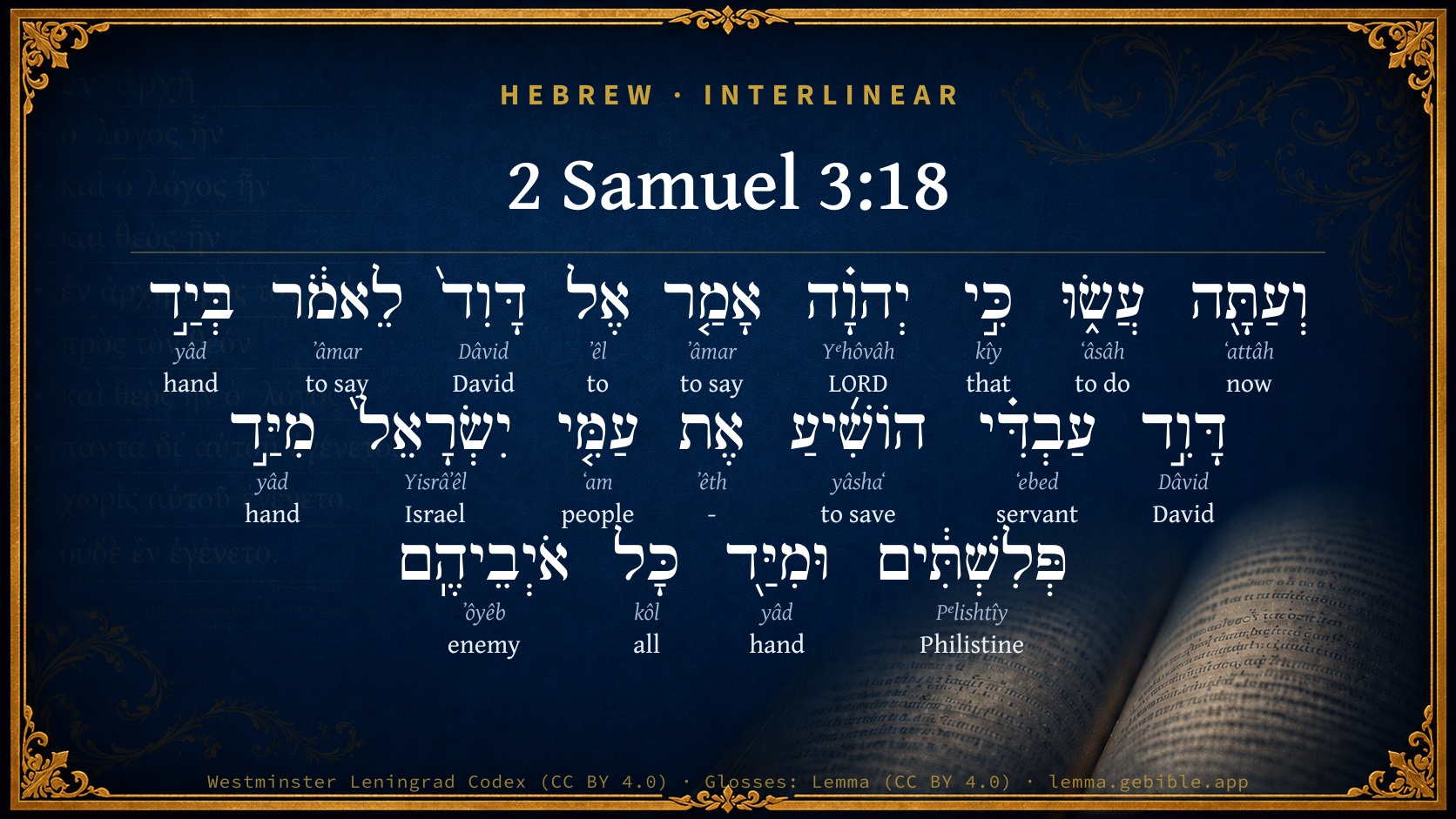
2 Samuel 3:18

Hebrew (Westminster Leningrad Codex) 2 Samuel 3:18 appears in the Hebrew Old Testament. The text above is from the Westminster Leningrad Codex. Each word links to its Strong’s number, a concise gloss, and parsing drawn from the Open Scriptures Hebrew Bible morphology. Click any word for its full Brown-Driver-Briggs (BDB) entry.
Download image
Cite this verse

2 Samuel 3:18 (World English Bible). Public Domain. Lemma interlinear Bible study tool, https://lemma.gebible.app/v/2-samuel/3/18.

Show BibTeX & RIS
BibTeX
RIS
English Translation
now then do it; for Yahweh has spoken of David, saying, By the hand of my servant David I will save my people Israel out of the hand of the Philistines, and out of the hand of all their enemies.
World English Bible · Public Domain
Download a study sheet

One document with this verse’s original text, its word-by-word gloss line, the meaning frame, cross-references with their text, attributed commentary, and full source and license credits — printable, and it pastes into notes with its structure intact.

This verse Autodidact and up

Study sheet (.html) Plain text (.txt)

A passage Seminary Student

Up to 50 verses in one chapter. A passage sheet keeps up to 6 commentary sources and 12 cross-references per verse, in the order this page ranks them, and says so on the sheet whenever that leaves anything out. Ask for a single verse and you get the Autodidact verse sheet above.

Everything on this page stays free to read, with no account — the sheet is a download of what is already on screen, not access to it.

Want to remove ads? Support Godless Engineer
Compare translations 3

The same verse in 3 English versions, stacked beneath the original-language interlinear above. Click any original word for its lexicon entry.

Each is an independent rendering of the whole verse — the interlinear is not word-aligned to these translations.

Highlighted words mark where these versions differ — a whole-verse word diff, not a word-by-word alignment.

  • World English Bible Public Domain
    now then do it; for Yahweh has spoken of David, saying, By the hand of my servant David I will save my people Israel out of the hand of the Philistines, and out of the hand of all their enemies.
  • King James Version Public Domain
    Now then do it: for the LORD hath spoken of David, saying, By the hand of my servant David I will save my people Israel out of the hand of the Philistines, and out of the hand of all their enemies.
  • unfoldingWord Literal Text CC BY-SA 4.0
    And now, do, for Yahweh spoke about David, saying, ‘By the hand of David my servant, I will save my people Israel from the hand of the Philistines and from the hand of all of their enemies.’”

unfoldingWord Literal Text — © unfoldingWord, licensed CC BY-SA 4.0. Word-aligned USFM3 via Door43 (git.door43.org/unfoldingWord/en_ult).

Versions to compare (up to 4)

3 of 4 selected

Show all 18 translations

Every available English version of this verse, each an independent rendering of the whole verse.

  • World English Bible Public Domain
    now then do it; for Yahweh has spoken of David, saying, By the hand of my servant David I will save my people Israel out of the hand of the Philistines, and out of the hand of all their enemies.
  • Berean Standard Bible Public Domain
    Now take action, because the LORD has said to David, ‘Through My servant David I will save My people Israel from the hands of the Philistines and of all their enemies.’”
  • Majority Standard Bible Public Domain
    Now take action, because the LORD has said to David, ‘Through My servant David I will save My people Israel from the hands of the Philistines and of all their enemies.’”
  • King James Version Public Domain
    Now then do it: for the LORD hath spoken of David, saying, By the hand of my servant David I will save my people Israel out of the hand of the Philistines, and out of the hand of all their enemies.
  • American Standard Version (1901) Public Domain
    now then do it; for Jehovah hath spoken of David, saying, By the hand of my servant David I will save my people Israel out of the hand of the Philistines, and out of the hand of all their enemies.
  • Revised Version (1885) Public Domain
    now then do it: for the LORD hath spoken of David, saying, By the hand of my servant David I will save my people Israel out of the hand of the Philistines, and out of the hand of all their enemies.
  • Geneva Bible (1599) Public Domain
    Nowe then doe it: for the Lord hath spoken of Dauid, saying, By the hand of my seruant Dauid I will saue my people Israel out of the handes of the Philistims, and out of the handes of all their enemies.
  • Douay-Rheims (1899) Public Domain
    Now then do it: because the Lord hath spoken to David, saying: By the hand of my servant David I will save my people Israel from the hands of the Philistines, and of all their enemies.
  • Young's Literal Translation Public Domain
    and now, do `it', for Jehovah hath spoken of David saying, By the hand of David my servant -- to save My people Israel out of the hand of the Philistines, and out of the hand of all their enemies.'
  • Literal Standard Version CC BY-SA 4.0
    and now, do [it], for YHWH has spoken of David saying, [It is] by the hand of my servant David to save My people Israel out of the hand of the Philistines, and out of the hand of all their enemies.”
  • Unlocked Literal Bible CC BY-SA 4.0
    Now do it. For Yahweh has spoken of David saying, 'By the hand of my servant David I will save my people Israel from the hand of the Philistines and from the hand of all their enemies.'”
  • unfoldingWord Literal Text CC BY-SA 4.0
    And now, do, for Yahweh spoke about David, saying, ‘By the hand of David my servant, I will save my people Israel from the hand of the Philistines and from the hand of all of their enemies.’”
  • Darby Bible Public Domain
    and now do [it], for Jehovah has spoken of David, saying, By my servant David will I save my people Israel out of the hand of the Philistines, and out of the hand of all their enemies.
  • World Messianic Bible Public Domain
    Now then do it! For the LORD has spoken of David, saying, ‘By the hand of my servant David, I will save my people Israel out of the hand of the Philistines, and out of the hand of all their enemies.’”
  • Webster's Bible Public Domain
    Now then do it: for the LORD hath spoken of David, saying, By the hand of my servant David I will save my people Israel from the hand of the Philistines, and from the hand of all their enemies.
  • Free Bible Version CC BY-SA 4.0
    Now is the time to do it, because the Lord promised David, ‘Through my servant David I am going to save my people Israel from the Philistines and all their enemies.’”
  • Bible in Basic English Public Domain
    For the Lord has said of David, By the hand of my servant David I will make my people Israel safe from the Philistines, and from all who are against them.
  • JPS Tanakh (1917) Public Domain
    now then do it; for the LORD hath spoken of David, saying: By the hand of My servant David I will save My people Israel out of the hand of the Philistines, and out of the hand of all their enemies.'

Literal Standard Version (2020), Covenant Press — licensed CC BY-SA 4.0. Text via the HelloAO Bible API (eBible.org). Unlocked Literal Bible (unfoldingWord) — licensed CC BY-SA 4.0. Text via the HelloAO Bible API (eBible.org). unfoldingWord Literal Text — © unfoldingWord, licensed CC BY-SA 4.0. Word-aligned USFM3 via Door43 (git.door43.org/unfoldingWord/en_ult). Free Bible Version, Dr. Jonathan Gallagher — licensed CC BY-SA 4.0. Text via the HelloAO Bible API (eBible.org).

Word by word

More ways to search: Search by grammar → Find every occurrence → Compare this word →

Practice this passage: Drill this verse → Learn its vocabulary →

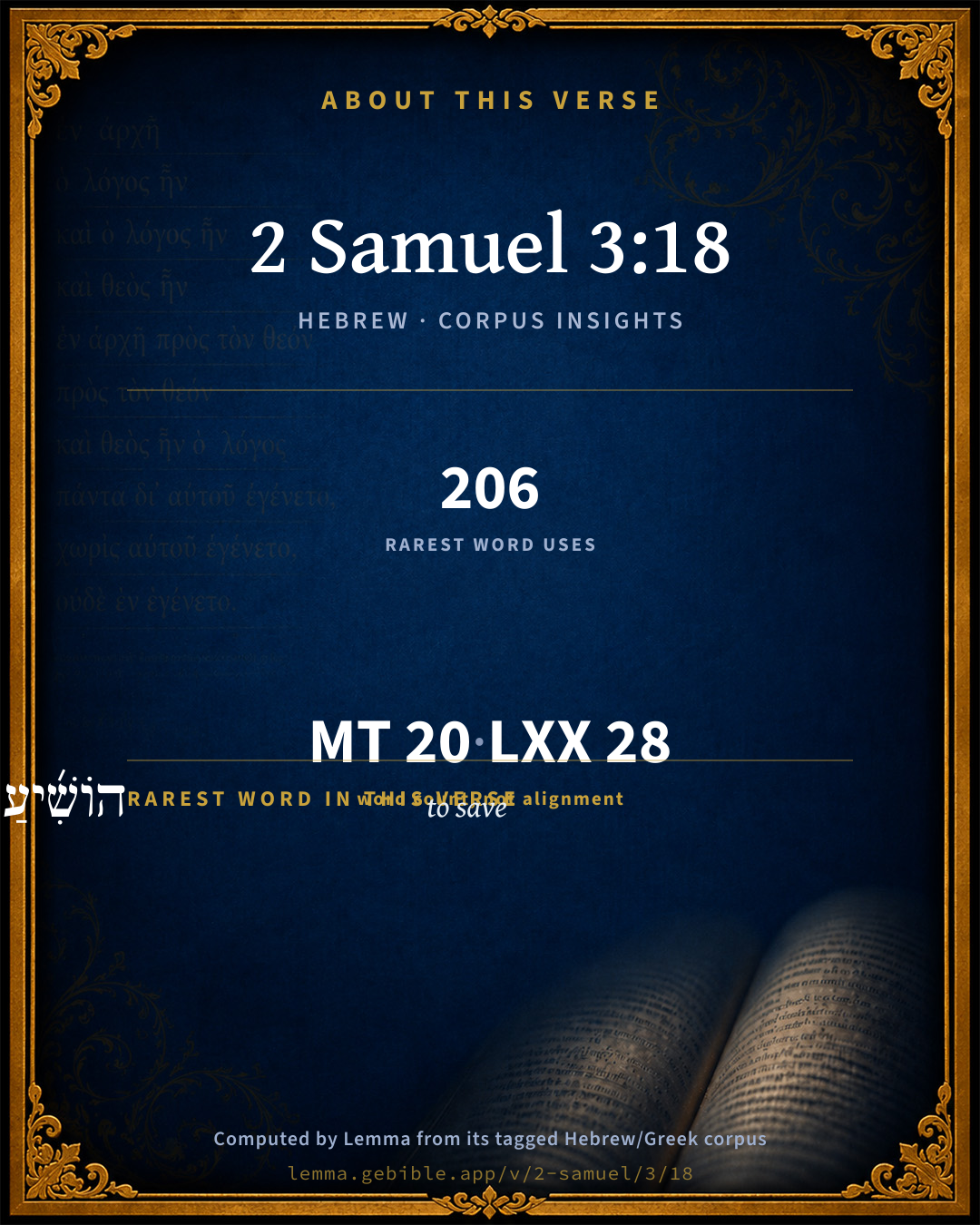
הוֹשִׁ֜יעַ
yâshaʻ
H3467
“to save”
Verb, Hiphil, Perfect, 3rd Person, Masculine, Singular
Part of Speech
Verb
Stem
Hiphil
Form
Perfect
Person
3rd Person
Gender
Masculine
Number
Singular
Full BDB Definition

Origin: a primitive root

TWOT: 929

to save, be saved, be delivered - (Niphal) - to be liberated, be saved, be delivered - to be saved (in battle), be victorious - (Hiphil) - to save, deliver - to save from moral troubles - to give victory to
  1. וְעַתָּ֖ה ʻattâh H6258 “and · now” Conjunction + Adverb
  2. עֲשׂ֑וּ ʻâsâh H6213 “do” Verb, Qal, Imperative, 2nd Person, Masculine, Plural
  3. כִּ֣י kîy H3588 “that” Conjunction
  4. יְהוָ֗ה Yᵉhôvâh H3068 “LORD” Noun, Proper
  5. אָמַ֤ר ʼâmar H559 “to say” Verb, Qal, Perfect, 3rd Person, Masculine, Singular
  6. אֶל ʼêl H413 “to” Preposition
  7. דָּוִד֙ Dâvid H1732 “David” Noun, Proper
  8. לֵאמֹ֔ר ʼâmar H559 “to say” Preposition + Verb, Qal, Infinitive Construct
  9. בְּיַ֣ד yâd H3027 “in/at · hand of” Preposition + Noun, Common, Both, Singular, Construct
  10. דָּוִ֣ד Dâvid H1732 “David” Noun, Proper
  11. עַבְדִּ֗י ʻebed H5650 “servant · my” Noun, Common, Masculine, Singular, Construct + Suffix, Personal, 1st Person, Common, Singular
  12. אֶת ʼêth H853 “-” Particle, Direct Object
  13. עַמִּ֤י ʻam H5971 “people · my” Noun, Common, Masculine, Singular, Construct + Suffix, Personal, 1st Person, Common, Singular
  14. יִשְׂרָאֵל֙ Yisrâʼêl H3478 “Israel” Noun, Proper
  15. מִיַּ֣ד yâd H3027 “from · hand of” Preposition + Noun, Common, Both, Singular, Construct
  16. פְּלִשְׁתִּ֔ים Pᵉlishtîy H6430 “Philistines” Noun, Gentilic, Masculine, Plural, Absolute
  17. וּמִיַּ֖ד yâd H3027 “and · from · hand of” Conjunction + Preposition + Noun, Common, Both, Singular, Construct
  18. כָּל kôl H3605 “all of” Noun, Common, Masculine, Singular, Construct
  19. אֹיְבֵיהֶֽם ʼôyêb H341 “enemy · them” Verb, Qal, Participle Active, Masculine, Plural, Construct + Suffix, Personal, 3rd Person, Masculine, Plural

About this verse

These counts appear in no published source. They are computed here, from the morphology-tagged text and Lemma’s own curated glosses. What Lemma adds →

20
words
16
distinct lemmas
Historical
section

Grammatical profile

  • 5 verbs
  • 11 nouns
  • 1 preposition
  • 1 conjunction
  • 1 adverb
  • 1 particle

Verb forms

  • עֲשׂ֑וּ Qal · Imperative
  • אָמַ֤ר Qal · Perfect
  • לֵאמֹ֔ר Qal · Infinitive Construct
  • הוֹשִׁ֜יעַ Hiphil · Perfect
  • אֹיְבֵיהֶֽם Qal · Participle Active

Repetition

Words recur within this verse — often emphatic in Hebrew:

  • בְּיַ֣ד hand H3027 ×3
  • אָמַ֤ר to say H559 ×2
  • דָּוִד֙ David H1732 ×2

Hebrew & Septuagint length

In English translation the verse runs 40 words from the Hebrew and 31 from the Septuagint (LXX English) — closely comparable.

A rough comparison of the two English renderings, which tokenize alike — not a word-level alignment.

Word counts can differ between the Hebrew and the Greek without any difference in meaning — e.g. the Hebrew direct-object marker אֵת has no separate Greek word, and Greek often adds the article ὁ.

In the original languages it is 20 Hebrew tokens and 28 Greek tokens — but the two are counted differently (Hebrew bundles its prefixes and suffixes into one token; the Greek is in lemma form), so that isn’t a like-for-like length.

Cross-references

10

Topical passages linked to 2 Samuel 3:18 in the Treasury of Scripture Knowledge — connected by theme and wording, ordered by reader-vote popularity; previews shown in the World English Bible.

  • 1 Samuel 15:28 Samuel said to him, Yahweh has torn the kingdom of Israel from you this day, and has given it to a neighbor of yours who is better than you.
  • Psalms 89:19–23 Then you spoke in vision to your saints, And said, "I have bestowed strength on the warrior. I have exalted a young man from the people.
  • 1 Samuel 9:16 Tomorrow about this time I will send you a man out of the land of Benjamin, and you shall anoint him to be prince over my people Israel; and he shall save my people out of the hand of the Philistines: for I have looked on my people, because their cry is come to me.
  • Psalms 89:3–4 "I have made a covenant with my chosen one, I have sworn to David, my servant,
  • 1 Samuel 13:14 But now your kingdom shall not continue: Yahweh has sought him a man after his own heart, and Yahweh has appointed him to be prince over his people, because you have not kept that which Yahweh commanded you.
  • 1 Samuel 16:1 Yahweh said to Samuel, How long will you mourn for Saul, seeing I have rejected him from being king over Israel? fill your horn with oil, and go: I will send you to Jesse the Bethlehemite; for I have provided me a king among his sons.
  • 1 Samuel 16:12–13 He sent, and brought him in. Now he was ruddy, and withal of a beautiful face, and goodly to look on. Yahweh said, Arise, anoint him; for this is he.
  • 2 Samuel 3:9 God do so to Abner, and more also, if, as Yahweh has sworn to David, I don't do even so to him;
  • Psalms 132:17–18 There I will make the horn of David to bud. I have ordained a lamp for my anointed.
  • John 12:42–43 Nevertheless even of the rulers many believed in him, but because of the Pharisees they didn't confess it, so that they wouldn't be put out of the synagogue,

Cross-references courtesy of OpenBible.info (CC BY 4.0).

Hebrew and Greek witnesses Masoretic Hebrew ↔ Greek Septuagint

The same verse in the two great witnesses to the Old Testament, shown verse-for-verse.

These are two independent witnesses, not word-aligned to each other, and the Septuagint is shown in lemma (dictionary) form.

Hebrew 2 Samuel 3:18 Masoretic · Westminster Leningrad Codex

וְעַתָּ֖ה עֲשׂ֑וּ כִּ֣י יְהוָ֗ה אָמַ֤ר אֶל דָּוִד֙ לֵאמֹ֔ר בְּיַ֣ד דָּוִ֣ד עַבְדִּ֗י הוֹשִׁ֜יעַ אֶת עַמִּ֤י יִשְׂרָאֵל֙ מִיַּ֣ד פְּלִשְׁתִּ֔ים וּמִיַּ֖ד כָּל אֹיְבֵיהֶֽם

now then do it; for Yahweh has spoken of David, saying, By the hand of my servant David I will save my people Israel out of the hand of the Philistines, and out of the hand of all their enemies.

World English Bible · Public Domain

Greek LXX 2 Samuel 3:18 Septuagint · lemma form

καί νῦν ποιέω ὅτι κύριος λαλέω περί δαυίδ λέγω ἐν χείρ ὁ δοῦλος ἐγώ δαυίδ σώζω ὁ ἰσραήλ ἐκ χείρ ἀλλόφυλος καί ἐκ χείρ πᾶς ὁ ἐχθρός αὐτός

and now perform it: for the Lord has spoken concerning David, saying, By the hand of my servant David I will save Israel out of the hand of all their enemies.

LXX2012 (modern English Septuagint) · Public Domain

Hebrew: Westminster Leningrad Codex (CC BY 4.0). Greek: Septuagint (public domain); English from LXX2012 (modern English Septuagint) (Public Domain). How the Septuagint differs from the Hebrew →

Targum (Aramaic paraphrase)

1

The Targum is the ancient Jewish Aramaic paraphrase of the Hebrew Scriptures — an interpretive translation, not the Hebrew text itself. Onkelos (literal) and Pseudo-Jonathan (expansive) render the Torah, and Jonathan the Prophets. Coverage is partial: where no permissively-licensed English translation exists for a verse, only the Aramaic is shown. This is verse-level text, not a word-by-word alignment to the Hebrew.

  1. Targum Jonathan Prophets (Joshua–Malachi)
    וּכְעַן עֲבִידוּ אֲרֵי יְיָ אֲמַר לְדָוִד לְמֵימַר בְּיַד דָוִד עַבְדִי אֶפְרוֹק יַת עַמִי יִשְׂרָאֵל מִידָא דִפְלִשְׁתָּאֵי וּמִיַד כָּל בַּעֲלֵי דְבָבֵיהוֹן:

    (no public-domain English translation for this verse)

    Targum Jonathan — Aramaic: “Mikraot Gedolot” (public domain). English: “Sefaria Community Translation” (CC0 1.0 (public-domain dedication)); “London "Chaldee Paraphrase," 1871” (public domain). Text via Sefaria.

Commentary

Notes on 2 Samuel 3:18 from classic Christian and Jewish commentators (each source and its license shown beneath its notes). The classic Christian expositions comment on the surrounding passage and are grouped to its opening verse, so a note may address several verses; the Jewish commentaries on the Tanakh (Rashi and others) are per-verse, so they appear only where the commentator wrote on this verse.

Lemma curates 59 commentaries, every one of them public domain or Creative Commons licensed, each selected and text-cleaned for this edition rather than reprinted as found. About our sources →

Trapp's Complete Commentary

John Trapp

2Sa 3:18 Now then do [it]: for the LORD hath spoken of David, saying, By the hand of my servant David I will save my people Israel out of the hand of the Philistines, and out of the hand of all their enemies.

Ver. 18. For the Lord hath spoken of David, saying,] Sententias loquitur carnifex. Hypocrites make use of God for their own purposes: and care only to make divine authority a colour for their own designs.

By the hand of my servant David.] We read not that God had so said in express terms: but either Abner had heard of such a promise made at the anointing of David by Samuel, or else he feigned it of his own head for his own ends.

John Trapp, A Commentary or Exposition upon All the Books of the Old and New Testament (1647–1656) — public domain. Text from a community e-Sword module.

The Biblical Illustrator

Joseph S. Exell

2Sa_3:18

Now then do it.

Now then do it

I. Remind undecided persons of former impulses.

1. The character and frequency of those impulses have varied greatly in different individuals.

2. These impulses have been usual in you at certain times, and these find a parallel in the case of Israel. These Israelites, perhaps, in their hearts sought for David to be king when they saw the joy upon the face of Davids men. His troopers often had spoil to share, and they always spake well of their captain, and whenever a Davids man was seen anywhere about Judah or Israel, the people said, Those warriors have a goodly heritage in being under such a noble leader, and they wished they had such a king themselves. I do not doubt but sometimes when you hear Christ preached in all His sweetness, your mouths begin to water after him. Is he so good, is he so pleasant? Oh, that we knew Him! And when you see Christians so happy, and especially when you see them in times of trouble so cheerful and joyous under all their trials, I know you have had an inward wish that you knew their secret and could share their peace.

3. These seekings after David were sometimes with the Israelites vivid and strong; and so, too, impulses with undecided people are occasionally very powerful.

4. Nothing has come of all the seekings of your youth and your after days.

II. Recommend decided action. Ye sought for David in times past to be king over you, now then do it.

1. Note the business on hand--it is that Jesus should be king over you.

2. Next notice that if Christ is to be your king, it must be by your own act and deed. So saith the text concerning king David Now then do it.

3. And here is the point, if Jesus is to reign the old king must go down. It is of no use trying to have Ishbosheth and David on the throne at the same time. It is impossible to serve sin and to serve Christ. Dream not of believing to-morrow or next year, nor even in half-an-hours time; but cast your guilty soul on Christ at once. Now then do it.

II. Reason with strong arguments. (C. H. Spurgeon.)

To-day

John Ruskin took for his great life-motto the simple word To-day. He had it engraved on his watch, and before him in his library, so that he could always see it as he sat at his desk, the text, Work, while it is yet called to-day. To-day let us repent, believe, love, pray, toil, so that to-day we may bring the kingdom to pass, by doing His will as it is done in heaven. (H. O. Mackey.)

Now

Perhaps there is now a shy, solitary serious thought, in your heart about becoming a Christian. If you let it alone, it may fly away like a bird through a cage-door left open, and may never come back. Or else a crowd of business cares and plans, or perhaps a host of social invitations will flock in, and the good thought be smothered to death. You have smothered just such blessed thoughts before. The thought in your heart is to become a Christian now, and the great bells ring out, Now is the accepted time: behold, now is the day of salvation. No soul was ever yet saved, and no good deed was ever done to-morrow. Be careful lest tomorrow shall find you beyond the world of probation! (Theodore L. Cuyler, D. D.)

The duty lying nearest

Soon after the death of Carlyle two friends met. And so Carlyle is dead, said one. Yes, said the other, he is gone; but he did me a very good turn once. How was that? asked the first speaker. Did you ever see him or hear him? No, came the answer, I never saw him nor heard him. But when I was beginning life, almost through my apprenticeship, I lost all interest in everything and everyone. I felt as if I had no duty of importance to discharge; that it did not matter whether I lived or not; that the world would do as well without me as with me. This condition continued more than a year. I should have been glad to die. One gloomy night, feeling that I could stand my darkness no longer, I went into a library, and lifting a book I found lying upon a table, I opened it. It was Sartor Resartus, by Thomas Carlyle. My eye fell upon one sentence, marked in italics, Do the duty which lies nearest to thee, which thou knowest to be a duty! The second duty will already have become clearer. That sentence, continued the speaker, was a flash of lightning striking into my dark soul. It gave me a new glimpse of human existence. It made a changed man of me. Carlyle, under God, saved me. He put content and purpose and power-into my life.

The Biblical Illustrator, edited by Joseph S. Exell (c. 1880s–1900s) — public domain. Text from a community e-Sword module.

Joseph Benson's Commentary

2Sa 3:18. The Lord hath spoken — By the hand of my servant David, &c. — We nowhere find these words recorded; but it is probable Samuel had often spoken them; at least the sense of them is implied in the words of God to Samuel, when he commanded him to anoint David king over Israel, 1Sa 10:1-12; for the intention of giving them a king was, that he might fight their battles, 1Sa 8:20.

Joseph Benson's Commentary on the Old and New Testaments (1811–1818) — public domain. Text from a community e-Sword module.

Tyndale Open Study Notes

Tyndale Open Resources

3:18 See also 3:9. By bringing relief from the Philistines, David would accomplish what Saul had failed to do (1 Sam 9:16).

Tyndale Open Study Notes — © Tyndale Open Resources, licensed CC BY-SA 4.0. Text via the HelloAO Bible API.

Adam Clarke's Commentary

Verse 18. The Lord hath spoken of David] Where is this spoken? Such a promise is not extant. Perhaps it means no more than, "Thus, it may be presumed, God hath determined."

Adam Clarke's Commentary on the Bible (1810–1826) — public domain. Text from a community e-Sword/MySword module.

Ellicott's Commentary for English Readers

(18) The Lord hath spoken.—The promise here quoted is not contained in so many words in the records which have come down to us. It may have been either an unrecorded utterance of one of the prophets (Samuel, Gad, or Nathan), or simply a reasonable inference from what had been promised, and from the Divine support of David in his career hitherto.

A Bible Commentary for English Readers, edited by Charles John Ellicott (1878–1897) — public domain. Text from a community e-Sword module.

The Cambridge Bible for Schools and Colleges

gen. ed. J. J. S. Perowne

18. I will save my people] The commission which had been given to Saul (1Sa_9:16) was transferred to David. Again we have an intimation that prophetic utterances respecting David’s divine appointment to the throne were commonly known.

The Cambridge Bible for Schools and Colleges (gen. ed. J. J. S. Perowne; Cambridge University Press, 1878–1918) — public domain. Text from a community e-Sword module.

John Gill's Exposition

Now then do it,.... Make him your king, and I shall no longer oppose it as I have done:

for the Lord hath spoken of David; concerning his being king, and the saviour of his people Israel:

saying, by the hand of my servant David I will save my people Israel out of the hand of the Philistines, and out of the hand of all their enemies; and which, though where recorded in so many words, yet was the sense of the promise of making him king, and the design of his unction; and besides they might have been spoken to Samuel, though not written; and which he might report, and so might pass from one to another to be generally known.

John Gill's Exposition of the Whole Bible (1746–1763) — public domain (CC PDM 1.0). Text via the HelloAO Bible API.

Haydock's Catholic Bible Commentary

Enemies. We read not of this promise elsewhere. But how many other things are omitted in the sacred books? (Calmet) --- Abner alleges God’s decree, that he may not be deemed a traitor. (Cajetan)

George Leo Haydock (1774–1849), Haydock's Catholic Family Bible and Commentary, 1859 edition — public domain. Excludes Psalms (Douay-Rheims chapter numbering differs from Protestant) and Deuterocanonical books (Catholic canon only).

Matthew Poole's English Annotations

Now then do it; you shall have my free consent and utmost assistance in procuring it.

The Lord hath spoken of David; he wickedly pretends religion, when he intended nothing but the satisfaction of his own pride, and malice, and fury against Ish-bosheth. It is very probable God spake these words, but undoubtedly he spake the same sense by Samuel, though it be not expressed before.

Matthew Poole's English Annotations on the Holy Bible (1683–1685) — public domain. Text from a community e-Sword/MySword module.

Whedon's Commentary on the Bible

Daniel D. Whedon

18. The Lord hath spoken of David — From the many intimations we have that it was generally understood in Israel that David was destined to be king. (2Sa_3:9; 1Sa_23:17; 1Sa_24:20,) we can hardly be wrong in affirming that Samuel, or some member of his school of prophets, had uttered open oracles to this effect, though the prophecy recorded in this verse is nowhere else referred to.

Daniel D. Whedon (gen. ed.), Commentary on the Old and New Testaments (1874–1909) — public domain. Text from a community e-Sword module.

The Pulpit Commentary

The Lord hath spoken. Here again Abner"s statements go far beyond the text of anything recorded in Holy Scripture, but probably they give the popular interpretation of the prophecies respecting David. It will be noticed also that Abner endeavours to meet the general prejudice against David by asserting that he was Israel"s destined deliverer from Philistine oppression. As Abner"s speech is virtually an acknowledgment of failure, we may also be sure that he had found himself unable any longer to make head against the Philistines on the western side of the Jordan, and that Judah was the only tribe there that enjoyed tranquillity. Everywhere else they had once again established their supremacy. Though a brave soldier, Abner was inferior, not only to David, but also to Joab, both as statesman and general; and the weak Ishbosheth was no help to him, but the contrary.

The Pulpit Commentary (1880–1919), ed. H.D.M. Spence-Jones & Joseph S. Exell — public domain. Text from a community e-Sword module.

Rashi

Rabbi Shlomo Yitzchaki (Rashi)

Said about Dovid. About Dovid, and this is not [an instance of the usual] meaning of the word, אל, "to".

Rashi on the Tanakh — English translations: “The Judaica Press complete Tanach with Rashi, translated by A. J. Rosenberg” (CC BY 4.0); “Pentateuch with Rashi's commentary by M. Rosenbaum and A.M. Silbermann, 1929-1934” (public domain); “The Metsudah Tanach series, Lakewood, N.J” (CC BY 4.0); and “The Book of Joshua, Metsudah Publications, 1997” (CC BY 4.0). Text via Sefaria.

Lesson kit

Teaching starters — assembled from the data on this page, not authored interpretation. Every prompt links to the verse data it draws on. Edit before teaching.

2 Samuel, in the Historical, opens this verse with 20 words (16 distinct Hebrew lemmas). Its most distinctive word is yâshaʻ (“to save”). A historical commentator’s framing appears above. Read the whole chapter for the surrounding context.

Discussion questions

  1. The word yâshaʻ carries the sense “to save.” How does it shape the verse?
  2. How does 1 Samuel 15:28, which shares this passage’s theme, read alongside this verse?
  3. What does the repetition of “hand” (3× in this one verse) do in this verse?
  4. The translations on this page render this verse differently — a whole-verse word diff, not a word-by-word alignment. What might account for the different wordings?
  5. «עֲשׂ֑וּ» is a Qal Imperative verb. How does that grammatical form shape the action described?
  6. Compare how Trapp's Complete Commentary and The Biblical Illustrator read this verse. Where do they agree or differ?

Things to notice

Reading settings

Reading text

Shown beneath each verse's original-language words.

Old Testament
Old Testament edition

Read the OT as the Masoretic Hebrew (MT) or the Greek Septuagint (LXX).

English shown for the Greek Septuagint (in the Hebrew ↔ Greek comparison).

Comparing translations? Open the Compare panel on any verse page to stack up to four side by side.