Isaiah 66:6

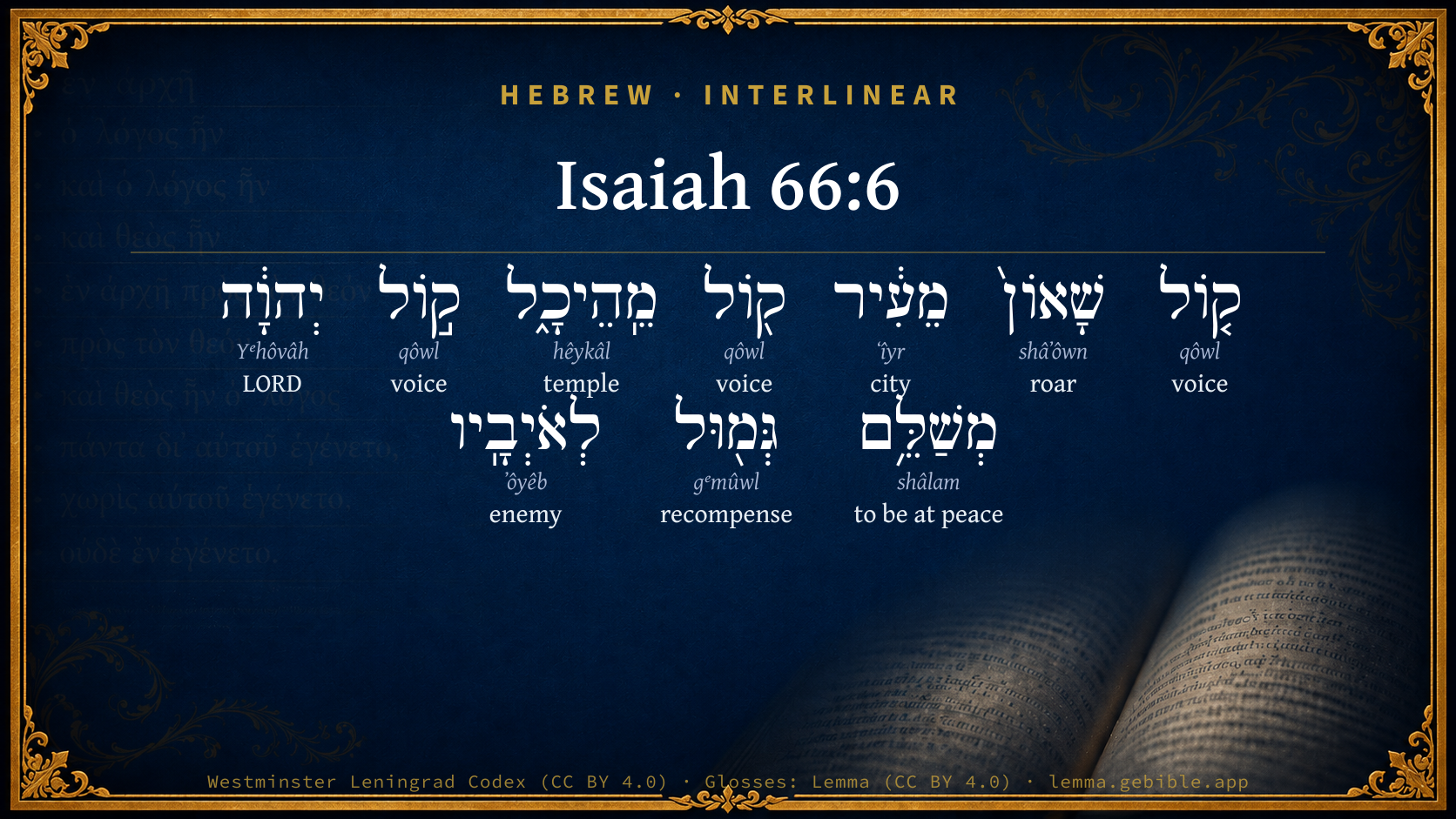
Hebrew (Westminster Leningrad Codex) Isaiah 66:6 appears in the Hebrew Old Testament. The text above is from the Westminster Leningrad Codex. Each word links to its Strong’s number, a concise gloss, and parsing drawn from the Open Scriptures Hebrew Bible morphology. Click any word for its full Brown-Driver-Briggs (BDB) entry.
Download image
Cite this verse

Isaiah 66:6 (World English Bible). Public Domain. Lemma interlinear Bible study tool, https://lemma.gebible.app/v/isaiah/66/6.

Show BibTeX & RIS
BibTeX
RIS
English Translation
A voice of tumult from the city, a voice from the temple, a voice of Yahweh that renders recompense to his enemies.
World English Bible · Public Domain
Download a study sheet

One document with this verse’s original text, its word-by-word gloss line, the meaning frame, cross-references with their text, attributed commentary, and full source and license credits — printable, and it pastes into notes with its structure intact.

This verse Autodidact and up

Study sheet (.html) Plain text (.txt)

A passage Seminary Student

Up to 50 verses in one chapter. A passage sheet keeps up to 6 commentary sources and 12 cross-references per verse, in the order this page ranks them, and says so on the sheet whenever that leaves anything out. Ask for a single verse and you get the Autodidact verse sheet above.

Everything on this page stays free to read, with no account — the sheet is a download of what is already on screen, not access to it.

Want to remove ads? Support Godless Engineer
Compare translations 3

The same verse in 3 English versions, stacked beneath the original-language interlinear above. Click any original word for its lexicon entry.

Each is an independent rendering of the whole verse — the interlinear is not word-aligned to these translations.

Highlighted words mark where these versions differ — a whole-verse word diff, not a word-by-word alignment.

  • World English Bible Public Domain
    A voice of tumult from the city, a voice from the temple, a voice of Yahweh that renders recompense to his enemies.
  • King James Version Public Domain
    A voice of noise from the city, a voice from the temple, a voice of the LORD that rendereth recompence to his enemies.
  • unfoldingWord Literal Text CC BY-SA 4.0
    The sound of an uproar from the city! A sound from the temple, the sound of Yahweh repaying recompense to his enemies! q1

unfoldingWord Literal Text — © unfoldingWord, licensed CC BY-SA 4.0. Word-aligned USFM3 via Door43 (git.door43.org/unfoldingWord/en_ult).

Versions to compare (up to 4)

3 of 4 selected

Show all 18 translations

Every available English version of this verse, each an independent rendering of the whole verse.

  • World English Bible Public Domain
    A voice of tumult from the city, a voice from the temple, a voice of Yahweh that renders recompense to his enemies.
  • Berean Standard Bible Public Domain
    Hear the uproar from the city; listen to the voice from the temple! It is the voice of the LORD, repaying His enemies what they deserve!
  • Majority Standard Bible Public Domain
    Hear the uproar from the city; listen to the voice from the temple! It is the voice of the LORD, repaying His enemies what they deserve!
  • King James Version Public Domain
    A voice of noise from the city, a voice from the temple, a voice of the LORD that rendereth recompence to his enemies.
  • American Standard Version (1901) Public Domain
    A voice of tumult from the city, a voice from the temple, a voice of Jehovah that rendereth recompense to his enemies.
  • Revised Version (1885) Public Domain
    A voice of tumult from the city, a voice from the temple, a voice of the LORD that rendereth recompence to his enemies.
  • Geneva Bible (1599) Public Domain
    A voyce soundeth from the citie, euen a voyce from the Temple, the voyce of the Lord, that recompenseth his enemies fully.
  • Douay-Rheims (1899) Public Domain
    A voice of the people from the city, a voice from the temple, the voice of the Lord that rendereth recompense to his enemies.
  • Young's Literal Translation Public Domain
    A voice of noise `is' from the city, a voice from the temple, The voice of Jehovah, giving recompence to His enemies.
  • Literal Standard Version CC BY-SA 4.0
    A voice of noise from the city, || A voice from the temple, || The voice of YHWH, || Giving repayment to His enemies.
  • Unlocked Literal Bible CC BY-SA 4.0
    A sound of battle tumult comes from the city, a sound from the temple, the sound of Yahweh paying back his enemies.
  • unfoldingWord Literal Text CC BY-SA 4.0
    The sound of an uproar from the city! A sound from the temple, the sound of Yahweh repaying recompense to his enemies! q1
  • Darby Bible Public Domain
    A voice of tumult from the city, a voice from the temple, a voice of Jehovah that rendereth recompence to his enemies!
  • World Messianic Bible Public Domain
    A voice of tumult from the city, a voice from the temple, a voice of the LORD that repays his enemies what they deserve.
  • Webster's Bible Public Domain
    A voice of noise from the city, a voice from the temple, a voice of the LORD that rendereth recompense to his enemies.
  • Free Bible Version CC BY-SA 4.0
    Hear all the shouting from the city! Hear all the noise from the Temple! It's the sound of the Lord giving his enemies back what they deserve.
  • Bible in Basic English Public Domain
    There is a noise of war from the town, a sound from the Temple, the voice of the Lord giving punishment to his haters.
  • JPS Tanakh (1917) Public Domain
    Hark! an uproar from the city, Hark! it cometh from the temple, Hark! the LORD rendereth recompense to His enemies.

Literal Standard Version (2020), Covenant Press — licensed CC BY-SA 4.0. Text via the HelloAO Bible API (eBible.org). Unlocked Literal Bible (unfoldingWord) — licensed CC BY-SA 4.0. Text via the HelloAO Bible API (eBible.org). unfoldingWord Literal Text — © unfoldingWord, licensed CC BY-SA 4.0. Word-aligned USFM3 via Door43 (git.door43.org/unfoldingWord/en_ult). Free Bible Version, Dr. Jonathan Gallagher — licensed CC BY-SA 4.0. Text via the HelloAO Bible API (eBible.org).

Word by word

More ways to search: Search by grammar → Find every occurrence → Compare this word →

Practice this passage: Drill this verse → Learn its vocabulary →

שָׁאוֹן֙
shâʼôwn
H7588
“roar”
Noun, Common, Masculine, Singular, Absolute
Part of Speech
Noun
Type
Common
Gender
Masculine
Number
Singular
State
Absolute
Full BDB Definition

Origin: from H7582

TWOT: 2301c

roar, din, crash, uproar - roar (of water) - uproar (of revellers)
  1. ק֤וֹל qôwl H6963 “voice of” Noun, Common, Masculine, Singular, Construct
  2. מֵעִ֔יר ʻîyr H5892 “from · city” Preposition + Noun, Common, Feminine, Singular, Absolute
  3. ק֖וֹל qôwl H6963 “voice” Noun, Common, Masculine, Singular, Absolute
  4. מֵֽהֵיכָ֑ל hêykâl H1964 “from · temple” Preposition + Noun, Common, Masculine, Singular, Absolute
  5. ק֣וֹל qôwl H6963 “voice of” Noun, Common, Masculine, Singular, Construct
  6. יְהוָ֔ה Yᵉhôvâh H3068 “LORD” Noun, Proper
  7. מְשַׁלֵּ֥ם shâlam H7999 “being at peace” Verb, Piel, Participle Active, Masculine, Singular, Absolute
  8. גְּמ֖וּל gᵉmûwl H1576 “recompense” Noun, Common, Masculine, Singular, Absolute
  9. לְאֹיְבָֽיו ʼôyêb H341 “to/for · enemy · him” Preposition + Verb, Qal, Participle Active, Masculine, Plural, Construct + Suffix, Personal, 3rd Person, Masculine, Singular

About this verse

These counts appear in no published source. They are computed here, from the morphology-tagged text and Lemma’s own curated glosses. What Lemma adds →

10
words
8
distinct lemmas
Prophets
section

Notable vocabulary

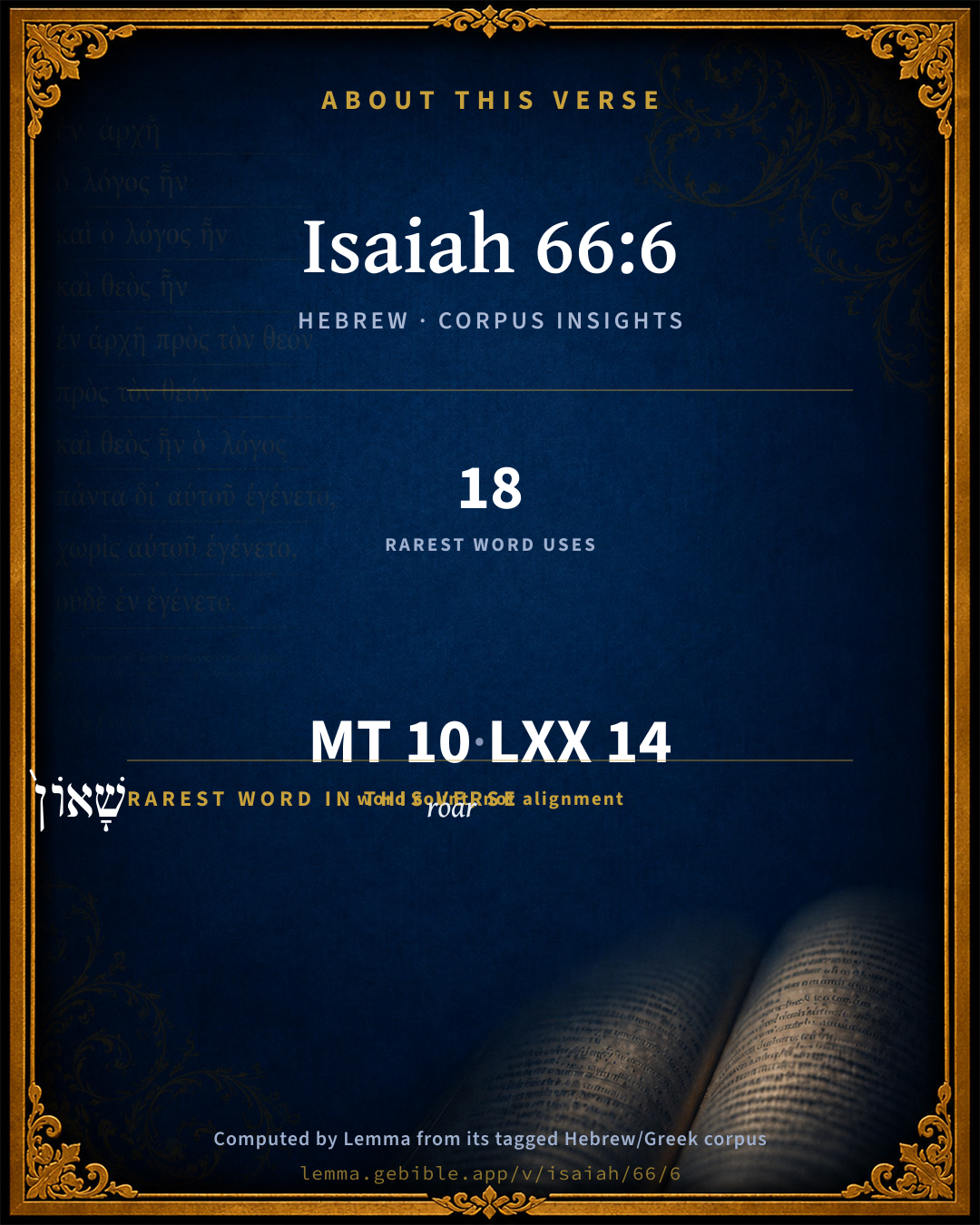
The rarest word here is שָׁאוֹן֙ roar H7588 — appearing just 18 times in the whole Hebrew Bible.

Shared distinctive vocabulary

שָׁאוֹן֙ roar H7588 occurs in 16 verses of the Hebrew Bible. Also found in:

Grammatical profile

  • 2 verbs
  • 8 nouns

Verb forms

  • מְשַׁלֵּ֥ם Piel · Participle Active
  • לְאֹיְבָֽיו Qal · Participle Active

Repetition

A word recurs within this verse — often emphatic in Hebrew:

  • ק֤וֹל voice H6963 ×3

Hebrew & Septuagint length

In English translation the verse runs 22 words from the Hebrew and 23 from the Septuagint (LXX English) — closely comparable.

A rough comparison of the two English renderings, which tokenize alike — not a word-level alignment.

Word counts can differ between the Hebrew and the Greek without any difference in meaning — e.g. the Hebrew direct-object marker אֵת has no separate Greek word, and Greek often adds the article ὁ.

In the original languages it is 10 Hebrew tokens and 14 Greek tokens — but the two are counted differently (Hebrew bundles its prefixes and suffixes into one token; the Greek is in lemma form), so that isn’t a like-for-like length.

Cross-references

5

Topical passages linked to Isaiah 66:6 in the Treasury of Scripture Knowledge — connected by theme and wording, ordered by reader-vote popularity; previews shown in the World English Bible.

  • Joel 3:7–16 Behold, I will stir them up out of the place where you have sold them, And will return your repayment on your own head;
  • Isaiah 34:8 For Yahweh has a day of vengeance, a year of recompense for the cause of Zion.
  • Amos 1:2 He said: "Yahweh will roar from Zion, And utter his voice from Jerusalem; And the pastures of the shepherds will mourn, And the top of Carmel will wither."
  • Isaiah 59:18 According to their deeds, accordingly he will repay, wrath to his adversaries, recompense to his enemies; to the islands he will repay recompense.
  • Isaiah 65:5–7 who say, Stand by yourself, don't come near to me, for I am holier than you. These are a smoke in my nose, a fire that burns all the day.

Cross-references courtesy of OpenBible.info (CC BY 4.0).

Hebrew and Greek witnesses Masoretic Hebrew ↔ Greek Septuagint

The same verse in the two great witnesses to the Old Testament, shown verse-for-verse.

These are two independent witnesses, not word-aligned to each other, and the Septuagint is shown in lemma (dictionary) form.

Hebrew Isaiah 66:6 Masoretic · Westminster Leningrad Codex

ק֤וֹל שָׁאוֹן֙ מֵעִ֔יר ק֖וֹל מֵֽהֵיכָ֑ל ק֣וֹל יְהוָ֔ה מְשַׁלֵּ֥ם גְּמ֖וּל לְאֹיְבָֽיו

A voice of tumult from the city, a voice from the temple, a voice of Yahweh that renders recompense to his enemies.

World English Bible · Public Domain

Greek LXX Isaiah 66:6 Septuagint · lemma form

φωνή κραυγή ἐκ πόλις φωνή ἐκ ναός φωνή κύριος ἀντι ἀποδίδωμι ἀνταπόδοσις ὁ ἀντικεῖμαι

A voice of a cry from the city, a voice from the temple, a voice of the Lord rendering recompence to his adversaries.

LXX2012 (modern English Septuagint) · Public Domain

Hebrew: Westminster Leningrad Codex (CC BY 4.0). Greek: Septuagint (public domain); English from LXX2012 (modern English Septuagint) (Public Domain). How the Septuagint differs from the Hebrew →

Targum (Aramaic paraphrase)

1

The Targum is the ancient Jewish Aramaic paraphrase of the Hebrew Scriptures — an interpretive translation, not the Hebrew text itself. Onkelos (literal) and Pseudo-Jonathan (expansive) render the Torah, and Jonathan the Prophets. Coverage is partial: where no permissively-licensed English translation exists for a verse, only the Aramaic is shown. This is verse-level text, not a word-by-word alignment to the Hebrew.

  1. Targum Jonathan Prophets (Joshua–Malachi)
    קַל אִתְרְגוֹשָׁא מֵקַרְתָּא דִירוּשְׁלֵם קָלָא מַהֵיכְלָא קַל מֵימְרָא דַייָ דִמְשַׁלֵים גַמְלָא לְבַעֲלֵי דְבָבוֹהִי:

    A voice of a tumult from the city of Jerusalem, a voice from the temple, a voice of the WORD of the Lord, who rendereth recompense to His enemies.

    Targum Jonathan — Aramaic: “Mikraot Gedolot” (public domain). English: “Sefaria Community Translation” (CC0 1.0 (public-domain dedication)); “London "Chaldee Paraphrase," 1871” (public domain). Text via Sefaria.

Commentary

Notes on Isaiah 66:6 from classic Christian and Jewish commentators (each source and its license shown beneath its notes). The classic Christian expositions comment on the surrounding passage and are grouped to its opening verse, so a note may address several verses; the Jewish commentaries on the Tanakh (Rashi and others) are per-verse, so they appear only where the commentator wrote on this verse.

Lemma curates 59 commentaries, every one of them public domain or Creative Commons licensed, each selected and text-cleaned for this edition rather than reprinted as found. About our sources →

Trapp's Complete Commentary

John Trapp

Isa 66:6 A voice of noise from the city, a voice from the temple, a voice of the LORD that rendereth recompence to his enemies.

Ver. 6. A voice of noise from the city.] This is a prophetic description of the last destruction of Jerusalem and the temple by the Romans. {a}

A voice from the temple.] Wherein they so much gloried, where they had oft heard Christ and his apostles preaching repentance unto life; but now have their ears filled with hideous and horrid outcries of such as were slain even in the very temple, which they defended as long as they were able, and till it was fired. That which Josephus {b} reporteth of Jesus, the son of Ananis, a plain country fellow, is very remarkable, viz., that for four years together before the last devastation, he went about the city day and night, crying as he went, in the words of this text almost, A voice from the east, a voice from the west, a voice from the four winds, a voice against Jerusalem and the temple, a voice against all the people, Woe, woe, woe to Jerusalem; and thus he continued to do, till at length, roaring out louder than ordinary, Woe to Jerusalem and to me also, he was slain upon the wall with a stone shot out of an engine, as Josephus reporteth.

That rendereth recompense to his enemies.] So they are here called who pretended so much to the glorifying of God. {Isa 66:5} False friends are true enemies.

{a} Diod.

{b} Lib. vii. Belli., cap. 12.

John Trapp, A Commentary or Exposition upon All the Books of the Old and New Testament (1647–1656) — public domain. Text from a community e-Sword module.

The Biblical Illustrator

Joseph S. Exell

Isa_66:6

A voice of noise from the city

Social degeneracy, national apostasy, and the voice of God

It is well for us to look around upon the things that are done in the midst of us as a people; well, because we must give no connivance at evil thinking or teaching or doing; well, because we must be careful about ourselves; well, because we must be truthful towards our neighbours; well, because we must be faithful toward our God.

This text suggests three different voices which thoughtful men should hear: A voice of noise from the city, etc. In other words, our ear must listen to the state of society and the state of religion amongst us, and then consider what the Lord has to say concerning both.

1. What is the voice which comes from the city, from the secular pursuits, the social habits, the business transactions, the political doings of men? There is a voice of noise, as of men that laugh, as of men that strive, as of men that boast. Luxury, with all its attendant evils, has come up as a cry from all our land, into the ears of earnest and anxious men, who know how foolish it is to be lovers of pleasure more than lovers of God. It has carried with it a hasting to be rich; and out of that has grown a covetousness, a cold system of reckless speculation, a hard system of indifference, to the ruin of many for the enrichment of a few, which have made our age and our country a by-word amongst men. What awful accounts of utter contempt for human sufferings! What sad chronicles of entire forgetfulness of human wrongs have become the familiar subjects of every-day knowledge amongst us! These are crying evils in our days; the voice of noises from the city, symptoms of our social life, of which all true patriots ought to be blushingly ashamed. Yet, over the moanings of the oppressed, and the sorrows of the forsaken, the roar still rises. I ask every pious parent to keep a jealous and watchful eye upon the children growing in their simplicity at home, and to protect them against the strange fascination which has come over the land. I call upon all true servants of Christ to come out and be separate, and touch not the unclean thing. The Lords people should be often with their God, seeking protection against the prevailing current of evil in mens hearts, minds, and ways. Expect no sympathy, because everything seems to say that faithful men must suffer for their faithfulness in the evil day. Fall back upon the right, the true, the good, the pure; fall back upon the oath and covenant and power and promise of God; but make no compromise with Satan.

2. But the prophet heard a voice out of the temple, and so may we. The luxury of the nation has had its influence upon the nations faith. Men who will not shape their conduct by Gods law will soon find means of accommodating their creed to their conduct. The pure Gospel is too plain-spoken for the consciences of men who desire to quarrel with God rather than with themselves. What is the voice from the temple in this our day? The great feature is a real indifference, not an avowed unbelief, not a bold blasphemy, not a studied contempt, not an entire ignoring of religious things, but a real indifference. There is an evil spirit abroad which takes to itself the blessed name of charity. It has always an excuse for evil, but it has little patience with truth. It has no strong convictions and no real love. There is a voice to be heard from the temple which may well make thoughtful people tremble. Men are falling again to their old and mischievous work of tampering with Gods Word. Multitudes, it is to be feared, have lost their reverence, if not their faith.

3. This brings me to the third voice, which the prophet heard in the days of Israels decline and fall: A voice of the Lord that rendereth recompence to His enemies. In the written Word we have warning about evil time. (1Ti_4:1; 2Ti_3:1.) The voice of God is against all such evil 2Ti_4:1-4). The voice of Him that rendereth recompense unto His enemies is, Woe unto you. What, then, should Gods servants do?

The voice from the city suggests that they must make their healthy influence felt in social life by a solemn and sacred protest against things which frivolize, secularize, materialize mens minds and ways. The voice from the temple suggests that all who love the pure Gospel truth must search it out so as to boldly set it forth, stand by it, speak for it, identify themselves with its honour, its advance, its defence. And the voice of the avenging God suggests that all who know Him should humble themselves before Him, and plead with Him that He would have mercy. (J. Richardson, M.A.)

The Biblical Illustrator, edited by Joseph S. Exell (c. 1880s–1900s) — public domain. Text from a community e-Sword module.

Joseph Benson's Commentary

Isa 66:6. A voice of noise from the city, &c. — This is an expression of a prophetical ecstasy, in which the prophet hears the noise of the ruin of the city and temple sounding in his ears. This voice of noise comes not from the city only, but from the temple, wherein these formalists had so much gloried, and reposed so much confidence. There is a noise of soldiers slaying, and of the poor people shrieking or crying out. A voice of the Lord — Not in thunder, which is sometimes called the Lord’s voice, but that rendereth recompense to his enemies — Thus he expresses the destruction of the Jews by the Roman armies, as a thing at that time doing. Some think this prophecy was fulfilled, partly at least, in the prodigies which, according to Josephus, in his history of the Jewish wars, (lib. 7. cap. 12,) preceded the destruction of Jerusalem: that the eastern gate of the temple, which was of solid brass and very heavy, and was scarcely shut in an evening by twenty men, and was fastened by strong bars and bolts, was seen, at the sixth hour of the night, opened of its own accord, and could hardly be shut again: that before the setting of the sun, there were seen over all the country chariots and armies fighting in the clouds, and besieging cities: that at the feast of pentecost, as the priests were going into the inner temple by night, as usual, to attend their service, they heard first a motion and noise, and then a voice, as of a multitude, saying, Let us depart hence; and, what he reckons as the most terrible of all, that one Jesus, the son of Ananus, an ordinary country fellow, four years before the war began, and when the city was in peace and plenty, came to the feast of tabernacles, and ran crying up and down the streets day and night, A voice from the east, a voice from the west, a voice from the four winds, a voice against Jerusalem and the temple, a voice against the bridegrooms and the brides, a voice against all the people. The magistrates endeavoured by stripes and torture to restrain him; but he still cried with a mournful voice, Wo, wo to Jerusalem! This he continued to do for seven years and five months together, and especially at the great festivals; and he neither grew hoarse nor was tired, but went about the walls and cried with a loud voice, Wo, wo to the city, and to the people, and to the temple! and, as he added at last, Wo, wo also to myself! it happened that a stone from some sling or engine immediately struck him dead. It may be proper to remark here, that there is not a more creditable historian than Josephus, who relates these things, and who appeals to the testimony of those who saw and heard them. But, as Bishop Newton observes, it may add some weight to his relation, that Tacitus, the Roman historian, a heathen, also gives us a summary account of the same occurrence. He says, “There happened several prodigies. Armies were seen to engage in different parts of the sky — glittering arms appeared — the temple shone by the sudden fire of the clouds — the doors of the temple were suddenly thrown wide open — a voice, more than human, was heard, that the gods were departing, and, at the same time, a great motion as if departing.” See Tacitus’s Hist., book 5. page 217, in Lipsius’s edition.

Joseph Benson's Commentary on the Old and New Testaments (1811–1818) — public domain. Text from a community e-Sword module.

Tyndale Open Study Notes

Tyndale Open Resources

66:6 terrible noise from the Temple: This parallels the situation described in Ezek 9 when God’s executioner began to destroy the wicked people of Jerusalem. • vengeance against his enemies: God would deal out retribution to the disobedient members of his own people. They were his enemies because of their persistent sin and rejection of God.

Tyndale Open Study Notes — © Tyndale Open Resources, licensed CC BY-SA 4.0. Text via the HelloAO Bible API.

Geneva Bible (1599)

Geneva Bible translators

The enemies shall shortly hear a more terrible voice, even fire and slaughter, seeing they would not hear the gentle voice of the Prophets, which called them to repentance.

Geneva Bible (1599) marginal notes — public domain. Text via Bolls.life.

Jamieson, Fausset & Brown

Robert Jamieson, A. R. Fausset & David Brown

God, from Jerusalem and His "temple," shall take vengeance on the enemy (Eze 43:1-8; Zac 12:2-3; Zac 14:3, Zac 14:19-21). The abrupt language of this verse marks the suddenness with which God destroys the hostile Gentile host outside: as Isa 66:5 refers to the confounding of the unbelieving Jews.

voice of noise--that is, the Lord's loud-sounding voice (Psa 68:33; Psa 29:3-9; Th1 4:16).

Jamieson, Fausset & Brown — Commentary Critical and Explanatory on the Whole Bible (1871) — public domain (CC PDM 1.0). Text via the HelloAO Bible API.

Adam Clarke's Commentary

Verse 6. A voice of noise from the city, a voice from the temple, a voice of the Lord] It is very remarkable that similar words were spoken by Jesus, son of Ananias, previously to the destruction of Jerusalem. See his very affecting history related by Josephus, WAR, B. vi., chap. v.

Adam Clarke's Commentary on the Bible (1810–1826) — public domain. Text from a community e-Sword/MySword module.

Ellicott's Commentary for English Readers

(6) A voice of noise . . .—The form reminds us of Isa_13:4. The words represent dramatically the wonder with which men will behold the great judgments of God, proceeding, as with the thunders of Sinai (Amo_1:2; Joe_3:16), from the city and the temple, that seemed to have been given over to destruction.

A Bible Commentary for English Readers, edited by Charles John Ellicott (1878–1897) — public domain. Text from a community e-Sword module.

The Cambridge Bible for Schools and Colleges

gen. ed. J. J. S. Perowne

6. Description of the sudden outbreak of Jehovah’s destructive might from His city and sanctuary (cf. Amo_1:2; Joe_3:16; ch. Isa_33:14). A noise of uproar from the city! A noise from the temple! The noise of Jehovah rendering recompence (see on Isa_59:18) to His enemies! (those referred to in Isa_66:5). That these words presuppose the existence of the Temple is certainly the most natural interpretation. The thought of the verse is resumed in Isa_66:15-16; the verses immediately following pass abruptly to a different subject.

The Cambridge Bible for Schools and Colleges (gen. ed. J. J. S. Perowne; Cambridge University Press, 1878–1918) — public domain. Text from a community e-Sword module.

John Gill's Exposition

A voice of noise from the city,.... From the city of Jerusalem, as the Targum; so Kimchi, who says, that in the days of the Messiah shall go out of Jerusalem the voice of noise concerning Gog and Magog: this indeed respects the days of the Messiah, but such as are now past, and a voice of crying in the city of Jerusalem, at, the taking and destruction of it by the Romans; when were heard from it the noisy voices of the Roman soldiers, triumphing and rejoicing at it, and the shrieks of the inhabitants, running about from place to place for shelter; so when destruction and desolation are come upon any place, a voice or a cry is said to come from it; see Jer 48:3,

a voice from the temple; either from heaven, as Aben Ezra; or rather from the temple at Jerusalem, of the priests there hindered from doing their service, and starving for want of sustenance; or of the people that fled thither for security, but forced from thence by the soldiers; and especially a voice of crying and lamentation was heard, when set on fire. Some illustrate this by what the priests heard in the temple a little before the destruction of it, a rustling and a noise like persons shifting and moving, and a voice in the holy of holies, saying, "let us go hence"; as also the words of Jesus the son of Ananus, a countryman, who went about uttering these words,

"a voice from the east, a voice from the west, a voice from the four winds, a voice against Jerusalem and against the temple, a voice against the bridegrooms and the brides, a voice against all the people:''

this he did before the war began, nor could he be persuaded to desist from it, but continued it afterwards; going on the walls of the city, saying,

"woe, woe to the city, and to the temple, and to the people, woe to myself also;''

and while he was speaking the last words, a stone, cast from a Roman engine, killed him, as Josephus (q) relates:

a voice of the Lord, that rendereth recompence to his enemies; for the Lord's voice was in all this, and his hand in the destruction of those people; it was according to his appointment, direction, and order, in righteous judgment for their sins, they being his implacable enemies, that would not have him to rule over them, Luk 19:14.

(q) De Bello Jud. I. 6. c. 5. sect. 3.

John Gill's Exposition of the Whole Bible (1746–1763) — public domain (CC PDM 1.0). Text via the HelloAO Bible API.

Albert Barnes' Notes on the Bible

A voice of noise from the city - That is, from the city of Jerusalem. The prophet sees in a vision a tumult in the city. He hears a voice that issues from the temple. His manner and language are rapid and hurried - such as a man would evince who should suddenly see a vast tumultuous assemblage, and hear a confused sound of many voices. There is also a remarkable abruptness in the whole description here. The preceding verse was calm and solemn. It was full of affectionate assurance of the divine favor to those whom the prophet saw to be persecuted. Here the scene suddenly changes. The vision passes to the agitating events which were occurring in the city and the temple, and to the great and sudden change which would be produced in the condition of the church of God. But to whom or what this refers has been a subject of considerable difference of opinion. Grotius understands it of the sound of triumph of Judas Maccabeus, and of his soldiers, rejoicing that the city was forsaken by Antiochus, and by the party of the Jews who adhered to him.

Rosenmuller understands it of the voice of God, who is seen by the prophet taking vengeance on his foes. There can be no doubt that the prophet, in vision, sees Yahweh taking recompence on his enemies - for that is expressly specified. Still it is not easy to determine the exact time referred to, or the exact scene which passes before the mind of the prophet. To me it seems probable that it is a scene that immediately preceded the rapid extension of the gospel, and the great and sudden increase of the church by the accession of the pagan world (see the following verses); and I would suggest, whether it is not a vision of the deeply affecting and agitating scenes when the temple and city were about to be destroyed by the Romans; when the voice of Yahweh would be heard in the city and at the temple, declaring the punishment which he would bring on those who had cast out and rejected the followers of the Messiah Isa 66:5; and when, as a result of this, the news of Salvation was to be rapidly spread throughout the pagan world.

This is the opinion, also, of Vitringa. The phrase rendered here ‘a voice of noise’ (שׁאון קול qôl shâ'ôn), means properly the voice of a tumultuous assemblage; the voice of a multitude. The word ‘noise’ (שׁאון shâ'ôn) is applied to a noise or roaring, as of waters Psa 65:8; or of a crowd or multitude of people Isa 5:14; Isa 42:4; Isa 24:8; and of war Amo 2:2; Hos 10:14. Here it seems probable that it refers to the confused clamor of war, the battle cry raised by soldiers attacking an army or a city; and the scene described is probably that when the Roman soldiers burst into the city, scaled the walls, and poured desolation through the capital.

A voice from the temple - That is, either the tumultous sound of war already having reached the temple; or the voice of Yahweh speaking from the temple, and commanding destruction on his foes. Vitringa supposes that it may mean the voice of Yahweh breaking forth from the temple, and commanding his foes to be slain. But to whichever it refers, it doubtless means that the sound of the tumult was not only around the city, but in it; not merely in the distant parts, but in the very midst, and even at the temple.

A voice of the Lord that rendereth recompence - Here we may observe:

1. That it is recompence taken on those who had cast out their brethren Isa 66:5.

2. It is vengeance taken within the city, and on the internal, not the external enemies.

3. It is vengeance taken in the midst of this tumult.

All this is a striking description of the scene when the city and temple were taken by the Roman armies. It was the vengeance taken on those who had cast out their brethren; it was the vengeance which was to precede the glorious triumph of truth and of the cause of the true religion.

Albert Barnes' Notes on the Bible (1834–1885) — public domain. Text from a community e-Sword/MySword module.

Haydock's Catholic Bible Commentary

Lord, who is about to quit the temple, and to abandon the Jews to their internal dissensions, and to the arms of the Romans. Many prodigies announced this judgment. (Calmet) --- One Jesus cried for seven years and five months, "Woe to the temple," &c. At last he cried, "Woe to myself;" when he was shot dead. (Josephus, Jewish Wars vii. 12.) (Tacitus, Hist. v.) --- Angels were heard crying in the temple, "Let us go hence." (Josephus) --- There was contradiction in the city, Psalm liv. (St. Jerome) (Worthington)

George Leo Haydock (1774–1849), Haydock's Catholic Family Bible and Commentary, 1859 edition — public domain. Excludes Psalms (Douay-Rheims chapter numbering differs from Protestant) and Deuterocanonical books (Catholic canon only).

Matthew Poole's English Annotations

A voice of noise from the city; the expression of a prophetical ecstasy, as much as, Methinks I already hear

a voice of noise, rather a sad and affrighting noise, than the noise of triumphers (as some think); yea, it comes not from the city only, but from the temple, wherein these formalists have so much gloried, and reposed so much confidence. There is a noise of soldiers slaying, and of the priests or poor people fled thither shrieking or crying out.

A voice of the Lord; not in thunder, which is sometimes called so, Psa 29:3-5, &c., but

that rendereth recompence to his enemies. Thus the noise of soldiers, the roaring of guns, the sound of drums and trumpets, are the voice of the Lord. Thus the prophet seemeth to express the destruction of the Jews by the Roman armies, as if a thing at that time doing.

Matthew Poole's English Annotations on the Holy Bible (1683–1685) — public domain. Text from a community e-Sword/MySword module.

Whedon's Commentary on the Bible

Daniel D. Whedon

6. A voice of the Lord — It would seem as if the mock prediction is coming to pass in a way the persecutors little counted on. There would seem to be a leap of time here to the destruction of Jerusalem.

A voice of noise — Or, sound of war from the city — from Jerusalem herself; the shock and tumult of battle by the Romans, A.D. 70. There is a triple sound of battle: — one from the temple, as well as from the city, and one from Jehovah. it is as a roar of armies rushing to deadly conflict, with God as the Unseen Leader.

Daniel D. Whedon (gen. ed.), Commentary on the Old and New Testaments (1874–1909) — public domain. Text from a community e-Sword module.

The Pulpit Commentary

A voice of noise from the city... from the temple. The "city" and "temple" are suddenly in existence they have sprung into being. The prophet sees Jerusalem rebuilt, restored, and hears sounds go forth from it partly, perhaps, the sounds of ordinary city life; but amid these, there is a voice of the Lord, rendering recompense to his enemies. The Jewish state, restored by Zerubbabel, did, after a time, bring under subjection several of its ancient adversaries.

Vers. 6-9. The enemies of Jehovah and his people.

I HE IS HEARD FROM HIS TEMPLE. With "a sound of uproar, a sound from the temple." He is issuing forth to render their deserts to his foes. "He will render to every man according to his deserts" is a great leading word in religion. God must be feared as well as loved nay, cannot be truly loved unless feared. From that same seat whence go forth the sweet sounds of reconciliation, the sound of the gospel"s silver trumpet, go forth the thunders of the God who appears to execute judgment upon human guilt. He is a "consuming Fire." His wrath may be "kindled;" we need to beware "lest he be angry." He is an awful God of whom, nevertheless, it may be said, "This awful God is ours.

II THE RESTORATION OF ISRAEL. With great energy the thought is put before us that Israel in these last days has sprung into new birth and life. The gift of male children was especially dear to the Israelitish heart. Now there is to be a great and sudden increase of Zion"s children. "This refers, probably," says Barnes, "to the sudden increase of the Church when the Messiah came, and to the great revivals of religion which attended the preaching of the gospel. Three thousand were converted on a single day, (Ac 2) and the gospel was speedily propagated over the known world." Something unlike the usual course of nature and of human affairs is hinted. Slow is the growth of vegetation, slow the growth of human institutions. Here an event as startling as the breaking forth of the tree out of the seed in a single day is contemplated; a nation born at once!" In fact, Christianity is such a wonder. A plant out of a dry ground, mysterious in its origin, despised in its professors, humble in its early associations, yet speedily, almost suddenly, overshading the lands with its branches, and yielding fruit and healing for the nations. "The expansiveness of Zion is such that nought but Omnipotence will be able to check it; and as Omnipotence has no motive for checking it, Zion has nothing to fear in heaven or earth" (Cheyne). J.

The Pulpit Commentary (1880–1919), ed. H.D.M. Spence-Jones & Joseph S. Exell — public domain. Text from a community e-Sword module.

John Wesley's Explanatory Notes

A voice - The expression of a prophetical extasy, as if he said, I hear a sad and affrighting noise; it comes not from the city only, but from the temple, wherein these formalists have so much gloried. There is a noise of soldiers slaying, and of the poor people shrieking or crying out. Of the Lord - A voice of the Lord, not in thunder, but that rendereth recompence to his enemies. Thus he seems to express the destruction of the Jews by the Roman armies, as a thing at that time doing.

John Wesley, Explanatory Notes Upon the Whole Bible (1754–1765) — public domain. Text via the GEBible commentary corpus.

Keil & Delitzsch

C. F. Keil & F. Delitzsch

The city and temple, to which they desire to go, are nothing more, so far as they are concerned, than the places from which just judgment will issue. "Sound of tumult from the city! Sound from the Temple! Sound of Jehovah, who repays His enemies with punishment." All three קול, to the second of which שׁאון must be supplied in thought, are in the form of interjectional exclamations (as in Isa 52:8). In the third, however, we have omitted the note of admiration, because here the interjectional clause approximates very nearly to a substantive clause ("it is the sound of Jehovah"), as the person shouting announces here who is the originator and cause of the noise which was so enigmatical at first. The city and temple are indeed still lying in ruins as the prophet is speaking; but even in this state they both preserve the holiness conferred upon them. They are the places where Jehovah will take up His abode once more; and even now, at the point at which promise and fulfilment coincide, they are in the very process of rising again. A loud noise (like the tumult of war) proceeds from it. It is Jehovah, He who is enthroned in Zion and rules from thence (Isa 31:9), who makes Himself heard in this loud noise (compare Joe 3:16 with the derivative passage in Amo 1:2); it is He who awards punishment or reckons retribution to His foes. In other cases גּמוּל (השׁהיב) שׁלּם generally means to repay that which has been worked out (what has been deserved; e.g., Psa 137:8, compare Isa 3:11); but in Isa 59:18 gemūl was the parallel word to chēmâh, and therefore, as in Isa 35:4, it did not apply to the works of men, but to the retribution of the judge, just as in Jer 51:6, where it is used quite as absolutely. We have therefore rendered it "punishment;" "merited punishment" would express both sides of this double-sided word. By "His enemies," according to the context, we are to understand primarily the mass of the exiles, who were so estranged from God, and yet withal so full of demands and expectations.

Keil & Delitzsch — Biblical Commentary on the Old Testament (1861–1891) — public domain (CC PDM 1.0). Text via the HelloAO Bible API. (Old Testament only.)

J. A. Alexander on Isaiah

Joseph Addison Alexander

“A voice of tumult from the city! A voice from the temple! The voice of Jehovah, rendering requital to His enemies!” The Hebrew word shaon is never applied elsewhere to a joyful cry or a cry of lamentation, but to the tumult of war, the rushing sound of armies and the shock of battle, in which sense it is repeatedly employed by Isaiah. The enemies here mentioned must of course be those who had just been described as the despisers and persecutors of their brethren, and whose confusion after being threatened generally in the verse preceding is here graphically represented in detail. The description therefore cannot without violence be understood of foreign or external enemies. In strict adherence to the usage of the words and to the requisitions of the context, both immediate and remote, the verse may be applied to the giving up of Zion and the temple to its enemies, as a final demonstration that the old economy was at an end, and that the sins of Israel were now to be visited on that generation. The assailants of Jerusalem and of the Jews were now no longer those of God Himself, but rather chosen instruments to execute His vengeance on His enemies, the unbelieving Jews themselves. The tumult comprehends the whole confusion of the siege and conquest, and a better commentary on this brief but grand prediction cannot be desired than that afforded by Josephus in his narrative of what may be regarded as not only the most dreadful siege on record but in some respects the most sublime and critical conjuncture in all history, because coincident with the transition from the abrogated system of the old economy to the acknowledged introduction of the new, a change of infinitely more extensive influence on human character and destiny than many philosophical historians have been willing to admit or even able to discover.

Joseph Addison Alexander, The Prophecies of Isaiah (1846–1847; New York: Scribner, 1870–1878) — public domain. Text from a community e-Sword module.

unfoldingWord translationNotes

Door43 World Missions Community

General Information:

Yahweh describes the punishment for the hypocrisy of the worshipers.

A sound of battle tumult

The sound represents the real fighting that is going on in the temple as Yahweh is carrying out the punishment. (See: Metonymy)

translationWords

temple

Yahweh

unfoldingWord translationNotes — © Distant Shores Media and the Door43 World Missions Community, licensed CC BY-SA 4.0. Source: git.door43.org/Door43/en_tn.

Ibn Ezra

Rabbi Abraham ibn Ezra

From the city. From Zion.

From the temple of the Lord, that is, from the temple in Jerusalem, or from the heavens, which are called the holy temple. A voice. The report of their punishment by God, that will spread everywhere.

To his enemies. To those that cast you out, etc.

Ibn Ezra on the Tanakh — English translations: “Sefaria Community Translation” (CC0 1.0 (public-domain dedication)); “Yalkut, Sifsei Chachomim Chumash, Metsudah Publications, 2009” (CC BY 4.0); and “Commentary of Ibn Ezra on Isaiah - trans. by M. Friedlander, 1873” (public domain). Text via Sefaria.

Lesson kit

Teaching starters — assembled from the data on this page, not authored interpretation. Every prompt links to the verse data it draws on. Edit before teaching.

Isaiah, in the Prophets, opens this verse with 10 words (8 distinct Hebrew lemmas). Its most distinctive word is shâʼôwn (“roar”). A historical commentator’s framing appears above. Read the whole chapter for the surrounding context.

Discussion questions

  1. What does “roar” (shâʼôwn) contribute to the verse as a whole?
  2. How does Psalms 40:2, which shares the word «roar», read alongside this verse?
  3. What does the repetition of “voice” (3× in this one verse) do in this verse?
  4. These translations render this verse differently. What is at stake in choosing one wording over another?
  5. «מְשַׁלֵּ֥ם» is a Piel Participle Active verb. How does that grammatical form shape the action described?
  6. Compare how Trapp's Complete Commentary and The Biblical Illustrator read this verse. Where do they agree or differ?

Things to notice

Reading settings

Reading text

Shown beneath each verse's original-language words.

Old Testament
Old Testament edition

Read the OT as the Masoretic Hebrew (MT) or the Greek Septuagint (LXX).

English shown for the Greek Septuagint (in the Hebrew ↔ Greek comparison).

Comparing translations? Open the Compare panel on any verse page to stack up to four side by side.