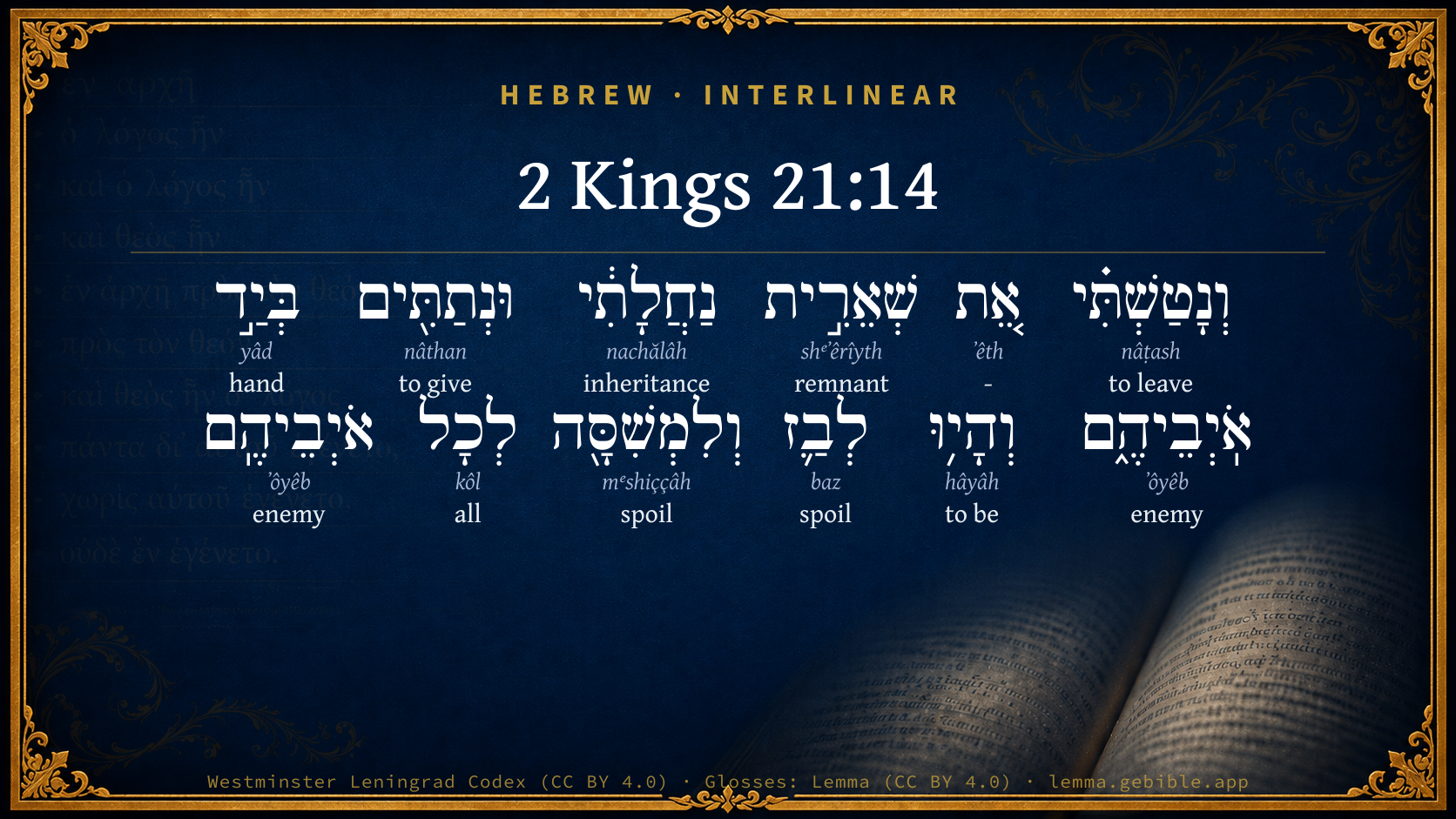
2 Kings 21:14

Hebrew (Westminster Leningrad Codex) 2 Kings 21:14 appears in the Hebrew Old Testament. The text above is from the Westminster Leningrad Codex. Each word links to its Strong’s number, a concise gloss, and parsing drawn from the Open Scriptures Hebrew Bible morphology. Click any word for its full Brown-Driver-Briggs (BDB) entry.
Download image
Cite this verse

2 Kings 21:14 (World English Bible). Public Domain. Lemma interlinear Bible study tool, https://lemma.gebible.app/v/2-kings/21/14.

Show BibTeX & RIS
BibTeX
RIS
English Translation
I will cast off the remnant of my inheritance, and deliver them into the hand of their enemies; and they shall become a prey and a spoil to all their enemies;
World English Bible · Public Domain
Highlights
  • 1 first appearance in the Hebrew Bible
Full analysis ↓
Download a study sheet

One document with this verse’s original text, its word-by-word gloss line, the meaning frame, cross-references with their text, attributed commentary, and full source and license credits — printable, and it pastes into notes with its structure intact.

This verse Autodidact and up

Study sheet (.html) Plain text (.txt)

A passage Seminary Student

Up to 50 verses in one chapter. A passage sheet keeps up to 6 commentary sources and 12 cross-references per verse, in the order this page ranks them, and says so on the sheet whenever that leaves anything out. Ask for a single verse and you get the Autodidact verse sheet above.

Everything on this page stays free to read, with no account — the sheet is a download of what is already on screen, not access to it.

Want to remove ads? Support Godless Engineer
Compare translations 3

The same verse in 3 English versions, stacked beneath the original-language interlinear above. Click any original word for its lexicon entry.

Each is an independent rendering of the whole verse — the interlinear is not word-aligned to these translations.

Highlighted words mark where these versions differ — a whole-verse word diff, not a word-by-word alignment.

  • World English Bible Public Domain
    I will cast off the remnant of my inheritance, and deliver them into the hand of their enemies; and they shall become a prey and a spoil to all their enemies;
  • King James Version Public Domain
    And I will forsake the remnant of mine inheritance, and deliver them into the hand of their enemies; and they shall become a prey and a spoil to all their enemies;
  • unfoldingWord Literal Text CC BY-SA 4.0
    And I will abandon the remnant of my inheritance, and I will give them into the hand of their enemies. And they will become spoil and plunder for all of their enemies,

unfoldingWord Literal Text — © unfoldingWord, licensed CC BY-SA 4.0. Word-aligned USFM3 via Door43 (git.door43.org/unfoldingWord/en_ult).

Versions to compare (up to 4)

3 of 4 selected

Show all 18 translations

Every available English version of this verse, each an independent rendering of the whole verse.

  • World English Bible Public Domain
    I will cast off the remnant of my inheritance, and deliver them into the hand of their enemies; and they shall become a prey and a spoil to all their enemies;
  • Berean Standard Bible Public Domain
    So I will forsake the remnant of My inheritance and deliver them into the hands of their enemies. And they will become plunder and spoil to all their enemies,
  • Majority Standard Bible Public Domain
    So I will forsake the remnant of My inheritance and deliver them into the hands of their enemies. And they will become plunder and spoil to all their enemies,
  • King James Version Public Domain
    And I will forsake the remnant of mine inheritance, and deliver them into the hand of their enemies; and they shall become a prey and a spoil to all their enemies;
  • American Standard Version (1901) Public Domain
    And I will cast off the remnant of mine inheritance, and deliver them into the hand of their enemies; and they shall become a prey and a spoil to all their enemies;
  • Revised Version (1885) Public Domain
    And I will cast off the remnant of mine inheritance, and deliver them into the hand of their enemies; and they shall become a prey and a spoil to all their enemies;
  • Geneva Bible (1599) Public Domain
    And I will forsake the remnant of mine inheritance, and deliuer them into the hande of their enemies, and they shalbe robbed and spoyled of all their aduersaries,
  • Douay-Rheims (1899) Public Domain
    And I will leave the remnants of my inheritance, and will deliver them into the hands of their enemies: and they shall become a prey, and a spoil to all their enemies.
  • Young's Literal Translation Public Domain
    `And I have left the remnant of Mine inheritance, and given them into the hand of their enemies, and they have been for a prey and for a spoil to all their enemies,
  • Literal Standard Version CC BY-SA 4.0
    And I have left the remnant of My inheritance, and given them into the hand of their enemies, and they have been for a prey and for a spoil to all their enemies,
  • Unlocked Literal Bible CC BY-SA 4.0
    I will throw off the remnant of my inheritance and give them into the hand of their enemies. They will become victims and plunder for all their enemies,
  • unfoldingWord Literal Text CC BY-SA 4.0
    And I will abandon the remnant of my inheritance, and I will give them into the hand of their enemies. And they will become spoil and plunder for all of their enemies,
  • Darby Bible Public Domain
    And I will forsake the remnant of mine inheritance, and deliver them into the hand of their enemies; and they shall become a prey and a spoil to all their enemies;
  • World Messianic Bible Public Domain
    I will cast off the remnant of my inheritance and deliver them into the hands of their enemies. They will become a prey and a plunder to all their enemies,
  • Webster's Bible Public Domain
    And I will forsake the remnant of my inheritance, and deliver them into the hand of their enemies; and they shall become a prey and a spoil to all their enemies;
  • Free Bible Version CC BY-SA 4.0
    I will give up on the remnant of my special people and hand them over to their enemies. They will be plunder and loot to all their enemies,
  • Bible in Basic English Public Domain
    And I will put away from me the rest of my heritage, and give them up into the hands of their haters, who will take their property and their goods for themselves;
  • JPS Tanakh (1917) Public Domain
    And I will cast off the remnant of Mine inheritance, and deliver them into the hand of their enemies; and they shall become a prey and a spoil to all their enemies;

Literal Standard Version (2020), Covenant Press — licensed CC BY-SA 4.0. Text via the HelloAO Bible API (eBible.org). Unlocked Literal Bible (unfoldingWord) — licensed CC BY-SA 4.0. Text via the HelloAO Bible API (eBible.org). unfoldingWord Literal Text — © unfoldingWord, licensed CC BY-SA 4.0. Word-aligned USFM3 via Door43 (git.door43.org/unfoldingWord/en_ult). Free Bible Version, Dr. Jonathan Gallagher — licensed CC BY-SA 4.0. Text via the HelloAO Bible API (eBible.org).

Word by word

More ways to search: Search by grammar → Find every occurrence → Compare this word →

Practice this passage: Drill this verse → Learn its vocabulary →

וְלִמְשִׁסָּ֖ה
mᵉshiççâh
H4933
“and · to/for · spoil”
Conjunction + Preposition + Noun, Common, Feminine, Singular, Absolute
Part of Speech
Conjunction + Preposition + Noun
Type
Common
Gender
Feminine
Number
Singular
State
Absolute
Full BDB Definition

Origin: from H8155

TWOT: 2426a

booty, spoil, plunder
  1. וְנָטַשְׁתִּ֗י nâṭash H5203 “and · to leave” Conjunction + Verb, Qal, Sequential Perfect, 1st Person, Common, Singular
  2. אֵ֚ת ʼêth H853 “-” Particle, Direct Object
  3. שְׁאֵרִ֣ית shᵉʼêrîyth H7611 “remnant of” Noun, Common, Feminine, Singular, Construct
  4. נַחֲלָתִ֔י nachălâh H5159 “inheritance · my” Noun, Common, Feminine, Singular, Construct + Suffix, Personal, 1st Person, Common, Singular
  5. וּנְתַתִּ֖ים nâthan H5414 “and · to give · them” Conjunction + Verb, Qal, Sequential Perfect, 1st Person, Common, Singular + Suffix, Personal, 3rd Person, Masculine, Plural
  6. בְּיַ֣ד yâd H3027 “in/at · hand of” Preposition + Noun, Common, Both, Singular, Construct
  7. אֹֽיְבֵיהֶ֑ם ʼôyêb H341 “enemy · them” Verb, Qal, Participle Active, Masculine, Plural, Construct + Suffix, Personal, 3rd Person, Masculine, Plural
  8. וְהָי֥וּ hâyâh H1961 “and · to be” Conjunction + Verb, Qal, Sequential Perfect, 3rd Person, Common, Plural
  9. לְבַ֛ז baz H957 “to/for · spoil” Preposition + Noun, Common, Masculine, Singular, Absolute
  10. לְכָל kôl H3605 “to/for · all of” Preposition + Noun, Common, Masculine, Singular, Construct
  11. אֹיְבֵיהֶֽם ʼôyêb H341 “enemy · them” Verb, Qal, Participle Active, Masculine, Plural, Construct + Suffix, Personal, 3rd Person, Masculine, Plural

About this verse

These counts appear in no published source. They are computed here, from the morphology-tagged text and Lemma’s own curated glosses. What Lemma adds →

12
words
11
distinct lemmas
Historical
section

Notable vocabulary

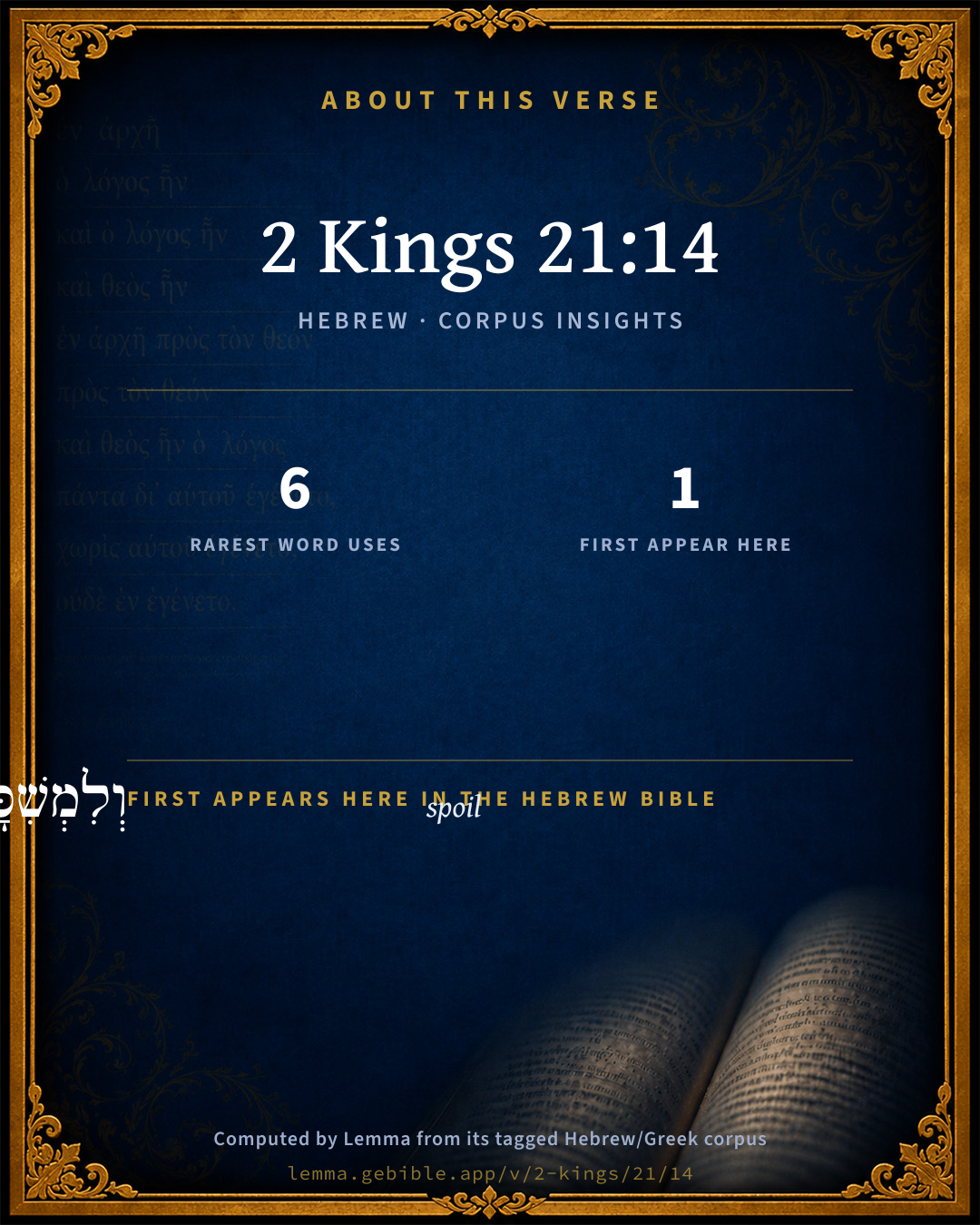
The rarest word here is וְלִמְשִׁסָּ֖ה spoil H4933 — appearing just 6 times in the whole Hebrew Bible.

First appearance in Scripture

This word makes its first canonical appearance in the Hebrew Bible here:

  • וְלִמְשִׁסָּ֖ה spoil H4933

Shared distinctive vocabulary

וְלִמְשִׁסָּ֖ה spoil H4933 occurs in 6 verses of the Hebrew Bible. Also found in:

Grammatical profile

  • 5 verbs
  • 6 nouns
  • 1 particle

Verb forms

  • וְנָטַשְׁתִּ֗י Qal · Sequential Perfect
  • וּנְתַתִּ֖ים Qal · Sequential Perfect
  • אֹֽיְבֵיהֶ֑ם Qal · Participle Active
  • וְהָי֥וּ Qal · Sequential Perfect
  • אֹיְבֵיהֶֽם Qal · Participle Active

Repetition

A word recurs within this verse — often emphatic in Hebrew:

  • אֹֽיְבֵיהֶ֑ם enemy H341 ×2

Hebrew & Septuagint length

In English translation the verse runs 31 words from the Hebrew and 34 from the Septuagint (LXX English) — closely comparable.

A rough comparison of the two English renderings, which tokenize alike — not a word-level alignment.

Word counts can differ between the Hebrew and the Greek without any difference in meaning — e.g. the Hebrew direct-object marker אֵת has no separate Greek word, and Greek often adds the article ὁ.

Cross-references

25

Topical passages linked to 2 Kings 21:14 in the Treasury of Scripture Knowledge — connected by theme and wording, ordered by reader-vote popularity; previews shown in the World English Bible.

  • Jeremiah 23:33 When this people, or the prophet, or a priest, shall ask you, saying, What is the burden of Yahweh? then shall you tell them, What burden! I will cast you off, says Yahweh.
  • 2 Kings 19:4 It may be Yahweh your God will hear all the words of Rabshakeh, whom the king of Assyria his master has sent to defy the living God, and will rebuke the words which Yahweh your God has heard. Therefore lift up your prayer for the remnant that is left.
  • Psalms 89:38–45 But you have rejected and spurned. You have been angry with your anointed.
  • Leviticus 26:17 I will set my face against you, and you will be struck before your enemies. Those who hate you will rule over you; and you will flee when no one pursues you.
  • Leviticus 26:36–38 "'As for those of you who are left, I will send a faintness into their hearts in the lands of their enemies: and the sound of a driven leaf will put them to flight; and they shall flee, as one flees from the sword; and they will fall when no one pursues.
  • Deuteronomy 4:26–27 I call heaven and earth to witness against you this day, that you shall soon utterly perish from off the land whereunto you go over the Jordan to possess it; you shall not prolong your days on it, but shall utterly be destroyed.
  • Deuteronomy 28:25 Yahweh will cause you to be struck before your enemies; you shall go out one way against them, and shall flee seven ways before them: and you shall be tossed back and forth among all the kingdoms of the earth.
  • Deuteronomy 28:31–33 Your ox shall be slain before your eyes, and you shall not eat of it: your donkey shall be violently taken away from before your face, and shall not be restored to you: your sheep shall be given to your enemies, and you shall have none to save you.
  • Deuteronomy 28:48 therefore shall you serve your enemies whom Yahweh shall send against you, in hunger, and in thirst, and in nakedness, and in want of all things: and he shall put a yoke of iron on your neck, until he have destroyed you.
  • Deuteronomy 31:17 Then my anger shall be kindled against them in that day, and I will forsake them, and I will hide my face from them, and they shall be devoured, and many evils and troubles shall come on them; so that they will say in that day, Haven't these evils come on us because our God is not among us?
  • Judges 2:14–15 The anger of Yahweh was kindled against Israel, and he delivered them into the hands of spoilers who despoiled them; and he sold them into the hands of their enemies round about, so that they could not any longer stand before their enemies.
  • 2 Kings 19:30–31 The remnant that has escaped of the house of Judah shall again take root downward, and bear fruit upward.
  • 2 Kings 24:2 Yahweh sent against him bands of the Chaldeans, and bands of the Syrians, and bands of the Moabites, and bands of the children of Ammon, and sent them against Judah to destroy it, according to the word of Yahweh, which he spoke by his servants the prophets.
  • 2 Chronicles 15:2 and he went out to meet Asa, and said to him, Hear you me, Asa, and all Judah and Benjamin: Yahweh is with you, while you are with him; and if you seek him, he will be found of you; but if you forsake him, he will forsake you.
  • 2 Chronicles 36:16–17 but they mocked the messengers of God, and despised his words, and scoffed at his prophets, until the wrath of Yahweh arose against his people, until there was no remedy.
  • Nehemiah 9:27–37 Therefore you delivered them into the hand of their adversaries, who distressed them: and in the time of their trouble, when they cried to you, you heard from heaven; and according to your manifold mercies you gave them saviors who saved them out of the hand of their adversaries.
  • Psalms 37:28 For Yahweh loves justice, And doesn't forsake his saints. They are preserved forever, But the children of the wicked shall be cut off.
  • Psalms 71:1–7 In you, Yahweh, I take refuge. Never let me be disappointed.
  • Psalms 106:40–43 Therefore Yahweh burned with anger against his people. He abhorred his inheritance.
  • Isaiah 10:6 I will send him against a profane nation, and against the people of my wrath will I give him a charge, to take the spoil, and to take the prey, and to tread them down like the mire of the streets.
  • Jeremiah 12:7 I have forsaken my house, I have cast off my heritage; I have given the dearly beloved of my soul into the hand of her enemies.
  • Lamentations 1:5 Her adversaries are become the head, her enemies prosper; For Yahweh has afflicted her for the multitude of her transgressions: Her young children are gone into captivity before the adversary.
  • Lamentations 1:10 The adversary has spread out his hand on all her pleasant things: For she has seen that the nations are entered into her sanctuary, Concerning whom you did command that they should not enter into your assembly.
  • Lamentations 5:20 Why do you forget us forever, [And] forsake us so long time?
  • Amos 5:2 "The virgin of Israel has fallen; She shall rise no more. She is cast down on her land; There is no one to raise her up."

Cross-references courtesy of OpenBible.info (CC BY 4.0).

Hebrew and Greek witnesses Masoretic Hebrew ↔ Greek Septuagint

The same verse in the two great witnesses to the Old Testament, shown verse-for-verse.

These are two independent witnesses, not word-aligned to each other, and the Septuagint is shown in lemma (dictionary) form.

Hebrew 2 Kings 21:14 Masoretic · Westminster Leningrad Codex

וְנָטַשְׁתִּ֗י אֵ֚ת שְׁאֵרִ֣ית נַחֲלָתִ֔י וּנְתַתִּ֖ים בְּיַ֣ד אֹֽיְבֵיהֶ֑ם וְהָי֥וּ לְבַ֛ז וְלִמְשִׁסָּ֖ה לְכָל אֹיְבֵיהֶֽם

I will cast off the remnant of my inheritance, and deliver them into the hand of their enemies; and they shall become a prey and a spoil to all their enemies;

World English Bible · Public Domain

Greek LXX 2 Kings 21:14 Septuagint · lemma form

καί ἀποὠθέω ὁ ὑπόλειμμα ὁ κληρονομία ἐγώ καί παραδίδωμι αὐτός εἰς χείρ ἐχθρός αὐτός καί εἰμί εἰς διαρπαγή καί εἰς προνομή πᾶς ὁ ἐχθρός αὐτός

And I will reject the remnant of my inheritance, and will deliver them into the hands of their enemies; and they shall be for a plunder and for a spoil to all their enemies:

LXX2012 (modern English Septuagint) · Public Domain

On this verse, Ellicott's Commentary for English Readers discusses the Septuagint’s reading. Read the note in Commentary ↓

Hebrew: Westminster Leningrad Codex (CC BY 4.0). Greek: Septuagint (public domain); English from LXX2012 (modern English Septuagint) (Public Domain). How the Septuagint differs from the Hebrew →

Targum (Aramaic paraphrase)

1

The Targum is the ancient Jewish Aramaic paraphrase of the Hebrew Scriptures — an interpretive translation, not the Hebrew text itself. Onkelos (literal) and Pseudo-Jonathan (expansive) render the Torah, and Jonathan the Prophets. Coverage is partial: where no permissively-licensed English translation exists for a verse, only the Aramaic is shown. This is verse-level text, not a word-by-word alignment to the Hebrew.

  1. Targum Jonathan Prophets (Joshua–Malachi)
    וְאֶרְטוֹשׁ יַת שְׁאָרָא דְאַחְסַנְתִּי וְאֶמְסְרִינוּן בְּיַד בַּעֲלֵי דְבָבֵיהוֹן וִיהוֹן לָבַז וְלִתְבַר לְכָל סַנְאֵיהוֹן:

    (no public-domain English translation for this verse)

    Targum Jonathan — Aramaic: “Mikraot Gedolot” (public domain). English: “Sefaria Community Translation” (CC0 1.0 (public-domain dedication)); “London "Chaldee Paraphrase," 1871” (public domain). Text via Sefaria.

Commentary

Notes on 2 Kings 21:14 from classic Christian and Jewish commentators (each source and its license shown beneath its notes). The classic Christian expositions comment on the surrounding passage and are grouped to its opening verse, so a note may address several verses; the Jewish commentaries on the Tanakh (Rashi and others) are per-verse, so they appear only where the commentator wrote on this verse.

Lemma curates 59 commentaries, every one of them public domain or Creative Commons licensed, each selected and text-cleaned for this edition rather than reprinted as found. About our sources →

Trapp's Complete Commentary

John Trapp

2Ki 21:14 And I will forsake the remnant of mine inheritance, and deliver them into the hand of their enemies; and they shall become a prey and a spoil to all their enemies;

Ver. 14. And I will forsake the remnant of mine inheritance.] Which is now unto me "as a speckled bird: the birds round about are against her," &c. {Jer 12:9}

And deliver them into the hand of their enemies.] When God once forsaketh a people, all evils come rushing in upon them, as by a sluice. Saul’s doleful complaint was, "God hath forsaken me, and the Philistines are upon me." {1Sa 28:15} See Hos 9:12. {See Trapp on "Hos 9:12"}

John Trapp, A Commentary or Exposition upon All the Books of the Old and New Testament (1647–1656) — public domain. Text from a community e-Sword module.

Joseph Benson's Commentary

2Ki 21:14-15. I will forsake the remnant of mine inheritance — The kingdom of Judah, the only remainder of all the tribes of Israel, which I once chose for my inheritance; but now, notwithstanding that I conferred on them that privilege, I will utterly reject and forsake them. They have provoked me since the day, &c. — This sore judgment, though it was chiefly inflicted for the sins of Manasseh and his generation, yet had a respect unto all their former sins.

Joseph Benson's Commentary on the Old and New Testaments (1811–1818) — public domain. Text from a community e-Sword module.

Tyndale Open Study Notes

Tyndale Open Resources

21:14-15 the remnant: Those not killed in God’s impending judgment would be at the mercy of their captors. This prophecy was fulfilled when thousands of Judeans were taken into captivity in the Babylonian invasion during the fall of Jerusalem in 586 BC (25:8-21; 2 Chr 36:20; Jer 39:9; 52:15).

Tyndale Open Study Notes — © Tyndale Open Resources, licensed CC BY-SA 4.0. Text via the HelloAO Bible API.

Geneva Bible (1599)

Geneva Bible translators

Meaning, Judah and Benjamin, which were only left of the rest of the tribes.

Geneva Bible (1599) marginal notes — public domain. Text via Bolls.life.

Jamieson, Fausset & Brown

Robert Jamieson, A. R. Fausset & David Brown

I will forsake the remnant of mine inheritance--The people of Judah, who of all the chosen people alone remained. The consequence of the Lord's forsaking them would be their fall into the power of their enemies.

Jamieson, Fausset & Brown — Commentary Critical and Explanatory on the Whole Bible (1871) — public domain (CC PDM 1.0). Text via the HelloAO Bible API.

Adam Clarke's Commentary

Verse 14. I will forsake the remnant of mine inheritance] One part (the ten tribes) was already forsaken, and carried into captivity; the remnant (the tribe of Judah) was now about to be forsaken.

Adam Clarke's Commentary on the Bible (1810–1826) — public domain. Text from a community e-Sword/MySword module.

Ellicott's Commentary for English Readers

(14) Forsake.—Or, cast off; LXX., ἀπώσομαι. Jdg_6:13.

The remnant of mine inheritance.—The Northern Kingdom had already been depopulated.

A prey and a spoil.—Isa_42:22.; Jer_30:16.

A Bible Commentary for English Readers, edited by Charles John Ellicott (1878–1897) — public domain. Text from a community e-Sword module.

The Cambridge Bible for Schools and Colleges

gen. ed. J. J. S. Perowne

14. And I will forsake [R.V. cast off] the remnant] ‘Forsake’ need not necessarily imply ‘a punishment that has been deserved’ which is what is here intended. Hence R.V. has substituted ‘cast off’ or ‘reject’ in many instances. Cf. Jdg_6:13; Jer_15:16; Jer_23:33; Jer_23:39, &c.

The Cambridge Bible for Schools and Colleges (gen. ed. J. J. S. Perowne; Cambridge University Press, 1878–1918) — public domain. Text from a community e-Sword module.

John Gill's Exposition

And I will forsake the remnant of mine inheritance,.... The whole land of Canaan was the Lord's inheritance; ten tribes in it were already removed, only Judah with Benjamin was left, and the Lord threatens to forsake that remnant:

and deliver them into the hands of their enemies, and they shall become a prey and spoil to all their enemies; which was fulfilled in their captivity in Babylon.

John Gill's Exposition of the Whole Bible (1746–1763) — public domain (CC PDM 1.0). Text via the HelloAO Bible API.

Haydock's Catholic Bible Commentary

Leave. Septuagint, "with horror," Greek: apeasomai (Haydock) "I will cast off." So Chaldean, Syriac, &c. --- Remnants. Juda, &c., who shall be treated like the ten tribes. (Calmet) --- All shared in the punishment, though some preserved the true religion, Psalm lxxxviii. 35. (Worthington)

George Leo Haydock (1774–1849), Haydock's Catholic Family Bible and Commentary, 1859 edition — public domain. Excludes Psalms (Douay-Rheims chapter numbering differs from Protestant) and Deuterocanonical books (Catholic canon only).

Matthew Poole's English Annotations

The remnant of mine inheritance, i.e. the kingdom of Judah, the only remainder of all the tribes of Israel, which I did once choose for my inheritance, but now, notwithstanding that privilege, will utterly reject and forsake them.

Matthew Poole's English Annotations on the Holy Bible (1683–1685) — public domain. Text from a community e-Sword/MySword module.

Whedon's Commentary on the Bible

Daniel D. Whedon

14. The remnant of mine inheritance — Judah and Benjamin, which alone remained as tribes and chief representatives of the chosen nation.

Daniel D. Whedon (gen. ed.), Commentary on the Old and New Testaments (1874–1909) — public domain. Text from a community e-Sword module.

The Pulpit Commentary

And I will forsake the remnant of mine inheritance. "The remnant" here is not the remnant left of Judah after the deportation of two hundred thousand souls by Sennacherib (as in 2Ki_19:4) but the remnant that is left of the whole people of Israel the two tribes as distinct from the ten. The ten tribes were forsaken when the Assyrians took and destroyed Samaria; (2Ki_17:18, 2Ki_17:23) the two remained. Now the two also would be forsaken, and the last remnant of God"s inheritance cast out. And deliver them into the hand of their enemies. Not the Chaldeans only, who were not yet "their enemies," but their persistent and inveterate enemies, the Syrians, Moabites, Ammonites, (see 2Ki_24:2) and Edomites (Eze_25:12; Joe_3:19) who all joined with Nebuchadnezzar at the last, and (as Ewald says, "History of Israel," vol. 4. p, 270) "indulged their ancient hatred by taking a very active part in the final war." And they shall become a prey and a spoil to all their enemies. (comp. Jer_41:2-10 Jer_48:27; Oba_1:10-14; Zep_2:8, etc.) The years which immediately followed the Captivity were years of terrible suffering to the remnant whom Nebuchadnezzar left in the land. (2Ki_25:12) Every petty power in the neighborhood felt itself at liberty to make incursions with Judaea at its pleasure, to plunder and ravage, and drive off cap-tires, or massacre them in cold blood, or commit, any other atrocity. Some critics regard the description of Isaiah in Isa_42:22-24 as prophetic of these sufferings.

The Pulpit Commentary (1880–1919), ed. H.D.M. Spence-Jones & Joseph S. Exell — public domain. Text from a community e-Sword module.

Lesson kit

Teaching starters — assembled from the data on this page, not authored interpretation. Every prompt links to the verse data it draws on. Edit before teaching.

2 Kings, in the Historical, opens this verse with 12 words (11 distinct Hebrew lemmas). Its most distinctive word is mᵉshiççâh (“spoil”). A historical commentator’s framing appears above. Read the whole chapter for the surrounding context.

Discussion questions

  1. How does “spoil” (mᵉshiççâh) shape what this verse is saying?
  2. The word “spoil” first appears here in Scripture. What is being introduced at this debut?
  3. Isaiah 42:22 shares the word «spoil» with this verse. How do the two illuminate each other?
  4. “enemy” occurs 2× in this one verse. What is the effect of the repetition?
  5. These translations render this verse differently; the difference is in the English rendering, not the original. What questions does that raise?
  6. The verb «וְנָטַשְׁתִּ֗י» is Qal Sequential Perfect. How does its form color the action?
  7. Reading how Trapp's Complete Commentary and Joseph Benson's Commentary read this verse, where do the two commentators agree and where do they part?

Things to notice

  • 1 word makes its first canonical appearance in Scripture here.
  • These translations choose different wording for 10 words in this verse.
  • “enemy” occurs 2× in this single verse.
  • 11 distinct Hebrew lemmas span 12 words in this verse.

Reading settings

Reading text

Shown beneath each verse's original-language words.

Old Testament
Old Testament edition

Read the OT as the Masoretic Hebrew (MT) or the Greek Septuagint (LXX).

English shown for the Greek Septuagint (in the Hebrew ↔ Greek comparison).

Comparing translations? Open the Compare panel on any verse page to stack up to four side by side.