
2 Chronicles 6:24

Hebrew (Westminster Leningrad Codex) 2 Chronicles 6:24 appears in the Hebrew Old Testament. The text above is from the Westminster Leningrad Codex. Each word links to its Strong’s number, a concise gloss, and parsing drawn from the Open Scriptures Hebrew Bible morphology. Click any word for its full Brown-Driver-Briggs (BDB) entry.
Download image
Cite this verse

2 Chronicles 6:24 (World English Bible). Public Domain. Lemma interlinear Bible study tool, https://lemma.gebible.app/v/2-chronicles/6/24.

Show BibTeX & RIS
BibTeX
RIS
English Translation
If your people Israel be struck down before the enemy, because they have sinned against you, and shall turn again and confess your name, and pray and make supplication before you in this house;
World English Bible · Public Domain
Download a study sheet

One document with this verse’s original text, its word-by-word gloss line, the meaning frame, cross-references with their text, attributed commentary, and full source and license credits — printable, and it pastes into notes with its structure intact.

This verse Autodidact and up

Study sheet (.html) Plain text (.txt)

A passage Seminary Student

Up to 50 verses in one chapter. A passage sheet keeps up to 6 commentary sources and 12 cross-references per verse, in the order this page ranks them, and says so on the sheet whenever that leaves anything out. Ask for a single verse and you get the Autodidact verse sheet above.

Everything on this page stays free to read, with no account — the sheet is a download of what is already on screen, not access to it.

Want to remove ads? Support Godless Engineer
Compare translations 3

The same verse in 3 English versions, stacked beneath the original-language interlinear above. Click any original word for its lexicon entry.

Each is an independent rendering of the whole verse — the interlinear is not word-aligned to these translations.

Highlighted words mark where these versions differ — a whole-verse word diff, not a word-by-word alignment.

  • World English Bible Public Domain
    If your people Israel be struck down before the enemy, because they have sinned against you, and shall turn again and confess your name, and pray and make supplication before you in this house;
  • King James Version Public Domain
    And if thy people Israel be put to the worse before the enemy, because they have sinned against thee; and shall return and confess thy name, and pray and make supplication before thee in this house;
  • unfoldingWord Literal Text CC BY-SA 4.0
    And if your people Israel are struck down before an enemy because they have sinned against you, and they return, and they confess your name, and they pray, and they seek favor before you in this house,

unfoldingWord Literal Text — © unfoldingWord, licensed CC BY-SA 4.0. Word-aligned USFM3 via Door43 (git.door43.org/unfoldingWord/en_ult).

Versions to compare (up to 4)

3 of 4 selected

Show all 18 translations

Every available English version of this verse, each an independent rendering of the whole verse.

  • World English Bible Public Domain
    If your people Israel be struck down before the enemy, because they have sinned against you, and shall turn again and confess your name, and pray and make supplication before you in this house;
  • Berean Standard Bible Public Domain
    When Your people Israel are defeated before an enemy because they have sinned against You, and they return to You and confess Your name, praying and pleading before You in this temple,
  • Majority Standard Bible Public Domain
    When Your people Israel are defeated before an enemy because they have sinned against You, and they return to You and confess Your name, praying and pleading before You in this temple,
  • King James Version Public Domain
    And if thy people Israel be put to the worse before the enemy, because they have sinned against thee; and shall return and confess thy name, and pray and make supplication before thee in this house;
  • American Standard Version (1901) Public Domain
    And if thy people Israel be smitten down before the enemy, because they have sinned against thee, and shall turn again and confess thy name, and pray and make supplication before thee in this house;
  • Revised Version (1885) Public Domain
    And if thy people Israel be smitten down before the enemy, because they have sinned against thee; and shall turn again and confess thy name, and pray and make supplication before thee in this house:
  • Geneva Bible (1599) Public Domain
    And when thy people Israel shalbe ouerthrowen before the enemie, because they haue sinned against thee, and turne againe, and confesse thy Name, and pray, and make supplication before thee in this house,
  • Douay-Rheims (1899) Public Domain
    If thy people Israel be overcome by their enemies, (for they will sin against thee,) and being converted shall do penance, and call upon thy name, and pray to thee in this place,
  • Young's Literal Translation Public Domain
    `And if Thy people Israel is smitten before an enemy, because they sin against Thee, and they have turned back and confessed Thy name, and prayed and made supplication before Thee in this house --
  • Literal Standard Version CC BY-SA 4.0
    And if Your people Israel is struck before an enemy because they sin against You, and they have turned back and confessed Your Name, and prayed and made supplication before You in this house—
  • Unlocked Literal Bible CC BY-SA 4.0
    When your people Israel are defeated by an enemy because they have sinned against you, if they turn back to you, confess your name, pray, and request forgiveness before you in this temple—
  • unfoldingWord Literal Text CC BY-SA 4.0
    And if your people Israel are struck down before an enemy because they have sinned against you, and they return, and they confess your name, and they pray, and they seek favor before you in this house,
  • Darby Bible Public Domain
    And if thy people Israel be put to the worse before the enemy, because they have sinned against thee, and shall turn again and confess thy name, and pray, and make supplication before thee in this house;
  • World Messianic Bible Public Domain
    “If your people Israel are struck down before the enemy because they have sinned against you, and they turn again and confess your name, and pray and make supplication before you in this house,
  • Webster's Bible Public Domain
    And if thy people Israel shall be put to the worse before the enemy, because they have sinned against thee; and shall return and confess thy name, and pray and make supplication before thee in this house;
  • Free Bible Version CC BY-SA 4.0
    When your people Israel are defeated by an enemy because they have sinned against you, and if they come back in repentance to you, praying for forgiveness in this Temple,
  • Bible in Basic English Public Domain
    And if your people Israel are overcome in war, because of their sin against you; if they are turned to you again, honouring your name, making prayers and requesting your grace in this house:
  • JPS Tanakh (1917) Public Domain
    And if Thy people Israel be smitten down before the enemy, when they sin against Thee, and shall turn again and confess Thy name, and pray and make supplication before Thee in this house;

Literal Standard Version (2020), Covenant Press — licensed CC BY-SA 4.0. Text via the HelloAO Bible API (eBible.org). Unlocked Literal Bible (unfoldingWord) — licensed CC BY-SA 4.0. Text via the HelloAO Bible API (eBible.org). unfoldingWord Literal Text — © unfoldingWord, licensed CC BY-SA 4.0. Word-aligned USFM3 via Door43 (git.door43.org/unfoldingWord/en_ult). Free Bible Version, Dr. Jonathan Gallagher — licensed CC BY-SA 4.0. Text via the HelloAO Bible API (eBible.org).

Word by word

More ways to search: Search by grammar → Find every occurrence → Compare this word →

Practice this passage: Drill this verse → Learn its vocabulary →

יִנָּגֵ֞ף
nâgaph
H5062
“to strike”
Verb, Niphal, Imperfect, 3rd Person, Masculine, Singular
Part of Speech
Verb
Stem
Niphal
Form
Imperfect
Person
3rd Person
Gender
Masculine
Number
Singular
Full BDB Definition

Origin: a primitive root

TWOT: 1294

to strike, smite - (Qal) to strike, smite - (Niphal) to be stricken, be smitten - (Hithpael) to stumble
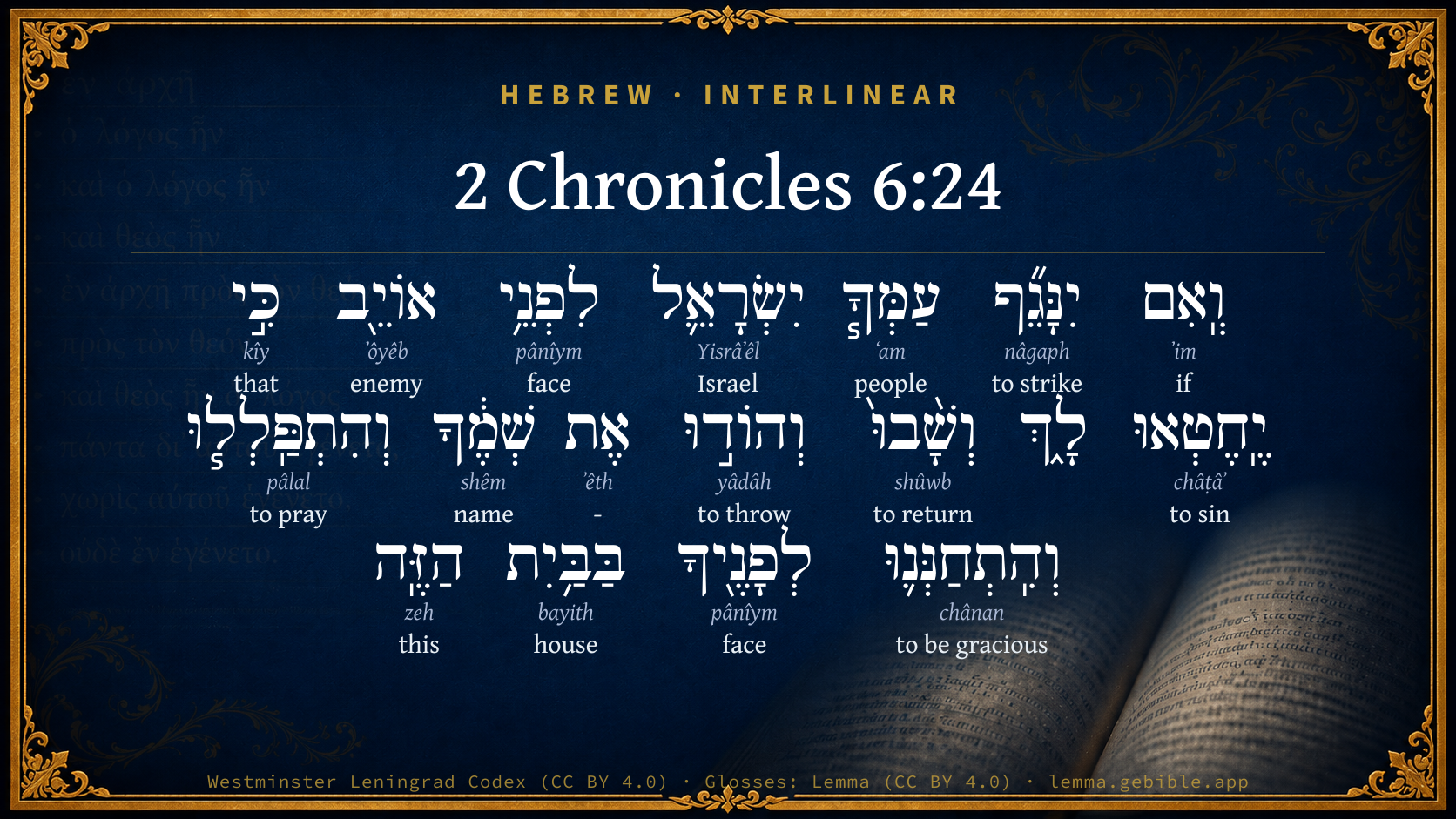
  1. וְֽאִם ʼim H518 “and · if” Conjunction + Conjunction
  2. עַמְּךָ֧ ʻam H5971 “people · your” Noun, Common, Masculine, Singular, Construct + Suffix, Personal, 2nd Person, Masculine, Singular
  3. יִשְׂרָאֵ֛ל Yisrâʼêl H3478 “Israel” Noun, Proper
  4. לִפְנֵ֥י pânîym H6440 “to/for · face(s) of” Preposition + Noun, Common, Both, Plural, Construct
  5. אוֹיֵ֖ב ʼôyêb H341 “enemy” Verb, Qal, Participle Active, Masculine, Singular, Absolute
  6. כִּ֣י kîy H3588 “that” Conjunction
  7. יֶֽחֶטְאוּ châṭâʼ H2398 “to sin” Verb, Qal, Imperfect, 3rd Person, Masculine, Plural
  8. וְשָׁ֨בוּ֙ shûwb H7725 “and · to return” Conjunction + Verb, Qal, Sequential Perfect, 3rd Person, Common, Plural
  9. וְהוֹד֣וּ yâdâh H3034 “and · to throw” Conjunction + Verb, Hiphil, Sequential Perfect, 3rd Person, Common, Plural
  10. אֶת ʼêth H853 “-” Particle, Direct Object
  11. שְׁמֶ֔ךָ shêm H8034 “name · your” Noun, Common, Masculine, Singular, Construct + Suffix, Personal, 2nd Person, Masculine, Singular
  12. וְהִתְפַּֽלְל֧וּ pâlal H6419 “and · to pray” Conjunction + Verb, Hithpael, Sequential Perfect, 3rd Person, Common, Plural
  13. וְהִֽתְחַנְּנ֛וּ chânan H2603 “and · to be gracious” Conjunction + Verb, Hithpael, Sequential Perfect, 3rd Person, Common, Plural
  14. לְפָנֶ֖יךָ pânîym H6440 “to/for · face(s) · your” Preposition + Noun, Common, Both, Plural, Construct + Suffix, Personal, 2nd Person, Masculine, Singular
  15. בַּבַּ֥יִת bayith H1004 “in/at the · house” Preposition, Determined + Noun, Common, Masculine, Singular, Absolute
  16. הַזֶּֽה zeh H2088 “the · this” Particle, Definite Article + Pronoun, Demonstrative, Masculine, Singular

About this verse

These counts appear in no published source. They are computed here, from the morphology-tagged text and Lemma’s own curated glosses. What Lemma adds →

18
words
16
distinct lemmas
Historical
section

Shared distinctive vocabulary

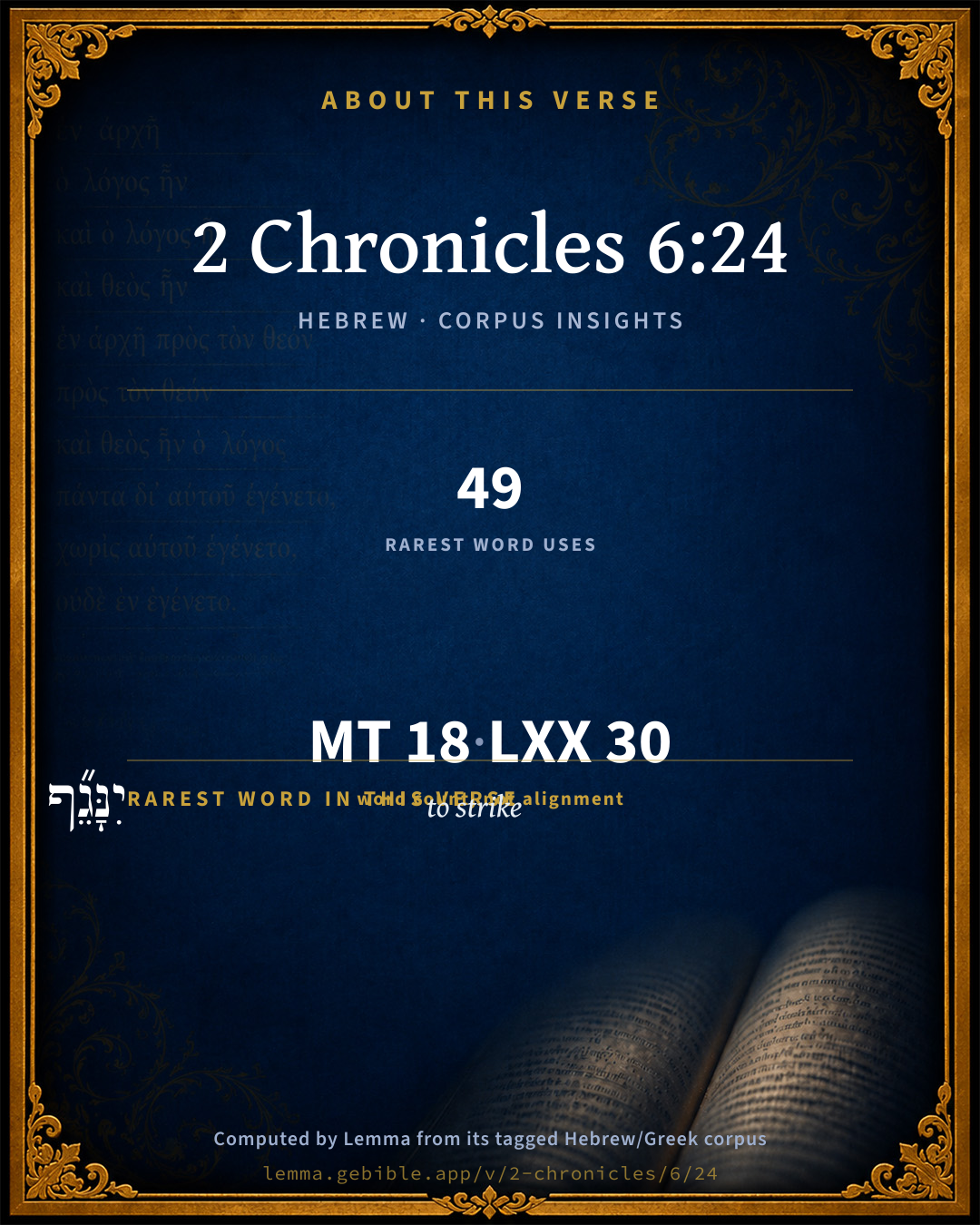
יִנָּגֵ֞ף to strike H5062 occurs in 46 verses of the Hebrew Bible. Also found in:

Grammatical profile

  • 7 verbs
  • 6 nouns
  • 1 pronoun
  • 1 preposition
  • 2 conjunctions
  • 1 particle

Verb forms

  • יִנָּגֵ֞ף Niphal · Imperfect
  • אוֹיֵ֖ב Qal · Participle Active
  • יֶֽחֶטְאוּ Qal · Imperfect
  • וְשָׁ֨בוּ֙ Qal · Sequential Perfect
  • וְהוֹד֣וּ Hiphil · Sequential Perfect
  • וְהִתְפַּֽלְל֧וּ Hithpael · Sequential Perfect
  • וְהִֽתְחַנְּנ֛וּ Hithpael · Sequential Perfect

Repetition

A word recurs within this verse — often emphatic in Hebrew:

  • לִפְנֵ֥י face H6440 ×2

Hebrew & Septuagint length

In English translation the verse runs 34 words from the Hebrew and 38 from the Septuagint (LXX English) — closely comparable.

A rough comparison of the two English renderings, which tokenize alike — not a word-level alignment.

Word counts can differ between the Hebrew and the Greek without any difference in meaning — e.g. the Hebrew direct-object marker אֵת has no separate Greek word, and Greek often adds the article ὁ.

In the original languages it is 18 Hebrew tokens and 30 Greek tokens — but the two are counted differently (Hebrew bundles its prefixes and suffixes into one token; the Greek is in lemma form), so that isn’t a like-for-like length.

Cross-references

21

Topical passages linked to 2 Chronicles 6:24 in the Treasury of Scripture Knowledge — connected by theme and wording, ordered by reader-vote popularity; previews shown in the World English Bible.

  • Leviticus 26:17 I will set my face against you, and you will be struck before your enemies. Those who hate you will rule over you; and you will flee when no one pursues you.
  • Leviticus 26:37 They will stumble over one another, as it were before the sword, when no one pursues: and you will have no power to stand before your enemies.
  • Leviticus 26:40–42 "'If they confess their iniquity, and the iniquity of their fathers, in their trespass which they trespassed against me, and also that, because they walked contrary to me,
  • Deuteronomy 4:29–31 But from there you shall seek Yahweh your God, and you shall find him, when you search after him with all your heart and with all your soul.
  • Deuteronomy 28:25 Yahweh will cause you to be struck before your enemies; you shall go out one way against them, and shall flee seven ways before them: and you shall be tossed back and forth among all the kingdoms of the earth.
  • Deuteronomy 28:48 therefore shall you serve your enemies whom Yahweh shall send against you, in hunger, and in thirst, and in nakedness, and in want of all things: and he shall put a yoke of iron on your neck, until he have destroyed you.
  • Deuteronomy 30:1–6 It shall happen, when all these things are come on you, the blessing and the curse, which I have set before you, and you shall call them to mind among all the nations, where Yahweh your God has driven you,
  • Joshua 7:8 Oh, Lord, what shall I say, after that Israel has turned their backs before their enemies!
  • Joshua 7:11–12 Israel has sinned; yes, they have even transgressed my covenant which I commanded them: yes, they have even taken of the devoted thing, and have also stolen, and dissembled also; and they have even put it among their own stuff.
  • Judges 2:11 The children of Israel did that which was evil in the sight of Yahweh, and served the Baals;
  • Judges 2:14–15 The anger of Yahweh was kindled against Israel, and he delivered them into the hands of spoilers who despoiled them; and he sold them into the hands of their enemies round about, so that they could not any longer stand before their enemies.
  • 1 Kings 8:33–34 When your people Israel are struck down before the enemy, because they have sinned against you; if they turn again to you, and confess your name, and pray and make supplication to you in this house:
  • 2 Kings 17:7–18 It was so, because the children of Israel had sinned against Yahweh their God, who brought them up out of the land of Egypt from under the hand of Pharaoh king of Egypt, and had feared other gods,
  • Ezra 9:5–15 At the evening offering I arose up from my humiliation, even with my garment and my robe torn; and I fell on my knees, and spread out my hands to Yahweh my God;
  • Nehemiah 1:8–9 Remember, I beg you, the word that you commanded your servant Moses, saying, If you trespass, I will scatter you abroad among the peoples:
  • Nehemiah 9:1–37 Now in the twenty-fourth day of this month the children of Israel were assembled with fasting, and with sackcloth, and earth on them.
  • Psalms 44:10 You make us turn back from the adversary. Those who hate us take spoil for themselves.
  • Proverbs 28:13 He who conceals his sins doesn't prosper, But whoever confesses and renounces them finds mercy.
  • Isaiah 63:1–19 Who is this who comes from Edom, with dyed garments from Bozrah? this who is glorious in his clothing, marching in the greatness of his strength? I who speak in righteousness, mighty to save.
  • Jeremiah 3:12–13 Go, and proclaim these words toward the north, and say, Return, you backsliding Israel, says Yahweh; I will not look in anger on you; for I am merciful, says Yahweh, I will not keep [anger] forever.
  • Daniel 9:3–19 I set my face to the Lord God, to seek by prayer and petitions, with fasting and sackcloth and ashes.

Cross-references courtesy of OpenBible.info (CC BY 4.0).

Hebrew and Greek witnesses Masoretic Hebrew ↔ Greek Septuagint

The same verse in the two great witnesses to the Old Testament, shown verse-for-verse.

These are two independent witnesses, not word-aligned to each other, and the Septuagint is shown in lemma (dictionary) form.

Hebrew 2 Chronicles 6:24 Masoretic · Westminster Leningrad Codex

וְֽאִם יִנָּגֵ֞ף עַמְּךָ֧ יִשְׂרָאֵ֛ל לִפְנֵ֥י אוֹיֵ֖ב כִּ֣י יֶֽחֶטְאוּ לָ֑ךְ וְשָׁ֨בוּ֙ וְהוֹד֣וּ אֶת שְׁמֶ֔ךָ וְהִתְפַּֽלְל֧וּ וְהִֽתְחַנְּנ֛וּ לְפָנֶ֖יךָ בַּבַּ֥יִת הַזֶּֽה

If your people Israel be struck down before the enemy, because they have sinned against you, and shall turn again and confess your name, and pray and make supplication before you in this house;

World English Bible · Public Domain

Greek LXX 2 Chronicles 6:24 Septuagint · lemma form

καί ἐάν θραύω ὁ λαός σύ ἰσραήλ κατέναντι ὁ ἐχθρός ἐάν ἁμαρτάνω σύ καί ἐπιστρέφω καί ἐκὁμολογέω ὁ ὄνομα σύ καί προςεὔχομαι καί δέω ἐναντίον σύ ἐν ὁ οἶκος οὗτος

And if your people Israel should be put to the worse before the enemy, if they should sin against you, and then turn and confess to your name, and pray and make supplication before you in this house;

LXX2012 (modern English Septuagint) · Public Domain

On this verse, Ellicott's Commentary for English Readers discusses the Septuagint’s reading. Read the note in Commentary ↓

Hebrew: Westminster Leningrad Codex (CC BY 4.0). Greek: Septuagint (public domain); English from LXX2012 (modern English Septuagint) (Public Domain). How the Septuagint differs from the Hebrew →

Commentary

Notes on 2 Chronicles 6:24 from classic Christian and Jewish commentators (each source and its license shown beneath its notes). The classic Christian expositions comment on the surrounding passage and are grouped to its opening verse, so a note may address several verses; the Jewish commentaries on the Tanakh (Rashi and others) are per-verse, so they appear only where the commentator wrote on this verse.

Lemma curates 59 commentaries, every one of them public domain or Creative Commons licensed, each selected and text-cleaned for this edition rather than reprinted as found. About our sources →

Tyndale Open Study Notes

Tyndale Open Resources

6:24-25 Petition 2: Solomon asked God to grant relief in response to repentance when sin causes misfortune. Prayer provides an opportunity for redemption, and God’s people experience his pardon through restoration.

Tyndale Open Study Notes — © Tyndale Open Resources, licensed CC BY-SA 4.0. Text via the HelloAO Bible API.

Geneva Bible (1599)

Geneva Bible translators

Or, praise.

Geneva Bible (1599) marginal notes — public domain. Text via Bolls.life.

Ellicott's Commentary for English Readers

(24) And if thy people Israel be put to the worse.—See margin. Kings has a different construction, “when thy people Israel are smitten.” (Comp. 2Ch_6:26.)

Because they have sinned.—When or if they sin (so also in 2Ch_6:26). LXX., ἐὰν ἁμάρτωσίν. Vuig., “peccabunt enim tibi,” as a parenthesis. Syriac and Arabic, “when.” Kings, if (’asher) they sin, a rarer usage.

A Bible Commentary for English Readers, edited by Charles John Ellicott (1878–1897) — public domain. Text from a community e-Sword module.

The Cambridge Bible for Schools and Colleges

gen. ed. J. J. S. Perowne

24. be put to the worse] R.V. be smitten down (as in 1 Kings).

and shall return] R.V. and shall turn again (as in 1 Kings) i.e. repent.

The Cambridge Bible for Schools and Colleges (gen. ed. J. J. S. Perowne; Cambridge University Press, 1878–1918) — public domain. Text from a community e-Sword module.

The Pulpit Commentary

Vers. 24, 25. (see Lev_26:3, Lev_26:17, Lev_26:33, Lev_26:40; Deu_27:7, Deu_27:25; also 4:27, 29-31; 28:64-68; 30:1-50)

Vers. 24-28, 34, 35.

God and the nation.

Solomon takes his place and his part on this great occasion as the sovereign of the nation; he prays for the people of the land in the double sense of representing them and of interceding for them. It is the Hebrew nation that was then "before God," and is now before us. We therefore think of

I NATIONAL RESPONSIBILITY. That is assumed throughout. It is not stated in so many words, but the idea of it pervades the whole prayer. The people of Israel were not at liberty to choose their own deity, nor their own ecclesiastical polity, nor even their own forms of worship; nor might they determine how they should be related to one another. In all the important relationships in which they stood, of every kind, they owed a direct obedience to God. And this rested upon the bases of

II NATIONAL INHERITANCE. Their land was that which God had "given his people for an inheritance" (ver. 27). So very distinctly and remarkably had God bestowed their land upon them, that they might well realize their national obligation. But when we take all things into account, we shall see that every nation owes all that it has and is to the creative, formative, providential goodness of Almighty God; and it is, therefore, responsible to him for its creed, its religious worship, its laws and statutes, its habits of life; for there is no nation anywhere that has not derived its inheritance from him. Even that which may, at first sight, seem to disconnect it from him, viz. the element of national courage, energy, industry, struggle, suffering, this also is "of the Lord.

III NATIONAL ACTIVITY. Solomon prayed (ver. 34) that, when God"s people "went out to war," their prayers for victory might be heard, and that God would "maintain their cause." He could offer this supplication with a perfectly clear conscience. Neither as a spirit nor as a sentiment, much less as a religious conviction, had peace entered into the minds of men as it has now. Be had not been born who came to be the Prince of peace, and whose advent was to be the beginning of the era of "peace on earth." War was then regarded as a rightful, honourable, commendable activity a field of enterprise and capacity which any one might desire to enter. There may still be found a place for it, as a sad and deplorable necessity. Under the sway of Jesus Christ, it can hold no larger or higher position among national activities than that. But as it was right that prayer should be offered for God"s blessing on national wars, more certainly is it right that his Divine blessing should be continually sought on all peaceful industries; that is to say, on all those peaceful industries which make for the comfort, the enrichment, the well-being of the world. There are activities on which the pure or kind heart must shrink from invoking the blessing of God. And what we cannot conscientiously ask him to bless we should refuse to promote or to entertain. Surely, however, it is a very large part of national piety that prayer should be made continually, in the church and in the home, that, in every path of honourable and estimable industry, the people of the land may walk before God, and fulfil in this respect his holy will; that they may also receive his sanction and his blessing.

IV NATIONAL MISFORTUNE (Vers. 24, 26-28.) Solomon anticipates the hour of national misfortune defeat in battle, drought, pestilence, locusts, etc. He regards this conceivable calamity as the consequence of national sin and the sign of Divine displeasure (vers. 24, 26), "because they have sinned against thee," and he prays for mercy and for the removal of the stroke of penalty. It is a question of great importance whether this view is to be taken under all circumstances whatever. We must remember that the way in which the favour of God was manifested in Old Testament times was the way of temporal prosperity, and (conversely) the form of Divine disapproval was that of temporal adversity. But we are living in a period when the spiritual and the future are the prevailing elements; and what was a certain conclusion then may be only a possibility or a probability now.

1. It may be true that national calamity speaks of national delinquency, and calls for national repentance. It is not only possible, but even probable, that this is the case. For national sin is commonly showing itself in guilty indulgence, and that leads to weakness, to exposure to the enemy, to misfortune of many kinds.

2. It may be that national calamity is Divine discipline. It is quite possible that God is testing, is purifying, is refining the nation as he does the individual, is intervening to save it from sin and shame, is working thus for its moral elevation and enlargement, And therefore it may be that the question to be asked is What have we to learn? what is the peril to be shunned? which is the way God desires should be taken? C.

The Pulpit Commentary (1880–1919), ed. H.D.M. Spence-Jones & Joseph S. Exell — public domain. Text from a community e-Sword module.

unfoldingWord translationNotes

Door43 World Missions Community

When your people Israel are defeated by an enemy

This can be stated in active form. AT: "When an enemy defeats your people Israel" (See: Active or Passive)

because they have sinned against you

"because your people Israel have sinned against you"

if they turn back to you

Here "turn back to you" represents submitting again to God. AT: "if they submit to you again" (See: Metaphor)

confess your name

Possible meanings are 1) "confess that they have sinned against you" or 2) "praise you" or 3) "say that they will obey you from now on."

request forgiveness before you

The abstract noun "forgiveness" can be translated as a verb. AT: "ask you to forgive them" (See: Abstract Nouns)

please listen from the heavens

To "listen" is an idiom for responding to prayer. AT: "please honor their prayer" or "please answer their prayer" (See: Idiom)

bring them back to the land that you gave to them and to their ancestors

This implies that when their enemies defeated them, God's people will have gone to live in other lands. AT: "bring them back to their own land" (See: Assumed Knowledge and Implicit Information)

translationWords

people group

adversary

turn

confess

unfoldingWord translationNotes — © Distant Shores Media and the Door43 World Missions Community, licensed CC BY-SA 4.0. Source: git.door43.org/Door43/en_tn.

Rashi

Rabbi Shlomo Yitzchaki (Rashi)

And if Your people...is struck down not because You have no power, but because they will sin against You.

and confess - Heb. וְהוֹדוּ. The meaning is: and they will confess their iniquity, and the latter verse proves this (verse 26): “and confess to Your name and repent of their sin, so that You may answer them.”

Rashi on the Tanakh — English translations: “The Judaica Press complete Tanach with Rashi, translated by A. J. Rosenberg” (CC BY 4.0); “Pentateuch with Rashi's commentary by M. Rosenbaum and A.M. Silbermann, 1929-1934” (public domain); “The Metsudah Tanach series, Lakewood, N.J” (CC BY 4.0); and “The Book of Joshua, Metsudah Publications, 1997” (CC BY 4.0). Text via Sefaria.

Lesson kit

Teaching starters — assembled from the data on this page, not authored interpretation. Every prompt links to the verse data it draws on. Edit before teaching.

2 Chronicles, in the Historical, opens this verse with 18 words (16 distinct Hebrew lemmas). Its most distinctive word is nâgaph (“to strike”). A historical commentator’s framing appears above. Read the whole chapter for the surrounding context.

Discussion questions

  1. What does “to strike” (nâgaph) contribute to the verse as a whole?
  2. Exodus 8:2 shares the word «to strike» with this verse. How do the two illuminate each other?
  3. “face” occurs 2× in this one verse. What is the effect of the repetition?
  4. These translations render this verse differently. What is at stake in choosing one wording over another?
  5. The verb «יִנָּגֵ֞ף» is Niphal Imperfect. How does its form color the action?
  6. Reading how Tyndale Open Study Notes and Geneva Bible (1599) read this verse, where do the two commentators agree and where do they part?

Things to notice

Reading settings

Reading text

Shown beneath each verse's original-language words.

Old Testament
Old Testament edition

Read the OT as the Masoretic Hebrew (MT) or the Greek Septuagint (LXX).

English shown for the Greek Septuagint (in the Hebrew ↔ Greek comparison).

Comparing translations? Open the Compare panel on any verse page to stack up to four side by side.