
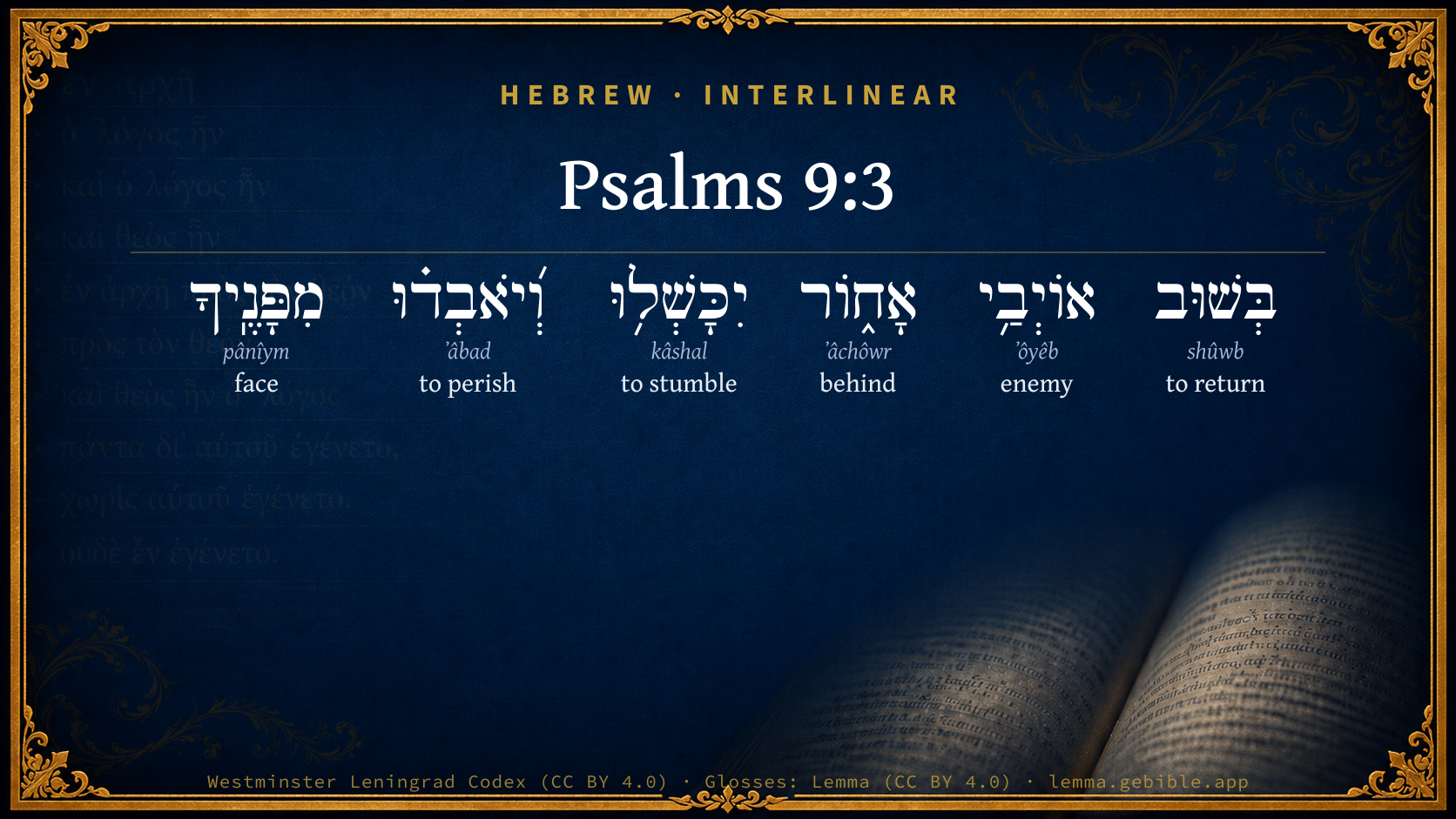
Psalms 9:3

Hebrew (Westminster Leningrad Codex) Psalms 9:3 appears in the Hebrew Old Testament. The text above is from the Westminster Leningrad Codex. Each word links to its Strong’s number, a concise gloss, and parsing drawn from the Open Scriptures Hebrew Bible morphology. Click any word for its full Brown-Driver-Briggs (BDB) entry.
Download image
Cite this verse

Psalms 9:3 (World English Bible). Public Domain. Lemma interlinear Bible study tool, https://lemma.gebible.app/v/psalms/9/3.

Show BibTeX & RIS
BibTeX
RIS
English Translation
When my enemies turn back, They stumble and perish in your presence.
World English Bible · Public Domain
Download a study sheet

One document with this verse’s original text, its word-by-word gloss line, the meaning frame, cross-references with their text, attributed commentary, and full source and license credits — printable, and it pastes into notes with its structure intact.

This verse Autodidact and up

Study sheet (.html) Plain text (.txt)

A passage Seminary Student

Up to 50 verses in one chapter. A passage sheet keeps up to 6 commentary sources and 12 cross-references per verse, in the order this page ranks them, and says so on the sheet whenever that leaves anything out. Ask for a single verse and you get the Autodidact verse sheet above.

Everything on this page stays free to read, with no account — the sheet is a download of what is already on screen, not access to it.

Want to remove ads? Support Godless Engineer
Compare translations 3

The same verse in 3 English versions, stacked beneath the original-language interlinear above. Click any original word for its lexicon entry.

Each is an independent rendering of the whole verse — the interlinear is not word-aligned to these translations.

Highlighted words mark where these versions differ — a whole-verse word diff, not a word-by-word alignment.

  • World English Bible Public Domain
    When my enemies turn back, They stumble and perish in your presence.
  • King James Version Public Domain
    When mine enemies are turned back, they shall fall and perish at thy presence.
  • unfoldingWord Literal Text CC BY-SA 4.0
    When my enemies turn back, they stumble and perish from your face.

unfoldingWord Literal Text — © unfoldingWord, licensed CC BY-SA 4.0. Word-aligned USFM3 via Door43 (git.door43.org/unfoldingWord/en_ult).

Versions to compare (up to 4)

3 of 4 selected

Show all 18 translations

Every available English version of this verse, each an independent rendering of the whole verse.

  • World English Bible Public Domain
    When my enemies turn back, They stumble and perish in your presence.
  • Berean Standard Bible Public Domain
    When my enemies retreat, they stumble and perish before You.
  • Majority Standard Bible Public Domain
    When my enemies retreat, they stumble and perish before You.
  • King James Version Public Domain
    When mine enemies are turned back, they shall fall and perish at thy presence.
  • American Standard Version (1901) Public Domain
    When mine enemies turn back, They stumble and perish at thy presence.
  • Revised Version (1885) Public Domain
    When mine enemies turn back, they stumble and perish at thy presence.
  • Geneva Bible (1599) Public Domain
    For that mine enemies are turned backe: they shall fall, and perish at thy presence.
  • Douay-Rheims (1899) Public Domain
    I will be glad and rejoice in thee: I will sing to thy name, O thou most high.
  • Young's Literal Translation Public Domain
    In mine enemies turning backward, they stumble and perish from Thy face.
  • Literal Standard Version CC BY-SA 4.0
    In my enemies turning backward, || They stumble and perish from Your face.
  • Unlocked Literal Bible CC BY-SA 4.0
    When my enemies turn back, they stumble and perish before you.
  • unfoldingWord Literal Text CC BY-SA 4.0
    When my enemies turn back, they stumble and perish from your face.
  • Darby Bible Public Domain
    When mine enemies turned back, they stumbled and perished at thy presence:
  • World Messianic Bible Public Domain
    When my enemies turn back, they stumble and perish in your presence.
  • Webster's Bible Public Domain
    \\9:2\\I will be glad and rejoice in thee: I will sing praise to thy name, O thou most High.
  • Free Bible Version CC BY-SA 4.0
    Those who hate me retreat; they fall back and die when you confront them.
  • Bible in Basic English Public Domain
    When my haters are turned back, they will be broken and overcome before you.
  • JPS Tanakh (1917) Public Domain
    (9-4) When mine enemies are turned back, they stumble and perish at Thy presence;

Literal Standard Version (2020), Covenant Press — licensed CC BY-SA 4.0. Text via the HelloAO Bible API (eBible.org). Unlocked Literal Bible (unfoldingWord) — licensed CC BY-SA 4.0. Text via the HelloAO Bible API (eBible.org). unfoldingWord Literal Text — © unfoldingWord, licensed CC BY-SA 4.0. Word-aligned USFM3 via Door43 (git.door43.org/unfoldingWord/en_ult). Free Bible Version, Dr. Jonathan Gallagher — licensed CC BY-SA 4.0. Text via the HelloAO Bible API (eBible.org).

Word by word

More ways to search: Search by grammar → Find every occurrence → Compare this word →

Practice this passage: Drill this verse → Learn its vocabulary →

About this verse

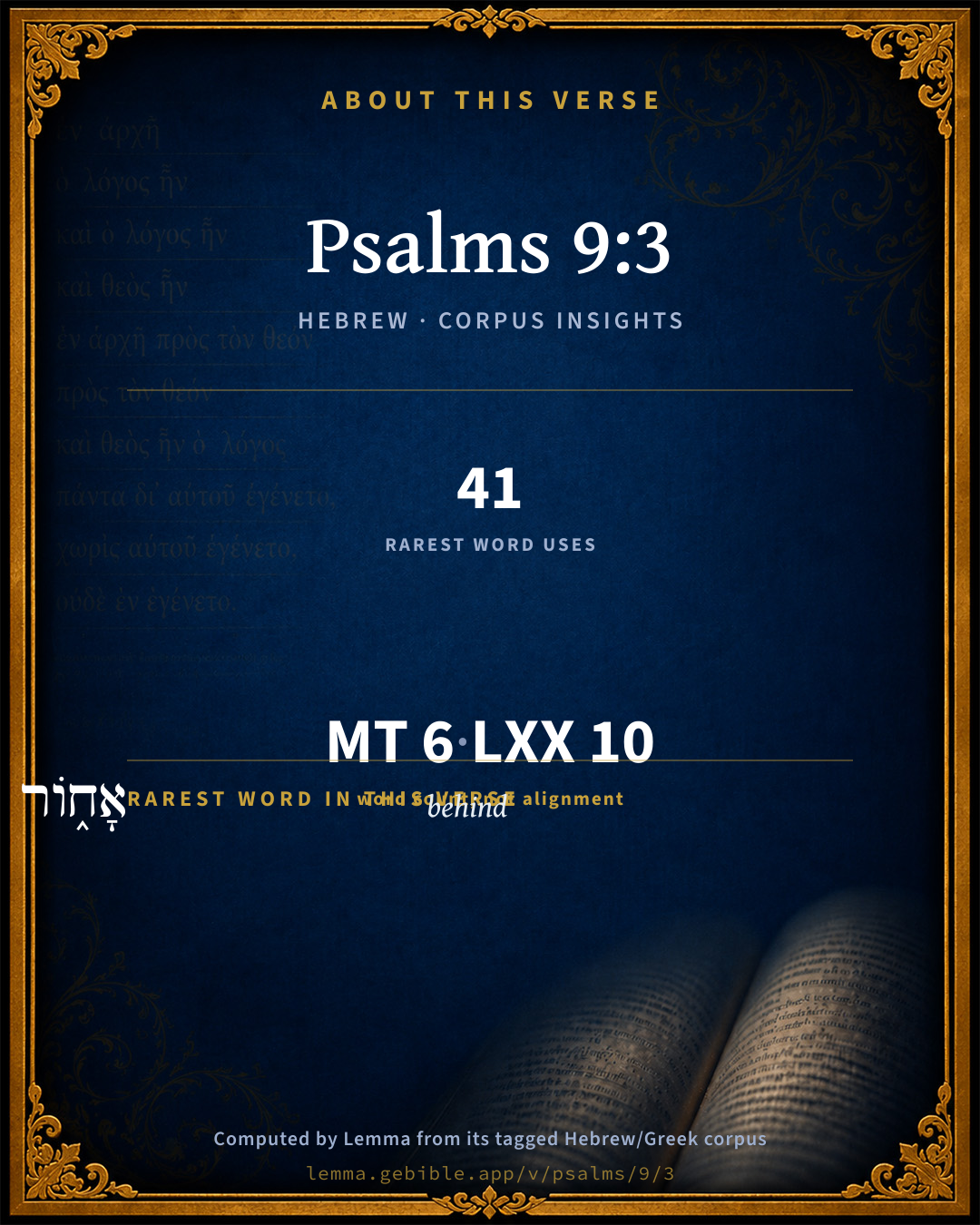
These counts appear in no published source. They are computed here, from the morphology-tagged text and Lemma’s own curated glosses. What Lemma adds →

6
words
6
distinct lemmas
Wisdom
section

Shared distinctive vocabulary

אָח֑וֹר behind H268 occurs in 41 verses of the Hebrew Bible. Also found in:

Grammatical profile

  • 4 verbs
  • 2 nouns

Verb forms

  • בְּשׁוּב Qal · Infinitive Construct
  • אוֹיְבַ֥י Qal · Participle Active
  • יִכָּשְׁל֥וּ Niphal · Imperfect
  • וְ֝יֹאבְד֗וּ Qal · Imperfect

Hebrew & Septuagint length

In English translation the verse runs 12 words from the Hebrew and 15 from the Septuagint (LXX English) — closely comparable.

A rough comparison of the two English renderings, which tokenize alike — not a word-level alignment.

Word counts can differ between the Hebrew and the Greek without any difference in meaning — e.g. the Hebrew direct-object marker אֵת has no separate Greek word, and Greek often adds the article ὁ.

In the original languages it is 6 Hebrew tokens and 10 Greek tokens — but the two are counted differently (Hebrew bundles its prefixes and suffixes into one token; the Greek is in lemma form), so that isn’t a like-for-like length.

Cross-references

7

Topical passages linked to Psalms 9:3 in the Treasury of Scripture Knowledge — connected by theme and wording, ordered by reader-vote popularity; previews shown in the World English Bible.

  • 2 Thessalonians 1:9 who will pay the penalty: eternal destruction from the face of the Lord and from the glory of his might,
  • Psalms 76:7 You, even you, are to be feared. Who can stand in your sight when you are angry?
  • Psalms 80:16 It's burned with fire. It's cut down. They perish at your rebuke.
  • Revelation 6:12–17 I saw when he opened the sixth seal, and there was a great earthquake. The sun became black as sackcloth made of hair, and the whole moon became as blood.
  • Revelation 20:11 I saw a great white throne, and him who sat on it, from whose face the earth and the heaven fled away. There was found no place for them.
  • Psalms 68:1–2 Let God arise! Let his enemies be scattered! Let them who hate him also flee before him.
  • Isaiah 64:3 When you did terrible things which we didn't look for, you came down, the mountains quaked at your presence.

Cross-references courtesy of OpenBible.info (CC BY 4.0).

Hebrew and Greek witnesses Masoretic Hebrew ↔ Greek Septuagint

The same verse in the two great witnesses to the Old Testament, shown verse-for-verse.

You’re reading Greek Psalm 9 (Hebrew Psalm 9). The Septuagint counts the superscription, so verse numbers can differ from the Hebrew — chapter-level alignment, not verse-by-verse. Numbering follows Rahlfs.

These are two independent witnesses, not word-aligned to each other, and the Septuagint is shown in lemma (dictionary) form.

Hebrew Psalms 9:3 Masoretic · Westminster Leningrad Codex

בְּשׁוּב אוֹיְבַ֥י אָח֑וֹר יִכָּשְׁל֥וּ וְ֝יֹאבְד֗וּ מִפָּנֶֽיךָ

When my enemies turn back, They stumble and perish in your presence.

World English Bible · Public Domain

Greek LXX Greek Psalm 9:3 Septuagint · lemma form

εὐφραίνω καί ἀγαλλιάομαι ἐν σύ ψάλλω ὁ ὄνομα σύ ὕψιστος

When my enemies are turned back, they shall be feeble and perish at your presence.

LXX2012 (modern English Septuagint) · Public Domain

On this verse, Ellicott's Commentary for English Readers discusses the Septuagint’s reading. Read the note in Commentary ↓

Hebrew: Westminster Leningrad Codex (CC BY 4.0). Greek: Septuagint (public domain); English from LXX2012 (modern English Septuagint) (Public Domain). How the Septuagint differs from the Hebrew →

Commentary

Notes on Psalms 9:3 from classic Christian and Jewish commentators (each source and its license shown beneath its notes). The classic Christian expositions comment on the surrounding passage and are grouped to its opening verse, so a note may address several verses; the Jewish commentaries on the Tanakh (Rashi and others) are per-verse, so they appear only where the commentator wrote on this verse.

Lemma curates 59 commentaries, every one of them public domain or Creative Commons licensed, each selected and text-cleaned for this edition rather than reprinted as found. About our sources →

The Cambridge Bible for Schools and Colleges

gen. ed. J. J. S. Perowne

3, 4. Stanza of Beth. It is best to place a semicolon only at the end of Psa_9:2, and render Psa_9:3 in close connexion with it:

Because mine enemies turn back,

Stumble and perish at Thy presence.

The ‘presence’ or ‘face’ of God is to His enemies necessarily a manifestation of victorious wrath. Comp. Psa_21:9 (R.V. marg.); Psa_34:16; Exo_14:24. The verse is a vivid picture of a panic rout: the foe turning to flee, stumbling in their precipitate haste, overtaken and annihilated. Cp. Psa_35:5-6.

The Cambridge Bible for Schools and Colleges (gen. ed. J. J. S. Perowne; Cambridge University Press, 1878–1918) — public domain. Text from a community e-Sword module.

Trapp's Complete Commentary

John Trapp

Psa 9:3 When mine enemies are turned back, they shall fall and perish at thy presence.

Ver. 3. When mine enemies] This, Tremellius maketh to be the form of praise which the psalmist professeth that he will sing to God, and rendereth it thus, That mine enemies returning back are fallen, &c.

And perish at thy presence] The victory is of God, and to him alone to be ascribed. The Romans in their triumphs presented a palm to Jupiter. The Grecians also thankfully ascribed to Jupiter their deliverance from the Persians, wrought by Themistocles, and there hence called him ελευθεριος, that is, deliverer.

John Trapp, A Commentary or Exposition upon All the Books of the Old and New Testament (1647–1656) — public domain. Text from a community e-Sword module.

Joseph Benson's Commentary

Psa 9:3. When mine enemies are turned back — Discomfited and put to flight; they shall fall and perish — They shall not save themselves by flight and so reserve themselves to do farther mischief but shall stumble, as it were, at the obstacles and impediments laid by thee in their way, and shall be pursued, overtaken, and cut off; at thy presence — Upon thy appearing against them. One angry look of thine is sufficient to confound and destroy them. Hebrew, מפניךְ, mippaneicha, from thy face; they could not stand before thee, because thou didst march at the head of our armies against them. So he ascribes the honour of his victories to God only, and to his presence and assistance.

Joseph Benson's Commentary on the Old and New Testaments (1811–1818) — public domain. Text from a community e-Sword module.

J. A. Alexander on Psalms

Joseph Addison Alexander

4. (Psa 9:3). In the turning of my enemies back, i. e. from their assault on me, which is equivalent to saying, in their retreat, their defeat, their disappointment. This may either be connected with what goes before, and understood as a statement of the reason or occasion of the praise there promised: "I will celebrate thy name when (or because) my enemies turn back;" or it may begin a new sentence, and ascribe their defeat to the agency of God himself: "When my enemies turn back (it is because) they are to stumble, and perish from thy presence, from before thee, or at thy presence, i.e. as soon as thou appearest." The Hebrew preposition has both a causative and local meaning. The form of the verbs does not necessarily imply that the deliverance acknowledged was still future, but only that it might occur again, and that in any such case, whether past or yet to come, Jehovah was and would be the true author of the victory achieved. The act of stumbling implies that of falling as its natural consequence, and is often used in Scripture as a figure for complete and ruinous failure.

Joseph Addison Alexander, The Psalms Translated and Explained (1850) — public domain. Text from a community e-Sword module.

Tyndale Open Study Notes

Tyndale Open Resources

9:3-6 The psalmist celebrates God’s judgment of the wicked, which is a testimony to the Lord’s reliable promise to establish his kingdom on earth (1:6; Ps 2).

9:3 retreated . . . staggered: The Lord overpowers even powerful enemies (see 27:2). Israel also experienced judgment when it resisted the Lord (107:12).

Tyndale Open Study Notes — © Tyndale Open Resources, licensed CC BY-SA 4.0. Text via the HelloAO Bible API.

Jamieson, Fausset & Brown

Robert Jamieson, A. R. Fausset & David Brown

When . . . are turned back--It is the result of God's power alone. He, as a righteous Judge (Psa 7:11), vindicates His people. He rebukes by acts as well as words (Psa 6:1; Psa 18:15), and so effectually as to destroy the names of nations as well as persons.

Jamieson, Fausset & Brown — Commentary Critical and Explanatory on the Whole Bible (1871) — public domain (CC PDM 1.0). Text via the HelloAO Bible API.

Adam Clarke's Commentary

Verse 3. When mine enemies are turned back] It is a sure sign of a nearly approaching complete conquest over sin, when, by resistance to its influences, it begins to lose its power. That is the time to follow on to know the Lord.

Adam Clarke's Commentary on the Bible (1810–1826) — public domain. Text from a community e-Sword/MySword module.

John Calvin's Commentaries

3. While my enemies are turned back. In these words he assigns the reason why he undertakes to sing the praises of God, namely, because he acknowledges that his frequent victories had been achieved, not by his own power, nor by the power of his soldiers, but by the free favor of God. In the first part of the verse he narrates historically how his enemies were discomfited or put to flight; and then he adds, what faith alone could enable him to say, that this did not take place by the power of man or by chance, but because God fought for him, “Mais pource que Dieu a battacile pour luy. — Fr.

The idea implied in the verb כשל, cashal, is that of stumbling, and it is here employed in a military sense. In Psalm 27:2, where it is said of David’s enemies, “they stumbled and fell;” this is the verb used for stumbled. The idea there is not properly that of falling, but of being wounded and weakened by the stumbling-blocks in the way, previous to falling. The word כשל, cashal, has been viewed as having the same meaning in the passage before us. “It refers,” says Hammond, “to those that either faint in a march or are wounded in a battle, or especially that in flight meet with galling traps in their way, and so are galled and lamed, rendered unable to go forward, and so fall, and become liable to all the ill chances of pursuits, and as here are overtaken and perish in the fall.”

“C’est la face de Dieu qui les poursuit.” — Fr. “It is the face of God which pursues them.”

John Calvin's Commentaries (1540-1563) — public domain. Text from the Calvin Translation Society English edition (1840s-50s) via the Christian Classics Ethereal Library (ccel.org). Calvin's coverage is partial (roughly two-thirds of the Bible); uncommented books and verses are honest gaps, never fabricated. The 19th-century editor's footnotes and remarks are omitted so the notes are faithfully Calvin's own voice.

Ellicott's Commentary for English Readers

(3) When.—Literally, in the turning of mine enemies back, which may be either when they turned, or because they turned, or possibly with both ideas combined. The older versions have when. Psa_9:2-3 form one sentence, “I will be glad and rejoice in thee . . . when mine enemies are turned back, (when) they fall and perish at thy presence.”

Fall.—Better, stumble through weakness. So the LXX., “are weak.”

A Bible Commentary for English Readers, edited by Charles John Ellicott (1878–1897) — public domain. Text from a community e-Sword module.

John Gill's Exposition

When mine enemies are turned back,.... As the Philistines were, when Goliath their champion was dead; and as the men that came to apprehend Christ, David's antitype, went backwards and fell to the ground, through the superior power of Christ; and as sin, Satan, and the world, and at last antichrist, are made to retreat from the Lord's people, who are more than conquerors over them through Christ that has loved them. "They shall fall and perish at thy presence"; they shall stumble at one thing or another which divine Providence will throw in their way to hinder them from executing their designs, and so fall before them they meant to destroy, and perish at the presence of God as wax melteth before the fire; see Psa 27:2; so antichrist shall be consumed with the breath of Christ's mouth, and the brightness of his coming, Th2 2:8; and this is the ground and foundation of the psalmist's joy, and rejoicing, and singing praise to God as it will be the reason of the joy of saints in the latter day, Rev 18:22.

.

Psalms 9:4

psa 9:4

psa 9:4

psa 9:4For thou hast maintained my right and my cause,.... Or vindicated and established his righteous cause; God had pleaded and defended it, and by the flight, fall, and ruin of his enemies, had clearly made it appear that his cause was just and good;

thou sittest in the throne judging right; God has not only a throne of grace on which he sits, and from whence he distributes grace and mercy to his people, but he has a throne of judgment, and which is prepared for it, as in Psa 9:7; where he sits as the Judge of all the earth, and will do right; nor can he do otherwise, though his judgments are not always manifest in the present state of things; and the vindication of the psalmist's innocence and uprightness is another reason of his joy and gladness.

John Gill's Exposition of the Whole Bible (1746–1763) — public domain (CC PDM 1.0). Text via the HelloAO Bible API.

Albert Barnes' Notes on the Bible

When mine enemies are turned back - Who these enemies were, the psalmist does not say. It is clear, however, as was remarked in the introduction, that the psalm was composed:

(a) in view of a victory which had been achieved over some formidable enemies; and

(b) in view of some dangers still impending from a similar source.

The literal meaning of the passage here is, “In the turning of my enemies back;” that is, in their retreat, defeat, overthrow. So far as the Hebrew form of expression is concerned, this may either refer to what had been done, or to what would be; and may imply either that they had been turned back, or that the psalmist hoped and believed that they would be; for in either case the fact would show the divine perfections, and give occasion for gratitude and praise. The verbs with which this is connected - “they shall fall and perish” - are indeed in the Hebrew, as in our version, in the future tense; but this does not necessarily determine the question whether the psalmist refers to what had occurred or what would occur. His attitude is this: he contemplates his enemies as mighty and formidable; he sees the danger which exists when such enemies surround one; he looks at the interposition of God, and he sees that whenever it occurs it would be followed by this consequence, that they would stumble and fall before him. But while this verse does not determine the question whether he refers to what has been, or to what would be, the subsequent verses Psa 9:4-6 seem to settle it, where he speaks as if this were already done, and as if God had interposed in a remarkable manner in defeating his foes. I regard this, therefore, as a reflection on what had occurred, and as expressing what was then actually a ground of praise and thanksgiving.

They shall fall and perish - A general statement in view of what had occurred, meaning that this would always be the case.

At thy presence - Before thee; that is, when thou dost manifest thyself. This was the reason why they would stumble and fall, and is equivalent to saying, that “whenever mine enemies are turned back, the reason why they stumble and fall is “thy presence.” It is the interposition of thy power. It is not to be traced to the prowess of man that they thus turn back, and that they fall and perish; it is to be traced to the fact that thou art present - that thou dost interpose.” It is thus an acknowledgment of God as the author of the victory in all cases.

Albert Barnes' Notes on the Bible (1834–1885) — public domain. Text from a community e-Sword/MySword module.

Matthew Poole's English Annotations

When they are discomfited and put to flight, they shall not save themselves by flight, and reserve themselves to do further mischief, but shall stumble as it were at gall-traps by thee laid in their way, and shall be pursued, and overtaken, and cut off, upon thy appearance against them. One angry look of thine is able to confound and destroy them. Heb. from thy face, because thou didst march in the head of our armies, and against them. They could not stand before thee. So he ascribes the honour of his victories to God only, and to his presence and assistance.

Matthew Poole's English Annotations on the Holy Bible (1683–1685) — public domain. Text from a community e-Sword/MySword module.

The Treasury of David

Charles H. Spurgeon

Ver. 3. God's presence is evermore sufficient to work the defeat of our most furious foes, and their ruin is so complete when the Lord takes them in hand, that even flight cannot save them, they fall to rise no more when he pursues them. We must be careful, like David, to give all the glory to him whose presence gives the victory. If we have here the exultings of our conquering Captain, let us make the triumphs of the Redeemer the triumphs of the redeemed, and rejoice with him at the total discomfiture of all his foes.

Ver. 3. When mine enemies are turned back, etc. Were turned back, repulsed, and put to flight. To render this in the present time, as our translators did, is certainly improper; it destroys the coherence, and introduces obscurity. Ainsworth saw this, and rendered in the past, "When mine enemies turned backward." "At thy presence." That is, by thine anger. For as God's presence or face denotes his favour to such as fear and serve him, so it denotes his anger towards the wicked. "The face of Jehovah is against them that do evil." B. Boothroyd, 1824.

Ver. 3. They shall fall and perish. It refers to those that either faint in a march, or are wounded in a battle, or especially that in flight meet with galling haps in their way, and so are galled and lamed, rendered unable to go forward, and so fall, and become liable to all the chances of pursuits, and as here, are overtaken and perish in the fall. Henry Hammond, D.D.

None.

Charles H. Spurgeon's The Treasury of David (1869–1885) — public domain. Psalms only. Text from a community e-Sword/MySword module.

Whedon's Commentary on the Bible

Daniel D. Whedon

3-6. A graphic description of the desolating effect of the war.

When mine enemies are turned back—Or, because “mine enemies are turned back.” The preposition may denote both time (when) and reason (because.)

Perish at thy presence—Literally, at thy appearance, or, at thy face. God appeared, or looked on them, and they retreated backward, stumbled, and perished. See Exo_14:24.

For thou—Because thou hast executed my judgment and my cause. The language in Psa_9:4-5 is strictly juridical.

O thou enemy—Rather read this line, the enemy are perished, [they are] perpetual desolations.

Cities… their memorial is perished—The very names of the cities are forgotten, so complete is their ruin. David’s second Syrian war extended from Ammon in Arabia to Helam in Syria, a distance of about three hundred miles, and probably in no district in the world, of equal extent, are there at this day more ruins of ancient cities whose very names have perished, than in this.

Thou… destroyed cities— “Thou,” here, refers not to his enemies, but to God, as in Psa_9:4-5. God alone is the dispenser of these judgments, and this blotting out of cities and peoples is the threatened doom of his enemies. Exo_17:14; Deu_25:19

Daniel D. Whedon (gen. ed.), Commentary on the Old and New Testaments (1874–1909) — public domain. Text from a community e-Sword module.

The Pulpit Commentary

When mine enemies are turned back; or, because mine enemies are turned back ("Speaker"s Commentary"); i.e. made to retreat, repulsed, driven before me in hasty flight. They shall fall and perish at thy presence; or, they stumble and perish, etc. The psalmist represents the enemy, poetically, "as if they had been thrown to the ground by the glance of God"s fiery countenance" (Hengstenberg).

The Pulpit Commentary (1880–1919), ed. H.D.M. Spence-Jones & Joseph S. Exell — public domain. Text from a community e-Sword module.

John Wesley's Explanatory Notes

Turned back - Put to flight.

John Wesley, Explanatory Notes Upon the Whole Bible (1754–1765) — public domain. Text via the GEBible commentary corpus.

Keil & Delitzsch

C. F. Keil & F. Delitzsch

(Heb.: 9:4-5) The call upon himself to thanksgiving sounds forth, and the ב-strophe continues it by expressing the ground of it. The preposition בּ in this instance expresses both the time and the reason together (as in Psa 76:10; Ch2 28:6); in Latin it is recedentibus hostibus meis retro. אחור serves to strengthen the notion of being driven back, as in Psa 56:10, cf. Psa 44:11; and just as, in Latin, verbs compounded of re are strengthened by retro. In Psa 9:4 finite verbs take the place of the infinitive construct; here we have futt. with a present signification, just as in Ch2 16:7 we find a praet. intended as perfect. For the rendering which Hitzig adopts: When mine enemies retreat backwards, they stumble... is opposed both by the absence of any syntactic indication in Psa 9:4 of an apodosis (cf. Psa 27:2); and also by the fact that יכּשׁלוּ is well adapted to be a continuation of the description of שׁוּב אחור (cf. Joh 18:6), but is tame as a principal clause to the definitive clause בשוב אויבי אחור. Moreover, אחור does not signify backwards (which would rather be אחרנּית Gen 9:23; Sa1 4:18), but back, or into the rear. The מן of מפּניך is the מן of the cause, whence the action proceeds. What is intended is God's angry countenance, the look of which sets his enemies on fire as if they were fuel (Psa 21:10), in antithesis to God's countenance as beaming with the light of His love. Now, while this is taking place, and because of its taking place, will be sing praise to God. From Psa 9:2 we see that the Psalm is composed directly after the victory and while the destructive consequences of it to the vanquished are still in operation. David sees in it all an act of Jahve's judicial power. To execute any one's right, משׁפּט (Mic 7:9), to bring to an issue any one's suit or lawful demand, דּין (Psa 140:13), is equivalent to: to assist him and his good cause in securing their right. The phrases are also used in a judicial sense without the suffix. The genitive object after these principal words never denotes the person against whom, but the person on whose behalf, the third party steps forward with his judicial authority. Jahve has seated Himself upon His judgment-seat as a judge of righteousness (as in Jer 11:20), i.e., as a judge whose judicial mode of procedure is righteousness, justice,

(Note: Also Pro 8:16 is probably to be read צדק כּל־שׁכּטי, with Norzi, according to the Targum, Syriac version, and old Codices; at any rate this is an old various reading, and one in accordance with the sense, side by side with כל־שׁפטי ארץ.)

and has decided in his favour. In ישׁב ל (as in Psa 132:11), which is distinguished in this respect from ישׁב על (Psa 47:9), the idea of motion, considere, comes prominently forward.

Keil & Delitzsch — Biblical Commentary on the Old Testament (1861–1891) — public domain (CC PDM 1.0). Text via the HelloAO Bible API. (Old Testament only.)

unfoldingWord translationNotes

Door43 World Missions Community

turn back

"retreat" or "flee in fear"

you sit on your throne, a righteous judge

Kings had authority to judge people, and they would sit on their throne when they judged. David speaks as if God were an earthly king. AT: "you judge like a king who sits on his throne, and you are righteous" (See: Metonymy)

translationWords

perish

just

throne

righteous

judge

unfoldingWord translationNotes — © Distant Shores Media and the Door43 World Missions Community, licensed CC BY-SA 4.0. Source: git.door43.org/Door43/en_tn.

Radak

Rabbi David Kimhi (Radak)

I will be glad and exult in Thee: – for in Thee I trusted when I came to the fight with him, though I was a youth and he a man of war.

I will sing to Thy Name, Thou Most High: – for Thou art exalted above all, and vain is the might of man.

Radak on the Tanakh — English translations: “Sefaria Community Translation” (CC0 1.0 (public-domain dedication)); “Eliyahu Munk, HaChut Hameshulash” (CC BY 4.0); “Rabbi Mike Feuer, Jerusalem Anthology” (CC BY 4.0); and “R. David Kimhi on the first book of Psalms, Translated by R.G. Finch, London, 1919” (public domain). Text via Sefaria.

Lesson kit

Teaching starters — assembled from the data on this page, not authored interpretation. Every prompt links to the verse data it draws on. Edit before teaching.

Psalms, in the Wisdom, opens this verse with 6 words (6 distinct Hebrew lemmas). Its most distinctive word is ʼâchôwr (“behind”). A historical commentator’s framing appears above. Read the whole chapter for the surrounding context.

Discussion questions

  1. The word ʼâchôwr carries the sense “behind.” How does it shape the verse?
  2. Genesis 49:17 shares the word «behind» with this verse. How do the two illuminate each other?
  3. These translations render this verse differently; the difference is in the English rendering, not the original. What questions does that raise?
  4. The verb «בְּשׁוּב» is Qal Infinitive Construct. How does its form color the action?
  5. Reading how The Cambridge Bible for Schools and Colleges and Trapp's Complete Commentary read this verse, where do the two commentators agree and where do they part?

Things to notice

Reading settings

Reading text

Shown beneath each verse's original-language words.

Old Testament
Old Testament edition

Read the OT as the Masoretic Hebrew (MT) or the Greek Septuagint (LXX).

English shown for the Greek Septuagint (in the Hebrew ↔ Greek comparison).

Comparing translations? Open the Compare panel on any verse page to stack up to four side by side.