
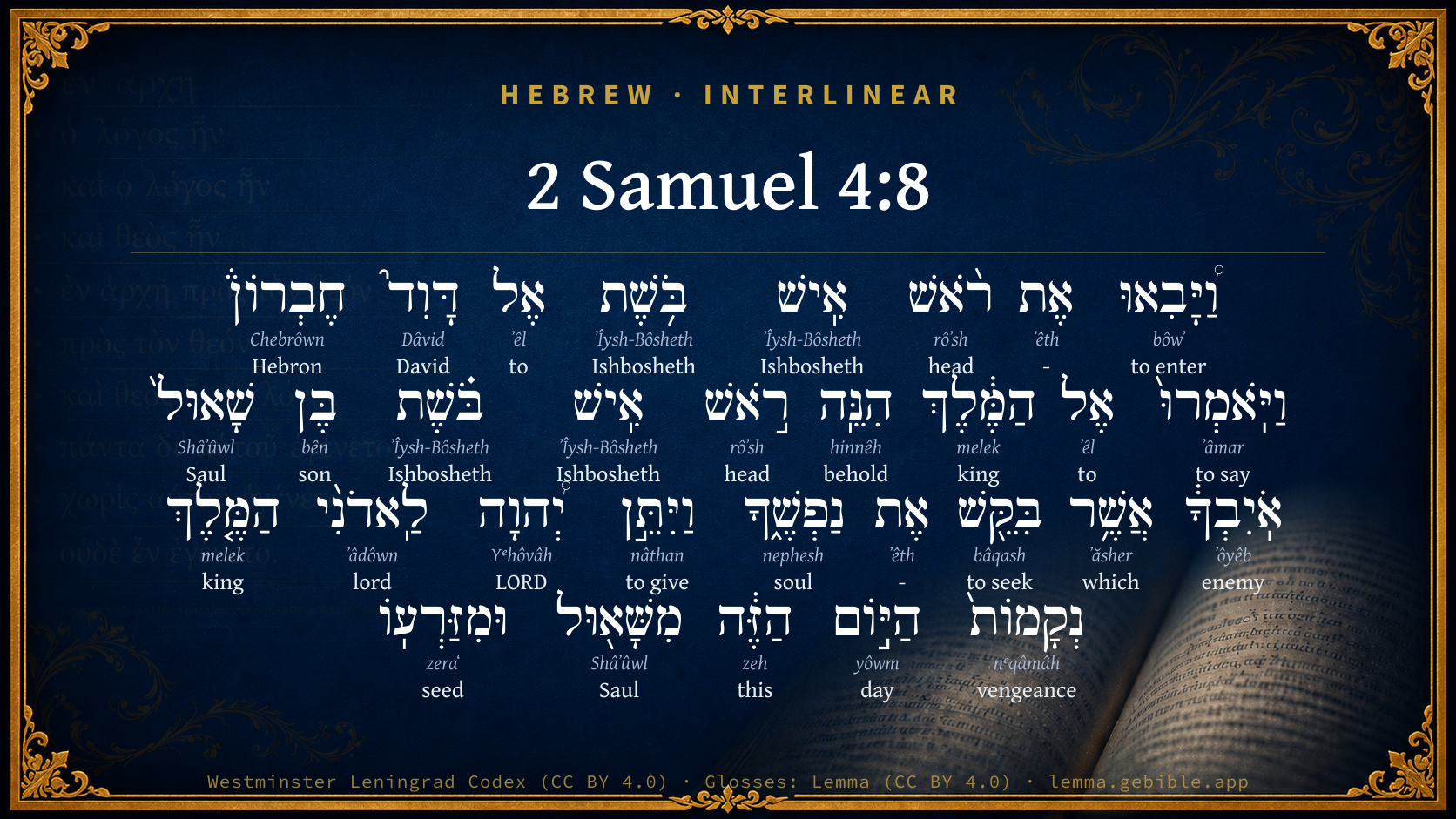
2 Samuel 4:8

Hebrew (Westminster Leningrad Codex) 2 Samuel 4:8 appears in the Hebrew Old Testament. The text above is from the Westminster Leningrad Codex. Each word links to its Strong’s number, a concise gloss, and parsing drawn from the Open Scriptures Hebrew Bible morphology. Click any word for its full Brown-Driver-Briggs (BDB) entry.
Download image
Cite this verse

2 Samuel 4:8 (World English Bible). Public Domain. Lemma interlinear Bible study tool, https://lemma.gebible.app/v/2-samuel/4/8.

Show BibTeX & RIS
BibTeX
RIS
English Translation
They brought the head of Ish-bosheth to David to Hebron, and said to the king, Behold, the head of Ish-bosheth, the son of Saul, your enemy, who sought your life; and Yahweh has avenged my lord the king this day of Saul, and of his seed.
World English Bible · Public Domain
Download a study sheet

One document with this verse’s original text, its word-by-word gloss line, the meaning frame, cross-references with their text, attributed commentary, and full source and license credits — printable, and it pastes into notes with its structure intact.

This verse Autodidact and up

Study sheet (.html) Plain text (.txt)

A passage Seminary Student

Up to 50 verses in one chapter. A passage sheet keeps up to 6 commentary sources and 12 cross-references per verse, in the order this page ranks them, and says so on the sheet whenever that leaves anything out. Ask for a single verse and you get the Autodidact verse sheet above.

Everything on this page stays free to read, with no account — the sheet is a download of what is already on screen, not access to it.

Want to remove ads? Support Godless Engineer
Compare translations 3

The same verse in 3 English versions, stacked beneath the original-language interlinear above. Click any original word for its lexicon entry.

Each is an independent rendering of the whole verse — the interlinear is not word-aligned to these translations.

Highlighted words mark where these versions differ — a whole-verse word diff, not a word-by-word alignment.

  • World English Bible Public Domain
    They brought the head of Ish-bosheth to David to Hebron, and said to the king, Behold, the head of Ish-bosheth, the son of Saul, your enemy, who sought your life; and Yahweh has avenged my lord the king this day of Saul, and of his seed.
  • King James Version Public Domain
    And they brought the head of Ishbosheth unto David to Hebron, and said to the king, Behold the head of Ishbosheth the son of Saul thine enemy, which sought thy life; and the LORD hath avenged my lord the king this day of Saul, and of his seed.
  • unfoldingWord Literal Text CC BY-SA 4.0
    And they brought the head of Ish Bosheth to David Hebron, and they said to the king, “Behold, the head of Ish Bosheth, the son of Saul, your enemy who sought your life. Now Yahweh has given to my lord the king vengeance this day against Saul and against his seed.”

unfoldingWord Literal Text — © unfoldingWord, licensed CC BY-SA 4.0. Word-aligned USFM3 via Door43 (git.door43.org/unfoldingWord/en_ult).

Versions to compare (up to 4)

3 of 4 selected

Show all 18 translations

Every available English version of this verse, each an independent rendering of the whole verse.

  • World English Bible Public Domain
    They brought the head of Ish-bosheth to David to Hebron, and said to the king, Behold, the head of Ish-bosheth, the son of Saul, your enemy, who sought your life; and Yahweh has avenged my lord the king this day of Saul, and of his seed.
  • Berean Standard Bible Public Domain
    They brought the head of Ish-bosheth to David at Hebron and said to the king, “Here is the head of Ish-bosheth son of Saul, your enemy who sought your life. Today the LORD has granted vengeance to my lord the king against Saul and his offspring.”
  • Majority Standard Bible Public Domain
    They brought the head of Ish-bosheth to David at Hebron and said to the king, “Here is the head of Ish-bosheth son of Saul, your enemy who sought your life. Today the LORD has granted vengeance to my lord the king against Saul and his offspring.”
  • King James Version Public Domain
    And they brought the head of Ishbosheth unto David to Hebron, and said to the king, Behold the head of Ishbosheth the son of Saul thine enemy, which sought thy life; and the LORD hath avenged my lord the king this day of Saul, and of his seed.
  • American Standard Version (1901) Public Domain
    And they brought the head of Ish-bosheth unto David to Hebron, and said to the king, Behold, the head of Ish-bosheth, the son of Saul, thine enemy, who sought thy life; and Jehovah hath avenged my lord the king this day of Saul, and of his seed.
  • Revised Version (1885) Public Domain
    And they brought the head of Ish-bosheth unto David to Hebron, and said to the king, Behold the head of Ish-bosheth the son of Saul thine enemy, which sought thy life; and the LORD hath avenged my lord the king this day of Saul, and of his seed.
  • Geneva Bible (1599) Public Domain
    And they brought the head of Ish-bosheth vnto Dauid to Hebron, and saide to the King, Beholde the head of Ish-bosheth Sauls sonne thine enemie, who sought after thy life: and the Lord hath auenged my lorde the King this day of Saul, and of his seede.
  • Douay-Rheims (1899) Public Domain
    And they brought the head of Isboseth to David to Hebron: and they said to the king: Behold the head of Isboseth the son of Saul thy enemy who sought thy life: and the Lord hath revenged my lord the king this day of Saul, and of his seed.
  • Young's Literal Translation Public Domain
    and bring in the head of Ish-Bosheth unto David in Hebron, and say unto the king, `Lo, the head of Ish-Bosheth, son of Saul, thine enemy, who sought thy life; and Jehovah doth give to my lord the king vengeance this day, of Saul and of his seed.'
  • Literal Standard Version CC BY-SA 4.0
    and bring in the head of Ish-Bosheth to David in Hebron, and say to the king, “Behold, the head of Ish-Bosheth, son of Saul, your enemy, who sought your life; and YHWH gives vengeance to my lord the king this day, of Saul and of his seed.”
  • Unlocked Literal Bible CC BY-SA 4.0
    They brought the head of Ishbosheth to David at Hebron, and they said to the king, “Look, this is the head of Ishbosheth son of Saul, your enemy, who sought your life. Today Yahweh has avenged our master the king against Saul and his descendants.”
  • unfoldingWord Literal Text CC BY-SA 4.0
    And they brought the head of Ish Bosheth to David Hebron, and they said to the king, “Behold, the head of Ish Bosheth, the son of Saul, your enemy who sought your life. Now Yahweh has given to my lord the king vengeance this day against Saul and against his seed.”
  • Darby Bible Public Domain
    And they brought the head of Ishbosheth to David in Hebron, and said to the king, Behold the head of Ishbosheth the son of Saul, thine enemy who sought thy life; and Jehovah has given to my lord the king to be avenged this day of Saul and of his seed.
  • World Messianic Bible Public Domain
    They brought the head of Ishbosheth to David to Hebron, and said to the king, “Behold, the head of Ishbosheth, the son of Saul, your enemy, who sought your life! The LORD has avenged my lord the king today of Saul and of his offspring. ”
  • Webster's Bible Public Domain
    And they brought the head of Ish-bosheth to David to Hebron, and said to the king, Behold the head of Ish-bosheth the son of Saul thy enemy, who sought thy life; and the LORD hath avenged my lord the king this day of Saul and of his seed.
  • Free Bible Version CC BY-SA 4.0
    They took the head of Ishbosheth to David in Hebron. They told the king, “Here is the head of Ishbosheth, son of Saul, your enemy who tried to kill you. Today the Lord has taken revenge on Saul and his family for my lord the king.”
  • Bible in Basic English Public Domain
    And they took the head of Ish-bosheth to David in Hebron, and said to the king, Here is the head of Ish-bosheth, the son of Saul your hater, who would have taken your life; the Lord has taken payment for the wrongs of my lord the king from Saul and his seed today.
  • JPS Tanakh (1917) Public Domain
    And they brought the head of Ish-bosheth unto David to Hebron, and said to the king: 'Behold the head of Ish-bosheth the son of Saul thine enemy, who sought thy life; and the LORD hath avenged my lord the king this day of Saul, and of his seed.'

Literal Standard Version (2020), Covenant Press — licensed CC BY-SA 4.0. Text via the HelloAO Bible API (eBible.org). Unlocked Literal Bible (unfoldingWord) — licensed CC BY-SA 4.0. Text via the HelloAO Bible API (eBible.org). unfoldingWord Literal Text — © unfoldingWord, licensed CC BY-SA 4.0. Word-aligned USFM3 via Door43 (git.door43.org/unfoldingWord/en_ult). Free Bible Version, Dr. Jonathan Gallagher — licensed CC BY-SA 4.0. Text via the HelloAO Bible API (eBible.org).

Word by word

More ways to search: Search by grammar → Find every occurrence → Compare this word →

Practice this passage: Drill this verse → Learn its vocabulary →

אִֽישׁ
ʼÎysh-Bôsheth
H378
“Ishbosheth of”
Noun, Common, Masculine, Singular, Construct
Part of Speech
Noun
Type
Common
Gender
Masculine
Number
Singular
State
Construct
Full BDB Definition

Origin: from H376 and H1322

TWOT: None

Ishbosheth = "man of shame" - surviving son of Saul, king of Israel for 7 years while David was king over Judah; succeeded by David who united the kingdom
  1. וַ֠יָּבִאוּ bôwʼ H935 “and · to enter” Conjunction + Verb, Hiphil, Sequential Imperfect, 3rd Person, Masculine, Plural
  2. אֶת ʼêth H853 “-” Particle, Direct Object
  3. רֹ֨אשׁ rôʼsh H7218 “head of” Noun, Common, Masculine, Singular, Construct
  4. בֹּ֥שֶׁת ʼÎysh-Bôsheth H378 “Ishbosheth” Noun, Proper
  5. אֶל ʼêl H413 “to” Preposition
  6. דָּוִד֮ Dâvid H1732 “David” Noun, Proper
  7. חֶבְרוֹן֒ Chebrôwn H2275 “Hebron” Noun, Proper
  8. וַיֹּֽאמְרוּ֙ ʼâmar H559 “and · to say” Conjunction + Verb, Qal, Sequential Imperfect, 3rd Person, Masculine, Plural
  9. אֶל ʼêl H413 “to” Preposition
  10. הַמֶּ֔לֶךְ melek H4428 “the · king” Particle, Definite Article + Noun, Common, Masculine, Singular, Absolute
  11. הִנֵּֽה hinnêh H2009 “behold” Particle, Demonstrative
  12. רֹ֣אשׁ rôʼsh H7218 “head of” Noun, Common, Masculine, Singular, Construct
  13. אִֽישׁ ʼÎysh-Bôsheth H378 “Ishbosheth” Noun, Proper
  14. בֹּ֗שֶׁת ʼÎysh-Bôsheth H378 “Ishbosheth” Noun, Proper
  15. בֶּן bên H1121 “son of” Noun, Common, Masculine, Singular, Construct
  16. שָׁאוּל֙ Shâʼûwl H7586 “Saul” Noun, Proper
  17. אֹֽיִבְךָ֔ ʼôyêb H341 “enemy · you” Verb, Qal, Participle Active, Masculine, Singular, Construct + Suffix, Personal, 2nd Person, Masculine, Singular
  18. אֲשֶׁ֥ר ʼăsher H834 “which” Particle, Relative
  19. בִּקֵּ֖שׁ bâqash H1245 “to seek” Verb, Piel, Perfect, 3rd Person, Masculine, Singular
  20. אֶת ʼêth H853 “-” Particle, Direct Object
  21. נַפְשֶׁ֑ךָ nephesh H5315 “soul · your” Noun, Common, Both, Singular, Construct + Suffix, Personal, 2nd Person, Masculine, Singular
  22. וַיִּתֵּ֣ן nâthan H5414 “and · to give” Conjunction + Verb, Qal, Sequential Imperfect, 3rd Person, Masculine, Singular
  23. יְ֠הוָה Yᵉhôvâh H3068 “LORD” Noun, Proper
  24. לַֽאדֹנִ֨י ʼâdôwn H113 “to/for · lord · my” Preposition + Noun, Common, Masculine, Singular, Construct + Suffix, Personal, 1st Person, Common, Singular
  25. הַמֶּ֤לֶךְ melek H4428 “the · king” Particle, Definite Article + Noun, Common, Masculine, Singular, Absolute
  26. נְקָמוֹת֙ nᵉqâmâh H5360 “vengeance” Noun, Common, Feminine, Plural, Absolute
  27. הַיּ֣וֹם yôwm H3117 “the · day” Particle, Definite Article + Noun, Common, Masculine, Singular, Absolute
  28. הַזֶּ֔ה zeh H2088 “the · this” Particle, Definite Article + Pronoun, Demonstrative, Masculine, Singular
  29. מִשָּׁא֖וּל Shâʼûwl H7586 “from · Saul” Preposition + Noun, Proper
  30. וּמִזַּרְעֽוֹ zeraʻ H2233 “and · from · seed · his” Conjunction + Preposition + Noun, Common, Masculine, Singular, Construct + Suffix, Personal, 3rd Person, Masculine, Singular

About this verse

These counts appear in no published source. They are computed here, from the morphology-tagged text and Lemma’s own curated glosses. What Lemma adds →

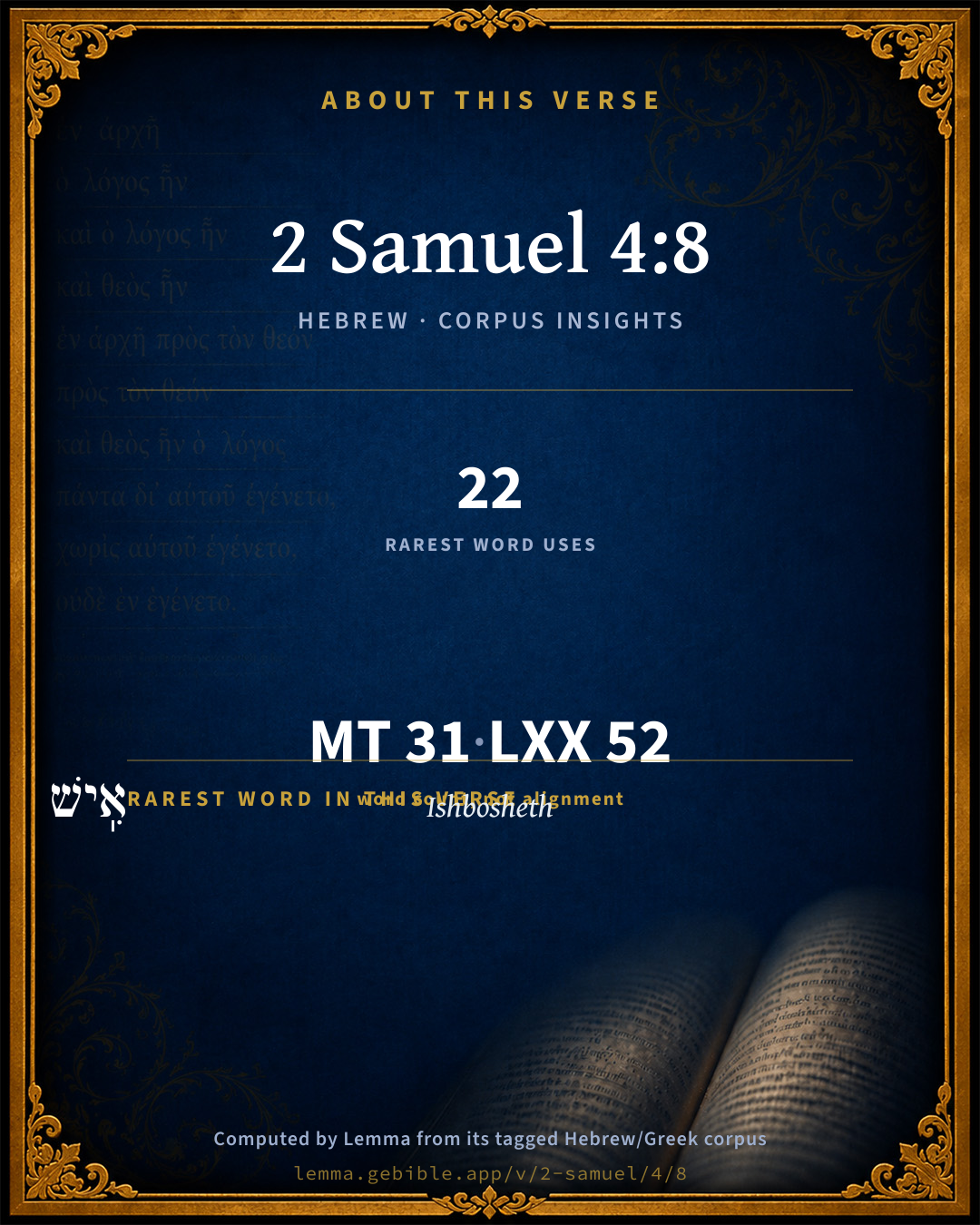
31
words
23
distinct lemmas
Historical
section

Notable vocabulary

The rarest word here is אִֽישׁ Ishbosheth H378 — appearing just 22 times in the whole Hebrew Bible.

Shared distinctive vocabulary

אִֽישׁ Ishbosheth H378 occurs in 10 verses of the Hebrew Bible. Also found in:

Grammatical profile

  • 5 verbs
  • 19 nouns
  • 1 pronoun
  • 2 prepositions
  • 4 particles

Verb forms

  • וַ֠יָּבִאוּ Hiphil · Sequential Imperfect
  • וַיֹּֽאמְרוּ֙ Qal · Sequential Imperfect
  • אֹֽיִבְךָ֔ Qal · Participle Active
  • בִּקֵּ֖שׁ Piel · Perfect
  • וַיִּתֵּ֣ן Qal · Sequential Imperfect

Repetition

Words recur within this verse — often emphatic in Hebrew:

  • אִֽישׁ Ishbosheth H378 ×4
  • רֹ֨אשׁ head H7218 ×2
  • הַמֶּ֔לֶךְ king H4428 ×2
  • שָׁאוּל֙ Saul H7586 ×2
  • אֶל to H413 ×2

Hebrew & Septuagint length

In English translation the verse runs 46 words from the Hebrew and 60 from the Septuagint (LXX English) — closely comparable.

A rough comparison of the two English renderings, which tokenize alike — not a word-level alignment.

Word counts can differ between the Hebrew and the Greek without any difference in meaning — e.g. the Hebrew direct-object marker אֵת has no separate Greek word, and Greek often adds the article ὁ.

In the original languages it is 31 Hebrew tokens and 52 Greek tokens — but the two are counted differently (Hebrew bundles its prefixes and suffixes into one token; the Greek is in lemma form), so that isn’t a like-for-like length.

Cross-references

16

Topical passages linked to 2 Samuel 4:8 in the Treasury of Scripture Knowledge — connected by theme and wording, ordered by reader-vote popularity; previews shown in the World English Bible.

  • 1 Samuel 25:29 Though men be risen up to pursue you, and to seek your soul, yet the soul of my lord shall be bound in the bundle of life with Yahweh your God; and the souls of your enemies, them shall he sling out, as from the hollow of a sling.
  • 2 Samuel 22:48 Even the God who executes vengeance for me, Who brings down peoples under me,
  • 1 Samuel 18:11 and Saul cast the spear; for he said, I will strike David even to the wall. David avoided out of his presence twice.
  • 1 Samuel 19:2–11 Jonathan told David, saying, Saul my father seeks to kill you: now therefore, please take care of yourself in the morning, and live in a secret place, and hide yourself:
  • 1 Samuel 19:15 Saul sent the messengers to see David, saying, Bring him up to me in the bed, that I may kill him.
  • 1 Samuel 20:1 David fled from Naioth in Ramah, and came and said before Jonathan, "What have I done? What is my iniquity?" and "What is my sin before your father, that he seeks my life?"
  • 1 Samuel 23:15 David saw that Saul had come out to seek his life: and David was in the wilderness of Ziph in the wood.
  • 1 Samuel 24:4 The men of David said to him, Behold, the day of which Yahweh said to you, Behold, I will deliver your enemy into your hand, and you shall do to him as it shall seem good to you. Then David arose, and cut off the skirt of Saul's robe secretly.
  • 2 Samuel 18:19 Then said Ahimaaz the son of Zadok, Let me now run, and bear the king news, how that Yahweh has avenged him of his enemies.
  • 2 Samuel 18:31 Behold, the Cushite came; and the Cushite said, News for my lord the king; for Yahweh has avenged you this day of all those who rose up against you.
  • Psalms 63:9–10 But those who seek my soul, to destroy it, Shall go into the lower parts of the earth.
  • Psalms 71:24 My tongue will also talk about your righteousness all day long, For they are disappointed, and they are confounded, who want to harm me.
  • Matthew 2:20 "Arise and take the young child and his mother, and go into the land of Israel, for those who sought the young child's life are dead."
  • Luke 18:7–8 Won't God avenge his chosen ones, who are crying out to him day and night, and yet he exercises patience with them?
  • Revelation 6:10 They cried with a loud voice, saying, "How long, Master, the holy and true, until you judge and avenge our blood on those who dwell on the earth?"
  • Revelation 18:20 Rejoice over her, O heaven, you saints, apostles, and prophets; for God has judged your judgment on her."

Cross-references courtesy of OpenBible.info (CC BY 4.0).

Hebrew and Greek witnesses Masoretic Hebrew ↔ Greek Septuagint

The same verse in the two great witnesses to the Old Testament, shown verse-for-verse.

These are two independent witnesses, not word-aligned to each other, and the Septuagint is shown in lemma (dictionary) form.

Hebrew 2 Samuel 4:8 Masoretic · Westminster Leningrad Codex

וַ֠יָּבִאוּ אֶת רֹ֨אשׁ אִֽישׁ בֹּ֥שֶׁת אֶל דָּוִד֮ חֶבְרוֹן֒ וַיֹּֽאמְרוּ֙ אֶל הַמֶּ֔לֶךְ הִנֵּֽה רֹ֣אשׁ אִֽישׁ בֹּ֗שֶׁת בֶּן שָׁאוּל֙ אֹֽיִבְךָ֔ אֲשֶׁ֥ר בִּקֵּ֖שׁ אֶת נַפְשֶׁ֑ךָ וַיִּתֵּ֣ן יְ֠הוָה לַֽאדֹנִ֨י הַמֶּ֤לֶךְ נְקָמוֹת֙ הַיּ֣וֹם הַזֶּ֔ה מִשָּׁא֖וּל וּמִזַּרְעֽוֹ

They brought the head of Ish-bosheth to David to Hebron, and said to the king, Behold, the head of Ish-bosheth, the son of Saul, your enemy, who sought your life; and Yahweh has avenged my lord the king this day of Saul, and of his seed.

World English Bible · Public Domain

Greek LXX 2 Samuel 4:8 Septuagint · lemma form

καί φέρω ὁ κεφαλή μεμφιβοσθε ὁ δαυίδ εἰς χεβρων καί εἶπον πρός ὁ βασιλεύς ἰδού ὁ κεφαλή μεμφιβοσθε υἱός σαούλ ὁ ἐχθρός σύ ὅς ζητέω ὁ ψυχή σύ καί δίδωμι κύριος ὁ κύριος βασιλεύς ἐκδίκησις ὁ ἐχθρός αὐτός ὡς ὁ ἡμέρα οὗτος ἐκ σαούλ ὁ ἐχθρός σύ καί ἐκ ὁ σπέρμα αὐτός

And they brought the head of Jebosthe to David to Chebron, and they said to the king, Behold the head of Jebosthe the son of Saul your enemy, who sought your life; and the Lord has executed for my lord the king vengeance on his enemies, as it is this day: even on Saul your enemy, and on his seed.

LXX2012 (modern English Septuagint) · Public Domain

Hebrew: Westminster Leningrad Codex (CC BY 4.0). Greek: Septuagint (public domain); English from LXX2012 (modern English Septuagint) (Public Domain). How the Septuagint differs from the Hebrew →

Targum (Aramaic paraphrase)

1

The Targum is the ancient Jewish Aramaic paraphrase of the Hebrew Scriptures — an interpretive translation, not the Hebrew text itself. Onkelos (literal) and Pseudo-Jonathan (expansive) render the Torah, and Jonathan the Prophets. Coverage is partial: where no permissively-licensed English translation exists for a verse, only the Aramaic is shown. This is verse-level text, not a word-by-word alignment to the Hebrew.

  1. Targum Jonathan Prophets (Joshua–Malachi)
    וְאַיְתִיאוּ יַת רֵישׁ אִישׁ בּוֹשֶׁת לְוַת דָוִד לְחֶבְרוֹן וַאֲמַרוּ לְמַלְכָּא הָא רֵישׁ אִישׁ בֹּשֶׁת בַּר שָׁאוּל בְּעֵיל דְבָבָךְ דִבְעָא לְמִקְטְלָךְ וַעֲבַד יְיָ לְרִבּוֹנִי מַלְכָּא פּוּרְעֲנוּתָא יוֹמָא הָדֵין מִשָׁאוּל וּמִזַרְעֵיהּ:

    (no public-domain English translation for this verse)

    Targum Jonathan — Aramaic: “Mikraot Gedolot” (public domain). English: “Sefaria Community Translation” (CC0 1.0 (public-domain dedication)); “London "Chaldee Paraphrase," 1871” (public domain). Text via Sefaria.

Commentary

Notes on 2 Samuel 4:8 from classic Christian and Jewish commentators (each source and its license shown beneath its notes). The classic Christian expositions comment on the surrounding passage and are grouped to its opening verse, so a note may address several verses; the Jewish commentaries on the Tanakh (Rashi and others) are per-verse, so they appear only where the commentator wrote on this verse.

Lemma curates 59 commentaries, every one of them public domain or Creative Commons licensed, each selected and text-cleaned for this edition rather than reprinted as found. About our sources →

Trapp's Complete Commentary

John Trapp

2Sa 4:8 And they brought the head of Ishbosheth unto David to Hebron, and said to the king, Behold the head of Ishbosheth the son of Saul thine enemy, which sought thy life; and the LORD hath avenged my lord the king this day of Saul, and of his seed.

Ver. 8. Behold the head of Ishbosheth.] A plausible oration they make, but miss of their purpose. They commend their own act to David: (1.) A iucundo, from delight, Lo, here the head of thine enemy; and what more pleasant sight than this? (2.) Ab honesto, from honesty, We did it not without the Lord, who hath set us on work to avenge my lord the king, &c. (3.) Ab utili, from usefulness, For now thine enemy being removed, thou shalt reign alone without a rival. Thus these wretches rhetoricate, and all to insinuate; which yet would not be.

John Trapp, A Commentary or Exposition upon All the Books of the Old and New Testament (1647–1656) — public domain. Text from a community e-Sword module.

Tyndale Open Study Notes

Tyndale Open Resources

4:8 your enemy Saul: As far as we know, David never referred to Saul as an enemy. • the Lord has given . . . revenge: Wrongdoers often presume upon God’s favor to justify political ambition. However, David would not reward treachery.

Tyndale Open Study Notes — © Tyndale Open Resources, licensed CC BY-SA 4.0. Text via the HelloAO Bible API.

Jamieson, Fausset & Brown

Robert Jamieson, A. R. Fausset & David Brown

They brought the head of Ish-bosheth unto David . . . and said, Behold the head of Ish-bosheth--Such bloody trophies of rebels and conspirators have always been acceptable to princes in the East, and the carriers have been liberally rewarded. Ish-bosheth being a usurper, the two assassins thought they were doing a meritorious service to David by removing the only existing obstacle to the union of the two kingdoms.

Jamieson, Fausset & Brown — Commentary Critical and Explanatory on the Whole Bible (1871) — public domain (CC PDM 1.0). Text via the HelloAO Bible API.

Adam Clarke's Commentary

Verse 8. They brought the head - unto David] They thought, as did the poor lying Amalekite, to ingratiate themselves with David by this abominable act.

Adam Clarke's Commentary on the Bible (1810–1826) — public domain. Text from a community e-Sword/MySword module.

Ellicott's Commentary for English Readers

(8) The Lord hath avenged.—It is not to be supposed that the murderers pretended a Divine commission for their wicked deed; they only meant to say that, in the providence of God, David was thus avenged on the seed of his cruel persecutor. Yet they state the fact in the way they thought best calculated to awaken the gratitude of David towards themselves.

A Bible Commentary for English Readers, edited by Charles John Ellicott (1878–1897) — public domain. Text from a community e-Sword module.

The Cambridge Bible for Schools and Colleges

gen. ed. J. J. S. Perowne

8–12. The Punishment of the Murderers by David

8. to the king] Observe that Ish-bosheth is never honoured with the title of king.

thine enemy, which sought thy life] These words are to be referred to Saul not to Ish-bosheth. Cp. 1Sa_24:4; 1Sa_25:29.

the Lord hath avenged] The murderers profanely represented themselves as the instruments of Providence. “They pretended piety and loyalty, but they regarded nothing except their own interest.” Wordsworth.

The Cambridge Bible for Schools and Colleges (gen. ed. J. J. S. Perowne; Cambridge University Press, 1878–1918) — public domain. Text from a community e-Sword module.

John Gill's Exposition

And David answered Rechab and Baanah his brother, the sons of Rimmon the Beerothite,.... In a manner they did not expect:

and said unto them, as the Lord liveth, who hath redeemed my soul out of all adversity; spiritual and temporal, especially the latter is meant, and particularly what he had been brought into by the persecution of Saul, while living, and by those that adhered to his house since his death; which he ascribes to the Lord, and doubted not that he would still deliver him, and complete what he had designed for him, and that he needed not the assistance of such wicked hands as theirs; the words contain the form of an oath made to testify the truth of the following narrative, concerning the man that brought the tidings of Saul's death to him, or for the certainty of what he would do those persons for the murder of Ishbosheth.

John Gill's Exposition of the Whole Bible (1746–1763) — public domain (CC PDM 1.0). Text via the HelloAO Bible API.

Haydock's Catholic Bible Commentary

Life. They wish to recall to David’s remembrance what Saul had done against him, that he may approve the more of what they had perpetrated. (Menochius) --- They supposed that, as Abner had been well received, they should obtain still greater favour. (Salien)

George Leo Haydock (1774–1849), Haydock's Catholic Family Bible and Commentary, 1859 edition — public domain. Excludes Psalms (Douay-Rheims chapter numbering differs from Protestant) and Deuterocanonical books (Catholic canon only).

Matthew Poole's English Annotations

Which sought thy life, i.e. to destroy it, or take it away; as this phrase is used, 1Sa 20:1; 23:15, and elsewhere. They thought their action not only blameless, but meritorious; because they had but executed justice upon Saul’s house, and David’s enemies, and made way for David’s obtaining of his rights. It may seem strange they were not discouraged by David’s punishing of the Amalekite for killing Saul, 2Sa 1, and by his sharp reproof of Joab for murdering Abner; but they thought the first case much differing from theirs, because Saul was anointed king by God; whereas Ish-bosheth was not, but was a mere usurper: and for the latter, they thought that David’s sharp words proceeded rather from art and policy, than from any real dislike of thee thing; which they judged, because David contented himself with words, and Joab did not only go unpunished, but continued in his former place and power.

Matthew Poole's English Annotations on the Holy Bible (1683–1685) — public domain. Text from a community e-Sword/MySword module.

Whedon's Commentary on the Bible

Daniel D. Whedon

8. The Lord hath avenged my lord the king — By these words the assassins thought to gain the favour of David; but, like the Amalekite at Ziklag, they little understood how his soul abhorred their bloody deed.

Daniel D. Whedon (gen. ed.), Commentary on the Old and New Testaments (1874–1909) — public domain. Text from a community e-Sword module.

The Pulpit Commentary

Which sought thy life. Saul had sought David"s life, but Ishbosheth was innocent of any such attempts. Still, had he been victorious, David, as his rival, would certainly have been put to death. Jehovah hath avenged my lord the king. The ordinary language of the East is so religious that these words imply nothing more than that these wicked men saw in their base act a step towards the carrying out of a Divine purpose. But in thus referring to the common belief that David"s kingdom was assured to him by Jehovah, they evidently intended to commend their deed to the really devout mind of the king.

The Pulpit Commentary (1880–1919), ed. H.D.M. Spence-Jones & Joseph S. Exell — public domain. Text from a community e-Sword module.

unfoldingWord translationNotes

Door43 World Missions Community

sought your life

This idiom means "was trying to kill you." (See: Idiom)

As Yahweh lives

This is one of the strongest oaths David could swear, as Yahweh is the witness. AT: "I swear on the life of Yahweh" (See: Idiom)

who delivered my life

Here "life" refers to David himself. This means that Yahweh has kept David alive. AT: "who rescued me" (See: Synecdoche)

translationWords

David

king

avenge

lord

descend

Yahweh

reward

unfoldingWord translationNotes — © Distant Shores Media and the Door43 World Missions Community, licensed CC BY-SA 4.0. Source: git.door43.org/Door43/en_tn.

Lesson kit

Teaching starters — assembled from the data on this page, not authored interpretation. Every prompt links to the verse data it draws on. Edit before teaching.

2 Samuel, in the Historical, opens this verse with 31 words (23 distinct Hebrew lemmas). Its most distinctive word is ʼÎysh-Bôsheth (“Ishbosheth”). A historical commentator’s framing appears above. Read the whole chapter for the surrounding context.

Discussion questions

  1. The word ʼÎysh-Bôsheth carries the sense “Ishbosheth.” How does it shape the verse?
  2. How does 2 Samuel 2:8, which shares the word «Ishbosheth», read alongside this verse?
  3. What does the repetition of “Ishbosheth” (4× in this one verse) do in this verse?
  4. These translations render this verse differently. What is at stake in choosing one wording over another?
  5. «וַ֠יָּבִאוּ» is a Hiphil Sequential Imperfect verb. How does that grammatical form shape the action described?
  6. Compare how Trapp's Complete Commentary and Tyndale Open Study Notes read this verse. Where do they agree or differ?

Things to notice

Reading settings

Reading text

Shown beneath each verse's original-language words.

Old Testament
Old Testament edition

Read the OT as the Masoretic Hebrew (MT) or the Greek Septuagint (LXX).

English shown for the Greek Septuagint (in the Hebrew ↔ Greek comparison).

Comparing translations? Open the Compare panel on any verse page to stack up to four side by side.