
1 Samuel 29:8

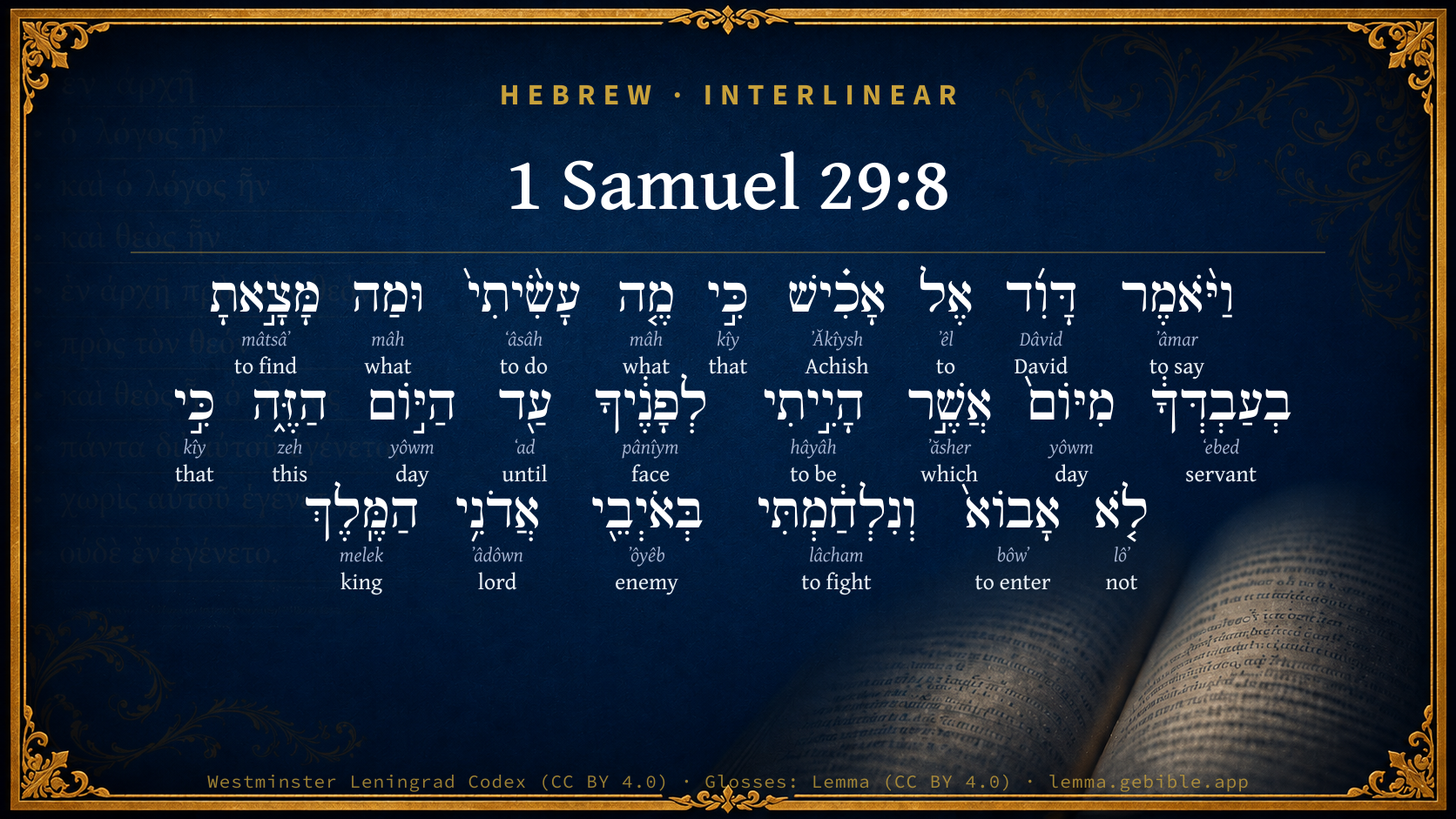
Hebrew (Westminster Leningrad Codex) 1 Samuel 29:8 appears in the Hebrew Old Testament. The text above is from the Westminster Leningrad Codex. Each word links to its Strong’s number, a concise gloss, and parsing drawn from the Open Scriptures Hebrew Bible morphology. Click any word for its full Brown-Driver-Briggs (BDB) entry.
Download image
Cite this verse

1 Samuel 29:8 (World English Bible). Public Domain. Lemma interlinear Bible study tool, https://lemma.gebible.app/v/1-samuel/29/8.

Show BibTeX & RIS
BibTeX
RIS
English Translation
David said to Achish, But what have I done? and what have you found in your servant so long as I have been before you to this day, that I may not go and fight against the enemies of my lord the king?
World English Bible · Public Domain
Download a study sheet

One document with this verse’s original text, its word-by-word gloss line, the meaning frame, cross-references with their text, attributed commentary, and full source and license credits — printable, and it pastes into notes with its structure intact.

This verse Autodidact and up

Study sheet (.html) Plain text (.txt)

A passage Seminary Student

Up to 50 verses in one chapter. A passage sheet keeps up to 6 commentary sources and 12 cross-references per verse, in the order this page ranks them, and says so on the sheet whenever that leaves anything out. Ask for a single verse and you get the Autodidact verse sheet above.

Everything on this page stays free to read, with no account — the sheet is a download of what is already on screen, not access to it.

Want to remove ads? Support Godless Engineer
Compare translations 3

The same verse in 3 English versions, stacked beneath the original-language interlinear above. Click any original word for its lexicon entry.

Each is an independent rendering of the whole verse — the interlinear is not word-aligned to these translations.

Highlighted words mark where these versions differ — a whole-verse word diff, not a word-by-word alignment.

  • World English Bible Public Domain
    David said to Achish, But what have I done? and what have you found in your servant so long as I have been before you to this day, that I may not go and fight against the enemies of my lord the king?
  • King James Version Public Domain
    And David said unto Achish, But what have I done? and what hast thou found in thy servant so long as I have been with thee unto this day, that I may not go fight against the enemies of my lord the king?
  • unfoldingWord Literal Text CC BY-SA 4.0
    And David said to Achish, “But what have I done? And what have you found in your servant from the day when I was to your face to this day, that I may not come and fight with the enemies of my lord the king?”

unfoldingWord Literal Text — © unfoldingWord, licensed CC BY-SA 4.0. Word-aligned USFM3 via Door43 (git.door43.org/unfoldingWord/en_ult).

Versions to compare (up to 4)

3 of 4 selected

Show all 18 translations

Every available English version of this verse, each an independent rendering of the whole verse.

  • World English Bible Public Domain
    David said to Achish, But what have I done? and what have you found in your servant so long as I have been before you to this day, that I may not go and fight against the enemies of my lord the king?
  • Berean Standard Bible Public Domain
    “But what have I done?” David replied. “What have you found against your servant, from the day I came to you until today, to keep me from going along to fight against the enemies of my lord the king?”
  • Majority Standard Bible Public Domain
    “But what have I done?” David replied. “What have you found against your servant, from the day I came to you until today, to keep me from going along to fight against the enemies of my lord the king?”
  • King James Version Public Domain
    And David said unto Achish, But what have I done? and what hast thou found in thy servant so long as I have been with thee unto this day, that I may not go fight against the enemies of my lord the king?
  • American Standard Version (1901) Public Domain
    And David said unto Achish, But what have I done? and what hast thou found in thy servant so long as I have been before thee unto this day, that I may not go and fight against the enemies of my lord the king?
  • Revised Version (1885) Public Domain
    And David said unto Achish, But what have I done? and what hast thou found in thy servant so long as I have been before thee unto this day, that I may not go and fight against the enemies of my lord the king?
  • Geneva Bible (1599) Public Domain
    And Dauid said vnto Achish, But what haue I done? and what hast thou founde in thy seruant as long as I haue bene with thee vnto this day, that I may not goe and fight against the enemies of my lorde the King?
  • Douay-Rheims (1899) Public Domain
    And David said to Achis: But what have I done, and what hast thou found in me thy servant, from the day that I have been in thy sight until this day, that I may not go and fight against the enemies of my lord the king?
  • Young's Literal Translation Public Domain
    And David saith unto Achish, `But what have I done? and what hast thou found in thy servant from the day that I have been before thee till this day -- that I go not in and have fought against the enemies of my lord the king?'
  • Literal Standard Version CC BY-SA 4.0
    And David says to Achish, “But what have I done? And what have you found in your servant from the day that I have been before you until this day—that I do not go in and have fought against the enemies of my lord the king?”
  • Unlocked Literal Bible CC BY-SA 4.0
    David said to Achish, “But what have I done? What have you found in your servant as long as I have been before you to this day, that I may not go and fight against the enemies of my master the king?”
  • unfoldingWord Literal Text CC BY-SA 4.0
    And David said to Achish, “But what have I done? And what have you found in your servant from the day when I was to your face to this day, that I may not come and fight with the enemies of my lord the king?”
  • Darby Bible Public Domain
    And David said to Achish, But what have I done? and what hast thou found in thy servant so long as I have been with thee to this day, that I should not go and fight against the enemies of my lord the king?
  • World Messianic Bible Public Domain
    David said to Achish, “But what have I done? What have you found in your servant so long as I have been before you to this day, that I may not go and fight against the enemies of my lord the king?”
  • Webster's Bible Public Domain
    And David said to Achish, But what have I done? and what hast thou found in thy servant, so long as I have been with thee to this day, that I may not go and fight against the enemies of my lord the king.
  • Free Bible Version CC BY-SA 4.0
    “But what have I done?” David asked. “What fault have you found in me, your servant, from the day I came to you until now, that would prevent me from going to fight the enemies of my lord the king?”
  • Bible in Basic English Public Domain
    And David said to Achish, But what have I done? what have you seen in your servant while I have been with you till this day, that I may not go and take up arms against those who are now making war on my lord the king?
  • JPS Tanakh (1917) Public Domain
    And David said unto Achish: 'But what have I done? and what hast thou found in thy servant so long as I have been before thee unto this day, that I may not go and fight against the enemies of my lord the king?'

Literal Standard Version (2020), Covenant Press — licensed CC BY-SA 4.0. Text via the HelloAO Bible API (eBible.org). Unlocked Literal Bible (unfoldingWord) — licensed CC BY-SA 4.0. Text via the HelloAO Bible API (eBible.org). unfoldingWord Literal Text — © unfoldingWord, licensed CC BY-SA 4.0. Word-aligned USFM3 via Door43 (git.door43.org/unfoldingWord/en_ult). Free Bible Version, Dr. Jonathan Gallagher — licensed CC BY-SA 4.0. Text via the HelloAO Bible API (eBible.org).

Word by word

More ways to search: Search by grammar → Find every occurrence → Compare this word →

Practice this passage: Drill this verse → Learn its vocabulary →

אָכִ֗ישׁ
ʼĂkîysh
H397
“Achish”
Noun, Proper
Part of Speech
Noun
Type
Proper
Full BDB Definition

Origin: of uncertain derivation

TWOT: None

Achish = "I will blacken (or terrify)" or " only a man" - Philistine king of Gath
  1. וַיֹּ֨אמֶר ʼâmar H559 “and · to say” Conjunction + Verb, Qal, Sequential Imperfect, 3rd Person, Masculine, Singular
  2. דָּוִ֜ד Dâvid H1732 “David” Noun, Proper
  3. אֶל ʼêl H413 “to” Preposition
  4. כִּ֣י kîy H3588 “that” Conjunction
  5. מֶ֤ה mâh H4100 “what” Particle, Interrogative
  6. עָשִׂ֨יתִי֙ ʻâsâh H6213 “to do” Verb, Qal, Perfect, 1st Person, Common, Singular
  7. וּמַה mâh H4100 “and · what” Conjunction + Particle, Interrogative
  8. מָּצָ֣אתָ mâtsâʼ H4672 “to find” Verb, Qal, Perfect, 2nd Person, Masculine, Singular
  9. בְעַבְדְּךָ֔ ʻebed H5650 “in/at · servant · your” Preposition + Noun, Common, Masculine, Singular, Construct + Suffix, Personal, 2nd Person, Masculine, Singular
  10. מִיּוֹם֙ yôwm H3117 “from · day” Preposition + Noun, Common, Masculine, Singular, Absolute
  11. אֲשֶׁ֣ר ʼăsher H834 “which” Particle, Relative
  12. הָיִ֣יתִי hâyâh H1961 “to be” Verb, Qal, Perfect, 1st Person, Common, Singular
  13. לְפָנֶ֔יךָ pânîym H6440 “to/for · face(s) · your” Preposition + Noun, Common, Both, Plural, Construct + Suffix, Personal, 2nd Person, Masculine, Singular
  14. עַ֖ד ʻad H5704 “until” Preposition
  15. הַיּ֣וֹם yôwm H3117 “the · day” Particle, Definite Article + Noun, Common, Masculine, Singular, Absolute
  16. הַזֶּ֑ה zeh H2088 “the · this” Particle, Definite Article + Pronoun, Demonstrative, Masculine, Singular
  17. כִּ֣י kîy H3588 “that” Conjunction
  18. לֹ֤א lôʼ H3808 “not” Particle, Negative
  19. אָבוֹא֙ bôwʼ H935 “to enter” Verb, Qal, Imperfect, 1st Person, Common, Singular
  20. וְנִלְחַ֔מְתִּי lâcham H3898 “and · to fight” Conjunction + Verb, Niphal, Sequential Perfect, 1st Person, Common, Singular
  21. בְּאֹיְבֵ֖י ʼôyêb H341 “in/at · enemy” Preposition + Verb, Qal, Participle Active, Masculine, Plural, Construct
  22. אֲדֹנִ֥י ʼâdôwn H113 “lord · my” Noun, Common, Masculine, Singular, Construct + Suffix, Personal, 1st Person, Common, Singular
  23. הַמֶּֽלֶךְ melek H4428 “the · king” Particle, Definite Article + Noun, Common, Masculine, Singular, Absolute

About this verse

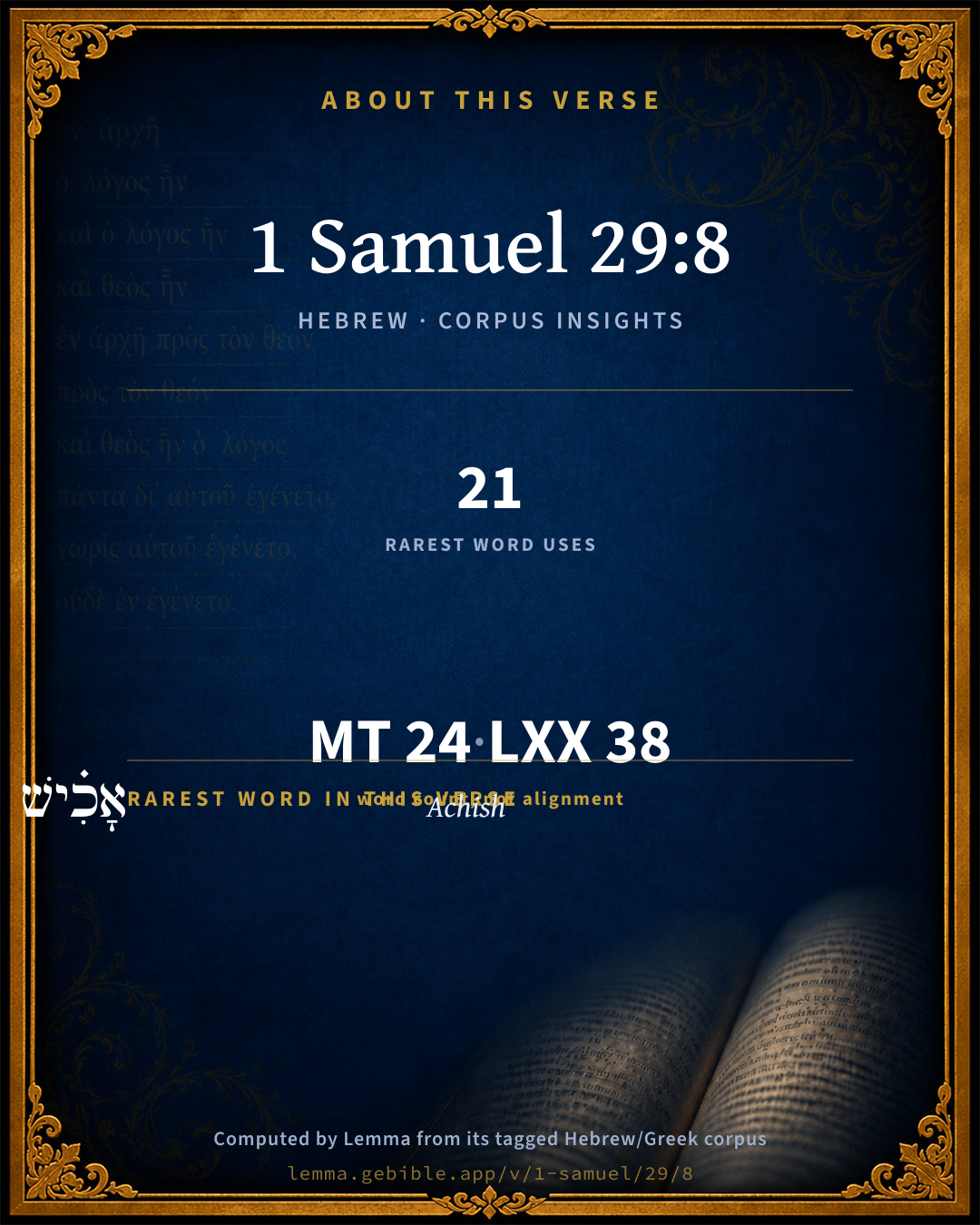
These counts appear in no published source. They are computed here, from the morphology-tagged text and Lemma’s own curated glosses. What Lemma adds →

24
words
21
distinct lemmas
Historical
section

Notable vocabulary

The rarest word here is אָכִ֗ישׁ Achish H397 — appearing just 21 times in the whole Hebrew Bible.

Shared distinctive vocabulary

אָכִ֗ישׁ Achish H397 occurs in 20 verses of the Hebrew Bible. Also found in:

Grammatical profile

  • 7 verbs
  • 8 nouns
  • 1 pronoun
  • 2 prepositions
  • 2 conjunctions
  • 4 particles

Verb forms

  • וַיֹּ֨אמֶר Qal · Sequential Imperfect
  • עָשִׂ֨יתִי֙ Qal · Perfect
  • מָּצָ֣אתָ Qal · Perfect
  • הָיִ֣יתִי Qal · Perfect
  • אָבוֹא֙ Qal · Imperfect
  • וְנִלְחַ֔מְתִּי Niphal · Sequential Perfect
  • בְּאֹיְבֵ֖י Qal · Participle Active

Repetition

Words recur within this verse — often emphatic in Hebrew:

  • מִיּוֹם֙ day H3117 ×2
  • כִּ֣י that H3588 ×2
  • מֶ֤ה what H4100 ×2

Hebrew & Septuagint length

In English translation the verse runs 43 words from the Hebrew and 47 from the Septuagint (LXX English) — closely comparable.

A rough comparison of the two English renderings, which tokenize alike — not a word-level alignment.

Word counts can differ between the Hebrew and the Greek without any difference in meaning — e.g. the Hebrew direct-object marker אֵת has no separate Greek word, and Greek often adds the article ὁ.

In the original languages it is 24 Hebrew tokens and 38 Greek tokens — but the two are counted differently (Hebrew bundles its prefixes and suffixes into one token; the Greek is in lemma form), so that isn’t a like-for-like length.

Cross-references

8

Topical passages linked to 1 Samuel 29:8 in the Treasury of Scripture Knowledge — connected by theme and wording, ordered by reader-vote popularity; previews shown in the World English Bible.

  • Psalms 34:13–14 Keep your tongue from evil, And your lips from speaking lies.
  • Matthew 6:13 Bring us not into temptation, but deliver us from the evil one. For yours is the Kingdom, the power, and the glory forever. Amen.'
  • 1 Samuel 12:3 Here I am: witness against me before Yahweh, and before his anointed: whose ox have I taken? or whose donkey have I taken? or whom have I defrauded? whom have I oppressed? or of whose hand have I taken a ransom to blind my eyes therewith? and I will restore it you.
  • 1 Samuel 17:29 David said, What have I now done? Is there not a cause?
  • 1 Samuel 20:8 Therefore deal kindly with your servant; for you have brought your servant into a covenant of Yahweh with you: but if there be in me iniquity, kill me yourself; for why should you bring me to your father?
  • 1 Samuel 26:18 He said, Why does my lord pursue after his servant? for what have I done? or what evil is in my hand?
  • 1 Samuel 28:2 David said to Achish, Therefore you shall know what your servant will do. Achish said to David, Therefore will I make you keeper of my head for ever.
  • 2 Samuel 16:18–19 Hushai said to Absalom, No; but whom Yahweh, and this people, and all the men of Israel have chosen, his will I be, and with him will I abide.

Cross-references courtesy of OpenBible.info (CC BY 4.0).

Hebrew and Greek witnesses Masoretic Hebrew ↔ Greek Septuagint

The same verse in the two great witnesses to the Old Testament, shown verse-for-verse.

These are two independent witnesses, not word-aligned to each other, and the Septuagint is shown in lemma (dictionary) form.

Hebrew 1 Samuel 29:8 Masoretic · Westminster Leningrad Codex

וַיֹּ֨אמֶר דָּוִ֜ד אֶל אָכִ֗ישׁ כִּ֣י מֶ֤ה עָשִׂ֨יתִי֙ וּמַה מָּצָ֣אתָ בְעַבְדְּךָ֔ מִיּוֹם֙ אֲשֶׁ֣ר הָיִ֣יתִי לְפָנֶ֔יךָ עַ֖ד הַיּ֣וֹם הַזֶּ֑ה כִּ֣י לֹ֤א אָבוֹא֙ וְנִלְחַ֔מְתִּי בְּאֹיְבֵ֖י אֲדֹנִ֥י הַמֶּֽלֶךְ

David said to Achish, But what have I done? and what have you found in your servant so long as I have been before you to this day, that I may not go and fight against the enemies of my lord the king?

World English Bible · Public Domain

Greek LXX 1 Samuel 29:8 Septuagint · lemma form

καί εἶπον δαυίδ πρός αγχους τίς ποιέω σύ καί τίς εὑρίσκω ἐν ὁ δοῦλος σύ ἀπό ὅς ἡμέρα εἰμί ἐνώπιον σύ καί ἕως ὁ ἡμέρα οὗτος ὅτι οὐ μή ἔρχομαι πολεμέω ὁ ἐχθρός ὁ κύριος ἐγώ ὁ βασιλεύς

And David said to Anchus, What have I done to you? and what have you found in your servant from the first day that I was before you even until this day, that I should not come and war against the enemies of the lord my king?

LXX2012 (modern English Septuagint) · Public Domain

Hebrew: Westminster Leningrad Codex (CC BY 4.0). Greek: Septuagint (public domain); English from LXX2012 (modern English Septuagint) (Public Domain). How the Septuagint differs from the Hebrew →

Targum (Aramaic paraphrase)

1

The Targum is the ancient Jewish Aramaic paraphrase of the Hebrew Scriptures — an interpretive translation, not the Hebrew text itself. Onkelos (literal) and Pseudo-Jonathan (expansive) render the Torah, and Jonathan the Prophets. Coverage is partial: where no permissively-licensed English translation exists for a verse, only the Aramaic is shown. This is verse-level text, not a word-by-word alignment to the Hebrew.

  1. Targum Jonathan Prophets (Joshua–Malachi)
    וַאֲמַר דָוִד לְאָכִישׁ אֲרֵי מָה עֲבָדִית וּמַה אַשְׁכַּחְתָּא בְעַבְדָךְ מִיוֹמָא דַהֲוֵיתִי מְשַׁמֵשׁ קֳדָמָךְ עַד יוֹמָא הָדֵין אֲרֵי לָא אֱהָךְ וְאַגִיח קְרָבָא בְּשַׂנְאֵי רִבּוֹנִי מַלְכָּא:

    (no public-domain English translation for this verse)

    Targum Jonathan — Aramaic: “Mikraot Gedolot” (public domain). English: “Sefaria Community Translation” (CC0 1.0 (public-domain dedication)); “London "Chaldee Paraphrase," 1871” (public domain). Text via Sefaria.

Commentary

Notes on 1 Samuel 29:8 from classic Christian and Jewish commentators (each source and its license shown beneath its notes). The classic Christian expositions comment on the surrounding passage and are grouped to its opening verse, so a note may address several verses; the Jewish commentaries on the Tanakh (Rashi and others) are per-verse, so they appear only where the commentator wrote on this verse.

Lemma curates 59 commentaries, every one of them public domain or Creative Commons licensed, each selected and text-cleaned for this edition rather than reprinted as found. About our sources →

Trapp's Complete Commentary

John Trapp

1Sa 29:8 And David said unto Achish, But what have I done? and what hast thou found in thy servant so long as I have been with thee unto this day, that I may not go fight against the enemies of my lord the king?

Ver. 8. That I may not go fight against the enemies.] This David pretended; but this he would not have done for any good: so that he evidently flattereth and glosseth with Achish. The best have their frailties, not a few: Nimis augusta res est, nuspiam errare.

John Trapp, A Commentary or Exposition upon All the Books of the Old and New Testament (1647–1656) — public domain. Text from a community e-Sword module.

Joseph Benson's Commentary

1Sa 29:8. David said, But what have I done? — This was deep dissimulation and flattery in David, no way to be justified. But who, that has not experienced it, can know how strong a temptation they who attend on great men are under to compliment them and dissemble. David, no doubt, heartily rejoiced at this dismission; but as he did not know how much longer he might be obliged to stay in the land of the Philistines, he seems to have yielded to a temptation that prudence required him to carry it fair toward them, and to pretend to have that concern upon this occasion which he certainly did not feel.

Joseph Benson's Commentary on the Old and New Testaments (1811–1818) — public domain. Text from a community e-Sword module.

Geneva Bible (1599)

Geneva Bible translators

This dissimulation cannot be excused: for it grieved him to go against the people of God.

Geneva Bible (1599) marginal notes — public domain. Text via Bolls.life.

Adam Clarke's Commentary

Verse 8. David said - what have I done?] Dr. Chandler and others may say what they will to make David act a consistent part in this business; but it is most evident, whatever his intentions might be as to the part he was to take in the approaching battle, he did intend to persuade Achish that he would fight against Israel; and affects to feel his reputation injured by not being permitted on this occasion to show his fidelity to the king of Gath.

It was in the order of God's gracious providence that the Philistine lords refused to let David go with them to this battle. Had he gone, he had his choice of two sins - First, If he had fought for the Philistines, he would have fought against God and his country. Secondly If he had in the battle gone over to the Israelites, he would have deceived and become a traitor to the hospitable Achish. God, therefore, so ordered it in his mercy that he was not permitted to go to a battle in which he was sure to be disgraced, whatever side he took, or with what success soever he might be crowned.

Adam Clarke's Commentary on the Bible (1810–1826) — public domain. Text from a community e-Sword/MySword module.

Ellicott's Commentary for English Readers

(8) And David said unto Achish, But what have I done?—David’s words have a ring of falseness in them; he never contemplated fighting in the ranks against Israel, and yet he speaks thus. The generous confidence of the chivalrous Achish is here in painful contrast with the dissimulation of the Israelite chieftain, David.

It has been suggested that these suspicions of his loyalty on the part of the Philistine leaders had been aroused by David deliberately, in order to bring about his dismissal from the army in the field. This is possible, for the situation in which David now finds himself was most embarrassing from every point of view.

A Bible Commentary for English Readers, edited by Charles John Ellicott (1878–1897) — public domain. Text from a community e-Sword module.

The Cambridge Bible for Schools and Colleges

gen. ed. J. J. S. Perowne

8. And David said, &c.] A hypocritical answer, designed to confirm Achish in the belief of his fidelity. Compare David’s previous conduct (ch. 1Sa_27:10-12). But David can scarcely have intended to fight against his countrymen, and must have inwardly rejoiced that God had delivered him out of so perplexing a dilemma.

The Cambridge Bible for Schools and Colleges (gen. ed. J. J. S. Perowne; Cambridge University Press, 1878–1918) — public domain. Text from a community e-Sword module.

John Gill's Exposition

And David said unto Achish, what have I done?.... This question is anticipated by the speech of Achish, who had declared he had found no evil in him; but David must say something to put on an appearance of concern for being dismissed, when he was heartily glad of it:

and what hast thou found in thy servant, so long as I have been with thee unto this day, that I may not go fight against the enemies of my lord the king? which cannot be excused of great dissimulation, since nothing was more foreign from his heart, and against his will, than fighting against the Israelites, and which he determined to avoid if possible; and glad at heart he was to be thus excused, and freed from the straits and difficulties he was involved in; but that the Philistines might have no cause of suspicion of him, and that he was warmly attached to their interest among whom he was still to continue, he put on these airs. Abarbinel is of opinion that the lords of the Philistines were only afraid of David, but not of his men, and therefore were not solicitous about their going, but his, which gave David a concern; and since he was particularly singled out, he desired to know what special evil had been found in him; but when he understood, by the following answer of Achish, that his servants were to go with him, he was content, and said no more; but the princes asked, "what do these Hebrews here?" Sa1 29:3.

John Gill's Exposition of the Whole Bible (1746–1763) — public domain (CC PDM 1.0). Text via the HelloAO Bible API.

Albert Barnes' Notes on the Bible

See 1Sa 29:10 note.

Albert Barnes' Notes on the Bible (1834–1885) — public domain. Text from a community e-Sword/MySword module.

Haydock's Catholic Bible Commentary

King. He speaks thus that he might not increase the suspicions of the Philistines. (Menochius) --- In the mean time, God called him to fight against Amalec, and to defend his own property, which was actually, or the next day, taken from Siceleg; (Haydock) so that nothing could have been more desirable to him, than to be thus dismissed with applause. (Salien)

George Leo Haydock (1774–1849), Haydock's Catholic Family Bible and Commentary, 1859 edition — public domain. Excludes Psalms (Douay-Rheims chapter numbering differs from Protestant) and Deuterocanonical books (Catholic canon only).

Matthew Poole's English Annotations

This was deep dissimulation and flattery; but he apprehended it necessary, lest he should tacitly confess himself guilty of that whereof they accused him, and thereby expose himself to the utmost hazards. These perplexities he brought himself into by his irregular course, in forsaking the land of Judah, where God had placed him, 1Sa 22:5, and promised him protection, and putting himself into the hands of the Philistines.

Matthew Poole's English Annotations on the Holy Bible (1683–1685) — public domain. Text from a community e-Sword/MySword module.

Whedon's Commentary on the Bible

Daniel D. Whedon

8. David said unto Achish — Whether David was really anxious to go into battle with the Philistines we have no means of clearly deciding. It is possible that, as the Philistine lords conjectured, he designed to reconcile himself unto Saul by treacherously fighting against Achish and his compeers, and so was much disappointed when he found this opportunity cut off by the suspicions of the lords. In this case, by my lord the king David would have meant Saul, though he knew that Achish would understand him differently. He who had so deliberately lied to the king of Gath on a former occasion (1Sa_27:10) was none too good to betray his hospitality and kindness. But Divine Providence arranged for him a more excellent way.

Daniel D. Whedon (gen. ed.), Commentary on the Old and New Testaments (1874–1909) — public domain. Text from a community e-Sword module.

The Pulpit Commentary

David"s answer is subtle and prevaricating; he pretends that his honour has been attacked, when really he had tricked the unsuspecting Achish. But truth is a modern virtue, and though David extols it in the Psalms, (Psa_15:2 Psa_51:6) we too often find him practising falsehood.

The Pulpit Commentary (1880–1919), ed. H.D.M. Spence-Jones & Joseph S. Exell — public domain. Text from a community e-Sword module.

John Wesley's Explanatory Notes

David said &c. - This was deep dissimulation and flattery, no way to be justified. None knows, how strong a temptation they are in to compliment and dissemble, which they are in who attend great men.

John Wesley, Explanatory Notes Upon the Whole Bible (1754–1765) — public domain. Text via the GEBible commentary corpus.

unfoldingWord translationNotes

Door43 World Missions Community

my master the king

David speaks as if Achish were another person so that Achish will think David respects him. AT: "you, my master and king" (See: Pronouns)

nevertheless, the princes

"even though that is true, this is more important: the princes" or "however, the princes"

translationWords

David

servant

lord

king

angel

God

prince

Philistines

unfoldingWord translationNotes — © Distant Shores Media and the Door43 World Missions Community, licensed CC BY-SA 4.0. Source: git.door43.org/Door43/en_tn.

Lesson kit

Teaching starters — assembled from the data on this page, not authored interpretation. Every prompt links to the verse data it draws on. Edit before teaching.

1 Samuel, in the Historical, opens this verse with 24 words (21 distinct Hebrew lemmas). Its most distinctive word is ʼĂkîysh (“Achish”). A historical commentator’s framing appears above. Read the whole chapter for the surrounding context.

Discussion questions

  1. What does “Achish” (ʼĂkîysh) contribute to the verse as a whole?
  2. How does 1 Samuel 21:10, which shares the word «Achish», read alongside this verse?
  3. What does the repetition of “day” (2× in this one verse) do in this verse?
  4. These translations render this verse differently. What is at stake in choosing one wording over another?
  5. «וַיֹּ֨אמֶר» is a Qal Sequential Imperfect verb. How does that grammatical form shape the action described?
  6. Compare how Trapp's Complete Commentary and Joseph Benson's Commentary read this verse. Where do they agree or differ?

Things to notice

Reading settings

Reading text

Shown beneath each verse's original-language words.

Old Testament
Old Testament edition

Read the OT as the Masoretic Hebrew (MT) or the Greek Septuagint (LXX).

English shown for the Greek Septuagint (in the Hebrew ↔ Greek comparison).

Comparing translations? Open the Compare panel on any verse page to stack up to four side by side.