Psalms 13:2

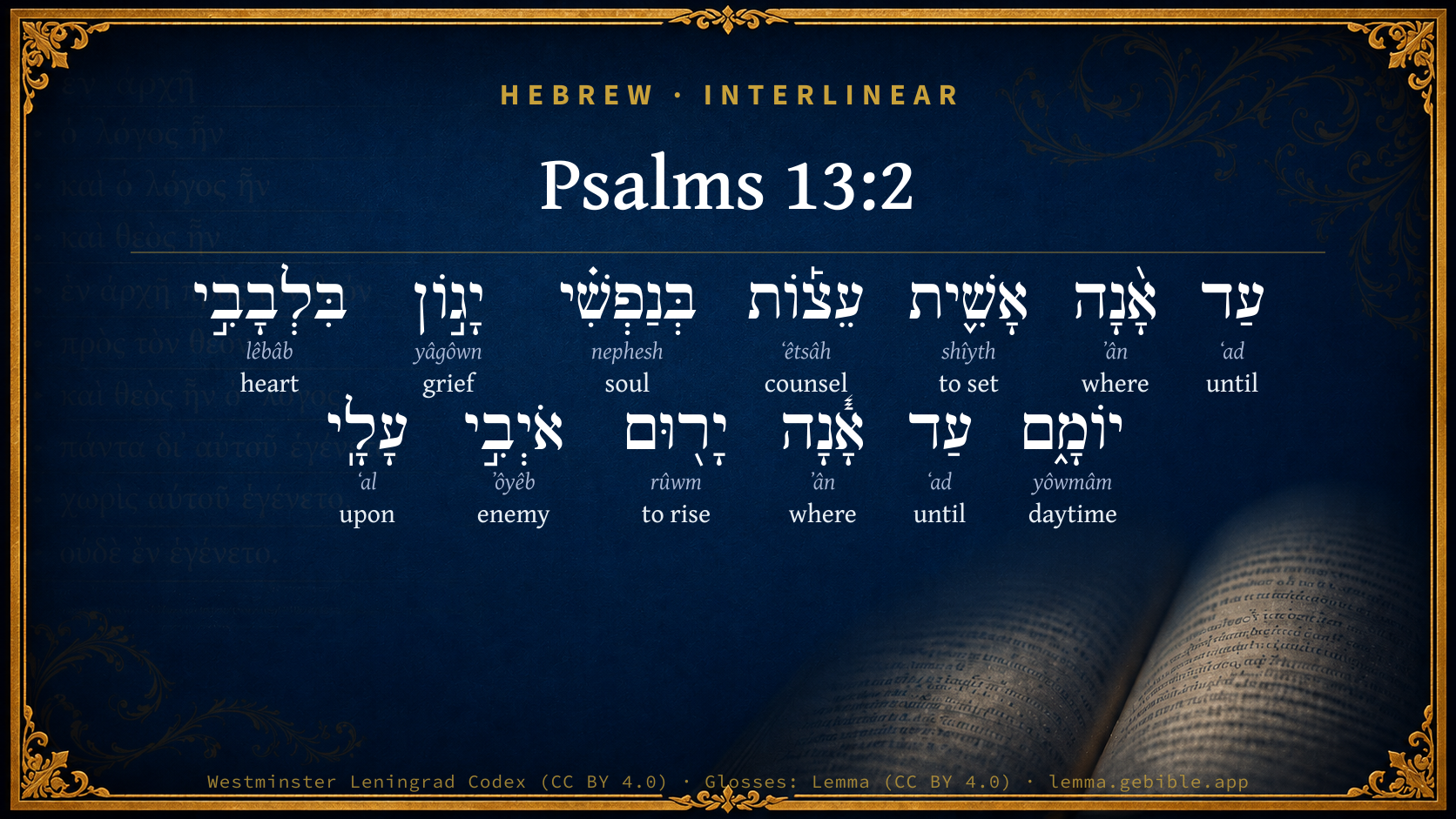
Hebrew (Westminster Leningrad Codex) Psalms 13:2 appears in the Hebrew Old Testament. The text above is from the Westminster Leningrad Codex. Each word links to its Strong’s number, a concise gloss, and parsing drawn from the Open Scriptures Hebrew Bible morphology. Click any word for its full Brown-Driver-Briggs (BDB) entry.
Download image
Cite this verse

Psalms 13:2 (World English Bible). Public Domain. Lemma interlinear Bible study tool, https://lemma.gebible.app/v/psalms/13/2.

Show BibTeX & RIS
BibTeX
RIS
English Translation
How long shall I take counsel in my soul, Having sorrow in my heart every day? How long shall my enemy triumph over me?
World English Bible · Public Domain
Download a study sheet

One document with this verse’s original text, its word-by-word gloss line, the meaning frame, cross-references with their text, attributed commentary, and full source and license credits — printable, and it pastes into notes with its structure intact.

This verse Autodidact and up

Study sheet (.html) Plain text (.txt)

A passage Seminary Student

Up to 50 verses in one chapter. A passage sheet keeps up to 6 commentary sources and 12 cross-references per verse, in the order this page ranks them, and says so on the sheet whenever that leaves anything out. Ask for a single verse and you get the Autodidact verse sheet above.

Everything on this page stays free to read, with no account — the sheet is a download of what is already on screen, not access to it.

Want to remove ads? Support Godless Engineer
Compare translations 3

The same verse in 3 English versions, stacked beneath the original-language interlinear above. Click any original word for its lexicon entry.

Each is an independent rendering of the whole verse — the interlinear is not word-aligned to these translations.

Highlighted words mark where these versions differ — a whole-verse word diff, not a word-by-word alignment.

  • World English Bible Public Domain
    How long shall I take counsel in my soul, Having sorrow in my heart every day? How long shall my enemy triumph over me?
  • King James Version Public Domain
    How long shall I take counsel in my soul, having sorrow in my heart daily? how long shall mine enemy be exalted over me?
  • unfoldingWord Literal Text CC BY-SA 4.0
    How long must I take counsel in my soul, sorrow in my heart by day? How long will the one being hostile to me be high over me?

unfoldingWord Literal Text — © unfoldingWord, licensed CC BY-SA 4.0. Word-aligned USFM3 via Door43 (git.door43.org/unfoldingWord/en_ult).

Versions to compare (up to 4)

3 of 4 selected

Show all 18 translations

Every available English version of this verse, each an independent rendering of the whole verse.

  • World English Bible Public Domain
    How long shall I take counsel in my soul, Having sorrow in my heart every day? How long shall my enemy triumph over me?
  • Berean Standard Bible Public Domain
    How long must I wrestle in my soul, with sorrow in my heart each day? How long will my enemy dominate me?
  • Majority Standard Bible Public Domain
    How long must I wrestle in my soul, with sorrow in my heart each day? How long will my enemy dominate me?
  • King James Version Public Domain
    How long shall I take counsel in my soul, having sorrow in my heart daily? how long shall mine enemy be exalted over me?
  • American Standard Version (1901) Public Domain
    How long shall I take counsel in my soul, Having sorrow in my heart all the day? How long shall mine enemy be exalted over me?
  • Revised Version (1885) Public Domain
    How long shall I take counsel in my soul, having sorrow in my heart all the day? how long shall mine enemy be exalted over me?
  • Geneva Bible (1599) Public Domain
    How long shall I take counsell within my selfe, hauing wearinesse dayly in mine heart? how long shall mine enemie be exalted aboue me?
  • Douay-Rheims (1899) Public Domain
    How long shall I take counsels in my soul, sorrow in my heart all the day?
  • Young's Literal Translation Public Domain
    Till when do I set counsels in my soul? Sorrow inn my heart daily? Till when is mine enemy exalted over me?
  • Literal Standard Version CC BY-SA 4.0
    Until when do I set counsels in my soul, || [With] sorrow in my heart daily? Until when is my enemy exalted over me?
  • Unlocked Literal Bible CC BY-SA 4.0
    How long must I worry and have grief in my heart all day? How long will my enemy triumph over me?
  • unfoldingWord Literal Text CC BY-SA 4.0
    How long must I take counsel in my soul, sorrow in my heart by day? How long will the one being hostile to me be high over me?
  • Darby Bible Public Domain
    How long shall I take counsel in my soul, with sorrow in my heart daily? how long shall mine enemy be exalted over me?
  • World Messianic Bible Public Domain
    How long shall I take counsel in my soul, having sorrow in my heart every day? How long shall my enemy triumph over me?
  • Webster's Bible Public Domain
    How long shall I take counsel in my soul, having sorrow in my heart daily? how long shall my enemy be exalted over me?
  • Free Bible Version CC BY-SA 4.0
    How long must I be in inner turmoil, feeling sad all day long? How long will my enemy be victorious over me?
  • Bible in Basic English Public Domain
    How long is my soul to be in doubt, with sorrow in my heart all the day? how long will he who is against me be given power over me?
  • JPS Tanakh (1917) Public Domain
    (13-3) How long shall I take counsel in my soul, having sorrow in my heart by day? How long shall mine enemy be exalted over me?

Literal Standard Version (2020), Covenant Press — licensed CC BY-SA 4.0. Text via the HelloAO Bible API (eBible.org). Unlocked Literal Bible (unfoldingWord) — licensed CC BY-SA 4.0. Text via the HelloAO Bible API (eBible.org). unfoldingWord Literal Text — © unfoldingWord, licensed CC BY-SA 4.0. Word-aligned USFM3 via Door43 (git.door43.org/unfoldingWord/en_ult). Free Bible Version, Dr. Jonathan Gallagher — licensed CC BY-SA 4.0. Text via the HelloAO Bible API (eBible.org).

Word by word

More ways to search: Search by grammar → Find every occurrence → Compare this word →

Practice this passage: Drill this verse → Learn its vocabulary →

יָג֣וֹן
yâgôwn
H3015
“grief”
Noun, Common, Masculine, Singular, Absolute
Part of Speech
Noun
Type
Common
Gender
Masculine
Number
Singular
State
Absolute
Full BDB Definition

Origin: from H3013

TWOT: 839a

grief, sorrow, anguish
  1. עַד ʻad H5704 “until” Preposition
  2. אָ֨נָה ʼân H575 “where” Adverb
  3. אָשִׁ֪ית shîyth H7896 “to set” Verb, Qal, Imperfect, 1st Person, Common, Singular
  4. עֵצ֡וֹת ʻêtsâh H6098 “counsels” Noun, Common, Feminine, Plural, Absolute
  5. בְּנַפְשִׁ֗י nephesh H5315 “in/at · soul · my” Preposition + Noun, Common, Both, Singular, Construct + Suffix, Personal, 1st Person, Common, Singular
  6. בִּלְבָבִ֣י lêbâb H3824 “in/at · heart · my” Preposition + Noun, Common, Masculine, Singular, Construct + Suffix, Personal, 1st Person, Common, Singular
  7. יוֹמָ֑ם yôwmâm H3119 “daytime” Adverb
  8. עַד ʻad H5704 “until” Preposition
  9. אָ֓נָה ʼân H575 “where” Adverb
  10. יָר֖וּם rûwm H7311 “to rise” Verb, Qal, Imperfect, 3rd Person, Masculine, Singular
  11. אֹיְבִ֣י ʼôyêb H341 “enemy · me” Verb, Qal, Participle Active, Masculine, Singular, Construct + Suffix, Personal, 1st Person, Common, Singular
  12. עָלָֽי ʻal H5921 “upon · me” Preposition + Suffix, Personal, 1st Person, Common, Singular

About this verse

These counts appear in no published source. They are computed here, from the morphology-tagged text and Lemma’s own curated glosses. What Lemma adds →

13
words
11
distinct lemmas
Wisdom
section

Notable vocabulary

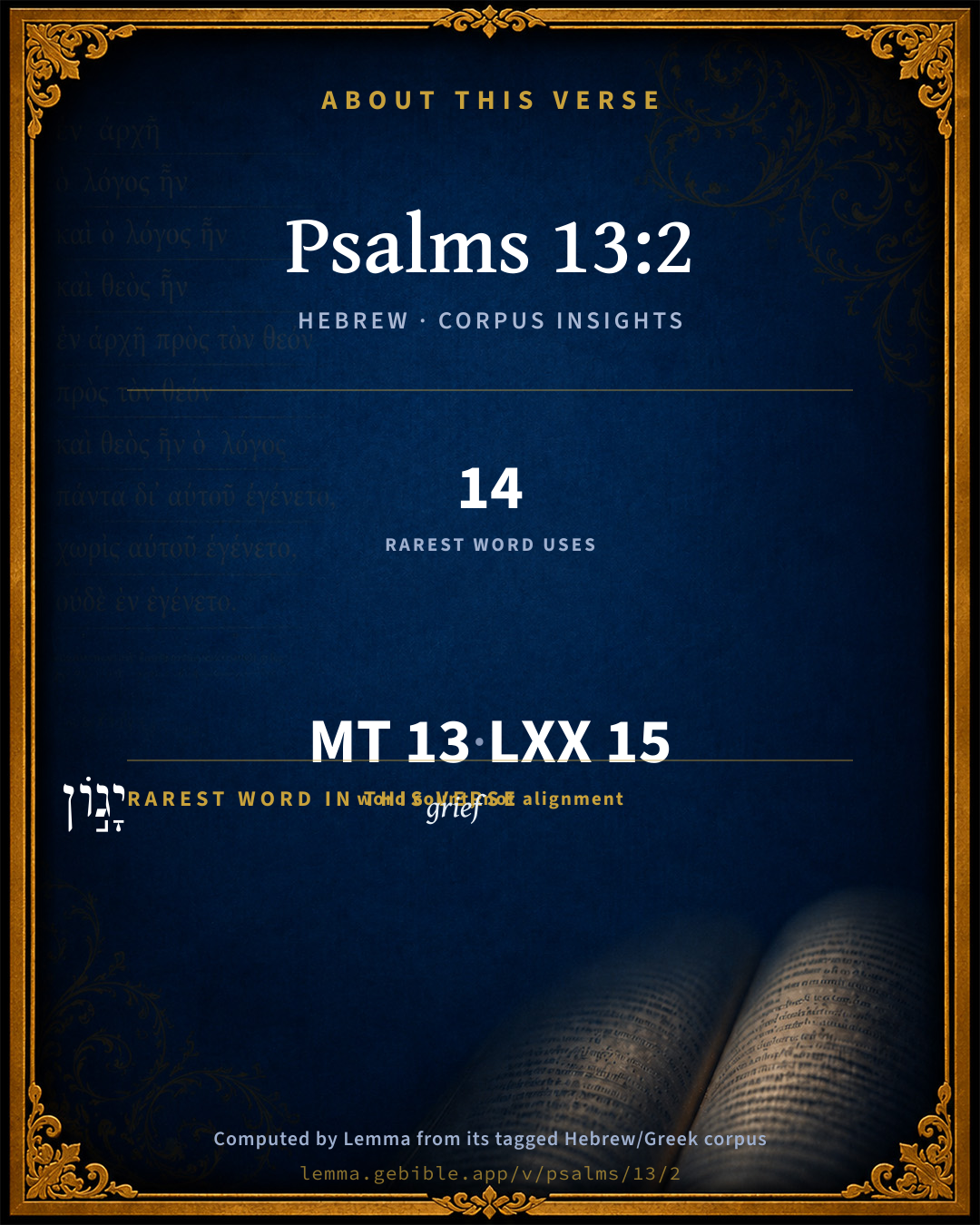
The rarest word here is יָג֣וֹן grief H3015 — appearing just 14 times in the whole Hebrew Bible.

Shared distinctive vocabulary

יָג֣וֹן grief H3015 occurs in 14 verses of the Hebrew Bible. Also found in:

Grammatical profile

  • 3 verbs
  • 4 nouns
  • 3 prepositions
  • 3 adverbs

Verb forms

  • אָשִׁ֪ית Qal · Imperfect
  • יָר֖וּם Qal · Imperfect
  • אֹיְבִ֣י Qal · Participle Active

Repetition

Words recur within this verse — often emphatic in Hebrew:

  • עַד until H5704 ×2
  • אָ֨נָה where H575 ×2

Hebrew & Septuagint length

In English translation the verse runs 24 words from the Hebrew and 24 from the Septuagint (LXX English) — the same length.

A rough comparison of the two English renderings, which tokenize alike — not a word-level alignment.

Word counts can differ between the Hebrew and the Greek without any difference in meaning — e.g. the Hebrew direct-object marker אֵת has no separate Greek word, and Greek often adds the article ὁ.

In the original languages it is 13 Hebrew tokens and 15 Greek tokens — but the two are counted differently (Hebrew bundles its prefixes and suffixes into one token; the Greek is in lemma form), so that isn’t a like-for-like length.

Cross-references

42

Topical passages linked to Psalms 13:2 in the Treasury of Scripture Knowledge — connected by theme and wording, ordered by reader-vote popularity; previews shown in the World English Bible.

  • Micah 7:8–10 Don't rejoice against me, my enemy. When I fall, I will arise. When I sit in darkness, Yahweh will be a light to me.
  • Jeremiah 8:18 Oh that I could comfort myself against sorrow! my heart is faint within me.
  • Jeremiah 15:18 Why is my pain perpetual, and my wound incurable, which refuses to be healed? will you indeed be to me as a deceitful [brook], as waters that fail?
  • Psalms 143:3–4 For the enemy pursues my soul. He has struck my life down to the ground. He has made me live in dark places, as those who have been long dead.
  • Proverbs 15:13 A glad heart makes a cheerful face; But an aching heart breaks the spirit.
  • Lamentations 1:5 Her adversaries are become the head, her enemies prosper; For Yahweh has afflicted her for the multitude of her transgressions: Her young children are gone into captivity before the adversary.
  • Job 10:15 If I am wicked, woe to me. If I am righteous, I still shall not lift up my head, Being filled with disgrace, And conscious of my affliction.
  • Job 23:8–10 "If I go east, he is not there; If west, I can't find him;
  • Psalms 123:3–4 Have mercy on us, Yahweh, have mercy on us, For we have endured much contempt.
  • Psalms 142:4–7 Look on my right, and see; For there is no one who is concerned for me. Refuge has fled from me. No one cares for my soul.
  • Ecclesiastes 5:17 All his days he also eats in darkness, he is frustrated, and has sickness and wrath.
  • 1 Samuel 18:29 Saul was yet the more afraid of David; and Saul was David's enemy continually.
  • 1 Samuel 24:19 For if a man finds his enemy, will he let him go away unharmed? Therefore may Yahweh reward you good for that which you have done to me this day.
  • Nehemiah 2:2 The king said to me, Why is your face sad, seeing you are not sick? this is nothing else but sorrow of heart. Then I was very sore afraid.
  • Esther 7:6 Esther said, An adversary and an enemy, even this wicked Haman. Then Haman was afraid before the king and the queen.
  • Job 7:12–15 Am I a sea, or a sea-monster, That you put a guard over me?
  • Job 9:19–21 If it is a matter of strength, behold, he is mighty! If of justice, 'Who,' says he, 'will summon me?'
  • Job 9:27–28 If I say, 'I will forget my complaint, I will put off my sad face, and cheer up;'
  • Psalms 7:2 Lest they tear apart my soul like a lion, Ripping it in pieces, while there is none to deliver.
  • Psalms 7:4–5 If I have rewarded evil to him who was at peace with me (Yes, I have delivered him who without cause was my adversary),
  • Psalms 8:2 From the lips of babes and infants you have established strength, Because of your adversaries, that you might silence the enemy and the avenger.
  • Psalms 9:6 The enemy is overtaken by endless ruin. The very memory of the cities which you have overthrown has perished.
  • Psalms 10:18 To judge the fatherless and the oppressed, That man who is of the earth may terrify no more.
  • Psalms 17:9 From the wicked who oppress me, My deadly enemies, who surround me.
  • Psalms 31:18 Let the lying lips be mute, Which speak against the righteous insolently, with pride and contempt.
  • Psalms 42:4 These things I remember, and pour out my soul within me, How I used to go with the crowd, and led them to the house of God, With the voice of joy and praise, a multitude keeping a holy day.
  • Psalms 42:9–10 I will ask God, my rock, "Why have you forgotten me? Why do I go mourning because of the oppression of the enemy?"
  • Psalms 44:14–16 You make us a byword among the nations, A shaking of the head among the peoples.
  • Psalms 74:10 How long, God, shall the adversary reproach? Shall the enemy blaspheme your name forever?
  • Psalms 74:18 Remember this, that the enemy has mocked you, Yahweh. Foolish people have blasphemed your name.
  • Psalms 94:18–19 When I said, "My foot is slipping!" Your loving kindness, Yahweh, held me up.
  • Psalms 116:3 The cords of death surrounded me, The pains of Sheol got a hold of me. I found trouble and sorrow.
  • Lamentations 1:9 Her filthiness was in her skirts; she didn't remember her latter end; Therefore is she come down wonderfully; she has no comforter: See, Yahweh, my affliction; for the enemy has magnified himself.
  • Matthew 26:38 Then he said to them, "My soul is exceedingly sorrowful, even to death. Stay here, and watch with me."
  • John 16:6 But because I have told you these things, sorrow has filled your heart.
  • Romans 9:2 that I have great sorrow and unceasing pain in my heart.
  • Philippians 2:27 For indeed he was sick, nearly to death, but God had mercy on him; and not on him only, but on me also, that I might not have sorrow on sorrow.
  • Psalms 22:7–8 All those who see me mock me. They insult me with their lips. They shake their heads, saying,
  • Psalms 38:17 For I am ready to fall. My pain is continually before me.
  • Psalms 77:2–12 In the day of my trouble I sought the Lord. My hand was stretched out in the night, and didn't get tired. My soul refused to be comforted.
  • Jeremiah 45:3 You did say, Woe is me now! for Yahweh has added sorrow to my pain; I am weary with my groaning, and I find no rest.
  • Luke 22:53 When I was with you in the temple daily, you didn't stretch out your hands against me. But this is your hour, and the power of darkness."

Cross-references courtesy of OpenBible.info (CC BY 4.0).

Hebrew and Greek witnesses Masoretic Hebrew ↔ Greek Septuagint

The same verse in the two great witnesses to the Old Testament, shown verse-for-verse.

You’re reading Greek Psalm 12 (Hebrew Psalm 13). The Septuagint counts the superscription, so verse numbers can differ from the Hebrew — chapter-level alignment, not verse-by-verse. Numbering follows Rahlfs.

These are two independent witnesses, not word-aligned to each other, and the Septuagint is shown in lemma (dictionary) form.

Hebrew Psalms 13:2 Masoretic · Westminster Leningrad Codex

עַד אָ֨נָה אָשִׁ֪ית עֵצ֡וֹת בְּנַפְשִׁ֗י יָג֣וֹן בִּלְבָבִ֣י יוֹמָ֑ם עַד אָ֓נָה יָר֖וּם אֹיְבִ֣י עָלָֽי

How long shall I take counsel in my soul, Having sorrow in my heart every day? How long shall my enemy triumph over me?

World English Bible · Public Domain

Greek LXX Greek Psalm 12:2 Septuagint · lemma form

ἕως πότε κύριος ἐπιλανθάνω ἐγώ εἰς τέλος ἕως πότε ἀποστρέφω ὁ πρόσωπον σύ ἀπό ἐγώ

How long shall I take counsel in my soul, having sorrows in my heart daily? how long shall my enemy be exalted over me?

LXX2012 (modern English Septuagint) · Public Domain

On this verse, Ellicott's Commentary for English Readers discusses the Septuagint’s reading. Read the note in Commentary ↓

Hebrew: Westminster Leningrad Codex (CC BY 4.0). Greek: Septuagint (public domain); English from LXX2012 (modern English Septuagint) (Public Domain). How the Septuagint differs from the Hebrew →

Commentary

Notes on Psalms 13:2 from classic Christian and Jewish commentators (each source and its license shown beneath its notes). The classic Christian expositions comment on the surrounding passage and are grouped to its opening verse, so a note may address several verses; the Jewish commentaries on the Tanakh (Rashi and others) are per-verse, so they appear only where the commentator wrote on this verse.

Lemma curates 59 commentaries, every one of them public domain or Creative Commons licensed, each selected and text-cleaned for this edition rather than reprinted as found. About our sources →

Trapp's Complete Commentary

John Trapp

Psa 13:2 How long shall I take counsel in my soul, [having] sorrow in my heart daily? how long shall mine enemy be exalted over me?

Ver. 2. How long shall I take counsel in my soul] i.e. Conceal my grief, saith Aben Ezra, which is no small aggravation of it; or, How long shall I toss and tumble in my mind sundry counsels and purposes, but all to no purpose? This is no small affliction, when we try all courses to get out of durance, and nothing will do. Such must needs have much sorrow in their hearts.

Having sorrow in my heart daily?] Heb. by day, sc. when others are full of business and forget their sorrows, saith R. David. But the Greek rendereth it, day and night. David was a cheerful man, and a great musician; but at this time heaviness had possessed his heart, and his harp would not relieve him. Sadness of spirit had dried up his bones, Pro 17:22, and made him a very bag of bones, a bottle in the smoke, shrinking away to nothing almost. See Pro 12:25; Pro 15:13, {See Trapp on "Pro 12:25"} {See Trapp on "Pro 15:13"}

John Trapp, A Commentary or Exposition upon All the Books of the Old and New Testament (1647–1656) — public domain. Text from a community e-Sword module.

The Biblical Illustrator

Joseph S. Exell

Psa_13:2

How long shall I take counsel in my soul?

Plan making

The literal rendering of this verse brings before us the folly of mere plan making. David is taking counsel in his own soul: inventing plans of self-deliverance; making up schemes of daily life and programmes of service and progress. He no sooner makes one plan than it is displaced by another. His schemes follow in quick succession, but the second always amends the first, and both give way to the third, and he finds that in much scheming is much disappointment; it brings sorrow into his heart daily. By day he is mocked by harassing thoughts; by night he reverses all his plans in dreams; and in the morning he awakes to forget both day and night in some new vision of possible self-deliverance. Thus the mind, left to itself, is self-tormented; being limited in range, it is continually checking its own conclusions, and hesitating as to its own purposes. How true it is, Without Me ye can do nothing. This is what Jesus Christ said to His disciples, and we feel it to be true in our own souls when we endeavour to invent plans for ourselves, and to make our will into a kind of divinity. It is curious to observe, too, how the Psalmist continually mixes up the right view and the wrong one, and how he is certain to fail into the wrong view the moment he turns away his complete attention from the living God. In this verse he occupies the wrong standpoint when he is wondering how long his enemy is to be exalted over him. When a man is truly living in God he has no time to think about his enemy, nor any disposition to consider what that enemy will do. God occupies the whole soul with equal vividness at every point, and dominates in gracious sovereignty over every beating pulse and living thought. (Joseph Parker, D. D.)

Having sorrow in my heart dally.

Sorrows

Can this be a common experience? Many of us would say so. Sorrow is an excellent discipline, and a healing medicine. Let us notice a few of our sorrows.

I. There is that of our lonely path. Many people find a friend, husband, wife, business, pleasure on which they can lean, but there comes a time when you feel helpless. Sometimes you say, There is nobody who has to walk in a path like mine. This is true, but then we all feel the same. Let our loneliness teach us to seek the presence of God. You will always be disappointed until you feel the touch of God.

II. That which is too painful to receive sympathy in words. See the history of Job, when his three friends came to mourn with him. None spake a word unto him; for the) saw that his grief was very great. None but God can comfort you.

III. That which arises from doubt. Satan said to our Lord, If Thou be the Son of God. So we all feel at times, and we say, Is there really a God? Can He care for me? No, seems the answer to everything at times. You may have a medicine chest in your house, which may help you in slight disorders; but there may come a time when it fails, and you look for other help. And so, at times, the Bible, the Church, and the minister are like that medicine chest, and you turn from each, saying, I cannot obtain any relief there. At such time go into your room, shut your door, and speak to God Himself. It is a sin to doubt if you make it despair. Last night, when I went up to bed, my little child called out, Papa, I am so afraid! I comforted her, and said, Dont be afraid, dear! She whispered, Papa, leave your door wide open, and then I can go to sleep. I went to my room, and let the door bang against the chair, to let the little one hear that it was wide open. The thought that my door was wide open, and that my care reached her from my room to hers rested her little, anxious heart, and she slept the sleep of the innocent. In your doubts and fears keep fast hold on this fact--that Jesus Christ is Gods door, wide open for you.

IV. That from temporal losses. A ruined merchant came home one afternoon earlier than usual, and, sitting in his chair, buried his face in his hands. When his wife touched him on the shoulder he exclaimed, in a groan like as from a man who is being buried alive, Mary, I have lost all! I am ruined! She said, But, James, you have not lost me! Then a sweet child came up, saying, Father, you havent lost me either! One of his daughters said, Father, have you lost God? Another asked, Father, have you lost heaven? Stupid man, he said he was ruined! Fancy a man saying he has lost all when he has at least one or two kind friends, and also a loving God and a blessed heaven!

V. That from sin. There is great sorrow in the heart of a sinner, and it is well to be so. It would be a calamity else. The wages of sin is the death of happiness, but the life of misery.

VI. That from bereavement. Some of you keep relics of your departed ones. The boys rusty knife, with only one blade, and that broken; but how the eyes of the mother glisten when she looks on that old knife. Here is a toy soldier, without a head; but see the tear of that strong man drop thereon. Ah, your children who have gone from you! Are they not the Lords magnets to draw you up to heaven? (William Birch.)

Advice to the dejected

To commune with our own hearts and to take counsel, as is meant here, are not the same things. We may pore over our guilt and wretchedness, and overlook our highest mercies. Such, for a time, was the case with David, and there are many who still do the same.

I. The disconsolate situation, with the remedy to which he repaired under it.

1. He was sorely persecuted.

2. The Lord seemed to prosper his persecutors and not him.

3. His most intimate acquaintance seemed to have forsaken him.

4. And there were spiritual distresses beside. The Lord hid His face.

5. And for a long time. How long, etc. Now concerning all this load of trouble, he is said to have taken counsel in his soul. He was in much perplexity and distress. It did not last long, however, for, he says, I have trusted in Thy mercy. What cannot Divine mercy effect?

II. Those who are like David and need the same help. Such are--

1. Those who sink into despondency under the adverse providences of God.

2. Those who at the outset of their religious concern are encompassed with darkness and long-continued dejection. Various are the causes of this. Circumstances without them. False ideas as to election. Something within them, as a propensity to take unfavourable views of themselves; or a species of self-righteousness.

3. Those who during the most part of their Christian profession live under habitual fear lest they should prove reprobate at last. Now if we would wish to discover whether there were any particles of steel in a heap of rubbish, the best way would not be to search for them, but to hold a large and powerful magnet over it. And this, if it be there, is the way to discover true religion in our souls. Hold the truths of the Gospel over them and this will draw it forth. (Andrew Fuller.)

Sources and remedies of disquietude

Presumption and despair are the two fatal rocks on which we are in danger of making shipwreck of faith and of a good conscience. A vain conceit of our own righteousness and strength exposes to the one; sad and gloomy reflections on our own sin and corruptions, as if they exceeded the mercies of God and excluded us from the hope of forgiveness, plunge us into the other. There is a godly jealousy of ourselves which is highly proper and necessary, as it leads to watchfulness and circumspection and a constant dependence upon Divine strength. But this jealousy may, like zeal, be without knowledge, and may exceed its just and proper limits. Point out some of those things on account of which good men take counsel in their souls and have sorrow in their heart daily.

1. Many humble and sincere Christians are apt to complain of irregular and wandering thoughts, in prayer and other religious duties. Whence they conclude that their minds are not duly impressed with a sense of Divine things. Doubts and fears of this nature constitute the grand distinction between man, as a being capable of religion, and the inferior creatures. In everything we attempt we are interrupted with various impressions and distractions of mind. There are many who cannot attend upon any religious duty with that steadiness and alacrity which they discover in their secular employments. Others, more deserving of our sympathy, both desire and endeavour to have their minds composed when engaged in devotional duties; but, to their sorrow of heart, they fall short of their wishes and fail in their attempts. The best of men are not wholly exempted from these wanderings of heart. It may be asked, how are we to distinguish the suggestions and temptations of Satan from those that arise from the remains of sin and corruption in the renewed heart? We may distinguish them by the welcome reception we give them on the one hand, and by the pain and uneasiness they give us on the other. Do you abhor the evil thoughts and suggestions you complain of? In that case you have no reason to be east down or discouraged. His grace will be sufficient for you. It is the consent of the will that constitutes the criminality of any action whatever; and, while it is our daily struggle to withhold this, and we are, by Divine grace, enabled to withhold it, we have no reason to be cast down or disquieted.

2. Another source of inward disquietude arises from the defects and imperfections that attend our best services. There is not a just man that liveth and sinneth not, is the language of Scripture and of universal experience. But this consideration, though it ought to humble, need not discourage us in our Christian warfare. Though we cannot hope wholly to eradicate our sins and corruptions, it is our duty to resist and oppose them by our constant endeavours and fervent prayers. Those who imagine that they have arrived at sinless perfection must be unacquainted with the spirituality of the Divine law, and with the extent of its obligations. This is our encouragement, that if any man sin we have an advocate with the Father. With regard to those who have fallen into grievous sins after the most solemn engagements, their case requires to be treated with the utmost caution. A good man may be overtaken in a fault. Such are fit objects of Christian compassion, and stand in need of all that comfort which the nature of the Gospel covenant, rightly understood, abundantly administers.

3. Another source of disquietude arises from the outward troubles and afflictions of life. When these overtake the Christian he naturally looks up to God for relief. But guilt is suspicious, and there is sin enough in the best of men to justify the severest trials with which they may be visited in this world. When affliction brings the sins of men of distinguished piety to their remembrance the recollection of them is accompanied with many aggravating circumstances. In all the trying circumstances of this changeful life the Christian has an anchor of hope sure and steadfast.

4. Another source of disquietude is seen in the case of David--The Lord hid His face from him. He walked in darkness. This is not peculiar to the case of David. The exercised Christian knows what is meant by it, and has felt it in his painful experience. Job experienced the same. David says, I have trusted in Thy mercy; my heart shall rejoice in Thy salvation. This remedy will be found effectual in every similar case. We shall not pretend to state all the reasons why God permits some of His dearest children to lose their spiritual comfort. One reason may be, that they are apt to build too much on their frames and feelings. Practical reflections--

(1) If the thoughts of our hearts and the actions of our lives have so great an influence on our present peace and future happiness, we ought constantly to observe and duly to regulate them.

(2) Religion is intended to regulate our practice, as well as to soothe and elevate our minds. As in the natural, so in the spiritual life, activity and enjoyment are essentially connected with one another; and the more we attend to the weightier matters of the law, the more will our comforts abound. (James Ross, D. D.)

The Biblical Illustrator, edited by Joseph S. Exell (c. 1880s–1900s) — public domain. Text from a community e-Sword module.

Tyndale Open Study Notes

Tyndale Open Resources

13:2 A sense of anguish and sorrow closes off any perspective of hope (6:3). Unless the Lord answers the psalmist’s prayers (22:1), death seems inescapable, torturous, and slow (6:6; 32:3; 55:4; 61:2; 102:5; 116:3). The psalmist hardly knows how to pray; he longs for God’s redemption (25:17-18; 31:10; 38:8; 39:2).

Tyndale Open Study Notes — © Tyndale Open Resources, licensed CC BY-SA 4.0. Text via the HelloAO Bible API.

Geneva Bible (1599)

Geneva Bible translators

Changing my purposes as the sick man doth his place.

Geneva Bible (1599) marginal notes — public domain. Text via Bolls.life.

Jamieson, Fausset & Brown

Robert Jamieson, A. R. Fausset & David Brown

The counsels or devices of his heart afford no relief.

Jamieson, Fausset & Brown — Commentary Critical and Explanatory on the Whole Bible (1871) — public domain (CC PDM 1.0). Text via the HelloAO Bible API.

Adam Clarke's Commentary

Verse 2. Take counsel in my soul] I am continually framing ways and means of deliverance; but they all come to naught, because thou comest not to my deliverance. When a soul feels the burden and guilt of sin, it tries innumerable schemes of self-recovery; but they are all useless. None but God can speak peace to a guilty conscience.

Mine enemy be exalted] Satan appears to triumph while the soul lies under the curse of a broken law.

Adam Clarke's Commentary on the Bible (1810–1826) — public domain. Text from a community e-Sword/MySword module.

John Calvin's Commentaries

2. How long shall I take counsel in my soul? We know that men in adversity give way to discontent, and look around them, first to one quarter, and then to another, in search of remedies. Especially, upon seeing that they are destitute of all resources, they torment themselves greatly, and are distracted by a multitude of thoughts; and in great dangers, anxiety and fear compel them to change their purposes from time to time, when they do not find any plan upon which they can fix with certainty. David, therefore, complains, that while thinking of different methods of obtaining relief, and deliberating with himself now in one way, and now in another, he is exhausted to no purpose with the multitude of suggestions which pass through his mind; and by joining to this complaint the sorrow which he felt daily, he points out the source of this disquietude. As in severe sickness the diseased would desire to change their place every moment, and the more acute the pains which afflict them are, the more fitful and eager are they in shifting and changing; so, when sorrow seizes upon the hearts of men, its miserable victims are violently agitated within, and they find it more tolerable to torment themselves without obtaining relief, than to endure their afflictions with composed and tranquil minds. The Lord, indeed, promises to give to the faithful “the spirit of counsels” (Isaiah 11:2) but he does not always give it to them at the very beginning of any matter in which they are interested, but suffers them for a time to be embarrassed by long deliberation without coming to a determinate decision, “Mais permet que pour un temps ils s’entortillent en de longs discours sans venir au poinct.” — Fr.

“Ne sachans on se tourner.” — Fr.

John Calvin's Commentaries (1540-1563) — public domain. Text from the Calvin Translation Society English edition (1840s-50s) via the Christian Classics Ethereal Library (ccel.org). Calvin's coverage is partial (roughly two-thirds of the Bible); uncommented books and verses are honest gaps, never fabricated. The 19th-century editor's footnotes and remarks are omitted so the notes are faithfully Calvin's own voice.

Ellicott's Commentary for English Readers

(2) Take counsel.—Literally, put plans unto my soul. The plans (LXX., βουλὰς) formed in the mind turn to sorrows as they are frustrated. It is, however, so doubtful whether nephesh can stand for the mind, that it is better to render, how long shall I form plans against my soul (having) sorrow in my heart all the day? The next verse confirms the suspicion that suicide had been in the psalmist’s mind.

Daily.—There is a doubt about this rendering; but so Symmachus, and many moderns, relying on Eze_30:16, “distresses daily.”

A Bible Commentary for English Readers, edited by Charles John Ellicott (1878–1897) — public domain. Text from a community e-Sword module.

The Cambridge Bible for Schools and Colleges

gen. ed. J. J. S. Perowne

2. Lit. How long shall I set counsels in my soul? devising one plan after another in vain.

daily] The Heb. word means by day in contrast to by night (Psa_22:2). We must either supply and by night (it is added in some MSS. of the LXX), or with R.V. render all the day, which however is hardly justified by usage. But an easy emendation gives the sense daily, which seems to be required by the context.

be exalted] Be in authority and have the upper hand. Cp. Psa_12:8.

The Cambridge Bible for Schools and Colleges (gen. ed. J. J. S. Perowne; Cambridge University Press, 1878–1918) — public domain. Text from a community e-Sword module.

John Gill's Exposition

How long shall I take counsel in my soul,.... Or "put it" (s); to take counsel of good men and faithful friends, in matters of moment and difficulty, is safe and right; and it is best of all to take counsel of God, who is wonderful in it, and guides his people with it; but nothing is worse than for a man to take counsel of his own heart, or only to consult himself; for such counsel often casts a man down, and he is ashamed of it sooner or later: but this seems not to be the sense here; the phrase denotes the distressing circumstances and anxiety of mind the psalmist was in; he was at his wits' end, and cast about in his mind, and had various devises and counsels formed there; and yet knew not what way to take, what course to steer;

having sorrow in my heart daily; by reason of God's hiding his face from him; on account of sin that dwelt in him, or was committed by him; because of his distance from the house of God, and the worship and ordinances of it; and by reason of his many enemies that surrounded him on every side: this sorrow was an heart sorrow, and what continually attended him day by day; or was in the daytime, when men are generally amused with business or diversions, as well as in the night, as Kimchi observes;

how long shall mine enemy be exalted over me? even the vilest of men, Psa 12:8; this may be understood either of temporal enemies, and was true of David when he was obliged not only to leave his own house and family, but the land of Judea, and flee to the Philistines; and when he fled from Absalom his son, lest he should be taken and slain by him; or of spiritual enemies, and is true of saints when sin prevails and leads captive, and when the temptations of Satan succeed; as when he prevailed upon David to number the people, Peter to deny his master, &c. The Jewish writers (t) observe that here are four "how longs", answerable to the four monarchies, Babylonian, Persian, Grecian, and Roman, and their captivities under them.

(s) "ponam", Pagninus, Montanus, Munster, Vatablus. (t) Jarchi, Midrash in Kimchi, & Abendana in Miclol Yophi in loc.

John Gill's Exposition of the Whole Bible (1746–1763) — public domain (CC PDM 1.0). Text via the HelloAO Bible API.

Albert Barnes' Notes on the Bible

How long - This refers to the third aspect of the case, or the third phase of the trouble, that is, that he was perplexed and embarrassed, having a deep and heavy sorrow in his heart, and he asks how long this was to continue. “Shall I take counsel in my soul.” This refers to the methods which he endeavored to devise to escape from trouble. He was perplexed, persecuted, and apparently forsaken; and being thus apparently forsaken, he was constrained to attempt to devise some plan for his own deliverance, without interposition or help from on high. He was under a necessity of relying on himself; and he asks “how long” this was to continue, or when he might hope that God would interpose to aid him by his counsels, and thus to deliver him.

Having sorrow in my heart daily - Every day; constantly. That is, there was no intermission to his troubles. The sorrow in his heart seems to have been not merely that which was caused by troubles from without, but also that which sprang from the painful necessity of attempting to form plans for his own relief - plans which seemed to be in vain.

How long shall mine enemy be exalted over me? - This is the fourth form or phase of his trouble, and he asks how long this was to continue. This clause suggests perhaps the exact form of the trial. It was that which arose from the designs of an enemy who persecuted and oppressed the psalmist, and who had done it so effectually that he seemed to have triumphed over him, or to have him completely in his power. All the other forms of the trial - the fact that he seemed to be forgotten; that God had apparently averted his face; that he was left to form plans of deliverance which seemed to be vain, were connected with the fact here adverted to, that an enemy had persecuted him, and had been suffered to gain a triumph over him. Who this enemy was we do not know.

Albert Barnes' Notes on the Bible (1834–1885) — public domain. Text from a community e-Sword/MySword module.

Matthew Poole's English Annotations

How long shall I be in such perplexities and anxieties of mind, not knowing what course to take, nor how to get out of my troubles?

Matthew Poole's English Annotations on the Holy Bible (1683–1685) — public domain. Text from a community e-Sword/MySword module.

The Treasury of David

Charles H. Spurgeon

Ver. 2. How long shall I take counsel, in my soul, having sorrow in my heart daily? There is in the original the idea of "laying up" counsels in his heart, as if his devices had become innumerable but unavailing. Herein we have often been like David, for we have considered and reconsidered day after day, but have not discovered the happy device by which to escape from our trouble. Such store is a sad sore. Ruminating upon trouble is bitter work. Children fill their mouths with bitterness when they rebelliously chew the pill which they ought obediently to have taken at once.

How long shall my enemy be exalted over me? This is like wormwood in the gall, to see the wicked enemy exulting while our soul is bowed down within us. The laughter of a foe grates horribly on the ears of grief. For the devil to make mirth of our misery is the last ounce of our complaint, and quite breaks down our patience; therefore let us make it one chief argument in our plea with mercy.

Thus the careful reader will remark that the question "how long?" is put in four shapes. The writer's grief is viewed, as it seems to be, as it is, as it affects himself within, and his foes without. We are all prone to play most on the worst string. We set up monumental stones over the graves of our joys, but who thinks of erecting monuments of praise for mercies received? We write four books of Lamentations and only one of Canticles, and are far more at home in wailing out a Misere than in chanting a Te Deum.

Ver. 2. How long? There are many situations of the believer in this life in which the words of this Psalm may be a consolation, and help to revive sinking faith. A certain man lay at the pool of Bethesda, who had an infirmity thirty and eight years. Joh 5:5. A woman had a spirit of infirmity eighteen years, before she was "loosed." Lu 13:11. Lazarus all his life long laboured under disease and poverty, till he was released by death and transferred to Abraham's bosom. Lu 16:20-22. Let every one, then, who may be tempted to use the complaints of this Psalm, assure his heart that God does not forget his people, help will come at last, and, in the meantime, all things shall work together for good to them that love him. W. Wilson, D.D.

Ver. 2. How long shall I take counsel in my soul, having sorrow in my heart daily? There is such a thing as to pore on our guilt and wretchedness, to the overlooking of our highest mercies. Though it be proper to know our own hearts, for the purposes of conviction, yet, if we expect consolation from this quarter, we shall find ourselves sadly disappointed. Such, for a time, appears to have been the case of David. He seems to have been in great distress; and, as is common in such cases, his thoughts turned inward, casting in his mind what he should do, and what would be the end of things. While thus exercised, he had sorrow in his heart daily: but, betaking himself to God for relief, he succeeded, trusting in his mercy, his heart rejoiced in his salvation. There are many persons, who, when in trouble, imitate David in the former part of this experience: I wish we may imitate him in the latter. Andrew Fuller.

Ver 2,4. How long shall my enemy be exalted over me? It is a great relief to the miserable and afflicted, to be pitied by others. It is some relief when others, though they cannot help us, yet seem to be truly concerned for the sadness of our case; when by the kindness of their words and of their actions they do a little smooth the wounds they cannot heal; but it is an unspeakable addition to the cross, when a man is brought low under the sense of God's displeasure, to have men mock at his calamity, or to revile him, or to speak roughly; this does inflame and exasperate the wound that was big enough before; and it is a hard thing when one has a dreadful sound in his ears to have every friend to become a son of thunder. It is a small matter for people that are at ease, to deal severely with such as are afflicted, but they little know how their severe speeches and their angry words pierce them to the very soul. It is easy to blame others for complaining, but if such had felt but for a little while what it is to be under the fear of God's anger, they would find that they could not but complain. It cannot but make any person restless and uneasy when he apprehends that God is his enemy. It is no wonder if he makes every one that he sees, and every place that he is in, a witness of his grief; but now it is a comfort in our temptations and in our fears, that we have so compassionate a friend as Christ is to whom we may repair. "For we have not an high priest which cannot be touched with the feelings of our infirmities; but was in all points tempted like as we are, yet without sin." Heb 4:15. Timothy Rogers.

Ver. 2. Advice to the dejected, or the soul directed to look out of itself for consolation. A. Fuller.

Ver. 2 (first clause). Self torture, its cause, curse, crime, and cure.

Ver. 2. Having sorrow in my heart daily.

1. The cause of daily sorrow. Great enemy, unbelief, sin, trial, loss of Jesus' presence, sympathy with others, mourning for human ruin.

2. The necessity of daily sorrow. Purge corruptions, excite graces, raise desires heavenward.

3. The cure of daily sorrow. Good food from God's table, old wine of promises, walks with Jesus, exercise in good works, avoidance of everything unhealthy.

B. Davies.

Ver. 2 (second clause). Time anticipated when defeat shall be turned into victory.

Psalms 13:3*

Ver. 2,4. How long shall my enemy be exalted over me? See Psalms on "Ps 11:2" for further information.

Charles H. Spurgeon's The Treasury of David (1869–1885) — public domain. Psalms only. Text from a community e-Sword/MySword module.

Whedon's Commentary on the Bible

Daniel D. Whedon

2. Take counsel in my soul—Literally, “put counsel in my soul.” How long shall this life of peril and anxiety compel me daily to new plans and new cares for my safety?

Daniel D. Whedon (gen. ed.), Commentary on the Old and New Testaments (1874–1909) — public domain. Text from a community e-Sword module.

The Pulpit Commentary

How long shall I take counsel in my soul? or, How long shall I arrange plans? (Kay). Tossing on a sea of doubt and perplexity, David forms plan after plan, but to no purpose. He seeks to find a way of escape from his difficulties, but cannot discover one. Having sorrow in my heart daily; or, all the day. It is, perhaps, implied that the plans are formed and thought over at night. How long shall mine enemy be exalted ever me? A special enemy is once more glanced at. The allusion seems to be to Saul. (comp. Psa_7:2, Psa_7:5, 11-16 8:2 9:6, 16 10:2-11, 15 11:5)

The Pulpit Commentary (1880–1919), ed. H.D.M. Spence-Jones & Joseph S. Exell — public domain. Text from a community e-Sword module.

John Wesley's Explanatory Notes

How long - Shall I be in such perplexities, not knowing what course to take?

John Wesley, Explanatory Notes Upon the Whole Bible (1754–1765) — public domain. Text via the GEBible commentary corpus.

J. A. Alexander on Psalms

Joseph Addison Alexander

2. (1). Until when, how long, Jehovah, wilt thou forget me for ever? Until when wilt thou hide thy face from me? The refusal or delay of the divine help is here, as often elsewhere, represented by the figures of forgetfulness and an averted countenance. See above, on Ps. 9:13, 19 (12, 18), Ps. 10:11, 12. The apparent solecism of combining how long with for ever may be avoided by supposing two interrogations, how long? for ever? It may also be avoided by giving to the sense of continuously, uninterruptedly. But even the obvious construction, which is more agreeable to usage and the masoretic interpunction of the sentence, may be justified as a strong but natural expression of the conflict between sense and faith. To the eye of sense and reason, the abandonment seemed final; but faith still prompted the inquiry, how long, which implies that it was not to last for ever. As if he had said, How long wilt thou persist in the purpose of forgetting me for

ever?

Joseph Addison Alexander, The Psalms Translated and Explained (1850) — public domain. Text from a community e-Sword module.

Rashi

Rabbi Shlomo Yitzchaki (Rashi)

How long Four times, corresponding to the four kingdoms [Babylon, Persia, Greece, and Edom] and it is stated concerning all Israel.

Rashi on the Tanakh — English translations: “The Judaica Press complete Tanach with Rashi, translated by A. J. Rosenberg” (CC BY 4.0); “Pentateuch with Rashi's commentary by M. Rosenbaum and A.M. Silbermann, 1929-1934” (public domain); “The Metsudah Tanach series, Lakewood, N.J” (CC BY 4.0); and “The Book of Joshua, Metsudah Publications, 1997” (CC BY 4.0). Text via Sefaria.

Lesson kit

Teaching starters — assembled from the data on this page, not authored interpretation. Every prompt links to the verse data it draws on. Edit before teaching.

Psalms, in the Wisdom, opens this verse with 13 words (11 distinct Hebrew lemmas). Its most distinctive word is yâgôwn (“grief”). A historical commentator’s framing appears above. Read the whole chapter for the surrounding context.

Discussion questions

  1. How does “grief” (yâgôwn) shape what this verse is saying?
  2. Genesis 42:38 shares the word «grief» with this verse. How do the two illuminate each other?
  3. “until” occurs 2× in this one verse. What is the effect of the repetition?
  4. These translations render this verse differently. What is at stake in choosing one wording over another?
  5. The verb «אָשִׁ֪ית» is Qal Imperfect. How does its form color the action?
  6. Reading how Trapp's Complete Commentary and The Biblical Illustrator read this verse, where do the two commentators agree and where do they part?

Things to notice

Reading settings

Reading text

Shown beneath each verse's original-language words.

Old Testament
Old Testament edition

Read the OT as the Masoretic Hebrew (MT) or the Greek Septuagint (LXX).

English shown for the Greek Septuagint (in the Hebrew ↔ Greek comparison).

Comparing translations? Open the Compare panel on any verse page to stack up to four side by side.