
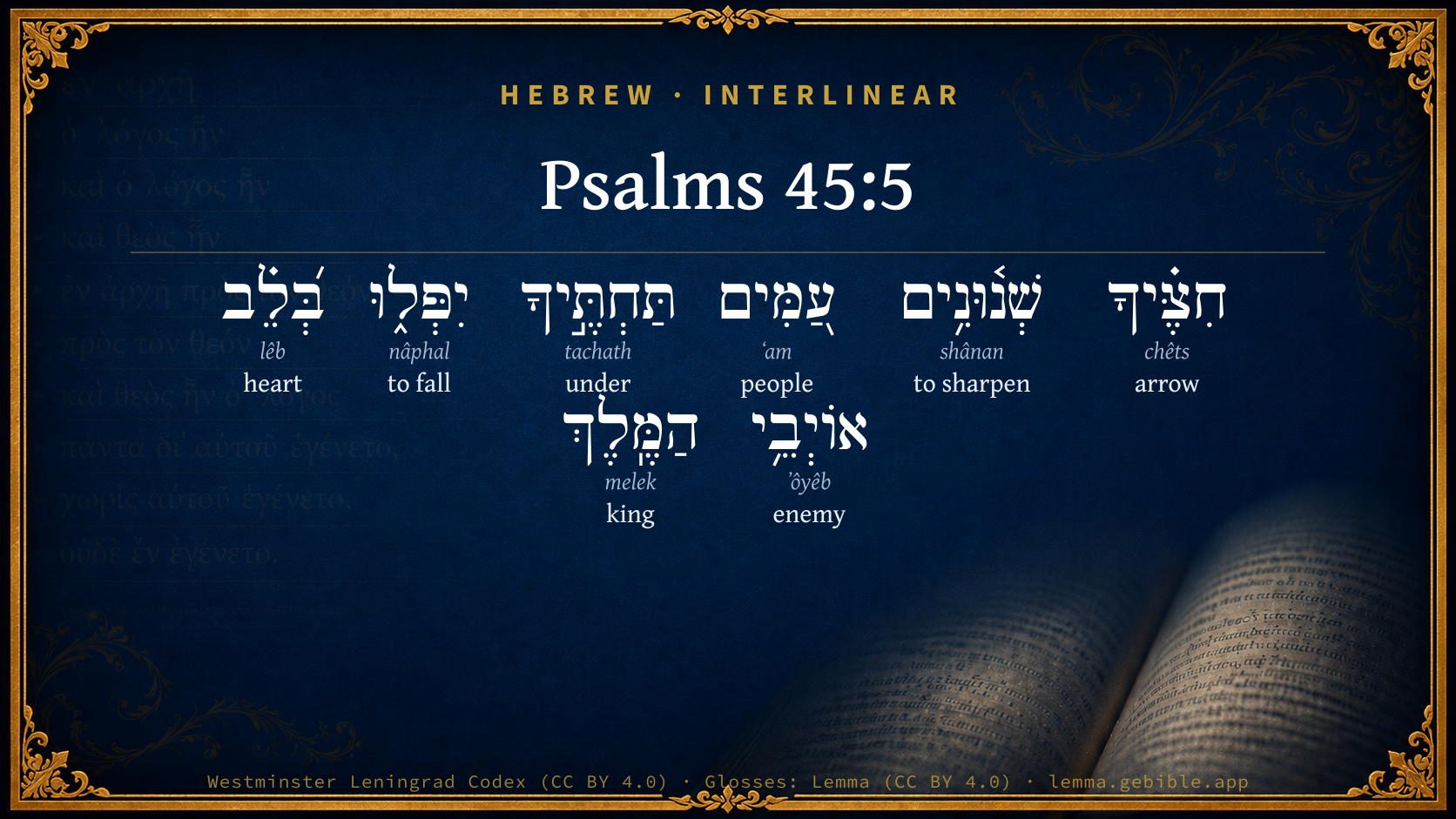
Psalms 45:5

Hebrew (Westminster Leningrad Codex) Psalms 45:5 appears in the Hebrew Old Testament. The text above is from the Westminster Leningrad Codex. Each word links to its Strong’s number, a concise gloss, and parsing drawn from the Open Scriptures Hebrew Bible morphology. Click any word for its full Brown-Driver-Briggs (BDB) entry.
Download image
Cite this verse

Psalms 45:5 (World English Bible). Public Domain. Lemma interlinear Bible study tool, https://lemma.gebible.app/v/psalms/45/5.

Show BibTeX & RIS
BibTeX
RIS
English Translation
Your arrows are sharp. The nations fall under you, with arrows in the heart of the king's enemies.
World English Bible · Public Domain
Download a study sheet

One document with this verse’s original text, its word-by-word gloss line, the meaning frame, cross-references with their text, attributed commentary, and full source and license credits — printable, and it pastes into notes with its structure intact.

This verse Autodidact and up

Study sheet (.html) Plain text (.txt)

A passage Seminary Student

Up to 50 verses in one chapter. A passage sheet keeps up to 6 commentary sources and 12 cross-references per verse, in the order this page ranks them, and says so on the sheet whenever that leaves anything out. Ask for a single verse and you get the Autodidact verse sheet above.

Everything on this page stays free to read, with no account — the sheet is a download of what is already on screen, not access to it.

Want to remove ads? Support Godless Engineer
Compare translations 3

The same verse in 3 English versions, stacked beneath the original-language interlinear above. Click any original word for its lexicon entry.

Each is an independent rendering of the whole verse — the interlinear is not word-aligned to these translations.

Highlighted words mark where these versions differ — a whole-verse word diff, not a word-by-word alignment.

  • World English Bible Public Domain
    Your arrows are sharp. The nations fall under you, with arrows in the heart of the king's enemies.
  • King James Version Public Domain
    Thine arrows are sharp in the heart of the king's enemies; whereby the people fall under thee.
  • unfoldingWord Literal Text CC BY-SA 4.0
    Your arrows are sharp; the peoples fall under you; in the heart of the enemies of the king.

unfoldingWord Literal Text — © unfoldingWord, licensed CC BY-SA 4.0. Word-aligned USFM3 via Door43 (git.door43.org/unfoldingWord/en_ult).

Versions to compare (up to 4)

3 of 4 selected

Show all 18 translations

Every available English version of this verse, each an independent rendering of the whole verse.

  • World English Bible Public Domain
    Your arrows are sharp. The nations fall under you, with arrows in the heart of the king's enemies.
  • Berean Standard Bible Public Domain
    Your arrows pierce the hearts of the king’s foes; the nations fall beneath your feet.
  • Majority Standard Bible Public Domain
    Your arrows pierce the hearts of the king’s foes; the nations fall beneath your feet.
  • King James Version Public Domain
    Thine arrows are sharp in the heart of the king's enemies; whereby the people fall under thee.
  • American Standard Version (1901) Public Domain
    Thine arrows are sharp; The peoples fall under thee; `They are' in the heart of the king's enemies.
  • Revised Version (1885) Public Domain
    Thine arrows are sharp; the peoples fall under thee; they are in the heart of the king’s enemies.
  • Geneva Bible (1599) Public Domain
    Thine arrowes are sharpe to pearce the heart of the Kings enemies: therefore the people shall fall vnder thee.
  • Douay-Rheims (1899) Public Domain
    With thy comeliness and thy beauty set out, proceed prosperously, and reign. Because of truth and meekness and justice: and thy right hand shall conduct thee wonderfully.
  • Young's Literal Translation Public Domain
    Thine arrows `are' sharp, -- Peoples fall under Thee -- In the heart of the enemies of the king.
  • Literal Standard Version CC BY-SA 4.0
    Your arrows [are] sharp—Peoples fall under You—In the heart of the enemies of the King.
  • Unlocked Literal Bible CC BY-SA 4.0
    Your arrows are sharp; the peoples fall under you; your arrows are in the hearts of the king's enemies.
  • unfoldingWord Literal Text CC BY-SA 4.0
    Your arrows are sharp; the peoples fall under you; in the heart of the enemies of the king.
  • Darby Bible Public Domain
    Thine arrows are sharp -- peoples fall under thee -- in the heart of the king's enemies.
  • World Messianic Bible Public Domain
    Your arrows are sharp. The nations fall under you, with arrows in the heart of the king’s enemies.
  • Webster's Bible Public Domain
    \\45:4\\And in thy majesty ride prosperously because of truth and meekness and righteousness; and thy right hand shall teach thee terrible things.
  • Free Bible Version CC BY-SA 4.0
    Your sharp arrows pierce the hearts of your enemies; the nations fall under you.
  • Bible in Basic English Public Domain
    Your arrows are sharp in the heart of the king's haters; because of them the peoples are falling under you.
  • JPS Tanakh (1917) Public Domain
    (45-6) Thine arrows are sharp — the peoples fall under thee — they sink into the heart of the king's enemies.

Literal Standard Version (2020), Covenant Press — licensed CC BY-SA 4.0. Text via the HelloAO Bible API (eBible.org). Unlocked Literal Bible (unfoldingWord) — licensed CC BY-SA 4.0. Text via the HelloAO Bible API (eBible.org). unfoldingWord Literal Text — © unfoldingWord, licensed CC BY-SA 4.0. Word-aligned USFM3 via Door43 (git.door43.org/unfoldingWord/en_ult). Free Bible Version, Dr. Jonathan Gallagher — licensed CC BY-SA 4.0. Text via the HelloAO Bible API (eBible.org).

Word by word

More ways to search: Search by grammar → Find every occurrence → Compare this word →

Practice this passage: Drill this verse → Learn its vocabulary →

שְׁנ֫וּנִ֥ים
shânan
H8150
“sharpened”
Verb, Qal, Participle Passive, Masculine, Plural, Absolute
Part of Speech
Verb
Stem
Qal
Form
Participle Passive
Gender
Masculine
Number
Plural
State
Absolute
Full BDB Definition

Origin: a primitive root

TWOT: 2422

to sharpen, whet - (Qal) to whet, sharpen - (Piel) to sharpen, teach (incisively) - (Hithpolel) to be pierced
  1. חִצֶּ֗יךָ chêts H2671 “arrows · your” Noun, Common, Masculine, Plural, Construct + Suffix, Personal, 2nd Person, Masculine, Singular
  2. עַ֭מִּים ʻam H5971 “peoples” Noun, Common, Masculine, Plural, Absolute
  3. תַּחְתֶּ֣יךָ tachath H8478 “under · you” Preposition + Suffix, Personal, 2nd Person, Masculine, Singular
  4. יִפְּל֑וּ nâphal H5307 “to fall” Verb, Qal, Imperfect, 3rd Person, Masculine, Plural
  5. בְּ֝לֵ֗ב lêb H3820 “in/at · heart of” Preposition + Noun, Common, Masculine, Singular, Construct
  6. אוֹיְבֵ֥י ʼôyêb H341 “enemy” Verb, Qal, Participle Active, Masculine, Plural, Construct
  7. הַמֶּֽלֶךְ melek H4428 “the · king” Particle, Definite Article + Noun, Common, Masculine, Singular, Absolute

About this verse

These counts appear in no published source. They are computed here, from the morphology-tagged text and Lemma’s own curated glosses. What Lemma adds →

8
words
8
distinct lemmas
Wisdom
section

Notable vocabulary

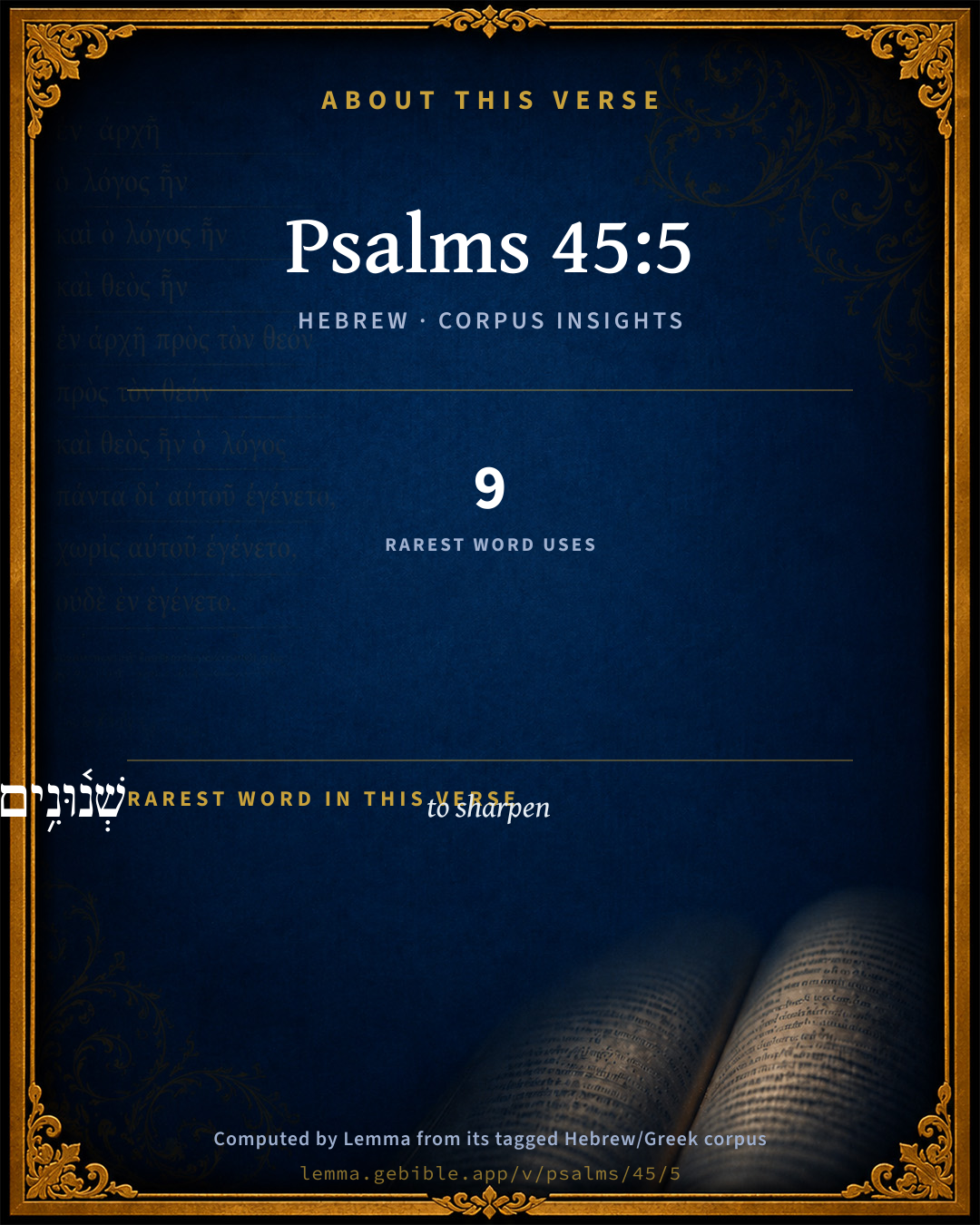
The rarest word here is שְׁנ֫וּנִ֥ים to sharpen H8150 — appearing just 9 times in the whole Hebrew Bible.

Shared distinctive vocabulary

שְׁנ֫וּנִ֥ים to sharpen H8150 occurs in 9 verses of the Hebrew Bible. Also found in:

Grammatical profile

  • 3 verbs
  • 4 nouns
  • 1 preposition

Verb forms

  • שְׁנ֫וּנִ֥ים Qal · Participle Passive
  • יִפְּל֑וּ Qal · Imperfect
  • אוֹיְבֵ֥י Qal · Participle Active

Hebrew & Septuagint length

In English translation the verse runs 18 words from the Hebrew and 21 from the Septuagint (LXX English) — closely comparable.

A rough comparison of the two English renderings, which tokenize alike — not a word-level alignment.

Word counts can differ between the Hebrew and the Greek without any difference in meaning — e.g. the Hebrew direct-object marker אֵת has no separate Greek word, and Greek often adds the article ὁ.

Cross-references

17

Topical passages linked to Psalms 45:5 in the Treasury of Scripture Knowledge — connected by theme and wording, ordered by reader-vote popularity; previews shown in the World English Bible.

  • Psalms 21:12 For you will make them turn their back, When you aim drawn bows at their face.
  • Numbers 24:8 God brings him forth out of Egypt; He has as it were the strength of the wild-ox: He shall eat up the nations his adversaries, Shall break their bones in pieces, Smite [them] through with his arrows.
  • Psalms 38:2 For your arrows have pierced me, Your hand presses hard on me.
  • Psalms 22:27 All the ends of the earth shall remember and turn to Yahweh. All the relatives of the nations shall worship before you.
  • Zechariah 9:13–14 For indeed I bend Judah as a bow for me. I have filled the bow with Ephraim; And I will stir up your sons, Zion, Against your sons, Greece, And will make you like the sword of a mighty man.
  • Psalms 66:3–4 Tell God, "How awesome are your deeds! Through the greatness of your power, your enemies submit themselves to you.
  • Romans 15:18–19 For I will not dare to speak of any things except those which Christ worked through me, for the obedience of the Gentiles, by word and deed,
  • Psalms 2:1–9 Why do the nations rage, And the peoples plot a vain thing?
  • Luke 19:42–44 saying, "If you, even you, had known today the things which belong to your peace! But now, they are hidden from your eyes.
  • Acts 4:4 But many of those who heard the word believed, and the number of the men came to be about five thousand.
  • Acts 6:7 The word of God increased and the number of the disciples multiplied in Jerusalem exceedingly. A great company of the priests were obedient to the faith.
  • Luke 20:18–19 "Everyone who falls on that stone will be broken to pieces, But it will crush whomever it falls on to dust."
  • Acts 2:37 Now when they heard this, they were cut to the heart, and said to Peter and the rest of the apostles, "Brothers, what shall we do?"
  • Acts 2:41 Then those who gladly received his word were baptized. There were added that day about three thousand souls.
  • Acts 5:14 More believers were added to the Lord, multitudes of both men and women.
  • Acts 5:33 But they, when they heard this, were cut to the heart, and determined to kill them.
  • Acts 7:54 Now when they heard these things, they were cut to the heart, and they gnashed at him with their teeth.

Cross-references courtesy of OpenBible.info (CC BY 4.0).

Hebrew and Greek witnesses Masoretic Hebrew ↔ Greek Septuagint

The same verse in the two great witnesses to the Old Testament, shown verse-for-verse.

You’re reading Greek Psalm 44 (Hebrew Psalm 45). The Septuagint counts the superscription, so verse numbers can differ from the Hebrew — chapter-level alignment, not verse-by-verse. Numbering follows Rahlfs.

These are two independent witnesses, not word-aligned to each other, and the Septuagint is shown in lemma (dictionary) form.

Hebrew Psalms 45:5 Masoretic · Westminster Leningrad Codex

חִצֶּ֗יךָ שְׁנ֫וּנִ֥ים עַ֭מִּים תַּחְתֶּ֣יךָ יִפְּל֑וּ בְּ֝לֵ֗ב אוֹיְבֵ֥י הַמֶּֽלֶךְ

Your arrows are sharp. The nations fall under you, with arrows in the heart of the king's enemies.

World English Bible · Public Domain

Greek LXX Greek Psalm 44:5 Septuagint · lemma form

καί ἐντείνω καί καταεὐοδόω καί βασιλεύω ἕνεκεν ἀλήθεια καί πραΰτης καί δικαιοσύνη καί ὁδηγέω σύ θαυμαστῶς ὁ δεξιός σύ

Your weapons are sharpened, Mighty One, (the nations shall fall under you) they are in the heart of the king's enemies.

LXX2012 (modern English Septuagint) · Public Domain

Hebrew: Westminster Leningrad Codex (CC BY 4.0). Greek: Septuagint (public domain); English from LXX2012 (modern English Septuagint) (Public Domain). How the Septuagint differs from the Hebrew →

Commentary

Notes on Psalms 45:5 from classic Christian and Jewish commentators (each source and its license shown beneath its notes). The classic Christian expositions comment on the surrounding passage and are grouped to its opening verse, so a note may address several verses; the Jewish commentaries on the Tanakh (Rashi and others) are per-verse, so they appear only where the commentator wrote on this verse.

Lemma curates 59 commentaries, every one of them public domain or Creative Commons licensed, each selected and text-cleaned for this edition rather than reprinted as found. About our sources →

Trapp's Complete Commentary

John Trapp

Psa 45:5 Thine arrows [are] sharp in the heart of the king’s enemies; [whereby] the people fall under thee.

Ver. 5. Thine arrows are sharp, &c.] Peter’s converts were pricked at heart; and Stephen’s hearers were cut to the heart, Act 2:37; Act 7:54. Christ can fetch in his rebels afar off; he hath arrows as well as a sword, to wound them; that men may either bend or break, yield or become his footstool; one way or other he will surely have the better of them.

John Trapp, A Commentary or Exposition upon All the Books of the Old and New Testament (1647–1656) — public domain. Text from a community e-Sword module.

The Biblical Illustrator

Joseph S. Exell

Psa_45:5

Thine arms are sharp in the heart of the Kings enemies: whereby the people fall under Thee.

Enemies turned into friends

I. The arrow of conviction. It is sharp in the heart, and is sure to kill the man. Where there is real conviction of sin the man is sure to become dead to what he was. If he were a profligate he now becomes a praying man; if a Pharisee, a self-loathing, self-despairing man; he will be humbled in the dust before God. This may explain the words, Let the brother of low degree rejoice in that he is exalted, as he is exalted when picked up from the dunghill of profligacy. And the Pharisee may rejoice that he is brought low. The two, meeting, may rejoice together for what God has done for them. There is a great variety of things the Lord turns into arrows. Dissatisfaction with self; the man gets into a pensive, moody state of mind, confesses himself unhappy, and begins to think the Christian the happiest man after all. The Lord may use this. Or the loss of a child may lead the mother to think about her own future state. What if it had been she who was taken. Or the loss of a friend, or husband, or wife, teaches the solemnity of death and the uncertainty of all human hopes. I have known mens own bad conduct sometimes turned into an arrow of conviction; I have known instances; two young men engaged to go out one Sunday and swear all the oaths they could think of. These oaths were turned, the awfulness of it, into an arrow of conviction to the one; he was stopped, paralyzed, and could no longer go on. Then again men may see that, though much despised and spoken against, Christians are best off after all, There is no sudden conviction here, no terror; the arrow may enter the heart almost imperceptibly, so gently, that they can hardly tell the time when they were converted. It does not matter if you are really Christs now. Or affliction, loss of property--this oftentimes--has been used of God. And, very often, usually by the Word itself. So, then, whatever the means were, if we are but brought,, if the arrow of conviction has but entered the heart, whether suddenly from the bow of Gods truth, whether from your own thoughts, whether from loss of friends, or property, or affliction, or whatever may be the means, if the conviction be but there, then thou art saved, for my text says, Whereby the people fall under Thee. This is sure to be the effect, only there must be this personal wounding more or less, this personal conviction, so as to bring you down to pray for yourself. For note--

II. The sure effect.

The people fall under Thee. Under the Lord Jesus Christ. He is the very Son of God. (James Wells.)

The arrows of Zions King, sharp in the hearts of His enemies, and the people falling in subjection under Him

I. Inquire who may be said to be Christs enemies. In general we may observe that He has as many enemies as there are devils in hell and irregenerate men upon earth. Should it then be inquired, What way do men evidence their enmity at Christ? We answer--

1. By setting up their own wisdom and carnal reasoning in opposition to the revelation He has made of His Fathers will to us in the Gospel.

2. By refusing to submit to His righteousness revealed in the Gospel (Rom_10:3).

3. By declining His yoke, and refusing to take on His burden.

4. By neglecting and despising His ordinances.

5. By persecuting His servants and people, both by tongue and hand.

6. By unbelief.

7. By raising, propagating and defending error.

8. By apostatizing from Christ after professing subjection to Him and kindness for Him.

9. By affecting to be neither His friends nor His foes; they do not choose to oppose religion, and as little can they think to be seen taking part with it. There are many other ways whereby the natural enmity of the heart exerts itself against Christ, which we cannot insist upon; such as resting on a form of godliness without seeking acquaintance with the power of it; living in the neglect of known duty when the Lord gives them an opportunity to perform it. Taking up with the hope of the hypocrite, and retaining a heart enmity to Christ under the cloak of pretended friendship. This is, indeed, a way of exerting the enmity of the heart against Christ, that eludes the eye of man; but He sees it, who will in a little make all the Churches know that He searches the hearts and tries the reins of the children of men.

II. Speak of that work of Christ which consists in his making his enemies become his friends by means of the gospel.

1. When our Lord Jesus is about to bring a person into u state of friendship with Himself, He convinces the man of the sinfulness of his condition, persuading him both of the reality of his enmity against Him, and the danger to which he is exposed on account of it.

2. Our Lord having thus convinced the sinner of his sin, He also shows him the danger to which it exposes him, letting him see that they who do the things with which He stands chargeable are worthy of death.

3. As our Lord Jesus convinces the man of his danger on account of his sin, He also causes him to see the vanity and fruitlessness of every attempt he is ready to make in order to recommend himself to the Divine favour by his own works of righteousness.

4. The Spirit of God enlightens the mind of the convinced and awakened sinner in the knowledge of Christ; He destroys the veil of ignorance: wherewith the mans understanding was covered, and shines into his heart, giving him the light of the knowledge of the glory of God as it is displayed in the person of our glorious Immanuel.

5. Christ having made Himself known to the sinner, the Spirit apprehends the man for Christ, works faith in his heart, with all the other saving graces which are inseparably connected with it; and having implanted faith in the soul by means of the promise, He draws it forth into exercise SO as that the soul is brought actually to embrace the Saviour and close with Him.

III. Offer some thoughts upon the effect of that work which consists in Christs making his enemies become his friends.

1. A real sense of the persons error and mistake in taking up the weapons of rebellion against God.

2. Falling in subjection under Christ includes in it faiths views of forgiveness, notwithstanding all the provocations the man sees himself chargeable with.

3. A sinners falling under Christ by kindly subjecting the heart and soul to Him, has in it a holy blushing and confusion of face on account of sin the man has done.

4. This falling under Christ includes in it a cordial renouncing and giving up with every other lord and lover lisa. 26:13).

5. It includes a hearty embracing of, and closing with, Christ as our Saviour, Head and Husband.

6. It has in it a solemn giving up of the Whole man unto Christ, to be saved by Him, and also to serve Him.

IV. The application.

1. Of information.

(1) We may see from this subject the woeful condition which all men are in by nature; they are enemies to God in their minds, and daily discovering they are so in their life and conversation (Col_1:21).

(2) We may see that men are not only enemies to God, but obstinately so; they are disposed to continue in that unhappy condition until Divine power is exerted in their behalf.

(3) We may see the kindness and love of God toward sinners of mankind in devising means to have them brought back into a state of favour and friendship with Himself.

(4) We may see the power and efficacy of the Word of Christ when accompanied by the Spirit.

(5) We may see that there is no standing it out against the Captain of salvation; His arrows are sharp and piercing. All must either bow to Him, and yield Him the subjection of faith, or be broken by the iron rod of His irresistible power.

(6) We may from this subject infer the safety and preservation of the Church and every particular believer. Zions King is a man of war; He fights for Mount Zion and the hill thereof. He is never at a loss to strike a blow with success upon His adversaries; for strong is His hand, and high is His right hand.

2. Of examination. Have you really seen the contrariety of your nature and practice to the image, will, and holy law of God? Has the Holy Spirit convinced you of sin, because ye believed not on the only begotten Son of God? Have you really received Christ Jesus the Lord in all His offices?

3. Of exhortation.

(1) We exhort such of you as are brought over to Christ, by the all-conquering power of His Spirit and grace, to bless the Lord, that ever He was pleased to make a saving revelation of His powerful arm to you, determining you to give up with the service of sin and Satan, and take on the yoke of Christ.

(2) We exhort you, who have had, it may be, some experience of what is affirmed concerning the arrows of Christ in the text, but have not as yet been brought to fall under Him, in a kindly manner, taking Him as the Captain of your salvation; we intreat you to beware of stifling your convictions and quenching the motions of the Holy Spirit.

(3) We exhort all who may be labouring under convictions to be on their guard against giving way to despondency or despair, though for the present you may not see anything but blackness, darkness and tempest, attended with the trumpet sounding loudly from Mount Sinai; yet you know not how soon the day may break and the shadows flee away.

(4) It may, perhaps, be the case with some that they cannot say but they have had some convictions; yet they have not had experience of so many strong and lasting convictions as they have heard and read of in the case of others, and so labour under doubts and fears whether or not they are yet brought over to Christ. If Christ be precious to you, if your souls cleave to the covenant of promise in faith and love; and if sin be the object of your real hatred, you have reason to conclude you are passed from death to life and shall never come into condemnation.

(5) We exhort you who are yet in the camp of Satan, and so acting the part of enemies to Zions King to consider the sinfulness of your conduct. You are engaged in a most unrighteous, dangerous and soul-ruining war. (T. Bennet.)

The Saviours conquests in the hearts of His enemies

I. Who are the enemies with whom the Saviour carries on a strife of mercy in seeking to subdue them unto Himself? They are mankind at large, all men by nature. And every believer was once His enemy and the bond-servant of sin. To this point our view can never be too stedfastly or too intensely directed. For until we see the guilt, the shame, the destitution, the ingratitude, the misery, and (if God interfere not to save), the hopelessness of every natural mans rebellion against his Maker, and the suicidal hand with which, in this dreadful treason, he is striking at every interest of his own soul as the soldier of Satan, and the slave of sin, he can have no saving view of a Redeemer; he cannot know the love of Christ which passeth knowledge; he cannot be filled with all the fulness of God.

II. Against these enemies what are the weapons employed, and with what success? They are the arrows of God in Christ reconciling the world to Himself, sharp in the heart of the Kings enemies, whereby the people fall under Him. They are so called from the suddenness, the secrecy and the swiftness of their motion. And every one of the arrows of Christ, piercing and penetrating as they all are, is taken from the same exhaustless quiver, brought by the victorious Lamb from heaven, wherewith to subdue His enemies. And whereof are they made? Feather, shaft and point, they are wholly and entirely love, pure, unimaginable, undeserved, unconditional, everlasting love. These arrows probe the wound that hath been slightly healed by the deceitfulness of sin, and probe it to the quick. They force the humbled transgressor toffee from himself and take refuge in the righteousness of Christ. Oh, it is a wonderful process, and as sure as it is wonderful, whereby that arrow of the Word, when it reaches a sinner, alters the whole mass of the minds affections, that he can no more stay himself up in the chariot of his guilty battle against God, but is carried forth that he may be dead indeed unto sin. If I should strike a rock of marble or adamant with an arrow, and see it cleft, and gushing out with water, I must needs imagine some wonderful and secret virtue to have wrought an effect so strange. Now, our hearts are of themselves harder than the nether millstone. When, therefore, the arrows of the love of Christ strike them so mightily, yet so tenderly, and transforms the soul into His nature, who can question whence it comes and where the glory ought to be? But, while there are these arrows of love, there are also arrows of wrath in a quiver of judgment for obdurate sinners. What these are may we never know. (J. P. Buddieom, M. A.)

Effective soul archery

(Psa_45:5):--There was something very fascinating about the archery of olden times. Perhaps you do not know what they could do with the bow and arrow. Why, the chief battles fought by the English Plantagenets were with the longbow. They would take the arrow of polished wood and feather it with the plume of a bird, and then it would fly from the bowstring of plaited silk. The broad fields of Agincourt and Solway Moss and Nevilles Cross heard the loud thrum of the archers bowstring. Now, we have a mightier weapon than that. It is the arrow of the Gospel; it is a sharp arrow; it is a straight arrow; it is feathered from the wing of the dove of Gods Spirit; it flies from a bow made out of the wood of the Cross. As far as I can estimate or calculate, it has brought down four hundred million souls. Paul knew how to bring the notch of that arrow on to that bowstring, and its whirr was heard through the Corinthian theatres, and through the courtroom, until the knees of Felix knocked together. It was the arrow that stuck in Luthers heart when he cried out, Oh, my sins! Oh my sins! If it strike a man in the head it kills his scepticism; if it strike him in the heel it will turn his step; if it strike him in the heart, he throws up his hands as did one of old when wounded in the battle, crying, O Galilean, Thou hast conquered! (T. De Witt Talmage.)

The Biblical Illustrator, edited by Joseph S. Exell (c. 1880s–1900s) — public domain. Text from a community e-Sword module.

Joseph Benson's Commentary

Psa 45:5. Thine arrows are sharp, &c. — The allusion to an earthly conqueror is still continued. The arrows mean the same with the sword, both denoting the instruments wherewith he conquers his enemies; which are the truths, precepts, threatenings, promises, &c., of his word. These, when accompanied by the influences of the Holy Spirit, are sharp and powerful, and pierce the hearts of men with conviction of sin, shame, and sorrow, producing frequently terror, dismay, and exquisite distress for a time, till sinners are humbled, subdued, and reconciled. In the heart of the king’s enemies — Of thine enemies, the third person being put for the second, as is frequently done in prophetical writings; and the word king being here brought in probably to describe the persons against whom the arrows are shot, and the reason thereof, because they were enemies of his kingdom, and would not be subject to him. Whereby the people fall under thee — Either slain by thine arrows, or prostrate at thy feet, after the manner of conquered persons. Those that were by nature enemies are thus wounded, in order to their being reduced, reconciled, and made subject to this king; and those that persist in their enmity, in order to their being ruined and destroyed. The arrows of God’s terrors are sharp in their hearts, that they may so fall under him as to be made his footstool, Psa 110:1; that, as they would not submit to his golden sceptre, and have him to reign over them, they may be broken by his iron rod, and slain before him.

Joseph Benson's Commentary on the Old and New Testaments (1811–1818) — public domain. Text from a community e-Sword module.

J. A. Alexander on Psalms

Joseph Addison Alexander

6. (Psa 45:5). Thine arrows are sharp—nations under thee shall fall—in the heart of the king's enemies. The word translated sharp is properly a participle meaning sharpened, like acutus from acuo, and may here have the same sense as in Isa 5:28, whose arrows are sharpened and all his bows bent, i.e. all his weapons of war ready for immediate use. Nations, not merely individuals, nor even armies, but whole nations, a description peculiarly, though. not exclusively, appropriate to a superhuman conqueror. In order to remove the apparent incoherence of the second and third members of the sentence, some give heart the local sense of midst. "Nations shall fall under thee in the midst of the king's enemies." But this explanation of heart is not justified by usage, and the king's enemies are evidently the nations themselves. Others make the second clause a vocative—thou under whom the nations fall—or a mere parenthesis, with a verb supplied after it—thy sharp arrows (nations fall under thee) shall penetrate into the heart of the king's enemies. But these are forced if not ungrammatical constructions, and by far the simplest solution is to repeat the first clause before the third—thine arrows are sharp—nations fall under thee—(thine arrows are sharp) in the heart of the king's enemies. This is the more natural, as the falling of the nations is supposed to be produced by the arrows. "Thine arrows are sharpened, and ready for the conquest of the nations; yes, thine arrows are already sharp in the heart of the king's enemies." This last expression does not refer to a different person from the one addressed, but is merely a more emphatic way of saying, "thine enemies, O king!"

Joseph Addison Alexander, The Psalms Translated and Explained (1850) — public domain. Text from a community e-Sword module.

Jamieson, Fausset & Brown

Robert Jamieson, A. R. Fausset & David Brown

The result.

people--Whole nations are subdued.

Jamieson, Fausset & Brown — Commentary Critical and Explanatory on the Whole Bible (1871) — public domain (CC PDM 1.0). Text via the HelloAO Bible API.

Adam Clarke's Commentary

Verse 5. Thine arrows are sharp] The arrows here may mean the convictions produced in the hearts of men by the preaching of the Gospel. The King is God himself; his enemies are sinners of all sorts. The people, the Jews, thousands of whom were pricked in their hearts under the preaching of Peter and others. All fall before Christ; those who received the word rose again by repentance and faith; those who did not, fell down-all down!

Adam Clarke's Commentary on the Bible (1810–1826) — public domain. Text from a community e-Sword/MySword module.

John Calvin's Commentaries

5. Thy arrows are sharp, etc. Here the Psalmist again refers to warlike power, when he says that the arrows of the king shall be sharp, so that they shall pierce the hearts of his enemies; by which he intimates that he has weapons in his hand with which to strike, even at a distance, all his enemies, whoever they may be, who resist his authority. In the same sense also he says that the people shall fall under him; as if it had been said, Whoever shall engage in the attempt to shake the stability of his kingdom shall miserably perish, for the king has in his hand a sufficiency of power to break the stubbornness of all such persons.

John Calvin's Commentaries (1540-1563) — public domain. Text from the Calvin Translation Society English edition (1840s-50s) via the Christian Classics Ethereal Library (ccel.org). Calvin's coverage is partial (roughly two-thirds of the Bible); uncommented books and verses are honest gaps, never fabricated. The 19th-century editor's footnotes and remarks are omitted so the notes are faithfully Calvin's own voice.

Ellicott's Commentary for English Readers

(5) Thine arrows.—Our version has transposed the clauses of this verse. The original is more vivid.

“Thine arrows are sharpened—

The people under Thee fall—

Against the heart of the king’s enemies.”

The poet actually sees the battle raging before him.

A Bible Commentary for English Readers, edited by Charles John Ellicott (1878–1897) — public domain. Text from a community e-Sword module.

The Cambridge Bible for Schools and Colleges

gen. ed. J. J. S. Perowne

5. As the text stands it must be rendered;

Thine arrows are sharp;

Peoples fall under thee:

(They are) in the heart of the king’s enemies.

The poet depicts the battle with rapid vigorous strokes of his pen. The king’s arrows are sharpened (Isa_5:28), ready for fatal effect; his enemies fall at their discharge; he rides on over their prostrate corpses; each shaft has found its mark in the heart of a foe. But the construction is abrupt, and possibly there is some error in the text.

The Cambridge Bible for Schools and Colleges (gen. ed. J. J. S. Perowne; Cambridge University Press, 1878–1918) — public domain. Text from a community e-Sword module.

John Gill's Exposition

Thine arrows are sharp in the heart of the king's enemies,.... Meaning either the Jews, who were the implacable enemies of Christ, and who would not have him to reign over them; in the midst of whom were sent his arrows, of the sword, famine, and pestilence, and which were very sharp, and made sad havoc among them, and caused such a time of tribulation as was not before, or has been since, Mat 24:21; or else the doctrines of the Gospel. The Scriptures are the quiver out of which they are taken; the Gospel is the bow into which they are put, and out of which they are shot; and ministers are the archers that draw the bow at a venture, and shoot them; and which are compared to "arrows" for their swift, sudden, and secret motion, and for their piercing and penetrating power and efficacy: and these are Christ's, which he is the author of, and which he makes use of to good purpose, by striking the hearts of his people with them, who in their state of unregeneracy are enemies to him; which appears by their wicked works, and as they were when he died for them, and reconciled them to God; by means of which arrows fixed in them, and with which their hearts are pricked and wounded, they submit unto him, signified by the next clause:

whereby the people fall under thee: acknowledge themselves sinners; fall down at his feet; humbly implore his grace and mercy; submit to his righteousness; depend on him alone for salvation; adore him, and give him the glory of it, as well as become subject to his laws and ordinances. This is to be understood of those who are God's covenant people, whom he has given to Christ, and he has redeemed by his blood; and particularly the Gentiles, who were not a people, but now openly are, in distinction from the Jews, the enemies of the King Messiah.

John Gill's Exposition of the Whole Bible (1746–1763) — public domain (CC PDM 1.0). Text via the HelloAO Bible API.

Albert Barnes' Notes on the Bible

Thine arrows are sharp in the heart ... - literally, “Thine arrows are sharp - the people under thee shall fall - in the heart of the enemies of the king.” The process of “thought” in the verse seems to be this: First. The “arrows” are seen as sharp or penetrating. Second. The “people” are seen falling as those arrows are shot forth. Third. It is seen that those who fall are the “enemies of the king,” and that the arrows have pierced the “heart.” The word “sharp” is applied to the arrows as denoting that they were adapted to “pierce.” Sometimes arrows are blunted, or with a thick head, rather adapted to smite with force than to wound by penetrating. The bow and the arrow were common instruments in ancient wars, and were mainly used by those who went forth to battle in a chariot. Compare 1Ki 22:34; 2Ki 9:21-24. As pertaining to the Messiah, the reference here is, of course, to the “truth,” and to the power of that truth in penetrating the hearts of people. Compare the notes at Heb 4:12.

In the heart of the king’s enemies - That is, the “truths” stated by the Messiah, the conquering king, would penetrate deep into the soul, and slay the sinner, the enemy of the king, that is, of the Messiah. The idea is, that truth would produce an effect in regard to the hopes of the sinner - his self-confidence - his life “as” a sinner - like that which the arrow does when it penetrates the heart. Compare Rom 7:9 : “For I was alive without the law once, but when the commandment came, sin revived and I died.” See also the notes at Rom 7:10-11.

Whereby the people fall under thee - As the effect of the arrows; as the effect of truth. The representation is that of victory. As here represented, it is the victory of truth; a conquest by subjecting people to the authority and reign of God.

Albert Barnes' Notes on the Bible (1834–1885) — public domain. Text from a community e-Sword/MySword module.

Matthew Poole's English Annotations

Thine arrows; the same thing for substance with the sword, Psa 45:3, both noting the instruments by which he conquers his enemies; which is no other than his word, which is sharp and powerful, and pierceth the hearts of men, Heb 4:12; which also first wounds sinners, and then heals them; and which is for the fall as well as for the rising of many, Luk 2:34, and for judgment as well as for mercy, Joh 9:39; to some a savour of death, and to others a savour of life, 2Co 2:16; and therefore is fitly compared to arrows; which title is sometimes given to words, as Psa 64:3, and frequently to God’s plagues or judgments, Deu 32:23; Psa 18:14; 64:7, such as the word becomes to ungodly men by their own fault. And these metaphorical weapons are oft ascribed to Christ, who hath a bow, Rev 6:2, and weapons of warfare, 2Co 10:4, and whose mouth God is said to make a sword and an arrow, Isa 49:2.

Of the king’s enemies, i.e. of thine enemies; the third person being put for the second, as is usual in prophetical writings; which here may seem to have some emphasis, as describing the persons against whom he shot his arrows, and the reason why he did so, because they were the enemies of his kingdom, and would not have him to reign over them, Luk 19:27.

The people fall under thee; either as slain by thine arrows; or as prostrate at thy feet, after the manner of conquered persons, Psa 18:38; 20:8. According to this and many other translations the words are transplaced, which in the Hebrew lie thus, Thine arrows are sharp, whereby the people do fall under thee, in the heart (i. e. in the midst, which is oft called the heart, as Exo 15:8; Deu 4:11. And so it may be here; for the army, as such, hath no heart, properly so called. And so this is fitly alleged, as a proof of the sharpness and force of his arrows, that they not only wound those who march in the front, but even those who are in the midst of the army, where they may seem secure, and out of-their reach) of the king’s enemies. But the middle words may be, and are by many, included within a parenthesis, and so they may agree with our translation thus, Thine arrows are sharp (for the people fall under thee, which is an evidence of their sharpness) in the heart (or, against the heart; or, piercing into the heart; which is an easy and usual ellipsis) of the king’s enemies.

Matthew Poole's English Annotations on the Holy Bible (1683–1685) — public domain. Text from a community e-Sword/MySword module.

The Treasury of David

Charles H. Spurgeon

Ver. 5. Thine arrows. Our King is master of all weapons: he can strike those who are near and those afar off with equal force. Are sharp. Nothing that Jesus does is ill done, he uses no blunted shafts, no pointless darts. In the heart of the King's enemies. Our Captain aims at men's hearts rather than their heads, and he hits them too; point blank are his shots, and they enter deep into the vital part of man's nature. Whether for love or vengeance, Christ never misses aim, and when his arrows stick, they cause a smart not soon forgotten, a wound which only he can heal. Jesus' arrows of conviction are sharp in the quiver of his word, and sharp when on the bow of his ministers, but they are most known to be so when they find a way into careless hearts. They are his arrows, he made them, he shoots them. He makes them sharp, and he makes them enter the heart. May none of us ever fall under the darts of his judgment, for none kill so surely as they. Whereby the people fall under thee. On either side the slain of the Lord are many when Jesus leads on the war. Nations tremble and turn to him when he shoots abroad his truth. Under his power and presence, men are stricken down as though pricked in the heart. There is no standing against the Son of God when his bow of might is in his hands. Terrible will be that hour when his bow shall be made quite naked, and bolts of devouring fire shall be hurled upon his adversaries: then shall princes fall and nations perish.

Ver. 5. Thine arrows are sharp in the heart of the King's enemies. In a still bolder metaphor the arrows which are discharged from the bow of Christ are the preachers of the gospel, especially the apostles and evangelists. "His sagittis, "says S. Jerome, "totus orbis vulneratus et captus est." Paul, the apostle, was an arrow of the Lord, discharged from his bow from Jerusalem to Illyricum, and from Illyricum to Spain, flying from east to west, and subduing Christ's enemies beneath his feet. Christopher Wordsworth.

Ver. 5. While beseeching the Redeemer to ride forth prosperously, and predicting his success, he seems suddenly to have seen his prayers answered and his predictions fulfilled. He saw his all conquering Prince gird on his resistless sword, array himself in glory and majesty, ascend the chariot of his gospel, display the banner of his cross, and ride forth, as on the wings of the wind, while the tremendous voice of a herald proclaimed before him: "Prepare ye the way of the Lord, "exalt the valleys, and level the hills; make the crooked ways straight, and the rough places plain; for, behold, the Lord God comes; he comes with a strong hand, his reward is with him, and his work before him. From the bright and fiery cloud which enveloped his chariot, and concealed it from mortal eyes, he saw sharp arrows of conviction shot forth on every side, deeply wounding the obdurate hearts of sinners, and prostrating them in crowds around his path, while his right hand extended raised them again, and healed the wounds which his arrows had made; and his omnipotent voice spoke peace to their despairing souls, and bade them follow in his train, and witness and share in his triumph. From the same bright cloud he saw the vengeful lightnings flashing thick and dreadful, to blast and consume everything that opposed his progress; he saw sin, and death, and hell, with all its legions, baffled, defeated, and flying in trembling consternation before him; he saw them overtaken, bound, and chained to his triumphant chariot wheels; while enraptured voices were heard from heaven exclaiming, "Now is come salvation, and strength, and the kingdom of God, and the power of his Christ." Such was the scene which seems to have burst upon the ravished sight of the entranced prophet. Transported with the view, he exclaims, Thine arrows are sharp in the heart of the King's enemies; whereby the people fall under thee. Edward Payson.

Ver. 5. The king's enemies, is not simply an expression for "Thy enemies, "as some think, but rather implies that Christ's kingship is the ground of their enmity; just as in the second Psalm their cry was, "Let us break their bands asunder." George Harpur.

Ver. 5.

1. Arrows of judicial wrath are sharp.

2. Arrows of providential goodness are sharper still.

3. Arrows of subduing grace are sharpest of all. The quiver of the Almighty is full of these arrows. G.R.

Ver. 5. Arrowswhat they are; whose they are; whom they strike; where they strike; what they do; and what follows.

Psalms 45:6*

Charles H. Spurgeon's The Treasury of David (1869–1885) — public domain. Psalms only. Text from a community e-Sword/MySword module.

Whedon's Commentary on the Bible

Daniel D. Whedon

5. The people fall—There is no withstanding the power of the war-king. His enemies submit and return to duty, or perish. See Psalms 2, , 110

Daniel D. Whedon (gen. ed.), Commentary on the Old and New Testaments (1874–1909) — public domain. Text from a community e-Sword module.

The Pulpit Commentary

Thine arrows are sharp in the heart of the king"s enemies; whereby the people fall under thee. The original is more graphic. It runs, "Thy arrows are sharp the peoples fall under thee (they are) in the heart of the king"s enemies." All the enemies of Messiah shall one day be chastised, and fall before him.

The Pulpit Commentary (1880–1919), ed. H.D.M. Spence-Jones & Joseph S. Exell — public domain. Text from a community e-Sword module.

John Wesley's Explanatory Notes

Arrows - The same with the sword, and this is no other than his word, which is sharp and powerful, and pierceth the hearts of men. The kings - Of thine enemies. Fall - Prostrate at thy feet, after the manner of conquered persons.

John Wesley, Explanatory Notes Upon the Whole Bible (1754–1765) — public domain. Text via the GEBible commentary corpus.

unfoldingWord translationNotes

Door43 World Missions Community

the peoples fall under you

This phrase refers to the king defeating his enemies. Possible meanings are 1) "the peoples fall at your feet in surrender" or 2) "the peoples fall dead at your feet."

your arrows are in the hearts of the king's enemies

"your arrows have pierced the hearts of your enemies." The writer speaks to the king while referring to the king in the third person.

Your throne ... is forever and ever

The word "throne" represents the kingdom and rule of the king. AT: "Your kingdom ... is forever and ever" or "You will reign ... forever and ever" (See: Metonymy)

Your throne, God

Possible meanings are that the word "God" 1) is a title for the king, who is God's representative or 2) modifies the word "throne" and means "Your kingdom that God has given you."

a scepter of justice is the scepter of your kingdom

The word "scepter" represents the king's authority to rule his kingdom. AT: "you rule your kingdom with justice" (See: Metonymy)

God, your God, has anointed you with the oil of gladness

The writer speaks of gladness as if it were an oil that God used to anoint the king. That God has anointed him is a symbolic action that represents God's choosing him to be king. AT: "when God appointed you as king, he made you very glad" (See: Metaphor and Symbolic Action)

translationWords

bow and arrow

adversary

throne

God

eternity

scepter

just

kingdom

righteous

evil

anoint

oil

companion

unfoldingWord translationNotes — © Distant Shores Media and the Door43 World Missions Community, licensed CC BY-SA 4.0. Source: git.door43.org/Door43/en_tn.

Rashi

Rabbi Shlomo Yitzchaki (Rashi)

for the sake of truth To instruct according to the law and to behave with righteous humility.

and it shall instruct you The Torah and the matter of truth in which you shall engage shall teach you tactics of war so that your right should perform awesome things. Since he mentions the study of Torah in an expression of war, the expression of the right hand, prepared to fight, is appropriate (i.e., it is customary to fight with the right hand).

Rashi on the Tanakh — English translations: “The Judaica Press complete Tanach with Rashi, translated by A. J. Rosenberg” (CC BY 4.0); “Pentateuch with Rashi's commentary by M. Rosenbaum and A.M. Silbermann, 1929-1934” (public domain); “The Metsudah Tanach series, Lakewood, N.J” (CC BY 4.0); and “The Book of Joshua, Metsudah Publications, 1997” (CC BY 4.0). Text via Sefaria.

Lesson kit

Teaching starters — assembled from the data on this page, not authored interpretation. Every prompt links to the verse data it draws on. Edit before teaching.

Psalms, in the Wisdom, opens this verse with 8 words (8 distinct Hebrew lemmas). Its most distinctive word is shânan (“to sharpen”). A historical commentator’s framing appears above. Read the whole chapter for the surrounding context.

Discussion questions

  1. How does “to sharpen” (shânan) shape what this verse is saying?
  2. Deuteronomy 6:7 shares the word «to sharpen» with this verse. How do the two illuminate each other?
  3. The translations on this page render this verse differently — a whole-verse word diff, not a word-by-word alignment. What might account for the different wordings?
  4. The verb «שְׁנ֫וּנִ֥ים» is Qal Participle Passive. How does its form color the action?
  5. Reading how Trapp's Complete Commentary and The Biblical Illustrator read this verse, where do the two commentators agree and where do they part?

Things to notice

Reading settings

Reading text

Shown beneath each verse's original-language words.

Old Testament
Old Testament edition

Read the OT as the Masoretic Hebrew (MT) or the Greek Septuagint (LXX).

English shown for the Greek Septuagint (in the Hebrew ↔ Greek comparison).

Comparing translations? Open the Compare panel on any verse page to stack up to four side by side.