
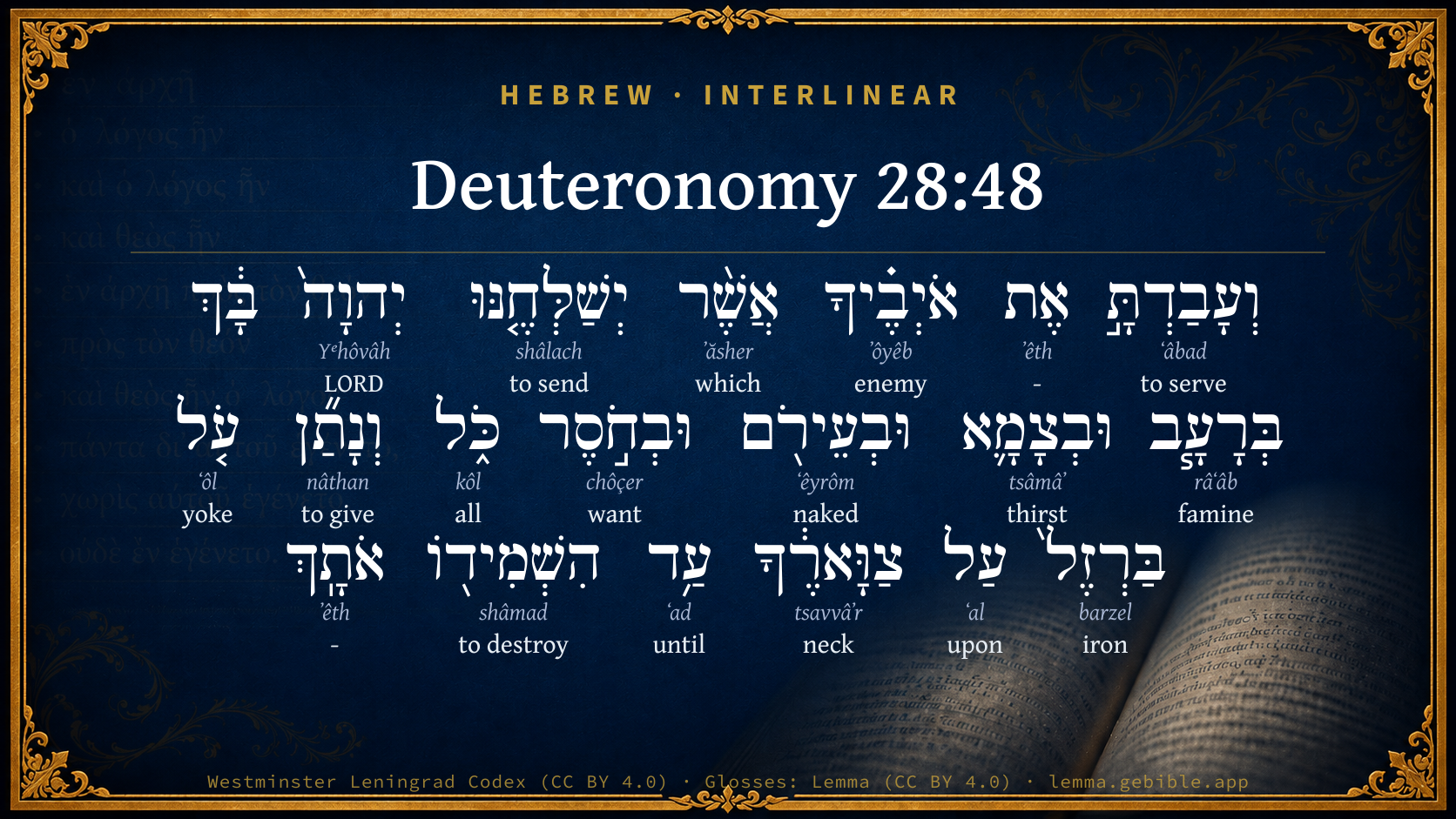
Deuteronomy 28:48

Hebrew (Westminster Leningrad Codex) Deuteronomy 28:48 appears in the Hebrew Old Testament. The text above is from the Westminster Leningrad Codex. Each word links to its Strong’s number, a concise gloss, and parsing drawn from the Open Scriptures Hebrew Bible morphology. Click any word for its full Brown-Driver-Briggs (BDB) entry.
Download image
Cite this verse

Deuteronomy 28:48 (World English Bible). Public Domain. Lemma interlinear Bible study tool, https://lemma.gebible.app/v/deuteronomy/28/48.

Show BibTeX & RIS
BibTeX
RIS
English Translation
therefore shall you serve your enemies whom Yahweh shall send against you, in hunger, and in thirst, and in nakedness, and in want of all things: and he shall put a yoke of iron on your neck, until he have destroyed you.
World English Bible · Public Domain
Highlights
  • 1 first appearance in the Hebrew Bible
Full analysis ↓
Download a study sheet

One document with this verse’s original text, its word-by-word gloss line, the meaning frame, cross-references with their text, attributed commentary, and full source and license credits — printable, and it pastes into notes with its structure intact.

This verse Autodidact and up

Study sheet (.html) Plain text (.txt)

A passage Seminary Student

Up to 50 verses in one chapter. A passage sheet keeps up to 6 commentary sources and 12 cross-references per verse, in the order this page ranks them, and says so on the sheet whenever that leaves anything out. Ask for a single verse and you get the Autodidact verse sheet above.

Everything on this page stays free to read, with no account — the sheet is a download of what is already on screen, not access to it.

Want to remove ads? Support Godless Engineer
Compare translations 3

The same verse in 3 English versions, stacked beneath the original-language interlinear above. Click any original word for its lexicon entry.

Each is an independent rendering of the whole verse — the interlinear is not word-aligned to these translations.

Highlighted words mark where these versions differ — a whole-verse word diff, not a word-by-word alignment.

  • World English Bible Public Domain
    therefore shall you serve your enemies whom Yahweh shall send against you, in hunger, and in thirst, and in nakedness, and in want of all things: and he shall put a yoke of iron on your neck, until he have destroyed you.
  • King James Version Public Domain
    Therefore shalt thou serve thine enemies which the LORD shall send against thee, in hunger, and in thirst, and in nakedness, and in want of all things: and he shall put a yoke of iron upon thy neck, until he have destroyed thee.
  • unfoldingWord Literal Text CC BY-SA 4.0
    so you will serve your enemies that Yahweh will send against you: in hunger and in thirst and in nakedness and in lacking everything. And he will put a yoke of iron on your neck until he destroys you.

unfoldingWord Literal Text — © unfoldingWord, licensed CC BY-SA 4.0. Word-aligned USFM3 via Door43 (git.door43.org/unfoldingWord/en_ult).

Versions to compare (up to 4)

3 of 4 selected

Show all 18 translations

Every available English version of this verse, each an independent rendering of the whole verse.

  • World English Bible Public Domain
    therefore shall you serve your enemies whom Yahweh shall send against you, in hunger, and in thirst, and in nakedness, and in want of all things: and he shall put a yoke of iron on your neck, until he have destroyed you.
  • Berean Standard Bible Public Domain
    you will serve your enemies the LORD will send against you in famine, thirst, nakedness, and destitution. He will place an iron yoke on your neck until He has destroyed you.
  • Majority Standard Bible Public Domain
    you will serve your enemies the LORD will send against you in famine, thirst, nakedness, and destitution. He will place an iron yoke on your neck until He has destroyed you.
  • King James Version Public Domain
    Therefore shalt thou serve thine enemies which the LORD shall send against thee, in hunger, and in thirst, and in nakedness, and in want of all things: and he shall put a yoke of iron upon thy neck, until he have destroyed thee.
  • American Standard Version (1901) Public Domain
    therefore shalt thou serve thine enemies that Jehovah shall send against thee, in hunger, and in thirst, and in nakedness, and in want of all things: and he shall put a yoke of iron upon thy neck, until he have destroyed thee.
  • Revised Version (1885) Public Domain
    therefore shalt thou serve thine enemies which the LORD shall send against thee, in hunger, and in thirst, and in nakedness, and in want of all things: and he shall put a yoke of iron upon thy neck, until he have destroyed thee.
  • Geneva Bible (1599) Public Domain
    Therefore thou shalt serue thine enemies which the Lord shall send vpon thee, in hunger and in thirst, and in nakednesse, and in neede of all things? and he shall put a yoke of yron vpon thy necke vntill he haue destroyed thee.
  • Douay-Rheims (1899) Public Domain
    Thou shalt serve thy enemy, whom the Lord will send upon thee, in hunger, and thirst, and nakedness, and in want of all things: and he shall put an iron yoke upon thy neck, till he consume thee.
  • Young's Literal Translation Public Domain
    thou hast served thine enemies, whom Jehovah sendeth against thee, in hunger, and in thirst, and in nakedness, and in lack of all things; and he hath put a yoke of iron on thy neck, till He hath destroyed thee.
  • Literal Standard Version CC BY-SA 4.0
    you have served your enemies, whom YHWH sends against you, in hunger, and in thirst, and in nakedness, and in lack of all things; and He has put a yoke of iron on your neck until He has destroyed you.
  • Unlocked Literal Bible CC BY-SA 4.0
    therefore will you serve the enemies that Yahweh will send against you; you will serve them in hunger, in thirst, in nakedness, and in poverty. He will put a yoke of iron on your neck until he destroys you.
  • unfoldingWord Literal Text CC BY-SA 4.0
    so you will serve your enemies that Yahweh will send against you: in hunger and in thirst and in nakedness and in lacking everything. And he will put a yoke of iron on your neck until he destroys you.
  • Darby Bible Public Domain
    thou shalt serve thine enemies whom Jehovah will send against thee, in hunger, and in thirst, and in nakedness, and in want of everything; and he shall put a yoke of iron upon thy neck, until he have destroyed thee.
  • World Messianic Bible Public Domain
    therefore you will serve your enemies whom the LORD sends against you, in hunger, in thirst, in nakedness, and in lack of all things. He will put an iron yoke on your neck until he has destroyed you.
  • Webster's Bible Public Domain
    Therefore shalt thou serve thy enemies which the LORD shall send against thee, in hunger, and in thirst, and in nakedness, and in want of all things: and he shall put a yoke of iron upon thy neck, until he hath destroyed thee.
  • Free Bible Version CC BY-SA 4.0
    you will serve your enemies that the Lord sends to attack you. You will be hungry, thirsty, naked, and poor. He will tie an iron yoke on your neck until he has destroyed you.
  • Bible in Basic English Public Domain
    For this cause you will become servants to those whom the Lord your God will send against you, without food and drink and clothing, and in need of all things: and he will put a yoke of iron on your neck till he has put an end to you.
  • JPS Tanakh (1917) Public Domain
    therefore shalt thou serve thine enemy whom the LORD shall send against thee, in hunger, and in thirst, and in nakedness, and in want of all things; and he shall put a yoke of iron upon thy neck, until he have destroyed thee.

Literal Standard Version (2020), Covenant Press — licensed CC BY-SA 4.0. Text via the HelloAO Bible API (eBible.org). Unlocked Literal Bible (unfoldingWord) — licensed CC BY-SA 4.0. Text via the HelloAO Bible API (eBible.org). unfoldingWord Literal Text — © unfoldingWord, licensed CC BY-SA 4.0. Word-aligned USFM3 via Door43 (git.door43.org/unfoldingWord/en_ult). Free Bible Version, Dr. Jonathan Gallagher — licensed CC BY-SA 4.0. Text via the HelloAO Bible API (eBible.org).

Word by word

More ways to search: Search by grammar → Find every occurrence → Compare this word →

Practice this passage: Drill this verse → Learn its vocabulary →

וּבְחֹ֣סֶר
chôçer
H2640
“and · in/at · want of”
Conjunction + Preposition + Noun, Common, Masculine, Singular, Construct
Part of Speech
Conjunction + Preposition + Noun
Type
Common
Gender
Masculine
Number
Singular
State
Construct
Full BDB Definition

Origin: from H2637

TWOT: 705b

want, lack, want of, lack of
  1. וְעָבַדְתָּ֣ ʻâbad H5647 “and · to serve” Conjunction + Verb, Qal, Sequential Perfect, 2nd Person, Masculine, Singular
  2. אֶת ʼêth H853 “-” Particle, Direct Object
  3. אֹיְבֶ֗יךָ ʼôyêb H341 “enemy · you” Verb, Qal, Participle Active, Masculine, Plural, Construct + Suffix, Personal, 2nd Person, Masculine, Singular
  4. אֲשֶׁ֨ר ʼăsher H834 “which” Particle, Relative
  5. יְשַׁלְּחֶ֤נּוּ shâlach H7971 “to send · him” Verb, Piel, Imperfect, 3rd Person, Masculine, Singular + Suffix, Personal, 3rd Person, Masculine, Singular
  6. יְהוָה֙ Yᵉhôvâh H3068 “LORD” Noun, Proper
  7. בְּרָעָ֧ב râʻâb H7458 “in/at · famine” Preposition + Noun, Common, Masculine, Singular, Absolute
  8. וּבְצָמָ֛א tsâmâʼ H6772 “and · in/at · thirst” Conjunction + Preposition + Noun, Common, Masculine, Singular, Absolute
  9. וּבְעֵירֹ֖ם ʻêyrôm H5903 “and · in/at · naked” Conjunction + Preposition + Adjective, Adjective, Masculine, Singular, Absolute
  10. כֹּ֑ל kôl H3605 “all” Noun, Common, Masculine, Singular, Absolute
  11. וְנָתַ֞ן nâthan H5414 “and · to give” Conjunction + Verb, Qal, Sequential Perfect, 3rd Person, Masculine, Singular
  12. עֹ֤ל ʻôl H5923 “yoke of” Noun, Common, Masculine, Singular, Construct
  13. בַּרְזֶל֙ barzel H1270 “iron” Noun, Common, Masculine, Singular, Absolute
  14. עַל ʻal H5921 “upon” Preposition
  15. צַוָּארֶ֔ךָ tsavvâʼr H6677 “neck · your” Noun, Common, Masculine, Singular, Construct + Suffix, Personal, 2nd Person, Masculine, Singular
  16. עַ֥ד ʻad H5704 “until” Preposition
  17. הִשְׁמִיד֖וֹ shâmad H8045 “to destroy · him” Verb, Hiphil, Infinitive Construct + Suffix, Personal, 3rd Person, Masculine, Singular
  18. אֹתָֽךְ ʼêth H853 “- · you” Particle, Direct Object + Suffix, Personal, 2nd Person, Feminine, Singular

About this verse

These counts appear in no published source. They are computed here, from the morphology-tagged text and Lemma’s own curated glosses. What Lemma adds →

20
words
18
distinct lemmas
Pentateuch
section

Notable vocabulary

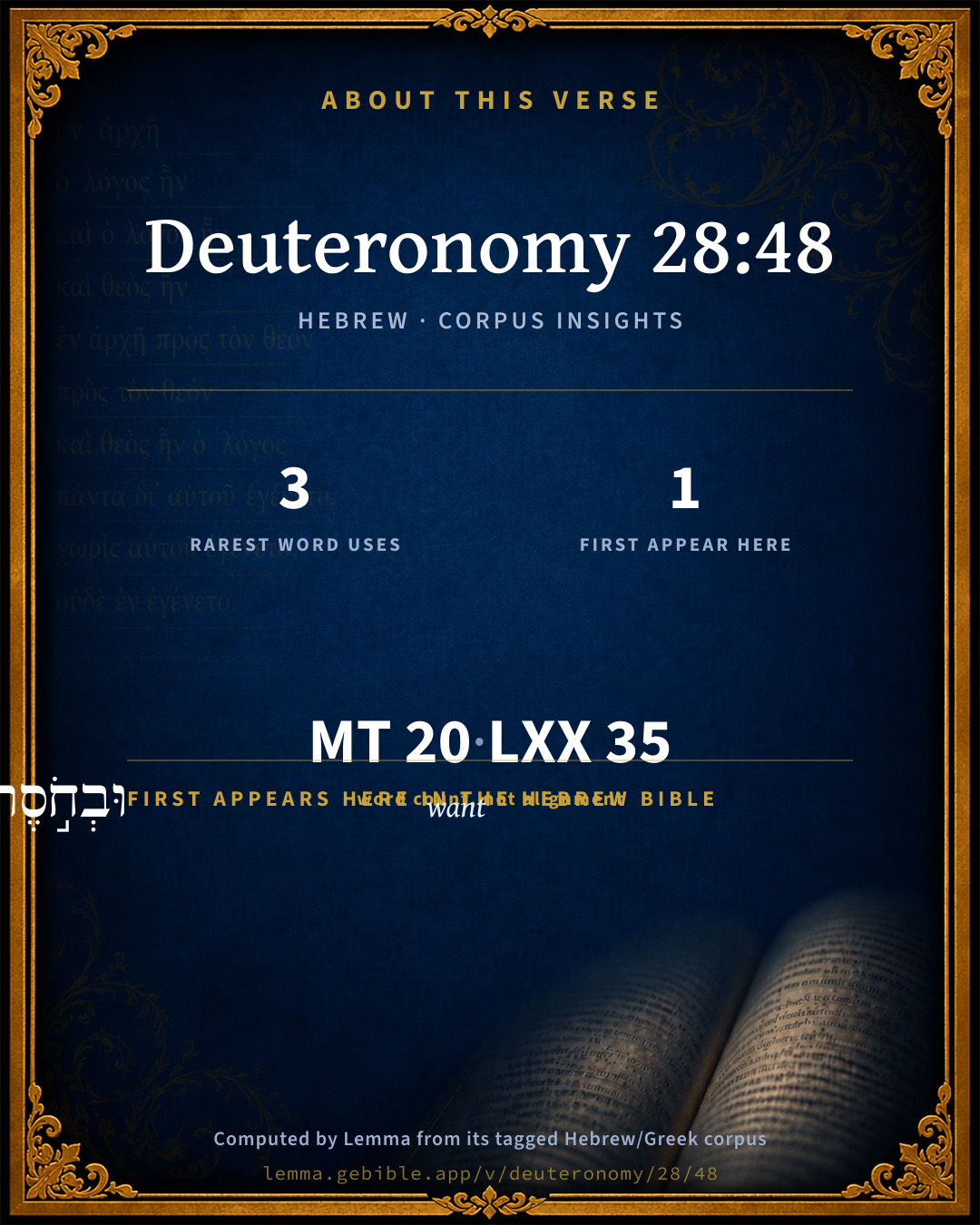
The rarest word here is וּבְחֹ֣סֶר want H2640 — appearing just 3 times in the whole Hebrew Bible.

First appearance in Scripture

This word makes its first canonical appearance in the Hebrew Bible here:

  • וּבְחֹ֣סֶר want H2640

Shared distinctive vocabulary

וּבְחֹ֣סֶר want H2640 occurs in 3 verses of the Hebrew Bible. Also found in:

Grammatical profile

  • 5 verbs
  • 8 nouns
  • 1 adjective
  • 3 prepositions
  • 3 particles

Verb forms

  • וְעָבַדְתָּ֣ Qal · Sequential Perfect
  • אֹיְבֶ֗יךָ Qal · Participle Active
  • יְשַׁלְּחֶ֤נּוּ Piel · Imperfect
  • וְנָתַ֞ן Qal · Sequential Perfect
  • הִשְׁמִיד֖וֹ Hiphil · Infinitive Construct

Hebrew & Septuagint length

In English translation the verse runs 42 words from the Hebrew and 46 from the Septuagint (LXX English) — closely comparable.

A rough comparison of the two English renderings, which tokenize alike — not a word-level alignment.

Word counts can differ between the Hebrew and the Greek without any difference in meaning — e.g. the Hebrew direct-object marker אֵת has no separate Greek word, and Greek often adds the article ὁ.

In the original languages it is 20 Hebrew tokens and 35 Greek tokens — but the two are counted differently (Hebrew bundles its prefixes and suffixes into one token; the Greek is in lemma form), so that isn’t a like-for-like length.

Cross-references

16

Topical passages linked to Deuteronomy 28:48 in the Treasury of Scripture Knowledge — connected by theme and wording, ordered by reader-vote popularity; previews shown in the World English Bible.

  • Jeremiah 28:13–14 Go, and tell Hananiah, saying, Thus says Yahweh: You have broken the bars of wood; but you have made in their place bars of iron.
  • Nehemiah 9:35–37 For they have not served you in their kingdom, and in your great goodness that you gave them, and in the large and fat land which you gave before them, neither turned they from their wicked works.
  • Jeremiah 44:17–18 But we will certainly perform every word that is gone forth out of our mouth, to burn incense to the queen of the sky, and to pour out drink-offerings to her, as we have done, we and our fathers, our kings and our princes, in the cities of Judah, and in the streets of Jerusalem; for then had we plenty of food, and were well, and saw no evil.
  • Jeremiah 44:22 so that Yahweh could no longer bear, because of the evil of your doings, and because of the abominations which you have committed; therefore is your land become a desolation, and an astonishment, and a curse, without inhabitant, as it is this day.
  • Jeremiah 44:27 Behold, I watch over them for evil, and not for good; and all the men of Judah who are in the land of Egypt shall be consumed by the sword and by the famine, until there be an end of them.
  • Lamentations 5:2–6 Our inheritance is turned to strangers, Our houses to aliens.
  • Ezekiel 4:16–17 Moreover he said to me, Son of man, behold, I will break the staff of bread in Jerusalem: and they shall eat bread by weight, and with fearfulness; and they shall drink water by measure, and in dismay:
  • Ezekiel 17:12 Say now to the rebellious house, Don't you know what these things mean? tell them, Behold, the king of Babylon came to Jerusalem, and took the king of it, and the princes of it, and brought them to him to Babylon:
  • 2 Chronicles 12:8 Nevertheless they shall be his servants, that they may know my service, and the service of the kingdoms of the countries.
  • Isaiah 47:6 I was angry with my people, I profaned my inheritance, and gave them into your hand: you did show them no mercy; on the aged have you very heavily laid your yoke.
  • Jeremiah 5:19 It shall happen, when you shall say, Why has Yahweh our God done all these things to us? then shall you say to them, Like as you have forsaken me, and served foreign gods in your land, so shall you serve strangers in a land that is not yours.
  • Jeremiah 17:4 You, even of yourself, shall discontinue from your heritage that I gave you; and I will cause you to serve your enemies in the land which you don't know: for you have kindled a fire in my anger which shall burn forever.
  • Jeremiah 27:12–13 I spoke to Zedekiah king of Judah according to all these words, saying, Bring your necks under the yoke of the king of Babylon, and serve him and his people, and live.
  • Ezekiel 17:3 and say, Thus says the Lord Yahweh: A great eagle with great wings and long feathers, full of feathers, which had various colors, came to Lebanon, and took the top of the cedar:
  • Ezekiel 17:7 There was also another great eagle with great wings and many feathers: and, behold, this vine did bend its roots toward him, and shot forth its branches toward him, from the beds of its plantation, that he might water it.
  • Matthew 11:29 Take my yoke upon you, and learn from me, for I am gentle and lowly in heart; and you will find rest for your souls.

Cross-references courtesy of OpenBible.info (CC BY 4.0).

Hebrew and Greek witnesses Masoretic Hebrew ↔ Greek Septuagint

The same verse in the two great witnesses to the Old Testament, shown verse-for-verse.

These are two independent witnesses, not word-aligned to each other, and the Septuagint is shown in lemma (dictionary) form.

Hebrew Deuteronomy 28:48 Masoretic · Westminster Leningrad Codex

וְעָבַדְתָּ֣ אֶת אֹיְבֶ֗יךָ אֲשֶׁ֨ר יְשַׁלְּחֶ֤נּוּ יְהוָה֙ בָּ֔ךְ בְּרָעָ֧ב וּבְצָמָ֛א וּבְעֵירֹ֖ם וּבְחֹ֣סֶר כֹּ֑ל וְנָתַ֞ן עֹ֤ל בַּרְזֶל֙ עַל צַוָּארֶ֔ךָ עַ֥ד הִשְׁמִיד֖וֹ אֹתָֽךְ

therefore shall you serve your enemies whom Yahweh shall send against you, in hunger, and in thirst, and in nakedness, and in want of all things: and he shall put a yoke of iron on your neck, until he have destroyed you.

World English Bible · Public Domain

Greek LXX Deuteronomy 28:48 Septuagint · lemma form

καί λατρεύω ὁ ἐχθρός σύ ὅς ἐπι ἀποστέλλω κύριος ἐπί σύ ἐν λιμός καί ἐν δίψος καί ἐν γυμνότης καί ἐν ἔκλειψις πᾶς καί ἐπιτίθημι κλοιός σιδηροῦς ἐπί ὁ τράχηλος σύ ἕως ἄν ἐκὀλεθρεύω σύ

And you shall serve your enemies, which the Lord will send forth against you, in hunger, and in thirst, and in nakedness, and in the lack of all things; and you shall wear upon your neck a yoke of iron until he shall have destroyed you.

LXX2012 (modern English Septuagint) · Public Domain

Hebrew: Westminster Leningrad Codex (CC BY 4.0). Greek: Septuagint (public domain); English from LXX2012 (modern English Septuagint) (Public Domain). How the Septuagint differs from the Hebrew →

Targum (Aramaic paraphrase)

2

The Targum is the ancient Jewish Aramaic paraphrase of the Hebrew Scriptures — an interpretive translation, not the Hebrew text itself. Onkelos (literal) and Pseudo-Jonathan (expansive) render the Torah, and Jonathan the Prophets. Coverage is partial: where no permissively-licensed English translation exists for a verse, only the Aramaic is shown. This is verse-level text, not a word-by-word alignment to the Hebrew.

  1. Targum Onkelos Torah (Genesis–Deuteronomy)
    וְתִפְלַח יָת בַּעֲלֵי דְבָבָךְ דִי יְגָרִנֵהּ יְיָ בָּךְ בְּכַפְנָא וּבְצַחוּתָא וּבְעַרְטִּלְיָתָא וּבַחֲסִירוּת כֹּלָא וְיִתֵּן נִיר פַּרְזְלָא עַל צַוְארָךְ עַד דִישֵׁיצֵי יָתָךְ

    (no public-domain English translation for this verse)

    Targum Onkelos — Aramaic: “Onkelos Genesis” (public domain); “Onkelos Exodus” (public domain); “Onkelos Leviticus” (public domain); “Onkelos Numbers” (public domain); “Onkelos Deuteronomy” (public domain). English: “Sefaria Community Translation” (CC0 1.0 (public-domain dedication)); “J.W. Etheridge. The Targums of Onkelos and Jonathan Ben Uzziel on the Pentateuch. London: Longmans, Green, 1862” (public domain). Text via Sefaria.

  2. Targum Pseudo-Jonathan Torah (Genesis–Deuteronomy)
    וְתִפְלְחוּן יַת בַּעֲלֵי דְבָבֵיכוֹן דִיגָרִינוּן מֵימְרָא דַיְיָ בְּכוֹן בְּכַפְנָא וּבְצָחוּתָא וּבְעַרְטִלְיוּתָא וּבְחוּסְרַן כָּל טַבְתָּא וְיִשְׁווֹן נִירֵי פַּרְזְלָא עַל צַוָורֵיכוֹן עַד זְמַן דִישֵׁיצֵי יַתְכוֹן

    But you will serve your enemies whom the Word of the Lord will send against you, in hunger, thirst, nakedness, and the want of every good; and they will put an iron yoke upon your necks until it hath worn you away.

    Targum Pseudo-Jonathan — Aramaic: “Targum Jonathan on Genesis” (public domain); “Targum Jonathan on Exodus” (public domain); “Targum Jonathan on Leviticus” (public domain); “Targum Jonathan on Numbers” (public domain); “Targum Jonathan on Deuteronomy” (public domain). English: “The Targum of Jonathan ben Uzziel, trans. J. W. Etheridge, London, 1862” (public domain). Text via Sefaria.

Commentary

Notes on Deuteronomy 28:48 from classic Christian and Jewish commentators (each source and its license shown beneath its notes). The classic Christian expositions comment on the surrounding passage and are grouped to its opening verse, so a note may address several verses; the Jewish commentaries on the Tanakh (Rashi and others) are per-verse, so they appear only where the commentator wrote on this verse.

Lemma curates 59 commentaries, every one of them public domain or Creative Commons licensed, each selected and text-cleaned for this edition rather than reprinted as found. About our sources →

Trapp's Complete Commentary

John Trapp

Deu 28:48 Therefore shalt thou serve thine enemies which the LORD shall send against thee, in hunger, and in thirst, and in nakedness, and in want of all [things]: and he shall put a yoke of iron upon thy neck, until he have destroyed thee.

Ver. 48. In want of all things.] The want whereof shall teach thee the worth of them. Blessings are fairest on the back side. {a}

{a} Bona a tergo formosissima.

John Trapp, A Commentary or Exposition upon All the Books of the Old and New Testament (1647–1656) — public domain. Text from a community e-Sword module.

Joseph Benson's Commentary

Deu 28:48. He shall put a yoke of iron about thy neck — That is, cruel thraldom, and rigorous oppression, Jer 27:11-12. This is highly just, that they who refuse the reasonable service of God should be made slaves to their enemies; and, instead of the easy yoke of God, should be put under a yoke of iron. See 2Ch 12:8.

Joseph Benson's Commentary on the Old and New Testaments (1811–1818) — public domain. Text from a community e-Sword module.

Tyndale Open Study Notes

Tyndale Open Resources

28:48 An iron yoke is portrayed in various inscriptions and artistic representations. The use of this hard, unyielding metal emphasizes the cruelty and severity of the bondage Israel would experience if it remained unrepentant.

Tyndale Open Study Notes — © Tyndale Open Resources, licensed CC BY-SA 4.0. Text via the HelloAO Bible API.

Adam Clarke's Commentary

Verse 48. Therefore shalt thou serve thine enemies] Because they would not serve GOD, therefore they became slaves to men.

Adam Clarke's Commentary on the Bible (1810–1826) — public domain. Text from a community e-Sword/MySword module.

The Cambridge Bible for Schools and Colleges

gen. ed. J. J. S. Perowne

48. a yoke of iron] Jer_28:14.

The Cambridge Bible for Schools and Colleges (gen. ed. J. J. S. Perowne; Cambridge University Press, 1878–1918) — public domain. Text from a community e-Sword module.

John Gill's Exposition

And he shall besiege thee in all thy gates,.... That is, in all their cities and walled towns, which had gates and bars for security:

until thy high and fenced walls come down, wherein thou trustedst,

throughout all thy land; the Jews had several cities well fenced and strongly fortified, besides Jerusalem, which was fortified both by art and nature, and in which they greatly put their trust and confidence; but these were broken down, particularly by the battering rams of the Romans:

and he shall besiege thee in all thy gates, throughout all thy land,

which the Lord thy God hath given thee; this is repeated for the certainty of it, and that it might be taken notice of, and abate their trust and confidence in their outward strength. Now all this was fulfilled, partly in the siege of Samaria by the king of Assyria, who went through all the land of the ten tribes, Kg2 17:5; and in Sennacherib's taking the fenced cities of Judah, Kg2 18:13; and in the siege of Jerusalem, and breaking down the walls of it by Nebuchadnezzar, Kg2 25:10; and, last of all, in the siege of Jerusalem, and battering down the walls of it, by the Romans; at which time also all their strong and fenced cities throughout the land were taken and demolished.

John Gill's Exposition of the Whole Bible (1746–1763) — public domain (CC PDM 1.0). Text via the HelloAO Bible API.

Matthew Poole's English Annotations

A yoke of iron, which thou canst neither well bear, nor break. See Jer 28:13,14.

Matthew Poole's English Annotations on the Holy Bible (1683–1685) — public domain. Text from a community e-Sword/MySword module.

Lesson kit

Teaching starters — assembled from the data on this page, not authored interpretation. Every prompt links to the verse data it draws on. Edit before teaching.

Deuteronomy, in the Pentateuch, opens this verse with 20 words (18 distinct Hebrew lemmas). Its most distinctive word is chôçer (“want”). A historical commentator’s framing appears above. Read the whole chapter for the surrounding context.

Discussion questions

  1. The word chôçer carries the sense “want.” How does it shape the verse?
  2. This is the first place “want” appears in Scripture (first appears here). What does its debut here establish?
  3. How does Deuteronomy 28:57, which shares the word «want», read alongside this verse?
  4. These translations render this verse differently. What is at stake in choosing one wording over another?
  5. «וְעָבַדְתָּ֣» is a Qal Sequential Perfect verb. How does that grammatical form shape the action described?
  6. Compare how Trapp's Complete Commentary and Joseph Benson's Commentary read this verse. Where do they agree or differ?

Things to notice

Reading settings

Reading text

Shown beneath each verse's original-language words.

Old Testament
Old Testament edition

Read the OT as the Masoretic Hebrew (MT) or the Greek Septuagint (LXX).

English shown for the Greek Septuagint (in the Hebrew ↔ Greek comparison).

Comparing translations? Open the Compare panel on any verse page to stack up to four side by side.