
Psalms 69:4

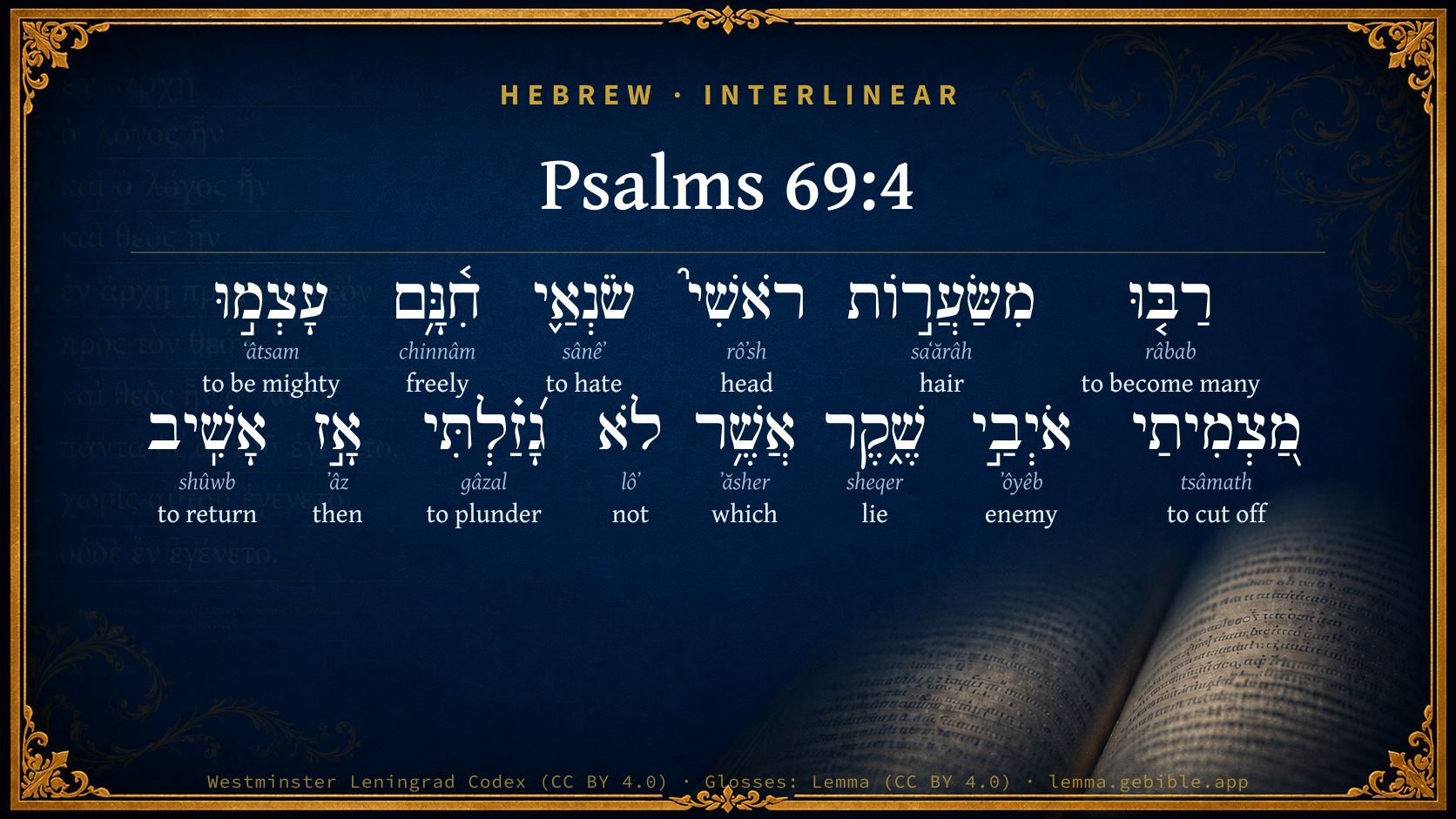
Hebrew (Westminster Leningrad Codex) Psalms 69:4 appears in the Hebrew Old Testament. The text above is from the Westminster Leningrad Codex. Each word links to its Strong’s number, a concise gloss, and parsing drawn from the Open Scriptures Hebrew Bible morphology. Click any word for its full Brown-Driver-Briggs (BDB) entry.
Download image
Cite this verse

Psalms 69:4 (World English Bible). Public Domain. Lemma interlinear Bible study tool, https://lemma.gebible.app/v/psalms/69/4.

Show BibTeX & RIS
BibTeX
RIS
English Translation
Those who hate me without a cause are more than the hairs of my head. Those who want to cut me off, being my enemies wrongfully, are mighty. I have to restore what I didn't take away.
World English Bible · Public Domain
Download a study sheet

One document with this verse’s original text, its word-by-word gloss line, the meaning frame, cross-references with their text, attributed commentary, and full source and license credits — printable, and it pastes into notes with its structure intact.

This verse Autodidact and up

Study sheet (.html) Plain text (.txt)

A passage Seminary Student

Up to 50 verses in one chapter. A passage sheet keeps up to 6 commentary sources and 12 cross-references per verse, in the order this page ranks them, and says so on the sheet whenever that leaves anything out. Ask for a single verse and you get the Autodidact verse sheet above.

Everything on this page stays free to read, with no account — the sheet is a download of what is already on screen, not access to it.

Want to remove ads? Support Godless Engineer
Compare translations 3

The same verse in 3 English versions, stacked beneath the original-language interlinear above. Click any original word for its lexicon entry.

Each is an independent rendering of the whole verse — the interlinear is not word-aligned to these translations.

Highlighted words mark where these versions differ — a whole-verse word diff, not a word-by-word alignment.

  • World English Bible Public Domain
    Those who hate me without a cause are more than the hairs of my head. Those who want to cut me off, being my enemies wrongfully, are mighty. I have to restore what I didn't take away.
  • King James Version Public Domain
    They that hate me without a cause are more than the hairs of mine head: they that would destroy me, being mine enemies wrongfully, are mighty: then I restored that which I took not away.
  • unfoldingWord Literal Text CC BY-SA 4.0
    The ones hating me gratuitously are more than the hairs of my head. The ones destroying me are mighty, my enemies of falsehood. What I did not steal, yet I must restore.

unfoldingWord Literal Text — © unfoldingWord, licensed CC BY-SA 4.0. Word-aligned USFM3 via Door43 (git.door43.org/unfoldingWord/en_ult).

Versions to compare (up to 4)

3 of 4 selected

Show all 18 translations

Every available English version of this verse, each an independent rendering of the whole verse.

  • World English Bible Public Domain
    Those who hate me without a cause are more than the hairs of my head. Those who want to cut me off, being my enemies wrongfully, are mighty. I have to restore what I didn't take away.
  • Berean Standard Bible Public Domain
    Those who hate me without cause outnumber the hairs of my head; many are those who would destroy me—my enemies for no reason. Though I did not steal, I must repay.
  • Majority Standard Bible Public Domain
    Those who hate me without cause outnumber the hairs of my head; many are those who would destroy me—my enemies for no reason. Though I did not steal, I must repay.
  • King James Version Public Domain
    They that hate me without a cause are more than the hairs of mine head: they that would destroy me, being mine enemies wrongfully, are mighty: then I restored that which I took not away.
  • American Standard Version (1901) Public Domain
    They that hate me without a cause are more than the hairs of my head: They that would cut me off, being mine enemies wrongfully, are mighty: That which I took not away I have to restore.
  • Revised Version (1885) Public Domain
    They that hate me without a cause are more than the hairs of mine head: they that would cut me off, being mine enemies wrongfully, are mighty: then I restored that which I took not away.
  • Geneva Bible (1599) Public Domain
    They that hate mee without a cause, are moe then the heares of mine heade: they that would destroy mee, and are mine enemies falsly, are mightie, so that I restored that which I tooke not.
  • Douay-Rheims (1899) Public Domain
    I have laboured with crying; my jaws are become hoarse: my eyes have failed, whilst I hope in my God.
  • Young's Literal Translation Public Domain
    Those hating me without cause Have been more than the hairs of my head, Mighty have been my destroyers, My lying enemies, That which I took not away -- I bring back.
  • Literal Standard Version CC BY-SA 4.0
    Those hating me without cause || Have been more than the hairs of my head, || Mighty have been my destroyers, || My lying enemies, || That which I did not take away—I bring back.
  • Unlocked Literal Bible CC BY-SA 4.0
    Those who hate me without a cause are more than the hairs on my head; those who would cut me off, being my enemies for wrong reasons, are mighty; what I did not steal, I have to give back.
  • unfoldingWord Literal Text CC BY-SA 4.0
    The ones hating me gratuitously are more than the hairs of my head. The ones destroying me are mighty, my enemies of falsehood. What I did not steal, yet I must restore.
  • Darby Bible Public Domain
    They that hate me without a cause are more than the hairs of my head; they that would destroy me, being mine enemies wrongfully, are mighty: then I restored that which I took not away.
  • World Messianic Bible Public Domain
    Those who hate me without a cause are more than the hairs of my head. Those who want to cut me off, being my enemies wrongfully, are mighty. I have to restore what I didn’t take away.
  • Webster's Bible Public Domain
    \\69:3\\I am weary of my crying: my throat is dried: my eyes fail while I wait for my God.
  • Free Bible Version CC BY-SA 4.0
    Those who hate me for no reason are more than the number of hairs on my head. Many enemies try to destroy me by telling lies. How can I give back what I didn't steal?
  • Bible in Basic English Public Domain
    Those who have hate for me without cause are greater in number than the hairs of my head; those who are against me, falsely desiring my destruction, are very strong; I gave back what I had not taken away.
  • JPS Tanakh (1917) Public Domain
    (69-5) They that hate me without a cause are more than the hairs of my head; they that would cut me off, being mine enemies wrongfully, are many; should I restore that which I took not away?

Literal Standard Version (2020), Covenant Press — licensed CC BY-SA 4.0. Text via the HelloAO Bible API (eBible.org). Unlocked Literal Bible (unfoldingWord) — licensed CC BY-SA 4.0. Text via the HelloAO Bible API (eBible.org). unfoldingWord Literal Text — © unfoldingWord, licensed CC BY-SA 4.0. Word-aligned USFM3 via Door43 (git.door43.org/unfoldingWord/en_ult). Free Bible Version, Dr. Jonathan Gallagher — licensed CC BY-SA 4.0. Text via the HelloAO Bible API (eBible.org).

Word by word

More ways to search: Search by grammar → Find every occurrence → Compare this word →

Practice this passage: Drill this verse → Learn its vocabulary →

מִשַּׂעֲר֣וֹת
saʻărâh
H8185
“from · hairs of”
Preposition + Noun, Common, Feminine, Plural, Construct
Part of Speech
Preposition + Noun
Type
Common
Gender
Feminine
Number
Plural
State
Construct
Full BDB Definition

Origin: from H8181

TWOT: 2274b

a single hair
  1. רַבּ֤וּ râbab H7231 “to become many” Verb, Qal, Perfect, 3rd Person, Common, Plural
  2. רֹאשִׁי֮ rôʼsh H7218 “head · my” Noun, Common, Masculine, Singular, Construct + Suffix, Personal, 1st Person, Common, Singular
  3. שֹׂנְאַ֪י sânêʼ H8130 “hating · me” Verb, Qal, Participle Active, Masculine, Plural, Construct + Suffix, Personal, 1st Person, Common, Singular
  4. חִ֫נָּ֥ם chinnâm H2600 “freely” Adverb
  5. עָצְמ֣וּ ʻâtsam H6105 “to be mighty” Verb, Qal, Perfect, 3rd Person, Common, Plural
  6. מַ֭צְמִיתַי tsâmath H6789 “cutting off · me” Verb, Hiphil, Participle Active, Masculine, Plural, Construct + Suffix, Personal, 1st Person, Common, Singular
  7. אֹיְבַ֣י ʼôyêb H341 “enemy · me” Verb, Qal, Participle Active, Masculine, Plural, Construct + Suffix, Personal, 1st Person, Common, Singular
  8. שֶׁ֑קֶר sheqer H8267 “lie” Noun, Common, Masculine, Singular, Absolute
  9. אֲשֶׁ֥ר ʼăsher H834 “which” Particle, Relative
  10. לֹא lôʼ H3808 “not” Particle, Negative
  11. גָ֝זַ֗לְתִּי gâzal H1497 “to plunder” Verb, Qal, Perfect, 1st Person, Common, Singular
  12. אָ֣ז ʼâz H227 “then” Adverb
  13. אָשִֽׁיב shûwb H7725 “to return” Verb, Hiphil, Imperfect, 1st Person, Common, Singular

About this verse

These counts appear in no published source. They are computed here, from the morphology-tagged text and Lemma’s own curated glosses. What Lemma adds →

14
words
14
distinct lemmas
Wisdom
section

Notable vocabulary

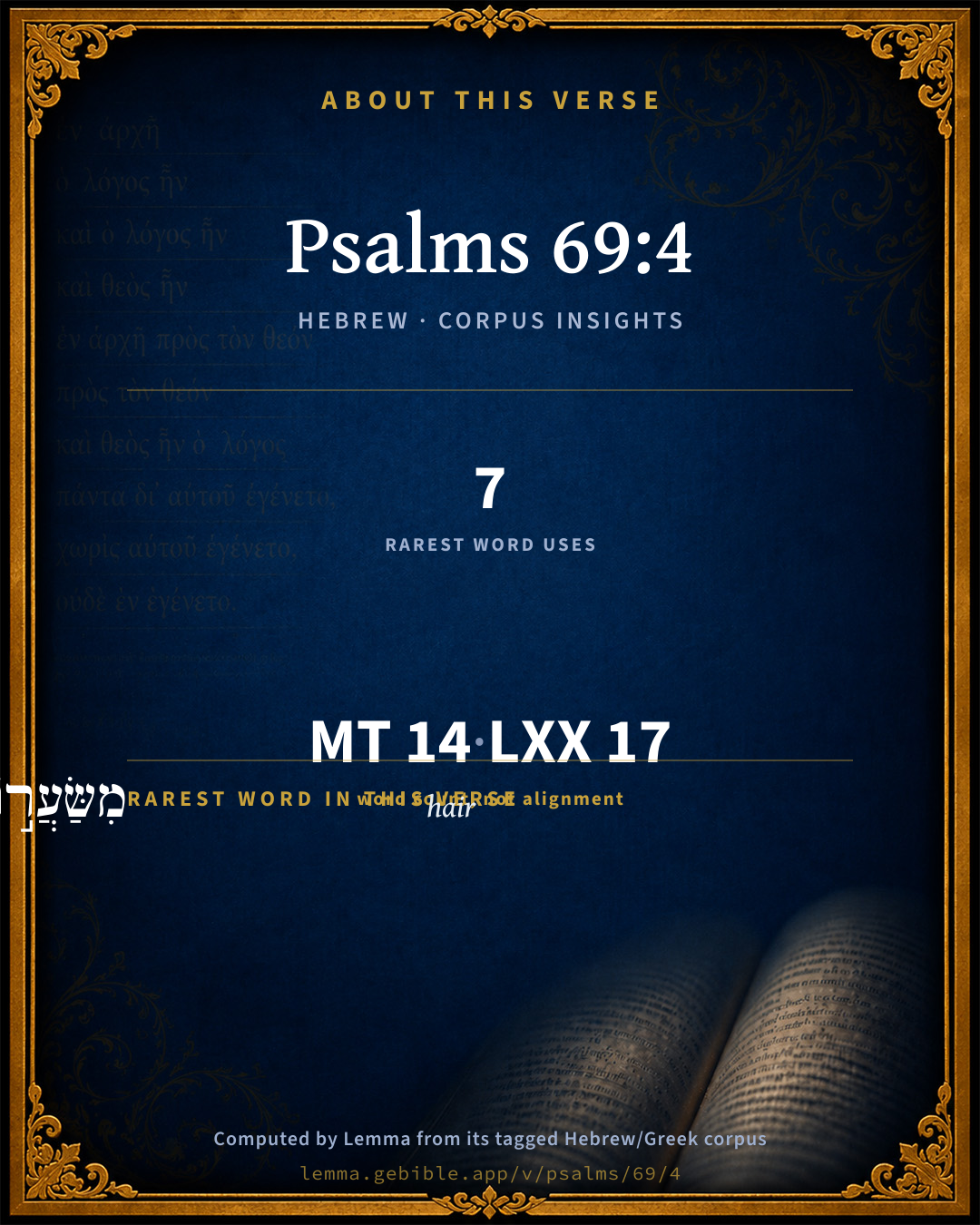
The rarest word here is מִשַּׂעֲר֣וֹת hair H8185 — appearing just 7 times in the whole Hebrew Bible.

Shared distinctive vocabulary

מִשַּׂעֲר֣וֹת hair H8185 occurs in 7 verses of the Hebrew Bible. Also found in:

Grammatical profile

  • 7 verbs
  • 3 nouns
  • 2 adverbs
  • 2 particles

Verb forms

  • רַבּ֤וּ Qal · Perfect
  • שֹׂנְאַ֪י Qal · Participle Active
  • עָצְמ֣וּ Qal · Perfect
  • מַ֭צְמִיתַי Hiphil · Participle Active
  • אֹיְבַ֣י Qal · Participle Active
  • גָ֝זַ֗לְתִּי Qal · Perfect
  • אָשִֽׁיב Hiphil · Imperfect

Hebrew & Septuagint length

In English translation the verse runs 37 words from the Hebrew and 32 from the Septuagint (LXX English) — closely comparable.

A rough comparison of the two English renderings, which tokenize alike — not a word-level alignment.

Word counts can differ between the Hebrew and the Greek without any difference in meaning — e.g. the Hebrew direct-object marker אֵת has no separate Greek word, and Greek often adds the article ὁ.

In the original languages it is 14 Hebrew tokens and 17 Greek tokens — but the two are counted differently (Hebrew bundles its prefixes and suffixes into one token; the Greek is in lemma form), so that isn’t a like-for-like length.

Cross-references

13

Topical passages linked to Psalms 69:4 in the Treasury of Scripture Knowledge — connected by theme and wording, ordered by reader-vote popularity; previews shown in the World English Bible.

  • Psalms 35:19 Don't let those who are my enemies wrongfully rejoice over me; Neither let them wink with the eye who hate me without a cause.
  • John 15:25 But this happened so that the word may be fulfilled which was written in their law, 'They hated me without a cause.'
  • Psalms 109:3–5 They have also surrounded me with words of hatred, And fought against me without a cause.
  • Psalms 35:11–12 Unrighteous witnesses rise up. They ask me about things that I don't know about.
  • Isaiah 53:4–7 Surely he has borne our sickness, and carried our suffering; yet we considered him plagued, struck by God, and afflicted.
  • 2 Corinthians 5:21 For him who knew no sin he made to be sin on our behalf; so that in him we might become the righteousness of God.
  • Psalms 38:19–20 But my enemies are vigorous and many. Those who hate me without reason are numerous.
  • Psalms 40:12 For innumerable evils have surrounded me. My iniquities have overtaken me, so that I am not able to look up. They are more than the hairs of my head. My heart has failed me.
  • Psalms 7:3–5 Yahweh, my God, if I have done this, If there is iniquity in my hands,
  • Psalms 59:3 For, behold, they lie in wait for my soul. The mighty gather themselves together against me, Not for my disobedience, nor for my sin, Yahweh.
  • 1 Peter 2:22 who did not sin, "neither was deceit found in his mouth."
  • 1 Peter 3:18 Because Christ also suffered for sins once, the righteous for the unrighteous, that he might bring you to God; being put to death in the flesh, but made alive in the spirit;
  • 1 Peter 2:24 who his own self bore our sins in his body on the tree, that we, having died to sins, might live to righteousness; by whose stripes you were healed.

Cross-references courtesy of OpenBible.info (CC BY 4.0).

Hebrew and Greek witnesses Masoretic Hebrew ↔ Greek Septuagint

The same verse in the two great witnesses to the Old Testament, shown verse-for-verse.

You’re reading Greek Psalm 68 (Hebrew Psalm 69). The Septuagint counts the superscription, so verse numbers can differ from the Hebrew — chapter-level alignment, not verse-by-verse. Numbering follows Rahlfs.

These are two independent witnesses, not word-aligned to each other, and the Septuagint is shown in lemma (dictionary) form.

Hebrew Psalms 69:4 Masoretic · Westminster Leningrad Codex

רַבּ֤וּ מִשַּׂעֲר֣וֹת רֹאשִׁי֮ שֹׂנְאַ֪י חִ֫נָּ֥ם עָצְמ֣וּ מַ֭צְמִיתַי אֹיְבַ֣י שֶׁ֑קֶר אֲשֶׁ֥ר לֹא גָ֝זַ֗לְתִּי אָ֣ז אָשִֽׁיב

Those who hate me without a cause are more than the hairs of my head. Those who want to cut me off, being my enemies wrongfully, are mighty. I have to restore what I didn't take away.

World English Bible · Public Domain

Greek LXX Greek Psalm 68:4 Septuagint · lemma form

κοπιάω κράζω βραγχιάω ὁ λάρυγξ ἐγώ ἐκλείπω ὁ ὀφθαλμός ἐγώ ἀπό ὁ ἐλπίζω ἐπί ὁ θεός ἐγώ

They that hate me without a cause are more than the hairs of my head: my enemies that persecute me unrighteously are strengthened: then I restored that which I took not away.

LXX2012 (modern English Septuagint) · Public Domain

On this verse, The Cambridge Bible for Schools and Colleges discusses the Septuagint’s reading. Read the note in Commentary ↓

Hebrew: Westminster Leningrad Codex (CC BY 4.0). Greek: Septuagint (public domain); English from LXX2012 (modern English Septuagint) (Public Domain). How the Septuagint differs from the Hebrew →

Commentary

Notes on Psalms 69:4 from classic Christian and Jewish commentators (each source and its license shown beneath its notes). The classic Christian expositions comment on the surrounding passage and are grouped to its opening verse, so a note may address several verses; the Jewish commentaries on the Tanakh (Rashi and others) are per-verse, so they appear only where the commentator wrote on this verse.

Lemma curates 59 commentaries, every one of them public domain or Creative Commons licensed, each selected and text-cleaned for this edition rather than reprinted as found. About our sources →

Trapp's Complete Commentary

John Trapp

Psa 69:4 They that hate me without a cause are more than the hairs of mine head: they that would destroy me, [being] mine enemies wrongfully, are mighty: then I restored [that] which I took not away.

Ver. 4. They that hate me without a cause, &c.] Christ, besides his inward fears and griefs caused by the sense of his Father’s wrath for our sins, was set against and assaulted both by men and devils (in that three hours’ darkness especially) with utmost might and malice.

Then I restored that which I took not away.] Quod non rapui reddebam. David was dealt with as a felon or false dealer. Christ also was crucified for saying that he was the Son of God, Joh 19:7, though he held it no robbery to be equal with God, Php 2:6. The martyrs likewise were loaden with many calumnies and false criminations, that they might seem to suffer not as martyrs, but as malefactors.

John Trapp, A Commentary or Exposition upon All the Books of the Old and New Testament (1647–1656) — public domain. Text from a community e-Sword module.

The Biblical Illustrator

Joseph S. Exell

Psa_69:4

I restored that which I took not away.

Christ restoring what He took not away

I. What it is which was taken away, and from whom.

1. Glory was taken from God.

(1) The glory of God shining forth in the holy government of His reasonable creatures, was taken away by sin.

(2) That glory which we are tied to give to God, was withheld by sin.

2. There was righteousness, holiness, and happiness taken from man.

II. Wherein it appears that Christ did not take these things from either.

1. It is plain, as to God, that He never took any glory from Him; for He never did anything dishonourable or offensive to God (Joh_8:29).

2. It is also clear, as to man, that He took not away any righteousness, holiness, or happiness from him (Isa_53:9; Act_10:33; Luk_9:56).

3. The Scripture therefore speaks of Christs being cut off, but not for Himself (Dan_9:26). Though He suffered in His own Person, He did not suffer on His own account (1Pe_3:18).

4. The innocency of Christ was conspicuous in His very sufferings (Act_13:28).

III. How did Christ restore those things which He took not away? In general, by His active and passive obedience; for both are concerned in this matter, and contribute their joint influence towards the great and blessed work of which I am now speaking.

IV. Why did Christ make it His work to restore what He took not away?

1. It was a necessary work, a work which must be done, in order to His being a Saviour.

2. It was a work impossible for any mere creature to do; so that if Christ did not, it could not have been done by any person besides Him.

3. Christ was ordained of God to this work, and in that respect there was a necessity of His accomplishing it (Joh_9:4).

4. The infinite love of Christ to sinners did sweetly incline Him to this work. (T. Cruse.)

A robbery committed, and restitution made, both to God and man

I. Premise two or three things for clearing of the way.

1. When God made man, He bestowed all manner of goods upon him, that were necessary to make him live comfortably here, and to make him eternally happy hereafter.

2. Satan, by this time, having fallen, like a star, from heaven to earth, filled with envy, enters into a resolution, if it were possible, to commit a robbery upon man, and to strike at Gods sovereignty through mans side; and accordingly--

3. Satan prevailed upon our first parents, and beguiled them; and thereby the covenant of works was broken.

4. The covenant of works being broken, and man having entered into a rebellion against God with the devil, he justly forfeited all the spiritual and temporal goods that God bestowed upon him, and likewise lost his title to a happy eternity, and became the enemys vassal; and thus the enemy robbed him of all the goods that God bestowed upon him.

5. The eternal Son of God having a delight in the sons of men, and beholding them in this miserable plight, enters upon a resolution that He will take on mans nature, and that He will in mans nature be avenged upon that serpent that hath beguiled our first parents, and spoiled them of their patrimony. And accordingly, in the fulness of time, He comes, and is manifested to destroy the works of the devil, and to recover all the stolen goods.

II. Inquire into the robbery that was committed by sin and Satan, both upon God and upon man.

1. To begin with the robbery that was committed upon God. It was the devils great drift, by tempting man to sin against God, to rob God of His glory.

2. Inquire into the goods that wore stolen from man by sin and Satan. Hero we may see a melancholy scene. The glory of the human nature was quite marred by sin. Sin hath robbed us of heaven, and made us heirs of hell and wrath. In short, sin hath disordered and disjointed the whole creation.

III. Make it appear that our glorious Immanuel makes a restitution of what was taken away both from God and from man. He restores unto God His due, and restores unto man his loss.

IV. Inquire into the time when Christ did all this: when did He restore that which He took not away? (Gal_4:4-5).

V. Inquire into the reasons of the doctrine. Why was it that our Lord restored what He took not away? Why did He restore these goods that sin and Satan took away both from God and man?

1. Because it was His Fathers pleasure.

2. Because it contributed very much to enhance His mediatorial glory.

3. Because of His regard to the holy law of God.

4. Because His delights were with the sons of men.

5. That He might still the enemy and the avenger, that is, the devil.

VI. Application.

1. Is it so that Christ restores what He took not away? Then, hence see, what a generous Kinsman we have of Him; He never took away anything from us, and yet He restores all to the spoiling of His own soul, and pouring it out unto death.

2. This doctrine serves to let us see into the meaning of (Rom_8:3). He condemned sin. Why, or how did He it? Why, sin is a robber, and is it not just that a robber should be condemned to die? Well, Christ condemns sin, and yet He saves the sinner.

3. Hence see what a criminal correspondence it is that the generality of the children of men have with sin. It is dangerous to haunt and harbour robbers; and yet will you keep a robber in your bosom.

4. If sin be such a robber of God and man, then see how reasonable the command is, to crucify sin, and to mortify the deeds of the body.

5. From this doctrine see what way Christ takes in order to carry on His mediatory work of making peace betwixt God and man.

6. From the doctrine we may likewise see, that the believer in Christ is the wisest man in the world, however the world may look upon him as a fool. Why? because he comes to Christ, and gets restitution of all the losses he suffered either by the sin of the first Adam or his own.

7. See the folly and madness of the sin of unbelief (Joh_5:40).

8. See the folly of the legalist, that goes about to make restitution to God, and to himself, of what was taken away by sin. But consider, that by the works of the law no flesh living can be justified; you will never repair your own losses, nor the dishonour you have done to God, but only by coming to Christ, who is the end of the law for righteousness to every one that believeth. (E. Erskine.)

The Biblical Illustrator, edited by Joseph S. Exell (c. 1880s–1900s) — public domain. Text from a community e-Sword module.

J. A. Alexander on Psalms

Joseph Addison Alexander

5. (Psa 69:4). More than the hairs of my head (are) those hating me without cause; strong are my destroyers, my false enemies; what I did not rob, then must I restore. With the first clause compare Psa 40:12); with the second, Psa 35:9; Psa 38:19); with the third, Psa 35:11, 2Sa 16:8. False enemies, literally enemies of falsehood, which may either mean in general perfidious, treacherous, or more specifically, using calumny and falsehood as a means for the attainment of their wicked ends. Then or afterwards, in reference to the previous innocence which he asserts. Though he took nothing at first, yet afterwards he must restore.

Joseph Addison Alexander, The Psalms Translated and Explained (1850) — public domain. Text from a community e-Sword module.

Tyndale Open Study Notes

Tyndale Open Resources

69:4 John applied this lament to Jesus (John 15:25).

Tyndale Open Study Notes — © Tyndale Open Resources, licensed CC BY-SA 4.0. Text via the HelloAO Bible API.

Geneva Bible (1599)

Geneva Bible translators

Condemning me guiltless.

They judged me poor innocent as a thief, and gave my goods to others, as though I had stolen them.

Geneva Bible (1599) marginal notes — public domain. Text via Bolls.life.

Jamieson, Fausset & Brown

Robert Jamieson, A. R. Fausset & David Brown

hate me, &c.--(Compare Joh 15:25). On the number and power of his enemies (compare Psa 40:12).

then I restored . . . away--that is, he suffered wrongfully under the imputation of robbery.

Jamieson, Fausset & Brown — Commentary Critical and Explanatory on the Whole Bible (1871) — public domain (CC PDM 1.0). Text via the HelloAO Bible API.

Adam Clarke's Commentary

Verse 4. Then I restored that which I took not away.] I think, with Calmet, that this is a sort of proverbial expression, like such as these, "Those who suffered the wrong, pay the costs." Delirant reges, plectuntur Achivi. "Kings sin, and the people are punished." "The fathers have eaten sour grapes, and the children's teeth are set on edge." Our fathers have grievously sinned against the Lord, and we their posterity suffer for it. See on Ps 69:12. Some have applied it to our Lord. I restored, by my suffering and death, that image of God and the Divine favour, which I took not away. That is, In my human nature I expiated the crime that human beings had committed against God. But such applications are very gratuitous.

Adam Clarke's Commentary on the Bible (1810–1826) — public domain. Text from a community e-Sword/MySword module.

John Calvin's Commentaries

4. They who hate me without cause are more in number than the hairs of my head The Psalmist now expresses without figure what he had said under the metaphors of the mire and of the impetuous rushing of the waters. Persecuted as he was by so great a multitude of enemies, he had too good reason to be afraid of death in innumerable ways. Nor is his language hyperbolical, when he represents his enemies as more in number than the hairs of his head, since he was mortally hated and detested by the whole kingdom, it being the universal belief that he was a base and wicked traitor to his country. Farther, we know from the sacred history how numerous and powerful the armies were which Saul sent forth to pursue him. He expresses the mortal hatred which they bore to him, when he tells us that they were intently set upon his destruction, being eagerly desirous to have him cut off by a violent death; and yet he avows that he had done nothing to merit such unrelenting persecution. The Hebrew word חנם, chinnam, which we have rendered, without cause, and which some translate, for nothing, intimates that they were impelled by a strong desire to do him injury, although he had not done them even the slightest wrong, nor given them the smallest provocation by ill usage of any kind. For this reason he applies to his enemies the appellation שקר, sheker, that is, liars, because they had no just ground to make war upon him, although they pretended the contrary. Let us, therefore, after his example, if at any time we are subjected to persecution, study to have the support arising from the testimony of a good conscience, and to be able freely to protest before God, that the hatred which our enemies cherish against us is altogether causeless. This implies a self-control to which it is very difficult for a man to inure himself; but the more difficult it is, the more strenuous ought to be his efforts to attain it. It is mere effeminacy to regard it as an intolerable evil to be unrighteously afflicted; and the folly of this is very happily exposed by that noble answer of Socrates to his wife, who, having one day lamented, in prison, that he was condemned wrongfully, received from him this reply, “What then — would you rather that I should have suffered death for my offenses?” Farther, David adds, that he not only had to suffer the wrongs of violence, but had also to bear much reviling and contumely, as if he had been convicted of many crimes; a trial which, to an ingenuous mind, is more bitter and hard to bear than a hundred deaths. Many are to be found resolutely prepared to encounter death, who are by no means prepared to exhibit equal fortitude in the endurance of shame. Farther, David was not only despoiled of his goods by the violence of robbers, but he had been also mangled in his person, as if he had been a thief and a robber: That which I took not by spoil, then I restored it When his enemies thus plundered and maltreated him, they doubtless boasted that they were acting as the judges of a perverse and wicked man; and we know that they were held in honorable estimation as judges. Let us therefore learn from this example to prepare ourselves not only to bear patiently all losses and troubles, yea, even death itself; but also shame and reproach, if at any time we are loaded with unfounded accusations. Christ himself, the fountain of all righteousness and holiness, was not exempted from foul calumny, why then should we be dismayed when we meet with a similar trial? It may well fortify our minds against it when we consider, that to persevere steadfastly in the practice of righteousness, although such is the reward which we receive from the world, is the genuine test of our integrity.

John Calvin's Commentaries (1540-1563) — public domain. Text from the Calvin Translation Society English edition (1840s-50s) via the Christian Classics Ethereal Library (ccel.org). Calvin's coverage is partial (roughly two-thirds of the Bible); uncommented books and verses are honest gaps, never fabricated. The 19th-century editor's footnotes and remarks are omitted so the notes are faithfully Calvin's own voice.

Ellicott's Commentary for English Readers

(4) They that would destroy me . . .—Properly, my exterminators. It seems a piece of hypercriticism to object to this as too strong a word. It is a very allowable prolepsis. At the same time the parallelism would be improved by adopting, as Ewald suggests, the Syriac reading “my enemies without are more numerous than my bones,” and the construction would be the same as in Psa_40:12.

Wrongfully.—Better, without cause. Comp. Psa_35:19.

Then I restored.—Rather, what I did not steal I must then restore, possibly a proverbial saying to express harsh and unjust treatment. Comp. Ps. Xxxv. 11; Jer_15:10.

A Bible Commentary for English Readers, edited by Charles John Ellicott (1878–1897) — public domain. Text from a community e-Sword module.

The Cambridge Bible for Schools and Colleges

gen. ed. J. J. S. Perowne

4. The number and the virulence of his foes, and the groundlessness of their hostility. For the language comp. Psa_40:12; Psa_35:19; Psa_38:19. The quotation in Joh_15:25 agrees with the LXX.

moe] This archaism for ‘more,’ which has disappeared from modern Bibles, is restored by Scrivener in accordance with the original edition of 1611.

they that would destroy me] R.V., they that would cut me off. Ewald and others follow the Syr. in reading this line, ‘More numerous than my bones are they that are mine enemies falsely.’ The parallelism of the first two lines of the verse is improved by the change, which involves only a slight alteration of the consonants; but the comparison is not a natural one, and the reading of the text is supported by the use of the same verb in Lam_3:53, in a closely similar context (note Lam_3:52; Lam_3:54).

wrongfully] Lit. falsely. Their hostility is based upon misconception and misrepresentation.

then I restored] Or, as R.V. marg., I had to restore. ‘Then’ may refer to some signal instance prominent in the Psalmist’s recollection.

that which I took not away] That which I had not plundered. Perhaps a proverbial expression for the extreme of injured innocence. He was accused of being an extortioner and oppressor of the poor who must be made to disgorge his ill-gotten gains (Eze_33:15). Cp. Eliphaz’ charges against Job (Job_22:6 ff.), and Zophar’s picture of the wicked man compelled to make restitution (Job_20:18 ff.).

The Cambridge Bible for Schools and Colleges (gen. ed. J. J. S. Perowne; Cambridge University Press, 1878–1918) — public domain. Text from a community e-Sword module.

John Gill's Exposition

They that hate me without a cause,.... As the Jews did; see Joh 15:18; for he did no injury to the persons or properties of men; but went about continually doing good, both to their souls and bodies; so that he merited their highest esteem and love, and not their hatred; and yet they were his implacable enemies; see Luk 19:14;

are more than the hairs of mine head; they were a multitude that came to take him in the garden; and it was the multitude that the priests and Pharisees instigated to ask for the release of Barabbas, and the crucifixion of Jesus; and a vast number of people followed him to the cross, and insulted him on it; the Gentiles and the people of Israel were gathered together against him;

they that would destroy me; as the Jews sought to do often before his time was come;

being mine enemies wrongfully; without cause, as before; or through lies and falsehoods told of him, and spread about concerning him:

are mighty; lively and strong, as David's enemies were, Psa 38:19. The great men of the earth, kings and princes, as Herod and Pontius Pilate, and also the infernal principalities and powers, who were concerned in contriving those lies, and putting them into the minds of men; for Satan is the father of lies and falsehood;

then I restored that which I took not away; by rapine, force, and violence, as the word (w) signifies; and which was done by others. Thus, for instance, Christ restored the glory of God, of which he was robbed, and which was taken away by the sin of man; by veiling his own glory, not seeking that, but his Father's; and by working out the salvation of his people, in such a manner as that all the divine perfections were glorified by it; hence, "glory to God in the highest", Luk 2:14. He satisfied justice he had never injured, though others had; he fulfilled a law, and bore the penalty of it, which he never broke; and made satisfaction for sins he never committed; and brought in a righteousness he had not taken away; and provided a better inheritance than what was lost by Adam: and all this was done at the time of his sufferings and death, and by the means of them.

(w) "rapui", V. L. Pagninus, Montanus, &c.

John Gill's Exposition of the Whole Bible (1746–1763) — public domain (CC PDM 1.0). Text via the HelloAO Bible API.

Albert Barnes' Notes on the Bible

They that hate me without a cause - Without any just reason; without any provocation on my part. There were many such in the case of David, for to those who rose up against him in the time of Saul, and to Absalom also, he had given no real occasion of offence. An expression similar to the one used here occurs in Psa 35:19. See the notes at that passage. The “language” is applied to the Saviour Joh 15:25, not as having had original reference to him, but as language which received its most perfect fulfillment in the treatment which he received from his enemies. See the notes at Joh 15:25.

Are more than the hairs of mine head - The number is so great that it cannot be estimated.

They that would destroy me, being mine enemies wrongfully, are mighty - literally, “More than the hairs of my head are my haters falsely (those who hate me falsely); strong are those destroying me; my enemies.” The idea is, that those who were numbered among his foes without any just provocation on his part were so numerous and strong that he could not contend with them.

Then I restored that which I took not away - Prof. Alexander renders this, “What I did not rob, then must I restore.” This seems to have a proverbial cast, and the idea is, that under this pressure of circumstances - borne down by numbers - he was compelled to give up what he had not taken away from others. They regarded and treated him as a bad man - as if he had been a robber; and they compelled him to give up what he possessed, “as if” he had no right to it, or “as if” he had obtained it by robbery. This does not seem to refer to anything that was “voluntary” on his part - as if, for the sake of peace, he had proposed to give up that to which they had no claim, or to surrender his just rights, but to the act of compulsion by which he was “forced” to surrender what he had, “as if” he had been a public offender. How far it is proper to yield to an unjust claim for the sake of peace, or to act “as if” we had done wrong, rather than to have controversy or strife, is a point which, if this interpretation is correct, is not settled by this passage. It seems here to have been merely a question of “power.”

Albert Barnes' Notes on the Bible (1834–1885) — public domain. Text from a community e-Sword/MySword module.

Matthew Poole's English Annotations

Without a cause; without any injury or occasion given them by me.

Restored that which I took not away; either because they unjustly and violently forced me to it, or because I was willing to do it to my own wrong for peace sake. By this one kind of wrong he understands all those injuries and violences which they practised against him.

Matthew Poole's English Annotations on the Holy Bible (1683–1685) — public domain. Text from a community e-Sword/MySword module.

The Treasury of David

Charles H. Spurgeon

Ver. 4. They that hate me. Surprising sin that men should hate the altogether lovely one, truly is it added,

without a cause, for reason there was none for this senseless enmity. He neither blasphemed God, nor injured man. As Samuel said: "Whose ox have I taken? or whose ass have I taken? or whom have I defrauded? Whom have I oppressed?" Even so might Jesus enquire. Besides, he had not only done us no evil, but he had bestowed countless and priceless benefits. Well might he demand, "For which of these works do ye stone me?" Yet from his cradle to his cross, beginning with Herod and not ending with Judas, he had foes without number; and he justly said, they

are more than the hairs of mine head. Both the civilians and the military, laics and clerics, doctors and drunkards, princes and people, set themselves against the Lord's anointed. "This is the heir, let us kill him that the inheritance may be ours, "was the unanimous resolve of all the keepers of the Jewish vineyard; while the Gentiles outside the walls of the garden furnished the instruments for his murder, and actually did the deed. The hosts of earth and hell, banded together, made up vast legions of antagonists, none of whom had any just ground for hating him.

They that would destroy me, being mine enemies wrongfully, are mighty. It was bad that they were many, but worse that they were mighty. All the ecclesiastical and military powers of his country were arrayed against him. The might of the Sanhedrin, the mob, and the Roman legions were combined in one for his utter destruction: "Away with such a fellow from this earth; it is not fit that he should live, "was the shout of his ferocious foes. David's adversaries were on the throne when he was hiding in caverns, and our Lord's enemies were the great ones of the earth; while he, of whom the world was not worthy, was reproached of men and despised of the people.

Then I restored that which I took not away. Though innocent, he was treated as guilty. Though David had no share in plots against Saul, yet he was held accountable for them. In reference to our Lord, it may be truly said that he restores what he took not away; for he gives back to the injured honour of God a recompense, and to man his lost happiness, though the insult of the one and the fall of the other were neither of them, in any sense, his doings. Usually, when the ruler sins the people suffer, but here the proverb is reversed--the sheep go astray, and their wanderings are laid at the Shepherd's door.

Ver. 4. Without a cause. In suffering, let not the mind be disturbed; for the injustice which is done to the innocent in his sufferings, is not laid to the charge of the sufferer, but to his who inflicts suffering... It is well known what Tertullian relates of Socrates, when his wife met him after his condemnation, and addresses him with a woman's tears: "Thou art unjustly condemned, Socrates." His reply was, "Wouldst thou have me justly?" Lorinus.

Ver. 4. Then I restored that which I took not away. It was the great and blessed work of our Lord Jesus here upon the earth, to restore what he took not away. In handling this:

I. Show what it is which was taken away, and from whom?

II. Wherein it appears that Christ took it not away.

III. How he restored it?

IV. Why he did so?

V. Use.

I. What it was which was taken away, and from whom?

1. There was glory taken from God. Not his essential glory, nor any perfection of his being, for that cannot be taken away; but that glory which shines forth in the moral government of his creatures, and that glory which we are bound to give him.

2. There was righteousness, holiness, and happiness taken from man also. (1) There was a loss of righteousness to the guilty sinner; (2) of holiness to the polluted sinner: (3) of happiness to the miserable sinner.

II. Wherein it appears that Christ did not take away

those things from either.

1. It is plain, as to God, he never took away any glory from him; for he never did anything dishonourable, or offensive to God. Joh 8:29; Isa 50:5 Lu 1:35.

2. It is also clear, as to man, that he took not away any righteousness, holiness, or happiness from him. He was not such a fountain of guilt, pollution, and misery, as the first Adam had been, but the contrary.

3. The Scripture, therefore, speaks of Christ's being cut off, but not for himself, Da 9:26; 1Pe 3:18 Isa 53:4-5.

4. The innocency of Christ was conspicuous in his very sufferings. Though they found no cause of death in him, yet desired they Pilate that he should be slain. Ac 13:28.

III. How did Christ restore those things which he took

not away? In general, by his active and passive

obedience.

1. Christ's doing the will of God in such a manner as he did it, was a greater honour to God than ever had been, or could be done before.

2. Christ's suffering of the will of God, made a considerable addition to the glory of God, which had been impaired by the sin of man, Heb 5:8; Joh 17:4 13:31.

3. Christ hath provided for the justification of the sinner by the obedience which he fulfilled, Ro 5:8.

4. Christ communicates that grace which is necessary for our sanctification also.

5. Christ hath merited for us a present blessedness in this world.

6. Jesus Christ hath procured for us a more full and absolute blessedness in the world to come.

IV. Why did Jesus Christ make it his work to restore

what he took not away?

1. It was a necessary work, a work which must be done, in order to his being a Saviour.

2. It was a work impossible for any mere creature to do; so that if Christ did not, it could not be done by any person besides him. Timothy Cruso's Sermon.

Ver. 4. Then I restored that which I took not away. Rosenmueller observes, that this seems to be a proverbial sentence, to denote an innocent man unjustly treated. According to the law, if a man stole and killed, or sold an ox, he was to restore five oxen; or a sheep, he was to restore four; and if the ox or sheep was found alive, he was to restore two. Hence, to oblige a man to restore when he had taken nothing, was the greatest injustice. Ex 22:1-5. Ainsworth observes, that though it may be taken for all unjust criminations, whereof David and Christ were innocent, yet in special, it was verified in Christ, who, "being in the form of God, thought it not robbery to be equal with God, "Php 2:6; notwithstanding, for witnessing himself to be the Son of God, he was put to death by the Jews. Joh 19:7. Benjamin Boothroyd.

Ver. 4. I restored that which I took not away. The devil took away by arrogating in heaven what was not his, when he boasted that he was like the Most High, and for this he pays a righteous penalty... Adam also took away what was not his own, when, by the enticement of the devil, "You will be as gods, "he sought after a likeness to God, by yielding to the deception of the woman. But the Lord Jesus thought it not robbery to be equal with God... And yet his enemies said, "Let him be crucified, for he hath made himself the Son of God." Gerhohus.

Ver. 4. I restored that which I took not away. What a blessed verse is here! Amidst all the opposition and contradiction of sinners against himself, Jesus manifested that character, by which Jehovah had pointed him out to the church by the prophet; "Thou shalt raise up the foundations of many generations; and thou shalt be called, the repairer of the breach, the restorer of paths to dwell in." Isa 58:12. But what was it Christ restored? Nay, all that was lost. Adam by sin had done all that he could to take away God's glory, and with it his own glory and happiness. He had robbed God of his glory, God's law of its due, himself of God's image, and of God's favour. Sin had brought in death, spiritual and eternal; and he and all his descendants stood tremblingly exposed to everlasting misery. All these and more Jesus restored. As man's Surety and man's Representative, and called to it by the authority of Jehovah, the Lord Christ restored to God his glory, and to man God's image of favour; and having destroyed sin, death, hell, and the grave, he restored to his redeemed a better paradise than our nature had lost! Hail, oh, thou blessed Restorer of all our long lost privileges. Robert Hawker.

Ver. 4. Jesus as the Restorer, the Christian imitating him in the same office; Christianity a power which will do this for the whole race in due season.

Psalms 69:5*

Charles H. Spurgeon's The Treasury of David (1869–1885) — public domain. Psalms only. Text from a community e-Sword/MySword module.

Whedon's Commentary on the Bible

Daniel D. Whedon

4. They that hate me—These bear a threefold distinction.

1. They are more than the hairs of mine head. Psa_39:12.

2. They are mighty,

3. They hate without cause—wrongfully. The whole psalm is highly Messianic, and our Lord directly refers to this latter description of his enemies, Joh_15:25. Then I restored that, etc.—I surrendered that which I had never taken, and which they had no right to demand. I was made legally answerable for acts which I never committed. See Jer_10:15. The language seems to be used proverbially. Bishop Mant versifies it:—

“For rapine, which my hands ne’er knew,

Content I paid the atonement due.”

How true of David! How much more true of Christ!

Daniel D. Whedon (gen. ed.), Commentary on the Old and New Testaments (1874–1909) — public domain. Text from a community e-Sword module.

The Pulpit Commentary

They that hate me without a cause are more than the hairs of mine head. (comp. Psa_35:14; and for the simile. comp. Psa_40:12; both of them Davidical compositions) They that would destroy me, being mine enemies wrongfully, are mighty. Joab and Abiathar, who supported the rebellion of Adonijah, (1Ki_1:7) and were "mighty" men, certainly were David"s enemies "wrongfully." And the same may be said of Absalom and Ahithophel. Then I restored that which I took not away. Dr. Kay supposes David"s quasi-abdication of a crown which he had not placed on his own head (2Sa_15:14-17) to be alluded to.

The Pulpit Commentary (1880–1919), ed. H.D.M. Spence-Jones & Joseph S. Exell — public domain. Text from a community e-Sword module.

John Wesley's Explanatory Notes

I restored - For peace sake.

John Wesley, Explanatory Notes Upon the Whole Bible (1754–1765) — public domain. Text via the GEBible commentary corpus.

Rashi

Rabbi Shlomo Yitzchaki (Rashi)

has become parched Heb. נחר, dry, as (Job 30:30): “are burned (חרה) with heat.”

my eyes fail Any drawn-out hope is called “failure of the eyes,” as (Deut. 28:32): “and pine after them all day”. [Similarly] (Lev. 26:16): “that cause the eyes to pine away”; (Job 11:20), “and the eyes of the wicked will pine away.”

Rashi on the Tanakh — English translations: “The Judaica Press complete Tanach with Rashi, translated by A. J. Rosenberg” (CC BY 4.0); “Pentateuch with Rashi's commentary by M. Rosenbaum and A.M. Silbermann, 1929-1934” (public domain); “The Metsudah Tanach series, Lakewood, N.J” (CC BY 4.0); and “The Book of Joshua, Metsudah Publications, 1997” (CC BY 4.0). Text via Sefaria.

Lesson kit

Teaching starters — assembled from the data on this page, not authored interpretation. Every prompt links to the verse data it draws on. Edit before teaching.

Psalms, in the Wisdom, opens this verse with 14 words (14 distinct Hebrew lemmas). Its most distinctive word is saʻărâh (“hair”). A historical commentator’s framing appears above. Read the whole chapter for the surrounding context.

Discussion questions

  1. What does “hair” (saʻărâh) contribute to the verse as a whole?
  2. How does Judges 20:16, which shares the word «hair», read alongside this verse?
  3. These translations render this verse differently; the difference is in the English rendering, not the original. What questions does that raise?
  4. «רַבּ֤וּ» is a Qal Perfect verb. How does that grammatical form shape the action described?
  5. Compare how Trapp's Complete Commentary and The Biblical Illustrator read this verse. Where do they agree or differ?

Things to notice

Reading settings

Reading text

Shown beneath each verse's original-language words.

Old Testament
Old Testament edition

Read the OT as the Masoretic Hebrew (MT) or the Greek Septuagint (LXX).

English shown for the Greek Septuagint (in the Hebrew ↔ Greek comparison).

Comparing translations? Open the Compare panel on any verse page to stack up to four side by side.