
Psalms 74:3

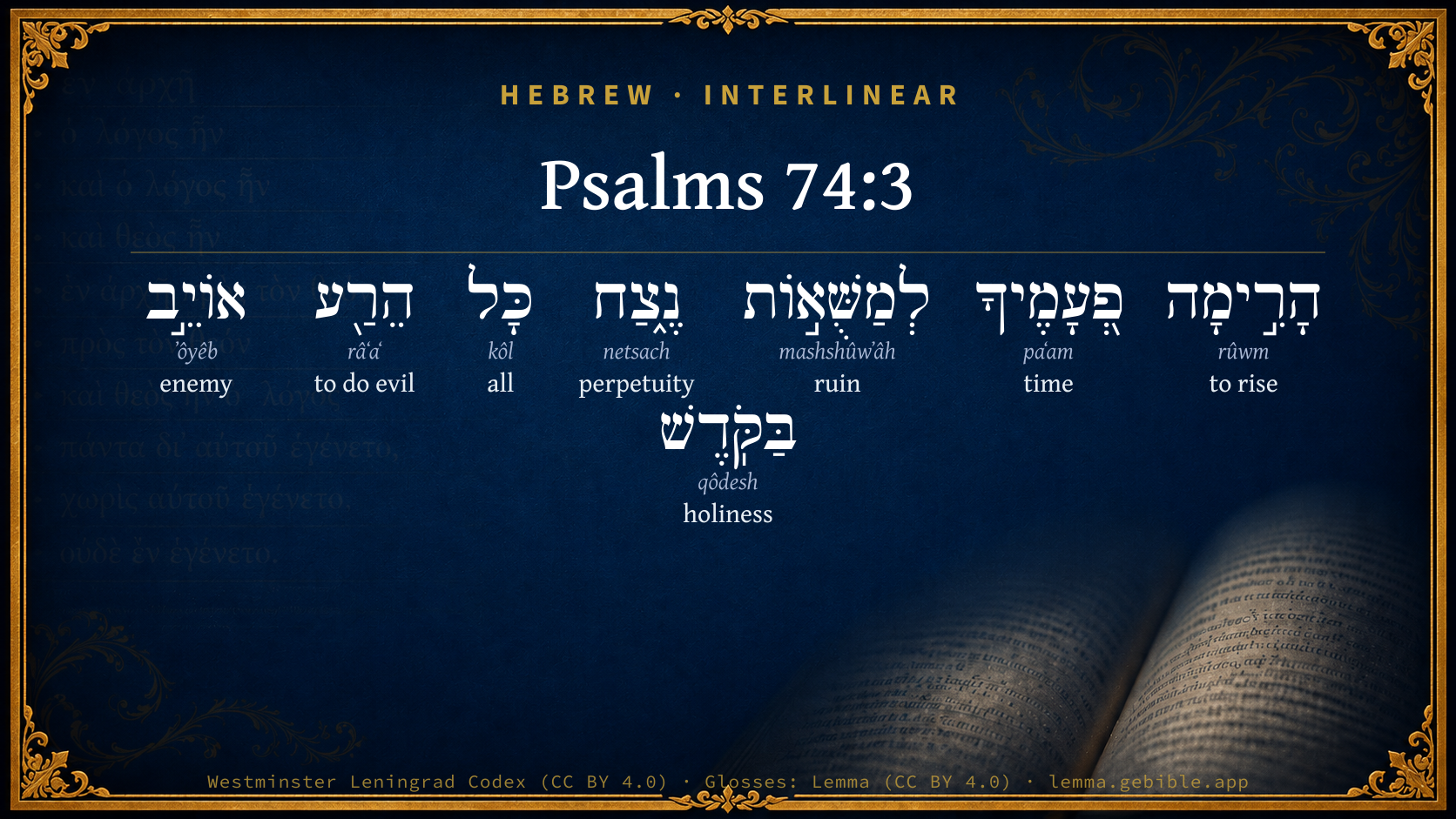
Hebrew (Westminster Leningrad Codex) Psalms 74:3 appears in the Hebrew Old Testament. The text above is from the Westminster Leningrad Codex. Each word links to its Strong’s number, a concise gloss, and parsing drawn from the Open Scriptures Hebrew Bible morphology. Click any word for its full Brown-Driver-Briggs (BDB) entry.
Download image
Cite this verse

Psalms 74:3 (World English Bible). Public Domain. Lemma interlinear Bible study tool, https://lemma.gebible.app/v/psalms/74/3.

Show BibTeX & RIS
BibTeX
RIS
English Translation
Lift up your feet to the perpetual ruins, All the evil that the enemy has done in the sanctuary.
World English Bible · Public Domain
Download a study sheet

One document with this verse’s original text, its word-by-word gloss line, the meaning frame, cross-references with their text, attributed commentary, and full source and license credits — printable, and it pastes into notes with its structure intact.

This verse Autodidact and up

Study sheet (.html) Plain text (.txt)

A passage Seminary Student

Up to 50 verses in one chapter. A passage sheet keeps up to 6 commentary sources and 12 cross-references per verse, in the order this page ranks them, and says so on the sheet whenever that leaves anything out. Ask for a single verse and you get the Autodidact verse sheet above.

Everything on this page stays free to read, with no account — the sheet is a download of what is already on screen, not access to it.

Want to remove ads? Support Godless Engineer
Compare translations 3

The same verse in 3 English versions, stacked beneath the original-language interlinear above. Click any original word for its lexicon entry.

Each is an independent rendering of the whole verse — the interlinear is not word-aligned to these translations.

Highlighted words mark where these versions differ — a whole-verse word diff, not a word-by-word alignment.

  • World English Bible Public Domain
    Lift up your feet to the perpetual ruins, All the evil that the enemy has done in the sanctuary.
  • King James Version Public Domain
    Lift up thy feet unto the perpetual desolations; even all that the enemy hath done wickedly in the sanctuary.
  • unfoldingWord Literal Text CC BY-SA 4.0
    Lift up your feet to the destructions of perpetuity, all the enemy has damaged in the holy place.

unfoldingWord Literal Text — © unfoldingWord, licensed CC BY-SA 4.0. Word-aligned USFM3 via Door43 (git.door43.org/unfoldingWord/en_ult).

Versions to compare (up to 4)

3 of 4 selected

Show all 18 translations

Every available English version of this verse, each an independent rendering of the whole verse.

  • World English Bible Public Domain
    Lift up your feet to the perpetual ruins, All the evil that the enemy has done in the sanctuary.
  • Berean Standard Bible Public Domain
    Turn Your steps to the everlasting ruins, to everything in the sanctuary the enemy has destroyed.
  • Majority Standard Bible Public Domain
    Turn Your steps to the everlasting ruins, to everything in the sanctuary the enemy has destroyed.
  • King James Version Public Domain
    Lift up thy feet unto the perpetual desolations; even all that the enemy hath done wickedly in the sanctuary.
  • American Standard Version (1901) Public Domain
    Lift up thy feet unto the perpetual ruins, All the evil that the enemy hath done in the sanctuary.
  • Revised Version (1885) Public Domain
    Lift up thy feet unto the perpetual ruins, all the evil that the enemy hath done in the sanctuary.
  • Geneva Bible (1599) Public Domain
    Lift vp thy strokes, that thou mayest for euer destroy euery enemie that doeth euill to the Sanctuarie.
  • Douay-Rheims (1899) Public Domain
    Lift up thy hands against their pride unto the end; see what things the enemy hath done wickedly in the sanctuary.
  • Young's Literal Translation Public Domain
    Lift up Thy steps to the perpetual desolations, Everything the enemy did wickedly in the sanctuary.
  • Literal Standard Version CC BY-SA 4.0
    Lift up Your steps to the continuous desolations, || Everything the enemy did wickedly in the sanctuary.
  • Unlocked Literal Bible CC BY-SA 4.0
    Come look at the complete ruins, all the damage that the enemy has done in the holy place.
  • unfoldingWord Literal Text CC BY-SA 4.0
    Lift up your feet to the destructions of perpetuity, all the enemy has damaged in the holy place.
  • Darby Bible Public Domain
    Lift up thy steps unto the perpetual desolations: everything in the sanctuary hath the enemy destroyed.
  • World Messianic Bible Public Domain
    Lift up your feet to the perpetual ruins, all the evil that the enemy has done in the sanctuary.
  • Webster's Bible Public Domain
    Lift up thy feet to the perpetual desolations; even all that the enemy hath done wickedly in the sanctuary.
  • Free Bible Version CC BY-SA 4.0
    Come and walk through the complete devastation. The enemy has totally destroyed your Temple.
  • Bible in Basic English Public Domain
    Go up and see the unending destruction; all the evil which your haters have done in the holy place;
  • JPS Tanakh (1917) Public Domain
    Lift up Thy steps because of the perpetual ruins, even all the evil that the enemy hath done in the sanctuary.

Literal Standard Version (2020), Covenant Press — licensed CC BY-SA 4.0. Text via the HelloAO Bible API (eBible.org). Unlocked Literal Bible (unfoldingWord) — licensed CC BY-SA 4.0. Text via the HelloAO Bible API (eBible.org). unfoldingWord Literal Text — © unfoldingWord, licensed CC BY-SA 4.0. Word-aligned USFM3 via Door43 (git.door43.org/unfoldingWord/en_ult). Free Bible Version, Dr. Jonathan Gallagher — licensed CC BY-SA 4.0. Text via the HelloAO Bible API (eBible.org).

Word by word

More ways to search: Search by grammar → Find every occurrence → Compare this word →

Practice this passage: Drill this verse → Learn its vocabulary →

About this verse

These counts appear in no published source. They are computed here, from the morphology-tagged text and Lemma’s own curated glosses. What Lemma adds →

8
words
8
distinct lemmas
Wisdom
section

Notable vocabulary

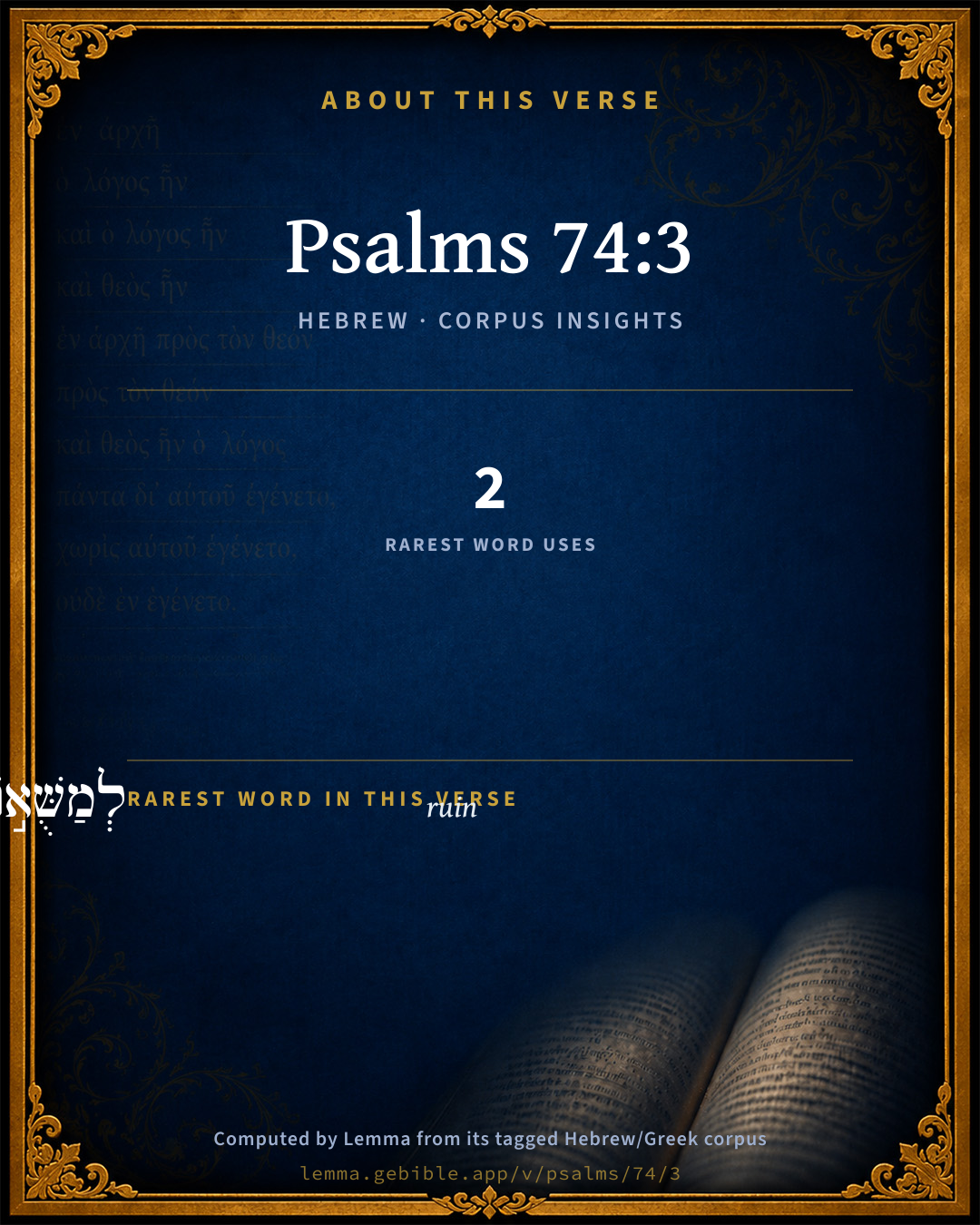
The rarest word here is לְמַשֻּׁא֣וֹת ruin H4876 — appearing just 2 times in the whole Hebrew Bible.

Shared distinctive vocabulary

לְמַשֻּׁא֣וֹת ruin H4876 occurs in 2 verses of the Hebrew Bible. Also found in:

Grammatical profile

  • 3 verbs
  • 5 nouns

Verb forms

  • הָרִ֣ימָה Hiphil · Imperative
  • הֵרַ֖ע Hiphil · Perfect
  • אוֹיֵ֣ב Qal · Participle Active

Hebrew & Septuagint length

In English translation the verse runs 19 words from the Hebrew and 21 from the Septuagint (LXX English) — closely comparable.

A rough comparison of the two English renderings, which tokenize alike — not a word-level alignment.

Word counts can differ between the Hebrew and the Greek without any difference in meaning — e.g. the Hebrew direct-object marker אֵת has no separate Greek word, and Greek often adds the article ὁ.

Cross-references

25

Topical passages linked to Psalms 74:3 in the Treasury of Scripture Knowledge — connected by theme and wording, ordered by reader-vote popularity; previews shown in the World English Bible.

  • Lamentations 1:10 The adversary has spread out his hand on all her pleasant things: For she has seen that the nations are entered into her sanctuary, Concerning whom you did command that they should not enter into your assembly.
  • Psalms 79:1 God, the nations have come into your inheritance. They have defiled your holy temple. They have laid Jerusalem in heaps.
  • Daniel 9:17 Now therefore, our God, listen to the prayer of your servant, and to his petitions, and cause your face to shine on your sanctuary that is desolate, for the Lord's sake.
  • Isaiah 64:10–11 Your holy cities are become a wilderness, Zion is become a wilderness, Jerusalem a desolation.
  • Mark 11:17 He taught, saying to them, "Isn't it written, 'My house will be called a house of prayer for all the nations?' But you have made it a den of robbers!"
  • Luke 21:24 They will fall by the edge of the sword, and will be led captive into all the nations. Jerusalem will be trampled down by the Gentiles, until the times of the Gentiles are fulfilled.
  • Joshua 10:24 It happened, when they brought forth those kings to Joshua, that Joshua called for all the men of Israel, and said to the chiefs of the men of war who went with him, Come near, put your feet on the necks of these kings. They came near, and put their feet on the necks of them.
  • 2 Samuel 22:39–43 I have consumed them, and struck them through, so that they can't arise: Yes, they are fallen under my feet.
  • Nehemiah 1:3 They said to me, The remnant who are left of the captivity there in the province are in great affliction and reproach: the wall of Jerusalem also is broken down, and the gates of it are burned with fire.
  • Nehemiah 2:3 I said to the king, Let the king live forever: why should not my face be sad, when the city, the place of my fathers' tombs, lies waste, and the gates of it are consumed with fire?
  • Nehemiah 2:13 I went out by night by the valley gate, even toward the jackal's well, and to the dung gate, and viewed the walls of Jerusalem, which were broken down, and the gates of it were consumed with fire.
  • Psalms 44:23 Wake up! Why do you sleep, Lord? Arise! Don't reject us forever.
  • Psalms 44:26 Rise up to help us. Redeem us for your loving kindness' sake.
  • Psalms 102:13–14 You will arise and have mercy on Zion; For it is time to have pity on her. Yes, the set time has come.
  • Isaiah 10:6 I will send him against a profane nation, and against the people of my wrath will I give him a charge, to take the spoil, and to take the prey, and to tread them down like the mire of the streets.
  • Isaiah 25:10 For in this mountain will the hand of Yahweh rest; and Moab shall be trodden down in his place, even as straw is trodden down in the water of the dung-hill.
  • Isaiah 61:4 They shall build the old wastes, they shall raise up the former desolations, and they shall repair the waste cities, the desolations of many generations.
  • Isaiah 63:3–6 I have trodden the winepress alone; and of the peoples there was no man with me: yes, I trod them in my anger, and trampled them in my wrath; and their lifeblood is sprinkled on my garments, and I have stained all my clothing.
  • Jeremiah 52:13 and he burned the house of Yahweh, and the king's house; and all the houses of Jerusalem, even every great house, burned he with fire.
  • Daniel 8:11–14 Yes, it magnified itself, even to the prince of the host; and it took away from him the continual [burnt offering], and the place of his sanctuary was cast down.
  • Daniel 9:27 He shall make a firm covenant with many for one week: and in the midst of the week he shall cause the sacrifice and the offering to cease; and on the wing of abominations [shall come] one who makes desolate; and even to the full end, and that determined, shall [wrath] be poured out on the desolate.
  • Daniel 11:31 Forces shall stand on his part, and they shall profane the sanctuary, even the fortress, and shall take away the continual [burnt offering], and they shall set up the abomination that makes desolate.
  • Micah 1:3 For, behold, Yahweh comes forth out of his place, And will come down and tread on the high places of the earth.
  • Micah 3:12 Therefore Zion for your sake will be plowed like a field, And Jerusalem will become heaps of rubble, And the mountain of the temple like the high places of a forest.
  • Revelation 11:2 Leave out the court which is outside of the temple, and don't measure it, for it has been given to the gentiles. They will tread the holy city under foot for forty-two months.

Cross-references courtesy of OpenBible.info (CC BY 4.0).

Hebrew and Greek witnesses Masoretic Hebrew ↔ Greek Septuagint

The same verse in the two great witnesses to the Old Testament, shown verse-for-verse.

You’re reading Greek Psalm 73 (Hebrew Psalm 74). The Septuagint counts the superscription, so verse numbers can differ from the Hebrew — chapter-level alignment, not verse-by-verse. Numbering follows Rahlfs.

These are two independent witnesses, not word-aligned to each other, and the Septuagint is shown in lemma (dictionary) form.

Hebrew Psalms 74:3 Masoretic · Westminster Leningrad Codex

הָרִ֣ימָה פְ֭עָמֶיךָ לְמַשֻּׁא֣וֹת נֶ֑צַח כָּל הֵרַ֖ע אוֹיֵ֣ב בַּקֹּֽדֶשׁ

Lift up your feet to the perpetual ruins, All the evil that the enemy has done in the sanctuary.

World English Bible · Public Domain

Greek LXX Greek Psalm 73:3 Septuagint · lemma form

ἐπιαἴρω ὁ χείρ σύ ἐπί ὁ ὑπερηφανία αὐτός εἰς τέλος ὅσος πονηρεύομαι ὁ ἐχθρός ἐν ὁ ἅγιος σύ

Lift up your hands against their pride continually; because of all that the enemy has done wickedly in your holy places.

LXX2012 (modern English Septuagint) · Public Domain

Hebrew: Westminster Leningrad Codex (CC BY 4.0). Greek: Septuagint (public domain); English from LXX2012 (modern English Septuagint) (Public Domain). How the Septuagint differs from the Hebrew →

Commentary

Notes on Psalms 74:3 from classic Christian and Jewish commentators (each source and its license shown beneath its notes). The classic Christian expositions comment on the surrounding passage and are grouped to its opening verse, so a note may address several verses; the Jewish commentaries on the Tanakh (Rashi and others) are per-verse, so they appear only where the commentator wrote on this verse.

Lemma curates 59 commentaries, every one of them public domain or Creative Commons licensed, each selected and text-cleaned for this edition rather than reprinted as found. About our sources →

Trapp's Complete Commentary

John Trapp

Psa 74:3 Lift up thy feet unto the perpetual desolations; [even] all [that] the enemy hath done wickedly in the sanctuary.

Ver. 3. Lift up thy feet unto the perpetual desolations] i.e. Make haste to help, accurre, advola, as Gen 29:1. Or, lift up thy feet, viz. to tread down thy enemies. A metaphor from combatants, Qui elevant pedes et passus, ut violentius in hostem invehantur. Some have rendered it, The loftiness of thy feet is perpetually (i.e. irreparably) desolated, understanding thereby the temple, that place of God’s feet, Eze 43:7

All that the enemy hath done wickedly in the sanctuary] Or, every one that hath done evil to his enemy in the sanctuary, whither he fled for safety.

John Trapp, A Commentary or Exposition upon All the Books of the Old and New Testament (1647–1656) — public domain. Text from a community e-Sword module.

Joseph Benson's Commentary

Psa 74:3. Lift up thy feet — This is spoken after the manner of men, and means, Come speedily to our rescue, and do not delay, as men do when they sit or stand still; unto — Or rather, because of, the perpetual desolations — Namely, those ruins of the city and country, which had lasted so very long, and which, if God did not come to their help, he intimates, would be perpetual and irrecoverable. Even all that the enemy hath done wickedly, &c. — God had deserted his sanctuary, and the shechinah, or cloud of glory, emblematical of the divine presence, had gone up from between the cherubim: see Eze 10:4. In consequence of which the heathen people had invaded that holy place, and laid it waste. And the psalmist here supplicates and urges God’s return to them, as that which alone could restore their temple, city, and country to their former happy state.

Joseph Benson's Commentary on the Old and New Testaments (1811–1818) — public domain. Text from a community e-Sword module.

J. A. Alexander on Psalms

Joseph Addison Alexander

Psa 74:3. Lift thy steps to the perpetual ruins, all the enemy has ill done in the holy place. The first phrase is a poetical expression meaning simply advance, draw near, for the purpose of inspection. The word translated ruins occurs only here and in Ps. lxxiii. 18. The whole phrase strictly means ruins of perpetuity, i.e. such as appears likely to continue for ever, and will certainly do so, unless God comply with this request to draw near. The construction of the second clause adopted by some writers, the enemy has destroyed all (or every thing) in the holy place, is scarcely grammatical. To express that idea, the word all would have the article, as in Psa 14:3, or a suffix, as in Psa 29:9, whereas its intimate connection here with the following verb in Hebrew is equivalent to a relative construction. Ill done, injured or destroyed, done mischief.

Joseph Addison Alexander, The Psalms Translated and Explained (1850) — public domain. Text from a community e-Sword module.

Tyndale Open Study Notes

Tyndale Open Resources

74:3-8 Like a guide, the psalmist points out to the Lord what took place during the destruction of Jerusalem in 586 BC.

Tyndale Open Study Notes — © Tyndale Open Resources, licensed CC BY-SA 4.0. Text via the HelloAO Bible API.

Geneva Bible (1599)

Geneva Bible translators

Or, feet.

Geneva Bible (1599) marginal notes — public domain. Text via Bolls.life.

Adam Clarke's Commentary

Verse 3. Lift up thy feet] Arise, and return to us, our desolations still continue. Thy sanctuary is profaned by thine and our enemies.

Adam Clarke's Commentary on the Bible (1810–1826) — public domain. Text from a community e-Sword/MySword module.

John Calvin's Commentaries

3. Lift up thy strokes. Here the people of God, on the other hand, beseech him to inflict a deadly wound upon their enemies, corresponding to the cruelty with which they had raged against his sanctuary. They would intimate, that a moderate degree of punishment was not sufficient for such impious and sacrilegious fury; and that, therefore, those who had shown themselves such violent enemies of the temple and of the worshippers of God should be completely destroyed, their impiety being altogether desperate. As the Holy Spirit has dictated this form of prayer, we may infer from it, in the first place, the infinite love which God bears towards us, when he is pleased to punish so severely the wrongs inflicted upon us; and, in the second place, the high estimation in which he holds the worship yielded to his Divine majesty, when he pursues with such rigour those who have violated it. With respect to the words, some translate פעמים, pheamim, which we have rendered strokes, by feet or steps, and understand the Church as praying that the Lord would lift up his feet, and run swiftly to strike her enemies. Others translate it hammers, which suits very well. I have, however, no hesitation in following the opinion of those who consider the reference to be to the act of striking, and that the strokes themselves are denoted. The last clause of the verse is explained by some as meaning that the enemy had corrupted all things in the sanctuary. But as this construction is not to be found elsewhere, I would not depart from the received and approved reading.

John Calvin's Commentaries (1540-1563) — public domain. Text from the Calvin Translation Society English edition (1840s-50s) via the Christian Classics Ethereal Library (ccel.org). Calvin's coverage is partial (roughly two-thirds of the Bible); uncommented books and verses are honest gaps, never fabricated. The 19th-century editor's footnotes and remarks are omitted so the notes are faithfully Calvin's own voice.

Ellicott's Commentary for English Readers

(3) Lift up thy feet.—Better, Lift thy steps. A poetical expression. God is invoked to hasten to view the desolation of the Temple. A somewhat similar expression will be found in Gen_29:1 (margin).

Perpetual desolations.—The word rendered “desolations” occurs also in Psa_73:18, where it is rendered “destruction.” Here, perhaps, we should render ruins which must be ever ruins, or complete ruins, or possibly, taking the first meaning of netsach, ruins of splendour. Isa_11:4 does not offer a parallel, since the Hebrew is different, and plainly refers to the long time the places have been in ruins.

Even all . . .—Better, the enemy hath devastated all in the holy place. 1Ma_1:38-40; 1Ma_3:45 (“Now Jerusalem lay void as a wilderness”) give the best explanation of the verse, descriptive, as it is, of the condition of the whole of Zion.

A Bible Commentary for English Readers, edited by Charles John Ellicott (1878–1897) — public domain. Text from a community e-Sword module.

The Cambridge Bible for Schools and Colleges

gen. ed. J. J. S. Perowne

3. Lift up thy feet] Bestir Thyself: come in might and majesty to visit and deliver. the perpetual desolations] R.V. the perpetual ruins: a word found elsewhere only in Psa_73:18. Cp. the threat, Jer_25:9, and the promises, Isa_58:12; Isa_61:4.

even all &c.] Better as R.V., All the evil that the enemy hath done in the sanctuary; or R.V. marg., The enemy hath wrought all evil.

The Cambridge Bible for Schools and Colleges (gen. ed. J. J. S. Perowne; Cambridge University Press, 1878–1918) — public domain. Text from a community e-Sword module.

John Gill's Exposition

Lift up thy feet unto the perpetual desolations,.... That is, arise, hasten, move swiftly, and in the greatness of strength, and come and see the desolations made by the enemy, which look as if they would remain for ever; meaning either the desolations made in the city and temple of Jerusalem, either by Nebuchadnezzar, or by Titus; or the havocs and devastations made in the church of God by the tyranny and persecutions of antichrist; which have continued so long, that an end of them has been almost despaired of. So Jacob is said to "lift up his feet"; which we render went on his way, Gen 29:1. Some take these words in a different sense, as a prayer for the destruction of the church's enemies; so the Targum,

"lift up thy feet or goings, to make desolate the nations for ever;''

and Kimchi makes but one sentence of this and the following clause, and reads it thus,

"lift up thy feet, to make desolate for ever every enemy that does wickedly in the sanctuary:''

but the accent "athnach", which divides propositions, and is upon the word forbids such a reading. The former sense is best, and most agreeable to the context;

even all that the enemy hath done wickedly in the sanctuary; by profaning and destroying the temple, as did Nebuchadnezzar, Antiochus, and Titus; or by antichrist sitting in the temple and church of God, setting up idolatrous worship in it, and blaspheming the tabernacle of God, and those that dwell therein, Th2 2:4.

John Gill's Exposition of the Whole Bible (1746–1763) — public domain (CC PDM 1.0). Text via the HelloAO Bible API.

Albert Barnes' Notes on the Bible

Lift up thy feet - That is, Advance, or draw near. Come and look directly and personally on the desolations which now exist in the holy city.

Unto the perpetual desolations - Hebrew, “the ruins of perpetuity,” or eternity; that is, such as have been long continued, and threaten to continue forever. The ruin had not suddenly come, and it did not seem likely soon to pass away, but appeared to be entire and permanent. The destruction of the city seemed to be complete and final.

Even all that the enemy hath done wickedly - That is, with wicked intent and purpose. The reference seems to be to the Chaldeans, and to the ruin which they had brought upon the temple and city.

In the sanctuary - That is, either Jerusalem, considered as a holy place; or the temple, the place of the public worship of God.

Albert Barnes' Notes on the Bible (1834–1885) — public domain. Text from a community e-Sword/MySword module.

Matthew Poole's English Annotations

Lift up thy feet, i.e. come speedily for our rescue, and do not sit or stand still, as hitherto thou seemest to do.

Unto the perpetual desolations; or rather, because of (as this prefix oft signifies) the perpetual desolations. So it is a powerful motive to God, to come to their help, because otherwise our destruction is everlasting and irrecoverable.

In the sanctuary; or, against thy sanctuary; of which see Psa 74:7.

Matthew Poole's English Annotations on the Holy Bible (1683–1685) — public domain. Text from a community e-Sword/MySword module.

The Treasury of David

Charles H. Spurgeon

Ver. 3. Lift up thy feet unto the perpetual desolations. The ruin made had already long been an eyesore to the suppliant, and there seemed no hope of restoration. Havoc lorded it not only for a day or a year, but with perpetual power. This is another argument with God. Would Jehovah sit still and see his own land made a wilderness, his own palace a desolation? Until he should arise, and draw near, the desolation would remain; only his presence could cure the evil, therefore is he entreated to hasten with uplifted feet for the deliverance of his people.

Even all that the enemy hath done wickedly in the sanctuary. Every stone in the ruined temple appealed to the Lord; on all sides were the marks of impious spoilers, the holiest places bore evidence of their malicious wickedness; would the Lord for ever permit this? Would he not hasten to overthrow the foe who defied him to his face, and profaned the throne of his glory? Faith finds pleas in the worst circumstances, she uses even the fallen stones of her desolate palaces, and assails with them the gates of heaven, casting them forth with the great engine of prayer.

Ver. 3. Lift up thy feet. Or, thy hammers, that is, "thy strokes, "to "stamp" or "beat down" the enemy "unto perpetual desolations." Thus the "feet" are used to "tread down with, " Isa 26:6; and so the Greek taketh it here, changing the metaphor, and translating it, "Thy hands, "which are also instruments to strike down with. Or, lift up thy feet, that is, come quickly to see the perpetual desolations, which the enemy hath made. Henry Ainsworth.

Ver. 3. Lift up thy feet. Abu Walid renders it, Tread hard upon thine enemies. The Jewish Arab, Shew forth thy punishment, adding in a note that the lifting up the feet implies punishment, the bringing under by force being usually expressed by treading under the feet. Henry Hammond.

Ver. 3. Lift up thy feet, etc. To these desolations they seek that God would lift up his footsteps, that is, that he would approach. In Ge 29:1, there occurs the phrase, to lift the feet; here the expression is much more marked--to lift up the footsteps --and must be taken to mean a swift, impetuous, majestic, and powerful approach; like a hero, who strikes the ground with heavy tread, and advances rapidly with far sounding footsteps. Hermann Venema.

Ver. 3. In the sanctuary. Their cities had been laid waste, their provinces, their farms, their vineyards, their oliveyards. They themselves had been everywhere cut down without striking a blow in defence, and their means of life had been snatched away without resistance. Yet they speak not of these things; not because things of this sort ought not to cause grief, nor yet because the saints are not touched with a sense of their loss; but because those things which threatened the extinction of religion and the worship of God, overtopped the feeling of all these other misfortunes with an intolerable sorrow. Musculus.

Ver. 3. Church mischief.

I. The church has enemies.

II. Wickedness in the church is their great weapon.

III. This causes much desolation to weak saints, to

enquirers, to peace, to prayer, to usefulness.

IV. The cure for it is God's interposition.

Ver. 3-4. The power of prayer.

I. On one side were,

1. Desolation: perpetual, etc.

2. Desecration.

3. Declamation: enemies roar.

4. Demonstration: they set up. II. On the other side is,

1. Supplication.

2. This brings God to the rescue effectually and quickly.

Psalms 74:4*

Ver. 3-4. The power of prayer.

I. On one side were,

1. Desolation: perpetual, etc.

2. Desecration.

3. Declamation: enemies roar.

4. Demonstration: they set up. II. On the other side is,

1. Supplication.

2. This brings God to the rescue effectually and quickly.

Charles H. Spurgeon's The Treasury of David (1869–1885) — public domain. Psalms only. Text from a community e-Sword/MySword module.

Whedon's Commentary on the Bible

Daniel D. Whedon

3. Lift up thy feet—Hasten thy footsteps to the places utterly desolate. This lifting up of the foot, [or hand,] implies the purpose of doing something, as in Gen_41:44 : “Without thee shall no man lift up his hand or foot [that is, to execute a purpose] in all Egypt.” The lifting up the foot is sometimes for trampling down, in judgment; but here for haste to witness the work of the enemy, with the implied idea of recompense. See Psa_7:5; Dan_8:7.

Perpetual—Without end, eternal. Psa_74:1. So the desolations appeared to the crushed spirit.

In the sanctuary—The desolations reach even to the temple.

Daniel D. Whedon (gen. ed.), Commentary on the Old and New Testaments (1874–1909) — public domain. Text from a community e-Sword module.

The Pulpit Commentary

Lift up thy feet unto the perpetual desolations; or, the perpetual ruins. God is asked to visit and protect, or else to visit and inspect, the desolate ruins with which the Babylonians have covered Mount Zion. Even all that the enemy hath done wickedly in the sanctuary. The Babylonians had plundered the temple of all its treasures, breaking the precious Phoenician bronze work into pieces, and carrying off everything of value that was portable. (2Ki_25:13-17) They had also "burnt the house of the Lord "(ver. 9), and "broken down the walls of Jerusalem" (ver. 10) and the walls of the temple to a large extent (see below, ver. 7). It is quite certain that neither Shishak nor the Syrians under Antiochus Epiphanes created any such devastation.

HOMILIES BY S. CONWAY Vers. 3-8. Hell"s carnival.

This is what is portrayed to us in these lamentations over the desecrations and destructions wreaked upon the temple at Jerusalem, probably at the time of Nebuchadnezzar"s invasion. (see 2Ch_36:17, etc.) As the destroyer acted then, so he acts now when the like work is on hand of profaning God"s sanctuary. What the ancient temple was, the Church of God is the sanctuary of God. And it has once and again come under the destroyer"s power.

I THE TEMPLE IS LAID WASTE. (Ver. 3)

1. That at Jerusalem was. The sacred service had come to an end; the throng of worshippers were driven away: the ministers of the temple no longer served at the altar; there was desolation everywhere. "The holy and beautiful house wherein the fathers of Israel had worshipped has been plundered and desecrated by a heathen soldiery. Instead of the psalms and hymns and sacred anthems which once echoed within those walls, has been heard the brutal shout of the fierce invaders, roaring like lions over their prey.

2. And there have been similar desecrations. Our own land, and other"s, are sprinkled over with the ruins of desecrated shrines. They are beautiful even now in their decay, and suggest to us how glorious they must have been when they stood erect and complete in all their grandeur; when, instead of being given over, as now, to mouldering ruin, they were thronged with devout worshippers, and the sublime music of the praises of God reverberated through their high-roofed naves and choirs, and down the long vistas of their vaulted aisles. One can, even now, scarce keep back the bitter curse upon those brutal iconoclasts who in these once magnificent houses of God have wrought such cruel havoc and desolation, and the effects of whose blind fanaticism or wanton wickedness and greed can now never be repaired. The sacred rage which breathes in this psalm finds place yet in many hearts against those detestable destroyers of the most beautiful products of God-inspired genius and devotion that the world has ever seen or will see.

3. But the desolation of the spiritual temple is worse still, and what most concerns us all. And the wasters of that are not wicked men who assail us from without, but spiritual foes whom we have sheltered within. It is unbelief which lays waste the spiritual temple. Worse than fire, or axe, or sword, it makes havoc of the soul. And wickedness following hard on its footsteps completes the work which it has begun. Then comes

II THE EXULTATION OF THE ADVERSARY. (Ver. 4) No doubt this literally occurred at Jerusalem, as it has in many another sanctuary of God which has been brought to ruin. But most assuredly that "roar" has been heard when the Church of God his temple in the soul has been laid waste. The adversaries of God point the finger of scorn; they scoff and jibe and mock; they never weary of holding up to contempt the loud, lofty pretensions and vast claims of the Christian Church, as they bid all men see what a wretched fraud she has at last proved to be. They contrast what she said and what she is, and the roar of execration and exultation over her is heard far and wide as that contrast is seen. Let none of us by our infidelities add to that bitter shame.

III THEY SET UP THEIR STANDARDS AS TRUE. (Ver. 4) In the temple at Jerusalem the invaders, no doubt, piled their military trophies, banners, and ensigns; or the "signs" spoken of may mean religious emblems, heathen rites and ceremonies. (cf. RAPC 1Ma 1:54, 59 3:48) But both meanings may be combined, as the temple may have been turned both into a barrack and heathen altar at the same time. The incident, however, suggests what is so continually seen when the spiritual temple of God is laid waste. Then men take their standards of truth for those of God; they assert their miserable theories of things for the verities which the Holy Scriptures have taught us; they bid us welcome some age of reason instead of the time-honoured truths on which the Church is founded. Their ensigns for signs, man"s speculations for God"s revelations.

IV THE BEAUTY AND GRACE OF THE TEMPLE THEY BREAK DOWN. (Ver. 6) So has it been with material sanctuaries of God, and the like has been done in those which are spiritual. For a while the unbeliever filches from the fair fabric of Christian truth those gracious and winsome doctrines which have ever commended the faith of Christ to men, and he claims them as the mere product of reason, as evolved by the processes of human thought. But when his work of destruction is complete, and the spiritual sanctuary of God is all laid waste, faith utterly gone, then it will be found that this "carved work of the sanctuary" will be broken down, and the love and care of men will depart with the love and faith of God.

V THE WORK GOES ON UNTIL ALL IS DESTROYED. (Ver. 7) It was so with the material temple; but, thank God, all is not lost in the spiritual There may be, however, individuals and groups of men in which the dread work is complete, and "God is not in all their thoughts.

VI EVERY RELIC AND TRACE OF THE WORSHIP OF GOD IS GOT RID OF. (Ver. 8) Besides the temple, there were, doubtless, synagogues, places of assembly, where religious men met for worship, though we do not meet with the actual mention of synagogues until the times of the New Testament. And when the first temple was destroyed, we may reasonably believe that such places existed, as we know they did afterwards. But there are, alas! places and human hearts where every relic and trace of God"s worship have been swept utterly away, as if burned with fire. So long as any place where the soul can meet with God is left, the great enemy"s triumph is not complete; he is not satisfied till what is said in ver. 8 has been done. But from this may God keep us all! S.C.

The Pulpit Commentary (1880–1919), ed. H.D.M. Spence-Jones & Joseph S. Exell — public domain. Text from a community e-Sword module.

John Wesley's Explanatory Notes

Lift up - Come speedily to our rescue. Because - Because otherwise our destruction is irrecoverable.

John Wesley, Explanatory Notes Upon the Whole Bible (1754–1765) — public domain. Text via the GEBible commentary corpus.

unfoldingWord translationNotes

Door43 World Missions Community

General Information:

These verses describe an actual event, a physical attack on the temple of Israel in Jerusalem.

Come look

Asaph is addressing God, asking him to come look at the destruction.

roared

The adversaries were shouting loudly with a great cry of victory.

engravings

This refers to carvings on wood, metal, or stone in the temple.

translationWords

ruin

holy place

adversary

ax

unfoldingWord translationNotes — © Distant Shores Media and the Door43 World Missions Community, licensed CC BY-SA 4.0. Source: git.door43.org/Door43/en_tn.

Rashi

Rabbi Shlomo Yitzchaki (Rashi)

Raise Your blows to inflict eternal ruin Raise Your blows and Your terrors that Your enemies will experience as eternal ruin for every evil thing that the enemy did in the Temple. In this manner, Menachem (p. 144) associates it with (Gen. 41:8): “that his spirit was troubled (ותפעם).”

to...ruin Heb. למשאות, an expression of destruction, as (Isa. 24:12): “through desolation (שאיה)”; (Isa. 6:11), “and the ground lies waste (למשאות) and desolate.”

Rashi on the Tanakh — English translations: “The Judaica Press complete Tanach with Rashi, translated by A. J. Rosenberg” (CC BY 4.0); “Pentateuch with Rashi's commentary by M. Rosenbaum and A.M. Silbermann, 1929-1934” (public domain); “The Metsudah Tanach series, Lakewood, N.J” (CC BY 4.0); and “The Book of Joshua, Metsudah Publications, 1997” (CC BY 4.0). Text via Sefaria.

Lesson kit

Teaching starters — assembled from the data on this page, not authored interpretation. Every prompt links to the verse data it draws on. Edit before teaching.

Psalms, in the Wisdom, opens this verse with 8 words (8 distinct Hebrew lemmas). Its most distinctive word is mashshûwʼâh (“ruin”). A historical commentator’s framing appears above. Read the whole chapter for the surrounding context.

Discussion questions

  1. How does “ruin” (mashshûwʼâh) shape what this verse is saying?
  2. Psalms 73:18 shares the word «ruin» with this verse. How do the two illuminate each other?
  3. These translations render this verse differently. What is at stake in choosing one wording over another?
  4. The verb «הָרִ֣ימָה» is Hiphil Imperative. How does its form color the action?
  5. Reading how Trapp's Complete Commentary and Joseph Benson's Commentary read this verse, where do the two commentators agree and where do they part?

Things to notice

Reading settings

Reading text

Shown beneath each verse's original-language words.

Old Testament
Old Testament edition

Read the OT as the Masoretic Hebrew (MT) or the Greek Septuagint (LXX).

English shown for the Greek Septuagint (in the Hebrew ↔ Greek comparison).

Comparing translations? Open the Compare panel on any verse page to stack up to four side by side.