Leviticus 26:39

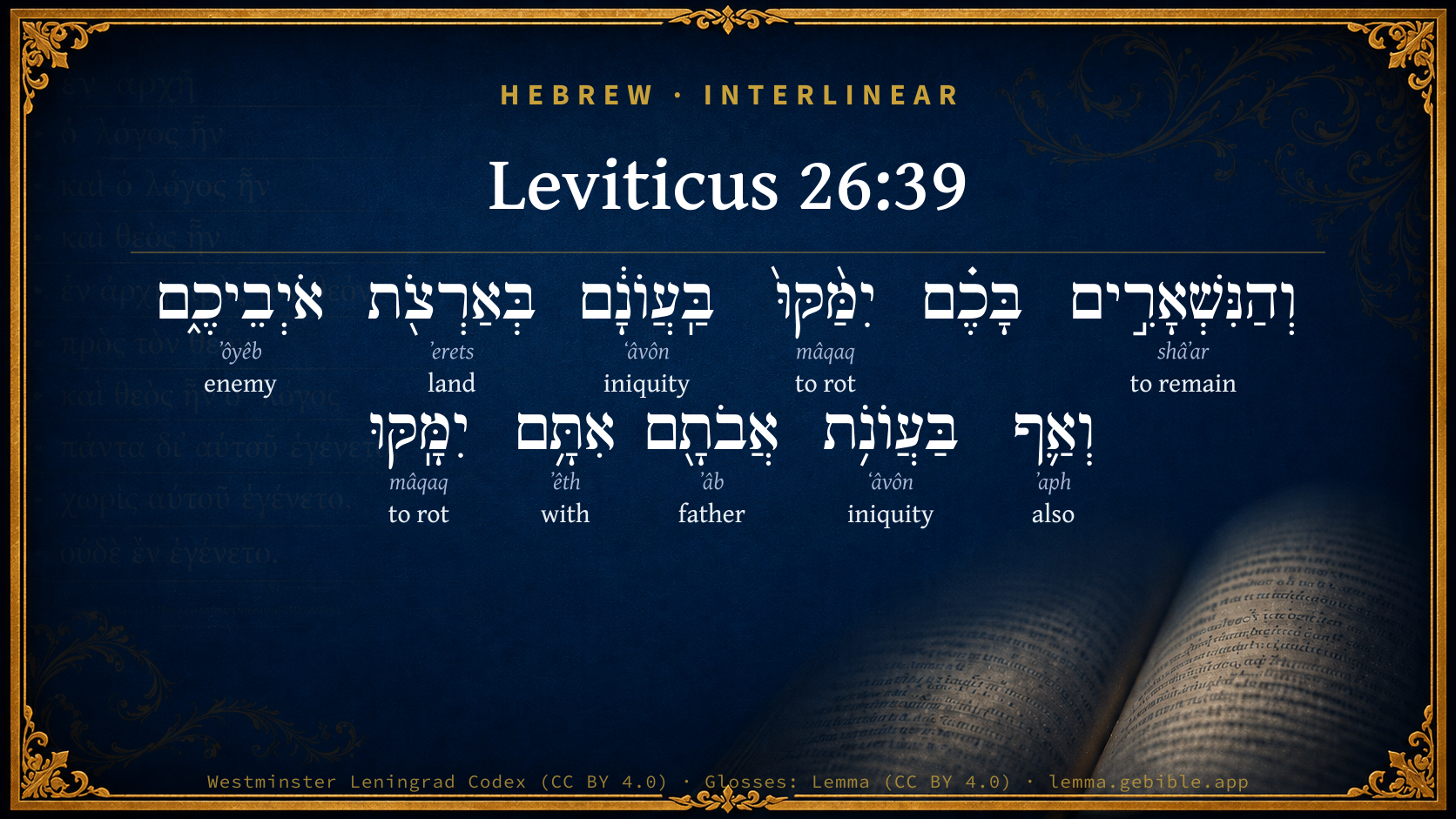
Hebrew (Westminster Leningrad Codex) Leviticus 26:39 appears in the Hebrew Old Testament. The text above is from the Westminster Leningrad Codex. Each word links to its Strong’s number, a concise gloss, and parsing drawn from the Open Scriptures Hebrew Bible morphology. Click any word for its full Brown-Driver-Briggs (BDB) entry.
Download image
Cite this verse

Leviticus 26:39 (World English Bible). Public Domain. Lemma interlinear Bible study tool, https://lemma.gebible.app/v/leviticus/26/39.

Show BibTeX & RIS
BibTeX
RIS
English Translation
Those of you who are left will pine away in their iniquity in your enemies' lands; and also in the iniquities of their fathers shall they pine away with them.
World English Bible · Public Domain
Highlights
  • 1 first appearance in the Hebrew Bible
Full analysis ↓
Download a study sheet

One document with this verse’s original text, its word-by-word gloss line, the meaning frame, cross-references with their text, attributed commentary, and full source and license credits — printable, and it pastes into notes with its structure intact.

This verse Autodidact and up

Study sheet (.html) Plain text (.txt)

A passage Seminary Student

Up to 50 verses in one chapter. A passage sheet keeps up to 6 commentary sources and 12 cross-references per verse, in the order this page ranks them, and says so on the sheet whenever that leaves anything out. Ask for a single verse and you get the Autodidact verse sheet above.

Everything on this page stays free to read, with no account — the sheet is a download of what is already on screen, not access to it.

Want to remove ads? Support Godless Engineer
Compare translations 3

The same verse in 3 English versions, stacked beneath the original-language interlinear above. Click any original word for its lexicon entry.

Each is an independent rendering of the whole verse — the interlinear is not word-aligned to these translations.

Highlighted words mark where these versions differ — a whole-verse word diff, not a word-by-word alignment.

  • World English Bible Public Domain
    Those of you who are left will pine away in their iniquity in your enemies' lands; and also in the iniquities of their fathers shall they pine away with them.
  • King James Version Public Domain
    And they that are left of you shall pine away in their iniquity in your enemies' lands; and also in the iniquities of their fathers shall they pine away with them.
  • unfoldingWord Literal Text CC BY-SA 4.0
    And the remaining in you will rot away in their iniquity in the lands of your enemies, and also in the iniquities of their fathers they will rot away with them.

unfoldingWord Literal Text — © unfoldingWord, licensed CC BY-SA 4.0. Word-aligned USFM3 via Door43 (git.door43.org/unfoldingWord/en_ult).

Versions to compare (up to 4)

3 of 4 selected

Show all 18 translations

Every available English version of this verse, each an independent rendering of the whole verse.

  • World English Bible Public Domain
    Those of you who are left will pine away in their iniquity in your enemies' lands; and also in the iniquities of their fathers shall they pine away with them.
  • Berean Standard Bible Public Domain
    Those of you who survive in the lands of your enemies will waste away in their iniquity and will decay in the sins of their fathers.
  • Majority Standard Bible Public Domain
    Those of you who survive in the lands of your enemies will waste away in their iniquity and will decay in the sins of their fathers.
  • King James Version Public Domain
    And they that are left of you shall pine away in their iniquity in your enemies' lands; and also in the iniquities of their fathers shall they pine away with them.
  • American Standard Version (1901) Public Domain
    And they that are left of you shall pine away in their iniquity in your enemies' lands; and also in the iniquities of their fathers shall they pine away with them.
  • Revised Version (1885) Public Domain
    And they that are left of you shall pine away in their iniquity in your enemies’ lands; and also in the iniquities of their fathers shall they pine away with them.
  • Geneva Bible (1599) Public Domain
    And they that are left of you, shall pine away for their iniquitie, in your enemies landes, and for the iniquities of their fathers shall they pine away with them also.
  • Douay-Rheims (1899) Public Domain
    And if of them also some remain, they shall pine away in their iniquities, in the land of their enemies, and they shall be afflicted for the sins of their fathers, and their own:
  • Young's Literal Translation Public Domain
    `And those who are left of you -- they consume away in their iniquity, in the lands of your enemies; and also in the iniquities of their fathers, with them they consume away.
  • Literal Standard Version CC BY-SA 4.0
    And those who are left of you—they consume away in their iniquity, in the lands of your enemies; and also in the iniquities of their fathers, they consume away with them.
  • Unlocked Literal Bible CC BY-SA 4.0
    Those who are left among you will waste away in their sins, there in your enemies' lands, and because of their fathers' sins they will waste away as well.
  • unfoldingWord Literal Text CC BY-SA 4.0
    And the remaining in you will rot away in their iniquity in the lands of your enemies, and also in the iniquities of their fathers they will rot away with them.
  • Darby Bible Public Domain
    And they that remain of you shall waste away through their iniquity in your enemies' lands; and also through the iniquities of their fathers shall they waste away with them.
  • World Messianic Bible Public Domain
    Those of you who are left will pine away in their iniquity in your enemies’ lands; and also in the iniquities of their fathers they shall pine away with them.
  • Webster's Bible Public Domain
    And they that are left of you shall pine away in their iniquity in your enemies' lands; and also in the iniquities of their fathers shall they pine away with them.
  • Free Bible Version CC BY-SA 4.0
    Those of you who do manage to survive in the countries of your enemies will wither away because of their guilt, decaying as they share the sins of their fathers.
  • Bible in Basic English Public Domain
    And those of you who are still living will be wasting away in their sins in the land of your haters; in the sins of their fathers they will be wasting away.
  • JPS Tanakh (1917) Public Domain
    And they that are left of you shall pine away in their iniquity in your enemies' lands; and also in the iniquities of their fathers shall they pine away with them.

Literal Standard Version (2020), Covenant Press — licensed CC BY-SA 4.0. Text via the HelloAO Bible API (eBible.org). Unlocked Literal Bible (unfoldingWord) — licensed CC BY-SA 4.0. Text via the HelloAO Bible API (eBible.org). unfoldingWord Literal Text — © unfoldingWord, licensed CC BY-SA 4.0. Word-aligned USFM3 via Door43 (git.door43.org/unfoldingWord/en_ult). Free Bible Version, Dr. Jonathan Gallagher — licensed CC BY-SA 4.0. Text via the HelloAO Bible API (eBible.org).

Word by word

More ways to search: Search by grammar → Find every occurrence → Compare this word →

Practice this passage: Drill this verse → Learn its vocabulary →

יִמַּ֨קּוּ֙
mâqaq
H4743
“to rot”
Verb, Niphal, Imperfect, 3rd Person, Masculine, Plural
Part of Speech
Verb
Stem
Niphal
Form
Imperfect
Person
3rd Person
Gender
Masculine
Number
Plural
Full BDB Definition

Origin: a primitive root

TWOT: 1237

to decay, pine away, rot, fester - (Niphal) - to fester (of wounds) - to rot, rot away - to moulder away - to pine away - (Hiphil) to cause to rot
  1. וְהַנִּשְׁאָרִ֣ים shâʼar H7604 “and · the · remaining” Conjunction + Particle, Definite Article + Verb, Niphal, Participle Active, Masculine, Plural, Absolute
  2. בַּֽעֲוֺנָ֔ם ʻâvôn H5771 “in/at · iniquity · their” Preposition + Noun, Common, Both, Singular, Construct + Suffix, Personal, 3rd Person, Masculine, Plural
  3. בְּאַרְצֹ֖ת ʼerets H776 “in/at · lands of” Preposition + Noun, Common, Both, Plural, Construct
  4. אֹיְבֵיכֶ֑ם ʼôyêb H341 “enemy · you” Verb, Qal, Participle Active, Masculine, Plural, Construct + Suffix, Personal, 2nd Person, Masculine, Plural
  5. וְאַ֛ף ʼaph H637 “and · also” Conjunction + Adverb
  6. בַּעֲוֺנֹ֥ת ʻâvôn H5771 “in/at the · iniquities of” Preposition, Determined + Noun, Common, Both, Plural, Construct
  7. אֲבֹתָ֖ם ʼâb H1 “fathers · their” Noun, Common, Masculine, Plural, Construct + Suffix, Personal, 3rd Person, Masculine, Plural
  8. אִתָּ֥ם ʼêth H854 “with · them” Preposition + Suffix, Personal, 3rd Person, Masculine, Plural
  9. יִמָּֽקּוּ mâqaq H4743 “to rot” Verb, Niphal, Imperfect, 3rd Person, Masculine, Plural

About this verse

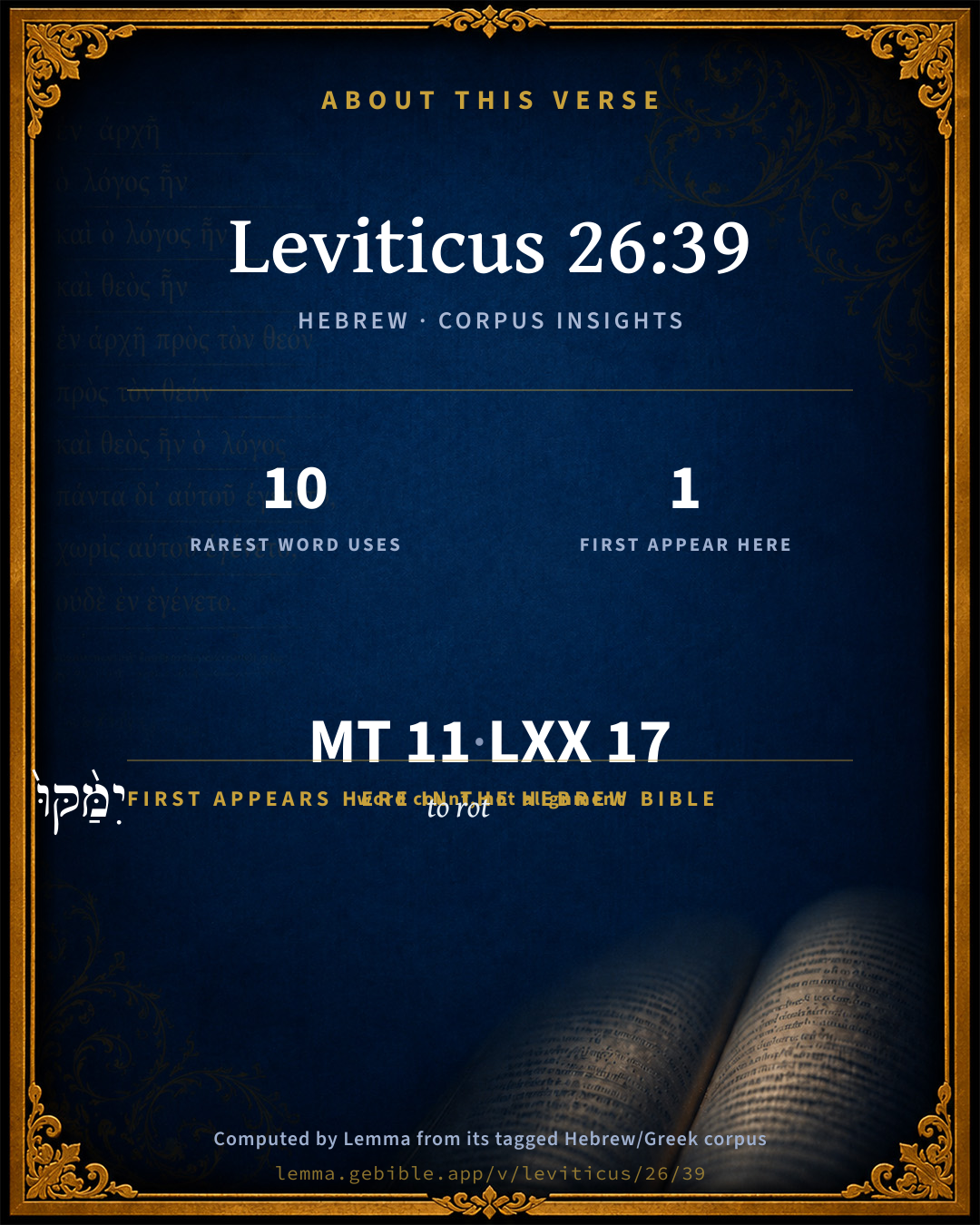
These counts appear in no published source. They are computed here, from the morphology-tagged text and Lemma’s own curated glosses. What Lemma adds →

11
words
8
distinct lemmas
Pentateuch
section

Notable vocabulary

The rarest word here is יִמַּ֨קּוּ֙ to rot H4743 — appearing just 10 times in the whole Hebrew Bible.

First appearance in Scripture

This word makes its first canonical appearance in the Hebrew Bible here:

  • יִמַּ֨קּוּ֙ to rot H4743

Shared distinctive vocabulary

יִמַּ֨קּוּ֙ to rot H4743 occurs in 7 verses of the Hebrew Bible. Also found in:

Grammatical profile

  • 4 verbs
  • 4 nouns
  • 2 prepositions
  • 1 adverb

Verb forms

  • וְהַנִּשְׁאָרִ֣ים Niphal · Participle Active
  • יִמַּ֨קּוּ֙ Niphal · Imperfect
  • אֹיְבֵיכֶ֑ם Qal · Participle Active
  • יִמָּֽקּוּ Niphal · Imperfect

Repetition

Words recur within this verse — often emphatic in Hebrew:

  • יִמַּ֨קּוּ֙ to rot H4743 ×2
  • בַּֽעֲוֺנָ֔ם iniquity H5771 ×2

Hebrew & Septuagint length

In English translation the verse runs 30 words from the Hebrew and 31 from the Septuagint (LXX English) — closely comparable.

A rough comparison of the two English renderings, which tokenize alike — not a word-level alignment.

Word counts can differ between the Hebrew and the Greek without any difference in meaning — e.g. the Hebrew direct-object marker אֵת has no separate Greek word, and Greek often adds the article ὁ.

In the original languages it is 11 Hebrew tokens and 17 Greek tokens — but the two are counted differently (Hebrew bundles its prefixes and suffixes into one token; the Greek is in lemma form), so that isn’t a like-for-like length.

Cross-references

24

Topical passages linked to Leviticus 26:39 in the Treasury of Scripture Knowledge — connected by theme and wording, ordered by reader-vote popularity; previews shown in the World English Bible.

  • Ezekiel 4:17 that they may want bread and water, and be dismayed one with another, and pine away in their iniquity.
  • Ezekiel 24:23 Your tires shall be on your heads, and your shoes on your feet: you shall not mourn nor weep; but you shall pine away in your iniquities, and moan one toward another.
  • Ezekiel 33:10 You, son of man, tell the house of Israel: Thus you speak, saying, Our transgressions and our sins are on us, and we pine away in them; how then can we live?
  • Exodus 20:5 you shall not bow yourself down to them, nor serve them, for I, Yahweh your God, am a jealous God, visiting the iniquity of the fathers on the children, on the third and on the fourth generation of those who hate me,
  • Deuteronomy 28:65 Among these nations shall you find no ease, and there shall be no rest for the sole of your foot: but Yahweh will give you there a trembling heart, and failing of eyes, and pining of soul;
  • Ezekiel 6:9 Those of you that escape shall remember me among the nations where they shall be carried captive, how that I have been broken with their lewd heart, which has departed from me, and with they eyes, which play the prostitute after their idols: and they shall loathe themselves in their own sight for the evils which they have committed in all their abominations.
  • Matthew 23:35–36 that on you may come all the righteous blood shed on the earth, from the blood of righteous Abel to the blood of Zachariah son of Barachiah, whom you killed between the sanctuary and the altar.
  • Exodus 34:7 keeping loving kindness for thousands, forgiving iniquity and disobedience and sin; and that will by no means clear the guilty, visiting the iniquity of the fathers on the children, and on the children's children, on the third and on the fourth generation."
  • Numbers 14:18 Yahweh is slow to anger, and abundant in loving kindness, forgiving iniquity and disobedience; and that will by no means clear [the guilty], visiting the iniquity of the fathers on the children, on the third and on the fourth generation.
  • Deuteronomy 5:9 you shall not bow down yourself to them, nor serve them; for I, Yahweh, your God, am a jealous God, visiting the iniquity of the fathers on the children, and on the third and on the fourth generation of those who hate me;
  • Deuteronomy 30:1 It shall happen, when all these things are come on you, the blessing and the curse, which I have set before you, and you shall call them to mind among all the nations, where Yahweh your God has driven you,
  • Nehemiah 1:9 but if you return to me, and keep my commandments and do them, though your outcasts were in the uttermost part of the heavens, yet will I gather them from there, and will bring them to the place that I have chosen, to cause my name to dwell there.
  • Psalms 32:3–4 When I kept silence, my bones wasted away through my groaning all day long.
  • Jeremiah 3:25 Let us lie down in our shame, and let our confusion cover us; for we have sinned against Yahweh our God, we and our fathers, from our youth even to this day; and we have not obeyed the voice of Yahweh our God.
  • Jeremiah 29:12 You shall call on me, and you shall go and pray to me, and I will listen to you.
  • Jeremiah 31:29 In those days they shall say no more, The fathers have eaten sour grapes, and the children's teeth are set on edge.
  • Lamentations 4:9 Those who are killed with the sword are better than those who are killed with hunger; For these pine away, stricken through, for want of the fruits of the field.
  • Ezekiel 18:2–3 What do you mean, that you use this proverb concerning the land of Israel, saying, The fathers have eaten sour grapes, and the children's teeth are set on edge?
  • Ezekiel 18:19 Yet say you, Why does not the son bear the iniquity of the father? when the son has done that which is lawful and right, and has kept all my statutes, and has done them, he shall surely live.
  • Ezekiel 20:43 There shall you remember your ways, and all your doings, in which you have polluted yourselves; and you shall loathe yourselves in your own sight for all your evils that you have committed.
  • Ezekiel 36:31 Then shall you remember your evil ways, and your doings that were not good; and you shall loathe yourselves in your own sight for your iniquities and for your abominations.
  • Hosea 5:15 I will go and return to my place, until they acknowledge their offense, And seek my face. In their affliction they will seek me earnestly."
  • Zechariah 10:9 I will sow them among the peoples; And they will remember me in far countries; And they will live with their children, and will return.
  • Romans 11:8–10 According as it is written, "God gave them a spirit of stupor, eyes that they should not see, and ears that they should not hear, to this very day."

Cross-references courtesy of OpenBible.info (CC BY 4.0).

Hebrew and Greek witnesses Masoretic Hebrew ↔ Greek Septuagint

The same verse in the two great witnesses to the Old Testament, shown verse-for-verse.

These are two independent witnesses, not word-aligned to each other, and the Septuagint is shown in lemma (dictionary) form.

Hebrew Leviticus 26:39 Masoretic · Westminster Leningrad Codex

וְהַנִּשְׁאָרִ֣ים בָּכֶ֗ם יִמַּ֨קּוּ֙ בַּֽעֲוֺנָ֔ם בְּאַרְצֹ֖ת אֹיְבֵיכֶ֑ם וְאַ֛ף בַּעֲוֺנֹ֥ת אֲבֹתָ֖ם אִתָּ֥ם יִמָּֽקּוּ

Those of you who are left will pine away in their iniquity in your enemies' lands; and also in the iniquities of their fathers shall they pine away with them.

World English Bible · Public Domain

Greek LXX Leviticus 26:39 Septuagint · lemma form

καί ὁ καταλείπω ἀπό σύ καταφθείρω διά ὁ ἁμαρτία σύ ἐν ὁ γῆ ὁ ἐχθρός αὐτός τήκω

And those who are left of you shall perish, because of their sins, and because of the sins of their fathers: in the land of their enemies shall they consume away.

LXX2012 (modern English Septuagint) · Public Domain

Hebrew: Westminster Leningrad Codex (CC BY 4.0). Greek: Septuagint (public domain); English from LXX2012 (modern English Septuagint) (Public Domain). How the Septuagint differs from the Hebrew →

Targum (Aramaic paraphrase)

2

The Targum is the ancient Jewish Aramaic paraphrase of the Hebrew Scriptures — an interpretive translation, not the Hebrew text itself. Onkelos (literal) and Pseudo-Jonathan (expansive) render the Torah, and Jonathan the Prophets. Coverage is partial: where no permissively-licensed English translation exists for a verse, only the Aramaic is shown. This is verse-level text, not a word-by-word alignment to the Hebrew.

  1. Targum Onkelos Torah (Genesis–Deuteronomy)
    וּדְיִשְׁתַּאֲרוּן בְּכוֹן יִתִּמְסוּן בְּחוֹבֵיהוֹן בְּאַרְעֲתָא בַּעֲלֵי דְבָבֵיכוֹן וְאַף בְּחוֹבֵי אֲבָהַתְהוֹן בִּישַׁיָא דַאֲחִידִין בִּידֵיהוֹן יִתִּמְסוּן

    (no public-domain English translation for this verse)

    Targum Onkelos — Aramaic: “Onkelos Genesis” (public domain); “Onkelos Exodus” (public domain); “Onkelos Leviticus” (public domain); “Onkelos Numbers” (public domain); “Onkelos Deuteronomy” (public domain). English: “Sefaria Community Translation” (CC0 1.0 (public-domain dedication)); “J.W. Etheridge. The Targums of Onkelos and Jonathan Ben Uzziel on the Pentateuch. London: Longmans, Green, 1862” (public domain). Text via Sefaria.

  2. Targum Pseudo-Jonathan Torah (Genesis–Deuteronomy)
    וּדְמִשְׁתַּיֵיר מִנְכוֹן יִתְיַמְסוּן בְּחוֹבֵיהוֹן בְּאַרְעֲתָא דְסַנְאֵיכוֹן וְאוּף בְּחוֹבֵי אַבְהַתְהוֹן בִּישַׁיָא דַאֲחִידִין בִּידֵיהוֹן עִמְהוֹן יִתְיַמְסוּן

    And those who remain of you shall fail (melt away) for their sins in the land of your enemies, and also for the evil sin of your fathers which they held fast in their hands: like them shall they melt away.

    Targum Pseudo-Jonathan — Aramaic: “Targum Jonathan on Genesis” (public domain); “Targum Jonathan on Exodus” (public domain); “Targum Jonathan on Leviticus” (public domain); “Targum Jonathan on Numbers” (public domain); “Targum Jonathan on Deuteronomy” (public domain). English: “The Targum of Jonathan ben Uzziel, trans. J. W. Etheridge, London, 1862” (public domain). Text via Sefaria.

Commentary

Notes on Leviticus 26:39 from classic Christian and Jewish commentators (each source and its license shown beneath its notes). The classic Christian expositions comment on the surrounding passage and are grouped to its opening verse, so a note may address several verses; the Jewish commentaries on the Tanakh (Rashi and others) are per-verse, so they appear only where the commentator wrote on this verse.

Lemma curates 59 commentaries, every one of them public domain or Creative Commons licensed, each selected and text-cleaned for this edition rather than reprinted as found. About our sources →

Trapp's Complete Commentary

John Trapp

Lev 26:39 And they that are left of you shall pine away in their iniquity in your enemies’ lands; and also in the iniquities of their fathers shall they pine away with them.

Ver. 39. Shall pine away in their iniquity,] i.e., saith Diodate, Forsake their hardness of heart, and humble themselves with tears and repentance. But I rather adhere to those who take the words for a dreadful threatening worse than all the rest, viz., that after all their losses, captivities, &c., they that were left should swelter and pine away in their iniquities, as if nothing could awake them.

John Trapp, A Commentary or Exposition upon All the Books of the Old and New Testament (1647–1656) — public domain. Text from a community e-Sword module.

Joseph Benson's Commentary

Lev 26:39. Shall pine away — Shall languish out the remainder of their days in bitter grief, and sad reflections upon the miseries which their own and their fathers’ complicated guilt has brought upon them; and hereby shall be consumed and melt away.

Joseph Benson's Commentary on the Old and New Testaments (1811–1818) — public domain. Text from a community e-Sword module.

Geneva Bible (1599)

Geneva Bible translators

Forasmuch as they are culpable of their fathers’ faults, they shall be punished as well as their fathers.

Geneva Bible (1599) marginal notes — public domain. Text via Bolls.life.

Ellicott's Commentary for English Readers

(39) And they that are left of you shall pine away in their iniquity.—Better, But those that remain of you shall pine away because of their iniquity, that is, those who will survive the terrible doom described under the five warnings, will pine away with grief, reflecting upon their sins which have brought upon them these tribulations.

And also in the iniquities of their fathers shall they pine away with them.—Better, and also on account of the iniquity of their fathers with them shall they pine away, that is, they shall pine away on account of their ancestral sins, which they repeat and reproduce. Hence the ancient Chaldee Versions render it, “And also on account of the evil sins of their fathers, which they hold fast in their hands, shall they pine away.” It may, however, also be rendered, “And also on account of the iniquities of their fathers which are with them;” that is, which they must bear and expiate. (See Exo_20:5.)

A Bible Commentary for English Readers, edited by Charles John Ellicott (1878–1897) — public domain. Text from a community e-Sword module.

The Cambridge Bible for Schools and Colleges

gen. ed. J. J. S. Perowne

39. in the iniquities of their fathers] in the guilt to which their fathers have contributed.

with them] meaning either, as they have done, or, as holding fast by their fathers’ iniquities.

The Cambridge Bible for Schools and Colleges (gen. ed. J. J. S. Perowne; Cambridge University Press, 1878–1918) — public domain. Text from a community e-Sword module.

John Gill's Exposition

If they shall confess their iniquity, and the iniquity of their fathers,.... The Targum of Jonathan adds,"in the time of their distress;''which might serve to bring their sins to remembrance, and them to a confession of them, not only of their own sins, but of their fathers' also; acknowledging thereby that they had been guilty of sinning against God for a long course of years past; and that God had been long suffering towards them, and bore much with them before he brought his judgments on them, which were just, and what they righteously deserved; and such a confession Daniel made, Dan 9:4; and the words may as well be rendered absolute as conditional, or better, and as a prediction of what would be done by them when in captivity and distress, "and they shall confess their iniquity" (c); with shame and sorrow, with repentance for it, and abhorrence of it; or otherwise, if the confession was only verbal and hypocritical, it would not be acceptable:

with their trespass which they trespassed against me; along with their own iniquities, and those of their fathers, they should confess, their trespass against the Lord would be acknowledged by them; which seems to design some particular and grievous sin committed by them, by which perhaps is meant their idolatry, a capital sin, directly against God, and what those people were prone unto:

and that also they have walked contrary unto me; to his mind and will, to his laws, commands, statutes, and ordinances, disregarding him and them, as if enemies to him; or "by chance"; See Gill on Lev 26:21.

(c) "et confitebuntur", Pagninus, Montanus.

John Gill's Exposition of the Whole Bible (1746–1763) — public domain (CC PDM 1.0). Text via the HelloAO Bible API.

Haydock's Catholic Bible Commentary

Own. The sins of their fathers, which they have imitated, shall fall upon them; so that they shall pine away with remorse and misery.

George Leo Haydock (1774–1849), Haydock's Catholic Family Bible and Commentary, 1859 edition — public domain. Excludes Psalms (Douay-Rheims chapter numbering differs from Protestant) and Deuterocanonical books (Catholic canon only).

Matthew Poole's English Annotations

Shall pine away, be consumed and melt away by degrees, through diseases, oppressions, griefs, and manifold miseries.

Matthew Poole's English Annotations on the Holy Bible (1683–1685) — public domain. Text from a community e-Sword/MySword module.

Whedon's Commentary on the Bible

Daniel D. Whedon

39. In the iniquities of their fathers shall they pine — For ten points of difference between the natural consequences of the parents’ sins and their punishment, see Exo_20:5, note.

Daniel D. Whedon (gen. ed.), Commentary on the Old and New Testaments (1874–1909) — public domain. Text from a community e-Sword module.

John Wesley's Explanatory Notes

Pine away - Be consumed and melt away by degrees through diseases, oppressions, griefs, and manifold miseries.

John Wesley, Explanatory Notes Upon the Whole Bible (1754–1765) — public domain. Text via the GEBible commentary corpus.

Keil & Delitzsch

C. F. Keil & F. Delitzsch

But those who still remained under this oppression would pine away in their iniquities (ימּקּוּ, lit., to rot, moulder away), and "also in the iniquities of their fathers with them." אתּם refers to עונות, "which are with them," which they carry with them and must atone for (see at Exo 20:5),

Keil & Delitzsch — Biblical Commentary on the Old Testament (1861–1891) — public domain (CC PDM 1.0). Text via the HelloAO Bible API. (Old Testament only.)

Rashi

Rabbi Shlomo Yitzchaki (Rashi)

בעונת אבתם אתם means if the iniquities of their fathers shall be with them, i. e. if they hold fast to (imitate) the doings of their fathers (cf. Sifra, Bechukotai, Chapter 8 2; Sanhedrin 27b).

ימקו — This is an expression denoting “melting away” and therefore means the same as ימסו, “they shall melt away”. Similar to it are (Zechariah 14:12) “[their eyes] shall melt away (תמקנה) in their holes”; (Psalms 38:6) “My wounds נמקו, melt” (i. e. run with pus).

Rashi on the Tanakh — English translations: “The Judaica Press complete Tanach with Rashi, translated by A. J. Rosenberg” (CC BY 4.0); “Pentateuch with Rashi's commentary by M. Rosenbaum and A.M. Silbermann, 1929-1934” (public domain); “The Metsudah Tanach series, Lakewood, N.J” (CC BY 4.0); and “The Book of Joshua, Metsudah Publications, 1997” (CC BY 4.0). Text via Sefaria.

Lesson kit

Teaching starters — assembled from the data on this page, not authored interpretation. Every prompt links to the verse data it draws on. Edit before teaching.

Leviticus, in the Pentateuch, opens this verse with 11 words (8 distinct Hebrew lemmas). Its most distinctive word is mâqaq (“to rot”). A historical commentator’s framing appears above. Read the whole chapter for the surrounding context.

Discussion questions

  1. The word mâqaq carries the sense “to rot.” How does it shape the verse?
  2. The word “to rot” first appears here in Scripture. What is being introduced at this debut?
  3. Psalms 38:5 shares the word «to rot» with this verse. How do the two illuminate each other?
  4. “to rot” occurs 2× in this one verse. What is the effect of the repetition?
  5. These translations render this verse differently; the difference is in the English rendering, not the original. What questions does that raise?
  6. The verb «וְהַנִּשְׁאָרִ֣ים» is Niphal Participle Active. How does its form color the action?
  7. Reading how Trapp's Complete Commentary and Joseph Benson's Commentary read this verse, where do the two commentators agree and where do they part?

Things to notice

Reading settings

Reading text

Shown beneath each verse's original-language words.

Old Testament
Old Testament edition

Read the OT as the Masoretic Hebrew (MT) or the Greek Septuagint (LXX).

English shown for the Greek Septuagint (in the Hebrew ↔ Greek comparison).

Comparing translations? Open the Compare panel on any verse page to stack up to four side by side.