
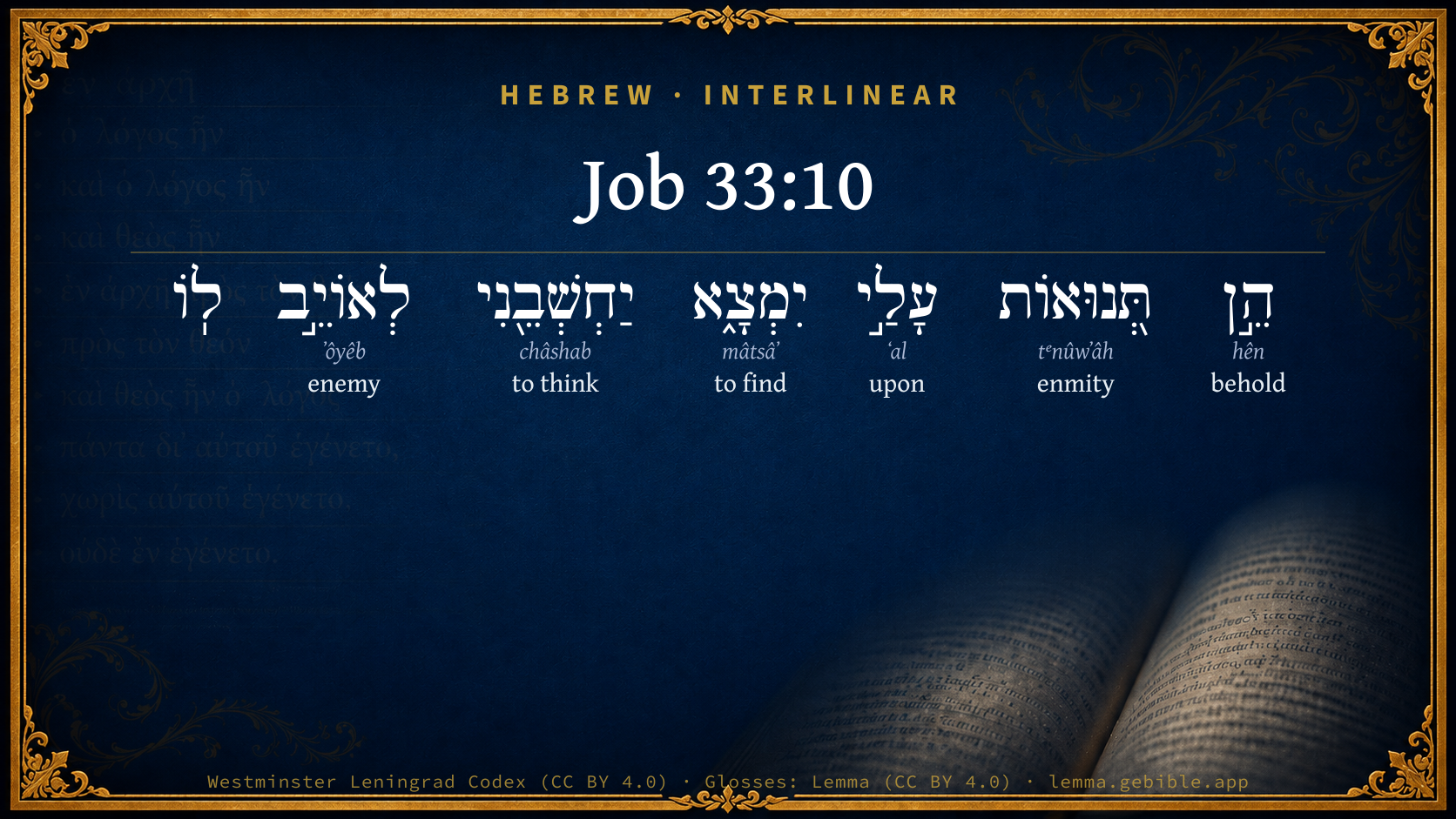
Job 33:10

Hebrew (Westminster Leningrad Codex) Job 33:10 appears in the Hebrew Old Testament. The text above is from the Westminster Leningrad Codex. Each word links to its Strong’s number, a concise gloss, and parsing drawn from the Open Scriptures Hebrew Bible morphology. Click any word for its full Brown-Driver-Briggs (BDB) entry.
Download image
Cite this verse

Job 33:10 (World English Bible). Public Domain. Lemma interlinear Bible study tool, https://lemma.gebible.app/v/job/33/10.

Show BibTeX & RIS
BibTeX
RIS
English Translation
Behold, he finds occasions against me, He counts me for his enemy:
World English Bible · Public Domain
Download a study sheet

One document with this verse’s original text, its word-by-word gloss line, the meaning frame, cross-references with their text, attributed commentary, and full source and license credits — printable, and it pastes into notes with its structure intact.

This verse Autodidact and up

Study sheet (.html) Plain text (.txt)

A passage Seminary Student

Up to 50 verses in one chapter. A passage sheet keeps up to 6 commentary sources and 12 cross-references per verse, in the order this page ranks them, and says so on the sheet whenever that leaves anything out. Ask for a single verse and you get the Autodidact verse sheet above.

Everything on this page stays free to read, with no account — the sheet is a download of what is already on screen, not access to it.

Want to remove ads? Support Godless Engineer
Compare translations 3

The same verse in 3 English versions, stacked beneath the original-language interlinear above. Click any original word for its lexicon entry.

Each is an independent rendering of the whole verse — the interlinear is not word-aligned to these translations.

Highlighted words mark where these versions differ — a whole-verse word diff, not a word-by-word alignment.

  • World English Bible Public Domain
    Behold, he finds occasions against me, He counts me for his enemy:
  • King James Version Public Domain
    Behold, he findeth occasions against me, he counteth me for his enemy,
  • unfoldingWord Literal Text CC BY-SA 4.0
    Behold, he finds occasions against me; he considers me an enemy to him.

unfoldingWord Literal Text — © unfoldingWord, licensed CC BY-SA 4.0. Word-aligned USFM3 via Door43 (git.door43.org/unfoldingWord/en_ult).

Versions to compare (up to 4)

3 of 4 selected

Show all 18 translations

Every available English version of this verse, each an independent rendering of the whole verse.

  • World English Bible Public Domain
    Behold, he finds occasions against me, He counts me for his enemy:
  • Berean Standard Bible Public Domain
    Yet God finds occasions against me; He counts me as His enemy.
  • Majority Standard Bible Public Domain
    Yet God finds occasions against me; He counts me as His enemy.
  • King James Version Public Domain
    Behold, he findeth occasions against me, he counteth me for his enemy,
  • American Standard Version (1901) Public Domain
    Behold, he findeth occasions against me, He counteth me for his enemy:
  • Revised Version (1885) Public Domain
    Behold, he findeth occasions against me, he counteth me for his enemy;
  • Geneva Bible (1599) Public Domain
    Lo, he hath found occasions against me, and counted me for his enemie.
  • Douay-Rheims (1899) Public Domain
    Because he hath found complaints against me, therefore he hath counted me for his enemy.
  • Young's Literal Translation Public Domain
    Lo, occasions against me He doth find, He doth reckon me for an enemy to Him,
  • Literal Standard Version CC BY-SA 4.0
    Behold, He develops hindrances against me, || He reckons me for an enemy to Him,
  • Unlocked Literal Bible CC BY-SA 4.0
    See, God finds opportunities to attack me; he regards me as his enemy.
  • unfoldingWord Literal Text CC BY-SA 4.0
    Behold, he finds occasions against me; he considers me an enemy to him.
  • Darby Bible Public Domain
    Lo, he findeth occasions of hostility against me, he counteth me for his enemy;
  • World Messianic Bible Public Domain
    Behold, he finds occasions against me. He counts me for his enemy.
  • Webster's Bible Public Domain
    Behold, he findeth occasions against me, he counteth me for his enemy,
  • Free Bible Version CC BY-SA 4.0
    See how God finds fault with me and treats me as his enemy.
  • Bible in Basic English Public Domain
    See, he is looking for something against me; in his eyes I am as one of his haters;
  • JPS Tanakh (1917) Public Domain
    Behold, He findeth occasions against me, He counteth me for His enemy;

Literal Standard Version (2020), Covenant Press — licensed CC BY-SA 4.0. Text via the HelloAO Bible API (eBible.org). Unlocked Literal Bible (unfoldingWord) — licensed CC BY-SA 4.0. Text via the HelloAO Bible API (eBible.org). unfoldingWord Literal Text — © unfoldingWord, licensed CC BY-SA 4.0. Word-aligned USFM3 via Door43 (git.door43.org/unfoldingWord/en_ult). Free Bible Version, Dr. Jonathan Gallagher — licensed CC BY-SA 4.0. Text via the HelloAO Bible API (eBible.org).

Word by word

More ways to search: Search by grammar → Find every occurrence → Compare this word →

Practice this passage: Drill this verse → Learn its vocabulary →

About this verse

These counts appear in no published source. They are computed here, from the morphology-tagged text and Lemma’s own curated glosses. What Lemma adds →

7
words
6
distinct lemmas
Wisdom
section

Notable vocabulary

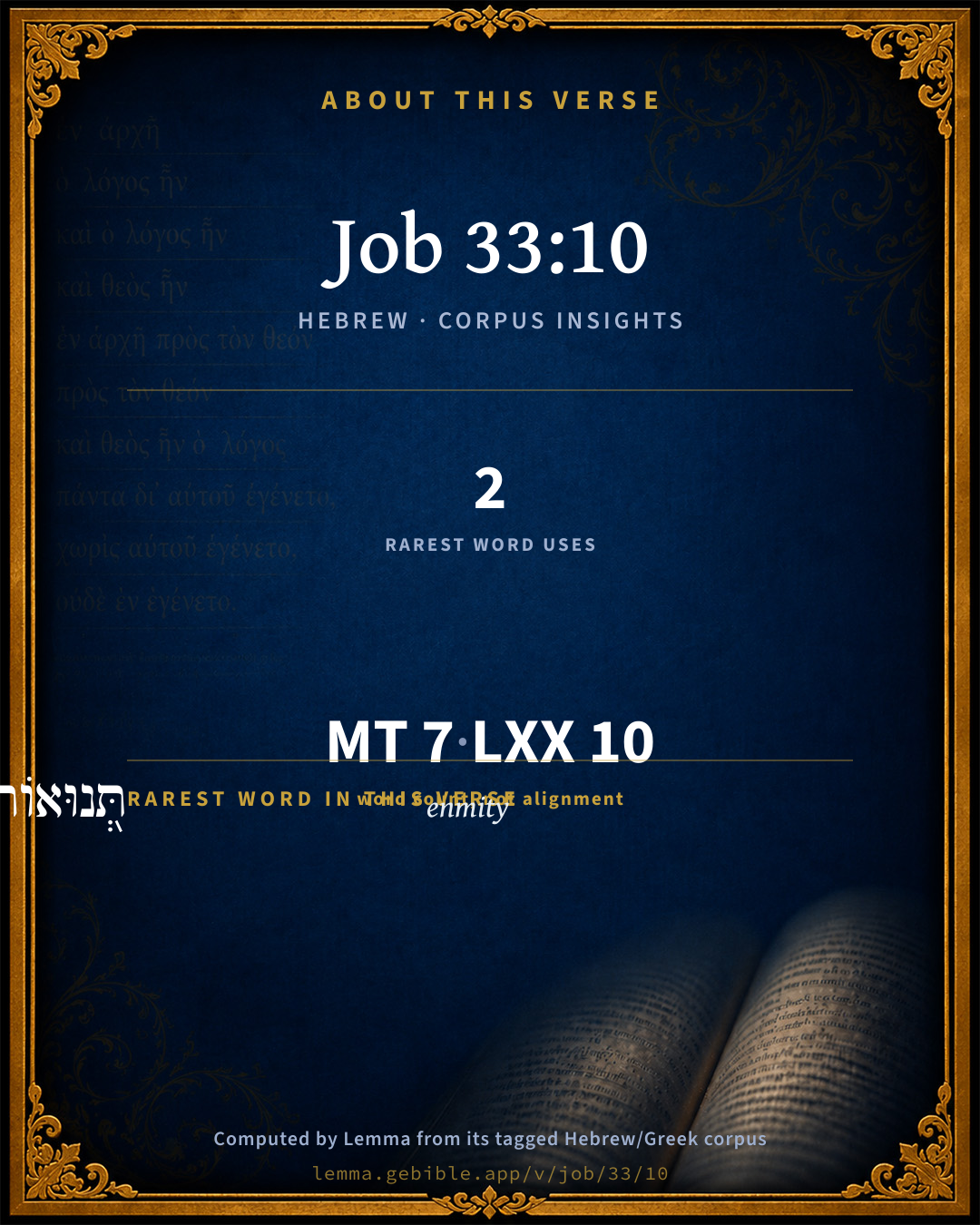
The rarest word here is תְּ֭נוּאוֹת enmity H8569 — appearing just 2 times in the whole Hebrew Bible.

Shared distinctive vocabulary

תְּ֭נוּאוֹת enmity H8569 occurs in 2 verses of the Hebrew Bible. Also found in:

Grammatical profile

  • 3 verbs
  • 1 noun
  • 2 prepositions
  • 1 particle

Verb forms

  • יִמְצָ֑א Qal · Imperfect
  • יַחְשְׁבֵ֖נִי Qal · Imperfect
  • לְאוֹיֵ֣ב Qal · Participle Active

Hebrew & Septuagint length

In English translation the verse runs 12 words from the Hebrew and 16 from the Septuagint (LXX English) — closely comparable.

A rough comparison of the two English renderings, which tokenize alike — not a word-level alignment.

Word counts can differ between the Hebrew and the Greek without any difference in meaning — e.g. the Hebrew direct-object marker אֵת has no separate Greek word, and Greek often adds the article ὁ.

In the original languages it is 7 Hebrew tokens and 10 Greek tokens — but the two are counted differently (Hebrew bundles its prefixes and suffixes into one token; the Greek is in lemma form), so that isn’t a like-for-like length.

Cross-references

9

Topical passages linked to Job 33:10 in the Treasury of Scripture Knowledge — connected by theme and wording, ordered by reader-vote popularity; previews shown in the World English Bible.

  • Job 13:24–25 Why hide you your face, And hold me for your enemy?
  • Job 19:11 He has also kindled his wrath against me. He counts me among his adversaries.
  • Job 9:30–31 If I wash myself with snow, And cleanse my hands with lye,
  • Job 10:15–17 If I am wicked, woe to me. If I am righteous, I still shall not lift up my head, Being filled with disgrace, And conscious of my affliction.
  • Job 14:16 But now you number my steps. Don't you watch over my sin?
  • Job 16:9 He has torn me in his wrath, and persecuted me; He has gnashed on me with his teeth: My adversary sharpens his eyes on me.
  • Job 30:21 You have turned to be cruel to me. With the might of your hand you persecute me.
  • Job 31:35 Oh that I had one to hear me! (Behold, here is my signature, let the Almighty answer me); Let the accuser write my indictment!
  • Job 34:5 For Job has said, 'I am righteous, God has taken away my right:

Cross-references courtesy of OpenBible.info (CC BY 4.0).

Hebrew and Greek witnesses Masoretic Hebrew ↔ Greek Septuagint

The same verse in the two great witnesses to the Old Testament, shown verse-for-verse.

These are two independent witnesses, not word-aligned to each other, and the Septuagint is shown in lemma (dictionary) form.

Hebrew Job 33:10 Masoretic · Westminster Leningrad Codex

הֵ֣ן תְּ֭נוּאוֹת עָלַ֣י יִמְצָ֑א יַחְשְׁבֵ֖נִי לְאוֹיֵ֣ב לֽוֹ

Behold, he finds occasions against me, He counts me for his enemy:

World English Bible · Public Domain

Greek LXX Job 33:10 Septuagint · lemma form

μέμψις δέ κατά ἐγώ εὑρίσκω ἡγέομαι δέ ἐγώ ὥσπερ ὑπεναντίος

Yet he has revealed a charge against me, and he has reckoned me as an adversary.

LXX2012 (modern English Septuagint) · Public Domain

On this verse, Albert Barnes' Notes on the Bible discusses the Septuagint’s reading. Read the note in Commentary ↓

Hebrew: Westminster Leningrad Codex (CC BY 4.0). Greek: Septuagint (public domain); English from LXX2012 (modern English Septuagint) (Public Domain). How the Septuagint differs from the Hebrew →

Commentary

Notes on Job 33:10 from classic Christian and Jewish commentators (each source and its license shown beneath its notes). The classic Christian expositions comment on the surrounding passage and are grouped to its opening verse, so a note may address several verses; the Jewish commentaries on the Tanakh (Rashi and others) are per-verse, so they appear only where the commentator wrote on this verse.

Lemma curates 59 commentaries, every one of them public domain or Creative Commons licensed, each selected and text-cleaned for this edition rather than reprinted as found. About our sources →

Trapp's Complete Commentary

John Trapp

Job 33:10 Behold, he findeth occasions against me, he counteth me for his enemy,

Ver. 10. Behold, he findeth occasions against me] Or, breaches; he picks quarrels with me, and would fain find out somewhat in my carriage wherefore to break friendship with me, and to break me in pieces. But did Job ever say in this sort? Not expressly so; but by consequence, and to the same purpose, Job 9:17; Job 13:24; Job 14:17; Job 16:9; Job 19:11.

He counteth me for his enemy] This indeed he had said, and somewhat more, Job 13:24; Job 16:9; Job 30:21, as if God, of his mere pleasure, had made cruel wars upon him, and exercised all kind of hostility against him, as a vanquished enemy. {See Trapp on "Job 13:24"} {See Trapp on "Job 19:11"}

John Trapp, A Commentary or Exposition upon All the Books of the Old and New Testament (1647–1656) — public domain. Text from a community e-Sword module.

Jamieson, Fausset & Brown

Robert Jamieson, A. R. Fausset & David Brown

occasions--for hostility; literally, "enmities" (Job 13:24; Job 16:9; Job 19:11; Job 30:21).

Jamieson, Fausset & Brown — Commentary Critical and Explanatory on the Whole Bible (1871) — public domain (CC PDM 1.0). Text via the HelloAO Bible API.

Ellicott's Commentary for English Readers

(10) Behold, he findeth occasions against me.—See Job_13:24; Job_13:26-27; Job_19:11.

A Bible Commentary for English Readers, edited by Charles John Ellicott (1878–1897) — public domain. Text from a community e-Sword module.

The Cambridge Bible for Schools and Colleges

gen. ed. J. J. S. Perowne

10. See ch. Job_10:13 seq., Job_13:24, Job_19:11, Job_30:21.

he findeth occasions] lit. enmities, i. e. grounds of enmity or hostility; he “findeth” is almost equivalent to He “invents.” Coverdale quaintly, “he hath pyked a quarell agaynst me.”

The Cambridge Bible for Schools and Colleges (gen. ed. J. J. S. Perowne; Cambridge University Press, 1878–1918) — public domain. Text from a community e-Sword module.

John Gill's Exposition

Behold, he findeth occasions against me,.... That is, sought in order to find them; so Job in some places suggests, that God inquired after his sins, and sought diligently after them, that he might have something to bring against him; and because he could not find great sins, gross enormities, he sought after lesser sins; so some render the word, "staggerings", "totterings" (h); frailties, failings, and infirmities; and because he could find none of late of a very heinous nature, he went back as far as the sins of his youth; see Job 10:6; and this in order to pick a quarrel with him; and so Mr. Broughton renders the words, "lo, he picketh quarrels against me"; or that he might have just reason to depart from him, or to break from him, or to break off friendship with him, or to break him to pieces in his estate, family, and health; all which senses some observe the words will bear: but it would be needless for God to seek in order to find occasions against men; there is enough ready at hand, the sins that are about them; and to represent the Lord as dealing thus with good men is to represent him as acting contrary to the declarations and methods of his grace; yea, as doing what wicked men do to good men, as the enemies of David, Daniel, and Jeremiah, did to them; nay, even as Satan himself does, who goes about and seeks for, and picks up accusations against the saints; this must be owned to be a very irreverent and unbecoming expression of Job's, and for which he deserved to be sharply rebuked, as well as for some following ones, and for which he afterwards was thoroughly humbled:

he counteth me for his enemy; this he had often said, but very wrongly; See Gill on Job 13:24, and See Gill on Job 16:9, and See Gill on Job 19:11.

(h) "vacillationes", Cocceius; "aut mutationes", Michaelis.

John Gill's Exposition of the Whole Bible (1746–1763) — public domain (CC PDM 1.0). Text via the HelloAO Bible API.

Albert Barnes' Notes on the Bible

Behold, he findeth occasions against me - That is, God. This is not exactly the language of Job, though much that he had said had seemed to imply this. The idea is, that God sought opportunity to oppose him; that he was desirous to find in him some ground or reason for punishing him; that he wished to be hostile to him, and was narrowly on the watch to find an opportunity which would justify his bringing calamity upon him. The word rendered “occasions” - תנואה tenû'âh, is from נוא nû', in the Hiphil, הניא hāniy' - to refuse, decline; to hinder, restrain, Num 30:6, Num 30:9,Num 30:12; and hence, the noun means, a holding back, a withdrawal, an alienation; and hence, the idea is, that God sought to be alienated from Job. The Vulgate renders it, “He seeks complaints (querales) against me.” The Septuagint, μέμψιν mempsin - accusation. Umbreit, Feindshaft, enmity. So Gesenius and Noyes. “He counteth me for his enemy.” This is language which Job had used; see Job 19:11.

Albert Barnes' Notes on the Bible (1834–1885) — public domain. Text from a community e-Sword/MySword module.

Haydock's Catholic Bible Commentary

Complaints. Something similar had indeed come from Job’s lips; (chap. xiv. 17., and xx. 21.) not that he pretended that God sought to find him guilty without cause; but he meant that He treated him as an enemy, for some secret purpose. (Calmet)

George Leo Haydock (1774–1849), Haydock's Catholic Family Bible and Commentary, 1859 edition — public domain. Excludes Psalms (Douay-Rheims chapter numbering differs from Protestant) and Deuterocanonical books (Catholic canon only).

Matthew Poole's English Annotations

He picketh quarrels with me, and watcheth over and searcheth after all my errors and frailties, as Job said, Job 10:6; 14:16,17; severely marking what is amiss in me, that thence he may take occasion to punish me worse than mine iniquities deserve. Though I have endeavoured to be his friend and faithful servant all my days, yet he treats me like an enemy. This Job said Job 13:24; 19:11.

Matthew Poole's English Annotations on the Holy Bible (1683–1685) — public domain. Text from a community e-Sword/MySword module.

Whedon's Commentary on the Bible

Daniel D. Whedon

10. Occasions — Rather, enmities, hostilities.

Daniel D. Whedon (gen. ed.), Commentary on the Old and New Testaments (1874–1909) — public domain. Text from a community e-Sword module.

The Pulpit Commentary

Behold, he findeth occasions against me. This charge may perhaps be justified by reference to Job"s complaints in Job_7:17-19 and Job_10:3-6; but the exact words are not Job"s. He counteth me for his enemy. Certainly, Job had said this more than ones. (see Job_16:9) But he cannot really have believed it, or his trust in God must have failed. The fact that to the last he clung to God, appealed to him, hoped to receive judgment from him, (Job_31:2, Job_31:6, Job_31:28, Job_31:35-37) is proof sufficient that he knew God was not really alienated from him, but would in the end acknowledge him and vindicate his character.

The Pulpit Commentary (1880–1919), ed. H.D.M. Spence-Jones & Joseph S. Exell — public domain. Text from a community e-Sword module.

unfoldingWord translationNotes

Door43 World Missions Community

General Information:

Elihu continues quoting what he heard Job say.

See

The speaker uses this word here to draw attention to what he says next. AT: "Listen"

He puts my feet in stocks

"Stocks" are wooden blocks a jailer puts around a prisoner's feet to restrict his movement. Job speaks of feeling like he is a prisoner by saying that he is in stocks. AT: "I feel he has made me a prisoner" (See: Metaphor)

my paths

These words refer to where he goes. Here where he goes represents what he does. AT: "everything that I do" (See: Metonymy)

I will answer you

Elihu is speaking to Job.

translationWords

God

adversary

unfoldingWord translationNotes — © Distant Shores Media and the Door43 World Missions Community, licensed CC BY-SA 4.0. Source: git.door43.org/Door43/en_tn.

Rashi

Rabbi Shlomo Yitzchaki (Rashi)

pretenses Heb. תאונות, pretenses to turn away from the Omnipresent, an expression of (Jud. 14: 4), “that he sought a pretense (תאנה).”

Rashi on the Tanakh — English translations: “The Judaica Press complete Tanach with Rashi, translated by A. J. Rosenberg” (CC BY 4.0); “Pentateuch with Rashi's commentary by M. Rosenbaum and A.M. Silbermann, 1929-1934” (public domain); “The Metsudah Tanach series, Lakewood, N.J” (CC BY 4.0); and “The Book of Joshua, Metsudah Publications, 1997” (CC BY 4.0). Text via Sefaria.

Lesson kit

Teaching starters — assembled from the data on this page, not authored interpretation. Every prompt links to the verse data it draws on. Edit before teaching.

Job, in the Wisdom, opens this verse with 7 words (6 distinct Hebrew lemmas). Its most distinctive word is tᵉnûwʼâh (“enmity”). A historical commentator’s framing appears above. Read the whole chapter for the surrounding context.

Discussion questions

  1. What does “enmity” (tᵉnûwʼâh) contribute to the verse as a whole?
  2. Numbers 14:34 shares the word «enmity» with this verse. How do the two illuminate each other?
  3. These translations render this verse differently; the difference is in the English rendering, not the original. What questions does that raise?
  4. The verb «יִמְצָ֑א» is Qal Imperfect. How does its form color the action?
  5. Reading how Trapp's Complete Commentary and Jamieson, Fausset & Brown read this verse, where do the two commentators agree and where do they part?

Things to notice

Reading settings

Reading text

Shown beneath each verse's original-language words.

Old Testament
Old Testament edition

Read the OT as the Masoretic Hebrew (MT) or the Greek Septuagint (LXX).

English shown for the Greek Septuagint (in the Hebrew ↔ Greek comparison).

Comparing translations? Open the Compare panel on any verse page to stack up to four side by side.