
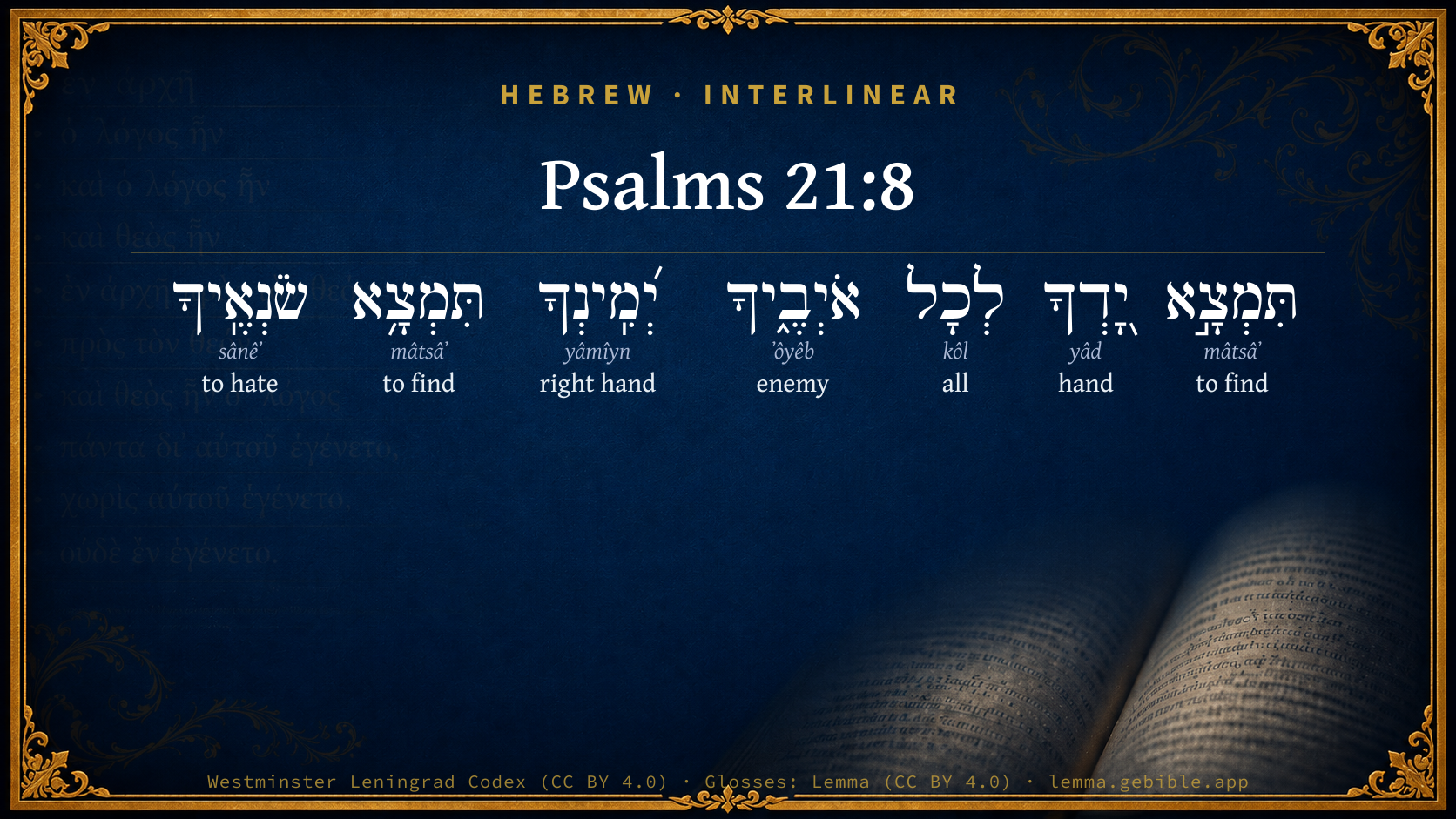
Psalms 21:8

Hebrew (Westminster Leningrad Codex) Psalms 21:8 appears in the Hebrew Old Testament. The text above is from the Westminster Leningrad Codex. Each word links to its Strong’s number, a concise gloss, and parsing drawn from the Open Scriptures Hebrew Bible morphology. Click any word for its full Brown-Driver-Briggs (BDB) entry.
Download image
Cite this verse

Psalms 21:8 (World English Bible). Public Domain. Lemma interlinear Bible study tool, https://lemma.gebible.app/v/psalms/21/8.

Show BibTeX & RIS
BibTeX
RIS
English Translation
Your hand will find out all of your enemies. Your right hand will find out those who hate you.
World English Bible · Public Domain
Download a study sheet

One document with this verse’s original text, its word-by-word gloss line, the meaning frame, cross-references with their text, attributed commentary, and full source and license credits — printable, and it pastes into notes with its structure intact.

This verse Autodidact and up

Study sheet (.html) Plain text (.txt)

A passage Seminary Student

Up to 50 verses in one chapter. A passage sheet keeps up to 6 commentary sources and 12 cross-references per verse, in the order this page ranks them, and says so on the sheet whenever that leaves anything out. Ask for a single verse and you get the Autodidact verse sheet above.

Everything on this page stays free to read, with no account — the sheet is a download of what is already on screen, not access to it.

Want to remove ads? Support Godless Engineer
Compare translations 3

The same verse in 3 English versions, stacked beneath the original-language interlinear above. Click any original word for its lexicon entry.

Each is an independent rendering of the whole verse — the interlinear is not word-aligned to these translations.

Highlighted words mark where these versions differ — a whole-verse word diff, not a word-by-word alignment.

  • World English Bible Public Domain
    Your hand will find out all of your enemies. Your right hand will find out those who hate you.
  • King James Version Public Domain
    Thine hand shall find out all thine enemies: thy right hand shall find out those that hate thee.
  • unfoldingWord Literal Text CC BY-SA 4.0
    Your hand will find all of your enemies; your right hand will find the ones hating you.

unfoldingWord Literal Text — © unfoldingWord, licensed CC BY-SA 4.0. Word-aligned USFM3 via Door43 (git.door43.org/unfoldingWord/en_ult).

Versions to compare (up to 4)

3 of 4 selected

Show all 18 translations

Every available English version of this verse, each an independent rendering of the whole verse.

  • World English Bible Public Domain
    Your hand will find out all of your enemies. Your right hand will find out those who hate you.
  • Berean Standard Bible Public Domain
    Your hand will apprehend all Your enemies; Your right hand will seize those who hate You.
  • Majority Standard Bible Public Domain
    Your hand will apprehend all Your enemies; Your right hand will seize those who hate You.
  • King James Version Public Domain
    Thine hand shall find out all thine enemies: thy right hand shall find out those that hate thee.
  • American Standard Version (1901) Public Domain
    Thy hand will find out all thine enemies; Thy right hand will find out those that hate thee.
  • Revised Version (1885) Public Domain
    Thine hand shall find out all thine enemies: thy right hand shall find out those that hate thee.
  • Geneva Bible (1599) Public Domain
    Thine hand shall finde out all thine enemies, and thy right hand shall finde out them that hate thee.
  • Douay-Rheims (1899) Public Domain
    For the king hopeth in the Lord: and through the mercy of the most High he shall not be moved.
  • Young's Literal Translation Public Domain
    Thy hand cometh to all Thine enemies, Thy right hand doth find Thy haters.
  • Literal Standard Version CC BY-SA 4.0
    Your hand comes to all Your enemies, || Your right hand finds Your haters.
  • Unlocked Literal Bible CC BY-SA 4.0
    Your hand will seize all your enemies; your right hand will seize those who hate you.
  • unfoldingWord Literal Text CC BY-SA 4.0
    Your hand will find all of your enemies; your right hand will find the ones hating you.
  • Darby Bible Public Domain
    Thy hand shall find out all thine enemies; thy right hand shall find out those that hate thee.
  • World Messianic Bible Public Domain
    Your hand will find out all of your enemies. Your right hand will find out those who hate you.
  • Webster's Bible Public Domain
    \\21:7\\For the king trusteth in the LORD, and through the mercy of the most High he shall not be moved.
  • Free Bible Version CC BY-SA 4.0
    You, the king, will find and capture all your enemies; you will seize everyone who hates you.
  • Bible in Basic English Public Domain
    Your hand will make a search for all your haters; your right hand will be hard on all those who are against you.
  • JPS Tanakh (1917) Public Domain
    (21-9) Thy hand shall be equal to all thine enemies; thy right hand shall overtake those that hate thee.

Literal Standard Version (2020), Covenant Press — licensed CC BY-SA 4.0. Text via the HelloAO Bible API (eBible.org). Unlocked Literal Bible (unfoldingWord) — licensed CC BY-SA 4.0. Text via the HelloAO Bible API (eBible.org). unfoldingWord Literal Text — © unfoldingWord, licensed CC BY-SA 4.0. Word-aligned USFM3 via Door43 (git.door43.org/unfoldingWord/en_ult). Free Bible Version, Dr. Jonathan Gallagher — licensed CC BY-SA 4.0. Text via the HelloAO Bible API (eBible.org).

Word by word

More ways to search: Search by grammar → Find every occurrence → Compare this word →

Practice this passage: Drill this verse → Learn its vocabulary →

יְ֝מִֽינְךָ
yâmîyn
H3225
“right hand · your”
Noun, Common, Feminine, Singular, Construct + Suffix, Personal, 2nd Person, Masculine, Singular
Part of Speech
Noun
Type
Common
Gender
Feminine
Number
Singular
State
Construct
Full BDB Definition

Origin: from H3231

TWOT: 872a

right, right hand, right side - right hand - right (of direction) - south (the direction of the right hand when facing East)
  1. תִּמְצָ֣א mâtsâʼ H4672 “to find” Verb, Qal, Imperfect, 3rd Person, Feminine, Singular
  2. יָ֭דְךָ yâd H3027 “hand · your” Noun, Common, Both, Singular, Construct + Suffix, Personal, 2nd Person, Masculine, Singular
  3. לְכָל kôl H3605 “to/for · all of” Preposition + Noun, Common, Masculine, Singular, Construct
  4. אֹיְבֶ֑יךָ ʼôyêb H341 “enemy · you” Verb, Qal, Participle Active, Masculine, Plural, Construct + Suffix, Personal, 2nd Person, Masculine, Singular
  5. תִּמְצָ֥א mâtsâʼ H4672 “to find” Verb, Qal, Imperfect, 3rd Person, Feminine, Singular
  6. שֹׂנְאֶֽיךָ sânêʼ H8130 “hating · you” Verb, Qal, Participle Active, Masculine, Plural, Construct + Suffix, Personal, 2nd Person, Masculine, Singular

About this verse

These counts appear in no published source. They are computed here, from the morphology-tagged text and Lemma’s own curated glosses. What Lemma adds →

7
words
6
distinct lemmas
Wisdom
section

Grammatical profile

  • 4 verbs
  • 3 nouns

Verb forms

  • תִּמְצָ֣א Qal · Imperfect
  • אֹיְבֶ֑יךָ Qal · Participle Active
  • תִּמְצָ֥א Qal · Imperfect
  • שֹׂנְאֶֽיךָ Qal · Participle Active

Repetition

A word recurs within this verse — often emphatic in Hebrew:

  • תִּמְצָ֣א to find H4672 ×2

Hebrew & Septuagint length

In English translation the verse runs 19 words from the Hebrew and 18 from the Septuagint (LXX English) — closely comparable.

A rough comparison of the two English renderings, which tokenize alike — not a word-level alignment.

Word counts can differ between the Hebrew and the Greek without any difference in meaning — e.g. the Hebrew direct-object marker אֵת has no separate Greek word, and Greek often adds the article ὁ.

Cross-references

15

Topical passages linked to Psalms 21:8 in the Treasury of Scripture Knowledge — connected by theme and wording, ordered by reader-vote popularity; previews shown in the World English Bible.

  • Psalms 110:1–2 Yahweh says to my Lord, "Sit at my right hand, Until I make your enemies your footstool for your feet."
  • 1 Corinthians 15:25 For he must reign until he has put all his enemies under his feet.
  • Psalms 72:9 Those who dwell in the wilderness shall bow before him. His enemies shall lick the dust.
  • Luke 19:27 But bring those enemies of mine who didn't want me to reign over them here, and kill them before me.'"
  • Revelation 19:15 Out of his mouth proceeds a sharp, double-edged sword, that with it he should strike the nations. He will rule them with a rod of iron. He treads the winepress of the fierceness of the wrath of God, the Almighty.
  • Psalms 2:9 You shall break them with a rod of iron. You shall dash them in pieces like a potter's vessel."
  • Psalms 18:1 I love you, Yahweh, my strength.
  • Psalms 89:22–23 No enemy will tax him. No wicked man will oppress him.
  • Amos 9:2–3 Though they dig into Sheol, there my hand will take them; and though they climb up to heaven, there I will bring them down.
  • Luke 19:14 But his citizens hated him, and sent an envoy after him, saying, 'We don't want this man to reign over us.'
  • Hebrews 10:28–29 A man who disregards Moses' law dies without compassion on the word of two or three witnesses.
  • 1 Samuel 31:3 The battle went sore against Saul, and the archers overtook him; and he was greatly distressed by reason of the archers.
  • 2 Samuel 7:1 It happened, when the king lived in his house, and Yahweh had given him rest from all his enemies round about,
  • Isaiah 10:10 As my hand has found the kingdoms of the idols, whose engraved images did excel them of Jerusalem and of Samaria;
  • 1 Samuel 25:29 Though men be risen up to pursue you, and to seek your soul, yet the soul of my lord shall be bound in the bundle of life with Yahweh your God; and the souls of your enemies, them shall he sling out, as from the hollow of a sling.

Cross-references courtesy of OpenBible.info (CC BY 4.0).

Hebrew and Greek witnesses Masoretic Hebrew ↔ Greek Septuagint

The same verse in the two great witnesses to the Old Testament, shown verse-for-verse.

You’re reading Greek Psalm 20 (Hebrew Psalm 21). The Septuagint counts the superscription, so verse numbers can differ from the Hebrew — chapter-level alignment, not verse-by-verse. Numbering follows Rahlfs.

These are two independent witnesses, not word-aligned to each other, and the Septuagint is shown in lemma (dictionary) form.

Hebrew Psalms 21:8 Masoretic · Westminster Leningrad Codex

תִּמְצָ֣א יָ֭דְךָ לְכָל אֹיְבֶ֑יךָ יְ֝מִֽינְךָ תִּמְצָ֥א שֹׂנְאֶֽיךָ

Your hand will find out all of your enemies. Your right hand will find out those who hate you.

World English Bible · Public Domain

Greek LXX Greek Psalm 20:8 Septuagint · lemma form

ὅτι ὁ βασιλεύς ἐλπίζω ἐπί κύριος καί ἐν ὁ ἔλεος ὁ ὕψιστος οὐ μή σαλεύω

Let your hand be found by all your enemies: let your right hand find all that hate you.

LXX2012 (modern English Septuagint) · Public Domain

Hebrew: Westminster Leningrad Codex (CC BY 4.0). Greek: Septuagint (public domain); English from LXX2012 (modern English Septuagint) (Public Domain). How the Septuagint differs from the Hebrew →

Commentary

Notes on Psalms 21:8 from classic Christian and Jewish commentators (each source and its license shown beneath its notes). The classic Christian expositions comment on the surrounding passage and are grouped to its opening verse, so a note may address several verses; the Jewish commentaries on the Tanakh (Rashi and others) are per-verse, so they appear only where the commentator wrote on this verse.

Lemma curates 59 commentaries, every one of them public domain or Creative Commons licensed, each selected and text-cleaned for this edition rather than reprinted as found. About our sources →

Trapp's Complete Commentary

John Trapp

Psa 21:8 Thine hand shall find out all thine enemies: thy right hand shall find out those that hate thee.

Ver. 8. Thine hand shall find out all thine enemies] Thine, because ours; for thou art in a league with us, both defensive and offensive: now our enemies act as if they were out of the reach of thy rod, but thou wilt easily hunt them down and root them out. Pursued they shall be by thee, and overtaken, run they never so far, never so fast.

ουδεις ανθρωπων αδικων τισιν ουκ αποτισει.

John Trapp, A Commentary or Exposition upon All the Books of the Old and New Testament (1647–1656) — public domain. Text from a community e-Sword module.

The Biblical Illustrator

Joseph S. Exell

Psa_21:8-9

Thine hand shall find out all Thine enemies.

The exposure and punishment of sin

I. The exposure of sin is inevitable. Iniquity delights in cunning, and is itself a masterpiece of cunning. It may succeed in deluding its victims, and for a time escape detection. But there is One to whom every detail of the plot is fully known. Sin is often its own detective. An unguarded word, a suspicious sign, an unconscious oversight, will unmask the most skilfully disguised plans, and lead to exposure and misery. It is the theme of many a ballad, how the cranes aided in the discovery of the assassins of Idycus, the poet. Recently the house of the Caliph of the Ben Oreazen in Algeria was entered by a band of robbers, and a box containing 25,000 francs stolen. In their haste to escape the thieves left behind them an Arab cake bearing a particular mark, which one of the bakers of the town recognised as the sign used by Ben Xerafas, it being the custom for each family, in sending their bread to the oven, to mark it so as to distinguish the loaves. The police acted on the information, and, descending on a certain hut, caught the robbers asleep, with a portion of the plunder still in their possession. A simple Arab cake was the insignificant agent of discovery and exposure.

II. The exposure of sin will extend to the inmost feelings of the heart. Those that hate Thee. That sin is not always the worst which is most apparent.

III. The punishment of sin will be terrible and complete.

1. It will be terrible. The sins of the impenitent wicked will supply fuel to the fire of their own sufferings, and perhaps be used as an instrument for punishing others.

2. It will be complete. Swallow them up in His wrath. Nations are an example--Antediluvians, Sodomites, Jews. Individuals are an example--Korah, Dathan, Abiram, Saul, and Judas. (Homiletic Commentary.)

Enemies found out by God

Oh, what a wonderful prophecy that is! Christs hand shall find out all His enemies. If they hide themselves, He shall discover them. If they cover themselves with chain armour, yet still His hand will find out their vulnerable parts, and touch their very souls until they melt with fear. (C. H. Spurgeon.)

The Biblical Illustrator, edited by Joseph S. Exell (c. 1880s–1900s) — public domain. Text from a community e-Sword module.

Joseph Benson's Commentary

Psa 21:8-9. Thy hand shall find out all thine enemies — When they seek to hide themselves, or flee away from thee, thy hand shall discover, overtake, and destroy them. Thou shalt make them as a fiery oven — Hebrew, תשׁיתמו כתנור אשׁ, teshithemo chetannur esh, thou shalt put them, as it were, into an oven of fire. The Lord shall swallow them up — Destroy them. Thus, Psa 2:9, Thou shalt bruise them with a rod of iron, &c., which prediction, and those contained in these verses, particularly relate to the unbelieving Jews. Compare Mal 4:1; Psa 2:2-4; Psa 109:13-15.

Joseph Benson's Commentary on the Old and New Testaments (1811–1818) — public domain. Text from a community e-Sword module.

J. A. Alexander on Psalms

Joseph Addison Alexander

9. (Psa 21:8). Thy hand shall find out all thine enemies; thy right hand shall find (those) hating thee. Having shewn what God would do for his Anointed, the psalm now describes what the latter shall accomplish through divine assistance. Corresponding to this variation in the subject, is that in the object of address, which has been already noticed. By a kind of climax in the form of expression, hand is followed by right hand, a still more emphatic sign of active strength. To find, in this connection, includes the ideas of detecting and reaching. Compare 1Sa 23:17, Isa 10:10; in the latter of which places the verb is construed with a preposition, as it is in the first clause of the verse before us, whereas in the other clause it governs the noun directly. If any difference of meaning was intended, it is probably not greater than that between find and find out in English.

Joseph Addison Alexander, The Psalms Translated and Explained (1850) — public domain. Text from a community e-Sword module.

Tyndale Open Study Notes

Tyndale Open Resources

21:8-12 As long as even a single enemy opposed the king’s authority, God’s kingdom was not fully present. This prayer requests victory over all evil in the world.

Tyndale Open Study Notes — © Tyndale Open Resources, licensed CC BY-SA 4.0. Text via the HelloAO Bible API.

Geneva Bible (1599)

Geneva Bible translators

Here he describeth the power of Christ’s kingdom against the enemies thereof.

Geneva Bible (1599) marginal notes — public domain. Text via Bolls.life.

Jamieson, Fausset & Brown

Robert Jamieson, A. R. Fausset & David Brown

The address is now made to the king.

hand--denotes power, and

right hand--a more active and efficient degree of its exercise.

find out--reach, lay hold of, indicating success in pursuit of his enemies.

Jamieson, Fausset & Brown — Commentary Critical and Explanatory on the Whole Bible (1871) — public domain (CC PDM 1.0). Text via the HelloAO Bible API.

Adam Clarke's Commentary

Verse 8. Thine hand shall find out] Thy uncontrollable power shall find out all thine enemies, wheresoever hidden or howsoever secret. God knows the secret sinner, and where the workers of iniquity hide themselves.

Adam Clarke's Commentary on the Bible (1810–1826) — public domain. Text from a community e-Sword/MySword module.

John Calvin's Commentaries

8. Thy hand shall find. Hitherto the internal happiness of the kingdom has been described. Now there follows, as it was necessary there should, the celebration of its invincible strength against its enemies. What is said in this verse is of the same import as if the king had been pronounced victorious over all his enemies. I have just now remarked, that such a statement is not superfluous; for it would not have been enough for the kingdom to have flourished internally, and to have been replenished with peace, riches, and abundance of all good things, had it not also been well fortified against the attacks of foreign enemies. This particularly applies to the kingdom of Christ, which is never without enemies in this world. True, it is not always assailed by open war, and there is sometimes granted to it a period of respite; but the ministers of Satan never lay aside their malice and desire to do mischief, and therefore they never cease to plot and to endeavor to accomplish the overthrow of Christ’s kingdom. It is well for us that our King, who lifts up his hand as a shield before us to defend us, is stronger than all. As the Hebrew word מצא, matsa, which is twice repeated, and which we have translated, to find, sometimes signifies to suffice; and, as in the first clause, there is prefixed to the word כל, kal, which signifies all, the letter ל, lamed, which signifies for, or against, and which is not prefixed to the Hebrew word which is rendered those that hate thee; some expositors, because of this diversity, explain the verse as if it had been said, Thy hand shall be able for all thine enemies, thy right hand shall find out those that hate thee. Thus the sentence will ascend by degrees, — Thy hand shall be able to withstand, thy right hand shall lay hold upon thy enemies, so that they shall not escape destruction.

John Calvin's Commentaries (1540-1563) — public domain. Text from the Calvin Translation Society English edition (1840s-50s) via the Christian Classics Ethereal Library (ccel.org). Calvin's coverage is partial (roughly two-thirds of the Bible); uncommented books and verses are honest gaps, never fabricated. The 19th-century editor's footnotes and remarks are omitted so the notes are faithfully Calvin's own voice.

Ellicott's Commentary for English Readers

(8) Thine.—The psalm has hitherto been addressed to Jehovah. It now turns in prophetic strain to the king.

A Bible Commentary for English Readers, edited by Charles John Ellicott (1878–1897) — public domain. Text from a community e-Sword module.

The Cambridge Bible for Schools and Colleges

gen. ed. J. J. S. Perowne

8. shall find out] Reach them and get them into thy power (1Sa_23:17).

8–12. The king, who must be supposed to be present, is now addressed. This victory is an earnest of future victories. The total destruction of all his enemies is confidently anticipated.

The Cambridge Bible for Schools and Colleges (gen. ed. J. J. S. Perowne; Cambridge University Press, 1878–1918) — public domain. Text from a community e-Sword module.

John Gill's Exposition

Thine hand shall find out all thine enemies,.... The Jews, that would not have him to reign over them, who crucified him and persecuted his apostles; the Gentiles, who were also concerned in his death; the Roman emperors, who persecuted the Christians, and are signified by the red dragon that waited to devour the man child when brought forth by the woman, the church, Rev 12:3; and also the Papists, the followers of the man of sin, who oppose Christ in his offices and grace, and are the enemies of his witnesses, and of his interest; and besides these there are many professors of religion who are enemies of Christ, either doctrinally or practically; to whom may be added, the devil and his angels, and all those who are the children of him and are influenced by him: these the hand of Christ will find out sooner or later; for the words are an address to the King Messiah, who being omniscient knows where all his enemies are, and where to find them; and being omnipotent he will lay hold upon them, and hold them, and none shall escape from him; his hand of vengeance shall fall upon them, and he shall inflict righteous and deserved punishment on them; and this shall be the case of "all" of them, none will be able to hide themselves in secret places from him. This has been in part verified in the Jewish nation at the destruction of Jerusalem, when wrath came upon that people to the uttermost for their treatment of the Messiah; and in the Pagan empire, when it was demolished, and kings and great men in vain called to the rocks and mountains to hide them from the wrath of the Lamb, Rev 6:15; and will have a further accomplishment in the antichristian states and kingdoms, when the vials of God's wrath shall be poured out upon them; and especially at the battle of Armageddon, when Christ will avenge himself, and get rid of all his enemies at once; and will have its final accomplishment in all wicked men and devils at the day of judgment, when all Christ's enemies will be found out by him, whether open or secret, and receive their just punishment;

thy right hand shall find out those that hate thee; this is the same with the former clause, and is repeated for the further certainty and greater confirmation of the thing; and "the right hand" is mentioned as expressive of the mighty power of the Lord. The Chaldee paraphrase renders it, "the vengeance of thy right hand".

John Gill's Exposition of the Whole Bible (1746–1763) — public domain (CC PDM 1.0). Text via the HelloAO Bible API.

Albert Barnes' Notes on the Bible

Thine hand shall find out - That is, Thou wilt find out - the hand being that by which we execute our purposes. This verse commences a new division of the psalm (see the introduction) - in which the psalmist looks forward to the complete and final triumph of God over “all” his enemies. He looks to this in connection with what God had done for him. He infers that he who had enabled him to achieve such signal conquests over his own foes and the foes of God would not withdraw his interposition until he had secured a complete victory for the cause of truth and holiness. In connection with the promise made to him respecting his permanent reign and the reign of his successors on the throne Psa 21:4, he infers that God would ultimately subdue the enemies of truth, and would set up his kingdom over all.

All thine enemies - However they may attempt to conceal themselves - however they may evade the efforts to subdue them - yet they shall “all” be found out and overcome. As this was intended by the Spirit of inspiration, it undoubtedly refers to the final triumph of truth on the earth, or to the fact that the kingdom of God will be set up over all the world. All that are properly ranked among the enemies of God - all that are in any way opposed to him and to his reign - will be found out and conquered. All the worshippers of idols - all the enemies of truth - all the rejecters of revelation - all the workers of iniquity, - all that are infidels or scoffers - shall be found out and subdued. Either by being made to yield to the claims of truth, and thus becoming the friends of God, or by being cut off and punished for their sins - they will be all so overcome that God shall reign over all the earth. An important truth is further taught here, to wit, that no enemy of God can escape him. There is no place to which he can flee where God will not find him. “There is no darkness, nor shadow of death, where the workers of iniquity may hide themselves,” Job 34:22.

Thy right hand - See the notes at Psa 17:7.

Those that hate thee - All thine enemies.

Albert Barnes' Notes on the Bible (1834–1885) — public domain. Text from a community e-Sword/MySword module.

Matthew Poole's English Annotations

When they seek to hide themselves or flee away from thee, shall discover, and overtake, and destroy them. Or, shall be sufficient (as this verb sometimes signifies, as Num 11:22; Jdg 21:14) for all thine enemies, to wit, to conquer them; thou shalt need no foreign succours to help thee.

Matthew Poole's English Annotations on the Holy Bible (1683–1685) — public domain. Text from a community e-Sword/MySword module.

The Treasury of David

Charles H. Spurgeon

Ver. 8. Thine hand shall find out all thine enemies: thy right hand shall find out those that hate thee. The destruction of the wicked is a fitting subject for joy to the friends of righteousness; hence here, and in most scriptural songs, it is noted with calm thanksgiving. "Thou hast put down the mighty from their seats, "is a note of the same song which sings, "and hast exalted them of low degree." We pity the lost for they are men, but we cannot pity them as enemies of Christ. None can escape from the wrath of the victorious King, nor is it desirable that they should. Without looking for his flying foes he will find them with his hand, for his presence is about and around them. In vain shall any hope for escape, he will find out all, and be able to punish all, and that too with the ease and rapidity which belong to the warrior's right hand. The finding out relates, we think, not only to the discovery of the hiding places of the haters of God, but to the touching of them in their most tender parts, so as to cause the severest suffering. When he appears to judge the world hard hearts will be subdued into terror, and proud spirits humbled into shame. He who has the key of human nature can touch all its springs at his will, and find out the means of bringing the utmost confusion and terror upon those who aforetime boastfully expressed their hatred of him.

Ver. 8. If David had before been without the symbol of his royal dignity, namely, the diadem, he was the more justified in praising the goodness of God, which had now transferred it from the head of an enemy to his own. Augustus F. Tholuck.

Ver. 8. Thine hand shall find out all thine enemies: thy right hand shall find out those that hate thee. By a kind of climax in the form of expression, "hand, "is followed by "right hand, "a still more emphatic sign of active strength. To "find, "in this connection, includes the ideas of detecting and reaching. Compare 1Sa 23:17 Isa 10:10; in the latter of which places the verb is construed with a preposition (Heb.), as it is in the first clause of the verse before us, whereas in the other clause it governs the noun directly. If any difference of meaning was intended, it is probably not greater than that between find and find out in English. Joseph Addison Alexander.

Ver. 8. Thine hand shall find out all thine enemies: thy right hand shall find out those that hate thee. Saul killed himself, for fear of falling into the hands of his enemies, and thought death less terrible than the shame that he would have endured in seeing himself in their power. What will it be then "to fall into the hands of the living God" (Heb 10:31), of an offended God? of God unchangeably determined to be avenged? "Who can stand before his indignation?" says the prophet Nahum (Na 1:6). Who will dare look on him? Who will dare show himself? "Who may abide the day of his coming" (Mal 3:2) without shuddering and fainting for fear? If Joseph's brethren were so terrified that they "could not answer him, "when he said, "I am Joseph your brother, "how will it be with sinners, when they shall hear the voice of the Son of God, when he shall triumph over them in his wrath, and say unto them, "I am he" whom ye despised; "I am he" whom ye have offended; "I am he" whom ye have crucified? If these words, "I am he, "overthrew the soldiers in the garden of Olives (Joh 18:6), though spoken with extreme gentleness, how will it be when his indignation bursts forth, when it falls upon his enemies like a thunderbolt, and reduces them into dust? Then will they cry out in terror, and say to the mountains, "Fall on us, and hide us from the face of him that sitteth on the throne, and from the wrath of the Lamb." Re 6:16. James Nouet.

Ver. 8. Thine hand shall find out, etc. It is not meant only of a discovery of a person (though it be a truth, that the Lord will discover all that are his enemies), but thine hand shall find them out, is, it shall take hold of them, grasp them, and arrest them. "Thine hand shall find out" all "thine enemies", though close, though covert enemies; not only thy above ground enemies, but thy underground enemies; as well those that undermine thee, as those that assault thee. Joseph Caryl.

Ver. 8. The secret sinner unearthed, and deprived of all hope of concealment.

Ver. 8-9. The certainty and terror of the punishment of the wicked.

Psalms 21:9*

Ver. 8-9. The certainty and terror of the punishment of the wicked.

Psalms 21:10*

Charles H. Spurgeon's The Treasury of David (1869–1885) — public domain. Psalms only. Text from a community e-Sword/MySword module.

Whedon's Commentary on the Bible

Daniel D. Whedon

8. Thine hand shall find out—Shall take hold of, as the word often signifies, and as it is employed in Psa_116:3; Psa_119:143. The idea is, that God infallibly knows who and where his enemies are, and his justice shall arrest them.

Daniel D. Whedon (gen. ed.), Commentary on the Old and New Testaments (1874–1909) — public domain. Text from a community e-Sword module.

The Pulpit Commentary

Vers. 8-12. In this second portion of the psalm, the people address themselves to David, anticipating future glories for him. "Having shown what God would do for his anointed, the psalm now describes what the latter shall accomplish through Divine assistance" (Alexander). Past success is taken as a guarantee of victory over all other enemies.

Thine hand shall find out all thine enemies; i.e. "shall reach them, attain them, punish them". (comp. 1Sa_31:3) Thy right hand (the hand of greater power) shall find out those that hate thee; and, of" course, punish them severely.

The Pulpit Commentary (1880–1919), ed. H.D.M. Spence-Jones & Joseph S. Exell — public domain. Text from a community e-Sword module.

Kretzmann's Popular Commentary

Paul E. Kretzmann

The Confidence of Final Triumph

v. 8. Thine hand shall find out all Thine enemies, the psalmist’s hopeful statement now becoming a definite prophecy concerning the final revenge of Jehovah; Thy right hand shall find out those that hate Thee, reaching out for them to inflict a certain punishment upon them.

v. 9. Thou shalt make them as a fiery oven, a very strong expression to show how utterly the Lord’s vengeance would consume them, in the time of Thine anger; the Lord shall swallow them up in His wrath, and the fire shall devour them, this being an unmistakable reference to the punishment following the final Judgment, 2Pe 3:1

v. 10. Their fruit, that is, their children, their posterity, shalt Thou destroy from the earth and their seed, all those descending from them, from among the children of men, because they followed their parents in their wickedness.

v. 11. For they intended evil against Thee, the figure being taken from the laying or stretching out of snares for the purpose of catching wild beasts; they imagined a mischievous device, plans for bringing harm upon the king, which they are not able to perform, due to the interference of the Lord they shall not prevail with their wickedness.

v. 12. Therefore shalt Thou make them turn their back, make them turn their shoulder, force them to retreat and flee, when Thou shalt make ready Thine arrows upon Thy strings against the face of them, that is, when their troubles would cause them to flee, the Lord would overtake them and set His bow to aim at their face, thereby harassing them on both sides, placing them between two fires, and thus annihilating them.

v. 13. Be Thou exalted, Lord, in Thine own strength, with the glory which rightly belonged to Him for this mighty deliverance; so will we sing and praise Thy power. Thus the believers ever acknowledge and praise the mercy of God and the wonderful manifestation of His might, who in Jesus Christ has given them a perfect, eternal deliverance.

Paul E. Kretzmann, Popular Commentary of the Bible (1921–1924) — public domain. Text from a community e-Sword module.

Rashi

Rabbi Shlomo Yitzchaki (Rashi)

that he should not falter And he trusts in the loving-kindness of the Most High that he should not falter.

Rashi on the Tanakh — English translations: “The Judaica Press complete Tanach with Rashi, translated by A. J. Rosenberg” (CC BY 4.0); “Pentateuch with Rashi's commentary by M. Rosenbaum and A.M. Silbermann, 1929-1934” (public domain); “The Metsudah Tanach series, Lakewood, N.J” (CC BY 4.0); and “The Book of Joshua, Metsudah Publications, 1997” (CC BY 4.0). Text via Sefaria.

Lesson kit

Teaching starters — assembled from the data on this page, not authored interpretation. Every prompt links to the verse data it draws on. Edit before teaching.

Psalms, in the Wisdom, opens this verse with 7 words (6 distinct Hebrew lemmas). Its most distinctive word is yâmîyn (“right hand”). A historical commentator’s framing appears above. Read the whole chapter for the surrounding context.

Discussion questions

  1. The word yâmîyn carries the sense “right hand.” How does it shape the verse?
  2. How does Psalms 110:1–2, which shares this passage’s theme, read alongside this verse?
  3. What does the repetition of “to find” (2× in this one verse) do in this verse?
  4. These translations render this verse differently; the difference is in the English rendering, not the original. What questions does that raise?
  5. «תִּמְצָ֣א» is a Qal Imperfect verb. How does that grammatical form shape the action described?
  6. Compare how Trapp's Complete Commentary and The Biblical Illustrator read this verse. Where do they agree or differ?

Things to notice

  • These translations choose different wording for 8 words in this verse.
  • “to find” occurs 2× in this single verse.
  • 6 distinct Hebrew lemmas span 7 words in this verse.

Reading settings

Reading text

Shown beneath each verse's original-language words.

Old Testament
Old Testament edition

Read the OT as the Masoretic Hebrew (MT) or the Greek Septuagint (LXX).

English shown for the Greek Septuagint (in the Hebrew ↔ Greek comparison).

Comparing translations? Open the Compare panel on any verse page to stack up to four side by side.