
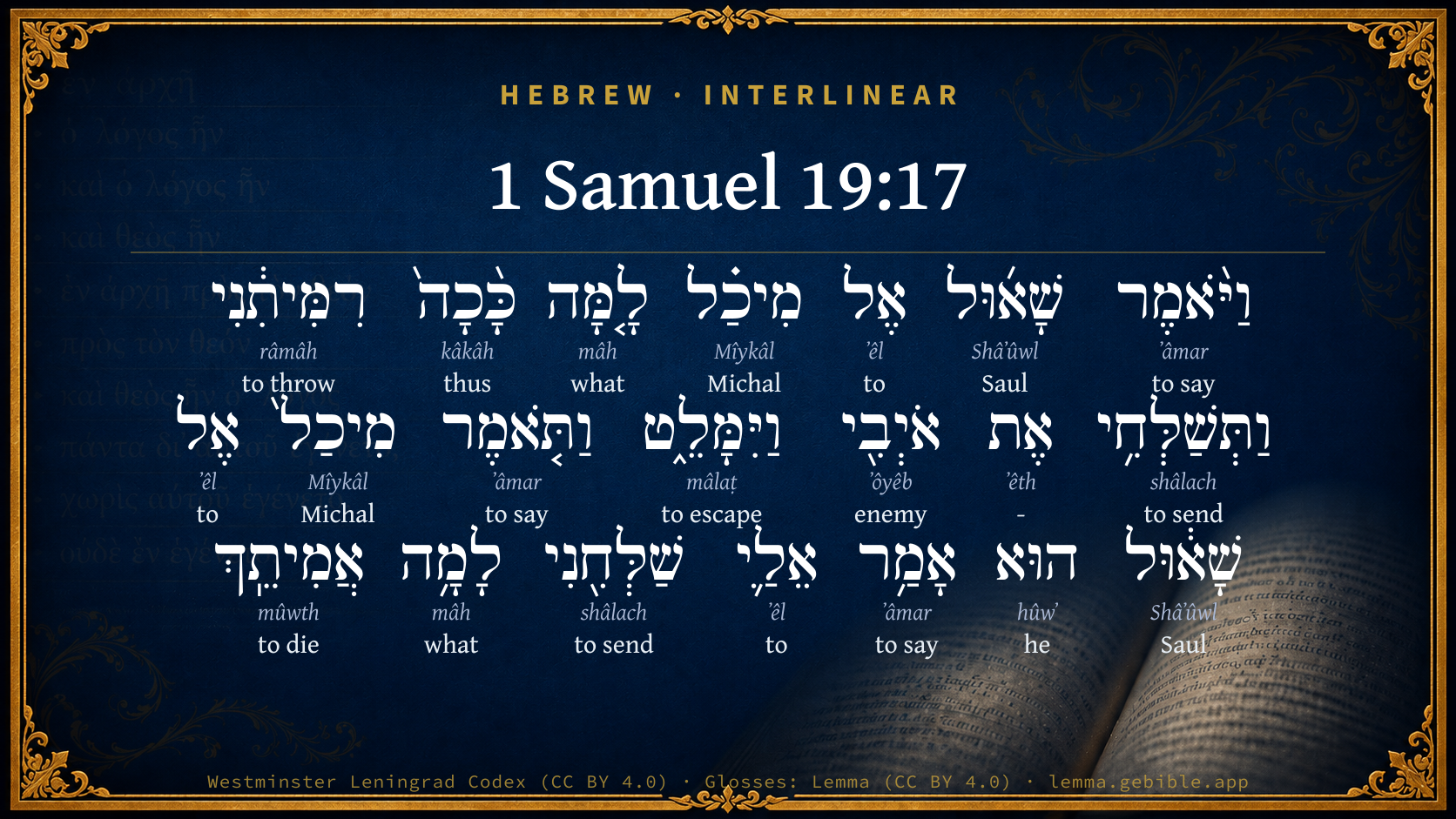
1 Samuel 19:17

Hebrew (Westminster Leningrad Codex) 1 Samuel 19:17 appears in the Hebrew Old Testament. The text above is from the Westminster Leningrad Codex. Each word links to its Strong’s number, a concise gloss, and parsing drawn from the Open Scriptures Hebrew Bible morphology. Click any word for its full Brown-Driver-Briggs (BDB) entry.
Download image
Cite this verse

1 Samuel 19:17 (World English Bible). Public Domain. Lemma interlinear Bible study tool, https://lemma.gebible.app/v/1-samuel/19/17.

Show BibTeX & RIS
BibTeX
RIS
English Translation
Saul said to Michal, Why have you deceived me thus, and let my enemy go, so that he is escaped? Michal answered Saul, He said to me, Let me go; why should I kill you?
World English Bible · Public Domain
Download a study sheet

One document with this verse’s original text, its word-by-word gloss line, the meaning frame, cross-references with their text, attributed commentary, and full source and license credits — printable, and it pastes into notes with its structure intact.

This verse Autodidact and up

Study sheet (.html) Plain text (.txt)

A passage Seminary Student

Up to 50 verses in one chapter. A passage sheet keeps up to 6 commentary sources and 12 cross-references per verse, in the order this page ranks them, and says so on the sheet whenever that leaves anything out. Ask for a single verse and you get the Autodidact verse sheet above.

Everything on this page stays free to read, with no account — the sheet is a download of what is already on screen, not access to it.

Want to remove ads? Support Godless Engineer
Compare translations 3

The same verse in 3 English versions, stacked beneath the original-language interlinear above. Click any original word for its lexicon entry.

Each is an independent rendering of the whole verse — the interlinear is not word-aligned to these translations.

Highlighted words mark where these versions differ — a whole-verse word diff, not a word-by-word alignment.

  • World English Bible Public Domain
    Saul said to Michal, Why have you deceived me thus, and let my enemy go, so that he is escaped? Michal answered Saul, He said to me, Let me go; why should I kill you?
  • King James Version Public Domain
    And Saul said unto Michal, Why hast thou deceived me so, and sent away mine enemy, that he is escaped? And Michal answered Saul, He said unto me, Let me go; why should I kill thee?
  • unfoldingWord Literal Text CC BY-SA 4.0
    And Saul said to Michal, “Why have you deceived me like this and let my enemy go, so that he rescued himself?” And Michal said to Saul, “He himself said to me, ‘Let me go. Why should I kill you?’”

unfoldingWord Literal Text — © unfoldingWord, licensed CC BY-SA 4.0. Word-aligned USFM3 via Door43 (git.door43.org/unfoldingWord/en_ult).

Versions to compare (up to 4)

3 of 4 selected

Show all 18 translations

Every available English version of this verse, each an independent rendering of the whole verse.

  • World English Bible Public Domain
    Saul said to Michal, Why have you deceived me thus, and let my enemy go, so that he is escaped? Michal answered Saul, He said to me, Let me go; why should I kill you?
  • Berean Standard Bible Public Domain
    And Saul said to Michal, “Why did you deceive me like this? You sent my enemy away and he has escaped!” Michal replied, “He said to me, ‘Help me get away, or I will kill you!’”
  • Majority Standard Bible Public Domain
    And Saul said to Michal, “Why did you deceive me like this? You sent my enemy away, and he has escaped!” Michal replied, “He said to me, ‘Help me get away, or I will kill you!’”
  • King James Version Public Domain
    And Saul said unto Michal, Why hast thou deceived me so, and sent away mine enemy, that he is escaped? And Michal answered Saul, He said unto me, Let me go; why should I kill thee?
  • American Standard Version (1901) Public Domain
    And Saul said unto Michal, Why hast thou deceived me thus, and let mine enemy go, so that he is escaped? And Michal answered Saul, He said unto me, Let me go; why should I kill thee?
  • Revised Version (1885) Public Domain
    And Saul said unto Michal, Why hast thou deceived me thus, and let mine enemy go, that he is escaped? And Michal answered Saul, He said unto me, Let me go; why should I kill thee?
  • Geneva Bible (1599) Public Domain
    And Saul said vnto Michal, Why hast thou mocked me so, and sent away mine enemie, that he is escaped? And Michal answered Saul, He said vnto me, Let me go, or els I will kill thee.
  • Douay-Rheims (1899) Public Domain
    And Saul said to Michol: Why hast thou deceived me so, and let my enemy go and flee away? And Michol answered Saul: Because he said to me: Let me go, or else I will kill thee.
  • Young's Literal Translation Public Domain
    And Saul saith unto Michal, `Why thus hast thou deceived me -- that thou dost send away mine enemy, and he is escaped?' and Michal saith unto Saul, `He said unto me, Send me away: why do I put thee to death?'
  • Literal Standard Version CC BY-SA 4.0
    And Saul says to Michal, “Why have you thus deceived me—that you send my enemy away, and he escapes?” And Michal says to Saul, “He said to me, Send me away. Why do I put you to death?”
  • Unlocked Literal Bible CC BY-SA 4.0
    Saul said to Michal, “Why have you deceived me and let my enemy go, so that he has escaped?” Michal answered Saul, “He said to me, 'Let me go. Why should I kill you?'”
  • unfoldingWord Literal Text CC BY-SA 4.0
    And Saul said to Michal, “Why have you deceived me like this and let my enemy go, so that he rescued himself?” And Michal said to Saul, “He himself said to me, ‘Let me go. Why should I kill you?’”
  • Darby Bible Public Domain
    Then Saul said to Michal, Why hast thou deceived me so, and sent away mine enemy, that he is escaped? And Michal said to Saul, He said to me, Let me go; why should I slay thee?
  • World Messianic Bible Public Domain
    Saul said to Michal, “Why have you deceived me like this and let my enemy go, so that he has escaped?” Michal answered Saul, “He said to me, ‘Let me go! Why should I kill you?’”
  • Webster's Bible Public Domain
    And Saul said to Michal, Why hast thou deceived me so, and sent away my enemy, that he has escaped? And Michal answered Saul, He said to me, Let me go; why should I kill thee?
  • Free Bible Version CC BY-SA 4.0
    “Why did you trick me like this—helping my enemy get away so he could escape?” Saul asked Michal. “He told me, ‘Get out of my way! I don't want to have to kill you!’” Michal replied.
  • Bible in Basic English Public Domain
    And Saul said to Michal, why have you been false to me, letting my hater go and get safely away? And in answer Michal said to Saul, He said to me, Let me go, or I will put you to death.
  • JPS Tanakh (1917) Public Domain
    And Saul said unto Michal: 'Why hast thou deceived me thus, and let mine enemy go, that he is escaped?' And Michal answered Saul: 'He said unto me: Let me go; why should I kill thee?'

Literal Standard Version (2020), Covenant Press — licensed CC BY-SA 4.0. Text via the HelloAO Bible API (eBible.org). Unlocked Literal Bible (unfoldingWord) — licensed CC BY-SA 4.0. Text via the HelloAO Bible API (eBible.org). unfoldingWord Literal Text — © unfoldingWord, licensed CC BY-SA 4.0. Word-aligned USFM3 via Door43 (git.door43.org/unfoldingWord/en_ult). Free Bible Version, Dr. Jonathan Gallagher — licensed CC BY-SA 4.0. Text via the HelloAO Bible API (eBible.org).

Word by word

More ways to search: Search by grammar → Find every occurrence → Compare this word →

Practice this passage: Drill this verse → Learn its vocabulary →

רִמִּיתִ֔נִי
râmâh
H7411
“to throw · me”
Verb, Piel, Perfect, 2nd Person, Feminine, Singular + Suffix, Personal, 1st Person, Common, Singular
Part of Speech
Verb
Stem
Piel
Form
Perfect
Person
2nd Person
Gender
Feminine
Number
Singular
Full BDB Definition

Origin: a primitive root

TWOT: 2168 , 2169

to cast, shoot, hurl - (Qal) - to throw - bow-shooters, bowmen (participle) - (Piel) to throw down - to beguile, deceive, mislead, deal treacherously - (Piel) - to beguile, deceive, mislead, trick - to deal treacherously with, betray
  1. וַיֹּ֨אמֶר ʼâmar H559 “and · to say” Conjunction + Verb, Qal, Sequential Imperfect, 3rd Person, Masculine, Singular
  2. שָׁא֜וּל Shâʼûwl H7586 “Saul” Noun, Proper
  3. אֶל ʼêl H413 “to” Preposition
  4. מִיכַ֗ל Mîykâl H4324 “Michal” Noun, Proper
  5. לָ֤מָּה mâh H4100 “to/for · what” Preposition + Particle, Interrogative
  6. כָּ֨כָה֙ kâkâh H3602 “thus” Adverb
  7. וַתְּשַׁלְּחִ֥י shâlach H7971 “and · to send” Conjunction + Verb, Piel, Sequential Imperfect, 2nd Person, Feminine, Singular
  8. אֶת ʼêth H853 “-” Particle, Direct Object
  9. אֹיְבִ֖י ʼôyêb H341 “enemy · me” Verb, Qal, Participle Active, Masculine, Singular, Construct + Suffix, Personal, 1st Person, Common, Singular
  10. וַיִּמָּלֵ֑ט mâlaṭ H4422 “and · to escape” Conjunction + Verb, Niphal, Sequential Imperfect, 3rd Person, Masculine, Singular
  11. וַתֹּ֤אמֶר ʼâmar H559 “and · to say” Conjunction + Verb, Qal, Sequential Imperfect, 3rd Person, Feminine, Singular
  12. מִיכַל֙ Mîykâl H4324 “Michal” Noun, Proper
  13. אֶל ʼêl H413 “to” Preposition
  14. שָׁא֔וּל Shâʼûwl H7586 “Saul” Noun, Proper
  15. הוּא hûwʼ H1931 “he” Pronoun, Personal, 3rd Person, Masculine, Singular
  16. אָמַ֥ר ʼâmar H559 “to say” Verb, Qal, Perfect, 3rd Person, Masculine, Singular
  17. אֵלַ֛י ʼêl H413 “to · me” Preposition + Suffix, Personal, 1st Person, Common, Singular
  18. שַׁלְּחִ֖נִי shâlach H7971 “send · me” Verb, Piel, Imperative, 2nd Person, Feminine, Singular + Suffix, Personal, 1st Person, Common, Singular
  19. לָמָ֥ה mâh H4100 “to/for · what” Preposition + Particle, Interrogative
  20. אֲמִיתֵֽךְ mûwth H4191 “to die · you” Verb, Hiphil, Imperfect, 1st Person, Common, Singular + Suffix, Personal, 2nd Person, Feminine, Singular

About this verse

These counts appear in no published source. They are computed here, from the morphology-tagged text and Lemma’s own curated glosses. What Lemma adds →

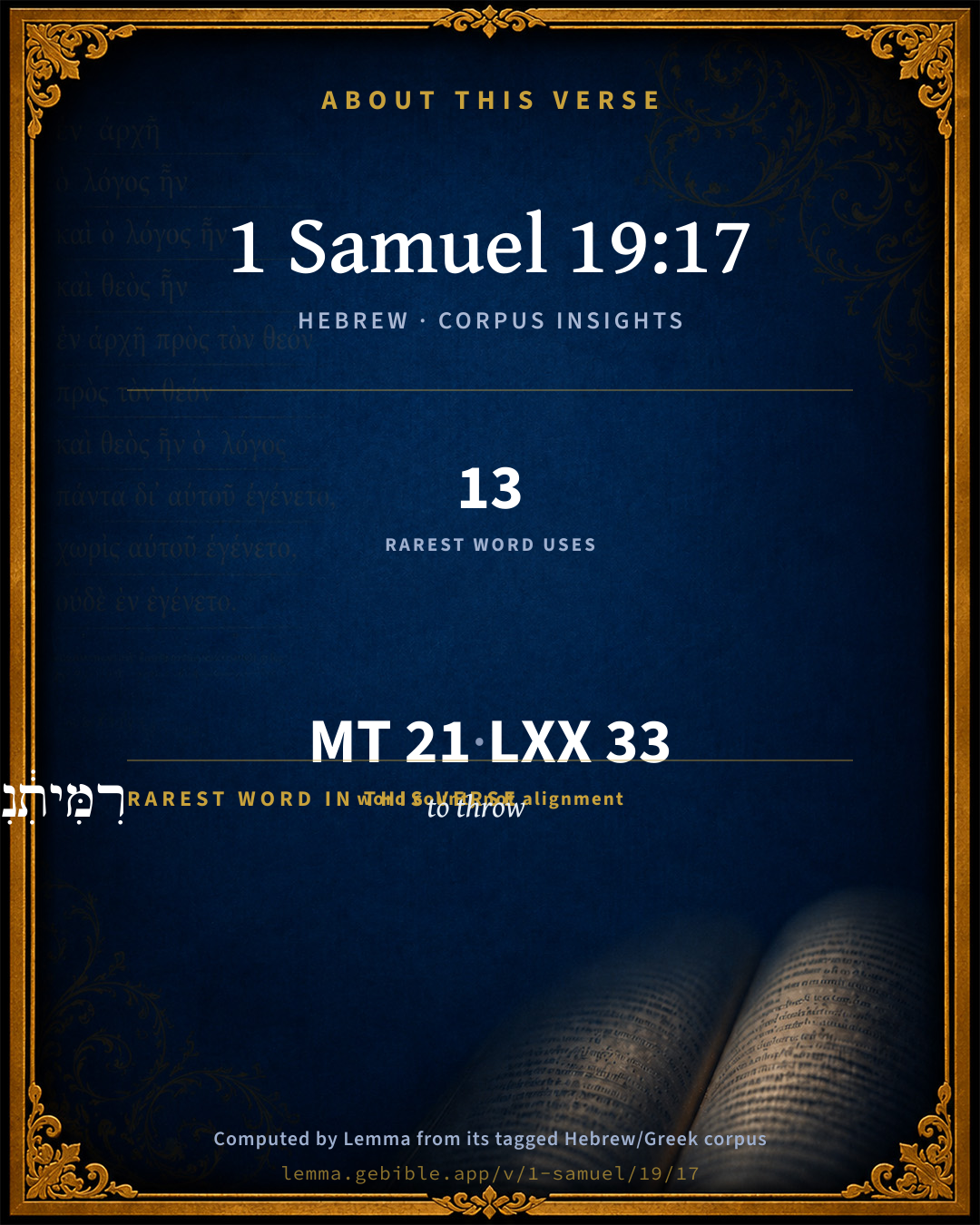
21
words
13
distinct lemmas
Historical
section

Notable vocabulary

The rarest word here is רִמִּיתִ֔נִי to throw H7411 — appearing just 13 times in the whole Hebrew Bible.

Shared distinctive vocabulary

רִמִּיתִ֔נִי to throw H7411 occurs in 13 verses of the Hebrew Bible. Also found in:

Grammatical profile

  • 9 verbs
  • 4 nouns
  • 1 pronoun
  • 3 prepositions
  • 1 adverb
  • 3 particles

Verb forms

  • וַיֹּ֨אמֶר Qal · Sequential Imperfect
  • רִמִּיתִ֔נִי Piel · Perfect
  • וַתְּשַׁלְּחִ֥י Piel · Sequential Imperfect
  • אֹיְבִ֖י Qal · Participle Active
  • וַיִּמָּלֵ֑ט Niphal · Sequential Imperfect
  • וַתֹּ֤אמֶר Qal · Sequential Imperfect
  • אָמַ֥ר Qal · Perfect
  • שַׁלְּחִ֖נִי Piel · Imperative
  • אֲמִיתֵֽךְ Hiphil · Imperfect

Repetition

Words recur within this verse — often emphatic in Hebrew:

  • וַיֹּ֨אמֶר to say H559 ×3
  • שָׁא֜וּל Saul H7586 ×2
  • מִיכַ֗ל Michal H4324 ×2
  • וַתְּשַׁלְּחִ֥י to send H7971 ×2
  • אֶל to H413 ×3
  • לָ֤מָּה what H4100 ×2

Hebrew & Septuagint length

In English translation the verse runs 35 words from the Hebrew and 38 from the Septuagint (LXX English) — closely comparable.

A rough comparison of the two English renderings, which tokenize alike — not a word-level alignment.

Word counts can differ between the Hebrew and the Greek without any difference in meaning — e.g. the Hebrew direct-object marker אֵת has no separate Greek word, and Greek often adds the article ὁ.

In the original languages it is 21 Hebrew tokens and 33 Greek tokens — but the two are counted differently (Hebrew bundles its prefixes and suffixes into one token; the Greek is in lemma form), so that isn’t a like-for-like length.

Cross-references

9

Topical passages linked to 1 Samuel 19:17 in the Treasury of Scripture Knowledge — connected by theme and wording, ordered by reader-vote popularity; previews shown in the World English Bible.

  • 2 Samuel 2:22 Abner said again to Asahel, Turn you aside from following me: why should I strike you to the ground? how then should I hold up my face to Joab your brother?
  • Exodus 1:17–19 But the midwives feared God, and didn't do what the king of Egypt commanded them, but saved the baby boys alive.
  • 1 Samuel 19:14 When Saul sent messengers to take David, she said, He is sick.
  • 1 Samuel 22:17 The king said to the guard who stood about him, Turn, and kill the priests of Yahweh; because their hand also is with David, and because they knew that he fled, and didn't disclose it to me. But the servants of the king wouldn't put forth their hand to fall on the priests of Yahweh.
  • 1 Samuel 28:12 When the woman saw Samuel, she cried with a loud voice; and the woman spoke to Saul, saying, Why have you deceived me? for you are Saul.
  • 2 Samuel 17:20 Absalom's servants came to the woman to the house; and they said, Where are Ahimaaz and Jonathan? The woman said to them, They have gone over the brook of water. When they had sought and could not find them, they returned to Jerusalem.
  • 1 Kings 21:20 Ahab said to Elijah, Have you found me, my enemy? He answered, I have found you, because you have sold yourself to do that which is evil in the sight of Yahweh.
  • Matthew 2:16 Then Herod, when he saw that he was mocked by the wise men, was exceedingly angry, and sent out, and killed all the male children who were in Bethlehem and in all the surrounding countryside, from two years old and under, according to the exact time which he had learned from the wise men.
  • Galatians 4:16 So then, have I become your enemy by telling you the truth?

Cross-references courtesy of OpenBible.info (CC BY 4.0).

Hebrew and Greek witnesses Masoretic Hebrew ↔ Greek Septuagint

The same verse in the two great witnesses to the Old Testament, shown verse-for-verse.

These are two independent witnesses, not word-aligned to each other, and the Septuagint is shown in lemma (dictionary) form.

Hebrew 1 Samuel 19:17 Masoretic · Westminster Leningrad Codex

וַיֹּ֨אמֶר שָׁא֜וּל אֶל מִיכַ֗ל לָ֤מָּה כָּ֨כָה֙ רִמִּיתִ֔נִי וַתְּשַׁלְּחִ֥י אֶת אֹיְבִ֖י וַיִּמָּלֵ֑ט וַתֹּ֤אמֶר מִיכַל֙ אֶל שָׁא֔וּל הוּא אָמַ֥ר אֵלַ֛י שַׁלְּחִ֖נִי לָמָ֥ה אֲמִיתֵֽךְ

Saul said to Michal, Why have you deceived me thus, and let my enemy go, so that he is escaped? Michal answered Saul, He said to me, Let me go; why should I kill you?

World English Bible · Public Domain

Greek LXX 1 Samuel 19:17 Septuagint · lemma form

καί εἶπον σαούλ ὁ μελχολ ἵνα τίς οὕτως παραλογίζομαι ἐγώ καί ἐκ ἀποστέλλω ὁ ἐχθρός ἐγώ καί διασώζω καί εἶπον μελχολ ὁ σαούλ αὐτός εἶπον ἐκ ἀποστέλλω ἐγώ εἰ δέ μή θανατόω σύ

And Saul said to Melchol, Why have you thus deceived me, and suffered my enemy to depart, and he has escaped? and Melchol said to Saul, He said, let me go, and if not, I will kill you.

LXX2012 (modern English Septuagint) · Public Domain

Hebrew: Westminster Leningrad Codex (CC BY 4.0). Greek: Septuagint (public domain); English from LXX2012 (modern English Septuagint) (Public Domain). How the Septuagint differs from the Hebrew →

Targum (Aramaic paraphrase)

1

The Targum is the ancient Jewish Aramaic paraphrase of the Hebrew Scriptures — an interpretive translation, not the Hebrew text itself. Onkelos (literal) and Pseudo-Jonathan (expansive) render the Torah, and Jonathan the Prophets. Coverage is partial: where no permissively-licensed English translation exists for a verse, only the Aramaic is shown. This is verse-level text, not a word-by-word alignment to the Hebrew.

  1. Targum Jonathan Prophets (Joshua–Malachi)
    וַאֲמַר שָׁאוּל לְמִיכַל לְמָא כְּדֵין שַׁקַרְתְּ בִּי וְשַׁלַחְתְּ יַת בְּעֵיל דְבָבִי וְאִשְׁתֵּיזִיב וַאֲמַרַת מִיכַל לְשָׁאוּל הוּא אֲמַר לִי שַׁלְחֵנִי לְמָה אֶקְטְלִנָךְ:

    (no public-domain English translation for this verse)

    Targum Jonathan — Aramaic: “Mikraot Gedolot” (public domain). English: “Sefaria Community Translation” (CC0 1.0 (public-domain dedication)); “London "Chaldee Paraphrase," 1871” (public domain). Text via Sefaria.

Commentary

Notes on 1 Samuel 19:17 from classic Christian and Jewish commentators (each source and its license shown beneath its notes). The classic Christian expositions comment on the surrounding passage and are grouped to its opening verse, so a note may address several verses; the Jewish commentaries on the Tanakh (Rashi and others) are per-verse, so they appear only where the commentator wrote on this verse.

Lemma curates 59 commentaries, every one of them public domain or Creative Commons licensed, each selected and text-cleaned for this edition rather than reprinted as found. About our sources →

Trapp's Complete Commentary

John Trapp

1Sa 19:17 And Saul said unto Michal, Why hast thou deceived me so, and sent away mine enemy, that he is escaped? And Michal answered Saul, He said unto me, Let me go; why should I kill thee?

Ver. 17. He said unto me, Let me go; why should I kill thee?] This was a second lie, as it is usual with liars to lay one lie upon another, and a worse than that former. {1Sa 19:14} If that were an officious lie, this was surely a pernicious one: slandering her husband to save herself. How much better the wife of Polixenus, who was sister to Dionysius, the tyrant: and when her husband, being accused of treason, was fled into Italy, she being asked by her brother, why she did not give notice unto him of her husband’s fleeing, confidently answered, An ita me degenerem putas, &c., Thinkest thou that I am so undutiful a wife, that if I had known my husband would have fled away, I would not have fled away with him? And here I cannot but insert what I have read of that brave Bohemian woman in the late bloody persecution there. The Major of Litomeritia had apprehended twenty-four godly citizens, of whom his own son-in-law was one, and after he had almost pined them in prison, he judged them to be drowned in the river Albis: whereupon his daughter, wringing her hands and falling at her father’s feet, besought him to spare her husband. But he, harder than a rock, bade her hold her peace, saying, What! can you not have a worthier husband than this? to which she answered, You shall never espouse me to any: and so beating her breasts and tearing her hair she followed her husband to the river. And when he was cast into the midst of the river bound, she leaped in and caught him about the middle; but being unable to draw him forth, they were both drowned together, and the next day were found embracing one another. {a}

{a} Mr Clark’s Mirror, 305.

John Trapp, A Commentary or Exposition upon All the Books of the Old and New Testament (1647–1656) — public domain. Text from a community e-Sword module.

Adam Clarke's Commentary

Verse 17. Let me go; why should I kill thee?] That is, If thou do not let me go, I will kill thee. This she said to excuse herself to her father: as a wife she could do not less than favour the escape of her husband, being perfectly satisfied that there was no guilt in him. It is supposed that it was on this occasion that David wrote the fifty-ninth Psalm, Deliver me frown mine enemies, &c.

Adam Clarke's Commentary on the Bible (1810–1826) — public domain. Text from a community e-Sword/MySword module.

John Gill's Exposition

And Saul said unto Michal,.... After the messengers returned and reported what they had seen, when Saul either came to her at her house, or sent for her to his palace:

why hast thou deceived me so; for deceiving his messengers was deceiving him, by pretending David was sick and in bed, when she had placed an image there, and had let him down through a window, and he was gone:

and sent away mine enemy, that he is escaped? as if she was more obliged to gratify the wicked passion of a father, than to provide for the safety of her husband:

and Michal answered Saul, he said unto me, let me go, why should I kill thee? though she was concerned for the preservation of her husband, yet not for his honour and credit, nor for her own veracity; she attempted not to vindicate her husband from the charge of being an enemy to Saul, as she might; but suggested that he was so desperate a man, that if she had offered to have detained him, he would have murdered her, and threatened, if she did, he would do when both were false; that he should say to her let me go, when it was she that advised him to go, and that if she refused he would kill her; which lies were framed by her to excuse herself, at the expense of her husband's reputation.

John Gill's Exposition of the Whole Bible (1746–1763) — public domain (CC PDM 1.0). Text via the HelloAO Bible API.

Albert Barnes' Notes on the Bible

Why should I kill thee? - To avert Saul’s anger from herself, she pretended that David had threatened her life unless she facilitated his escape.

Albert Barnes' Notes on the Bible (1834–1885) — public domain. Text from a community e-Sword/MySword module.

Matthew Poole's English Annotations

If thou dost not permit me to escape without discovery, I shall be forced for my own defence to kill thee. Though it is most likely this was a lie and a fiction of her own.

Matthew Poole's English Annotations on the Holy Bible (1683–1685) — public domain. Text from a community e-Sword/MySword module.

Whedon's Commentary on the Bible

Daniel D. Whedon

17. Why should I kill thee — This was falsehood on the part of Michal, by which she sought to deceive her father. Whatever apology be made for it, it is still a lie. There may be times when we should withhold the truth, but never when we should utter falsehood.

Daniel D. Whedon (gen. ed.), Commentary on the Old and New Testaments (1874–1909) — public domain. Text from a community e-Sword module.

Rashi

Rabbi Shlomo Yitzchaki (Rashi)

He said to me… You delivered me into the hands of a bandit. He drew his sword at me until I let him leave.

Rashi on the Tanakh — English translations: “The Judaica Press complete Tanach with Rashi, translated by A. J. Rosenberg” (CC BY 4.0); “Pentateuch with Rashi's commentary by M. Rosenbaum and A.M. Silbermann, 1929-1934” (public domain); “The Metsudah Tanach series, Lakewood, N.J” (CC BY 4.0); and “The Book of Joshua, Metsudah Publications, 1997” (CC BY 4.0). Text via Sefaria.

Lesson kit

Teaching starters — assembled from the data on this page, not authored interpretation. Every prompt links to the verse data it draws on. Edit before teaching.

1 Samuel, in the Historical, opens this verse with 21 words (13 distinct Hebrew lemmas). Its most distinctive word is râmâh (“to throw”). A historical commentator’s framing appears above. Read the whole chapter for the surrounding context.

Discussion questions

  1. How does “to throw” (râmâh) shape what this verse is saying?
  2. Genesis 29:25 shares the word «to throw» with this verse. How do the two illuminate each other?
  3. “to say” occurs 3× in this one verse. What is the effect of the repetition?
  4. The translations on this page render this verse differently — a whole-verse word diff, not a word-by-word alignment. What might account for the different wordings?
  5. The verb «וַיֹּ֨אמֶר» is Qal Sequential Imperfect. How does its form color the action?
  6. Reading how Trapp's Complete Commentary and Adam Clarke's Commentary read this verse, where do the two commentators agree and where do they part?

Things to notice

Reading settings

Reading text

Shown beneath each verse's original-language words.

Old Testament
Old Testament edition

Read the OT as the Masoretic Hebrew (MT) or the Greek Septuagint (LXX).

English shown for the Greek Septuagint (in the Hebrew ↔ Greek comparison).

Comparing translations? Open the Compare panel on any verse page to stack up to four side by side.