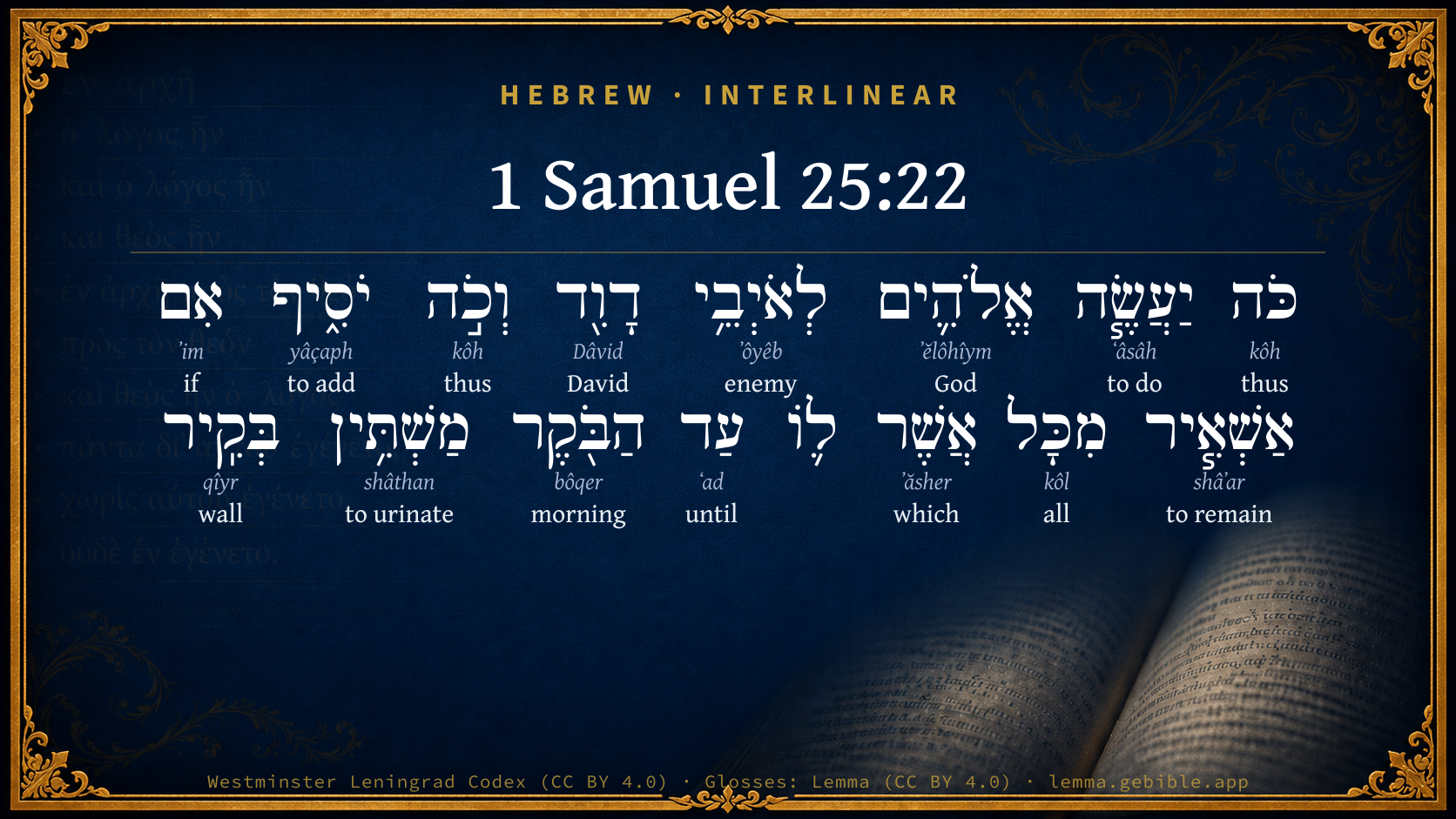
1 Samuel 25:22

Hebrew (Westminster Leningrad Codex) 1 Samuel 25:22 appears in the Hebrew Old Testament. The text above is from the Westminster Leningrad Codex. Each word links to its Strong’s number, a concise gloss, and parsing drawn from the Open Scriptures Hebrew Bible morphology. Click any word for its full Brown-Driver-Briggs (BDB) entry.
Download image
Cite this verse

1 Samuel 25:22 (World English Bible). Public Domain. Lemma interlinear Bible study tool, https://lemma.gebible.app/v/1-samuel/25/22.

Show BibTeX & RIS
BibTeX
RIS
English Translation
God do so to the enemies of David, and more also, if I leave of all that belongs to him by the morning light so much as one man-child.
World English Bible · Public Domain
Highlights
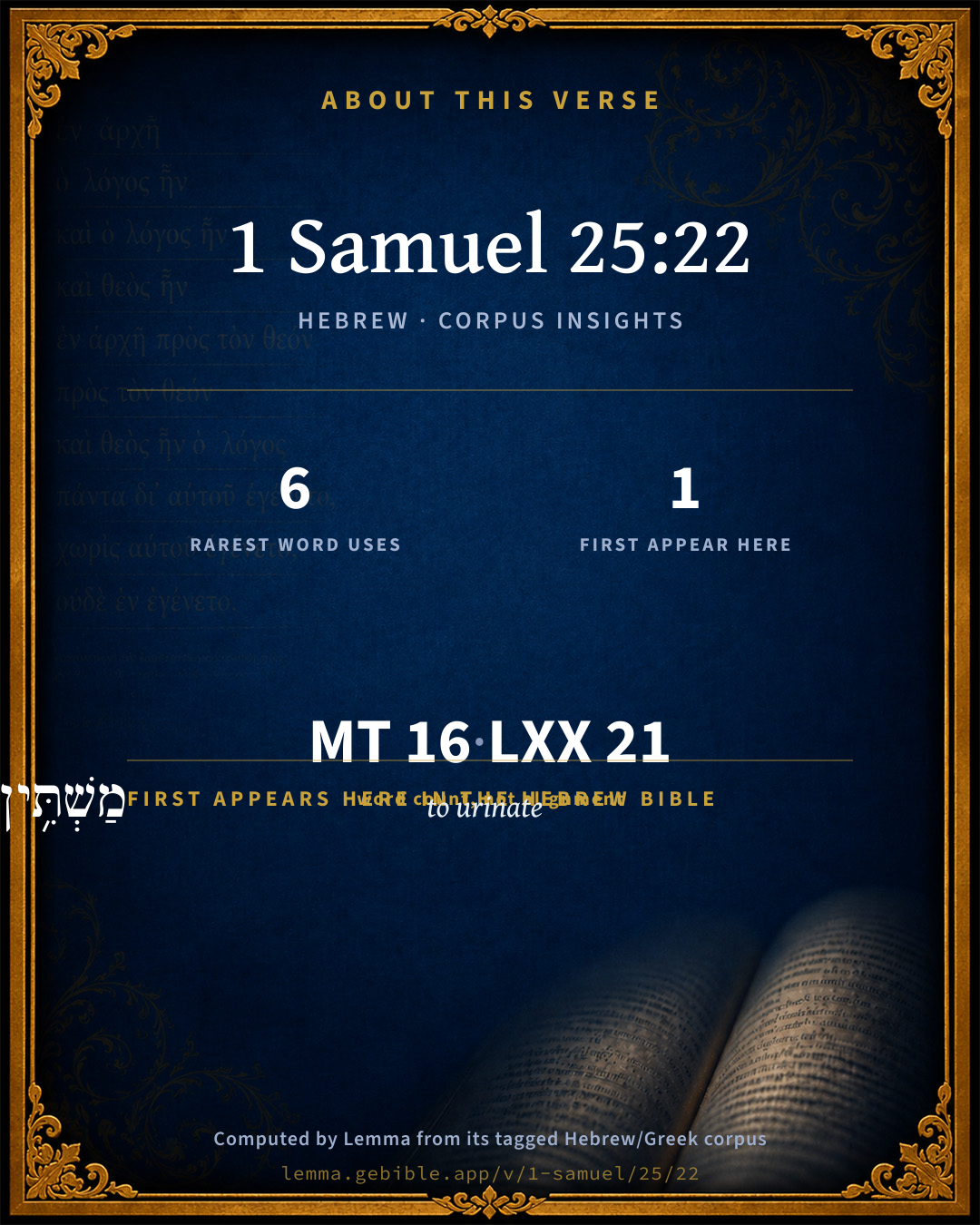
  • 1 first appearance in the Hebrew Bible
Full analysis ↓
Download a study sheet

One document with this verse’s original text, its word-by-word gloss line, the meaning frame, cross-references with their text, attributed commentary, and full source and license credits — printable, and it pastes into notes with its structure intact.

This verse Autodidact and up

Study sheet (.html) Plain text (.txt)

A passage Seminary Student

Up to 50 verses in one chapter. A passage sheet keeps up to 6 commentary sources and 12 cross-references per verse, in the order this page ranks them, and says so on the sheet whenever that leaves anything out. Ask for a single verse and you get the Autodidact verse sheet above.

Everything on this page stays free to read, with no account — the sheet is a download of what is already on screen, not access to it.

Want to remove ads? Support Godless Engineer
Compare translations 3

The same verse in 3 English versions, stacked beneath the original-language interlinear above. Click any original word for its lexicon entry.

Each is an independent rendering of the whole verse — the interlinear is not word-aligned to these translations.

Highlighted words mark where these versions differ — a whole-verse word diff, not a word-by-word alignment.

  • World English Bible Public Domain
    God do so to the enemies of David, and more also, if I leave of all that belongs to him by the morning light so much as one man-child.
  • King James Version Public Domain
    So and more also do God unto the enemies of David, if I leave of all that pertain to him by the morning light any that pisseth against the wall.
  • unfoldingWord Literal Text CC BY-SA 4.0
    Thus may God do to the enemies of David, and thus may he add, if I let remain until the morning any pissing against the wall who to him!”

unfoldingWord Literal Text — © unfoldingWord, licensed CC BY-SA 4.0. Word-aligned USFM3 via Door43 (git.door43.org/unfoldingWord/en_ult).

Versions to compare (up to 4)

3 of 4 selected

Show all 18 translations

Every available English version of this verse, each an independent rendering of the whole verse.

  • World English Bible Public Domain
    God do so to the enemies of David, and more also, if I leave of all that belongs to him by the morning light so much as one man-child.
  • Berean Standard Bible Public Domain
    May God punish David, and ever so severely, if I let one of Nabal’s men survive until morning.”
  • Majority Standard Bible Public Domain
    May God punish David, and ever so severely, if I let one male belonging to Nabal survive until morning.”
  • King James Version Public Domain
    So and more also do God unto the enemies of David, if I leave of all that pertain to him by the morning light any that pisseth against the wall.
  • American Standard Version (1901) Public Domain
    God do so unto the enemies of David, and more also, if I leave of all that pertain to him by the morning light so much as one man-child.
  • Revised Version (1885) Public Domain
    God do so unto the enemies of David, and more also, if I leave of all that pertain to him by the morning light so much as one man child.
  • Geneva Bible (1599) Public Domain
    So and more also doe God vnto the enemies of Dauid: for surely I will not leaue of all that he hath, by the dawning of the day, any that pisseth against the wall.
  • Douay-Rheims (1899) Public Domain
    May God do so and so, and add more to the foes of David, if I leave of all that belong to him till the morning, any that pisseth against the wall.
  • Young's Literal Translation Public Domain
    thus doth God do to the enemies of David, and thus He doth add, if I leave of all that he hath till the light of the morning -- of those sitting on the wall.'
  • Literal Standard Version CC BY-SA 4.0
    thus God does to the enemies of David, and thus He adds, if I leave of all that he has until the morning light—of those sitting on the wall.”
  • Unlocked Literal Bible CC BY-SA 4.0
    May God do so to me, David, and more also, if by the morning I leave so much as one male of all who belong to him.”
  • unfoldingWord Literal Text CC BY-SA 4.0
    Thus may God do to the enemies of David, and thus may he add, if I let remain until the morning any pissing against the wall who to him!”
  • Darby Bible Public Domain
    So and more also do God to the enemies of David, if I leave of all that is his by the morning light any male.
  • World Messianic Bible Public Domain
    God do so to the enemies of David, and more also, if I leave of all that belongs to him by the morning light so much as one who urinates on a wall.”
  • Webster's Bible Public Domain
    So and more also do God to the enemies of David, if I leave of all that pertain to him by the morning light any male person.)
  • Free Bible Version CC BY-SA 4.0
    May God punish me very severely if I leave even a single one of his men alive by morning!”
  • Bible in Basic English Public Domain
    May God's punishment be on David, if when morning comes there is so much as one male of his people still living.
  • JPS Tanakh (1917) Public Domain
    God do so unto the enemies of David, and more also, if I leave of all that pertain to him by the morning light so much as one male.' —

Literal Standard Version (2020), Covenant Press — licensed CC BY-SA 4.0. Text via the HelloAO Bible API (eBible.org). Unlocked Literal Bible (unfoldingWord) — licensed CC BY-SA 4.0. Text via the HelloAO Bible API (eBible.org). unfoldingWord Literal Text — © unfoldingWord, licensed CC BY-SA 4.0. Word-aligned USFM3 via Door43 (git.door43.org/unfoldingWord/en_ult). Free Bible Version, Dr. Jonathan Gallagher — licensed CC BY-SA 4.0. Text via the HelloAO Bible API (eBible.org).

Word by word

More ways to search: Search by grammar → Find every occurrence → Compare this word →

Practice this passage: Drill this verse → Learn its vocabulary →

מַשְׁתִּ֥ין
shâthan
H8366
“urinating”
Verb, Hiphil, Participle Active, Masculine, Singular, Absolute
Part of Speech
Verb
Stem
Hiphil
Form
Participle Active
Gender
Masculine
Number
Singular
State
Absolute
Full BDB Definition

Origin: a primitive root

TWOT: 2377

(Hiphil) to urinate - one who urinates (used as a designation of a male)
  1. כֹּה kôh H3541 “thus” Adverb
  2. יַעֲשֶׂ֧ה ʻâsâh H6213 “to do” Verb, Qal, Jussive, 3rd Person, Masculine, Singular
  3. אֱלֹהִ֛ים ʼĕlôhîym H430 “God(s)” Noun, Common, Masculine, Plural, Absolute
  4. לְאֹיְבֵ֥י ʼôyêb H341 “to/for · enemy” Preposition + Verb, Qal, Participle Active, Masculine, Plural, Construct
  5. דָוִ֖ד Dâvid H1732 “David” Noun, Proper
  6. וְכֹ֣ה kôh H3541 “and · thus” Conjunction + Adverb
  7. יֹסִ֑יף yâçaph H3254 “to add” Verb, Hiphil, Jussive, 3rd Person, Masculine, Singular
  8. אִם ʼim H518 “if” Conjunction
  9. אַשְׁאִ֧יר shâʼar H7604 “to remain” Verb, Hiphil, Imperfect, 1st Person, Common, Singular
  10. מִכָּל kôl H3605 “from · all of” Preposition + Noun, Common, Masculine, Singular, Construct
  11. אֲשֶׁר ʼăsher H834 “which” Particle, Relative
  12. עַד ʻad H5704 “until” Preposition
  13. הַבֹּ֖קֶר bôqer H1242 “the · morning” Particle, Definite Article + Noun, Common, Masculine, Singular, Absolute
  14. בְּקִֽיר qîyr H7023 “in/at · wall” Preposition + Noun, Common, Masculine, Singular, Absolute

About this verse

These counts appear in no published source. They are computed here, from the morphology-tagged text and Lemma’s own curated glosses. What Lemma adds →

16
words
14
distinct lemmas
Historical
section

Notable vocabulary

The rarest word here is מַשְׁתִּ֥ין to urinate H8366 — appearing just 6 times in the whole Hebrew Bible.

First appearance in Scripture

This word makes its first canonical appearance in the Hebrew Bible here:

  • מַשְׁתִּ֥ין to urinate H8366

Shared distinctive vocabulary

מַשְׁתִּ֥ין to urinate H8366 occurs in 6 verses of the Hebrew Bible. Also found in:

Grammatical profile

  • 5 verbs
  • 5 nouns
  • 2 prepositions
  • 1 conjunction
  • 2 adverbs
  • 1 particle

Verb forms

  • יַעֲשֶׂ֧ה Qal · Jussive
  • לְאֹיְבֵ֥י Qal · Participle Active
  • יֹסִ֑יף Hiphil · Jussive
  • אַשְׁאִ֧יר Hiphil · Imperfect
  • מַשְׁתִּ֥ין Hiphil · Participle Active

Repetition

A word recurs within this verse — often emphatic in Hebrew:

  • כֹּה thus H3541 ×2

Hebrew & Septuagint length

In English translation the verse runs 29 words from the Hebrew and 22 from the Septuagint (LXX English) — closely comparable.

A rough comparison of the two English renderings, which tokenize alike — not a word-level alignment.

Word counts can differ between the Hebrew and the Greek without any difference in meaning — e.g. the Hebrew direct-object marker אֵת has no separate Greek word, and Greek often adds the article ὁ.

In the original languages it is 16 Hebrew tokens and 21 Greek tokens — but the two are counted differently (Hebrew bundles its prefixes and suffixes into one token; the Greek is in lemma form), so that isn’t a like-for-like length.

Cross-references

9

Topical passages linked to 1 Samuel 25:22 in the Treasury of Scripture Knowledge — connected by theme and wording, ordered by reader-vote popularity; previews shown in the World English Bible.

  • 1 Samuel 3:17 He said, "What is the thing that [Yahweh] has spoken to you? Please don't hide it from me. God do so to you, and more also, if you hide anything from me of all the things that he spoke to you."
  • 1 Samuel 20:13 Yahweh do so to Jonathan, and more also, should it please my father to do you evil, if I don't disclose it to you, and send you away, that you may go in peace: and Yahweh be with you, as he has been with my father.
  • 1 Kings 14:10 therefore, behold, I will bring evil on the house of Jeroboam, and will cut off from Jeroboam every man-child, him who is shut up and him who is left at large in Israel, and will utterly sweep away the house of Jeroboam, as a man sweeps away dung, until it be all gone.
  • 1 Kings 21:21 Behold, I will bring evil on you, and will utterly sweep you away and will cut off from Ahab every man-child, and him who is shut up and him who is left at large in Israel:
  • Ruth 1:17 where you die, will I die, and there will I be buried: Yahweh do so to me, and more also, if anything but death part you and me."
  • 1 Samuel 14:44 Saul said, God do so and more also; for you shall surely die, Jonathan.
  • 1 Samuel 20:16 So Jonathan made a covenant with the house of David, [saying], Yahweh will require it at the hand of David's enemies.
  • 1 Kings 16:11 It happened, when he began to reign, as soon as he sat on his throne, that he struck all the house of Baasha: he didn't leave him a single man-child, neither of his relatives, nor of his friends.
  • 2 Kings 9:8 For the whole house of Ahab shall perish; and I will cut off from Ahab every man-child, and him who is shut up and him who is left at large in Israel.

Cross-references courtesy of OpenBible.info (CC BY 4.0).

Hebrew and Greek witnesses Masoretic Hebrew ↔ Greek Septuagint

The same verse in the two great witnesses to the Old Testament, shown verse-for-verse.

These are two independent witnesses, not word-aligned to each other, and the Septuagint is shown in lemma (dictionary) form.

Hebrew 1 Samuel 25:22 Masoretic · Westminster Leningrad Codex

כֹּה יַעֲשֶׂ֧ה אֱלֹהִ֛ים לְאֹיְבֵ֥י דָוִ֖ד וְכֹ֣ה יֹסִ֑יף אִם אַשְׁאִ֧יר מִכָּל אֲשֶׁר ל֛וֹ עַד הַבֹּ֖קֶר מַשְׁתִּ֥ין בְּקִֽיר

God do so to the enemies of David, and more also, if I leave of all that belongs to him by the morning light so much as one man-child.

World English Bible · Public Domain

Greek LXX 1 Samuel 25:22 Septuagint · lemma form

ὅδε ποιέω ὁ θεός ὁ δαυίδ καί ὅδε προςτίθημι εἰ ὑπολείπω ἐκ πᾶς ὁ ὁ ναβαλ ἕως πρωΐ οὐρέω πρός τοῖχος

So God do to David and more also, if I leave one male of all that belong to Nabal until the morning.

LXX2012 (modern English Septuagint) · Public Domain

On this verse, Trapp's Complete Commentary discusses the Septuagint’s reading. Read the note in Commentary ↓

Hebrew: Westminster Leningrad Codex (CC BY 4.0). Greek: Septuagint (public domain); English from LXX2012 (modern English Septuagint) (Public Domain). How the Septuagint differs from the Hebrew →

Targum (Aramaic paraphrase)

1

The Targum is the ancient Jewish Aramaic paraphrase of the Hebrew Scriptures — an interpretive translation, not the Hebrew text itself. Onkelos (literal) and Pseudo-Jonathan (expansive) render the Torah, and Jonathan the Prophets. Coverage is partial: where no permissively-licensed English translation exists for a verse, only the Aramaic is shown. This is verse-level text, not a word-by-word alignment to the Hebrew.

  1. Targum Jonathan Prophets (Joshua–Malachi)
    כְּדֵין יַעְבֵּיד אֱלֹהִים לְסַנְאֵי דָוִד וּכְדֵין יוֹסִיף אִם אַשְׁאִיר מִכָּל דִי לֵיהּ עַד מַנְהַר צַפְרָא יְדַע מַדָע:

    (no public-domain English translation for this verse)

    Targum Jonathan — Aramaic: “Mikraot Gedolot” (public domain). English: “Sefaria Community Translation” (CC0 1.0 (public-domain dedication)); “London "Chaldee Paraphrase," 1871” (public domain). Text via Sefaria.

Commentary

Notes on 1 Samuel 25:22 from classic Christian and Jewish commentators (each source and its license shown beneath its notes). The classic Christian expositions comment on the surrounding passage and are grouped to its opening verse, so a note may address several verses; the Jewish commentaries on the Tanakh (Rashi and others) are per-verse, so they appear only where the commentator wrote on this verse.

Lemma curates 59 commentaries, every one of them public domain or Creative Commons licensed, each selected and text-cleaned for this edition rather than reprinted as found. About our sources →

Trapp's Complete Commentary

John Trapp

1Sa 25:22 So and more also do God unto the enemies of David, if I leave of all that [pertain] to him by the morning light any that pisseth against the wall.

Ver. 22. So and more also do God unto the enemies of David,] i.e., To David’s self, say some, whom yet he was loath to curse, by an euphemismus: and so the Septuagint rendereth it. This was a rash vow, and not usual with David. We may say as much, and more, in excuse of it, as the historian doth of King Alphonsus, that he never swore any oath but by his father’s bones; Et quidem rarenter et ob causam, and that but now and then, and for some cause.

If I leave of all that pertain to him.] So rough and rash was David in a resolution of revenge:

“ Tantae ne animis coelestibus irae? ”

Men do in anger they know not what; such a smoke it raiseth; like as when fire is put to wet straw and filthy stuff. "Cease therefore from anger, and forsake wrath: fret not thyself in any wise to do evil." {Psa 37:8}

Any that pisseth against the wall.] Dog or cat, as we say: Canem in hoc oppido non relinquam, I will not leave a dog alive in this town, said Aurelian, the emperor, concerning Tyane, which had shut her gates upon him. {a}

{a} Vopiscus, in Aureliano.

John Trapp, A Commentary or Exposition upon All the Books of the Old and New Testament (1647–1656) — public domain. Text from a community e-Sword module.

Joseph Benson's Commentary

1Sa 25:22. So and more also do God unto the enemies of David — That is, unto David himself. But because it might seem ominous to curse himself, therefore, instead of David, he mentions David’s enemies: see 1Sa 20:16. The meaning seems to be, that he wishes God might bless his enemies, and pour evil upon himself, if he did not destroy Nabal and all the males of his family before the morning. But is this the voice of David? Can he speak so unadvisedly with his lips? Has he been so long in the school of affliction, and learned no more patience therein? Lord, what is man? And what need have we to pray, Lead us not into temptation! David’s wrath, though perhaps justly moved, here carried him to a pitch that, if executed, would have filled him with remorse, sorrow, and shame, as it could by no means have been reconciled to the laws of that God who was his defender, and whom alone he confided in for support under, and deliverance out of, his troubles. In which laws, too, he was well instructed, and therefore ought to have been governed by them, and not by his furious resentment.

Joseph Benson's Commentary on the Old and New Testaments (1811–1818) — public domain. Text from a community e-Sword module.

Geneva Bible (1599)

Geneva Bible translators

Meaning by this proverb, that he would destroy both small and great.

Geneva Bible (1599) marginal notes — public domain. Text via Bolls.life.

Adam Clarke's Commentary

Verse 22. So and more also do God] Nothing can justify this part of David's conduct. Whatever his provocation might have been, he had suffered, properly speaking, no wrongs; and his resolution to cut off a whole innocent family, because Nabal had acted ungenerously towards him, was abominable and cruel, not to say diabolic. He who attempts to vindicate this conduct of David is, at least constructively, a foe to God and truth. David himself condemns this most rash and unwarrantable conduct, and thanks God for having prevented him from doing this evil, 1Sa 25:32, c.

Any that pisseth against the wall.] This expression certainly means either men or dogs, and should be thus translated, if I leave-any male and this will answer both to men and dogs, and the offensive mode of expression be avoided. I will not enter farther into the subject: Bochart and Calmet have done enough, and more than enough; and in the plainest language too.

Adam Clarke's Commentary on the Bible (1810–1826) — public domain. Text from a community e-Sword/MySword module.

Ellicott's Commentary for English Readers

(22) So and more also.—This is an unusual variation of the common form of imprecation, “God do so to me and more also, if, &c, &c.” The Syriac and Arabic Versions, followed by some commentators, instead of “enemies of David,” read “his servant David.” The LXX., as usual, boldly cuts the knot by leaving out the word of difficulty, and reads “David” simply, omitting “enemies.” But there is no doubt that the Hebrew text here is correct. The words signify David himself. If God’s anger for the broken vow visited even David’s enemies, as distantly connected with him, how much more the guilty oath breaker himself? (This was Raschi’s explanation for a similar expression in Jonathan’s oath, 1Sa_20:16.) “A superstitious feeling probably lay at the root of this substitution of David’s enemies for himself, when thus invoking a curse” (Dean Payne Smith, in the Pulpit Commentary). Bishop Wordsworth here draws a good lesson on the non-obligation to keep a solemn oath, taken perhaps in a moment of undue excitement, and instances the evil example of Herod Antipas, who considered himself bound to carry out to the bitter end his rash oath to the daughter of Herodias, though it involved the death of John the Baptist, his former friend.

A Bible Commentary for English Readers, edited by Charles John Ellicott (1878–1897) — public domain. Text from a community e-Sword module.

The Cambridge Bible for Schools and Colleges

gen. ed. J. J. S. Perowne

22. unto the enemies of David] In the usual oath-formula the swearer invokes divine vengeance upon himself (1Sa_20:13), or upon the person adjured (1Sa_3:17). And so the Sept. here; “So God do to David.” “The enemies of David” may possibly be an euphemism, introduced by a corrector who was unwilling to let David invoke vengeance upon himself for an oath which he afterwards broke. Comp. the note on 1Sa_20:16.

if I leave … any, &c.] David vows that he will exterminate the family and not leave a single man alive. Cp. Deu_20:13.

The Cambridge Bible for Schools and Colleges (gen. ed. J. J. S. Perowne; Cambridge University Press, 1878–1918) — public domain. Text from a community e-Sword module.

John Gill's Exposition

So and more also do God unto the enemies of David,.... Give them as much health and prosperity, as much wealth and riches, as Nabal has, and much more:

if I leave of all that pertain to him, by the morning light, any that pisseth against the wall; which is generally understood of a dog, that he, would not leave him so much as a dog: but it is better, with Ben Gersom, to interpret it of the males in his house, himself, his sons, and servants; and so the Targum paraphrases it of reasonable creatures, of such"that know knowledge,''or are knowing and understanding creatures; it seems to have been towards the evening; of the day when David was marching towards Nabal's house, designing to fall upon him and his, amidst their jollity that night, and cut them all off before morning. This must be imputed to the sudden and violent passion David was thrown into when off his guard, through the necessity he was in, the disappointment he met with, and the opprobrious language he was treated with; but in this his conduct was not as it used to be, and as it was towards Saul his enemy. Nor is his rage and passion to be vindicated, or the rash vow he made to destroy Nabal and his family; his crime, though great, yet not to be published with death; his ingratitude and insolence deserved resentment, but were not capital crimes worthy of death, and especially of the destruction of his whole family; the Jews indeed make him to be guilty of treason, in that he knew that David was anointed king, and yet both abused him, and disobeyed his commands, and therefore being guilty of overt acts of treason, he and his were deserving of death; but David was not yet king.

John Gill's Exposition of the Whole Bible (1746–1763) — public domain (CC PDM 1.0). Text via the HelloAO Bible API.

Albert Barnes' Notes on the Bible

The concluding phrase denotes the utter destruction of a family, and is rightly explained to mean “every male,” perhaps with the idea, “down to the very meanest member of the household.”

Albert Barnes' Notes on the Bible (1834–1885) — public domain. Text from a community e-Sword/MySword module.

Haydock's Catholic Bible Commentary

The enemies, is left out in some editions of the Septuagint. But David wishes all evils to himself, though, to avoid the ominous expression, he specifies his enemies, if he do not punish Nabal. --- Leave. David certainly sinned in his designs against Nabal and his family, as he himself was afterwards sensible, when he blessed God for hindering him from executing the revenge he had proposed. (Challoner) --- All. Chaldean, "any one who is come to the use of reason." Syriac and Arabic, "the least thing hanging upon the wall." I will destroy the guilty, and plunder all the valuable effects. (Calmet) --- But the Hebrew, Septuagint, &c., agree with the Vulgate and the meaning is, either that every man, or that every dog, and even the meanest things, should be enveloped in the general ruin. (Haydock) --- The manners of men vary, but those of dogs are always the same. Hence, it is more generally supposed that this expression (Calmet) denotes that even dogs shall be exterminated, and consequently other things for which Nabal would have a greater affection. (Haydock) --- Aurelian being irritated against the inhabitants of Thiane, swore, "I will not leave a dog in this town;" which all people explained as if he meant to leave nothing alive in it. But being afterwards moved with compassion at the distress of the people, he executed his threat literally, and killed all the dogs. (Vopisc.) See 3 Kings xiv. 10., and xv. 29., and xxi. 21., and 4 Kings v. 6. (Bochart, Anim. ii. 55.; Delrio, adag. 184.) (Calmet) --- The unhappy Geddes translates, "a dog," to avoid the indelicate allusion. It would have been well if he had allowed himself no greater liberties! (Haydock) --- The Hebrew mashtin, may denote a shepherd’s or a mastiff dog. (Menochius)

George Leo Haydock (1774–1849), Haydock's Catholic Family Bible and Commentary, 1859 edition — public domain. Excludes Psalms (Douay-Rheims chapter numbering differs from Protestant) and Deuterocanonical books (Catholic canon only).

Matthew Poole's English Annotations

Unto the enemies of David, i. e. Unto David himself. But because it might seem ominous and unnatural to curse himself, therefore by a figure called euphemismus, instead of David, he mentions David’s enemies. See 1Sa 20:16. The words may be thus rendered:

So and more also let God do for (the Hebrew lamed being very oft so used) the enemies of David, i.e. let God work for them, and give them as much prosperity and success as Nabal hath hitherto had. Or, let God utterly destroy their enemies; and especially myself, the chief of them, if I do not destroy this man.

Any that pisseth against the wall, i.e. any of the males, for they only do so; and of them this phrase is manifestly understood, 1Ki 14:10; 21:21; 2Ki 9:8; and men not wholly barbarous have generally spared women in such cases.

Quest. Why then was Abigail so much concerned and afraid?

Answ. Partly from humanity, and the horror of so general and dreadful a slaughter of her family and nearest relations; and partly because when the sword was once drawn, she knew not where it would rest, nor whether she should escape; for she knew nothing of this limitation of David’s threatening till she came to him.

Matthew Poole's English Annotations on the Holy Bible (1683–1685) — public domain. Text from a community e-Sword/MySword module.

Whedon's Commentary on the Bible

Daniel D. Whedon

22. Any that pisseth against the wall — Here this proverbial expression first occurs, and we give the reader the several opinions on it. Bochart, Rodiger and Keil understand by the phrase a male person. But it is a sufficient objection to this opinion that in the East, men perform this office of nature in a sitting posture. And were this objection removed, there is no apparent reason for characterizing men generally by this term. For similar reasons we regard as unsatisfactory the opinion that a little boy is meant. More plausibility attaches to the explanation of Ephraem Syrus, Vatablus, and others, that the expression characterizes a dog. But it seems clear from 1Ki_14:10; 1Ki_16:11, and some other passages, that persons are intended; and Jahn, Furst and others have well inferred that, from being primarily applied to dogs, which are thus fittingly characterized, the expression was at length used of slaves and persons of the lowest class. Thus the phrase would be used contemptuously of an enemy whom one designed utterly to exterminate. He would cut off an entire household, even to the lowest, most insignificant, and contemptible member. Compare marginal references.

Daniel D. Whedon (gen. ed.), Commentary on the Old and New Testaments (1874–1909) — public domain. Text from a community e-Sword module.

John Wesley's Explanatory Notes

Enemies of David - That is, unto David himself. But because it might seem ominous to curse himself, therefore instead of David, he mentions David's enemies. But is this the voice of David? Can he speak so unadvisedly with his lips? Has he been so long in the school of affliction, and learned no more patience therein? Lord, what is man? And what need have we to pray, lead us not into temptation.

John Wesley, Explanatory Notes Upon the Whole Bible (1754–1765) — public domain. Text via the GEBible commentary corpus.

Rashi

Rabbi Shlomo Yitzchaki (Rashi)

Even one dog. Targum Yonoson renders, 'one possessing intelligence,' one who sets the walls of his heart. Another explanation is, 'even a dog whose manner is to urinate against a wall.'

Rashi on the Tanakh — English translations: “The Judaica Press complete Tanach with Rashi, translated by A. J. Rosenberg” (CC BY 4.0); “Pentateuch with Rashi's commentary by M. Rosenbaum and A.M. Silbermann, 1929-1934” (public domain); “The Metsudah Tanach series, Lakewood, N.J” (CC BY 4.0); and “The Book of Joshua, Metsudah Publications, 1997” (CC BY 4.0). Text via Sefaria.

Lesson kit

Teaching starters — assembled from the data on this page, not authored interpretation. Every prompt links to the verse data it draws on. Edit before teaching.

1 Samuel, in the Historical, opens this verse with 16 words (14 distinct Hebrew lemmas). Its most distinctive word is shâthan (“to urinate”). A historical commentator’s framing appears above. Read the whole chapter for the surrounding context.

Discussion questions

  1. What does “to urinate” (shâthan) contribute to the verse as a whole?
  2. This is the first place “to urinate” appears in Scripture (first appears here). What does its debut here establish?
  3. How does 1 Samuel 25:34, which shares the word «to urinate», read alongside this verse?
  4. What does the repetition of “thus” (2× in this one verse) do in this verse?
  5. The translations on this page render this verse differently — a whole-verse word diff, not a word-by-word alignment. What might account for the different wordings?
  6. «יַעֲשֶׂ֧ה» is a Qal Jussive verb. How does that grammatical form shape the action described?
  7. Compare how Trapp's Complete Commentary and Joseph Benson's Commentary read this verse. Where do they agree or differ?

Things to notice

Reading settings

Reading text

Shown beneath each verse's original-language words.

Old Testament
Old Testament edition

Read the OT as the Masoretic Hebrew (MT) or the Greek Septuagint (LXX).

English shown for the Greek Septuagint (in the Hebrew ↔ Greek comparison).

Comparing translations? Open the Compare panel on any verse page to stack up to four side by side.