
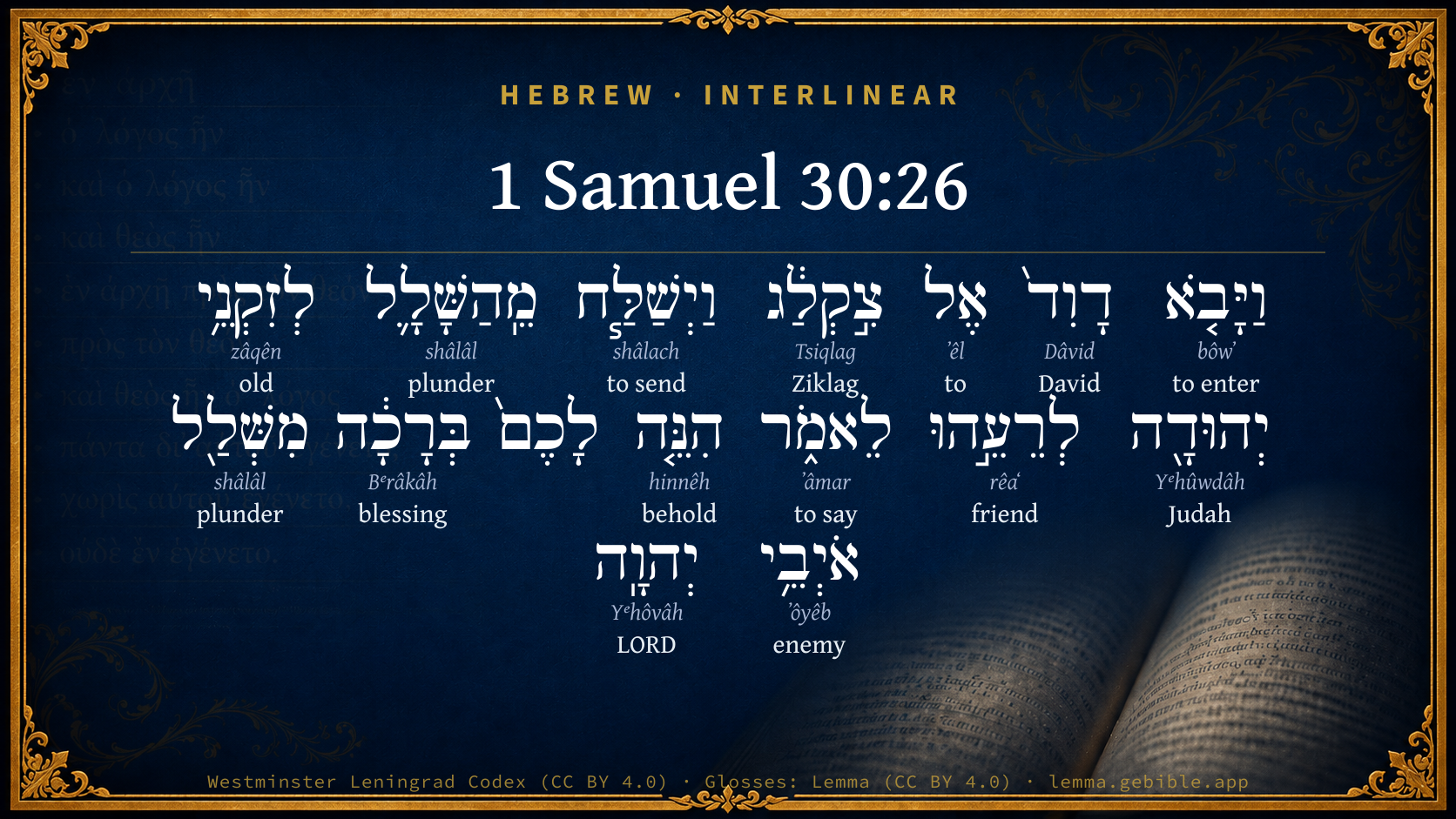
1 Samuel 30:26

Hebrew (Westminster Leningrad Codex) 1 Samuel 30:26 appears in the Hebrew Old Testament. The text above is from the Westminster Leningrad Codex. Each word links to its Strong’s number, a concise gloss, and parsing drawn from the Open Scriptures Hebrew Bible morphology. Click any word for its full Brown-Driver-Briggs (BDB) entry.
Download image
Cite this verse

1 Samuel 30:26 (World English Bible). Public Domain. Lemma interlinear Bible study tool, https://lemma.gebible.app/v/1-samuel/30/26.

Show BibTeX & RIS
BibTeX
RIS
English Translation
When David came to Ziklag, he sent of the spoil to the elders of Judah, even to his friends, saying, Behold, a present for you of the spoil of the enemies of Yahweh:
World English Bible · Public Domain
Download a study sheet

One document with this verse’s original text, its word-by-word gloss line, the meaning frame, cross-references with their text, attributed commentary, and full source and license credits — printable, and it pastes into notes with its structure intact.

This verse Autodidact and up

Study sheet (.html) Plain text (.txt)

A passage Seminary Student

Up to 50 verses in one chapter. A passage sheet keeps up to 6 commentary sources and 12 cross-references per verse, in the order this page ranks them, and says so on the sheet whenever that leaves anything out. Ask for a single verse and you get the Autodidact verse sheet above.

Everything on this page stays free to read, with no account — the sheet is a download of what is already on screen, not access to it.

Want to remove ads? Support Godless Engineer
Compare translations 3

The same verse in 3 English versions, stacked beneath the original-language interlinear above. Click any original word for its lexicon entry.

Each is an independent rendering of the whole verse — the interlinear is not word-aligned to these translations.

Highlighted words mark where these versions differ — a whole-verse word diff, not a word-by-word alignment.

  • World English Bible Public Domain
    When David came to Ziklag, he sent of the spoil to the elders of Judah, even to his friends, saying, Behold, a present for you of the spoil of the enemies of Yahweh:
  • King James Version Public Domain
    And when David came to Ziklag, he sent of the spoil unto the elders of Judah, even to his friends, saying, Behold a present for you of the spoil of the enemies of the LORD;
  • unfoldingWord Literal Text CC BY-SA 4.0
    And David came to Ziklag, and he sent from the plunder to the elders of Judah, to his friends, saying, “Behold, a blessing for you from the plunder of the enemies of Yahweh,”

unfoldingWord Literal Text — © unfoldingWord, licensed CC BY-SA 4.0. Word-aligned USFM3 via Door43 (git.door43.org/unfoldingWord/en_ult).

Versions to compare (up to 4)

3 of 4 selected

Show all 18 translations

Every available English version of this verse, each an independent rendering of the whole verse.

  • World English Bible Public Domain
    When David came to Ziklag, he sent of the spoil to the elders of Judah, even to his friends, saying, Behold, a present for you of the spoil of the enemies of Yahweh:
  • Berean Standard Bible Public Domain
    When David arrived in Ziklag, he sent some of the plunder to his friends, the elders of Judah, saying, “Here is a gift for you from the plunder of the LORD’s enemies.”
  • Majority Standard Bible Public Domain
    When David arrived in Ziklag, he sent some of the plunder to his friends, the elders of Judah, saying, “Here is a gift for you from the plunder of the LORD’s enemies.”
  • King James Version Public Domain
    And when David came to Ziklag, he sent of the spoil unto the elders of Judah, even to his friends, saying, Behold a present for you of the spoil of the enemies of the LORD;
  • American Standard Version (1901) Public Domain
    And when David came to Ziklag, he sent of the spoil unto the elders of Judah, even to his friends, saying, Behold, a present for you of the spoil of the enemies of Jehovah:
  • Revised Version (1885) Public Domain
    And when David came to Ziklag, he sent of the spoil unto the elders of Judah, even to his friends, saying, Behold a present for you of the spoil of the enemies of the LORD;
  • Geneva Bible (1599) Public Domain
    When Dauid therefore came to Ziklag, he sent of the pray vnto the Elders of Iudah and to his friends, saying, See there is a blessing for you of the spoyle of the enemies of the Lord.
  • Douay-Rheims (1899) Public Domain
    Then David came to Siceleg, and sent presents of the prey to the ancients of Juda his neighbours, saying: Receive a blessing of the prey of the enemies of the Lord.
  • Young's Literal Translation Public Domain
    And David cometh in unto Ziklag, and sendeth of the spoil to the elders of Judah, to his friends, (saying, `Lo, for you a blessing, of the spoil of the enemies of Jehovah),'
  • Literal Standard Version CC BY-SA 4.0
    And David comes to Ziklag, and sends of the spoil to [the] elderly of Judah, to his friends, saying, “Behold, a blessing for you of the spoil of the enemies of YHWH,”
  • Unlocked Literal Bible CC BY-SA 4.0
    When David came to Ziklag, he sent some of the booty to the elders of Judah, to his friends, saying, “See, here is a present for you from the booty from Yahweh's enemies.”
  • unfoldingWord Literal Text CC BY-SA 4.0
    And David came to Ziklag, and he sent from the plunder to the elders of Judah, to his friends, saying, “Behold, a blessing for you from the plunder of the enemies of Yahweh,”
  • Darby Bible Public Domain
    And David came to Ziklag, and he sent of the spoil to the elders of Judah, to his friends, saying, Behold a present for you of the spoil of the enemies of Jehovah:
  • World Messianic Bible Public Domain
    When David came to Ziklag, he sent some of the plunder to the elders of Judah, even to his friends, saying, “Behold, a present for you from the plunder of the LORD’s enemies.”
  • Webster's Bible Public Domain
    And when David came to Ziklag, he sent of the spoil to the elders of Judah, even to his friends, saying, Behold a present for you, of the spoil of the enemies of the LORD;
  • Free Bible Version CC BY-SA 4.0
    When David got back to Ziklag, he sent some of the plunder to each of his friends among the elders of Judah, saying, “Here's a gift for you from the plunder of the Lord's enemies.”
  • Bible in Basic English Public Domain
    And when David came to Ziklag, he sent some of the goods to the responsible men of Judah, and to his friends, saying, Here is an offering for you from the goods of those who were fighting against the Lord;
  • JPS Tanakh (1917) Public Domain
    And when David came to Ziklag, he sent of the spoil unto the elders of Judah, even to his friends, saying: 'Behold a present for you of the spoil of the enemies of the LORD';

Literal Standard Version (2020), Covenant Press — licensed CC BY-SA 4.0. Text via the HelloAO Bible API (eBible.org). Unlocked Literal Bible (unfoldingWord) — licensed CC BY-SA 4.0. Text via the HelloAO Bible API (eBible.org). unfoldingWord Literal Text — © unfoldingWord, licensed CC BY-SA 4.0. Word-aligned USFM3 via Door43 (git.door43.org/unfoldingWord/en_ult). Free Bible Version, Dr. Jonathan Gallagher — licensed CC BY-SA 4.0. Text via the HelloAO Bible API (eBible.org).

Word by word

More ways to search: Search by grammar → Find every occurrence → Compare this word →

Practice this passage: Drill this verse → Learn its vocabulary →

צִ֣קְלַ֔ג
Tsiqlag
H6860
“Ziklag”
Noun, Proper
Part of Speech
Noun
Type
Proper
Full BDB Definition

Origin: of uncertain derivation

TWOT: None

Ziklag = "winding" - a town in the south of Judah, later allotted to Simeon; noted for its having been the city of David given to him by king Achish of Gath and his residence when he was joined by many of his mighty warriors and when he received word of the death of Saul
  1. וַיָּבֹ֤א bôwʼ H935 “and · to enter” Conjunction + Verb, Qal, Sequential Imperfect, 3rd Person, Masculine, Singular
  2. דָוִד֙ Dâvid H1732 “David” Noun, Proper
  3. אֶל ʼêl H413 “to” Preposition
  4. וַיְשַׁלַּ֧ח shâlach H7971 “and · to send” Conjunction + Verb, Piel, Sequential Imperfect, 3rd Person, Masculine, Singular
  5. מֵֽהַשָּׁלָ֛ל shâlâl H7998 “from · the · plunder” Preposition + Particle, Definite Article + Noun, Common, Masculine, Singular, Absolute
  6. לְזִקְנֵ֥י zâqên H2205 “to/for · old of” Preposition + Adjective, Adjective, Masculine, Plural, Construct
  7. יְהוּדָ֖ה Yᵉhûwdâh H3063 “Judah” Noun, Proper
  8. לְרֵעֵ֣הוּ rêaʻ H7453 “to/for · friend · his” Preposition + Noun, Common, Masculine, Singular, Construct + Suffix, Personal, 3rd Person, Masculine, Singular
  9. לֵאמֹ֑ר ʼâmar H559 “to say” Preposition + Verb, Qal, Infinitive Construct
  10. הִנֵּ֤ה hinnêh H2009 “behold” Particle, Demonstrative
  11. בְּרָכָ֔ה Bᵉrâkâh H1293 “blessing” Noun, Common, Feminine, Singular, Absolute
  12. מִשְּׁלַ֖ל shâlâl H7998 “from · plunder of” Preposition + Noun, Common, Masculine, Singular, Construct
  13. אֹיְבֵ֥י ʼôyêb H341 “enemy” Verb, Qal, Participle Active, Masculine, Plural, Construct
  14. יְהוָֽה Yᵉhôvâh H3068 “LORD” Noun, Proper

About this verse

These counts appear in no published source. They are computed here, from the morphology-tagged text and Lemma’s own curated glosses. What Lemma adds →

16
words
14
distinct lemmas
Historical
section

Notable vocabulary

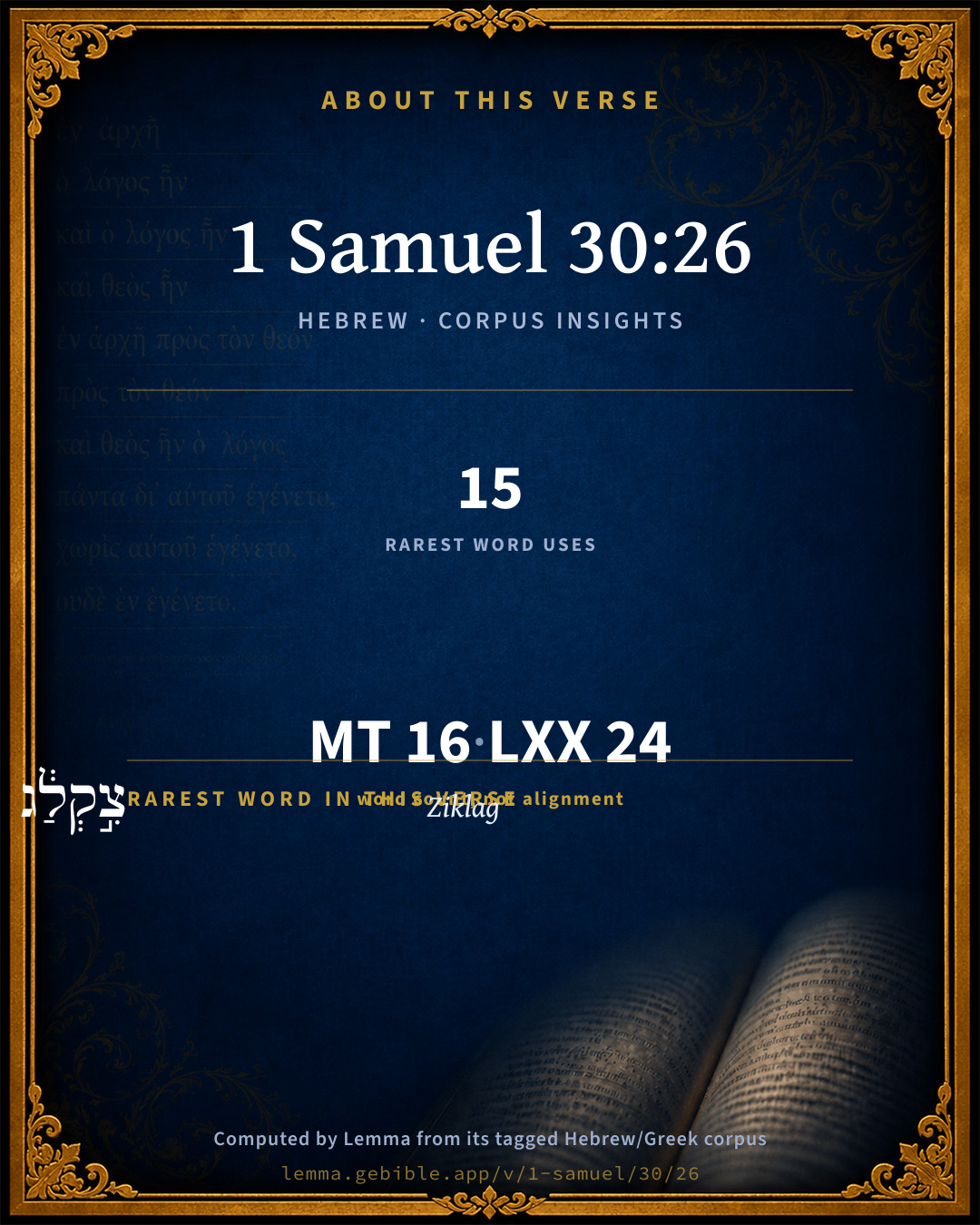
The rarest word here is צִ֣קְלַ֔ג Ziklag H6860 — appearing just 15 times in the whole Hebrew Bible.

Shared distinctive vocabulary

צִ֣קְלַ֔ג Ziklag H6860 occurs in 12 verses of the Hebrew Bible. Also found in:

Grammatical profile

  • 4 verbs
  • 8 nouns
  • 1 adjective
  • 2 prepositions
  • 1 particle

Verb forms

  • וַיָּבֹ֤א Qal · Sequential Imperfect
  • וַיְשַׁלַּ֧ח Piel · Sequential Imperfect
  • לֵאמֹ֑ר Qal · Infinitive Construct
  • אֹיְבֵ֥י Qal · Participle Active

Repetition

A word recurs within this verse — often emphatic in Hebrew:

  • מֵֽהַשָּׁלָ֛ל plunder H7998 ×2

Hebrew & Septuagint length

In English translation the verse runs 33 words from the Hebrew and 31 from the Septuagint (LXX English) — closely comparable.

A rough comparison of the two English renderings, which tokenize alike — not a word-level alignment.

Word counts can differ between the Hebrew and the Greek without any difference in meaning — e.g. the Hebrew direct-object marker אֵת has no separate Greek word, and Greek often adds the article ὁ.

In the original languages it is 16 Hebrew tokens and 24 Greek tokens — but the two are counted differently (Hebrew bundles its prefixes and suffixes into one token; the Greek is in lemma form), so that isn’t a like-for-like length.

Cross-references

9

Topical passages linked to 1 Samuel 30:26 in the Treasury of Scripture Knowledge — connected by theme and wording, ordered by reader-vote popularity; previews shown in the World English Bible.

  • 1 Samuel 25:27 Now this present which your servant has brought to my lord, let it be given to the young men who follow my lord.
  • Genesis 33:11 Please take the gift that I brought to you; because God has dealt graciously with me, and because I have enough." He urged him, and he took it.
  • 2 Kings 5:15 He returned to the man of God, he and all his company, and came, and stood before him; and he said, See now, I know that there is no God in all the earth, but in Israel: now therefore, please take a present from your servant.
  • 1 Chronicles 12:1–15 Now these are those who came to David to Ziklag, while he yet kept himself close because of Saul the son of Kish; and they were among the mighty men, his helpers in war.
  • Psalms 35:27 Let them shout for joy and be glad, who favor my righteous cause. Yes, let them say continually, "Yahweh be magnified, Who has pleasure in the prosperity of his servant!"
  • Psalms 68:18 You have ascended on high. You have led away captives. You have received gifts among men, Yes, among the rebellious also, that Yah God might dwell there.
  • Proverbs 18:16–24 A man's gift makes room for him, And brings him before great men.
  • Isaiah 32:8 But the noble devises noble things; and in noble things shall he continue.
  • 2 Corinthians 9:5 I thought it necessary therefore to entreat the brothers that they would go before to you, and arrange ahead of time the generous gift that you promised before, that the same might be ready as a matter of generosity, and not of greediness.

Cross-references courtesy of OpenBible.info (CC BY 4.0).

Hebrew and Greek witnesses Masoretic Hebrew ↔ Greek Septuagint

The same verse in the two great witnesses to the Old Testament, shown verse-for-verse.

These are two independent witnesses, not word-aligned to each other, and the Septuagint is shown in lemma (dictionary) form.

Hebrew 1 Samuel 30:26 Masoretic · Westminster Leningrad Codex

וַיָּבֹ֤א דָוִד֙ אֶל צִ֣קְלַ֔ג וַיְשַׁלַּ֧ח מֵֽהַשָּׁלָ֛ל לְזִקְנֵ֥י יְהוּדָ֖ה לְרֵעֵ֣הוּ לֵאמֹ֑ר הִנֵּ֤ה לָכֶם֙ בְּרָכָ֔ה מִשְּׁלַ֖ל אֹיְבֵ֥י יְהוָֽה

When David came to Ziklag, he sent of the spoil to the elders of Judah, even to his friends, saying, Behold, a present for you of the spoil of the enemies of Yahweh:

World English Bible · Public Domain

Greek LXX 1 Samuel 30:26 Septuagint · lemma form

καί ἔρχομαι δαυίδ εἰς σεκελακ καί ἀποστέλλω ὁ πρεσβύτερος ιουδα ὁ σκῦλον καί ὁ πλησίον αὐτός λέγω ἰδού ἀπό ὁ σκῦλον ὁ ἐχθρός κύριος

And David came to Sekelac, and sent of the spoils to the elders of Juda, and to his friends, saying, Behold some of the spoils of the enemies of the Lord;

LXX2012 (modern English Septuagint) · Public Domain

Hebrew: Westminster Leningrad Codex (CC BY 4.0). Greek: Septuagint (public domain); English from LXX2012 (modern English Septuagint) (Public Domain). How the Septuagint differs from the Hebrew →

Targum (Aramaic paraphrase)

1

The Targum is the ancient Jewish Aramaic paraphrase of the Hebrew Scriptures — an interpretive translation, not the Hebrew text itself. Onkelos (literal) and Pseudo-Jonathan (expansive) render the Torah, and Jonathan the Prophets. Coverage is partial: where no permissively-licensed English translation exists for a verse, only the Aramaic is shown. This is verse-level text, not a word-by-word alignment to the Hebrew.

  1. Targum Jonathan Prophets (Joshua–Malachi)
    וַאֲתָא דָוִד לְצִקְלַג וְשַׁדֵר מִבִּזְתָא לְסָבֵי יְהוּדָה לְרַחֲמוֹהִי לְמֵימַר הָא לְכוֹן מַתָּנָא מִבִּזַת סַנְאֵי עַמָא דַיָי:

    (no public-domain English translation for this verse)

    Targum Jonathan — Aramaic: “Mikraot Gedolot” (public domain). English: “Sefaria Community Translation” (CC0 1.0 (public-domain dedication)); “London "Chaldee Paraphrase," 1871” (public domain). Text via Sefaria.

Commentary

Notes on 1 Samuel 30:26 from classic Christian and Jewish commentators (each source and its license shown beneath its notes). The classic Christian expositions comment on the surrounding passage and are grouped to its opening verse, so a note may address several verses; the Jewish commentaries on the Tanakh (Rashi and others) are per-verse, so they appear only where the commentator wrote on this verse.

Lemma curates 59 commentaries, every one of them public domain or Creative Commons licensed, each selected and text-cleaned for this edition rather than reprinted as found. About our sources →

Trapp's Complete Commentary

John Trapp

1Sa 30:26 And when David came to Ziklag, he sent of the spoil unto the elders of Judah, [even] to his friends, saying, Behold a present for you of the spoil of the enemies of the LORD;

Ver. 26. He sent of the spoil unto the elders of Judah.] Thereby to show his liberalitas muneraria, and so to make them his friends; for "a gift maketh room for a man"; {Pro 18:16} it "is as a precious stone," {Pro 17:8} and hath a marvellous conciliating property; it is a very loadstone. Much about this time were Saul and his sons slain, and thereby way made for David to the crown; whereunto these presents would not a little conduce. The Roman emperors were wont to insinuate into their soldiers and subjects by gifts and congiaries. {a}

{a} [ Lenire multitudinem imperitam congiariis. - Cic., apud Ainsw.]

John Trapp, A Commentary or Exposition upon All the Books of the Old and New Testament (1647–1656) — public domain. Text from a community e-Sword module.

Joseph Benson's Commentary

1Sa 30:26. He sent of the spoil unto the elders of Judah — Partly in gratitude for their former favours to him; and partly in policy to engage their affections to him. Behold a present for you — In the Hebrew, a blessing. So he calls the present, because it was a token that he wished all prosperity to them, who had been kind to him in his banishment, and had helped to maintain and protect him. Of the spoil of the enemies of the Lord — The success of David in this pursuit of the Amalekites, will, upon examination, appear so extraordinary that it is not easy to account for it, otherwise than from the peculiar superintendence of Providence over David and his concerns. Indeed, the interposition of Providence is seen in every circumstance of this adventure; the number, the perseverance, the issue. That they might not think their number did the work, God reduced them to four hundred, as he did Gideon’s company to three, Judges 7. Many others have been as fortunate in surprising, and as successful in slaughtering their enemies; but to have strength both for the slaughter and pursuit, for so many hours together, is altogether extraordinary. But what is yet more remarkable is, that he should recover all the captives unhurt, out of the hands of a people so abandoned, and so execrable as the Amalekites! We have intimated that these Amalekites, being poor, spared their captives from a prospect of profiting greatly by the sale of them. Others, however, perhaps with as much reason, think they only respited their cruelty to execute it to more advantage at their leisure. How beautiful a contemplation is it to observe the signal goodness of God and malignity of man co-operating to the same end! See Delaney.

Joseph Benson's Commentary on the Old and New Testaments (1811–1818) — public domain. Text from a community e-Sword module.

Tyndale Open Study Notes

Tyndale Open Resources

30:26 elders of Judah . . . his friends: David extended his generosity to influential people throughout his own tribal area, possibly to secure their support for him as king.

Tyndale Open Study Notes — © Tyndale Open Resources, licensed CC BY-SA 4.0. Text via the HelloAO Bible API.

Jamieson, Fausset & Brown

Robert Jamieson, A. R. Fausset & David Brown

when David came to Ziklag, he sent of the spoil to the elders of Judah--This was intended as an acknowledgment to the leading men in those towns and villages of Judah which had ministered to his necessities in the course of his various wanderings. It was the dictate of an amiable and grateful heart; and the effect of this well-timed liberality was to bring a large accession of numbers to his camp (Ch1 12:22). The enumeration of these places shows what a numerous and influential party of adherents to his cause he could count within his own tribe [Sa1 30:27-31].

Next: 1 Samuel Chapter 31

Jamieson, Fausset & Brown — Commentary Critical and Explanatory on the Whole Bible (1871) — public domain (CC PDM 1.0). Text via the HelloAO Bible API.

Adam Clarke's Commentary

Verse 26. Unto the elders of Judah] These were the persons among whom he sojourned during his exile, and who had given him shelter and protection. Gratitude required these presents.

Adam Clarke's Commentary on the Bible (1810–1826) — public domain. Text from a community e-Sword/MySword module.

Ellicott's Commentary for English Readers

(26) He sent of the spoil.—To have made it worth while to have sent presents to all the places enumerated below, the spoil of the Amalekites captured on this occasion must have been enormous. One special circumstance connected with the history besides leads us to this conclusion. Although these desert Arabs were surprised and attacked at a terrible disadvantage after a debauch, they seem (so great evidently was their numbers) to have held their ground from early morning until evening, and then 400 managed to escape on their swiftest camels. It was not improbably the main division of the great tribe, and they had with them the bulk of their flocks and herds, besides what they had just captured in their raid in southern Canaan. No doubt the cities to whom rich gifts of cattle were sent were those places where, during his long wanderings, he and his followers had been kindly received and helped.

A Bible Commentary for English Readers, edited by Charles John Ellicott (1878–1897) — public domain. Text from a community e-Sword module.

The Cambridge Bible for Schools and Colleges

gen. ed. J. J. S. Perowne

26–31. The presents sent to the elders of Judah

26. he sent of the spoil, &c.] In gratitude for the assistance he had received from them during his wanderings, and to secure their good will when Saul’s death should open the way for him to the throne. On the elders see at 1Sa_8:4.

a present] Lit. a blessing, as in 1Sa_25:27.

the spoil of the enemies of the Lord] Since Israel was Jehovah’s people, the enemies of Israel were the enemies of His kingdom and His cause, and every war against them was a holy war. Cp. 1Sa_18:17, 1Sa_25:28.

The Cambridge Bible for Schools and Colleges (gen. ed. J. J. S. Perowne; Cambridge University Press, 1878–1918) — public domain. Text from a community e-Sword module.

John Gill's Exposition

And when David came to Ziklag,.... Perhaps with an intention to rebuild it, and make it still the place of his residence; and it is possible there might be some houses that escaped flames, and if not, tents might be pitched until the city was rebuilt, and it appears that he continued there some time:

he sent of the spoil to the elders of Judah: of that part of it which belonged to himself as a general:

even to his friends; such as had been kind to him when he sojourned among them; so that this was a piece of gratitude, as well as of policy in him, to make his way to the throne the easier, he perceiving the time drawing on for the expiration of the kingdom in the family of Saul; and besides, some in those parts he sent of the spoil to might have been sufferers by the Amalekites, so that it was but a point of justice to restore to them what had been taken from them; for they had invaded the south of Judea, and took spoils from thence, Sa1 30:14; it was to his friends in those parts he sent, not to the inhabitants of Ziph and Keilah, which were places in the tribe of Judah; but these having attempted to betray him, were not entitled to his favours, though they were not the objects of his vengeance:

saying, behold, a present for you, of the spoil of the Lord's enemies; or a "blessing" (z), which he sent them with a good will, wishing health and happiness to them; which they might without hesitation receive, seeing it was not the spoil of private enemies, or of what was taken from them in a way of private revenge, but the spoil of the enemies of the Lord, his and their common enemies; nor need they scruple eating and enjoying it, though the spoil of those that cursed the Lord, Abarbinel observes, since this they had with the blessing of the Lord.

(z) "benedictio", Pagninus, Montanus.

John Gill's Exposition of the Whole Bible (1746–1763) — public domain (CC PDM 1.0). Text via the HelloAO Bible API.

Haydock's Catholic Bible Commentary

Neighbours. Hebrew, "friends;" some were at a distance, ver. 28. (Haydock) --- The number of presents shews the quantity of the spoil, and the generosity of David towards those who had formerly assisted him. (Calmet)

George Leo Haydock (1774–1849), Haydock's Catholic Family Bible and Commentary, 1859 edition — public domain. Excludes Psalms (Douay-Rheims chapter numbering differs from Protestant) and Deuterocanonical books (Catholic canon only).

Matthew Poole's English Annotations

Partly in gratitude for their former favour to him; and partly in policy to engage their affections to him now when he apprehended Saul’s death near.

The enemies of the Lord; he intimates, that though he was fled to the Philistines, yet he employed not his forces against the Israelites, as, no doubt, Saul’s courtiers and soldiers reported that he designed; but only against God’s enemies.

Matthew Poole's English Annotations on the Holy Bible (1683–1685) — public domain. Text from a community e-Sword/MySword module.

Whedon's Commentary on the Bible

Daniel D. Whedon

26. To his friends — Those who had given him shelter and encouragement during the time of his wanderings. “Sending these gifts could not fail to make the elders of these cities well disposed towards him, and so to facilitate his recognition as king after the death of Saul, which occurred immediately afterwards.” — Keil.

Daniel D. Whedon (gen. ed.), Commentary on the Old and New Testaments (1874–1909) — public domain. Text from a community e-Sword module.

The Pulpit Commentary

DAVID PROPITIATES HIS FRIENDS BY SHARING WITH THEM HIS BOOTY (vers. 26-31).

The elders of Judah. The spoil taken from the Amalekites and assigned to David must have been very large, as it was worth distributing so widely. He did not, however, send to all the elders of Judah, but to such only as were his friends. A present. Hebrew, "a blessing". (see on 1Sa_25:27)

The Pulpit Commentary (1880–1919), ed. H.D.M. Spence-Jones & Joseph S. Exell — public domain. Text from a community e-Sword module.

John Wesley's Explanatory Notes

Elders of Judah - Partly in gratitude for their former favours to him: and partly, in policy, to engage their affections to him.

John Wesley, Explanatory Notes Upon the Whole Bible (1754–1765) — public domain. Text via the GEBible commentary corpus.

unfoldingWord translationNotes

Door43 World Missions Community

Connecting Statement:

The writer begins a list of cities whose elders received gifts from David.

Ziklag ... Bethel ... Jattir ... Aroer ... Siphmoth ... Eshtemoa

names of towns (See: How to Translate Names)

booty

goods that David had taken from the Amalekites after the battle. See how you translated this in 1 Samuel 30:16.

a present

"a gift"

translationWords

David

send

elder

kingdom of Judah

Yahweh

Ramoth

unfoldingWord translationNotes — © Distant Shores Media and the Door43 World Missions Community, licensed CC BY-SA 4.0. Source: git.door43.org/Door43/en_tn.

Rashi

Rabbi Shlomo Yitzchaki (Rashi)

To his allies. To his friends.

Rashi on the Tanakh — English translations: “The Judaica Press complete Tanach with Rashi, translated by A. J. Rosenberg” (CC BY 4.0); “Pentateuch with Rashi's commentary by M. Rosenbaum and A.M. Silbermann, 1929-1934” (public domain); “The Metsudah Tanach series, Lakewood, N.J” (CC BY 4.0); and “The Book of Joshua, Metsudah Publications, 1997” (CC BY 4.0). Text via Sefaria.

Lesson kit

Teaching starters — assembled from the data on this page, not authored interpretation. Every prompt links to the verse data it draws on. Edit before teaching.

1 Samuel, in the Historical, opens this verse with 16 words (14 distinct Hebrew lemmas). Its most distinctive word is Tsiqlag (“Ziklag”). A historical commentator’s framing appears above. Read the whole chapter for the surrounding context.

Discussion questions

  1. How does “Ziklag” (Tsiqlag) shape what this verse is saying?
  2. How does Joshua 15:31, which shares the word «Ziklag», read alongside this verse?
  3. What does the repetition of “plunder” (2× in this one verse) do in this verse?
  4. These translations render this verse differently. What is at stake in choosing one wording over another?
  5. «וַיָּבֹ֤א» is a Qal Sequential Imperfect verb. How does that grammatical form shape the action described?
  6. Compare how Trapp's Complete Commentary and Joseph Benson's Commentary read this verse. Where do they agree or differ?

Things to notice

Reading settings

Reading text

Shown beneath each verse's original-language words.

Old Testament
Old Testament edition

Read the OT as the Masoretic Hebrew (MT) or the Greek Septuagint (LXX).

English shown for the Greek Septuagint (in the Hebrew ↔ Greek comparison).

Comparing translations? Open the Compare panel on any verse page to stack up to four side by side.