
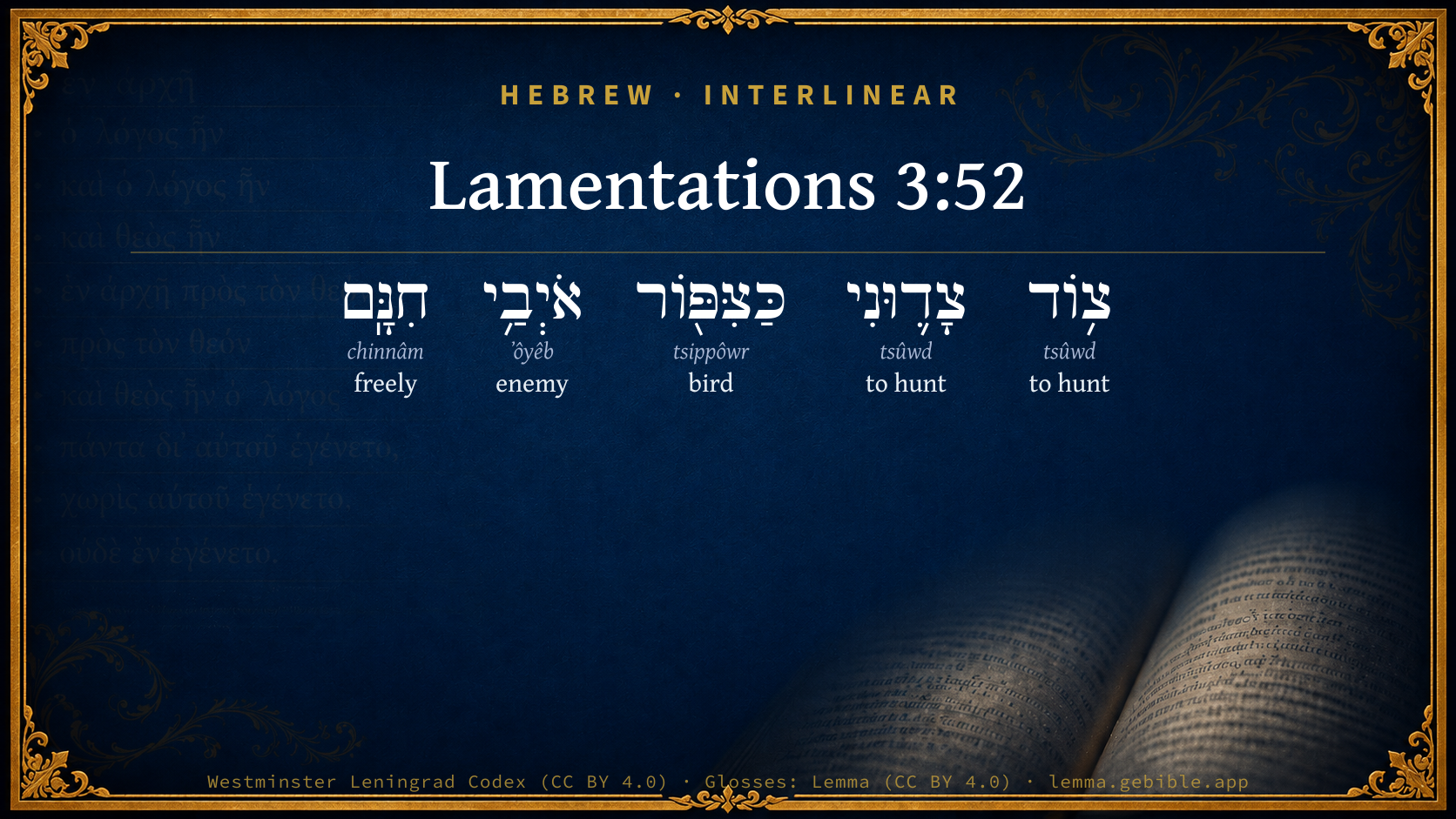
Lamentations 3:52

Hebrew (Westminster Leningrad Codex) Lamentations 3:52 appears in the Hebrew Old Testament. The text above is from the Westminster Leningrad Codex. Each word links to its Strong’s number, a concise gloss, and parsing drawn from the Open Scriptures Hebrew Bible morphology. Click any word for its full Brown-Driver-Briggs (BDB) entry.
Download image
Cite this verse

Lamentations 3:52 (World English Bible). Public Domain. Lemma interlinear Bible study tool, https://lemma.gebible.app/v/lamentations/3/52.

Show BibTeX & RIS
BibTeX
RIS
English Translation
They have chased me sore like a bird, those who are my enemies without cause.
World English Bible · Public Domain
Download a study sheet

One document with this verse’s original text, its word-by-word gloss line, the meaning frame, cross-references with their text, attributed commentary, and full source and license credits — printable, and it pastes into notes with its structure intact.

This verse Autodidact and up

Study sheet (.html) Plain text (.txt)

A passage Seminary Student

Up to 50 verses in one chapter. A passage sheet keeps up to 6 commentary sources and 12 cross-references per verse, in the order this page ranks them, and says so on the sheet whenever that leaves anything out. Ask for a single verse and you get the Autodidact verse sheet above.

Everything on this page stays free to read, with no account — the sheet is a download of what is already on screen, not access to it.

Want to remove ads? Support Godless Engineer
Compare translations 3

The same verse in 3 English versions, stacked beneath the original-language interlinear above. Click any original word for its lexicon entry.

Each is an independent rendering of the whole verse — the interlinear is not word-aligned to these translations.

Highlighted words mark where these versions differ — a whole-verse word diff, not a word-by-word alignment.

  • World English Bible Public Domain
    They have chased me sore like a bird, those who are my enemies without cause.
  • King James Version Public Domain
    Mine enemies chased me sore, like a bird, without cause.
  • unfoldingWord Literal Text CC BY-SA 4.0
    Hunting, they hunted me like a bird, my enemies without cause.

unfoldingWord Literal Text — © unfoldingWord, licensed CC BY-SA 4.0. Word-aligned USFM3 via Door43 (git.door43.org/unfoldingWord/en_ult).

Versions to compare (up to 4)

3 of 4 selected

Show all 18 translations

Every available English version of this verse, each an independent rendering of the whole verse.

  • World English Bible Public Domain
    They have chased me sore like a bird, those who are my enemies without cause.
  • Berean Standard Bible Public Domain
    Without cause my enemies hunted me like a bird.
  • Majority Standard Bible Public Domain
    Without cause my enemies hunted me like a bird.
  • King James Version Public Domain
    Mine enemies chased me sore, like a bird, without cause.
  • American Standard Version (1901) Public Domain
    They have chased me sore like a bird, they that are mine enemies without cause.
  • Revised Version (1885) Public Domain
    They have chased me sore like a bird, that are mine enemies without cause.
  • Geneva Bible (1599) Public Domain
    Mine enemies chased me sore like a birde, without cause.
  • Douay-Rheims (1899) Public Domain
    Sade. My enemies have chased me and caught me like a bird, without cause.
  • Young's Literal Translation Public Domain
    Hunted me sore as a bird have my enemies without cause.
  • Literal Standard Version CC BY-SA 4.0
    Hunting—my enemies have hunted me without cause like the bird.
  • Unlocked Literal Bible CC BY-SA 4.0
    I have been hunted like a bird by those who were my enemies; they hunted me without a reason.
  • unfoldingWord Literal Text CC BY-SA 4.0
    Hunting, they hunted me like a bird, my enemies without cause.
  • Darby Bible Public Domain
    They that are mine enemies without cause have chased me sore like a bird.
  • World Messianic Bible Public Domain
    They have chased me relentlessly like a bird, those who are my enemies without cause.
  • Webster's Bible Public Domain
    My enemies chased me fiercely, like a bird without cause.
  • Free Bible Version CC BY-SA 4.0
    For no reason my enemies trapped me like a bird.
  • Bible in Basic English Public Domain
    They who are against me without cause have gone hard after me as if I was a bird;
  • JPS Tanakh (1917) Public Domain
    They have chased me sore like a bird, that are mine enemies without cause.

Literal Standard Version (2020), Covenant Press — licensed CC BY-SA 4.0. Text via the HelloAO Bible API (eBible.org). Unlocked Literal Bible (unfoldingWord) — licensed CC BY-SA 4.0. Text via the HelloAO Bible API (eBible.org). unfoldingWord Literal Text — © unfoldingWord, licensed CC BY-SA 4.0. Word-aligned USFM3 via Door43 (git.door43.org/unfoldingWord/en_ult). Free Bible Version, Dr. Jonathan Gallagher — licensed CC BY-SA 4.0. Text via the HelloAO Bible API (eBible.org).

Word by word

More ways to search: Search by grammar → Find every occurrence → Compare this word →

Practice this passage: Drill this verse → Learn its vocabulary →

About this verse

These counts appear in no published source. They are computed here, from the morphology-tagged text and Lemma’s own curated glosses. What Lemma adds →

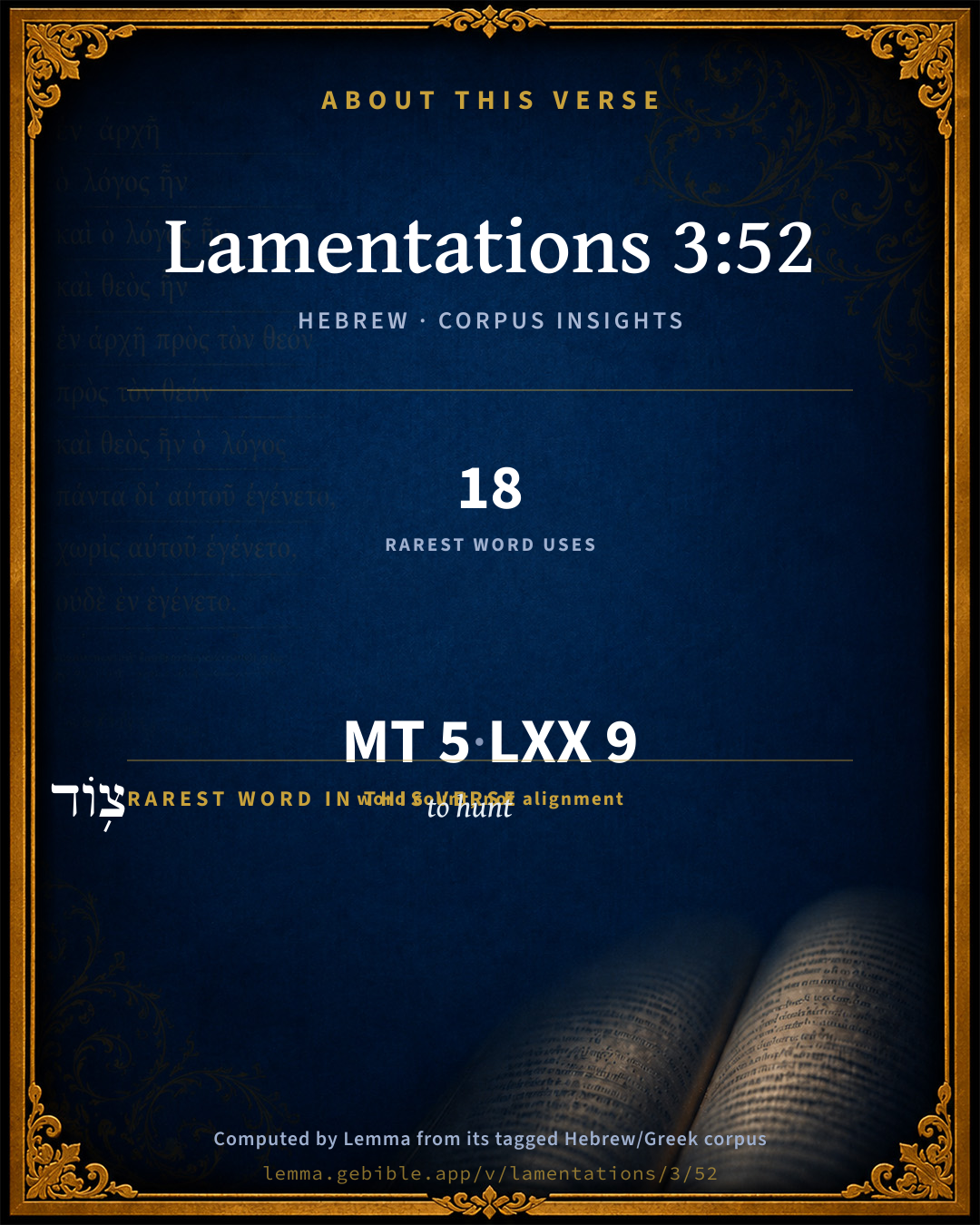
5
words
4
distinct lemmas
Prophets
section

Notable vocabulary

The rarest word here is צ֥וֹד to hunt H6679 — appearing just 18 times in the whole Hebrew Bible.

Shared distinctive vocabulary

צ֥וֹד to hunt H6679 occurs in 15 verses of the Hebrew Bible. Also found in:

Grammatical profile

  • 3 verbs
  • 1 noun
  • 1 adverb

Verb forms

  • צ֥וֹד Qal · Infinitive Absolute
  • צָד֛וּנִי Qal · Perfect
  • אֹיְבַ֥י Qal · Participle Active

Repetition

A word recurs within this verse — often emphatic in Hebrew:

  • צ֥וֹד to hunt H6679 ×2

Hebrew & Septuagint length

In English translation the verse runs 15 words from the Hebrew and 19 from the Septuagint (LXX English) — closely comparable.

A rough comparison of the two English renderings, which tokenize alike — not a word-level alignment.

Word counts can differ between the Hebrew and the Greek without any difference in meaning — e.g. the Hebrew direct-object marker אֵת has no separate Greek word, and Greek often adds the article ὁ.

In the original languages it is 5 Hebrew tokens and 9 Greek tokens — but the two are counted differently (Hebrew bundles its prefixes and suffixes into one token; the Greek is in lemma form), so that isn’t a like-for-like length.

Cross-references

13

Topical passages linked to Lamentations 3:52 in the Treasury of Scripture Knowledge — connected by theme and wording, ordered by reader-vote popularity; previews shown in the World English Bible.

  • Psalms 35:19 Don't let those who are my enemies wrongfully rejoice over me; Neither let them wink with the eye who hate me without a cause.
  • Psalms 35:7 For without cause they have hidden their net in a pit for me. Without cause they have dug a pit for my soul.
  • 1 Samuel 24:10–15 Behold, this day your eyes have seen how that Yahweh had delivered you today into my hand in the cave: and some bade me kill you; but [my eye] spared you; and I said, I will not put forth my hand against my lord; for he is Yahweh's anointed.
  • 1 Samuel 25:28–29 Please forgive the trespass of your handmaid: for Yahweh will certainly make my lord a sure house, because my lord fights the battles of Yahweh; and evil shall not be found in you all your days.
  • 1 Samuel 26:18–20 He said, Why does my lord pursue after his servant? for what have I done? or what evil is in my hand?
  • Psalms 11:1 In Yahweh, I take refuge. How can you say to my soul, "Flee as a bird to your mountain!"
  • Psalms 69:4 Those who hate me without a cause are more than the hairs of my head. Those who want to cut me off, being my enemies wrongfully, are mighty. I have to restore what I didn't take away.
  • Psalms 109:3 They have also surrounded me with words of hatred, And fought against me without a cause.
  • Psalms 119:161 Princes have persecuted me without a cause, But my heart stands in awe of your words.
  • Jeremiah 37:15–16 The princes were angry with Jeremiah, and struck him, and put him in prison in the house of Jonathan the scribe; for they had made that the prison.
  • Jeremiah 37:18 Moreover Jeremiah said to king Zedekiah, Wherein have I sinned against you, or against your servants, or against this people, that you have put me in prison?
  • Jeremiah 38:4–6 Then the princes said to the king, Let this man, we pray you, be put to death; because he weakens the hands of the men of war who remain in this city, and the hands of all the people, in speaking such words to them: for this man doesn't seek the welfare of this people, but the hurt.
  • John 15:25 But this happened so that the word may be fulfilled which was written in their law, 'They hated me without a cause.'

Cross-references courtesy of OpenBible.info (CC BY 4.0).

Hebrew and Greek witnesses Masoretic Hebrew ↔ Greek Septuagint

The same verse in the two great witnesses to the Old Testament, shown verse-for-verse.

These are two independent witnesses, not word-aligned to each other, and the Septuagint is shown in lemma (dictionary) form.

Hebrew Lamentations 3:52 Masoretic · Westminster Leningrad Codex

צ֥וֹד צָד֛וּנִי כַּצִּפּ֖וֹר אֹיְבַ֥י חִנָּֽם

They have chased me sore like a bird, those who are my enemies without cause.

World English Bible · Public Domain

Greek LXX Lamentations 3:52 Septuagint · lemma form

θηρεύω θηρεύω ἐγώ ὡς στρουθίον ὁ ἐχθρός ἐγώ δωρεά

TSADE. The fowlers chased me as a sparrow, all my enemies destroyed my life in a pit without cause,

LXX2012 (modern English Septuagint) · Public Domain

Hebrew: Westminster Leningrad Codex (CC BY 4.0). Greek: Septuagint (public domain); English from LXX2012 (modern English Septuagint) (Public Domain). How the Septuagint differs from the Hebrew →

Commentary

Notes on Lamentations 3:52 from classic Christian and Jewish commentators (each source and its license shown beneath its notes). The classic Christian expositions comment on the surrounding passage and are grouped to its opening verse, so a note may address several verses; the Jewish commentaries on the Tanakh (Rashi and others) are per-verse, so they appear only where the commentator wrote on this verse.

Lemma curates 59 commentaries, every one of them public domain or Creative Commons licensed, each selected and text-cleaned for this edition rather than reprinted as found. About our sources →

Trapp's Complete Commentary

John Trapp

Lam 3:52 Mine enemies chased me sore, like a bird, without cause.

Ver. 52. Mine enemies chased me sore.] In a most eager and extreme manner, with utmost cruelty and craft.

As a bird.] Beaten from bush to bush.

Without cause.] Jeremiah and the godly party might say so; but not Zedekiah and other perfidious ones.

John Trapp, A Commentary or Exposition upon All the Books of the Old and New Testament (1647–1656) — public domain. Text from a community e-Sword module.

Joseph Benson's Commentary

Lam 3:52-58. Mine enemies chased me sore — “The prophet in this, and the following verses, describes his own sufferings, when his enemies seized him and put him into the dungeon, Jer 37:16; Jer 38:6. He compares them to a fowler in pursuit of a bird; so, saith he, they sought all opportunities to take an advantage against me, and to deprive me of my life and liberty: and this they did without any provocation given on my part. So the word חנם, without cause, signifies.” — Lowth. They have cut off my life — I was not only sequestered from all human society, like a dead man, but in apparent danger of losing my life in the dungeon. And their laying a stone upon the entrance of that dark pit resembled the burying me alive. Waters flowed over my head; then I said, &c. — When I sunk down into the mire in this dungeon, I despaired of my life, just as if I had been sinking over head in a river. I called upon thy name, O Lord — I had recourse to thee, O Jehovah, in my distress; out of the low dungeon — As Jonah out of the whale’s belly. Observe, reader, though we be cast into ever so low a dungeon of calamity and trouble, we may from thence find a way of access to God in the highest heavens. Thus the psalmist, Out of the depths have I cried unto thee, Psa 130:1. Hide not thine ear at my breathing, at my cry — So he terms his prayer. It was his breathing toward God, and after God. Prayer is the breath of the new man, drawing in the air of grace in petitions, and returning it in praises; it is both the evidence and maintenance of the spiritual life. Some read it, at my gasping; when I lay gasping for life, and ready to expire, and thought I was breathing my last, then thou tookest cognizance of my distressed case. Thou drewest near in the day that I called upon thee — That is, thou didst graciously assure me of thy presence with me, and didst give me to see thee nigh unto me, whereas I had thought thee to be at a distance from me. Thou saidst, Fear not — This was the language, 1st, of God’s prophets, preaching to them not to fear, Isa 41:10; Isa 41:13; Isaiah 2 d, of his providence, preventing those things which they were afraid of; and, 3d, of his grace, quieting their minds, and making them easy, by the witness of his Spirit with their spirits, that they were his people still, though in distress, and therefore ought not to fear. Thou hast pleaded the causes of my soul — That is, as it follows, Thou hast redeemed my life, hast rescued it out of the hands of those that would have taken it away, hast saved it when it was ready to be swallowed up; thou hast given me my life for a prey.

Joseph Benson's Commentary on the Old and New Testaments (1811–1818) — public domain. Text from a community e-Sword module.

The Preacher's Complete Homiletical Commentary

Joseph S. Exell (gen. ed.)

EXEGETICAL NOTES.—

(צ) Lam_3:52. They have hunted me down like a bird is hunted when pursued with the eagerness of those who are my enemies without cause, and who will not relax efforts till they catch the quarry.

Lam_3:53. He was haled to prison by them. They have cut off my life in the pit. Shut in from all activities and society, he was as a man dead, as in a tomb over which they have cast stone on me. Taking such illustrations to be chiefly figurative, yet here the first clause is a probable allusion to the treatment of Jeremiah (Jer_38:6), and the second may refer to an unmentioned incident of the same time, for which corroboration may be found in the case of Daniel (Dan_6:17.)

Lam_3:54. The peril was aggravated by waters that flowed over my head; the plural perhaps indicating the influx of a spring and the condensation of vapour in the closeness of a pit. In a state so desperate to the eyes of flesh, I said, I am cut off as a man that has no help (Psa_88:4), as He was who became sin for us (Isa_53:8).

The remaining verses of the chapter take the form of prayer, as at the close of Chapters

1. and

2. In it there are thanksgivings for relief (Lam_3:55-58), an appeal because of the evil which enemies had done and were doing (Lam_3:59-63), and a call for recompense therefor (Lam_3:64-66).

(ק) Lam_3:55. I called upon thy name, O Jehovah, asking with some true idea of what the words and works of the God of Israel revealed concerning Himself, suggestive, too, of the manner in which the Lord Jesus would have His friends to pray—Ask the Father in My name—out of the depths of the pit into which he had been thrown.

Lam_3:56. A more true position is secured than that which was held previously (Lam_3:8; Lam_3:44). My voice thou heardest at that time when I besought thee with my spirit and voice, Hide not—close not—thine ear at my breathing—my sighing for relief—at my cry. It is questionable if the rendering, Hide not thine ear for my cry for relief, is not rather an explanation than a fair version.

Lam_3:57. Thou drewest near in the day I called upon thee. Only spiritual apprehension of God as He who is behind all events and plenteous in mercy can bring a conviction of accepted prayer. The heart is then in a state to hear His comforting words, Thou saidst, Fear not.

(ר) Lam_3:58. There were rights to be maintained, wrongs to be redressed, and in both help was received from a present God. Thou, O Jehovah, hast pleaded—contended for—the causes of my soul. One thing had hurt his soul (Lam_3:51), but others also saddened and weakened thought and effort, and the Lord had counteracted them. He had also interfered when hope of living was cut off, Thou hast redeemed my life by Thy power over all.

HOMILETICS

A FAITHFUL PROPHET IN TROUBLE

(Lam_3:52-58)

I. Cruelly treated by his enemies. “Mine enemies chased me sore like a bird, without cause: I am cut off” (Lam_3:52-54). In these verses, and to the end of the chapter, Jeremiah deals with his own personal afflictions. Without the least provocation, he was treated with the most malignant enmity. He was harassed, as a bird is tired out, and at length run down by continuous pursuit. He is overwhelmed with trouble, and is as one imprisoned in a dungeon, shut off from the current of active life. He acknowledged the righteousness of the Divine dealings, but he was keenly alive to the unrighteousness and undeserved cruelty of his persecutors. Had he been the aggressor, he might have expected retaliation, but he was oppressed without cause. His enemies were actuated by sheer hatred. His only fault was his faithfulness to God and to his own conscience. Simple goodness often rouses the wanton animosity of the wicked.

II. Seeks refuge in prayer. “I called upon Thy name, O Lord; hide not Thine ear at my cry” (Lam_3:55-56). It is a relief to turn from the cruelty of man to the compassion and power of God. The soul is never so helpless but that it can pray. When we can do nothing else, we can pray. Prayer is the language of need, and we are comforted with the assurance that God will hear, and not only hear but help. It seemed at one time that prayer was useless (Lam_3:44); but better thoughts prevailed, and the soul discovered that the cry for help was not in vain. “Prayer is the breath of the new man, sucking in the air of mercy in petitions and returning it in praises; it is both the evidence and the maintenance of the spiritual life.”

III. Rescued by Divine aid. “Thou drewest near in the day that I called upon Thee; Thou saidst, Fear not. O Lord, Thou hast pleaded the causes of my soul; Thou has redeemed my life” (Lam_3:57-58). When we draw near to God in prayer, He draws near to us. Our troubles are overwhelming when God is absent and we are left to ourselves. With His manifested presence our troubles vanish, and we are inspired with strength to endure and to triumph.

LESSONS.—

1. Fidelity makes many enemies.

2. The nation that ill-uses its best men courts its own ruin.

3. The Lord is ever on the side of the faithful.

GERM NOTES ON THE VERSES

Lam_3:54-57. The efficacy of prayer. I. These words show to what a state God’s most favoured servants may be reduced—extreme suffering, tears, despondency. II. The remedy open to them. Prayer expressed in cries, groans, breathings, sighs. III. The efficacy of that remedy whenever it is applied. “Thou drewest near in the day that I called upon Thee; Thou saidst, Fear not.” In these words we hear the consolatory voice of God. Marvellous condescension; certainty of help and deliverance.—Simeon.

Lam_3:57. A wonder explained by greater wonders. I. An explanation of this wonder. God doth draw near to men.

1. Men have ever been in the thoughts of God.

2. God came tenderly near in nature.

3. The Lord Jesus was specially near in the days of His life on earth.

4. He came still nearer to us in His death.

5. In heaven He is perpetually near us.

6. Jesus may well come near to His people, for there is a mystical union which ensures it. II. Consider the wonder itself.

1. By no means is this wonder at all contrary to expectation.

2. God draws near by strengthening us to bear up under pressure.

3. By vouchsafing a doubly vivid sense of His love.

4. By granting a sensible assurance of His sympathy.

5. By speedy and remarkable deliverance out of trouble.

6. The text indicates surprise concerning the memorable graciousness of God.

7. The promptness of God.

8. The extreme tenderness of God.—C. H. Spurgeon.

Lam_3:58. God pleading for saints and saints pleading for God. I. The Divine pleading.

1. The Lord pleads our cause in the court of Providence by silencing enemies and by raising up friends for His people.

2. He pleads for them in the court of Divine law.

3. In the court of conscience.

4. In the court of heaven.

5. And at the last great day of judgment. II. If the Lord hath pleaded the causes of our soul, we should plead His cause while we have breath to pray.

1. This is the life-work of the Christian.

2. Should be done in witnessing for Christ by our consistency of conduct.

3. We can all plead for Christ in a private way. Be it mine to weep for the sins of the time and prophesy against them. Be it yours in your own private walk and conversation to rebuke private sin, and by your loving earnestness to make Jesus Christ dear to many souls!—C. H. Spurgeon.

ILLUSTRATIONS.—Faithfulness in service. If you and I show that we attach importance to the solemn performance of even the slightest duty connected with our dear Master’s service; that we consider even the office of doorkeeper in His house an office of honour; that, convinced of His presence, we are as devout in offering the prayers when only two or three are present as when there are two or three hundred—we shall find His blessing attending us, and we shall be the means of converting others.—Dean Hook.

—A carpenter was once asked, Why he troubled to finish off a certain magistrate’s bench so carefully? His reply was, “I can’t do otherwise; besides, I may have to sit on it one of these days.”

Faithful to death. When Commodore Joseph Smith saw by the first despatch that reached Washington from Fortress Monroe that the Congress, on which his son was commander, had shown the white flag, he said, “Then Joe’s dead.” It was so.

Prayer an ever-open refuge. St. Cuthbert was once in a snowstorm that drove his boat on the coast of Fife. “The snowstorm closes the road along the shore,” mourned his comrades; “the storm bars our way over the sea.” “There is still the way of heaven; that lies open,” said the devoted saint.

Divine aid works a marvellous change. Probably there is nowhere on the globe so marked a climatic boundary as that of the Cascade Mountains in both Washington Territory and Oregon. West of this boundary the winters are mild and the summers cool and showery; east of it the winters are sharp and dry and the summers very hot. On one side are gigantic firs and cedars, while on the other all are of poor size and condition. Even the flowers are of new species, and all the atmospheric conditions are changed. The line that lies between the unsaved and the saved, once crossed, what changes are manifest! “If any man be in Jesus Christ, he is a new creation; old things have passed away; lo, all things have become new.”

The Preacher's Complete Homiletical Commentary (gen. ed. Joseph S. Exell; Funk & Wagnalls, c. 1892) — public domain (pre-1929). A full-Bible homiletical/sermon-outline anthology covering 65 of 66 books (2 John is absent from the source module). Text from a community e-Sword module.

Tyndale Open Study Notes

Tyndale Open Resources

3:52-57 This passage might refer to Jeremiah’s experience in the cistern (Jer 37:11-15; 38:1-13).

Tyndale Open Study Notes — © Tyndale Open Resources, licensed CC BY-SA 4.0. Text via the HelloAO Bible API.

Jamieson, Fausset & Brown

Robert Jamieson, A. R. Fausset & David Brown

a bird--which is destitute of counsel and strength. The allusion seems to be to Pro 1:17 [CALVIN].

without cause-- (Psa 69:4; Psa 109:3-4). Type of Messiah (Joh 15:25).

Jamieson, Fausset & Brown — Commentary Critical and Explanatory on the Whole Bible (1871) — public domain (CC PDM 1.0). Text via the HelloAO Bible API.

Adam Clarke's Commentary

Verse 52. Mine enemies chased me] From this to the end of the chapter the prophet speaks of his own personal sufferings, and especially of those which he endured in the dungeon. See Jer 38:6, &c.

Adam Clarke's Commentary on the Bible (1810–1826) — public domain. Text from a community e-Sword/MySword module.

John Calvin's Commentaries

We shall see to the end of the chapter the various complaints, by which the Prophet deplored the miseries of his own nation, that he might at length obtain the mercy of God. He takes here the comparison of a bird or a sparrow. He says that the Chaldeans had been like fowlers, and the Jews like sparrows: and we know that there is neither prudence nor courage in birds. He, then, means that the Jews had been destitute of all help, having been exposed as a prey to their enemies, who were like fowlers.

And he seems to allude to the words of Solomon, when he says, that without a cause is the net spread for birds (Proverbs 1:17;) and he means that innocent men are circumvented by the wicked, when they spread for them their snares as it were on every side, while they are like the birds, who have no prudence to avoid them.

We now, then, understand the drift of what the Prophet says: he amplifies the indignity of their calamity by this comparison, — that the Chaldeans at their pleasure plundered the miserable people, who were not able to resist them, who were indeed without any power to defend themselves. It follows, —

John Calvin's Commentaries (1540-1563) — public domain. Text from the Calvin Translation Society English edition (1840s-50s) via the Christian Classics Ethereal Library (ccel.org). Calvin's coverage is partial (roughly two-thirds of the Bible); uncommented books and verses are honest gaps, never fabricated. The 19th-century editor's footnotes and remarks are omitted so the notes are faithfully Calvin's own voice.

Ellicott's Commentary for English Readers

(52) Without cause . . .—The words connect themselves in the Hebrew with “mine enemies” (comp. Psa_35:7; Psa_35:19; Psa_69:4), and it has been inferred from this that Jeremiah speaks not of the Chaldeans as enemies of his nation, but of those who were individually his persecutors. The hypothesis receives some confirmation from the apparent reference in the “dungeon” and the “waters” to the narrative of Jeremiah 38. It has been urged, on the other hand, that those expressions may be figurative here, as they are in Psa_42:7; Psa_88:7; Psa_124:4.

A Bible Commentary for English Readers, edited by Charles John Ellicott (1878–1897) — public domain. Text from a community e-Sword module.

The Cambridge Bible for Schools and Colleges

gen. ed. J. J. S. Perowne

52–54. There is a possible reference on the part of the writer to Jer_38:6, but this is rendered unlikely by the fact that the “dungeon” had no water in it, and thus Lam_3:54 is inapplicable. The use of the singular “stone” in Lam_3:53 is difficult to understand, unless it refers to covering thus the mouth of a pit.

52–66. See intr. note.

The Cambridge Bible for Schools and Colleges (gen. ed. J. J. S. Perowne; Cambridge University Press, 1878–1918) — public domain. Text from a community e-Sword module.

John Gill's Exposition

Thou drewest near in the day that I called upon thee,.... When persons draw nigh to God in a way of duty, and particularly in this of prayer, and calling on his name; he draws nigh to them in a way of grace and mercy, and manifests himself to them, and works salvation for them. The Targum is,

"thou didst cause an angel to draw near to deliver me in the day that I prayed unto thee:''

thou saidst, fear not; any of thine enemies; or that thou shouldest not be delivered from them; see Isa 41:10.

John Gill's Exposition of the Whole Bible (1746–1763) — public domain (CC PDM 1.0). Text via the HelloAO Bible API.

Albert Barnes' Notes on the Bible

Or, “They who without cause are mine enemies have hunted me sore like a bird.” Probably the prophet is speaking of his personal sorrows.

Albert Barnes' Notes on the Bible (1834–1885) — public domain. Text from a community e-Sword/MySword module.

Matthew Poole's English Annotations

As boys beat a bird from bush to bush, suffering it to rest no where, so mine enemies, to whom I gave no cause, pursued me.

Matthew Poole's English Annotations on the Holy Bible (1683–1685) — public domain. Text from a community e-Sword/MySword module.

Whedon's Commentary on the Bible

Daniel D. Whedon

52. Without cause — The order of the words in this verse should be, to express the precise sense of the original, “without cause mine enemies chased me.”

Daniel D. Whedon (gen. ed.), Commentary on the Old and New Testaments (1874–1909) — public domain. Text from a community e-Sword module.

The Pulpit Commentary

Vers. 52-66. THE SPEAKER"S SUFFERINGS; AN EARNESTLY BELIEVING PRAYER FOR DELIVERANCE. He speaks as a representative of the nation; if we should not rather say that the nation itself, personified, is the speaker. In the first triad some have supposed a reference to the persecution suffered by Jeremiah at the hands of his countrymen. The "dungeon," or rather "pit," will in this case be the "dungeon" ("pit") mentioned in Jer_38:6. But a "pit" is a figure in the psalms for destruction, (Psa_40:2 Psa_69:15) and there is nothing recorded in Jeremiah as to the" princes" haying cast stones at Jeremiah, or rolled a stone on to the top of the "pit." Besides, the "pit" into which the prophet was cast had "no water, but mire.

Mine enemies... without cause. These words ought to be connected, as in the Hebrew.

The Pulpit Commentary (1880–1919), ed. H.D.M. Spence-Jones & Joseph S. Exell — public domain. Text from a community e-Sword module.

Keil & Delitzsch

C. F. Keil & F. Delitzsch

His pain and sorrow over the sad condition of the people recall to his memory the persecutions and sufferings which the godly have endured. The figure, "They who without cause are mine enemies have hunted me like a bird," is an imitation of Psa 11:1. איבי חנּם reminds one of שׂנאי , Psa 35:19 and Psa 69:5. But the prophet prefers איבי to שׂנאי, lest any one should restrict the words to persecutions which arose out of personal hatred.

Keil & Delitzsch — Biblical Commentary on the Old Testament (1861–1891) — public domain (CC PDM 1.0). Text via the HelloAO Bible API. (Old Testament only.)

Lesson kit

Teaching starters — assembled from the data on this page, not authored interpretation. Every prompt links to the verse data it draws on. Edit before teaching.

Lamentations, in the Prophets, opens this verse with 5 words (4 distinct Hebrew lemmas). Its most distinctive word is tsûwd (“to hunt”). A historical commentator’s framing appears above. Read the whole chapter for the surrounding context.

Discussion questions

  1. How does “to hunt” (tsûwd) shape what this verse is saying?
  2. How does Genesis 27:3, which shares the word «to hunt», read alongside this verse?
  3. What does the repetition of “to hunt” (2× in this one verse) do in this verse?
  4. The translations on this page render this verse differently — a whole-verse word diff, not a word-by-word alignment. What might account for the different wordings?
  5. «צ֥וֹד» is a Qal Infinitive Absolute verb. How does that grammatical form shape the action described?
  6. Compare how Trapp's Complete Commentary and Joseph Benson's Commentary read this verse. Where do they agree or differ?

Things to notice

Reading settings

Reading text

Shown beneath each verse's original-language words.

Old Testament
Old Testament edition

Read the OT as the Masoretic Hebrew (MT) or the Greek Septuagint (LXX).

English shown for the Greek Septuagint (in the Hebrew ↔ Greek comparison).

Comparing translations? Open the Compare panel on any verse page to stack up to four side by side.