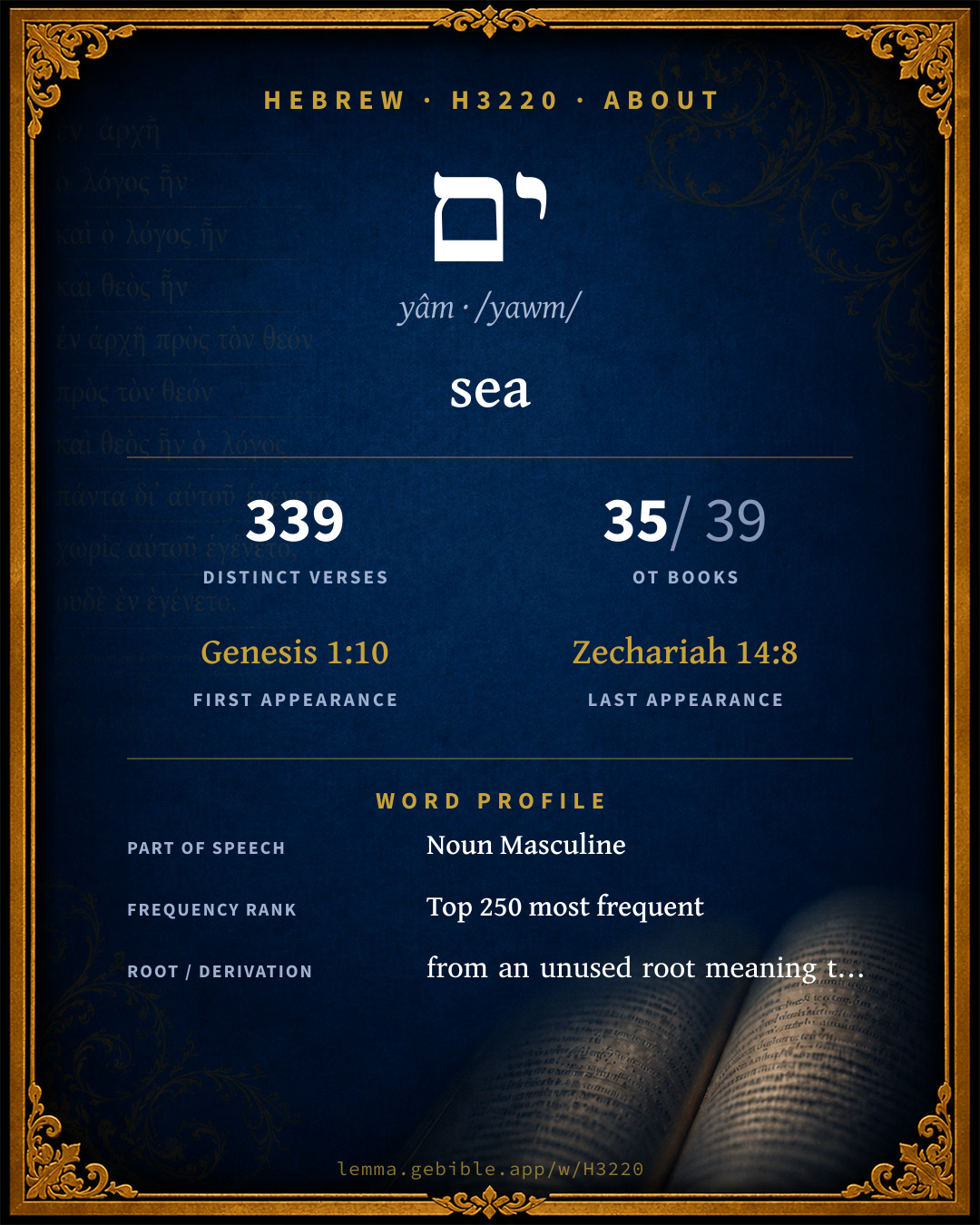
יָם
sea
‘sea’ is one of 9 main senses fuller range ↓
Full lexicon entry — Brown-Driver-Briggs (BDB)
From Brown-Driver-Briggs (BDB)
Where this word appears
See every Absolute-state word in the Hebrew Bible →
Grammar key — what these labels mean
Part of speech
- Noun
- A naming word — a person, place, thing, or idea.
Noun type
- Common
- A common noun — a general class of person, place, or thing (“king,” “city,” “water”), not a specific name.
State
- Absolute
- The independent form of a noun, not bound to a following word.
- Construct
- A noun bound to a following noun in a possessive / “of” relationship (the construct chain).
Gender
- Masculine
- Grammatically masculine.
Number
- Singular
- One.
- Plural
- More than one (in Hebrew, generally three or more).
Grammatical forms
- Noun, Common, Masculine, Singular, Absolute 317 times (80%)
- Noun, Common, Masculine, Singular, Construct 49 times (12%)
- Noun, Common, Masculine, Plural, Absolute 30 times (8%)
Parsed forms decoded from the imported morphology (morphhb / Westminster Leningrad Codex — WLC text public domain, morphhb tagging CC BY 4.0), counted across 396 parsed occurrences — not distinct verses.
Page 1 of 2 — showing verses 1–200 of 339 distinct verses where H3220 appears, across 35 books. Click any verse to open its interlinear word-by-word view. Verse text shown in the World English Bible for context — . Each verse’s Hebrew form is shown with its reference; the English is not keyword-highlighted, since the data carries no word-level English alignment. Use “Compare translations” on any verse to read it across multiple English versions. This concordance covers the Hebrew Bible; Septuagint (Greek Old Testament) occurrences are not indexed here.
Genesis 13 verses
- Genesis 1:10 יַמִּ֑ים n c mp God called the dry land Earth, and the gathering together of the waters he called Seas. God saw that it was good.
- Genesis 1:22 בַּ/יַּמִּ֔ים prep det + n c mp God blessed them, saying, "Be fruitful, and multiply, and fill the waters in the seas, and let birds multiply on the earth."
- Genesis 1:26 הַ/יָּ֜ם ptcl def.art + n c ms God said, "Let us make man in our image, after our likeness: and let them have dominion over the fish of the sea, and over the birds of the sky, and over the cattle, and over all the earth, and over every creeping thing that creeps on the earth."
- Genesis 1:28 הַ/יָּם֙ ptcl def.art + n c ms God blessed them. God said to them, "Be fruitful, multiply, fill the earth, and subdue it. Have dominion over the fish of the sea, over the birds of the sky, and over every living thing that moves on the earth."
- Genesis 9:2 הַ/יָּ֖ם ptcl def.art + n c ms The fear of you and the dread of you will be on every animal of the earth, and on every bird of the sky. Everything that the ground teems with, and all the fish of the sea are delivered into your hand.
- Genesis 12:8 מִ/יָּם֙ prep + n c ms He left from there to the mountain on the east of Bethel, and pitched his tent, having Bethel on the west, and Ai on the east. There he built an altar to Yahweh, and called on the name of Yahweh.
- Genesis 13:14 וָ/יָֽמָּ/ה conj + n c ms + sfx dem Yahweh said to Abram, after Lot was separated from him, "Now, lift up your eyes, and look from the place where you are, northward and southward and eastward and westward,
- Genesis 14:3 יָ֥ם n c ms cs All these joined together in the valley of Siddim (the same is the Salt Sea).
- Genesis 22:17 הַ/יָּ֑ם ptcl def.art + n c ms that in blessing I will bless you, and in multiplying I will multiply your seed as the stars of the heavens, and as the sand which is on the seashore. Your seed will possess the gate of his enemies.
- Genesis 28:14 יָ֥מָּ/ה n c ms + sfx dem Your seed will be as the dust of the earth, and you will spread abroad to the west, and to the east, and to the north, and to the south. In you and in your seed will all the families of the earth be blessed.
- Genesis 32:12 הַ/יָּ֔ם ptcl def.art + n c ms You said, 'I will surely do you good, and make your seed as the sand of the sea, which can't be numbered because there are so many.'"
- Genesis 41:49 הַ/יָּ֖ם ptcl def.art + n c ms Joseph laid up grain as the sand of the sea, very much, until he stopped counting, for it was without number.
- Genesis 49:13 יַמִּ֖ים n c mp "Zebulun will dwell at the haven of the sea. He will be for a haven of ships. His border will be on Sidon.
Exodus 28 verses
- Exodus 10:19 יָם֙ יָ֣מָּ/ה n c ms n c ms cs + sfx dem Yahweh turned an exceeding strong west wind, which took up the locusts, and drove them into the Red Sea. There remained not one locust in all the borders of Egypt.
- Exodus 13:18 יַם n c ms cs but God led the people around by the way of the wilderness by the Red Sea; and the children of Israel went up armed out of the land of Egypt.
- Exodus 14:2 הַ/יָּ֑ם הַ/יָּֽם ptcl def.art + n c ms ptcl def.art + n c ms "Speak to the children of Israel, that they turn back and encamp before Pihahiroth, between Migdol and the sea, before Baal Zephon. You shall encamp opposite it by the sea.
- Exodus 14:9 הַ/יָּ֔ם ptcl def.art + n c ms The Egyptians pursued after them: all the horses and chariots of Pharaoh, his horsemen, and his army; and overtook them encamping by the sea, beside Pihahiroth, before Baal Zephon.
- Exodus 14:16 הַ/יָּ֖ם הַ/יָּ֖ם ptcl def.art + n c ms ptcl def.art + n c ms Lift up your rod, and stretch out your hand over the sea, and divide it: and the children of Israel shall go into the midst of the sea on dry ground.
- Exodus 14:21 הַ/יָּם֒ הַ֠/יָּם הַ/יָּ֖ם ptcl def.art + n c ms ptcl def.art + n c ms ptcl def.art + n c ms Moses stretched out his hand over the sea, and Yahweh caused the sea to go back by a strong east wind all the night, and made the sea dry land, and the waters were divided.
- Exodus 14:22 הַ/יָּ֖ם ptcl def.art + n c ms The children of Israel went into the midst of the sea on the dry ground, and the waters were a wall to them on their right hand, and on their left.
- Exodus 14:23 הַ/יָּֽם ptcl def.art + n c ms The Egyptians pursued, and went in after them into the midst of the sea: all of Pharaoh's horses, his chariots, and his horsemen.
- Exodus 14:26 הַ/יָּ֑ם ptcl def.art + n c ms Yahweh said to Moses, "Stretch out your hand over the sea, that the waters may come again on the Egyptians, on their chariots, and on their horsemen."
- Exodus 14:27 הַ/יָּ֗ם הַ/יָּ֜ם הַ/יָּֽם ptcl def.art + n c ms ptcl def.art + n c ms ptcl def.art + n c ms Moses stretched out his hand over the sea, and the sea returned to its strength when the morning appeared; and the Egyptians fled against it. Yahweh overthrew the Egyptians in the midst of the sea.
- Exodus 14:28 בַּ/יָּ֑ם prep det + n c ms The waters returned, and covered the chariots and the horsemen, even all Pharaoh's army that went in after them into the sea. There remained not so much as one of them.
- Exodus 14:29 הַ/יָּ֑ם ptcl def.art + n c ms But the children of Israel walked on dry land in the midst of the sea, and the waters were a wall to them on their right hand, and on their left.
- Exodus 14:30 הַ/יָּֽם ptcl def.art + n c ms Thus Yahweh saved Israel that day out of the hand of the Egyptians; and Israel saw the Egyptians dead on the seashore.
- Exodus 15:1 בַ/יָּֽם prep det + n c ms Then Moses and the children of Israel sang this song to Yahweh, and said, "I will sing to Yahweh, for he has triumphed gloriously: The horse and his rider he has thrown into the sea.
- Exodus 15:4 בַ/יָּ֑ם בְ/יַם prep det + n c ms prep + n c ms cs Pharaoh's chariots and his host has he cast into the sea; His chosen captains are sunk in the Red Sea.
- Exodus 15:8 יָֽם n c ms With the blast of your nostrils the waters were piled up. The floods stood upright as a heap. The deeps were congealed in the heart of the sea.
- Exodus 15:10 יָ֑ם n c ms You blew with your wind. The sea covered them. They sank like lead in the mighty waters.
- Exodus 15:19 בַּ/יָּ֔ם הַ/יָּ֑ם הַ/יָּֽם prep det + n c ms ptcl def.art + n c ms ptcl def.art + n c ms For the horses of Pharaoh went in with his chariots and with his horsemen into the sea, and Yahweh brought back the waters of the sea on them; but the children of Israel walked on dry land in the midst of the sea.
- Exodus 15:21 בַ/יָּֽם prep det + n c ms Miriam answered them, "Sing to Yahweh, for he has triumphed gloriously: The horse and his rider he has thrown into the sea."
- Exodus 15:22 מִ/יַּם prep + n c ms cs Moses led Israel onward from the Red Sea, and they went out into the wilderness of Shur; and they went three days in the wilderness, and found no water.
- Exodus 20:11 הַ/יָּם֙ ptcl def.art + n c ms for in six days Yahweh made heaven and earth, the sea, and all that is in them, and rested the seventh day; therefore Yahweh blessed the Sabbath day, and made it holy.
- Exodus 23:31 מִ/יַּם יָ֣ם prep + n c ms cs n c ms cs I will set your border from the Red Sea even to the sea of the Philistines, and from the wilderness to the River; for I will deliver the inhabitants of the land into your hand, and you shall drive them out before you.
- Exodus 26:22 יָ֑מָּ/ה n c ms + sfx dem For the far part of the tent westward you shall make six boards.
- Exodus 26:27 יָֽמָּ/ה n c ms + sfx dem and five bars for the boards of the other side of the tent, and five bars for the boards of the side of the tent, for the far part westward.
- Exodus 27:12 יָ֔ם n c ms For the breadth of the court on the west side shall be hangings of fifty cubits; their pillars ten, and their sockets ten.
- Exodus 36:27 יָ֑מָּ/ה n c ms + sfx dem For the far part of the tent westward he made six boards.
- Exodus 36:32 יָֽמָּ/ה n c ms + sfx dem and five bars for the boards of the other side of the tent, and five bars for the boards of the tent for the hinder part westward.
- Exodus 38:12 יָ֗ם n c ms For the west side were hangings of fifty cubits, their pillars ten, and their sockets ten; the hooks of the pillars, and their fillets, of silver.
Leviticus 2 verses
- Leviticus 11:9 בַּ/יַּמִּ֛ים prep det + n c mp These you may eat of all that are in the waters: whatever has fins and scales in the waters, in the seas, and in the rivers, that you may eat.
- Leviticus 11:10 בַּ/יַּמִּים֙ prep det + n c mp All that don't have fins and scales in the seas, and in the rivers, of all that move in the waters, and of all the living creatures that are in the waters, they are an abomination to you,
Numbers 17 verses
- Numbers 2:18 יָ֑מָּ/ה n c ms + sfx dem "On the west side shall be the standard of the camp of Ephraim according to their divisions: and the prince of the children of Ephraim shall be Elishama the son of Ammihud.
- Numbers 3:23 יָֽמָּ/ה n c ms + sfx dem The families of the Gershonites shall encamp behind the tabernacle westward.
- Numbers 11:22 הַ/יָּ֛ם ptcl def.art + n c ms Shall flocks and herds be slain for them, to suffice them? or shall all the fish of the sea be gathered together for them, to suffice them?
- Numbers 11:31 הַ/יָּם֒ ptcl def.art + n c ms There went forth a wind from Yahweh, and brought quails from the sea, and let them fall by the camp, about a day's journey on this side, and a day's journey on the other side, round about the camp, and about two cubits above the surface of the earth.
- Numbers 13:29 הַ/יָּ֔ם ptcl def.art + n c ms Amalek dwells in the land of the South: and the Hittite, and the Jebusite, and the Amorite, dwell in the hill-country; and the Canaanite dwells by the sea, and along by the side of the Jordan.
- Numbers 14:25 יַם n c ms cs Now the Amalekite and the Canaanite dwell in the valley: tomorrow turn you, and get you into the wilderness by the way to the Red Sea.
- Numbers 21:4 יַם n c ms cs They traveled from Mount Hor by the way to the Red Sea, to compass the land of Edom: and the soul of the people was much discouraged because of the way.
- Numbers 33:8 הַ/יָּ֖ם ptcl def.art + n c ms They traveled from before Hahiroth, and passed through the midst of the sea into the wilderness: and they went three days' journey in the wilderness of Etham, and encamped in Marah.
- Numbers 33:10 יַם n c ms cs They traveled from Elim, and encamped by the Red Sea.
- Numbers 33:11 מִ/יַּם prep + n c ms cs They traveled from the Red Sea, and encamped in the wilderness of Sin.
- Numbers 34:3 יָם n c ms cs then your south quarter shall be from the wilderness of Zin along by the side of Edom, and your south border shall be from the end of the Salt Sea eastward;
- Numbers 34:5 הַ/יָּֽמָּ/ה ptcl def.art + n c ms + sfx dem and the border shall turn about from Azmon to the brook of Egypt, and the goings out of it shall be at the sea.
- Numbers 34:6 יָ֔ם הַ/יָּ֥ם יָֽם n c ms ptcl def.art + n c ms n c ms For the western border, you shall have the great sea and the border [of it]: this shall be your west border.
- Numbers 34:7 הַ/יָּם֙ ptcl def.art + n c ms This shall be your north border: from the great sea you shall mark out for you Mount Hor;
- Numbers 34:11 יָם n c ms cs and the border shall go down from Shepham to Riblah, on the east side of Ain; and the border shall go down, and shall reach to the side of the sea of Chinnereth eastward;
- Numbers 34:12 יָ֣ם n c ms cs and the border shall go down to the Jordan, and the goings out of it shall be at the Salt Sea. This shall be your land according to the borders of it round about.
- Numbers 35:5 יָ֣ם n c ms You shall measure outside of the city for the east side two thousand cubits, and for the south side two thousand cubits, and for the west side two thousand cubits, and for the north side two thousand cubits, the city being in the midst. This shall be to them the suburbs of the cities.
Deuteronomy 12 verses
- Deuteronomy 1:7 הַ/יָּ֑ם ptcl def.art + n c ms turn you, and take your journey, and go to the hill-country of the Amorites, and to all [the places] near thereunto, in the Arabah, in the hill-country, and in the lowland, and in the South, and by the sea-shore, the land of the Canaanites, and Lebanon, as far as the great river, the river Euphrates.
- Deuteronomy 1:40 יַם n c ms cs But as for you, turn you, and take your journey into the wilderness by the way to the Red Sea.
- Deuteronomy 2:1 יַם n c ms cs Then we turned, and took our journey into the wilderness by the way to the Red Sea, as Yahweh spoke to me; and we compassed Mount Seir many days.
- Deuteronomy 3:17 יָ֤ם יָ֣ם n c ms cs n c ms cs the Arabah also, and the Jordan and the border [of it], from Chinnereth even to the sea of the Arabah, the Salt Sea, under the slopes of Pisgah eastward.
- Deuteronomy 3:27 יָ֧מָּ/ה n c ms + sfx dem Go up to the top of Pisgah, and lift up your eyes westward, and northward, and southward, and eastward, and see with your eyes: for you shall not go over this Jordan.
- Deuteronomy 4:49 יָ֣ם n c ms cs and all the Arabah beyond the Jordan eastward, even to the sea of the Arabah, under the slopes of Pisgah.
- Deuteronomy 11:4 יַם n c ms cs and what he did to the army of Egypt, to their horses, and to their chariots; how he made the water of the Red Sea to overflow them as they pursued after you, and how Yahweh has destroyed them to this day;
- Deuteronomy 11:24 הַ/יָּ֣ם ptcl def.art + n c ms Every place whereon the sole of your foot shall tread shall be yours: from the wilderness, and Lebanon, from the river, the river Euphrates, even to the hinder sea shall be your border.
- Deuteronomy 30:13 לַ/יָּ֖ם הַ/יָּם֙ prep det + n c ms ptcl def.art + n c ms Neither is it beyond the sea, that you should say, Who shall go over the sea for us, and bring it to us, and make us to hear it, that we may do it?
- Deuteronomy 33:19 יַמִּים֙ n c mp They shall call the peoples to the mountain; There shall they offer sacrifices of righteousness: For they shall suck the abundance of the seas, The hidden treasures of the sand.
- Deuteronomy 33:23 יָ֥ם n c ms Of Naphtali he said, Naphtali, satisfied with favor, Full with the blessing of Yahweh, Possess you the west and the south.
- Deuteronomy 34:2 הַ/יָּ֥ם ptcl def.art + n c ms and all Naphtali, and the land of Ephraim and Manasseh, and all the land of Judah, to the hinder sea,
Joshua 41 verses
- Joshua 1:4 הַ/יָּ֥ם ptcl def.art + n c ms From the wilderness, and this Lebanon, even to the great river, the river Euphrates, all the land of the Hittites, and to the great sea toward the going down of the sun, shall be your border.
- Joshua 2:10 יַם n c ms cs For we have heard how Yahweh dried up the water of the Red Sea before you, when you came out of Egypt; and what you did to the two kings of the Amorites, who were beyond the Jordan, to Sihon and to Og, whom you utterly destroyed.
- Joshua 3:16 יָ֧ם יָם n c ms cs n c ms cs that the waters which came down from above stood, and rose up in one heap, a great way off, at Adam, the city that is beside Zarethan; and those that went down toward the sea of the Arabah, even the Salt Sea, were wholly cut off: and the people passed over right against Jericho.
- Joshua 4:23 לְ/יַם prep + n c ms cs For Yahweh your God dried up the waters of the Jordan from before you, until you were passed over, as Yahweh your God did to the Red Sea, which he dried up from before us, until we were passed over;
- Joshua 5:1 יָ֗מָּ/ה הַ/יָּ֔ם n c ms + sfx dem ptcl def.art + n c ms It happened, when all the kings of the Amorites, who were beyond the Jordan westward, and all the kings of the Canaanites, who were by the sea, heard how that Yahweh had dried up the waters of the Jordan from before the children of Israel, until we were passed over, that their heart melted, neither was there spirit in them any more, because of the children of Israel.
- Joshua 8:9 מִ/יָּ֣ם prep + n c ms Joshua sent them forth; and they went to set up the ambush, and stayed between Bethel and Ai, on the west side of Ai: but Joshua lodged that night among the people.
- Joshua 8:12 מִ/יָּ֥ם prep + n c ms He took about five thousand men, and set them in ambush between Bethel and Ai, on the west side of the city.
- Joshua 8:13 מִ/יָּ֣ם prep + n c ms So they set the people, even all the host who was on the north of the city, and their liers-in-wait who were on the west of the city; and Joshua went that night into the midst of the valley.
- Joshua 9:1 הַ/יָּ֣ם ptcl def.art + n c ms It happened, when all the kings who were beyond the Jordan, in the hill-country, and in the lowland, and on all the shore of the great sea in front of Lebanon, the Hittite, and the Amorite, the Canaanite, the Perizzite, the Hivite, and the Jebusite, heard of it;
- Joshua 11:2 מִ/יָּֽם prep + n c ms and to the kings who were on the north, in the hill-country, and in the Arabah south of Chinneroth, and in the lowland, and in the heights of Dor on the west,
- Joshua 11:3 וּ/מִ/יָּ֔ם conj + prep + n c ms to the Canaanite on the east and on the west, and the Amorite, and the Hittite, and the Perizzite, and the Jebusite in the hill-country, and the Hivite under Hermon in the land of Mizpah.
- Joshua 11:4 הַ/יָּ֖ם ptcl def.art + n c ms They went out, they and all their hosts with them, much people, even as the sand that is on the sea-shore in multitude, with horses and chariots very many.
- Joshua 12:3 יָ֨ם יָ֣ם יָם n c ms cs n c ms cs n c ms cs and the Arabah to the sea of Chinneroth, eastward, and to the sea of the Arabah, even the Salt Sea, eastward, the way to Beth-jeshimoth; and on the south, under the slopes of Pisgah:
- Joshua 12:7 יָ֔מָּ/ה n c ms + sfx dem These are the kings of the land whom Joshua and the children of Israel struck beyond the Jordan westward, from Baal Gad in the valley of Lebanon even to Mount Halak, that goes up to Seir; and Joshua gave it to the tribes of Israel for a possession according to their divisions;
- Joshua 13:27 יָם n c ms cs and in the valley, Beth Haram, and Beth Nimrah, and Succoth, and Zaphon, the rest of the kingdom of Sihon king of Heshbon, the Jordan and the border [of it], to the uttermost part of the sea of Chinnereth beyond the Jordan eastward.
- Joshua 15:2 יָ֣ם n c ms cs Their south border was from the uttermost part of the Salt Sea, from the bay that looks southward;
- Joshua 15:4 יָ֑מָּ/ה n c ms + sfx dem and it passed along to Azmon, and went out at the brook of Egypt; and the goings out of the border were at the sea: this shall be your south border.
- Joshua 15:5 יָ֣ם הַ/יָּ֔ם n c ms cs ptcl def.art + n c ms The east border was the Salt Sea, even to the end of the Jordan. The border of the north quarter was from the bay of the sea at the end of the Jordan;
- Joshua 15:8 יָ֔מָּ/ה n c ms + sfx dem and the border went up by the valley of the son of Hinnom to the side of the Jebusite southward (the same is Jerusalem); and the border went up to the top of the mountain that lies before the valley of Hinnom westward, which is at the uttermost part of the valley of Rephaim northward;
- Joshua 15:10 יָ֨מָּ/ה֙ n c ms + sfx dem and the border turned about from Baalah westward to Mount Seir, and passed along to the side of Mount Jearim on the north (the same is Chesalon), and went down to Beth-shemesh, and passed along by Timnah;
- Joshua 15:11 יָֽמָּ/ה n c ms + sfx dem and the border went out to the side of Ekron northward; and the border extended to Shikkeron, and passed along to Mount Baalah, and went out at Jabneel; and the goings out of the border were at the sea.
- Joshua 15:12 יָ֔ם הַ/יָּ֥מָּ/ה n c ms ptcl def.art + n c ms + sfx dem The west border was to the great sea, and the border [of it]. This is the border of the children of Judah round about according to their families.
- Joshua 15:46 וָ/יָ֑מָּ/ה conj + n c ms + sfx dem from Ekron even to the sea, all that were by the side of Ashdod, with their villages.
- Joshua 15:47 וְ/הַ/יָּ֥ם conj + ptcl def.art + n c ms Ashdod, its towns and its villages; Gaza, its towns and its villages; to the brook of Egypt, and the great sea, and the border [of it].
- Joshua 16:3 יָ֜מָּ/ה יָֽמָּ/ה n c ms + sfx dem n c ms + sfx dem and it went down westward to the border of the Japhletites, to the border of Beth Horon the lower, even to Gezer; and the goings out of it were at the sea.
- Joshua 16:6 הַ/יָּ֗מָּ/ה ptcl def.art + n c ms + sfx dem and the border went out westward at Michmethath on the north; and the border turned about eastward to Taanath Shiloh, and passed along it on the east of Janoah;
- Joshua 16:8 יָ֨מָּ/ה֙ הַ/יָּ֑מָּ/ה n c ms + sfx dem ptcl def.art + n c ms + sfx dem From Tappuah the border went along westward to the brook of Kanah; and the goings out of it were at the sea. This is the inheritance of the tribe of the children of Ephraim according to their families;
- Joshua 17:9 הַ/יָּֽמָּ/ה ptcl def.art + n c ms + sfx dem The border went down to the brook of Kanah, southward of the brook: these cities belonged to Ephraim among the cities of Manasseh: and the border of Manasseh was on the north side of the brook, and the goings out of it were at the sea:
- Joshua 17:10 הַ/יָּ֖ם ptcl def.art + n c ms southward it was Ephraim's, and northward it was Manasseh's, and the sea was his border; and they reached to Asher on the north, and to Issachar on the east.
- Joshua 18:12 יָ֔מָּ/ה n c ms + sfx dem Their border on the north quarter was from the Jordan; and the border went up to the side of Jericho on the north, and went up through the hill-country westward; and the goings out of it were at the wilderness of Beth Aven.
- Joshua 18:14 יָ֜ם יָֽם n c ms n c ms The border extended [there], and turned about on the west quarter southward, from the mountain that lies before Beth Horon southward; and the goings out of it were at Kiriath Baal (the same is Kiriath Jearim), a city of the children of Judah: this was the west quarter.
- Joshua 18:15 יָ֔מָּ/ה n c ms + sfx dem The south quarter was from the uttermost part of Kiriath Jearim; and the border went out westward, and went out to the spring of the waters of Nephtoah;
- Joshua 18:19 יָם n c ms cs and the border passed along to the side of Beth Hoglah northward; and the goings out of the border were at the north bay of the Salt Sea, at the south end of the Jordan: this was the south border.
- Joshua 19:11 לַ/יָּ֛מָּ/ה prep det + n c ms + sfx dem and their border went up westward, even to Maralah, and reached to Dabbesheth; and it reached to the brook that is before Jokneam;
- Joshua 19:26 הַ/יָּ֔מָּ/ה ptcl def.art + n c ms + sfx dem and Allammelech, and Amad, and Mishal; and it reached to Carmel westward, and to Shihorlibnath;
- Joshua 19:29 הַ/יָּ֖מָּ/ה ptcl def.art + n c ms + sfx dem and the border turned to Ramah, and to the fortified city of Tyre; and the border turned to Hosah; and the goings out of it were at the sea by the region of Achzib;
- Joshua 19:34 יָ֨מָּ/ה֙ מִ/יָּ֔ם n c ms + sfx dem prep + n c ms and the border turned westward to Aznoth Tabor, and went out from there to Hukkok; and it reached to Zebulun on the south, and reached to Asher on the west, and to Judah at the Jordan toward the sunrise.
- Joshua 22:7 יָ֑מָּ/ה n c ms + sfx dem Now to the one half-tribe of Manasseh Moses had given [inheritance] in Bashan; but to the other half gave Joshua among their brothers beyond the Jordan westward; moreover when Joshua sent them away to their tents, he blessed them,
- Joshua 23:4 וְ/הַ/יָּ֥ם conj + ptcl def.art + n c ms Behold, I have allotted to you these nations that remain, to be an inheritance for your tribes, from the Jordan, with all the nations that I have cut off, even to the great sea toward the going down of the sun.
- Joshua 24:6 הַ/יָּ֑מָּ/ה יַם ptcl def.art + n c ms + sfx dem n c ms cs I brought your fathers out of Egypt: and you came to the sea; and the Egyptians pursued after your fathers with chariots and with horsemen to the Red Sea.
- Joshua 24:7 הַ/יָּם֙ ptcl def.art + n c ms When they cried out to Yahweh, he put darkness between you and the Egyptians, and brought the sea on them, and covered them; and your eyes saw what I did in Egypt: and you lived in the wilderness many days.
Judges 3 verses
- Judges 5:17 יַמִּ֔ים n c mp Gilead abode beyond the Jordan: Dan, why did he remain in ships? Asher sat still at the haven of the sea, Abode by his creeks.
- Judges 7:12 הַ/יָּ֖ם ptcl def.art + n c ms The Midianites and the Amalekites and all the children of the east lay along in the valley like locusts for multitude; and their camels were without number, as the sand which is on the sea-shore for multitude.
- Judges 11:16 יַם n c ms cs but when they came up from Egypt, and Israel went through the wilderness to the Red Sea, and came to Kadesh;
1 Samuel 1 verse
2 Samuel 2 verses
- 2 Samuel 17:11 הַ/יָּ֖ם ptcl def.art + n c ms But I counsel that all Israel be gathered together to you, from Dan even to Beersheba, as the sand that is by the sea for multitude; and that you go to battle in your own person.
- 2 Samuel 22:16 יָ֔ם n c ms Then the channels of the sea appeared, The foundations of the world were laid bare, By the rebuke of Yahweh, At the blast of the breath of his nostrils.
1 Kings 13 verses
- 1 Kings 4:20 הַ/יָּ֖ם ptcl def.art + n c ms Judah and Israel were many as the sand which is by the sea in multitude, eating and drinking and making merry.
- 1 Kings 4:29 הַ/יָּֽם ptcl def.art + n c ms God gave Solomon wisdom and understanding exceeding much, and very great understanding, even as the sand that is on the sea-shore.
- 1 Kings 5:9 יָ֗מָּ/ה בַּ/יָּם֙ n c ms + sfx dem prep det + n c ms My servants shall bring them down from Lebanon to the sea; and I will make them into rafts to go by sea to the place that you shall appoint me, and will cause them to be broken up there, and you shall receive them; and you shall accomplish my desire, in giving food for my household.
- 1 Kings 7:23 הַ/יָּ֖ם ptcl def.art + n c ms He made the molten sea of ten cubits from brim to brim, round in compass, and the height of it was five cubits; and a line of thirty cubits compassed it round about.
- 1 Kings 7:24 הַ/יָּ֖ם ptcl def.art + n c ms Under the brim of it round about there were buds which did compass it, for ten cubits, compassing the sea round about: the buds were in two rows, cast when it was cast.
- 1 Kings 7:25 יָ֜מָּ/ה וְ/הַ/יָּ֥ם n c ms + sfx dem conj + ptcl def.art + n c ms It stood on twelve oxen, three looking toward the north, and three looking toward the west, and three looking toward the south, and three looking toward the east; and the sea was set on them above, and all their hinder parts were inward.
- 1 Kings 7:39 הַ/יָּ֗ם ptcl def.art + n c ms He set the bases, five on the right side of the house, and five on the left side of the house: and he set the sea on the right side of the house eastward, toward the south.
- 1 Kings 7:44 הַ/יָּ֖ם הַ/יָּֽם ptcl def.art + n c ms ptcl def.art + n c ms and the one sea, and the twelve oxen under the sea;
- 1 Kings 9:26 יַם n c ms cs King Solomon made a navy of ships in Ezion Geber, which is beside Eloth, on the shore of the Red Sea, in the land of Edom.
- 1 Kings 9:27 הַ/יָּ֑ם ptcl def.art + n c ms Hiram sent in the navy his servants, sailors who had knowledge of the sea, with the servants of Solomon.
- 1 Kings 10:22 בַּ/יָּ֔ם prep det + n c ms For the king had at sea a navy of Tarshish with the navy of Hiram: once every three years came the navy of Tarshish, bringing gold, and silver, ivory, and apes, and peacocks.
- 1 Kings 18:43 יָ֔ם n c ms He said to his servant, Go up now, look toward the sea. He went up, and looked, and said, There is nothing. He said, Go again seven times.
- 1 Kings 18:44 מִ/יָּ֑ם prep + n c ms It happened at the seventh time, that he said, "Behold, a small cloud, like a man's hand, is rising out of the sea." He said, Go up, tell Ahab, Make ready [your chariot], and get you down, that the rain not stop you.
2 Kings 4 verses
- 2 Kings 14:25 יָ֣ם n c ms cs He restored the border of Israel from the entrance of Hamath to the sea of the Arabah, according to the word of Yahweh, the God of Israel, which he spoke by his servant Jonah the son of Amittai, the prophet, who was of Gath Hepher.
- 2 Kings 16:17 הַ/יָּ֣ם ptcl def.art + n c ms King Ahaz cut off the panels of the bases, and removed the basin from off them, and took down the sea from off the brazen oxen that were under it, and put it on a pavement of stone.
- 2 Kings 25:13 יָ֧ם n c ms cs The pillars of brass that were in the house of Yahweh, and the bases and the brazen sea that were in the house of Yahweh, did the Chaldeans break in pieces, and carried the brass of them to Babylon.
- 2 Kings 25:16 הַ/יָּ֤ם ptcl def.art + n c ms The two pillars, the one sea, and the bases, which Solomon had made for the house of Yahweh, the brass of all these vessels was without weight.
1 Chronicles 3 verses
- 1 Chronicles 9:24 יָ֖מָּ/ה n c ms + sfx dem On the four sides were the porters, toward the east, west, north, and south.
- 1 Chronicles 16:32 הַ/יָּם֙ ptcl def.art + n c ms Let the sea roar, and the fullness of it; Let the field exult, and all that is therein;
- 1 Chronicles 18:8 יָ֤ם n c ms cs From Tibhath and from Cun, cities of Hadarezer, David took very much brass, with which Solomon made the brazen sea, and the pillars, and the vessels of brass.
2 Chronicles 10 verses
- 2 Chronicles 2:16 יָ֣ם n c ms and we will cut wood out of Lebanon, as much as you shall need; and we will bring it to you in floats by sea to Joppa; and you shall carry it up to Jerusalem.
- 2 Chronicles 4:2 הַ/יָּ֖ם ptcl def.art + n c ms Also he made the molten sea of ten cubits from brim to brim, round in compass; and the height of it was five cubits; and a line of thirty cubits compassed it round about.
- 2 Chronicles 4:3 הַ/יָּ֖ם ptcl def.art + n c ms Under it was the likeness of oxen, which did compass it round about, for ten cubits, compassing the sea round about. The oxen were in two rows, cast when it was cast.
- 2 Chronicles 4:4 יָ֜מָּ/ה וְ/הַ/יָּ֥ם n c ms + sfx dem conj + ptcl def.art + n c ms It stood on twelve oxen, three looking toward the north, and three looking toward the west, and three looking toward the south, and three looking toward the east: and the sea was set on them above, and all their hinder parts were inward.
- 2 Chronicles 4:6 וְ/הַ/יָּ֕ם conj + ptcl def.art + n c ms He made also ten basins, and put five on the right hand, and five on the left, to wash in them; such things as belonged to the burnt-offering they washed in them; but the sea was for the priests to wash in.
- 2 Chronicles 4:10 הַ/יָּ֗ם ptcl def.art + n c ms He set the sea on the right side [of the house] eastward, toward the south.
- 2 Chronicles 4:15 הַ/יָּ֖ם ptcl def.art + n c ms one sea, and the twelve oxen under it.
- 2 Chronicles 8:17 הַ/יָּ֖ם ptcl def.art + n c ms Then went Solomon to Ezion Geber, and to Eloth, on the seashore in the land of Edom.
- 2 Chronicles 8:18 יָם֒ n c ms Huram sent him by the hands of his servants ships, and servants who had knowledge of the sea; and they came with the servants of Solomon to Ophir, and fetched from there four hundred fifty talents of gold, and brought them to king Solomon.
- 2 Chronicles 20:2 לַ/יָּ֖ם prep det + n c ms Then there came some who told Jehoshaphat, saying, There comes a great multitude against you from beyond the sea from Syria; and, behold, they are in Hazazon Tamar (the same is En Gedi).
Ezra 1 verse
Nehemiah 3 verses
- Nehemiah 9:6 הַ/יַּמִּים֙ ptcl def.art + n c mp You are Yahweh, even you alone; you have made heaven, the heaven of heavens, with all their host, the earth and all things that are thereon, the seas and all that is in them, and you preserve them all; and the host of heaven worships you.
- Nehemiah 9:9 יַם n c ms cs You saw the affliction of our fathers in Egypt, and heard their cry by the Red Sea,
- Nehemiah 9:11 וְ/הַ/יָּם֙ הַ/יָּ֖ם conj + ptcl def.art + n c ms ptcl def.art + n c ms You divided the sea before them, so that they went through the midst of the sea on the dry land; and their pursuers you did cast into the depths, as a stone into the mighty waters.
Esther 1 verse
Job 12 verses
- Job 6:3 יַמִּ֣ים n c mp For now it would be heavier than the sand of the seas, Therefore have my words been rash.
- Job 7:12 הֲֽ/יָם ptcl inter + n c ms Am I a sea, or a sea-monster, That you put a guard over me?
- Job 9:8 יָֽם n c ms Who alone stretches out the heavens, Treads on the waves of the sea;
- Job 11:9 יָֽם n c ms The measure of it is longer than the earth, And broader than the sea.
- Job 12:8 הַ/יָּֽם ptcl def.art + n c ms Or speak to the earth, and it shall teach you; The fish of the sea shall declare to you.
- Job 14:11 יָ֑ם n c ms As the waters fail from the sea, And the river wastes and dries up,
- Job 26:12 הַ/יָּ֑ם ptcl def.art + n c ms He stirs up the sea with his power, And by his understanding he strikes through Rahab.
- Job 28:14 וְ/יָ֥ם conj + n c ms The deep says, 'It isn't in me.' The sea says, 'It isn't with me.'
- Job 36:30 הַ/יָּ֣ם ptcl def.art + n c ms Behold, he spreads his light around him. He covers the bottom of the sea.
- Job 38:8 יָ֑ם n c ms "Or who shut up the sea with doors, When it broke forth from the womb,
- Job 38:16 יָ֑ם n c ms "Have you entered into the springs of the sea? Or have you walked in the recesses of the deep?
- Job 41:31 יָ֝֗ם n c ms He makes the deep to boil like a pot. He makes the sea like a pot of ointment.
Psalms 35 verses
- Psalms 8:8 הַ/יָּ֑ם יַמִּֽים ptcl def.art + n c ms n c mp The birds of the sky, the fish of the sea, And whatever passes through the paths of the seas.
- Psalms 24:2 יַמִּ֣ים n c mp For he has founded it on the seas, And established it on the floods.
- Psalms 33:7 הַ/יָּ֑ם ptcl def.art + n c ms He gathers the waters of the sea together as a heap. He lays up the deeps in storehouses.
- Psalms 46:2 יַמִּֽים n c mp Therefore we won't be afraid, though the earth changes, Though the mountains are shaken into the heart of the seas;
- Psalms 65:5 וְ/יָ֣ם conj + n c ms By awesome deeds of righteousness, you answer us, God of our salvation. You who are the hope of all the ends of the earth, Of those who are far away on the sea;
- Psalms 65:7 יַ֭מִּים n c mp Who stills the roaring of the seas, The roaring of their waves, And the turmoil of the nations.
- Psalms 66:6 יָ֨ם n c ms He turned the sea into dry land. They went through the river on foot. There, we rejoiced in him.
- Psalms 68:22 יָֽם n c ms The Lord said, "I will bring you again from Bashan, I will bring you again from the depths of the sea;
- Psalms 69:34 יַ֝מִּ֗ים n c mp Let heaven and earth praise him; The seas, and everything that moves therein!
- Psalms 72:8 מִ/יָּ֣ם יָ֑ם prep + n c ms n c ms He shall have dominion also from sea to sea, From the River to the ends of the earth.
- Psalms 74:13 יָ֑ם n c ms You divided the sea by your strength. You broke the heads of the sea monsters in the waters.
- Psalms 77:19 בַּ/יָּ֤ם prep det + n c ms Your way was through the sea; Your paths through the great waters. Your footsteps were not known.
- Psalms 78:13 יָ֭ם n c ms He split the sea, and caused them to pass through; He made the waters stand as a heap.
- Psalms 78:27 יַ֝מִּ֗ים n c mp He rained also flesh on them as the dust; Winged birds as the sand of the seas.
- Psalms 78:53 הַ/יָּֽם ptcl def.art + n c ms He led them safely, so that they weren't afraid, But the sea overwhelmed their enemies.
- Psalms 80:11 יָ֑ם n c ms It sent out its branches to the sea, Its shoots to the River.
- Psalms 89:9 הַ/יָּ֑ם ptcl def.art + n c ms You rule the pride of the sea. When its waves rise up, you calm them.
- Psalms 89:25 בַ/יָּ֣ם prep det + n c ms I will set his hand also on the sea, And his right hand on the rivers.
- Psalms 93:4 יָ֑ם n c ms Above the voices of many waters, The mighty breakers of the sea, Yahweh on high is mighty.
- Psalms 95:5 הַ֭/יָּם ptcl def.art + n c ms The sea is his, and he made it. His hands formed the dry land.
- Psalms 96:11 הַ֝/יָּ֗ם ptcl def.art + n c ms Let the heavens be glad, and let the earth rejoice. Let the sea roar, and it's fullness!
- Psalms 98:7 הַ֭/יָּם ptcl def.art + n c ms Let the sea roar with its fullness; The world, and those who dwell therein.
- Psalms 104:25 הַ/יָּ֥ם ptcl def.art + n c ms There is the sea, great and wide, In which are innumerable living things, Both small and large animals.
- Psalms 106:7 יָ֣ם בְּ/יַם n c ms prep + n c ms cs Our fathers didn't understand your wonders in Egypt. They didn't remember the multitude of your loving kindnesses, But were rebellious at the sea, even at the Red Sea.
- Psalms 106:9 בְּ/יַם prep + n c ms cs He rebuked the Red Sea also, and it was dried up; So he led them through the depths, as through a desert.
- Psalms 106:22 יַם n c ms cs Wondrous works in the land of Ham, And awesome things by the Red Sea.
- Psalms 107:3 וּ/מִ/יָּֽם conj + prep + n c ms And gathered out of the lands, From the east and from the west, From the north and from the south.
- Psalms 107:23 הַ֭/יָּם ptcl def.art + n c ms Those who go down to the sea in ships, Who do business in great waters;
- Psalms 114:3 הַ/יָּ֣ם ptcl def.art + n c ms The sea saw it, and fled. The Jordan was driven back.
- Psalms 114:5 הַ֭/יָּם ptcl def.art + n c ms What was it, you sea, that you fled? You Jordan, that you turned back?
- Psalms 135:6 בַּ֝/יַּמִּ֗ים prep det + n c mp Whatever Yahweh pleased, that he has done, In heaven and in earth, in the seas and in all deeps;
- Psalms 136:13 יַם n c ms cs To him who divided the Red Sea apart; For his loving kindness endures forever;
- Psalms 136:15 בְ/יַם prep + n c ms cs But overthrew Pharaoh and his host in the Red Sea; For his loving kindness endures forever:
- Psalms 139:9 יָֽם n c ms If I take the wings of the dawn, And settle in the uttermost parts of the sea;
About this entry
At a glance — auto-summarized from this page’s data, not written by a person. Every figure links to its source below. This summary describes the numbers; it doesn’t interpret them.
At its core, ים (yâm) means “sea.” Not a single-sense word: explore its full sense range. It appears 339 verses across 35 books of the Hebrew Bible, among its common vocabulary. Scripture first uses it in Genesis 1:10. It clusters with ים under a shared root. Dig into 339-verse concordance and the renderings breakdown below.
Gloss history
Strong's 1890 vs modern scholarship
About this word
Strong's H3220 catalogs a Hebrew word from the Hebrew Old Testament.
These counts are not copied from any lexicon or concordance. They are computed here, from the morphology-tagged Hebrew Old Testament. What Lemma adds →
- 339
- distinct verses
- The word appears in 339 distinct verses.
- 35 / 39
- OT books
- The word appears in 35 of 39 Old Testament books.
- #127
- by frequency
- Top 250 most frequent Hebrew words (rank 127 of 8,640 Hebrew words by occurrence).
View all 339 occurrences in the concordance →
By section of the Old Testament
By traditional corpus
Conventional, traditional groupings — biblical authorship is debated, so this is a traditional corpus grouping, not an authorship claim. Each share is this word’s portion of its verses in that division of the Hebrew canon. Each figure is a share of the word’s 339 distinct verses.
- Prophets (Nevi'im) 195 verses · 58%
- Torah (Pentateuch) 72 verses · 21%
- Writings (Ketuvim) 72 verses · 21%
How translations render this word
Counts come from each version’s own published word-to-Strong’s tagging or interlinear alignment — an approximate guide to how each version renders this word, not a word-level alignment the data otherwise carries. Because each total is that version’s own tagged count, the per-version totals vary from one another and need not match the appearance or distinct-verse counts above. These counts may also differ from a printed concordance because Lemma counts each distinctly tagged rendering and does not collapse phrase taggings into a single head-word total. This is a fixed set of word-tagged versions (KJV, ASV, BSB, ULT) and does not change with the reading translation you choose elsewhere. Each version’s license is shown beside its name below (and on Sources).
- King James Version: Sea 248×, West 36×, Seas 21×
- American Standard Version: Sea 218×, West 34×, Westward 24×
- Berean Standard Bible: Sea 244×, West 50×, Seas 19×
- unfoldingWord Literal Text: Sea 215×, Sea of 42×, West 38×
King James Version Public Domain
Renders H3220 across 396 tagged occurrences — most commonly:
Plus other, less common renderings. Plus 31 renderings that appear only once — usually multi-word phrases or single function words the recovered tagging swept in, not distinct renderings.
American Standard Version Public Domain
Renders H3220 across 393 tagged occurrences — most commonly:
Plus other, less common renderings. Plus 50 renderings that appear only once — usually multi-word phrases or single function words the recovered tagging swept in, not distinct renderings.
Berean Standard Bible Public Domain
Renders H3220 across 378 tagged occurrences — most commonly:
Plus other, less common renderings. Plus 26 renderings that appear only once — usually multi-word phrases or single function words the recovered tagging swept in, not distinct renderings. Not rendered by a distinct English word in 17 further occurrences.
unfoldingWord Literal Text CC BY-SA 4.0
Renders H3220 across 398 tagged occurrences — most commonly:
Plus other, less common renderings. Plus 22 renderings that appear only once — usually multi-word phrases or single function words the recovered tagging swept in, not distinct renderings.
13 senses and sub-senses in the full BDB
What do BDB’s symbols mean?
BDB uses these scholarly abbreviations:
| Symbol | Meaning |
|---|---|
| 𝔊 | the Septuagint (the ancient Greek translation, LXX) |
| 𝔙 | the Vulgate (the Latin translation) |
| 𝔖 | the Syriac version (the Peshitta) |
| 𝔗 | the Targum (the Aramaic translation) |
| ψ | the Psalms |
| √ | root (the underlying root or stem) |
| ‖ | parallel passage (a synonymous or contrasted parallel) |
| † | the dagger: every passage where the word occurs is cited |
The 13 senses and sub-senses the full Brown-Driver-Briggs lexicon distinguishes for this word, in lexicon order (not ranked by frequency), with BDB’s own verbatim wording and sub-sense lettering. Shown in Hebrew script with BDB’s own scholarly abbreviations. The condensed entry is in the Lexicon Entry tab. See also the Forms in the corpus table below.
- 1. Mediterranean S. Nu 13:29 (E), 34:5 (P), Dt 1:7 Jos 5:1 1 K 5:23(×2) Jon 1:4(×2) + often; the Mediterr. is called also הַיָּם הַגָּדוֹל Nu 34:6, 7 Jos 15:12, 47 Ez 47:10, 15, 19, 20; 48:28 +, cf. הַיּ׳ גּ׳ וּרְחַב יָדַיִם ψ 104:25; הַיָּם הַגּ׳ מְבוֹא הַשָּׁ֑מֶשׁ Jos 1:4; 23:4 (v. its Assyrian name tiamtu rabîtu šâ šulmi šamši etc., SchrNamen der Meere. 171ff.); הַיּ׳ הַגּ׳ אֶל־מוּל הַלְּבָנוֹן Jos 9:1; הַיּ׳ הָאַחֲרוֹן the hinder sea Dt 11:24; 34:2 Zc 14:8 Jo 2:20 (in the last two opp. הַיּ׳ הַקַּדְמֹנִי, v. infr.); of Mediterr. in particular part יָם פְּלִשְׁתִּים Ex 23:31 (JE); יָם יָפוֹ 2 Ch 2:15 = יָם יָפוֹא Ezr 3:7; of Mediterr. in pl. Dn 11:45 [cf. 8 d] Hi Ke Meinh Bev Dr (world-encircling seas Behrm). e.g. Numbers 13:29
- 2. יַם־סוּף ‘Red Sea’ (v. סוּף Ex 13:18 (cf. 10:19), 15:4; Nu 14:25; Dt 1:40; Jos 2:10 Ju 11:16 + often; also הַיָּם Ex 14:2(×2), 9 (?) Is 51:10(×2); 63:11 +; prob. also יָם־מִצְרַיִם 11:15; ‘Red Sea’ named or referred to c. 66 times; יַם־סוּף clearly of Ælanitic Gulf 1 K 9:26 (cf. 2 Ch 8:17). e.g. Exodus 13:18
- 3. Dead Sea, יָם מֶלַח sea of salt Gn 14:3 Nu 34:3, 12 Dt 3:17 Jos 3:16; 12:3; 15:2, 5; 18:19; יָם הָעֲרָבָה Dt 3:17; 4:49 Jos 3:16; 12:3 2 K 14:25; הַיּ׳ הַקַּדְמֹנִי Ez 47:18 Zc 14:8 Jo 2:20 (v. supr.) simply יָם Is 16:8 Je 48:32;—in יָם יַעְזֵר Je 48:32 יָם is text. error, del. c. Gf Gr Che Gie e.g. Genesis 14:3
- 4. Sea of Galilee יָם כִּנֶּרֶת Nu 34:11 Jos 13:27; יָם כִּנְּרוֹת 12:3; simply יָם Dt 33:23. e.g. Numbers 34:11
- 5. more gen. sea, opp. earth and (or) sky Gn 1:26, 28; 9:2 (P), Ex 20:11 (E), Hg 2:6 + often Jb ψ Is 2 etc.; Am 6:12 read בַּבָּקָר יָם for בקרים (v. בָּקָר); sea as under earth ψ 24:2 (cf. Gn 1:10; 6:11 Ex 20:5 = Dt 5:3); fig. of flood of invaders, עָלָה עַל־בָּבֶל הַיָּם Je 51:42. e.g. Genesis 1:26
- 6. of a mighty river, the Nile Na 3:8(×2) Is 19:5 (‖ נָהָר); cf. הַתַּנִּין אֲשֶׁר בַּיָּם 27:1 and כַּתַּנִּים בַּיַּמִּים Ez 32:2 (sim. of Pharaoh); of Euphrates Is 21:1 Je 51:36 (according to Che Gf al.; Is 21:1 perhaps better of Persian Gulf, v. Di). e.g. Nahum 3:8
- 7. the great basin in temple-court, called the sea: וַיַּעַשׂ אֶת־הַיָּם מוּצָק 1 K 7:23 = 2 Ch 4:2; יָם הַנְּחשֶׁת 2 K 25:13 1 Ch 18:8 Je 52:17; הַיָּם alone 1 K 7:24, 25 + 10 times K Ch + Je 52:20. e.g. 1 Kings 7:23
- 8. combinations are:
- a. 10 שְׂפַת הַיָּם Jos 11:4 1 K 5:9, and in sim. Gn 22:17 Ju 7:12 1 S 13:5; חוֹף הַיּ׳ Jos 9:1 Ez 25:16; חוֹף יַמִּים Gn 49:13 Ju 5:17; cf. חֶבֶל הַיָּם Zp 2:5 region by the sea; so v 6 but dub., v i. חֶבֶל 3 e.g. Joshua 11:4
- b. sand of the sea (shore) חוֹל הַיָּם (in sim.) Gn 32:13; 41:49 Ho 2:1 Is 10:22 + often (v. חוֹל); חוֹל גְּבוּל לַיָּם Je 5:22. e.g. Genesis 32:13
- c. לְשׁוֹן הַיָּם tongue (arm or gulf) of sea Jos 15:5; 18:19 Is 11:15. e.g. Joshua 15:5
- d. מִיָּם עַד־יָם Am 8:12 Zc 9:10 ψ 72:8, cf. Mi 7:12 Zc 14:8(×2) Jo 2:20(×2) Dn 11:45. e.g. Amos 8:12
- 9. = 3 (orig. 3, from position of Mediterr. with ref. to Palestine, and this sense still often perceptible): with other three points of compass Gn 13:14; 28:14 (J), Nu 2:18; 35:5 (P), Dt 3:27 1 K 7:25 1 Ch 9:24 2 Ch 4:4 Ez 42:19 + 6 times, Ez, Zc 14:4 Dn 8:4 ψ 107:3 (מִמִּזְרָח וּמִמַּעֲרָב מִצָּפוֹן וּמִיָּם; but read perhaps וּמִיָּמִן from the south, Hu Pe Bi Che); opp. east Jos 11:2; 16:6 + 16 times Ez 48; west alone Gn 12:8 (J); רוּחַ יָם Ex 10:19 (J) west wind; מִיָּם לְ westward Jos 8:9, 12, 13 +; יָ֫מָּה westward, often of tabernacle Ex 26:22, 27 Nu 3:23 + (all P), and of land Jos 5:1; 15:8, 10 etc., + often Ez; דֶּרֶךְ הַיָּם = westward Ez 41:12; גְּבוּל יָם western border Nu 34:6(×2) Jos 15:12; פְּאַת־יָם west side Ex 27:12; 38:12 Nu 35:5 Jos 18:14; פְּאַת דרך הים Ez 41:12 (v. further פאה). e.g. Genesis 13:14
Senses from the full Brown-Driver-Briggs lexicon (Brown, Driver, Briggs; Oxford 1906 — public domain), digitized via Sefaria, supplemented by the OpenScriptures HebrewLexicon (CC BY 4.0). Full attribution on Sources.
Word origin
n.m. Ex 14:27 sea (Ph. ים; Arabic يَمٌّ; Palm. בימא on the sea, VogNo. 79; on Assyrian iâmu,, sea, v. DlHWB307 M-ACD 52 HptBAS i.171 n.)—abs. יָם 1 S 13:5 +; יָ֫מָּה Gn 28:14 +; cstr. יָם Gn 14:3 + 23 times, also יָ֫מָּה סוּף Ex 10:19, but always יַם־סוּף Ex 13:18 + 22 times; sf. יַמָּהּ Je 51:36; pl. יַמִּים Ju 5:17 + 29 times;—sea: especially
— Brown-Driver-Briggs (Oxford 1906, public domain), digitized via Sefaria, supplemented by the OpenScriptures HebrewLexicon (CC BY 4.0). See Sources.
Origin: from an unused root meaning to roar
Jastrow Dictionary
A second Hebrew/Aramaic lexicon for comparison, covering Aramaic and post-biblical (Talmudic, Targumic, Midrashic) usage that the biblical-Hebrew BDB does not. Matched by lemma rather than by Strong’s number, so a lemma may carry more than one Jastrow headword (shown separately below), and the entries cover usage well beyond the Bible.
יָם
- (b. h.) sea, lake, reservoir. Ber. 54ᵇ יורדי הים seafarers (on landing). B. Bath. 74ᵇ יַמָּהּ של טבריא the Lake of Tiberias; ים הגדול the Mediterranean Ocean. Gitt. 8ᵃ ים אוקיינוס; (Tosef. Ter. II, 14; a. e. only אוק׳).—Bekh. 13ᵇ, a. fr. ים המלח the Dead Sea; a. fr.—Pl. יַמִּים, B. Bath. l. c.; a. fr.—Esp. a) the cosmetic paint bottle. Cant. R. to I, 3, v. זַכְרוּת.—b) יַם נפה the receiver of flour at sifting or in the mill. Kel. XV, 3; (Tosef. Kel. B. Mets. V, 5 only נפה). Zab. IV, 2 (only הים).—c) the receptacle in the wine or oil press, tank. B. Bath. IV, 5.—d) the water reservoir in the Solomonic Temple. Zeb. 62ᵇ; Yoma 58ᵇ; a. e.—Fem. form: יַמָּה. Y. Shek. V, 48ᵈ לְיַמָּתִי (I offer a sacrifice) for my yammah, סברין מימר שופעת כים they thought she meant that she had a hemorrhage (flowing like a sea), אמר לון בימה סכנת said he to us, she was in danger on sea; Men. 64ᵇ, v. זִיבָה).
A Dictionary of the Targumim, the Talmud Babli and Yerushalmi, and the Midrashic Literature (Marcus Jastrow; London, Luzac, 1903) — Public Domain. Digitized via Sefaria. Digitized via Sefaria. Full attribution on Sources.
Forms in the corpus
The 118 distinct written forms H3220 takes in the Hebrew Bible, most frequent first — each parse links to that state’s occurrences in the concordance. Hebrew forms include their vowel points and cantillation, so a single lemma takes many written forms.
The 60 most common forms are shown; 58 rarer forms follow in the full concordance.
Same root — word family
Other BDB entries built from the same root as H3220, grouped by Strong’s listed origin. These share a root / origin per the lexicon — not necessarily a shared meaning. Each links to that word’s own entry.
Derived from this word
Compare all same-root words → They share a root, not necessarily a meaning.
Septuagint verse parallels
This word appears in 314 verses that also exist in the Greek Old Testament (Septuagint), out of the 339 Hebrew verses it occurs in. You can read those verses in Greek by switching the Old Testament edition to the Septuagint.
Read these verses in the Septuagint
- Genesis 1:10
- Exodus 10:19
- Leviticus 11:9
- Numbers 2:18
- Deuteronomy 1:7
- Joshua 1:4
- Judges 5:17
- 1 Samuel 13:5
- 2 Samuel 17:11
- 1 Kings 5:9
- 2 Kings 14:25
- 1 Chronicles 9:24
This is a verse-level parallel only — the same verses exist in both the Hebrew and Greek Old Testaments. No word-level Hebrew↔Greek correspondence is claimed: the data carries no such alignment, so no Greek word is shown as this Hebrew word’s translation. Coverage is not total — the Septuagint omits the deuterocanon and renumbers the Psalms, so some Hebrew verses have no direct Greek parallel.