
Joshua 15:11

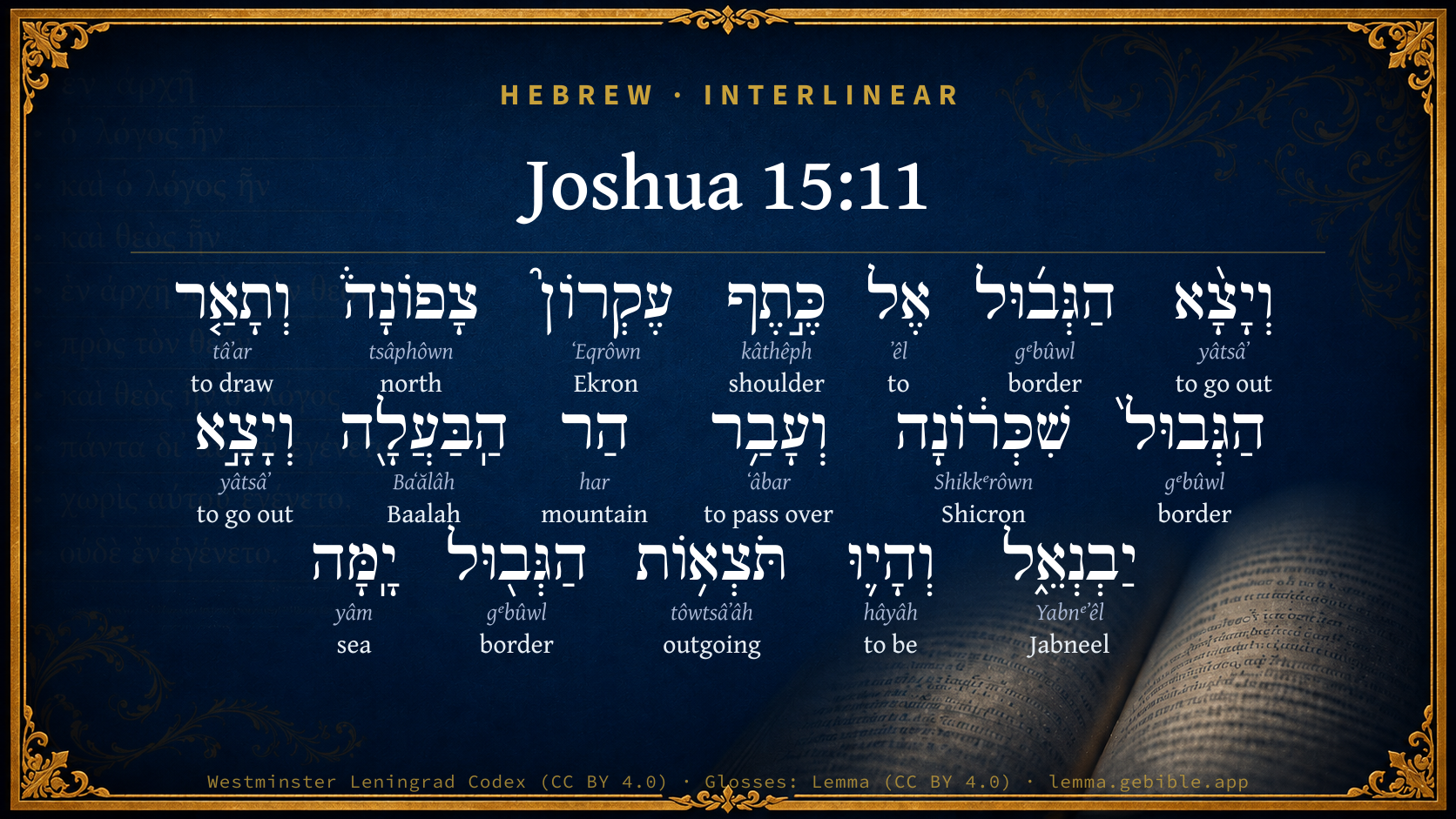
Hebrew (Westminster Leningrad Codex) Joshua 15:11 appears in the Hebrew Old Testament. The text above is from the Westminster Leningrad Codex. Each word links to its Strong’s number, a concise gloss, and parsing drawn from the Open Scriptures Hebrew Bible morphology. Click any word for its full Brown-Driver-Briggs (BDB) entry.
Download image
Cite this verse

Joshua 15:11 (World English Bible). Public Domain. Lemma interlinear Bible study tool, https://lemma.gebible.app/v/joshua/15/11.

Show BibTeX & RIS
BibTeX
RIS
English Translation
and the border went out to the side of Ekron northward; and the border extended to Shikkeron, and passed along to Mount Baalah, and went out at Jabneel; and the goings out of the border were at the sea.
World English Bible · Public Domain
Highlights
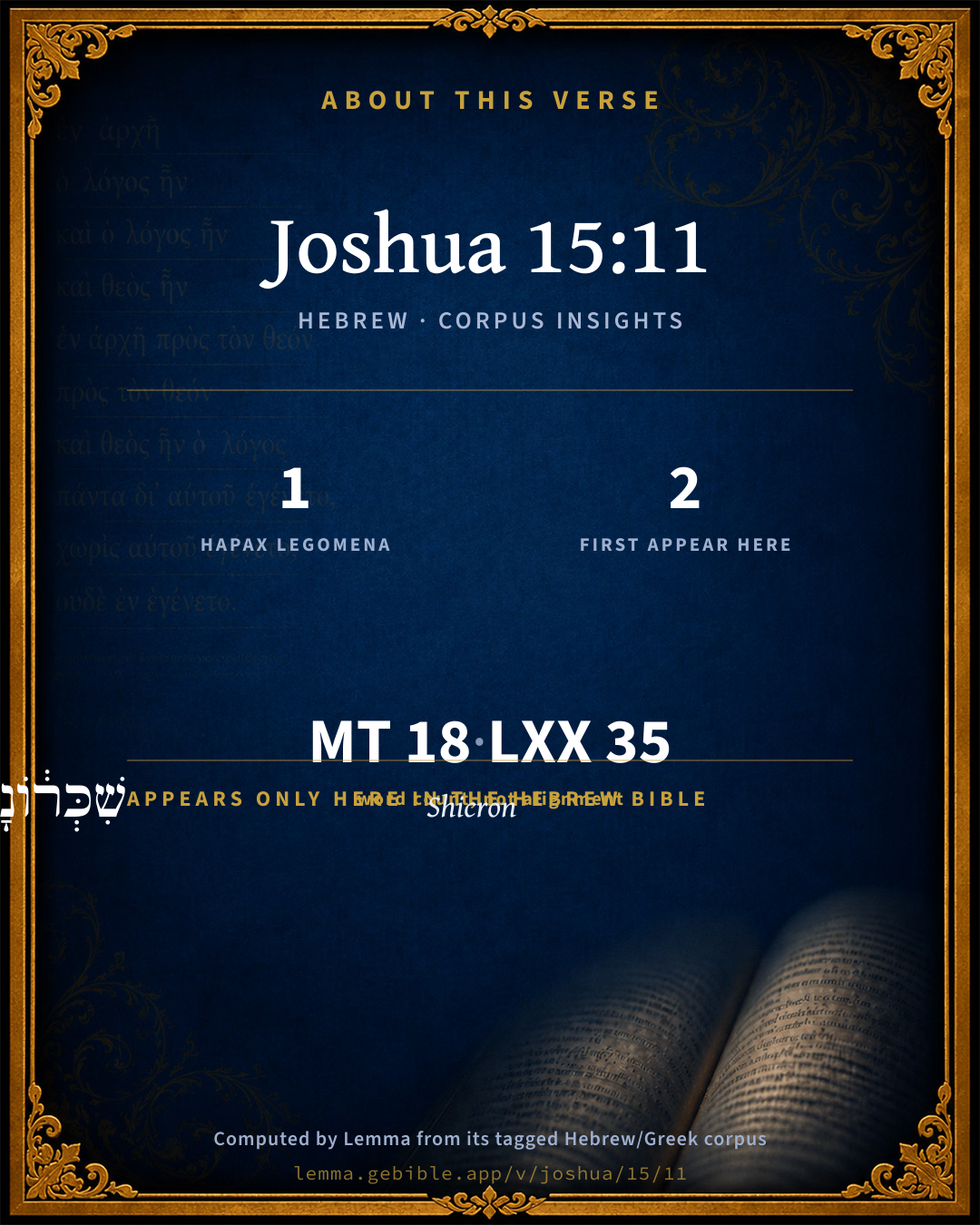
  • 1 hapax legomenon — only here in the Hebrew Bible
  • 2 first appearances in the Hebrew Bible
Full analysis ↓
Download a study sheet

One document with this verse’s original text, its word-by-word gloss line, the meaning frame, cross-references with their text, attributed commentary, and full source and license credits — printable, and it pastes into notes with its structure intact.

This verse Autodidact and up

Study sheet (.html) Plain text (.txt)

A passage Seminary Student

Up to 50 verses in one chapter. A passage sheet keeps up to 6 commentary sources and 12 cross-references per verse, in the order this page ranks them, and says so on the sheet whenever that leaves anything out. Ask for a single verse and you get the Autodidact verse sheet above.

Everything on this page stays free to read, with no account — the sheet is a download of what is already on screen, not access to it.

Want to remove ads? Support Godless Engineer
Compare translations 3

The same verse in 3 English versions, stacked beneath the original-language interlinear above. Click any original word for its lexicon entry.

Each is an independent rendering of the whole verse — the interlinear is not word-aligned to these translations.

Highlighted words mark where these versions differ — a whole-verse word diff, not a word-by-word alignment.

  • World English Bible Public Domain
    and the border went out to the side of Ekron northward; and the border extended to Shikkeron, and passed along to Mount Baalah, and went out at Jabneel; and the goings out of the border were at the sea.
  • King James Version Public Domain
    And the border went out unto the side of Ekron northward: and the border was drawn to Shicron, and passed along to mount Baalah, and went out unto Jabneel; and the goings out of the border were at the sea.
  • unfoldingWord Literal Text CC BY-SA 4.0
    And the border went out to the shoulder of Ekron northward. Then the border extended to Shikkeron and passed over Mount Baalah and went out Jabneel. And the goings out of the border were seaward.

unfoldingWord Literal Text — © unfoldingWord, licensed CC BY-SA 4.0. Word-aligned USFM3 via Door43 (git.door43.org/unfoldingWord/en_ult).

Versions to compare (up to 4)

3 of 4 selected

Show all 18 translations

Every available English version of this verse, each an independent rendering of the whole verse.

  • World English Bible Public Domain
    and the border went out to the side of Ekron northward; and the border extended to Shikkeron, and passed along to Mount Baalah, and went out at Jabneel; and the goings out of the border were at the sea.
  • Berean Standard Bible Public Domain
    Then it went out to the northern slope of Ekron, curved toward Shikkeron, proceeded to Mount Baalah, went on to Jabneel, and ended at the Sea.
  • Majority Standard Bible Public Domain
    Then it went out to the northern slope of Ekron, curved toward Shikkeron, proceeded to Mount Baalah, went on to Jabneel, and ended at the Sea.
  • King James Version Public Domain
    And the border went out unto the side of Ekron northward: and the border was drawn to Shicron, and passed along to mount Baalah, and went out unto Jabneel; and the goings out of the border were at the sea.
  • American Standard Version (1901) Public Domain
    and the border went out unto the side of Ekron northward; and the border extended to Shikkeron, and passed along to mount Baalah, and went out at Jabneel; and the goings out of the border were at the sea.
  • Revised Version (1885) Public Domain
    and the border went out unto the side of Ekron northward: and the border was drawn to Shikkeron, and passed along to mount Baalah, and went out at Jabneel; and the goings out of the border were at the sea.
  • Geneva Bible (1599) Public Domain
    Also this border goeth out vnto the side of Ekron Northwarde: and this border draweth to Shicron, and goeth along to mount Baalah, and stretcheth vnto Iabneel: and the endes of this coast are to the Sea.
  • Douay-Rheims (1899) Public Domain
    And it reacheth northward to a part of Accaron at the side: and bendeth to Sechrona, and passeth mount Baala: and cometh into Jebneel, and is bounded westward with the great sea.
  • Young's Literal Translation Public Domain
    and the border hath gone out unto the side of Ekron northward, and the border hath been marked out `to' Shicron, and hath passed over to mount Baalah, and gone out `to' Jabneel; and the outgoings of the border have been at the sea.
  • Literal Standard Version CC BY-SA 4.0
    and the border has gone out to the side of Ekron northward, and the border has been marked out [to] Shicron, and has passed over to Mount Ba‘alah, and gone out [to] Jabneel; and the outgoings of the border have been at the sea.
  • Unlocked Literal Bible CC BY-SA 4.0
    The border went out beside the northern hill of Ekron, and then it bends around to Shikkeron and passed along to Mount Baalah, from there it went to Jabneel. The border ended at the sea.
  • unfoldingWord Literal Text CC BY-SA 4.0
    And the border went out to the shoulder of Ekron northward. Then the border extended to Shikkeron and passed over Mount Baalah and went out Jabneel. And the goings out of the border were seaward.
  • Darby Bible Public Domain
    And the border went out to the side of Ekron northwards, and the border reached along toward Shicron, and passed mount Baalah, and went toward Jabneel; and the border ended at the sea.
  • World Messianic Bible Public Domain
    and the border went out to the side of Ekron northward; and the border extended to Shikkeron, and passed along to Mount Baalah, and went out at Jabneel; and the goings out of the border were at the sea.
  • Webster's Bible Public Domain
    And the border went out to the side of Ekron northward: and the border was drawn to Shicron, and passed along to mount Baalah, and went out to Jabneel; and the terminations of the border were at the sea.
  • Free Bible Version CC BY-SA 4.0
    The boundary then ran to the north slope of Ekron, and bent towards Shikkeron, passing Mount Baalah, out to Jabneel, and ending at the sea.
  • Bible in Basic English Public Domain
    And out to the side of Ekron to the north: then it is marked out to Shikkeron and on to Mount Baalah, ending at Jabneel; the end of the line is at the sea.
  • JPS Tanakh (1917) Public Domain
    And the border went out unto the side of Ekron northward; and the border was drawn to Shikkeron, and passed along to mount Baalah, and went out at Jabneel; and the goings out of the border were at the sea.

Literal Standard Version (2020), Covenant Press — licensed CC BY-SA 4.0. Text via the HelloAO Bible API (eBible.org). Unlocked Literal Bible (unfoldingWord) — licensed CC BY-SA 4.0. Text via the HelloAO Bible API (eBible.org). unfoldingWord Literal Text — © unfoldingWord, licensed CC BY-SA 4.0. Word-aligned USFM3 via Door43 (git.door43.org/unfoldingWord/en_ult). Free Bible Version, Dr. Jonathan Gallagher — licensed CC BY-SA 4.0. Text via the HelloAO Bible API (eBible.org).

Word by word

More ways to search: Search by grammar → Find every occurrence → Compare this word →

Practice this passage: Drill this verse → Learn its vocabulary →

שִׁכְּר֔וֹנָה
Shikkᵉrôwn
H7942
“Shicron · toward”
Noun, Proper + Suffix, Demonstrative
Part of Speech
Noun
Type
Proper
Full BDB Definition

Origin: for H7943

TWOT: None

Shicron = "drunkenness" - a landmark on the northwestern boundary of Judah lying between Ekron and Jabneel
  1. וְיָצָ֨א yâtsâʼ H3318 “and · to go out” Conjunction + Verb, Qal, Perfect, 3rd Person, Masculine, Singular
  2. הַגְּב֜וּל gᵉbûwl H1366 “the · border” Particle, Definite Article + Noun, Common, Masculine, Singular, Absolute
  3. אֶל ʼêl H413 “to” Preposition
  4. כֶּ֣תֶף kâthêph H3802 “shoulder of” Noun, Common, Feminine, Singular, Construct
  5. עֶקְרוֹן֮ ʻEqrôwn H6138 “Ekron” Noun, Proper
  6. צָפוֹנָה֒ tsâphôwn H6828 “north · toward” Noun, Common, Feminine, Singular, Absolute + Suffix, Demonstrative
  7. וְתָאַ֤ר tâʼar H8388 “and · to draw” Conjunction + Verb, Qal, Perfect, 3rd Person, Masculine, Singular
  8. הַגְּבוּל֙ gᵉbûwl H1366 “the · border” Particle, Definite Article + Noun, Common, Masculine, Singular, Absolute
  9. וְעָבַ֥ר ʻâbar H5674 “and · to pass over” Conjunction + Verb, Qal, Perfect, 3rd Person, Masculine, Singular
  10. הַר har H2022 “mountain of” Noun, Common, Masculine, Singular, Construct
  11. הַֽבַּעֲלָ֖ה Baʻălâh H1173 “the · Baalah” Particle, Definite Article + Noun, Proper
  12. וְיָצָ֣א yâtsâʼ H3318 “and · to go out” Conjunction + Verb, Qal, Perfect, 3rd Person, Masculine, Singular
  13. יַבְנְאֵ֑ל Yabnᵉʼêl H2995 “Jabneel” Noun, Proper
  14. וְהָי֛וּ hâyâh H1961 “and · to be” Conjunction + Verb, Qal, Perfect, 3rd Person, Common, Plural
  15. תֹּצְא֥וֹת tôwtsâʼâh H8444 “outgoings of” Noun, Common, Feminine, Plural, Construct
  16. הַגְּב֖וּל gᵉbûwl H1366 “the · border” Particle, Definite Article + Noun, Common, Masculine, Singular, Absolute
  17. יָֽמָּה yâm H3220 “sea · toward” Noun, Common, Masculine, Singular, Absolute + Suffix, Demonstrative

About this verse

These counts appear in no published source. They are computed here, from the morphology-tagged text and Lemma’s own curated glosses. What Lemma adds →

18
words
15
distinct lemmas
Historical
section

Notable vocabulary

1 hapax legomenon — a word that appears only here in the entire Hebrew Bible:

  • שִׁכְּר֔וֹנָה Shicron H7942

First appearance in Scripture

These words make their first canonical appearance in the Hebrew Bible here:

  • שִׁכְּר֔וֹנָה Shicron H7942
  • יַבְנְאֵ֑ל Jabneel H2995

Shared distinctive vocabulary

יַבְנְאֵ֑ל Jabneel H2995 occurs in 2 verses of the Hebrew Bible. Also found in:

Grammatical profile

  • 5 verbs
  • 12 nouns
  • 1 preposition

Verb forms

  • וְיָצָ֨א Qal · Perfect
  • וְתָאַ֤ר Qal · Perfect
  • וְעָבַ֥ר Qal · Perfect
  • וְיָצָ֣א Qal · Perfect
  • וְהָי֛וּ Qal · Perfect

Repetition

Words recur within this verse — often emphatic in Hebrew:

  • הַגְּב֜וּל border H1366 ×3
  • וְיָצָ֨א to go out H3318 ×2

Hebrew & Septuagint length

In English translation the verse runs 39 words from the Hebrew and 54 from the Septuagint (LXX English) — closely comparable.

A rough comparison of the two English renderings, which tokenize alike — not a word-level alignment.

Word counts can differ between the Hebrew and the Greek without any difference in meaning — e.g. the Hebrew direct-object marker אֵת has no separate Greek word, and Greek often adds the article ὁ.

In the original languages it is 18 Hebrew tokens and 35 Greek tokens — but the two are counted differently (Hebrew bundles its prefixes and suffixes into one token; the Greek is in lemma form), so that isn’t a like-for-like length.

Cross-references

7

Topical passages linked to Joshua 15:11 in the Treasury of Scripture Knowledge — connected by theme and wording, ordered by reader-vote popularity; previews shown in the World English Bible.

  • Joshua 15:45 Ekron, with its towns and its villages;
  • Joshua 19:43–44 and Elon, and Timnah, and Ekron,
  • 1 Samuel 5:10 So they sent the ark of God to Ekron. It happened, as the ark of God came to Ekron, that the Ekronites cried out, saying, They have brought about the ark of the God of Israel to us, to kill us and our people.
  • 1 Samuel 7:14 The cities which the Philistines had taken from Israel were restored to Israel, from Ekron even to Gath; and the border of it did Israel deliver out of the hand of the Philistines. There was peace between Israel and the Amorites.
  • 2 Kings 1:2–3 Ahaziah fell down through the lattice in his upper chamber that was in Samaria, and was sick: and he sent messengers, and said to them, Go, inquire of Baal Zebub, the god of Ekron, whether I shall recover of this sickness.
  • 2 Kings 1:6 They said to him, There came up a man to meet us, and said to us, Go, turn again to the king who sent you, and tell him, Thus says Yahweh, Is it because there is no God in Israel, that you send to inquire of Baal Zebub, the god of Ekron? therefore you shall not come down from the bed where you are gone up, but shall surely die.
  • 2 Kings 1:16 He said to him, Thus says Yahweh, Because you have sent messengers to inquire of Baal Zebub, the god of Ekron, is it because there is no God in Israel to inquire of his word? therefore you shall not come down from the bed where you are gone up, but shall surely die.

Cross-references courtesy of OpenBible.info (CC BY 4.0).

Hebrew and Greek witnesses Masoretic Hebrew ↔ Greek Septuagint

The same verse in the two great witnesses to the Old Testament, shown verse-for-verse.

These are two independent witnesses, not word-aligned to each other, and the Septuagint is shown in lemma (dictionary) form.

Hebrew Joshua 15:11 Masoretic · Westminster Leningrad Codex

וְיָצָ֨א הַגְּב֜וּל אֶל כֶּ֣תֶף עֶקְרוֹן֮ צָפוֹנָה֒ וְתָאַ֤ר הַגְּבוּל֙ שִׁכְּר֔וֹנָה וְעָבַ֥ר הַר הַֽבַּעֲלָ֖ה וְיָצָ֣א יַבְנְאֵ֑ל וְהָי֛וּ תֹּצְא֥וֹת הַגְּב֖וּל יָֽמָּה

and the border went out to the side of Ekron northward; and the border extended to Shikkeron, and passed along to Mount Baalah, and went out at Jabneel; and the goings out of the border were at the sea.

World English Bible · Public Domain

Greek LXX Joshua 15:11 Septuagint · lemma form

καί δια ἐκβάλλω ὁ ὅριον κατά νῶτον ακκαρων ἐπί βορέας καί δια ἐκβάλλω ὁ ὅριον εἰς σακχαρωνα καί παραἔρχομαι ὄρος ὁ βαλα καί δια ἐκβάλλω ἐπί ιαβνηλ καί εἰμί ὁ διέξοδος ὁ ὅριον ἐπί θάλασσα

And the border terminates behind Accaron northward, and the borders will terminate at Socchoth, and the borders will go on to the south, and will terminate at Lebna, and the issue of the borders will be at the sea; and their borders shall be toward the sea, the great sea shall be the boundary.

LXX2012 (modern English Septuagint) · Public Domain

Hebrew: Westminster Leningrad Codex (CC BY 4.0). Greek: Septuagint (public domain); English from LXX2012 (modern English Septuagint) (Public Domain). How the Septuagint differs from the Hebrew →

Targum (Aramaic paraphrase)

1

The Targum is the ancient Jewish Aramaic paraphrase of the Hebrew Scriptures — an interpretive translation, not the Hebrew text itself. Onkelos (literal) and Pseudo-Jonathan (expansive) render the Torah, and Jonathan the Prophets. Coverage is partial: where no permissively-licensed English translation exists for a verse, only the Aramaic is shown. This is verse-level text, not a word-by-word alignment to the Hebrew.

  1. Targum Jonathan Prophets (Joshua–Malachi)
    וְנָפַק תְּחוּמָא לְעִבַּר עֶקְרוֹן לְצִפּוּנָא וְיִסְחַר תְּחוּמָא לְשִׁכָּרוֹן וַעֲבַר לְטוּר בַּעֲלָה וְנָפֵק לְיַבְנְאֵל וַהֲווֹן מַפְקָנוֹהִי דִתְחוּמָא לְיַמָא:

    (no public-domain English translation for this verse)

    Targum Jonathan — Aramaic: “Mikraot Gedolot” (public domain). English: “Sefaria Community Translation” (CC0 1.0 (public-domain dedication)); “London "Chaldee Paraphrase," 1871” (public domain). Text via Sefaria.

Commentary

Notes on Joshua 15:11 from classic Christian and Jewish commentators (each source and its license shown beneath its notes). The classic Christian expositions comment on the surrounding passage and are grouped to its opening verse, so a note may address several verses; the Jewish commentaries on the Tanakh (Rashi and others) are per-verse, so they appear only where the commentator wrote on this verse.

Lemma curates 59 commentaries, every one of them public domain or Creative Commons licensed, each selected and text-cleaned for this edition rather than reprinted as found. About our sources →

Trapp's Complete Commentary

John Trapp

Jos 15:11 And the border went out unto the side of Ekron northward: and the border was drawn to Shicron, and passed along to mount Baalah, and went out unto Jabneel; and the goings out of the border were at the sea.

Ver. 11. Unto the side of Ekron.] Where Beelzebub was worshipped. Hence Acheron for hell,

“ Fiectere si nequeo superos, Acheronta movebo. ” - Virg.

John Trapp, A Commentary or Exposition upon All the Books of the Old and New Testament (1647–1656) — public domain. Text from a community e-Sword module.

Geneva Bible (1599)

Geneva Bible translators

Meaning, toward Syria.

Geneva Bible (1599) marginal notes — public domain. Text via Bolls.life.

Ellicott's Commentary for English Readers

(11) Ekron is Akir (on sheet 16). Here we are in the Shephêlah, or plain of the sea-coast.

Jabneel is Yebnah, west of Ekron, nearer the sea.

A Bible Commentary for English Readers, edited by Charles John Ellicott (1878–1897) — public domain. Text from a community e-Sword module.

The Cambridge Bible for Schools and Colleges

gen. ed. J. J. S. Perowne

11. unto the side of Ekron northward] The boundary, still following a N.W. course, now tended towards a point lying near the Philistine city of Ekron (see above, ch. Jos_13:3), whence it was drawn to Shicron, between Ekron and Jabneal (Yebna), and passed along to mount Baalah, “the short line of hills running almost parallel with the coast,” and so “went out unto Jabneel” the modern village of Yebna or Ibna, about two miles from the Sea, 11 miles south of Jaffa, and four from Ækir (Ekron), represents the ancient Jabneel or Jabneh (2Ch_26:6), or, in its Greek garb, Jamnia (1Ma_4:5; 1Ma_5:58).

The Cambridge Bible for Schools and Colleges (gen. ed. J. J. S. Perowne; Cambridge University Press, 1878–1918) — public domain. Text from a community e-Sword module.

John Gill's Exposition

And the border went out unto the side of Ekron northward,.... Which was one of the principalities of the Philistines; and which, though it fell to the lot of Judah, Jos 15:45, was not possessed by them:

and the border was drawn to Shicron, and passed along to Mount Baalah; of which places we have no account elsewhere:

and went unto Jabneel; which Masius makes no doubt was one of the Jamnias, and particularly that which was a seaport; which Strabo says (a) was distant from Azotus and Ashkelon about two hundred furlongs, or twenty five miles:

and the goings out of the border were at the sea; the Mediterranean sea; here the northern border ended.

(a) Geograph. l. 16. p. 522.

John Gill's Exposition of the Whole Bible (1746–1763) — public domain (CC PDM 1.0). Text via the HelloAO Bible API.

Albert Barnes' Notes on the Bible

Jabneel - The modern “Yebna”, about three miles from the coast and twelve miles south of Joppa. It is called Jabneh in 2Ch 26:6, where Uzziah is recorded to have taken it from the Philistines and destroyed its fortifications. The town is repeatedly mentioned with its haven in the wars of the Maccabees (1 Macc. 4:15; 2 Macc. 12:8), and by Josephus under the name of Jamnia. It is described by Philo as a very populous town; and after the destruction of Jerusalem was, for a long time, the seat of the Sanhedrin, and was a famous school of Jewish learning. Its ruins, which are still considerable, stand on the brink of the “Wady Rubin”.

Albert Barnes' Notes on the Bible (1834–1885) — public domain. Text from a community e-Sword/MySword module.

The Pulpit Commentary

Ekron. This important Philistine city (see Jos_13:3) lay close to the northern border of Judah. As a matter of fact, however, the tribe of Judah never succeeded in permanently occupying this territory, which only fell under their yoke during the reigns of David and Solomon. The cities of the Philistines were, it is true, most of them captured, (Jud_1:18) but we soon find the Philistines once more in possession of them. (see 1Sa_5:8-10) Northward. The border turned sharply northward until past Ekron, when it once more turned westward until it reached the sea.

The Pulpit Commentary (1880–1919), ed. H.D.M. Spence-Jones & Joseph S. Exell — public domain. Text from a community e-Sword module.

unfoldingWord translationNotes

Door43 World Missions Community

Shikkeron ... Mount Baalah ... Jabneel

These are the names of places. (See: How to Translate Names)

translationWords

Ekron

the sea

tribe

Judah

clan

unfoldingWord translationNotes — © Distant Shores Media and the Door43 World Missions Community, licensed CC BY-SA 4.0. Source: git.door43.org/Door43/en_tn.

Rashi

Rabbi Shlomo Yitzchaki (Rashi)

The boundary went out— Referring to the end of the boundary.

Toward the sea. Referring to the Great Sea [the Mediteranean] which is the western boundary [of Eretz Yisroel].

Rashi on the Tanakh — English translations: “The Judaica Press complete Tanach with Rashi, translated by A. J. Rosenberg” (CC BY 4.0); “Pentateuch with Rashi's commentary by M. Rosenbaum and A.M. Silbermann, 1929-1934” (public domain); “The Metsudah Tanach series, Lakewood, N.J” (CC BY 4.0); and “The Book of Joshua, Metsudah Publications, 1997” (CC BY 4.0). Text via Sefaria.

Lesson kit

Teaching starters — assembled from the data on this page, not authored interpretation. Every prompt links to the verse data it draws on. Edit before teaching.

Joshua, in the Historical, opens this verse with 18 words (15 distinct Hebrew lemmas). Its most distinctive word is Shikkᵉrôwn (“Shicron”). A historical commentator’s framing appears above. Read the whole chapter for the surrounding context.

Discussion questions

  1. The word Shikkᵉrôwn carries the sense “Shicron.” How does it shape the verse?
  2. This verse holds 1 word here found nowhere else in the Hebrew Bible. What might the rare word draw attention to?
  3. 2 words here appear for the first time in Scripture. What is being introduced at this debut?
  4. Joshua 19:33 shares the word «Jabneel» with this verse. How do the two illuminate each other?
  5. “border” occurs 3× in this one verse. What is the effect of the repetition?
  6. These translations render this verse differently; the difference is in the English rendering, not the original. What questions does that raise?
  7. The verb «וְיָצָ֨א» is Qal Perfect. How does its form color the action?
  8. Reading how Trapp's Complete Commentary and Geneva Bible (1599) read this verse, where do the two commentators agree and where do they part?

Things to notice

  • 1 word in this verse appears nowhere else in the Hebrew Bible.
  • 2 words make their first canonical appearance in Scripture here.
  • This verse counts 18 Hebrew ↔ 35 Greek words.
  • These translations choose different wording for 10 words in this verse.
  • “border” occurs 3× in this single verse.

Reading settings

Reading text

Shown beneath each verse's original-language words.

Old Testament
Old Testament edition

Read the OT as the Masoretic Hebrew (MT) or the Greek Septuagint (LXX).

English shown for the Greek Septuagint (in the Hebrew ↔ Greek comparison).

Comparing translations? Open the Compare panel on any verse page to stack up to four side by side.