
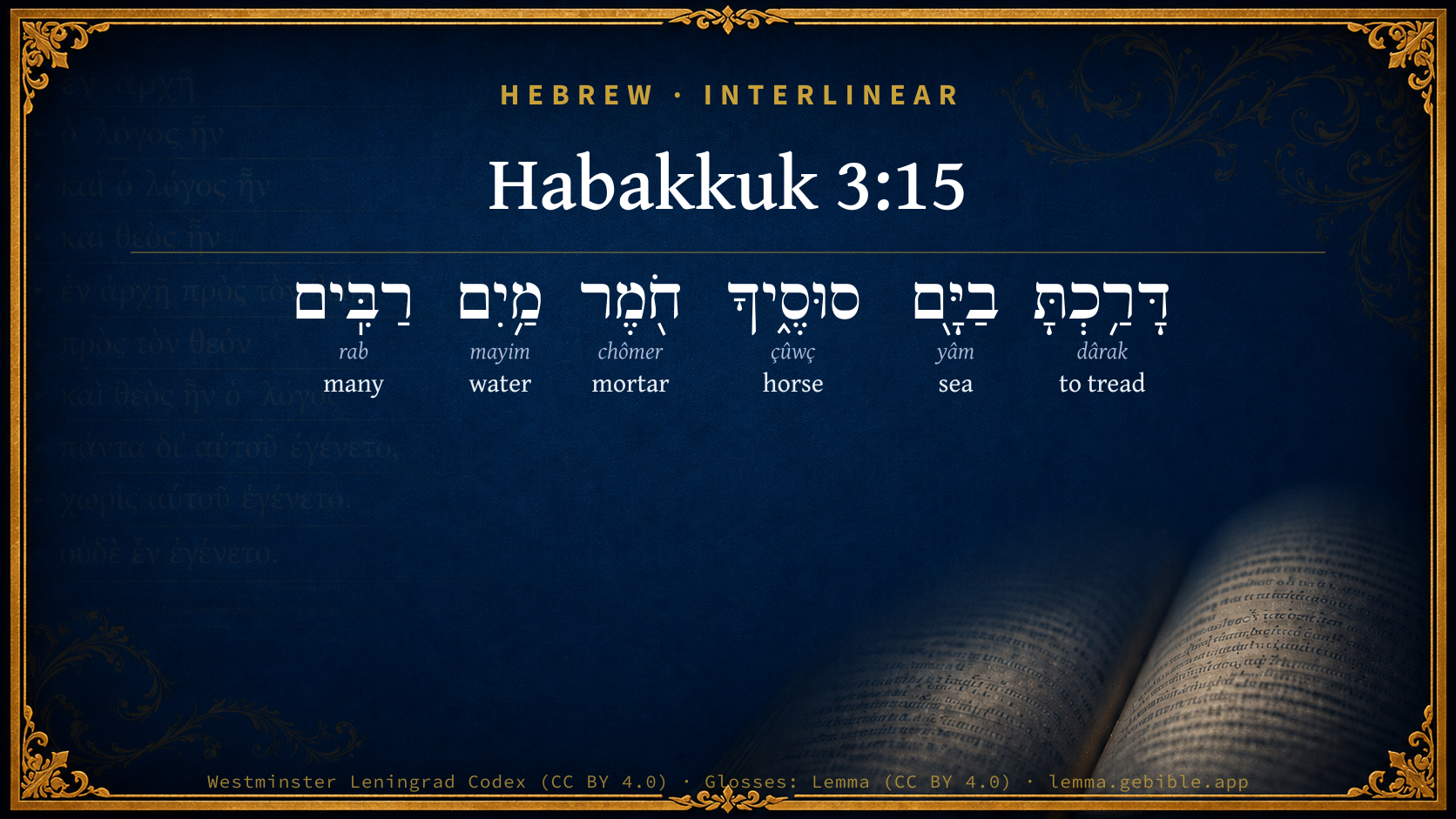
Habakkuk 3:15

Hebrew (Westminster Leningrad Codex) Habakkuk 3:15 appears in the Hebrew Old Testament. The text above is from the Westminster Leningrad Codex. Each word links to its Strong’s number, a concise gloss, and parsing drawn from the Open Scriptures Hebrew Bible morphology. Click any word for its full Brown-Driver-Briggs (BDB) entry.
Download image
Cite this verse

Habakkuk 3:15 (World English Bible). Public Domain. Lemma interlinear Bible study tool, https://lemma.gebible.app/v/habakkuk/3/15.

Show BibTeX & RIS
BibTeX
RIS
English Translation
You trampled the sea with your horses, Churning mighty waters.
World English Bible · Public Domain
Download a study sheet

One document with this verse’s original text, its word-by-word gloss line, the meaning frame, cross-references with their text, attributed commentary, and full source and license credits — printable, and it pastes into notes with its structure intact.

This verse Autodidact and up

Study sheet (.html) Plain text (.txt)

A passage Seminary Student

Up to 50 verses in one chapter. A passage sheet keeps up to 6 commentary sources and 12 cross-references per verse, in the order this page ranks them, and says so on the sheet whenever that leaves anything out. Ask for a single verse and you get the Autodidact verse sheet above.

Everything on this page stays free to read, with no account — the sheet is a download of what is already on screen, not access to it.

Want to remove ads? Support Godless Engineer
Compare translations 3

The same verse in 3 English versions, stacked beneath the original-language interlinear above. Click any original word for its lexicon entry.

Each is an independent rendering of the whole verse — the interlinear is not word-aligned to these translations.

Highlighted words mark where these versions differ — a whole-verse word diff, not a word-by-word alignment.

  • World English Bible Public Domain
    You trampled the sea with your horses, Churning mighty waters.
  • King James Version Public Domain
    Thou didst walk through the sea with thine horses, through the heap of great waters.
  • unfoldingWord Literal Text CC BY-SA 4.0
    You trod the sea with your horses, the heap of great waters. q1

unfoldingWord Literal Text — © unfoldingWord, licensed CC BY-SA 4.0. Word-aligned USFM3 via Door43 (git.door43.org/unfoldingWord/en_ult).

Versions to compare (up to 4)

3 of 4 selected

Show all 18 translations

Every available English version of this verse, each an independent rendering of the whole verse.

  • World English Bible Public Domain
    You trampled the sea with your horses, Churning mighty waters.
  • Berean Standard Bible Public Domain
    You trampled the sea with Your horses, churning the great waters.
  • Majority Standard Bible Public Domain
    You trampled the sea with Your horses, churning the great waters.
  • King James Version Public Domain
    Thou didst walk through the sea with thine horses, through the heap of great waters.
  • American Standard Version (1901) Public Domain
    Thou didst tread the sea with thy horses, The heap of mighty waters.
  • Revised Version (1885) Public Domain
    Thou didst tread the sea with thine horses, the heap of mighty waters.
  • Geneva Bible (1599) Public Domain
    Thou didest walke in the sea with thine horses vpon the heape of great waters.
  • Douay-Rheims (1899) Public Domain
    Thou madest a way in the sea for thy horses, in the mud of many waters.
  • Young's Literal Translation Public Domain
    Thou hast proceeded through the sea with Thy horses -- the clay of many waters.
  • Literal Standard Version CC BY-SA 4.0
    You have proceeded through the sea with Your horses—the clay of many waters.
  • Unlocked Literal Bible CC BY-SA 4.0
    You have traveled over the sea with your horses, and heaped up the great waters.
  • unfoldingWord Literal Text CC BY-SA 4.0
    You trod the sea with your horses, the heap of great waters. q1
  • Darby Bible Public Domain
    Thou didst walk through the sea with thy horses, The heap of great waters.
  • World Messianic Bible Public Domain
    You trampled the sea with your horses, churning mighty waters.
  • Webster's Bible Public Domain
    Thou didst walk through the sea with thy horses, through the mire of great waters.
  • Free Bible Version CC BY-SA 4.0
    You trod upon the sea with your horses, churning up the mighty waters.
  • Bible in Basic English Public Domain
    The feet of your horses were on the sea, on the mass of great waters.
  • JPS Tanakh (1917) Public Domain
    Thou hast trodden the sea with Thy horses, the foaming of mighty waters.

Literal Standard Version (2020), Covenant Press — licensed CC BY-SA 4.0. Text via the HelloAO Bible API (eBible.org). Unlocked Literal Bible (unfoldingWord) — licensed CC BY-SA 4.0. Text via the HelloAO Bible API (eBible.org). unfoldingWord Literal Text — © unfoldingWord, licensed CC BY-SA 4.0. Word-aligned USFM3 via Door43 (git.door43.org/unfoldingWord/en_ult). Free Bible Version, Dr. Jonathan Gallagher — licensed CC BY-SA 4.0. Text via the HelloAO Bible API (eBible.org).

Word by word

More ways to search: Search by grammar → Find every occurrence → Compare this word →

Practice this passage: Drill this verse → Learn its vocabulary →

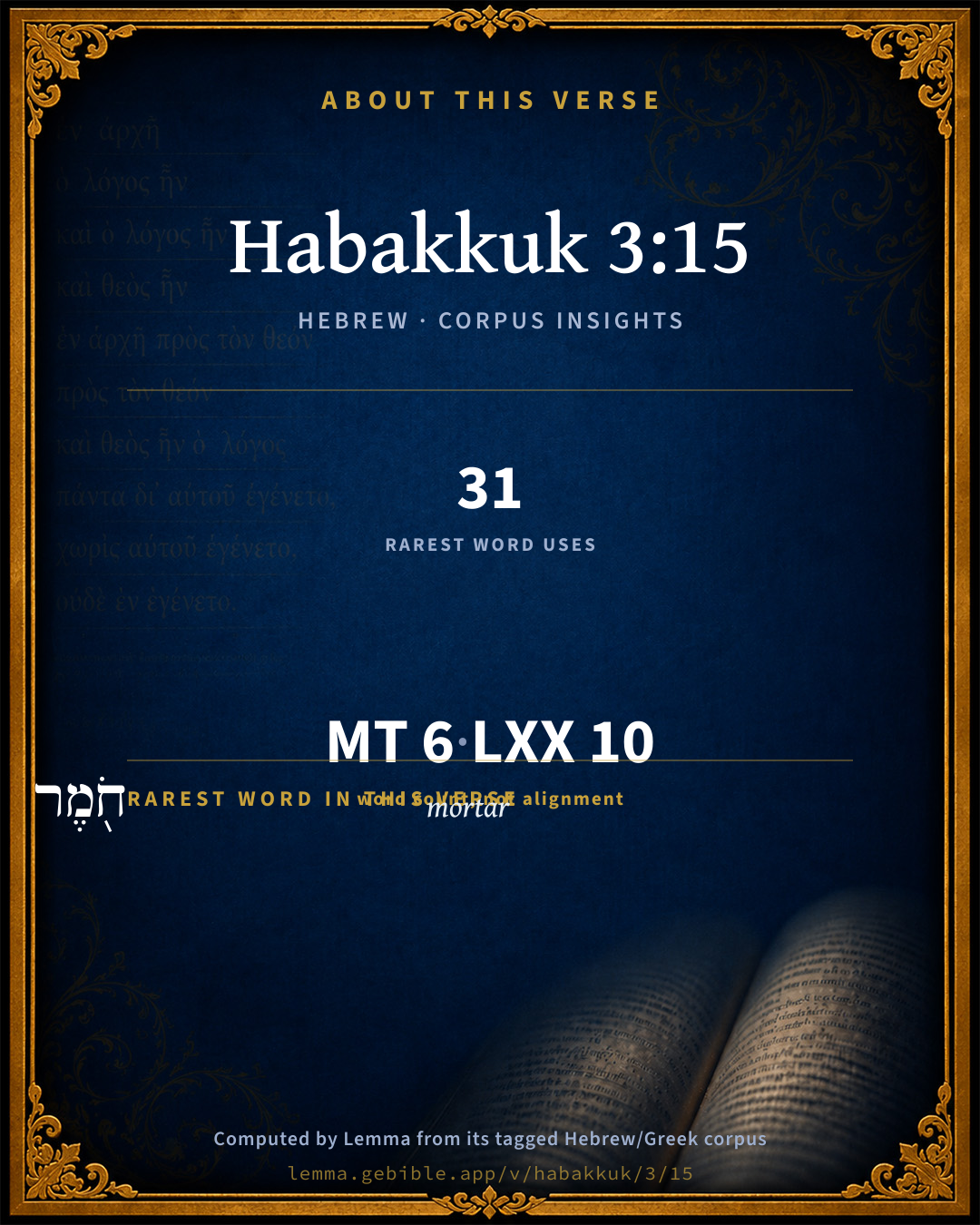
About this verse

These counts appear in no published source. They are computed here, from the morphology-tagged text and Lemma’s own curated glosses. What Lemma adds →

6
words
6
distinct lemmas
Prophets
section

Shared distinctive vocabulary

חֹ֖מֶר mortar H2563 occurs in 26 verses of the Hebrew Bible. Also found in:

Grammatical profile

  • 1 verb
  • 4 nouns
  • 1 adjective

Verb forms

  • דָּרַ֥כְתָּ Qal · Perfect

Hebrew & Septuagint length

In English translation the verse runs 10 words from the Hebrew and 13 from the Septuagint (LXX English) — closely comparable.

A rough comparison of the two English renderings, which tokenize alike — not a word-level alignment.

Word counts can differ between the Hebrew and the Greek without any difference in meaning — e.g. the Hebrew direct-object marker אֵת has no separate Greek word, and Greek often adds the article ὁ.

In the original languages it is 6 Hebrew tokens and 10 Greek tokens — but the two are counted differently (Hebrew bundles its prefixes and suffixes into one token; the Greek is in lemma form), so that isn’t a like-for-like length.

Cross-references

3

Topical passages linked to Habakkuk 3:15 in the Treasury of Scripture Knowledge — connected by theme and wording, ordered by reader-vote popularity; previews shown in the World English Bible.

  • Psalms 77:19 Your way was through the sea; Your paths through the great waters. Your footsteps were not known.
  • Habakkuk 3:8 Was Yahweh displeased with the rivers? Was your anger against the rivers, Or your wrath against the sea, That you rode on your horses, On your chariots of salvation?
  • Exodus 15:8 With the blast of your nostrils the waters were piled up. The floods stood upright as a heap. The deeps were congealed in the heart of the sea.

Cross-references courtesy of OpenBible.info (CC BY 4.0).

Hebrew and Greek witnesses Masoretic Hebrew ↔ Greek Septuagint

The same verse in the two great witnesses to the Old Testament, shown verse-for-verse.

These are two independent witnesses, not word-aligned to each other, and the Septuagint is shown in lemma (dictionary) form.

Hebrew Habakkuk 3:15 Masoretic · Westminster Leningrad Codex

דָּרַ֥כְתָּ בַיָּ֖ם סוּסֶ֑יךָ חֹ֖מֶר מַ֥יִם רַבִּֽים

You trampled the sea with your horses, Churning mighty waters.

World English Bible · Public Domain

Greek LXX Habakkuk 3:15 Septuagint · lemma form

καί ἐπιβιβάζω εἰς θάλασσα ὁ ἵππος σύ ταράσσω ὕδωρ πολύς

And you do cause your horses to enter the sea, disturbing much water.

LXX2012 (modern English Septuagint) · Public Domain

On this verse, John Gill's Exposition discusses the Septuagint’s reading. Read the note in Commentary ↓

Hebrew: Westminster Leningrad Codex (CC BY 4.0). Greek: Septuagint (public domain); English from LXX2012 (modern English Septuagint) (Public Domain). How the Septuagint differs from the Hebrew →

Targum (Aramaic paraphrase)

1

The Targum is the ancient Jewish Aramaic paraphrase of the Hebrew Scriptures — an interpretive translation, not the Hebrew text itself. Onkelos (literal) and Pseudo-Jonathan (expansive) render the Torah, and Jonathan the Prophets. Coverage is partial: where no permissively-licensed English translation exists for a verse, only the Aramaic is shown. This is verse-level text, not a word-by-word alignment to the Hebrew.

  1. Targum Jonathan Prophets (Joshua–Malachi)
    אִתְגְלֵיתָא עַל יַמָא בְּמֶרְכָּבַת יְקָרָךְ בִּדְגוּר מַיִן סַגִיאִין:

    (no public-domain English translation for this verse)

    Targum Jonathan — Aramaic: “Mikraot Gedolot” (public domain). English: “Sefaria Community Translation” (CC0 1.0 (public-domain dedication)); “London "Chaldee Paraphrase," 1871” (public domain). Text via Sefaria.

Commentary

Notes on Habakkuk 3:15 from classic Christian and Jewish commentators (each source and its license shown beneath its notes). The classic Christian expositions comment on the surrounding passage and are grouped to its opening verse, so a note may address several verses; the Jewish commentaries on the Tanakh (Rashi and others) are per-verse, so they appear only where the commentator wrote on this verse.

Lemma curates 59 commentaries, every one of them public domain or Creative Commons licensed, each selected and text-cleaned for this edition rather than reprinted as found. About our sources →

Trapp's Complete Commentary

John Trapp

Hab 3:15 Thou didst walk through the sea with thine horses, [through] the heap of great waters.

Ver. 15. Thou didst walk through the sea, &c.] q.d. Shall they thus prevail by iniquity? and did they carry the ball upon the foot till they had gotten the goal? Hath ever any waxed fierce against God, and prospered? Job 9:4. I think not. Thou that of old didst walk through the Red Sea, didst tread it, or foot it, and that most swiftly, as if thou hadst had thy change of horses.

Through the heap of great waters] Which thou laidest on heaps for thy people’s sake, so that, instead of being swallowed up, they were preserved thereby. Thou, Lord, I say, hast many times since (when all hope failed) opened a fair way for thy servants to escape out of greatest dangers; and so I trust thou wilt again, when they most stand in need of thine heavenly help. Cum res est in acie novaculae, God will be seen of his in the mount.

John Trapp, A Commentary or Exposition upon All the Books of the Old and New Testament (1647–1656) — public domain. Text from a community e-Sword module.

Whedon's Commentary on the Bible

Daniel D. Whedon

Hab_3:15 closes the description of the mighty works of Jehovah in the past.

Thine horses — See on Hab_3:8.

Sea… the heap of great waters — Here, as throughout the entire poem, the reference seems to be to the events connected with the Exodus from Egypt; in this verse to the crossing of the Red Sea. Jehovah, the mighty conqueror, delivered his people in that greatest crisis in their history (Exo_14:15; compare Isa_11:15-16); well may the singer trust that he will not fail them in the present calamity.

Daniel D. Whedon (gen. ed.), Commentary on the Old and New Testaments (1874–1909) — public domain. Text from a community e-Sword module.

Tyndale Open Study Notes

Tyndale Open Resources

3:15 sea . . . waters: The section ends as it began (3:8).

Tyndale Open Study Notes — © Tyndale Open Resources, licensed CC BY-SA 4.0. Text via the HelloAO Bible API.

Jamieson, Fausset & Brown

Robert Jamieson, A. R. Fausset & David Brown

Thou didst walk through the sea with thine horses-- (Hab 3:8). No obstacle could prevent Thy progress when leading Thy people in safety to their inheritance, whether the Red Sea, Jordan, or the figurative waves of foes raging against Israel (Psa 65:7; Psa 77:19).

Jamieson, Fausset & Brown — Commentary Critical and Explanatory on the Whole Bible (1871) — public domain (CC PDM 1.0). Text via the HelloAO Bible API.

Adam Clarke's Commentary

Verse 15. Thou didst walk through the sea] There was no occasion to hurry across; all was safe, for God had divided the waters: and his terrible cloud had removed from before, and stood behind them, so that it was between them and the Egyptians. See Ex 14:19-20.

Adam Clarke's Commentary on the Bible (1810–1826) — public domain. Text from a community e-Sword/MySword module.

John Calvin's Commentaries

Some read, “Thou hast trodden thy horses in the sea;” but it is a solecism, that is quite evident. Others, “Thou hast trodden in the sea by thy horses.” But what need is there of seeking such strained explanations, since the verb דרך, darek, means to go or to march? The Prophet’s meaning is by no means doubtful—that God would make a way for himself in the sea, and on his own horses. How? even when great waters were gathered into a mass. The Prophet again refers to the history of the passage through the Red Sea; for it was a work of God, as it has been said, worthy of being remembered above all other works: it is therefore no wonder that the Prophet dwells so much in setting forth this great miracle. Thou then didst make a way for thy horses —where? in the sea; which was contrary to nature. And then he adds, The heap of waters: for the waters had been gathered together, and a firm and thick mass appeared, which was not according to nature; for we know that water is a fluid, and that hardly a drop of water can stand without flowing. How then was it that he stopped the course of Jordan, and that the Red Sea was divided? These were evidences of God’s incomprehensible power, and rightly ought these to have added courage to the faithful, knowing, as they ought to have done, that nothing could have opposed their salvation, which God was not able easily to remove, whenever it pleased him. It follows—

John Calvin's Commentaries (1540-1563) — public domain. Text from the Calvin Translation Society English edition (1840s-50s) via the Christian Classics Ethereal Library (ccel.org). Calvin's coverage is partial (roughly two-thirds of the Bible); uncommented books and verses are honest gaps, never fabricated. The 19th-century editor's footnotes and remarks are omitted so the notes are faithfully Calvin's own voice.

Ellicott's Commentary for English Readers

(15) Thou didst walk.—Better, Thou walkest. “Heap” is probably the correct translation of chômer here, as in Exo_8:10. With this glance at the miraculous passage of the Red Sea (see Hab_3:8) this prophetic poem comes to a sudden termination. The new paragraph begins with Hab_3:16, not, as is indicated in the Authorised Version, with Hab_3:17.

A Bible Commentary for English Readers, edited by Charles John Ellicott (1878–1897) — public domain. Text from a community e-Sword module.

The Cambridge Bible for Schools and Colleges

gen. ed. J. J. S. Perowne

15. Thou didst walk through the sea] Thou hast gone through the sea (Isa_11:15). The verse refers to the passage of the Red Sea; and the thought remains unexpressed, though it is understood, that with this was completed the destruction of the enemy and the deliverance of the people. The strophe reads as a whole:

12. In indignation thou marchest through the earth,

Thou dost thresh the nations in anger.

13. Thou art come forth for the salvation of thy people,

For the salvation of thine anointed.

Thou hast shattered the head from the house of the wicked,

Laying bare the foundation unto the neck.

14. Thou hast pierced through with thy spears the head of his warriors,

Which were come out as a whirlwind to scatter me,

Exulting as about to devour the afflicted in secret places.

15. Thou hast gone through the sea with thy horses,

The heap of great waters.

16. Hab_3:16 returns to Hab_3:2, taking up the words “I heard the report of thee” and “I feared.”

When I heard] I heard (or, have heard) and my belly, i.e. heart or inward parts.

My lips quivered at the voice] i.e. the report or voice which he heard.

Rottenness entered] Or, entered. “Rottenness” is a figure for utter failure of strength.

I trembled in myself] I tremble in my place, or, where I stand. 2Sa_2:23.

That I might rest in the day of trouble] The words on to the end of the verse are very obscure. The first half of the verse describes the terror and paralysis that came upon the poet (or community) from what he “heard”; there appears no connexion between this idea and A.V. that I might rest. R.V. renders that I should rest, which appears to mean, that I must rest or remain quiet in the day of trouble, i.e. probably, endure patiently the day of trouble. R.V. marg. suggests: that I should rest waiting for the day of trouble, i.e. wait patiently for (or unto) the day of trouble. The term rest has nowhere else such a sense.

When he cometh up unto the people] The words might possibly mean: the day of trouble, which is to come up against the people, to invade them (like a troop). The “people” might be the speaker’s own people, for the day of trouble is universal; or possibly it might mean the people of the earth universally (Psa_22:6; Isa_40:7; Isa_42:5). The day of trouble is a day resembling that of which the speaker has “heard” (Hab_3:3-15), the report of which makes his lips tremble, and such a day can hardly be a time of calamity to come on Israel from any invader, it must rather be the day of general judgment and of the divine Theophany prayed for in ch. Hab_3:2. For this reason the other marginal suggestion of R.V. is not probable: the day of trouble, when he that shall invade them cometh up against the people. The hard ellipses which this rendering assumes in the Heb. text are also against it. Owing to the ambiguity of the pronouns in Heb. another rendering still is possible: the day of trouble, which is to come up against the people that invades (assails) us. So Wellh. Certainty as to the exact meaning is not attainable. The “day of distress,” however, is the Theophany of the judge, in conformity with the whole scope of the poem. Zep_1:15 also calls the day of the Lord “a day of distress.” This manifestation of the great God is terrible even to Israel, notwithstanding that the issue of it will be the deliverance of the people of God and the destruction of their adversaries. The “day” is personified and spoken of as coming on mankind (“the people”) like an invader.

The Cambridge Bible for Schools and Colleges (gen. ed. J. J. S. Perowne; Cambridge University Press, 1878–1918) — public domain. Text from a community e-Sword module.

John Gill's Exposition

Thou didst walk through the sea with thine horses,.... And as thou didst of old, so do again; as Jehovah walked through the Red sea in a pillar of cloud and fire, which were his horses and chariots, and destroyed the Egyptians; so may he walk through another sea by his instruments, and destroy the enemies of his church and people; See Gill on Hab 3:8. The "sea" here signifies the world, compared to it for the multitude of its people; the noise, fluctuation, and uncertainty of all things in it; and particularly the Roman empire, the sea out of which the antichristian beast arose, Rev 13:1. The "horses" are the angels or Christian princes, with whom the Lord will walk in majesty, and in the greatness of his strength, pouring out the vials of his wrath on the antichristian states:

through the heap of many waters; or "the clay", or "mud of many waters" (w); that lies at the bottom of them; which being walked through and trampled on by horses, is raised up, and "troubles" them, as the Septuagint and Arabic versions render it: these "many waters" are those on which the whore of Rome is said to sit; and which are interpreted of people, multitudes, nations, and tongues, Rev 17:1 and the "mud" of them is expressive of their pollution and corruption, with her false doctrines, idolatry, superstition, and immoralities; and of their disturbed state and condition, through the judgments of God upon them, signified by his horses walking through them; trampling upon them in fury; treating them with the utmost contempt; treading them like mire and clay, and bringing upon them utter ruin and destruction.

(w) "in luto aquarum multarum", Tigurine version; "calcasti lutum aquarum multarum", Cocceius, Van Till; "lutum, aquae multae", Burkius.

John Gill's Exposition of the Whole Bible (1746–1763) — public domain (CC PDM 1.0). Text via the HelloAO Bible API.

Albert Barnes' Notes on the Bible

Thou didst walk through the sea with Thine horses - God Himself is pictured as leading them on the way, Himself at the head of their multitude, having, as Asaph said of old “His path in the sea.” So Isaiah Isa 63:13. “who leddest them in the depths;” and Zechariah Zec 10:11. “And he shall pass through the sea.” God was literally there; for Act 17:28. “in Him we live and move and have our being.” He who “is wholly everywhere but the whole of Him nowhere” manifested His Presence there. Such anthropomorphisms have a truth, which people’s favorite abstractions have not.

Through the heap - o of great waters as of old Exo 15:8; Psa 78:13. “the waters stood us a heap, and He made the waters to stand a a heap.” The very hindrances to deliverance are in God’s hands a way for His ends. The waves of the Red Sea rose in heaps, yet this was but a readier way for the salvation of His people and the destruction of their enemies. Dion.: “God prepareth ever a way for His elect in this present evil world, and leadeth them along the narrow way which leadeth unto life.”

Albert Barnes' Notes on the Bible (1834–1885) — public domain. Text from a community e-Sword/MySword module.

Haydock's Catholic Bible Commentary

Sea, &c., to deliver thy people from the Egyptian bondage; and thou shalt work the like wonders, in the spiritual way, to rescue the children of thy Church from their enemies. (Challoner) --- The waters stood up like mountains, while God seemed to pass in his triumphal car. (Calmet)

George Leo Haydock (1774–1849), Haydock's Catholic Family Bible and Commentary, 1859 edition — public domain. Excludes Psalms (Douay-Rheims chapter numbering differs from Protestant) and Deuterocanonical books (Catholic canon only).

Matthew Poole's English Annotations

Thou, O God, or thou, O Israel, notwithstanding all plots and opposition,

didst walk; heldest on thy way, and walkedst from thy entering on the east of the land to the west thereof; from Beth-el, Jordan, and Jericho on the east, where they entered the land that lay within Jordan.

Through, rather to, (as Junius, Tremellius, and Grotius,)

the sea, the most western parts Of all the land God gave; they took possession from east to west, to the great sea, the western sea, the mightiest sea the Jews of that time knew, called here by way of eminency

the heap of great waters; called

the great sea, Eze 47:10,15,19,20, as Jos 9:1. So was fulfilled what was promised, and they took possession of that was estated on them, Jos 1:3,4. I rather refer this 15th verse in this manner, than, with most interpreters, to the Red Sea, which is to me a repetition unseemly for so short and elegant an enumeration of God’s wonderful deliverances and blessings to Israel, from their leaving Egypt to their settling in Canaan.

Matthew Poole's English Annotations on the Holy Bible (1683–1685) — public domain. Text from a community e-Sword/MySword module.

The Pulpit Commentary

The Exodus is the type of the deliverance of God"s people. Thou didst walk through (didst tread) the sea with thine horses; literally, thou treadest the sea, thy horses, the horses being explanatory. The prophet takes his imagery from Exo_15:1-19. He represents God as a warrior in his chariot, leading the way through the waters to the destruction of his enemies and to the salvation of his own people. Through the heap of great waters; or, upon the surge of mighty waters. The verse may also be rendered, Thou treadest the sea thy horses (tread) the heap of great waters. (Psa_77:19) Past mercies and deliverances are types and pledges of future.

The Pulpit Commentary (1880–1919), ed. H.D.M. Spence-Jones & Joseph S. Exell — public domain. Text from a community e-Sword module.

John Wesley's Explanatory Notes

Didst walk - Thou heldest on thy way, from thy entering in on the east of the land, to the west thereof.

John Wesley, Explanatory Notes Upon the Whole Bible (1754–1765) — public domain. Text via the GEBible commentary corpus.

Rashi

Rabbi Shlomo Yitzchaki (Rashi)

You trampled in the sea You trampled upon [Sennacherib’s] hordes, which were as heavy as the sand by the sea.

a heap of many waters Jonathan renders. upon a heap, an expression of (Exod. 8: 10) “many heaps.”

Rashi on the Tanakh — English translations: “The Judaica Press complete Tanach with Rashi, translated by A. J. Rosenberg” (CC BY 4.0); “Pentateuch with Rashi's commentary by M. Rosenbaum and A.M. Silbermann, 1929-1934” (public domain); “The Metsudah Tanach series, Lakewood, N.J” (CC BY 4.0); and “The Book of Joshua, Metsudah Publications, 1997” (CC BY 4.0). Text via Sefaria.

Lesson kit

Teaching starters — assembled from the data on this page, not authored interpretation. Every prompt links to the verse data it draws on. Edit before teaching.

Habakkuk, in the Prophets, opens this verse with 6 words (6 distinct Hebrew lemmas). Its most distinctive word is chômer (“mortar”). A historical commentator’s framing appears above. Read the whole chapter for the surrounding context.

Discussion questions

  1. The word chômer carries the sense “mortar.” How does it shape the verse?
  2. How does Genesis 11:3, which shares the word «mortar», read alongside this verse?
  3. These translations render this verse differently; the difference is in the English rendering, not the original. What questions does that raise?
  4. «דָּרַ֥כְתָּ» is a Qal Perfect verb. How does that grammatical form shape the action described?
  5. Compare how Trapp's Complete Commentary and Whedon's Commentary on the Bible read this verse. Where do they agree or differ?

Things to notice

Reading settings

Reading text

Shown beneath each verse's original-language words.

Old Testament
Old Testament edition

Read the OT as the Masoretic Hebrew (MT) or the Greek Septuagint (LXX).

English shown for the Greek Septuagint (in the Hebrew ↔ Greek comparison).

Comparing translations? Open the Compare panel on any verse page to stack up to four side by side.