
Job 6:3

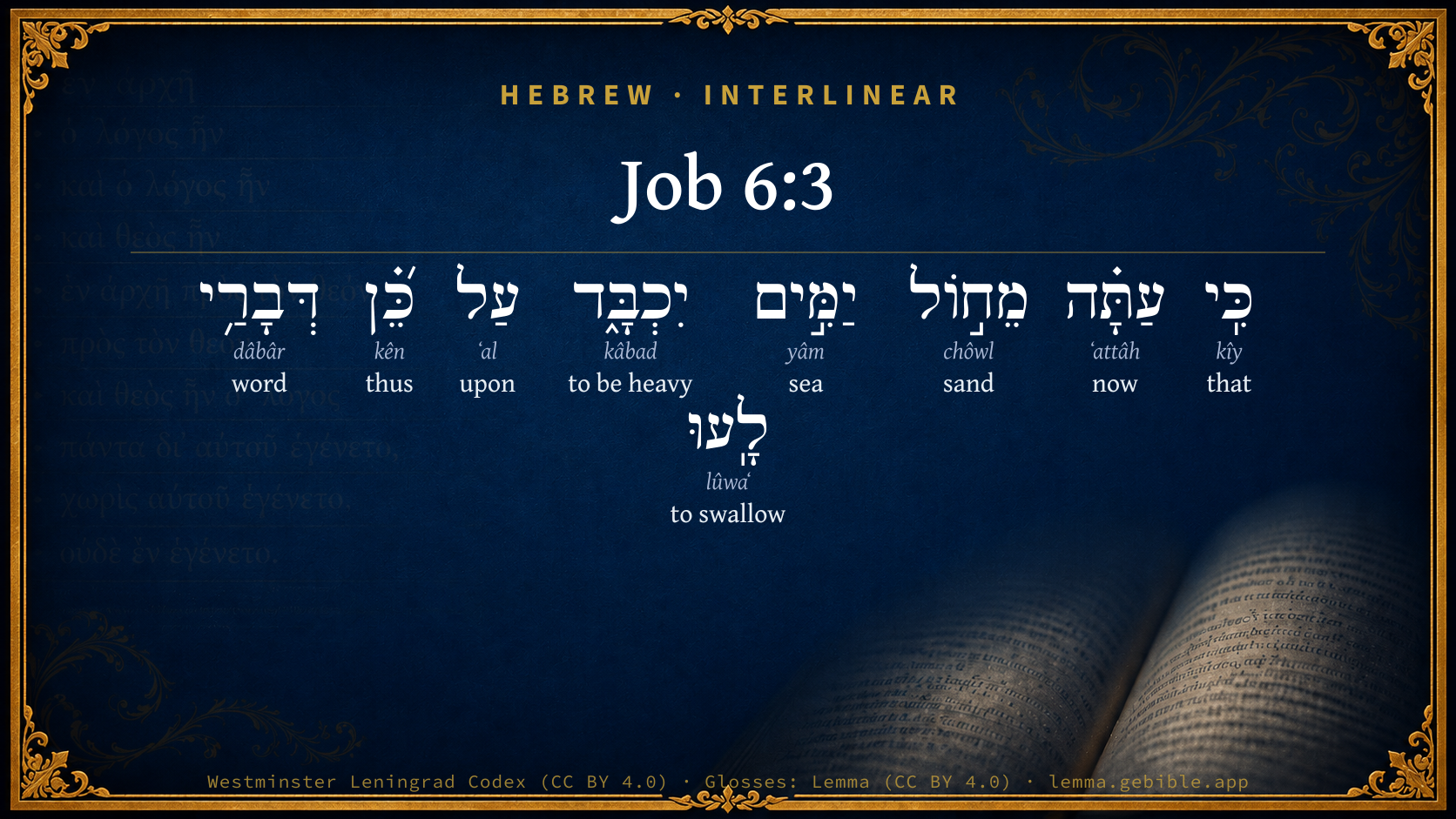
Hebrew (Westminster Leningrad Codex) Job 6:3 appears in the Hebrew Old Testament. The text above is from the Westminster Leningrad Codex. Each word links to its Strong’s number, a concise gloss, and parsing drawn from the Open Scriptures Hebrew Bible morphology. Click any word for its full Brown-Driver-Briggs (BDB) entry.
Download image
Cite this verse

Job 6:3 (World English Bible). Public Domain. Lemma interlinear Bible study tool, https://lemma.gebible.app/v/job/6/3.

Show BibTeX & RIS
BibTeX
RIS
English Translation
For now it would be heavier than the sand of the seas, Therefore have my words been rash.
World English Bible · Public Domain
Highlights
  • 1 first appearance in the Hebrew Bible
Full analysis ↓
Download a study sheet

One document with this verse’s original text, its word-by-word gloss line, the meaning frame, cross-references with their text, attributed commentary, and full source and license credits — printable, and it pastes into notes with its structure intact.

This verse Autodidact and up

Study sheet (.html) Plain text (.txt)

A passage Seminary Student

Up to 50 verses in one chapter. A passage sheet keeps up to 6 commentary sources and 12 cross-references per verse, in the order this page ranks them, and says so on the sheet whenever that leaves anything out. Ask for a single verse and you get the Autodidact verse sheet above.

Everything on this page stays free to read, with no account — the sheet is a download of what is already on screen, not access to it.

Want to remove ads? Support Godless Engineer
Compare translations 3

The same verse in 3 English versions, stacked beneath the original-language interlinear above. Click any original word for its lexicon entry.

Each is an independent rendering of the whole verse — the interlinear is not word-aligned to these translations.

Highlighted words mark where these versions differ — a whole-verse word diff, not a word-by-word alignment.

  • World English Bible Public Domain
    For now it would be heavier than the sand of the seas, Therefore have my words been rash.
  • King James Version Public Domain
    For now it would be heavier than the sand of the sea: therefore my words are swallowed up.
  • unfoldingWord Literal Text CC BY-SA 4.0
    For now it would be heavier than the sand of the seas; therefore my words raved.

unfoldingWord Literal Text — © unfoldingWord, licensed CC BY-SA 4.0. Word-aligned USFM3 via Door43 (git.door43.org/unfoldingWord/en_ult).

Versions to compare (up to 4)

3 of 4 selected

Show all 18 translations

Every available English version of this verse, each an independent rendering of the whole verse.

  • World English Bible Public Domain
    For now it would be heavier than the sand of the seas, Therefore have my words been rash.
  • Berean Standard Bible Public Domain
    For then it would outweigh the sand of the seas—no wonder my words have been rash.
  • Majority Standard Bible Public Domain
    For then it would outweigh the sand of the seas—no wonder my words have been rash.
  • King James Version Public Domain
    For now it would be heavier than the sand of the sea: therefore my words are swallowed up.
  • American Standard Version (1901) Public Domain
    For now it would be heavier than the sand of the seas: Therefore have my words been rash.
  • Revised Version (1885) Public Domain
    For now it would be heavier than the sand of the seas: therefore have my words been rash.
  • Geneva Bible (1599) Public Domain
    For it woulde be nowe heauier then the sande of the sea: therefore my wordes are swallowed vp.
  • Douay-Rheims (1899) Public Domain
    As the sand of the sea this would appear heavier: therefore my words are full of sorrow:
  • Young's Literal Translation Public Domain
    For now, than the sands of the sea it is heavier, Therefore my words have been rash.
  • Literal Standard Version CC BY-SA 4.0
    For now it is heavier than the sands of the sea, || Therefore my words have been rash.
  • Unlocked Literal Bible CC BY-SA 4.0
    For now it would be heavier than the sand of the seas. That is why my words were reckless.
  • unfoldingWord Literal Text CC BY-SA 4.0
    For now it would be heavier than the sand of the seas; therefore my words raved.
  • Darby Bible Public Domain
    For now it would be heavier than the sand of the seas; therefore my words are vehement.
  • World Messianic Bible Public Domain
    For now it would be heavier than the sand of the seas, therefore my words have been rash.
  • Webster's Bible Public Domain
    For now it would be heavier than the sand of the sea: therefore my words are swallowed up.
  • Free Bible Version CC BY-SA 4.0
    they would be heavier than the sand of the sea. That's why I spoke so rashly.
  • Bible in Basic English Public Domain
    For then its weight would be more than the sand of the seas: because of this my words have been uncontrolled.
  • JPS Tanakh (1917) Public Domain
    For now it would be heavier than the sand of the seas; therefore are my words broken.

Literal Standard Version (2020), Covenant Press — licensed CC BY-SA 4.0. Text via the HelloAO Bible API (eBible.org). Unlocked Literal Bible (unfoldingWord) — licensed CC BY-SA 4.0. Text via the HelloAO Bible API (eBible.org). unfoldingWord Literal Text — © unfoldingWord, licensed CC BY-SA 4.0. Word-aligned USFM3 via Door43 (git.door43.org/unfoldingWord/en_ult). Free Bible Version, Dr. Jonathan Gallagher — licensed CC BY-SA 4.0. Text via the HelloAO Bible API (eBible.org).

Word by word

More ways to search: Search by grammar → Find every occurrence → Compare this word →

Practice this passage: Drill this verse → Learn its vocabulary →

About this verse

These counts appear in no published source. They are computed here, from the morphology-tagged text and Lemma’s own curated glosses. What Lemma adds →

9
words
9
distinct lemmas
Wisdom
section

Notable vocabulary

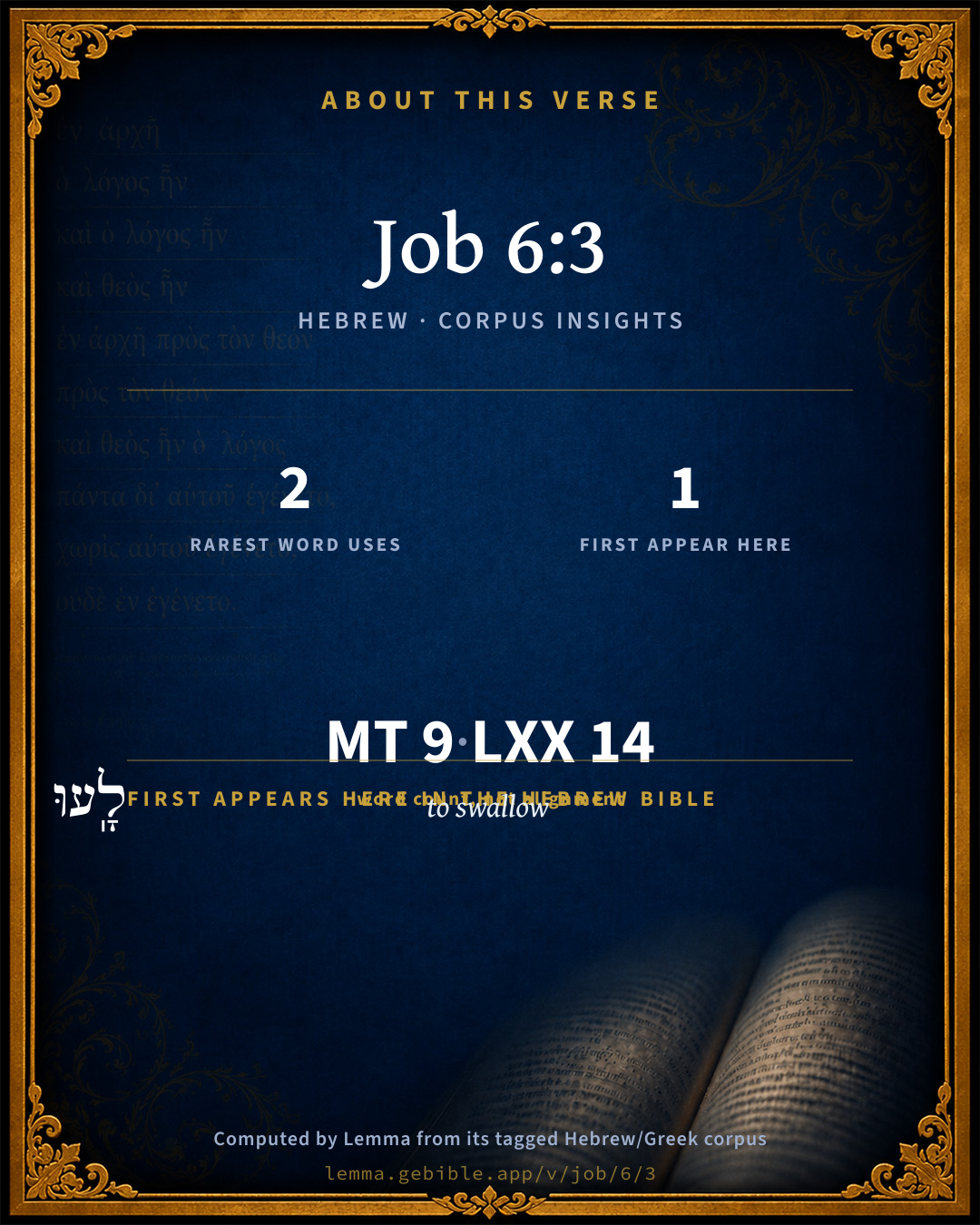
The rarest word here is לָֽעוּ to swallow H3886 — appearing just 2 times in the whole Hebrew Bible.

First appearance in Scripture

This word makes its first canonical appearance in the Hebrew Bible here:

  • לָֽעוּ to swallow H3886

Shared distinctive vocabulary

לָֽעוּ to swallow H3886 occurs in 2 verses of the Hebrew Bible. Also found in:

Grammatical profile

  • 2 verbs
  • 3 nouns
  • 1 preposition
  • 1 conjunction
  • 1 adverb
  • 1 particle

Verb forms

  • יִכְבָּ֑ד Qal · Imperfect
  • לָֽעוּ Qal · Perfect

Hebrew & Septuagint length

In English translation the verse runs 18 words from the Hebrew and 20 from the Septuagint (LXX English) — closely comparable.

A rough comparison of the two English renderings, which tokenize alike — not a word-level alignment.

Word counts can differ between the Hebrew and the Greek without any difference in meaning — e.g. the Hebrew direct-object marker אֵת has no separate Greek word, and Greek often adds the article ὁ.

In the original languages it is 9 Hebrew tokens and 14 Greek tokens — but the two are counted differently (Hebrew bundles its prefixes and suffixes into one token; the Greek is in lemma form), so that isn’t a like-for-like length.

Cross-references

6

Topical passages linked to Job 6:3 in the Treasury of Scripture Knowledge — connected by theme and wording, ordered by reader-vote popularity; previews shown in the World English Bible.

  • Proverbs 27:3 A stone is heavy, And sand is a burden; But a fool's provocation is heavier than both.
  • Job 23:2 "Even today is my complaint rebellious. His hand is heavy in spite of my groaning.
  • Job 37:19–20 Teach us what we shall tell him; For we can't make our case by reason of darkness.
  • Psalms 40:5 Many, Yahweh, my God, are the wonderful works which you have done, And your thoughts which are toward us. They can't be set in order to you; If I would declare and speak of them, they are more than can be numbered.
  • Psalms 77:4 You hold my eyelids open. I am so troubled that I can't speak.
  • Matthew 11:28 "Come to me, all you who labor and are heavily burdened, and I will give you rest.

Cross-references courtesy of OpenBible.info (CC BY 4.0).

Hebrew and Greek witnesses Masoretic Hebrew ↔ Greek Septuagint

The same verse in the two great witnesses to the Old Testament, shown verse-for-verse.

These are two independent witnesses, not word-aligned to each other, and the Septuagint is shown in lemma (dictionary) form.

Hebrew Job 6:3 Masoretic · Westminster Leningrad Codex

כִּֽי עַתָּ֗ה מֵח֣וֹל יַמִּ֣ים יִכְבָּ֑ד עַל כֵּ֝֗ן דְּבָרַ֥י לָֽעוּ

For now it would be heavier than the sand of the seas, Therefore have my words been rash.

World English Bible · Public Domain

Greek LXX Job 6:3 Septuagint · lemma form

καί δή ἄμμος παράλιος βαρύς εἰμί ἀλλά ὡς ἔοικα ὁ ῥῆμα ἐγώ εἰμί φαῦλος

And verily they would be heavier than the sand by the seashore: but, as it seems, my words are vain.

LXX2012 (modern English Septuagint) · Public Domain

On this verse, Albert Barnes' Notes on the Bible discusses the Septuagint’s reading. Read the note in Commentary ↓

Hebrew: Westminster Leningrad Codex (CC BY 4.0). Greek: Septuagint (public domain); English from LXX2012 (modern English Septuagint) (Public Domain). How the Septuagint differs from the Hebrew →

Commentary

Notes on Job 6:3 from classic Christian and Jewish commentators (each source and its license shown beneath its notes). The classic Christian expositions comment on the surrounding passage and are grouped to its opening verse, so a note may address several verses; the Jewish commentaries on the Tanakh (Rashi and others) are per-verse, so they appear only where the commentator wrote on this verse.

Lemma curates 59 commentaries, every one of them public domain or Creative Commons licensed, each selected and text-cleaned for this edition rather than reprinted as found. About our sources →

Trapp's Complete Commentary

John Trapp

Job 6:3 For now it would be heavier than the sand of the sea: therefore my words are swallowed up.

Ver. 3. For now it would be heavier than the sand of the sea] How light soever thou, O Eliphaz, esteemest it, as being in a prosperous condition. It is easy to swim in a warm bath; and every bird can sing in a sunshine day. But grief lieth like a load of lead upon the soul, heavy and cold; afflicting it, as an unsupportable burden doth the body. It so oppressed the poor Israelites in Egypt, that they had no mind to hearken to Moses, Exo 6:9. Solomon cries out, "A wounded spirit who can bear?" Pro 18:14. My soul is very heavy, and exceeding sorrowful, even unto death, saith our blessed Saviour, Mat 26:37-38, then when the Father made all our sins to meet upon him, and he bare our griefs and carried our sorrows, Isa 53:4; Isa 53:12. Sure it is, that had he not been God as well as man, he had been utterly crushed by that inconceivable weight of sin and wrath that he then groaned under. Oh what will all Christless persons do in hell, where God shall lay upon them and not spare! they would fain fly out of his hand, Job 27:22, but that cannot be.

Therefore my words are swallowed up] Vix loqui possum, vox faucibus haeret: I want words, which yet, if I had them at will, would be far too weak to utter the grief of my mind. Broughton rendereth it, Therefore my words fall short; they are semesa, saith Junius, half eaten before spoken; I am, as it were, gagged with grief; or, my words are even smothered up with sighs and sobs. Thus Job rhetoricates, and yet thinks himself greatly word bound.

John Trapp, A Commentary or Exposition upon All the Books of the Old and New Testament (1647–1656) — public domain. Text from a community e-Sword module.

Joseph Benson's Commentary

Job 6:3. For now it — That is, my grief or calamity; would be heavier than the sand of the sea — Which is much heavier than dry sand. Therefore my words are swallowed up — My voice and spirit fail me. I cannot find or utter words sufficient to express my sorrow or misery.

Joseph Benson's Commentary on the Old and New Testaments (1811–1818) — public domain. Text from a community e-Sword module.

Tyndale Open Study Notes

Tyndale Open Resources

6:3-4 In the Old Testament, arrows are associated with supernatural peril, pestilence, and destructive ills (7:20; 16:12-13; Deut 32:23-24, 42; Pss 7:12-13; 38:2; 64:7; 91:5-6; Lam 2:4; 3:12-13; Ezek 5:16).

Tyndale Open Study Notes — © Tyndale Open Resources, licensed CC BY-SA 4.0. Text via the HelloAO Bible API.

Geneva Bible (1599)

Geneva Bible translators

My grief is so great that I lack words to express it.

Geneva Bible (1599) marginal notes — public domain. Text via Bolls.life.

Jamieson, Fausset & Brown

Robert Jamieson, A. R. Fausset & David Brown

the sand-- (Pro 27:3).

are swallowed up--See Margin [that is, "I want words to express my grief"]. But Job plainly is apologizing, not for not having had words enough, but for having spoken too much and too boldly; and the Hebrew is, "to speak rashly" [UMBREIT, GESENIUS, ROSENMULLER]. "Therefore were my words so rash."

Jamieson, Fausset & Brown — Commentary Critical and Explanatory on the Whole Bible (1871) — public domain (CC PDM 1.0). Text via the HelloAO Bible API.

Adam Clarke's Commentary

Verse 3. Heavier than the sand of the sea] This includes two ideas: their number was too great to be counted; their weight was too great to be estimated.

Adam Clarke's Commentary on the Bible (1810–1826) — public domain. Text from a community e-Sword/MySword module.

Ellicott's Commentary for English Readers

(3) Swallowed up.—That is. words are useless and powerless to express it. (See the margin.)

A Bible Commentary for English Readers, edited by Charles John Ellicott (1878–1897) — public domain. Text from a community e-Sword module.

The Cambridge Bible for Schools and Colleges

gen. ed. J. J. S. Perowne

3. the sand of the sea] A frequent figure for that which is infinite in weight, Pro_27:3, or number, Gen_32:12, or measure, Jer_33:22.

are swallowed up] Rather, have been wild, or perhaps vain or idle. Probably the word is allied to an Arabic root that signifies to speak, and also, to speak wrongly and foolishly. Job with transparent simplicity concedes a certain extravagance in his language, although he excuses it (Job_6:4 seq.). Elsewhere he says in reference to himself that the words of one that is desperate go into the wind (Job_6:26).

The Cambridge Bible for Schools and Colleges (gen. ed. J. J. S. Perowne; Cambridge University Press, 1878–1918) — public domain. Text from a community e-Sword module.

John Gill's Exposition

For now it would be heavier than the sand of the sea,.... Or "seas" (z); all sand is heavy in its own nature, Pro 27:3; especially the sand of the sea, that which is immediately taken out of it; for that on the shore is lighter, being dried by the winds and heat of the sun, but the other is heavier, through the additional weight of water; and much more especially how heavy must all the sand of the sea be, and of all the seas that are in the world: yet Job suggests by this hyperbolical expression, exaggerating his case, that his affliction was heavier than it all, a most intolerable and insupportable burden; the afflictions of God's people are but light when compared with what their sins deserve, with the torments of the damned in hell, with the sufferings of Christ in their room and stead, and with everlasting, happiness, the eternal weight of glory, Co2 4:17; but in themselves they are heavy, and press hard; they are so to flesh and blood, and especially unless everlasting arms are put under men, and they are supported and upheld with the right hand of God's righteousness; they are heavy when attended with the hidings of God's face, and a sense of his wrath and displeasure, which was Job's case, see Job 13:24; some render "it more copious", or "numerous" (a), and indeed the word has this signification, as in Num 20:20; and the metaphor is more frequently used to express a multitude, even what is innumerable, Hos 1:10; yet the notion of heaviness best agrees with the preceding figure of weighing in balances, and therefore at least is not to be excluded some learned men take in both, as the sense of the word, the number of afflictions, and the bulk and weight of them:

therefore my words are swallowed up; either by his friends, as Kimchi, who heard them, and put a wrong construction on them, without thoroughly examining the true sense of them; as men that swallow down their food greedily, do not chew it, nor take the true taste of it, and so are no judges whether it is good or bad; but this sense seems to have no connection with what goes before; rather they were swallowed up by himself, and the meaning either is, that such was the weight and pressure of his afflictions, that he wanted words to express it; his words "failed" him, as the Targum: or they "come short", as Mr. Broughton renders it; they were not sufficient to set forth and declare the greatness of his troubles; or he faltered in his speech, he could not speak out plainly and distinctly, because of his grief and sorrow, see Psa 77:4; what he had said was delivered amidst sighs and sobs, through the heaviness of the calamity on him; they were but half words, attended with groanings that could not be uttered; by which he would signify, that though his friends had charged him with speaking too much and too freely, he had not spoken enough, nor could he, by reason of the greatness of his affliction; and also to excuse his present answer, if it was not delivered with that politeness and fulness of expression, with that eloquence and strength of reasoning and discoursing he at other times was capable of: or rather the words may be rendered, "therefore my words break out with heat" (b); in a vehement manner, in a hot and passionate way I am blamed for; but this is to be imputed to the burden of affliction and sorrow upon me, which, if considered, some allowances would be made, and the charge be alleviated.

(z) "marium", Pagninus, Montanus, Mercerus, Piscator, Michaelis, Schultens. (a) "copiosior et gravior est", Michaelis; so Schultens. (b) "propterea verba mea aestuantia sunt", Schultens.

John Gill's Exposition of the Whole Bible (1746–1763) — public domain (CC PDM 1.0). Text via the HelloAO Bible API.

Albert Barnes' Notes on the Bible

Heavier than the sand of the sea - That is, they would be found to be insupportable. Who could bear up the sands of the sea? So Job says of his sorrows. A comparison somewhat similar is found in Pro 27:3.

Heavy is a stone, and weighty the sand of the Sea,

But a fool’s wrath is heavier than them both.

My words are swallowed up - Margin, “I want words to express my grief.” This expresses the true sense - but not with the same poetic beauty. We express the same idea when we say that we are choked with grief; we are so overwhelmed with sorrow that we cannot speak. Any very deep emotion prevents the power of utterance. So in Psa 77:4 :

Thou holdest mine eyes waking:

I am so troubled that I cannot speak.

So the well-known expressions in Virgil,

Obstupui, steteruntque comae, et vox faucibus haesit.

There has been, however, considerable variety in the interpretation of the word here rendered swallowed up - לוּע lûa‛. Gesenius supposes that it means to speak rashly, to talk at random, and that the idea is, that Job now admits that his remarks had been unguarded - “therefore were my words rash.” The same sense Castell gives to the Arabic word. Schultens renders it, “therefore are my words tempestuous or fretful.” Rosenmuller, “my words exceed due moderation.” Castellio, “my words fail.” Luther, “therefore it is vain that I speak.” The Septuagint, “but my words seem to be evil.” Jerome, “my words are full of grief.” In this variety it is difficult to determine the meaning; but probably the old interpretation is to be retained, by which the word is derived from לוּע lûa‛, to absorb, to swallow up; compare Pro 20:25; Oba 1:16; Job 39:30; Pro 23:2. The word does not elsewhere occur.

Albert Barnes' Notes on the Bible (1834–1885) — public domain. Text from a community e-Sword/MySword module.

Haydock's Catholic Bible Commentary

Heavier. The figure hyperbole is frequently used in Scripture, to give us some idea of what surpasses our understanding. Job intimates that he punishment was incomparably greater than his sins. As he and other saints, particularly our Saviour and the blessed Virgin [Mary], have thus patiently suffered more than they had deserved, these merits form part of that treasure of the Church, out of which the pope and bishops are empowered to dispense indulgences, to release people from the pains due to sin, either in this world or in purgatory. (Worthington) --- Septuagint, "Yea, these (sorrows) are heavier than the sand of the seashore. But, it seems my words are wicked." (Haydock)

George Leo Haydock (1774–1849), Haydock's Catholic Family Bible and Commentary, 1859 edition — public domain. Excludes Psalms (Douay-Rheims chapter numbering differs from Protestant) and Deuterocanonical books (Catholic canon only).

Matthew Poole's English Annotations

It would be heavier, i.e. my grief or calamity,

than the sand of the sea, which is heavier than dry sand.

Swallowed up, as this verb is used, Pro 20:25; Oba 1:16. My voice and spirit faileth me. So far am I from speaking too liberally of it, for which I am now accused, that I cannot find nor utter words sufficient to express my sorrow or misery; but my groanings are such as cannot be uttered, as is said in another case, Rom 8:26. When I would express it, the words stick in my throat, and I am forced, as it were, to swallow them up.

Matthew Poole's English Annotations on the Holy Bible (1683–1685) — public domain. Text from a community e-Sword/MySword module.

Whedon's Commentary on the Bible

Daniel D. Whedon

3. Sand of the sea — A figure also common in the classic writers for what cannot be measured or numbered. Compare Hos_1:10. Swallowed up — לעו. Better, Therefore do my words rave. A candid admission! The proper acknowledgment of one’s error is a mark of a truly noble mind. Castell gives the meaning of the cognate word in Arabic as, “to be rash,” which Gesenius (Thesaurus, 758) and Furst both accept as the basis and meaning of the word here. The secret of his wild words lies in his inexpressible, unweighable misery.

Daniel D. Whedon (gen. ed.), Commentary on the Old and New Testaments (1874–1909) — public domain. Text from a community e-Sword module.

The Pulpit Commentary

For now it would be heavier than the sand of the sea. (comp. Pro_27:3, "A stone is heavy, and the sand weighty; but a fool"s wrath is heavier than them both;" see also Ecc 22:15) Therefore my words are swallowed up; rather, as in the Revised Version, therefore have my words been rash. Job here excuses without justifying himself. The excessive character of his sufferings has, he declares, forced him to utter rash and violent words, as these wherein he cursed his day and wished that he had never been born. (Psa_38:2, "For thine arrows stick fast in me So Shakespeare speaks of "the slings and arrows el outrageous fortune" for calamities generally. The metaphor is a very common one. (see Deu_32:23, 42 Psa_7:13 Psa_21:12 Psa_45:5 Lam_3:13, Lam_3:14) The poison whereof. Poisoned arrows, such as are now employed by the savage tribes of Central Africa, were common in antiquity, though seldom used by civilized nations. Ovid declares that the Scythians of his time made use of them ("Tristia," 1, 2). Drinketh up my spirit; rather, my spirit drinketh up. Job"s spirit absorbs the poison that festers in his wounds, and therefore loses control over itself. This is his apology for his vehemence; he is well-nigh distraught. He adds, The terrors of God do set themselves in array against me. Besides actual pains and sufferings, he is assailed by fears. God"s terrors, i.e. all the other evils that he has at his disposal, are drawn up against him, as it were, in battle array, and still further agitate and distract his soul. What further troubles may not God bring upon him?

"The arrows of the Almighty.

The first thought that occurs to Job when he attempts to describe his trouble to his misjudging friend is that that trouble has been produced by shafts from heaven. Here is the exceeding bitterness of his grief. He regards his calamities as more than natural mischances; such a terrible conjunction of disasters points to a superhuman source. Thus Job is Scourged by his faith. His theism adds an agony which the materialist would not feel.

I THE TERROR OF THE ARROWS OF THE ALMIGHTY.

1. They are impelled by an irresistible power. They are shot by "El Shaddai." God in his power is conceived of as the Source of the troubles. But none can resist the might of God. No wonder Job is prostrate in despair. It is useless for him to stand up against his adversary. The shield of faith may "quench all the fiery darts of the wicked"; (Eph_6:16) but no shield can keep off the piercing arrows of the Almighty If God is against us, we are utterly undone.

2. They come from the Source of light and blessing. God had been showering blessings on the head of the patriarch, who had learnt to honour him as his Benefactor. It was hard, indeed, to find his great Friend turned into a Foe. This fact made the wounds pain as with deadly venom. It is fearful to think that our Father in heaven is shooting wrath against his children. No arrows are so keen as the arrows of love.

3. They penetrate to the heart. Earthly calamities strike the outer life. We may have ramparts and bastions that keep them off from our true self. But God"s arrows penetrate to the citadel of the soul He reaches the heart whenever he smites. We can bear outside distresses so long as we keep up a stout heart; but the wounds of the inner man are deadly.

II THE MISAPPREHENSION OF THE ARROWS OF THE ALMIGHTY.

1. The error of ascribing to God what he has not sent. Job thinks that God is his Adversary, but the prologue shows that the adversary is Satan. Of the Satanic cause of his trouble Job has not the least conception. He ascribes it all to God. Thus he is mistaken, unjust, and needlessly dismayed. If he had but known that he was suffering from the arrows of Satan, he would have been more courageous and hopeful. May we not be in error in ascribing to God what he never sends? The evil state of society causes many troubles to the poor, which God does not wish them to suffer from- We cannot charge him with the terrible wrongs of a corrupt civilization which darken the slums of great cities. Our worst woes come from the devil within from our own heart of sin.

2. When God does smite, his purpose is good. Job was so far right that God had some hand in his sufferings, for God had permitted Satan to go to the great length in tormenting Job that he had now reached.

(1) There is a smiting to heal Grievous chastisement is a discipline of love. We think that the arrow poisons us; what it really brings is a needed astringent.

(2) There must be a smiting of judgment. God cannot suffer his rebellious creatures to sin with impunity. Though Job had not felt them, God has terrible arrows of judgment for the impenitent. It is well if we learn the lesson of the milder wounds of chastisement before those terrors burst over us. W.F.A.

The Pulpit Commentary (1880–1919), ed. H.D.M. Spence-Jones & Joseph S. Exell — public domain. Text from a community e-Sword module.

John Wesley's Explanatory Notes

Sea - Which is heavier than dry sand. Swallowed - My voice and spirit fail me. I cannot find, or utter words sufficient to express my sorrow or misery.

John Wesley, Explanatory Notes Upon the Whole Bible (1754–1765) — public domain. Text via the GEBible commentary corpus.

Rashi

Rabbi Shlomo Yitzchaki (Rashi)

stammer Heb. לעו. They are uncertain, like a person who has no strength to pronounce a word properly. Likewise (Obad. 16), “And they shall drink and stammer (ולעו),” because it is usual for a drunkard to stammer in his speech.

Rashi on the Tanakh — English translations: “The Judaica Press complete Tanach with Rashi, translated by A. J. Rosenberg” (CC BY 4.0); “Pentateuch with Rashi's commentary by M. Rosenbaum and A.M. Silbermann, 1929-1934” (public domain); “The Metsudah Tanach series, Lakewood, N.J” (CC BY 4.0); and “The Book of Joshua, Metsudah Publications, 1997” (CC BY 4.0). Text via Sefaria.

Lesson kit

Teaching starters — assembled from the data on this page, not authored interpretation. Every prompt links to the verse data it draws on. Edit before teaching.

Job, in the Wisdom, opens this verse with 9 words (9 distinct Hebrew lemmas). Its most distinctive word is lûwaʻ (“to swallow”). A historical commentator’s framing appears above. Read the whole chapter for the surrounding context.

Discussion questions

  1. The word lûwaʻ carries the sense “to swallow.” How does it shape the verse?
  2. The word “to swallow” first appears here in Scripture. What is being introduced at this debut?
  3. Obadiah 1:16 shares the word «to swallow» with this verse. How do the two illuminate each other?
  4. These translations render this verse differently. What is at stake in choosing one wording over another?
  5. The verb «יִכְבָּ֑ד» is Qal Imperfect. How does its form color the action?
  6. Reading how Trapp's Complete Commentary and Joseph Benson's Commentary read this verse, where do the two commentators agree and where do they part?

Things to notice

Reading settings

Reading text

Shown beneath each verse's original-language words.

Old Testament
Old Testament edition

Read the OT as the Masoretic Hebrew (MT) or the Greek Septuagint (LXX).

English shown for the Greek Septuagint (in the Hebrew ↔ Greek comparison).

Comparing translations? Open the Compare panel on any verse page to stack up to four side by side.