Daniel 11:45

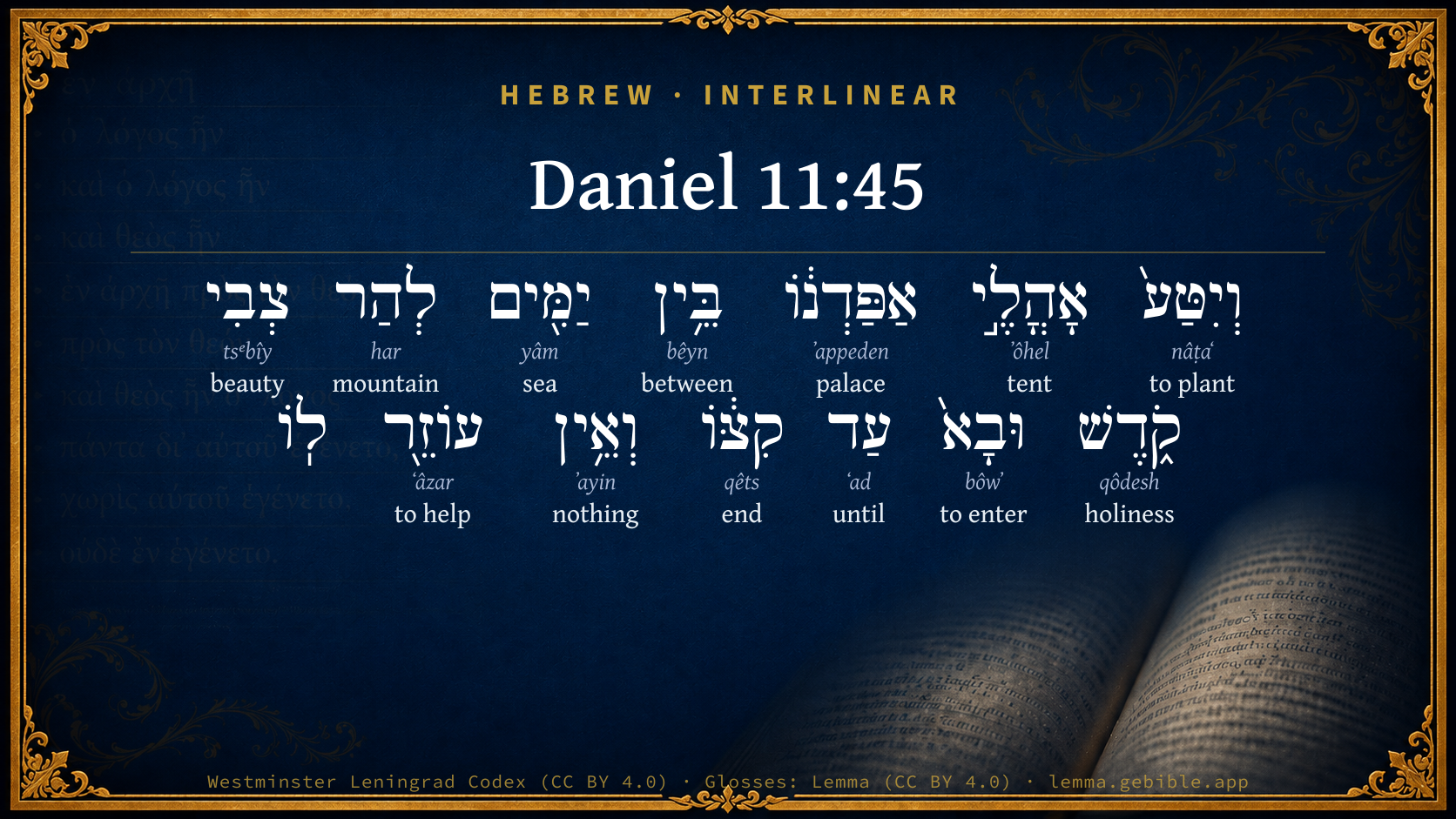
Hebrew (Westminster Leningrad Codex) Daniel 11:45 appears in the Hebrew Old Testament. The text above is from the Westminster Leningrad Codex. Each word links to its Strong’s number, a concise gloss, and parsing drawn from the Open Scriptures Hebrew Bible morphology. Click any word for its full Brown-Driver-Briggs (BDB) entry.
Download image
Cite this verse

Daniel 11:45 (World English Bible). Public Domain. Lemma interlinear Bible study tool, https://lemma.gebible.app/v/daniel/11/45.

Show BibTeX & RIS
BibTeX
RIS
English Translation
He shall plant the tents of his palace between the sea and the glorious holy mountain; yet he shall come to his end, and none shall help him.
World English Bible · Public Domain
Highlights
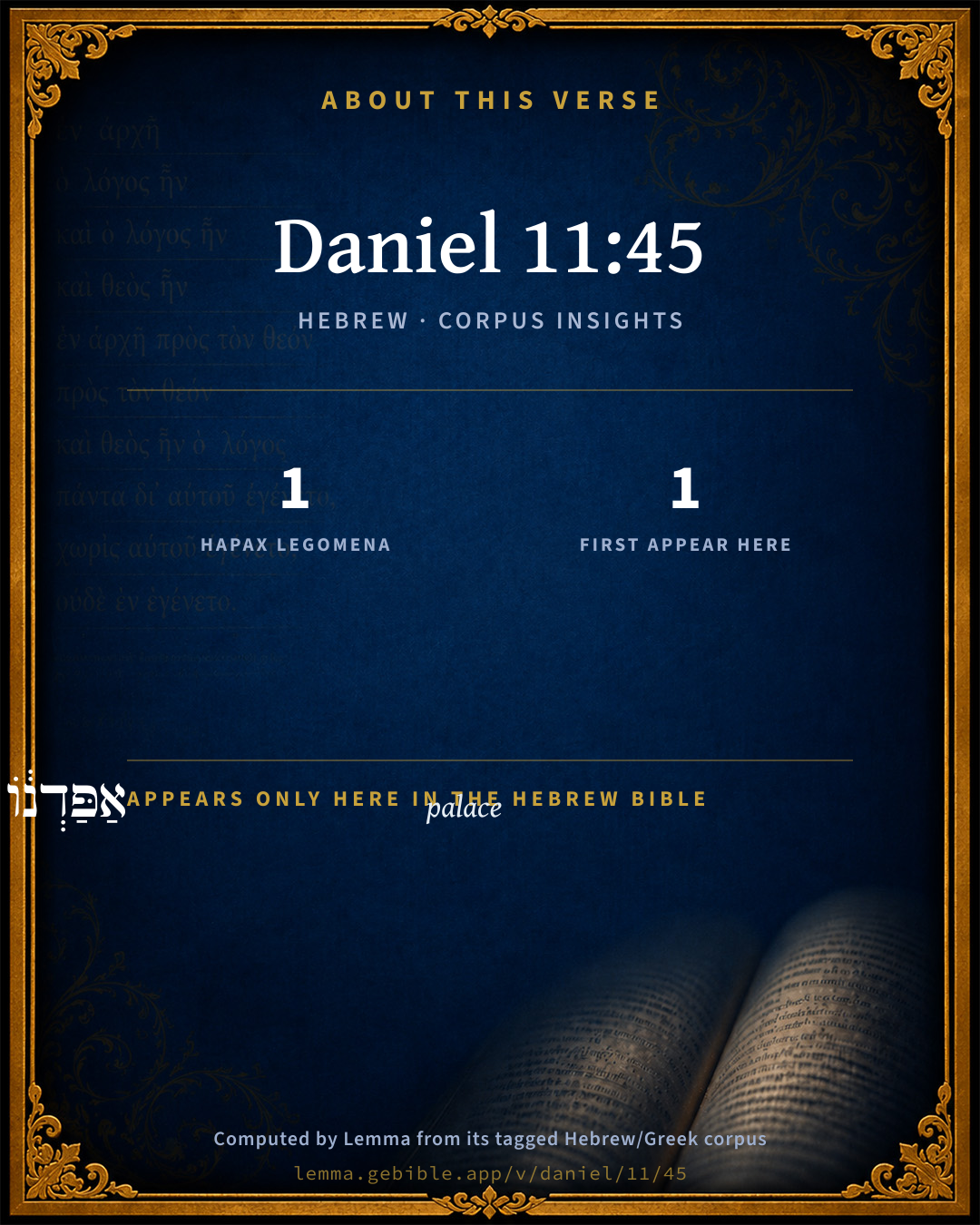
  • 1 hapax legomenon — only here in the Hebrew Bible
  • 1 first appearance in the Hebrew Bible
Full analysis ↓
Download a study sheet

One document with this verse’s original text, its word-by-word gloss line, the meaning frame, cross-references with their text, attributed commentary, and full source and license credits — printable, and it pastes into notes with its structure intact.

This verse Autodidact and up

Study sheet (.html) Plain text (.txt)

A passage Seminary Student

Up to 50 verses in one chapter. A passage sheet keeps up to 6 commentary sources and 12 cross-references per verse, in the order this page ranks them, and says so on the sheet whenever that leaves anything out. Ask for a single verse and you get the Autodidact verse sheet above.

Everything on this page stays free to read, with no account — the sheet is a download of what is already on screen, not access to it.

Want to remove ads? Support Godless Engineer
Compare translations 3

The same verse in 3 English versions, stacked beneath the original-language interlinear above. Click any original word for its lexicon entry.

Each is an independent rendering of the whole verse — the interlinear is not word-aligned to these translations.

Highlighted words mark where these versions differ — a whole-verse word diff, not a word-by-word alignment.

  • World English Bible Public Domain
    He shall plant the tents of his palace between the sea and the glorious holy mountain; yet he shall come to his end, and none shall help him.
  • King James Version Public Domain
    And he shall plant the tabernacles of his palace between the seas in the glorious holy mountain; yet he shall come to his end, and none shall help him.
  • unfoldingWord Literal Text CC BY-SA 4.0
    He will pitch his palatial tents between the seas and the beautiful holy mountain. Yet he will come to his end, and no one will help him.

unfoldingWord Literal Text — © unfoldingWord, licensed CC BY-SA 4.0. Word-aligned USFM3 via Door43 (git.door43.org/unfoldingWord/en_ult).

Versions to compare (up to 4)

3 of 4 selected

Show all 18 translations

Every available English version of this verse, each an independent rendering of the whole verse.

  • World English Bible Public Domain
    He shall plant the tents of his palace between the sea and the glorious holy mountain; yet he shall come to his end, and none shall help him.
  • Berean Standard Bible Public Domain
    He will pitch his royal tents between the sea and the beautiful holy mountain, but he will meet his end with no one to help him.
  • Majority Standard Bible Public Domain
    He will pitch his royal tents between the sea and the beautiful holy mountain, but he will meet his end with no one to help him.
  • King James Version Public Domain
    And he shall plant the tabernacles of his palace between the seas in the glorious holy mountain; yet he shall come to his end, and none shall help him.
  • American Standard Version (1901) Public Domain
    And he shall plant the tents of his palace between the sea and the glorious holy mountain; yet he shall come to his end, and none shall help him.
  • Revised Version (1885) Public Domain
    And he shall plant the tents of his palace between the sea and the glorious holy mountain; yet he shall come to his end, and none shall help him.
  • Geneva Bible (1599) Public Domain
    And he shall plant the tabernacles of his palace betweene the seas in the glorious and holy mountaine, yet he shall come to his end, and none shall helpe him.
  • Douay-Rheims (1899) Public Domain
    And he shall fix his tabernacle Apadno between the seas, upon a glorious and holy mountain: and he shall come even to the top thereof, and none shall help him.
  • Young's Literal Translation Public Domain
    and he planteth the tents of his palace between the seas and the holy desirable mountain, and hath come unto his end, and there is no helper to him.
  • Literal Standard Version CC BY-SA 4.0
    and he plants the tents of his palace between the seas and the holy desirable mountain, and has come to his end, and there is no helper to him.”
  • Unlocked Literal Bible CC BY-SA 4.0
    He will set up the tent of his royal residence between the seas and the mountain of the beauty of holiness. He will come to his end, and there will be no helper for him.
  • unfoldingWord Literal Text CC BY-SA 4.0
    He will pitch his palatial tents between the seas and the beautiful holy mountain. Yet he will come to his end, and no one will help him.
  • Darby Bible Public Domain
    And he shall plant the tents of his palace between the sea and the mountain of holy beauty; and he shall come to his end, and there shall be none to help him.
  • World Messianic Bible Public Domain
    He will plant the tents of his palace between the sea and the glorious holy mountain; yet he will come to his end, and no one will help him.
  • Webster's Bible Public Domain
    And he shall plant the tabernacles of his palace between the seas in the glorious holy mountain: yet he shall come to his end, and none shall help him.
  • Free Bible Version CC BY-SA 4.0
    He will set up his royal camp between the sea and the beautiful holy mountain. But he will die with no one to help him.
  • Bible in Basic English Public Domain
    He will put the tents of his great house between the sea and the beautiful holy mountain: but he will come to his end with no helper.
  • JPS Tanakh (1917) Public Domain
    And he shall plant the tents of his palace between the seas and the beauteous holy mountain; and he shall come to his end, and none shall help him.

Literal Standard Version (2020), Covenant Press — licensed CC BY-SA 4.0. Text via the HelloAO Bible API (eBible.org). Unlocked Literal Bible (unfoldingWord) — licensed CC BY-SA 4.0. Text via the HelloAO Bible API (eBible.org). unfoldingWord Literal Text — © unfoldingWord, licensed CC BY-SA 4.0. Word-aligned USFM3 via Door43 (git.door43.org/unfoldingWord/en_ult). Free Bible Version, Dr. Jonathan Gallagher — licensed CC BY-SA 4.0. Text via the HelloAO Bible API (eBible.org).

Word by word

More ways to search: Search by grammar → Find every occurrence → Compare this word →

Practice this passage: Drill this verse → Learn its vocabulary →

אַפַּדְנ֔וֹ
ʼappeden
H643
“palace · his”
Noun, Common, Masculine, Singular, Construct + Suffix, Personal, 3rd Person, Masculine, Singular
Part of Speech
Noun
Type
Common
Gender
Masculine
Number
Singular
State
Construct
Full BDB Definition

Origin: apparently of foreign derivation

TWOT: 142 . 2

palace
  1. וְיִטַּע֙ nâṭaʻ H5193 “and · to plant” Conjunction + Verb, Qal, Imperfect, 3rd Person, Masculine, Singular
  2. אָהֳלֶ֣י ʼôhel H168 “tents of” Noun, Common, Masculine, Plural, Construct
  3. בֵּ֥ין bêyn H996 “between” Preposition
  4. יַמִּ֖ים yâm H3220 “seas” Noun, Common, Masculine, Plural, Absolute
  5. לְהַר har H2022 “to/for · mountain of” Preposition + Noun, Common, Masculine, Singular, Construct
  6. צְבִי tsᵉbîy H6643 “beauty of” Noun, Common, Masculine, Singular, Construct
  7. קֹ֑דֶשׁ qôdesh H6944 “holiness” Noun, Common, Masculine, Singular, Absolute
  8. וּבָא֙ bôwʼ H935 “and · to enter” Conjunction + Verb, Qal, Sequential Perfect, 3rd Person, Masculine, Singular
  9. עַד ʻad H5704 “until” Preposition
  10. קִצּ֔וֹ qêts H7093 “end · his” Noun, Common, Masculine, Singular, Construct + Suffix, Personal, 3rd Person, Masculine, Singular
  11. וְאֵ֥ין ʼayin H369 “and · nothing” Conjunction + Particle, Negative
  12. עוֹזֵ֖ר ʻâzar H5826 “helping” Verb, Qal, Participle Active, Masculine, Singular, Absolute

About this verse

These counts appear in no published source. They are computed here, from the morphology-tagged text and Lemma’s own curated glosses. What Lemma adds →

14
words
13
distinct lemmas
Prophets
section

Notable vocabulary

1 hapax legomenon — a word that appears only here in the entire Hebrew Bible:

  • אַפַּדְנ֔וֹ palace H643

First appearance in Scripture

This word makes its first canonical appearance in the Hebrew Bible here:

  • אַפַּדְנ֔וֹ palace H643

Shared distinctive vocabulary

צְבִי beauty H6643 occurs in 32 verses of the Hebrew Bible. Also found in:

Grammatical profile

  • 3 verbs
  • 7 nouns
  • 3 prepositions
  • 1 particle

Verb forms

  • וְיִטַּע֙ Qal · Imperfect
  • וּבָא֙ Qal · Sequential Perfect
  • עוֹזֵ֖ר Qal · Participle Active

Hebrew & Septuagint length

In English translation the verse runs 28 words from the Hebrew and 32 from the Septuagint (LXX English) — closely comparable.

A rough comparison of the two English renderings, which tokenize alike — not a word-level alignment.

Word counts can differ between the Hebrew and the Greek without any difference in meaning — e.g. the Hebrew direct-object marker אֵת has no separate Greek word, and Greek often adds the article ὁ.

Cross-references

20

Topical passages linked to Daniel 11:45 in the Treasury of Scripture Knowledge — connected by theme and wording, ordered by reader-vote popularity; previews shown in the World English Bible.

  • 2 Thessalonians 2:4 he who opposes and exalts himself against all that is called God or that is worshiped; so that he sits as God in the temple of God, setting himself up as God.
  • Daniel 8:25 Through his policy he shall cause craft to prosper in his hand; and he shall magnify himself in his heart, and in [their] security shall he destroy many: he shall also stand up against the prince of princes; but he shall be broken without hand.
  • Isaiah 2:2 It shall happen in the latter days, that the mountain of Yahweh's house shall be established on the top of the mountains, And shall be raised above the hills; And all nations shall flow to it.
  • Isaiah 14:13 You said in your heart, I will ascend into heaven, I will exalt my throne above the stars of God; and I will sit on the mountain of congregation, in the uttermost parts of the north;
  • Ezekiel 38:22–23 With pestilence and with blood will I enter into judgment with him; and I will rain on him, and on his hordes, and on the many peoples who are with him, an overflowing shower, and great hailstones, fire, and sulfur.
  • Ezekiel 39:2 and I will turn you about, and will lead you on, and will cause you to come up from the uttermost parts of the north; and I will bring you on the mountains of Israel;
  • Daniel 2:35 Then was the iron, the clay, the brass, the silver, and the gold, broken in pieces together, and became like the chaff of the summer threshing floors; and the wind carried them away, so that no place was found for them: and the stone that struck the image became a great mountain, and filled the whole earth.
  • Daniel 7:26 But the judgment shall be set, and they shall take away his dominion, to consume and to destroy it to the end.
  • Daniel 11:16 But he who comes against him shall do according to his own will, and none shall stand before him; and he shall stand in the glorious land, and in his hand shall be destruction.
  • Daniel 11:41 He shall enter also into the glorious land, and many [countries] shall be overthrown; but these shall be delivered out of his hand: Edom, and Moab, and the chief of the children of Ammon.
  • Joel 2:20 But I will remove the northern army far away from you, And will drive it into a barren and desolate land, Its front into the eastern sea, And its back into the western sea; And its stench will come up, And its bad smell will rise." Surely he has done great things.
  • Micah 4:2 Many nations will go and say, "Come, and let us go up to the mountain of Yahweh, And to the house of the God of Jacob; And he will teach us of his ways, And we will walk in his paths." For out of Zion will go forth the law, And the word of Yahweh from Jerusalem;
  • Zechariah 14:8 It will happen in that day, that living waters will go out from Jerusalem; half of them toward the eastern sea, and half of them toward the western sea; in summer and in winter will it be.
  • 2 Thessalonians 2:8 Then the lawless one will be revealed, whom the Lord will kill with the breath of his mouth, and bring to nothing by the brightness of his coming;
  • Revelation 13:10 If anyone has captivity, he will go. If anyone is with the sword, he must be killed. Here is the endurance and the faith of the saints.
  • Revelation 14:14–20 I looked, and behold, a white cloud; and on the cloud one sitting like a son of man, having on his head a golden crown, and in his hand a sharp sickle.
  • Revelation 19:19–21 I saw the beast, and the kings of the earth, and their armies, gathered together to make war against him who sat on the horse, and against his army.
  • Revelation 20:2 He seized the dragon, the old serpent, which is the devil and Satan, who deceives the whole inhabited earth, and bound him for a thousand years,
  • Revelation 20:9 They went up over the breadth of the earth, and surrounded the camp of the saints, and the beloved city. Fire came down out of heaven from God, and devoured them.
  • Psalms 48:2 Beautiful in elevation, the joy of the whole earth, Is Mount Zion, on the north sides, The city of the great King.

Cross-references courtesy of OpenBible.info (CC BY 4.0).

Hebrew and Greek witnesses Masoretic Hebrew ↔ Greek Septuagint

The same verse in the two great witnesses to the Old Testament, shown verse-for-verse.

These are two independent witnesses, not word-aligned to each other, and the Septuagint is shown in lemma (dictionary) form.

Hebrew Daniel 11:45 Masoretic · Westminster Leningrad Codex

וְיִטַּע֙ אָהֳלֶ֣י אַפַּדְנ֔וֹ בֵּ֥ין יַמִּ֖ים לְהַר צְבִי קֹ֑דֶשׁ וּבָא֙ עַד קִצּ֔וֹ וְאֵ֥ין עוֹזֵ֖ר לֽוֹ

He shall plant the tents of his palace between the sea and the glorious holy mountain; yet he shall come to his end, and none shall help him.

World English Bible · Public Domain

Greek LXX Daniel 11:45 Septuagint · lemma form

καί ἵστημι αὐτός ὁ σκηνή τότε ἀνά μέσος ὁ θάλασσα καί ὁ ὄρος ὁ θελήσις ὁ ἅγιος καί ἥκω ὥρα ὁ συντέλεια αὐτός καί οὐ εἰμί ὁ βοηθέω αὐτός

And he shall pitch the tabernacle of his palace between the seas in the holy mountain of beauty: but he shall come to his portion, and there is none to deliver him.

LXX2012 (modern English Septuagint) · Public Domain

On this verse, Ellicott's Commentary for English Readers discusses the Septuagint’s reading. Read the note in Commentary ↓

Hebrew: Westminster Leningrad Codex (CC BY 4.0). Greek: Septuagint (public domain); English from LXX2012 (modern English Septuagint) (Public Domain). How the Septuagint differs from the Hebrew →

Commentary

Notes on Daniel 11:45 from classic Christian and Jewish commentators (each source and its license shown beneath its notes). The classic Christian expositions comment on the surrounding passage and are grouped to its opening verse, so a note may address several verses; the Jewish commentaries on the Tanakh (Rashi and others) are per-verse, so they appear only where the commentator wrote on this verse.

Lemma curates 59 commentaries, every one of them public domain or Creative Commons licensed, each selected and text-cleaned for this edition rather than reprinted as found. About our sources →

Trapp's Complete Commentary

John Trapp

Dan 11:45 And he shall plant the tabernacles of his palace between the seas in the glorious holy mountain; yet he shall come to his end, and none shall help him.

Ver. 45. And he shall plant the tabernacles of his palace,] i.e., He shall pitch his tent-royal (in token of full power given to his captains Lysias and the rest) in Emmaus, near to Jerusalem, to keep the Jews in subjection. {1Ma 3:40; 1Ma 4:3}

Between the seas.] The Dead Sea and the Medditerranean Sea, which are the bounds of Judea, called here the glorious holy mountain. {a}

Yet he shall come to his end.] A loathsome and lamentable one. See 1Ma 6:8 2Ma 9:5-12 not so much because he would have spoiled the temple of Diana, but because he did spoil the temple at Jerusalem.

{a} Polyb.; Joseph., lib. xii. cap. 12.

John Trapp, A Commentary or Exposition upon All the Books of the Old and New Testament (1647–1656) — public domain. Text from a community e-Sword module.

Tyndale Open Study Notes

Tyndale Open Resources

11:45 The glorious holy mountain includes Zion, Jerusalem, and the Temple—the place God chose for his name to dwell. • The sea probably refers to the Mediterranean Sea.

Tyndale Open Study Notes — © Tyndale Open Resources, licensed CC BY-SA 4.0. Text via the HelloAO Bible API.

Geneva Bible (1599)

Geneva Bible translators

The Romans after this reigned quietly throughout all countries, and from sea to sea, and in Judea: but at length for their cruelty God shall destroy them.

Geneva Bible (1599) marginal notes — public domain. Text via Bolls.life.

Jamieson, Fausset & Brown

Robert Jamieson, A. R. Fausset & David Brown

plant . . . between the seas--the Dead Sea and the Mediterranean.

tabernacles of . . . palace--his palace-like military tents, such as Oriental princes travel with. See on Dan 11:40, as to the time of Antiochus' attack on Judea, and his subsequent "end" at Tabes, which was caused by chagrin both at hearing that his forces under Lysias were overcome by the Jews, and at the failure of his expedition against the temple of Elymais (2 Maccabees 9:5).

holy mountain--Jerusalem and Mount Zion. The desolation of the sanctuary by Antiochus, and also the desecration of the consecrated ground round Jerusalem by the idolatrous Roman ensigns, as also by the Mohammedan mosque, and, finally, by the last Antichrist, are referred to. So the last Antichrist is to sit upon "the mount of the congregation" (Isa 14:13), but "shall be brought down to hell" (compare Note, see on Dan 7:26; Th2 2:8).

Compare Dan 12:4, Dan 12:13; as Dan 12:6-7 refer to Dan 7:25, that is, to the time of Antichrist, so the subsequent Dan 12:8-12 treat of the time of Antiochus (compare Dan 12:11 with Dan 11:31), thus putting together in one summary view the two great periods of distress. The political resurrection of the Jews under the Maccabees is the starting-point of transition to the literal resurrection about to follow the destruction of Antichrist by Christ's coming in glory. The language passes here from the nearer to the more remote event, to which alone it is fully applicable.

Next: Daniel Chapter 12

Jamieson, Fausset & Brown — Commentary Critical and Explanatory on the Whole Bible (1871) — public domain (CC PDM 1.0). Text via the HelloAO Bible API.

Adam Clarke's Commentary

Verse 45. He shalt plant the tabernacles] He shall make a last stand in Judea, and there shall his power be smitten.

He shall come to his end, and none shall help him] All his confederate and tributary kingdoms, states, and provinces shall desert him, and leave that government to come to a shameful end.

IN the interpretation of this chapter I have generally followed Bp. Newton, in his most excellent Dissertations on the Prophecies, consulting other eminent authors occasionally.

From the beginning of the chapter Da 11:1 to the end of Da 11:30 all is very clear and plain, relative to the Grecian, Syrian, and Egyptian histories; from the thirty-first verse to the end, Da 11:31-45 the mode of interpretation is not so satisfactory, in its application to the times since Christ. Yet possibly these alone may be intended; though the whole might be, with considerable ease, applied to the remaining part of the Syrian and Egyptian history. It is a wonderful piece of prophecy, and of great utility to the cause of Divine revelation.

Adam Clarke's Commentary on the Bible (1810–1826) — public domain. Text from a community e-Sword/MySword module.

John Calvin's Commentaries

The angel at length concludes with the settled sway of the Romans in Asia Minor and the regions of the coast, as well as in Syria, Judea, and Persia. We have already shewn how everything here predicted is related by profane historians, and each event is well known to all who are moderately versed in the knowledge of those times. We must now notice the phrase, The Roman king should fix the tents of his palace This expression signifies not only the carrying on of the war by the Romans in the east, but their being lords of the whole of that region. When he had said they should fix their tents according to the usual practice of warfare, he might have been content with the usual method of speech, but he contrasts the word “palace” with frequent migrations, and signifies their not measuring their camp according to the usage of warfare, but their occupying a fixed station for a permanence. Why then does he speak of tents? Because Asia was not the seat of their empire; for they were careful in not attributing more dignity to any place than was expedient for themselves. For this reason the proconsuls took with them numerous attendants, to avoid the necessity of any fixed palace they had their own tents, and often remained in such temporary dwellings as they found on their road. This language of the angel — they shall fix the tents of their palace — will suit the Romans exceedingly well, because they reigned there in tranquillity after the east was subdued; and yet they had no fixed habitation, because they did not wish any place to become strong enough to rebel against them. When he says, between the seas, some think the Dead Sea intended, and the Lake of Asphalt, as opposed to the Mediterranean Sea. I do not hesitate to think the Persian Sea is intended by the angel. He does not say the Romans should become masters of all the lands lying between the two seas, but he only says they should fix the tents of their palace between the seas; and we know this to have been done when they held the dominion between the Euxine and the Persian Gulf. The extent of the sway of Mithridates is well known, for historians record twenty-two nations as subject to his power. Afterwards, on one side stood Asia Minor, which consisted of many nations, according to our statement elsewhere, and Armenia became theirs after Tigranes was conquered, while Cilicia, though only a part of a province, was a very extensive and wealthy region. It had many deserts and many stony and uncultivated mountains, while there were in Cilicia many rich cities, though it did not form a single province, like Syria and Judea, so that it is not surprising when the angel says the Romans should fix their tents between the seas, for their habitation was beyond the Mediterranean Sea. They first passed over into Sicily and then into Spain; thirdly, they began to extend their power into Greece and Asia Minor against Antiochus, and then they seized upon the whole east. On the one shore was Asia Minor and many other nations; and on the other side was the Syrian Sea, including Judea as far as the Egyptian Sea. We observe, then, the tranquillity of the Roman Empire between the seas, and yet it had no permanent seat there, because the proconsuls spent their time as foreigners in the midst of a strange country.

At length he adds, They should come to the mountain of the desire of holiness I have already expressed the reason why this prophecy was uttered; it was to prevent the novelty of these events from disturbing the minds of the pious, when they saw so barbarous and distant a nation trampling upon them, and ruling with pride, insolence, and cruelty. When, therefore, so sorrowful a spectacle was set before the eyes of the pious, they required no ordinary supports lest they should yield to the pressure of despair. The angel therefore predicts future events, to produce the acknowledgment of nothing really happening by chance; and next, to shew how all these turbulent motions throughout the world are governed by a divine power. The consolation follows, they shall come at length to their end, and no one shall bring them help This was not fulfilled immediately, for after Crassus had despoiled the temple, and had suffered in an adverse engagement against the Parthians, the Romans did not fail all at once, but their monarchy flourished even more and more under Augustus. The city was then razed to the ground by Titus, and the very name and existence of the Jewish nation all but; annihilated. Then, after this, the Romans suffered disgraceful defeats; they were east out of nearly the whole east, and compelled to treat with the Parthians, the Persians, and other nations, till their empire was entirely ruined. If we study the history of the next hundred years no nation will be found to have suffered such severe punishments as the Romans, and no monarchy was ever overthrown with greater disgrace. God then poured such fury upon that nation as to render them the gazing-stock of the world. Tim angel’s words are not in vain, their own end should soon come; after they had devastated and depopulated all lands, and penetrated and pervaded everywhere, and all the world had given themselves up to their power, then the Romans became utterly ruined and swept away. They should have gone to help them Without doubt this prophecy may be here extended to rite promulgation of the gospel; for although Christ was born about one age before the preaching of the gospel, yet he truly shone forth to the world by means of that promulgation. The angel therefore brought up his prophecy to that point of time. He now subjoins, —

John Calvin's Commentaries (1540-1563) — public domain. Text from the Calvin Translation Society English edition (1840s-50s) via the Christian Classics Ethereal Library (ccel.org). Calvin's coverage is partial (roughly two-thirds of the Bible); uncommented books and verses are honest gaps, never fabricated. The 19th-century editor's footnotes and remarks are omitted so the notes are faithfully Calvin's own voice.

Ellicott's Commentary for English Readers

(45) He shall plant . . .—For a similar prophecy, comp. Jer_43:10 (where see the Targum). The king is here represented as halting while a palatial tent is being erected for him. The word “palace” is omitted by the LXX., and simply transliterated “Apedno” by St. Jerome and Theodotion, as if it were a proper name.

Between the seas—i.e., between the Mediterranean and the Dead Sea.

The glorious holy mountain.—Literally, The mountain of the holy ornament, generally explained to be Mount Zion. (Comp. Psa_48:2.) This he threatens, as once did the Assyrian (comp. Isa_10:32-34), but without success.

He shall come to his end.—It is to be remarked that the end of this king is placed in the same locality which is elsewhere predicted by the prophets as the scene of the overthrow of Antichrist (Eze_39:4; Joe_3:2; Joe_3:12; Zec_14:2).

A Bible Commentary for English Readers, edited by Charles John Ellicott (1878–1897) — public domain. Text from a community e-Sword module.

The Cambridge Bible for Schools and Colleges

gen. ed. J. J. S. Perowne

45. plant] viz. as a tree: fig. for fix. A late usage: cf. Ecc_12:11; and see Levy, NHWB[392] iii. 380.

[392] HWB. M. Levy, Neuhebräisches und Chaldäisches Wörterbuch, 1876–89.

the tents of his palace] the large and sumptuous tent, or collection of tents, which would form naturally the headquarters of an oriental king[393]. The word for ‘palace’ (appéden) occurs only here in the O.T.: it is a Persian word, denoting properly a large hall or throne-room (see on Dan_8:1). From Persian it passed into Aramaic,—it is used in the Targ. of Jer_43:10 of the ‘royal pavilion’ which Nebuchadnezzar was to erect in Egypt,—and occurs frequently in Syriac in the sense of ‘palace.’ The present passage shews that it passed similarly into late Hebrew.

[393] Polyaenus (Strateg. iv. iii. 24) describes the spacious and gorgeously decorated tent in which Alexander administered justice whilst in India.

between the seas and the beauteous holy mountain] between the Mediterranean Sea (for the poet. plur., see Jdg_5:17, Deu_33:19) and the hill of Zion; ‘holy mountain,’ as Psa_2:6, and frequently; ‘beauteous’ as Dan_11:16; Dan_11:41.

and he shall come to his end] Antiochus died actually at Tabae in Persia. It is certainly not said here in so many words that he should meet his end at the spot on which his royal tent was to be pitched; but the connexion between the two parts of the verse naturally implies it: Antiochus is to meet his death in Palestine, the country in which he had committed his greatest crimes, and which he was even now threatening to invade and ravage again. Other prophets also represent the powers hostile to Israel as defeated in proximity to Jerusalem: cf. Eze_39:4, Joe_3:2; Joe_3:12 f., Zec_14:2.

The Cambridge Bible for Schools and Colleges (gen. ed. J. J. S. Perowne; Cambridge University Press, 1878–1918) — public domain. Text from a community e-Sword module.

John Gill's Exposition

And he shall plant the tabernacles of his palace,.... Or "pavilion" (c); the tents for his princes and generals that come with him; which shall be placed about his own, and where he will think himself safe and secure, and sure of victory. Symmachus renders the words, "the tents of his cavalry" (d); or the stables of his horses; which agrees well enough with the Turks, whole cavalry is usually very large, their armies chiefly consisting of horsemen; such he shall bring into the land of Judea, and place them as after mentioned, as if he had got the day, and had obtained a settlement. The word used has the signification of covering and clothing; hence some translate it, "the tents of his curtain" (e); tents covered with curtains or veils, such as the tents of kings, generals, and principal officers, were covered with, distinguished from others by the splendour and magnificence of them. It seems to be derived from the same root as the ephod, a curious garment wore by the high priest among the Jews; hence Saadiah interprets it here a covering figured and wrought very artificially; and it is by some rendered "the tents or tabernacles of his tunic or clothing" (f). And it is an ingenious conjecture of a learned man of our own country (g), that it may refer to an ancient custom of the Roman emperors, who used before a battle to have a scarlet coat spread over their tents, or hung up upon a spear, to give notice of it, as appears from Plutarch, Isidore, and others; and so this furious enemy of the church of God is here represented as setting up his bloody flag or ensign, and preparing for battle, threatening with utter desolation and destruction. And this will be

between the seas, in the glorious holy mountain; in the mountain or mountains of the land of Israel, upon which it is certain Gog or the Turk shall come, and there he shall fall, Eze 39:2, particularly the mountains about Jerusalem, and more especially Mount Zion, or Moriah, as Jacchiades; on which the temple was built formerly, and was glorious and holy on that account, and for which reason the epithets may be retained; though it will now be glorious and holy, through a glorious and holy people, the Jews, become Christian, residing and worshipping in Jerusalem; whose situation is between two seas, the Mediterranean sea to the west, and the sea of Sodom, or the Syrian or Persian sea, to the east, called the hinder and the former seas in Zac 14:8. Some take the word "Apadno", translated "palace", for the proper name of a place, Theodoret takes it to be a place near Jerusalem; and Jerom says it was near Nicopolis, which was formerly called Emmaus; where the mountainous parts of Judea begin to rise, and lay between the Dead sea on the east, and the great sea on the west, where he supposes antichrist will pitch his tent: and Porphyry, as he relates, who interprets the whole of Antiochus, places it between the two rivers Tigris and Euphrates; he says that Antiochus went on an expedition against Artaxis, king of Armenia, and, having slain many of his army, pitched his tent in the place Apadno, which is situated between two large rivers, Tigris and Euphrates; and that he afterwards went to the top of a mountain, in the province of Elymais, the further part of Persia to the east, with a design to rob the temple of Diana; but being discovered by the people was obliged to flee, and that he died with grief in Tabes, a town in Persia: and Father Calmet is of opinion that a place between those two rivers before mentioned is meant, and translates the words thus,

"he shall pitch his tents in Apadno of the two seas;''

or in Padan of two rivers, Mesopotamia, situated between the Euphrates and the Tigris, two large rivers, and justly compared with the sea, particularly for their inundations. Dr. Goodwin (h) expresses his fears that our British isles are here invaded, which so eminently stand between the seas, and which God has made the eminent seat of the church in these latter days; and his fears would seem to be too well grounded, were the Romish or western antichrist here designed; but the Turk, or the eastern antichrist, is manifestly spoken of, as appears by the context: and the reason why he is so much observed, and so many things said of him, is, because the Jews have, and will have, the greatest concern with him, their country being in his hands; and it is for their sakes chiefly that the whole of this prophecy is delivered out; however, both antichrists, the one and the other, shall come to utter destruction, as follows: "yet he shall come to his end, and none shall help him"; he shall fall upon the mountains of Israel, he and his princes, his generals, and captains, and mighty men; the whole Ottoman empire shall be destroyed, signified by the drying up of the river Euphrates, which is in his dominions, Rev 16:12, and of the vast multitudes that shall come with him, Persia, Ethiopia, Lybia, Gomer, and Togarmah, Eze 38:5 and the numerous provinces he is master of; none shall be able to help him, or save him from ruin: of the destruction of the Turk, under the name of Gog, see Eze 39:1.

(c) "praetorii sui", Vatablus. So Aquila in Drusius. (d) , Symm.; "papiliones equitatus sui", interpr. Hieronymo; "vel potius tentoria equilis sui, seu stabuli equorum suorum", Fuller. (e) "Tentoria aulaei sui", Schindler, col. 108. (f) "Tentoria tunicae suae", Fuller; "tentoria hujus amietus", Cocceius, Lex. col. 57. (g) Fuller. Miscell. Sacr. l. 5. c. 18. So Lydius, De Re Miliari, l. 4. c. 2. p. 155, 156. (h) Exposition of the Revelation, part 2. p. 166.

Next: Daniel Chapter 12

John Gill's Exposition of the Whole Bible (1746–1763) — public domain (CC PDM 1.0). Text via the HelloAO Bible API.

Albert Barnes' Notes on the Bible

And he shall plant the tabernacles of his palace - The loyal tents; the military tents of himself and his court. Oriental princes, when they went forth even in war, marched in great state, with a large retinue of the officers of their court, and often with their wives and concubines, and with all the appliances of luxury. Compare the account of the invasion of Greece by Xerxes, or of the camp of Darius, as taken by Alexander the Great. The military stations of Antiochus, therefore, in this march, would be, for a time, the residence of the court, and would be distinguished for as great a degree of royal luxury as the circumstances would allow. At the same time, they would consist of tabernacles or tents, as those stations were not designed to be permanent. The meaning is, that the royal temporary residence in this expedition, and previous to the close - the end of the whole matter, that is, the death of Antiochus - would be in the mountain here referred to.

Between the seas - That is, between some seas in the “east,” or “north” - for it was by tidings from the east and north that he would be disturbed and summoned forth, Dan 11:44. We are, therefore, most naturally to look for this place in one of those quarters. The fact was, that he had two objects in view - the one was to put down the revolt in Armenia, and the other to replenish his exhausted treasury from Persia. The former would be naturally what he would first endeavor to accomplish, for if he suffered the revolt to proceed, it might increase to such an extent that it would be impossible to subdue it. Besides, he would not be likely to go to Persia when there was a formidable insurrection in his rear, by which he might be harassed either in Persia, or on his return. It is most probable, therefore, that he would first quell the rebellion in Armenia on his way to Persia, and that the place here referred to where he would pitch his royal tent, and where he would end his days, would be some mountain where he would encamp before he reached the confines of Persia. There have been various conjectures as to the place here denoted by the phrase “between the seas,” and much speculation has been employed to determine the precise location.

Jerome renders it, “And he shall pitch his tent in Apadno between the seas” - regarding the word which our translators have rendered “his palaces” (אפדנו 'apadenô) as a proper name denoting a place. So the Greek, ἐφαδανῷ ephadanō. The Syriac renders it, “in a plain, between the sea and the mountain.” Theodoret takes it for a place near Jerusalem; Jerome says it was near Nicopolis, which was formerly called Emmaus, where the mountainous parts of Judea began to rise, and that it lay between the Dead Sea on the east, and the Mediterranean on the west, where he supposes that Anti-christ will pitch his tent; Porphyry and Calmer place it between the two rivers, the Tigris and Euphrates - the latter supposing it means “Padan of two rivers,” that is, some place in Mesopotamia; and Dr. Goodwin supposes that the British Isles are intended, “which so eminently stand ‘between the seas.’” Prof. Stuart understands this of the Mediterranean Sea, and that the idea is, that the encampment of Antiochus was in some situation between this sea and Jerusalem, mentioned here as “the holy and beautiful mountain.”

So far as the phrase used here - “between the seas” - is concerned, there can be no difficulty. It might be applied to any place lying between two sheets of water, as the country between the Dead Sea and the Mediterranean, or the Dead Sea, and Persian Gulf; or the Caspian and Euxine Seas; or the Caspian Sea and the Persian Gulf, for there is nothing in the language to determine the exact locality. There is no reason for taking the word אפדנו 'apadenô as a proper name - the literal meaning of it being tent or tabernacle; and the simple idea in the passage is, that the transaction here referred to - the event which would close this series, and which would constitute the “end” of these affairs - would occur in some mountainous region situated between two seas or bodies of water. Any such place, so far as the meaning of the word is concerned, would correspond with this prophecy.

In the glorious holy mountain - That is, this would occur

(a) in a mountain, or in a mountainous region; and

(b) it would be a mountain to which the appellation used here - “glorious holy” - would be properly given.

The most obvious application of this phrase, it cannot be doubted, would be Jerusalem, as being the “holy mountain,” or “the mountain of holiness,” and as the place which the word “glorious” (צבי tsı̂by) would most naturally suggest. Compare Dan 11:16, Dan 11:41. Bertholdt and Dereser propose a change in the text here, and understand it as signifying that “he would pitch his tent between a sea and a mountain, and would seize upon a temple (קדשׁ qôdesh) there.” But there is no authority for so changing the text. Rosenmuller, whom Lengerke follows, renders it, “between some sea and the glorious holy mountain;” Lengerke supposes that the meaning is, that Antiochus, on his return from Egypt, and before he went to Persia, “pitched his tents in that region, somewhere along the coasts of the Mediterranean, for the purpose of chastising the Jews,” and that this is the reference here. But this, as well as the proposed reading of Dereser and Bertholdt, is a forced interpretation. Gesenius (Lexicon) supposes that the phrase means, “mount of holy beauty,” i. e., Mount Sion. There are some things which are clear, and which the honest principles of interpretation demand in this passage, such as the following:

(a) What is here stated was to occur after the rumour from the east and the north Dan 11:44 should call forth the person here referred to on this expedition.

(b) It would not be long before his “end,” - before the close of the series, and would be connected with that; or would be the place where that would occur.

(c) It would be on some mountainous region, to which the appellation “glorious holy” might with propriety be applied.

The only question of difficulty is, whether it is necessary to interpret this of Jerusalem, or whether it may be applied to some other mountainous region where it may be supposed Antiochus “pitched his tents” on his last expedition to the East; and near the close of his life. Jerome renders this, Supermontem inclytum, et sanctum; the Greek, “on the holy mountain Sabaein” - σαβαεὶν sabaein. The Syriac, “in a plain, between a sea and a mountain, and shall preserve his sanctuary.” The literal meaning of the passage may be thus expressed, “on a mountain of beauty that is holy or sacred.” The essential things are,

(a) that it would be on a mountain, or in a mountainous region;

(b) that this mountain would be celebrated or distinguished for “beauty” - צבי tsebı̂y - that is, for the beauty of its situation, or the beauty of its scenery, or the beauty of its structures - or that it should be regarded as beautiful;

(c) that it would be held as sacred or holy - קדשׁ qôdesh - that is, as sacred to religion, or regarded as a holy place, or a place of worship.

Now it is true that this language might be applied to Mount Sion, for that was a mountain; it was distinguished for beauty, or was so regarded by those who dwelt there (compare Psa 48:2); and it was holy, as being the place where the worship of God was celebrated. But it is also true, that, so far as the language is concerned, it might be applied to any other mountain or mountainous region that was distinguished for beauty, and that was regarded as sacred, or in any way consecrated to religion. I see no objection, therefore, to the supposition, that this may be understood of some mountain or elevated spot which was held as sacred to religion, or where a temple was reared for worship, and hence, it may have referred to some mountain, in the vicinity of some temple dedicated to idol worship, where Antiochus would pitch his tent for the purpose of rapine and plunder.

Yet he shall come to his end - Evidently in the expedition referred to, and in the vicinity referred to. Though he had gone full of wrath; and though he was preparing to wreak his vengeance on the people of God; and though he had every prospect of success in the enterprise, yet he would come to an end there, or would die. This would be the end of his career, and would be at the same time the end of that series of calamities that the angel predicted. The assurance is more than once given Dan 11:27, Dan 11:35; that there was an “appointed” time during which these troubles would continue, or that there would be an “end” of them at the appointed time, and the design was, that when these inflictions came upon the Jews they should be permitted to comfort themselves with the assurance that they would have a termination - that is, that the institutions of religion in their land would not be utterly overthrown.

And none shall help him - None shall save his life; none shall rescue him out of his danger. That is, he would certainly die, and his plans of evil would thus be brought to a close.

The question now is, whether this can be applied to the closing scenes in the life of Antiochus Epiphanes. The materials for writing the life of Antiochus are indeed scanty, but there is little doubt as to the place and manner of his death. According to all the accounts, he received intelligence of the success of the Jewish arms under Judas Maccabeus, and the overthrow of the Syrians, at Elymais or Persepolis (2 Macc. 9:2), in Persia; and as he was detained there by an insurrection of the people, occasioned by his robbing the celebrated Temple of Diana (Jos. Ant. b. xii. ch. 9: Section 1), in which his father, Antiochus the Great, lost his life; his vexation was almost beyond endurance. He set out on his return with a determination to make every possible effort to exterminate the Jews; but during his journey he was attacked by a disease, in which he suffered excessive pain, and was tormented by the bitterest anguish of conscience, on account of his sacrilege and other crimes. He finally died at Tabae in Paratacene, on the frontiers of Persia and Babylon, in the year 163 B. C, after a reign of eleven years. See the account of his wretched death in 2 Macc. 9; Jos. Antiq. b. xii. ch. ix.; Section 1; Prideaux, Con. iii. pp. 272, 273; Polybius in Excerpta Valesii de Virtutibus et Vitiis, xxxi., and Appian, Syriac. xlvi. 80. Now this account agrees substantially with the prediction in the passage before us in the following respects:

(a) The circumstances which called him forth. It was on account of “tidings” or rumours out of the east and north that he went on this last expedition.

(b) The place specified where the last scenes would occur, “between the seas.” Any one has only to look on a map of the Eastern hemisphere to see that the ancient Persepolis, the capital of Persia, where the rumour of the success of the Jews reached him which induced him to return, is “between the seas” - the Caspian Sea and the Persian Gulf - lying not far from midway between the two.

(c) The “glorious holy mountain,” or, as the interpretation above proposed would render it, “the mountain of beauty,” sacred to religion or to worship.

(1) The whole region was mountainous.

(2) It is not unlikely that a temple would be raised on a mountain or elevated place, for this was the almost universal custom among the ancients, and it may be assumed as not improbable, that the temple of Diana, at Elymais, or Persepolis, which Antiochus robbed, and where he “pitched his tent,” was on such a place. Such a place would be regarded as “holy,” and would be spoken of as “an ornament,” or as beautiful, for this was the language which the Hebrews were accustomed to apply to a place of worship.

I suppose, therefore, that the reference is here to the closing scene in the life of Antiochus, and that the account in the prophecy agrees in the most striking manner with the facts of history, and consequently that it is not necessary to look to any other events for a fulfillment, or to suppose that it has any secondary and ultimate reference to what would occur in far-distant years.

In view of this exposition, we may see the force of the opinion maintained by Porphyry, that this portion of the book of Daniel must have been written after the events occurred. He could not but see, as anyone can now, the surprising accuracy of the statements of the chapter, and their applicability to the events of history as they had actually occurred; and seeing this, there was but one of two courses to be taken - either to admit the inspiration of the book, or to maintain that it was written after the events. He chose the latter alternative; and, so far as can be judged from the few fragments which we have of his work in the commentary of Jerome on this book, he did it solely on the ground of the accuracy of the description. He referred to no external evidence; he adduced no historical proofs that the book was written subsequent to the events; but he maintained simply that an account so minute and exact could not have been written before the events, and that the very accuracy of the alleged predictions, and their entire agreement with history, was full demonstration that they were written after. The testimony of Porphyry, therefore, may be allowed to be a sufficient proof of the correspondence of this portion of the book of Daniel with the facts of history; and if the book was written before the age of Antiochus Epiphanes, the evidence is clear of its inspiration, for no man will seriously maintain that these historic events could be drawn out, with so much particularity of detail, by any natural skill, three hundred and seventy years before they occurred, as must have been the case if written by Daniel. Human sagacity does not extend its vision thus far into the future with the power of foretelling the fates of kingdoms, and giving in detail the lives and fortunes of individual men. Either the infidel must dispose of the testimony that Daniel lived and wrote at the time alleged, or, as an honest man, he should admit that he was inspired.

Albert Barnes' Notes on the Bible (1834–1885) — public domain. Text from a community e-Sword/MySword module.

Haydock's Catholic Bible Commentary

Apadno. Some take it for the proper name of a place; others, from the Hebrew translate it, his palace. (Challoner) --- He fixed his royal tent between the Mediterranean and the Dead Sea. (Worthington) ---Porphyrius explains this of the march beyond the Euphrates, which St. Jerome does not disapprove. Apadno may denote Mesopotamia, which is styled Padan Aram. --- Glorious. Hebrew: Zebi, (Calmet) or Tsebi, (Haydock) may allude to Mount Taba, where the king perished, without help. (1 Machabees vi. 11. and 2 Machabees ix. 9.) St. Jerome and many others explain all this of antichrist, and no doubt he was prefigured. The like events will probably take place again towards the end of the world. But as the particulars cannot be ascertained, we have adhered to the history of Antiochus. (Calmet)

George Leo Haydock (1774–1849), Haydock's Catholic Family Bible and Commentary, 1859 edition — public domain. Excludes Psalms (Douay-Rheims chapter numbering differs from Protestant) and Deuterocanonical books (Catholic canon only).

Matthew Poole's English Annotations

Between the seas; the Euxine and Mediterranean. at Constantinople, and even to the Red Sea;

in the glorious holy mountain, in the church of Christ eastern: so the Turk. Or in the western seas, the Mediterranean and Adriatic: so the pope, reaching to the western ocean. Both antichrists, one without, and the other within the temple of God.

Matthew Poole's English Annotations on the Holy Bible (1683–1685) — public domain. Text from a community e-Sword/MySword module.

Whedon's Commentary on the Bible

Daniel D. Whedon

45. R.V., “And he shall plant the tents of his palace between the seas and [margin, at] the glorious holy mountain; yet he shall come to his end and none shall help him.” He shall pitch his headquarters near to Jerusalem between the Mediterranean and Mount Zion, and work an awful destruction upon the holy people (see notes Dan_11:31-36); but his own “end” is near and no heavenly help will come to him such as is offered to the persecuted Israelites (Dan_10:21; Dan_12:1). The tragic circumstances connected with the death of Antiochus are perhaps exaggerated in the Jewish writings, but at the best it was a death of dishonor following several years of disappointment, poverty, and failure. There are many opinions as to the meaning of the sea (or, seas) near to which Antiochus pitched his palace tents. Meinhold, for example, thinks these were the Euphrates and Tigris, between which Antiochus camped after his victory over the Armenians; but the above explanation seems best to us. The “holy mount,” as used in Scripture, seems always to refer to the temple mountain. We do not agree with Terry that this verse clearly implies that Antiochus came to “his end” in his Palestine camp. (Compare note Dan_11:44.) The very form of apocalyptic composition forbids any such insistency upon the customary prosaic unities of time and place.

His end — This is simply the repetition of a refrain which has been repeated again and again (Dan_11:27; Dan_11:35-40).

The “end of the indignation” is closely connected with the end of the little horn, and wherever the one has been promised the other has been threatened. Beyond this “end” of persecution — as beyond the “end” which Jeremiah saw at the close of the seventy years captivity-there lies another period of struggle dimly seen and then everlasting victory!

Daniel D. Whedon (gen. ed.), Commentary on the Old and New Testaments (1874–1909) — public domain. Text from a community e-Sword module.

The Pulpit Commentary

And he shall plant the tabernacles of his palace between the seas in the glorious holy mountain; yet he shall come to his end, and none shall help him. The rendering of the LXX is, "Then shall he set up his tent between the seas and the mountains of the choice of the sanctuary, and the hour of his end shall come, and he shall have no helper." Theodotion"s rendering is, "He shall pitch his tent Epha-dane between the seas at the holy mountain of Sabacin; he shall come to his lot, and there will not be a deliverer to him." It is to be observed that the word yondpa (appadno), "royal tent," a late word in Hebrew, was not present in the text before the translator of the Septuagint. Further, Theodotion did not know the meaning of the word, although his recension was prepared under Jewish supervision. The Peshitta renders, "And he shall place his tout on the plain space between the sea and the mountain, and shall assail its sanctuary, and he shall come to his end; there shall not be to him a helper." The Vulgate renders, "And he shall place his tabernacle, aphadno, between the two seas upon the glorious and holy mountain; he shall come even to its (his) highest point, and no one shall help him." He shall plant the tabernacle of his palace. The word here used (appadno) does not occur elsewhere, and seems to denote the royal tent. The fact that it does not appear in the Septuagint or Peshitta renders its right to be in the text somewhat doubtful. Theodotion and Jerome transliterate it, as if it had not got a place in Hebrew even in their day. It does occur in the Targum and the Peshitta. At the same time, a purely technical word like this might really be of ancient usage, yet the occasion for its use might not have previously occurred; the literature of ancient Hebrew is exceedingly limited. Between the seas in the glorious holy mountain. Havernick maintains that the glorious and holy mountain here is the mountain on which the temple of Nanaia was placed, and that the seas in question were the Caspian and the Persian Gulf. It is difficult to imagine a Jew calling the mountain on which a heathen temple was placed, "glorious holy," even were we sure that the temple in question was on a mountain, for which we have no evidence. The Jews probably knew of the sea into which the Euphrates discharged its waters; but it is not prominent in their writings, and the Caspian may be looked upon as unknown. The distance between these two seas is so great that no one would locate such a small thing as a city by saying that it was between them. The natural interpretation is that the seas in question are the Mediterranean the great sea and the Dead Sea the Salt Sea. But the Hebrew leads rather to the idea that the plural is one of excellence. ybe (bayn), "between," is not infrequently construed with l (le), "to," as here; hence the translation would be between the seas, i.e. the great sea and the holy mountain. There can be no doubt that "the glorious and holy mountain" is Mount Zion. Yet he shall come to his end, and none shall help him. The death of Antiochus, baffled in his attempt to rifle the temple of Nanaia, humiliated not only by his own disaster, but by the news received from Jerusalem, is full of disappointment and misery, even when we get rid of the rhetoric with which the events are clothed in Polybius and 1 and 2 Maccabees. One-half of his army under Lysias had been baffled and defeated by Judas Maccabaeus; he himself had been repulsed in his attempt to replenish his coffers; the, re is therefore for him no helper, so he dies of disappointment at Tabes.

The Pulpit Commentary (1880–1919), ed. H.D.M. Spence-Jones & Joseph S. Exell — public domain. Text from a community e-Sword module.

John Wesley's Explanatory Notes

None shall help him - God shall cut him off in the midst of his days. And when he destroys, who can help?

John Wesley, Explanatory Notes Upon the Whole Bible (1754–1765) — public domain. Text via the GEBible commentary corpus.

Scofield Reference Notes

C. I. Scofield

palace

(See Scofield "Dan 11:2").

The Scofield Reference Bible (1917 edition), notes by C. I. Scofield — public domain. Text from a community e-Sword module.

Lesson kit

Teaching starters — assembled from the data on this page, not authored interpretation. Every prompt links to the verse data it draws on. Edit before teaching.

Daniel, in the Prophets, opens this verse with 14 words (13 distinct Hebrew lemmas). Its most distinctive word is ʼappeden (“palace”). A historical commentator’s framing appears above. Read the whole chapter for the surrounding context.

Discussion questions

  1. How does “palace” (ʼappeden) shape what this verse is saying?
  2. This verse holds 1 word here found nowhere else in the Hebrew Bible. What might the rare word draw attention to?
  3. The word “palace” first appears here in Scripture. What is being introduced at this debut?
  4. Deuteronomy 12:15 shares the word «beauty» with this verse. How do the two illuminate each other?
  5. These translations render this verse differently. What is at stake in choosing one wording over another?
  6. The verb «וְיִטַּע֙» is Qal Imperfect. How does its form color the action?
  7. Reading how Trapp's Complete Commentary and Tyndale Open Study Notes read this verse, where do the two commentators agree and where do they part?

Things to notice

  • 1 word in this verse appears nowhere else in the Hebrew Bible.
  • 1 word makes its first canonical appearance in Scripture here.
  • These translations choose different wording for 14 words in this verse.
  • 13 distinct Hebrew lemmas span 14 words in this verse.

Reading settings

Reading text

Shown beneath each verse's original-language words.

Old Testament
Old Testament edition

Read the OT as the Masoretic Hebrew (MT) or the Greek Septuagint (LXX).

English shown for the Greek Septuagint (in the Hebrew ↔ Greek comparison).

Comparing translations? Open the Compare panel on any verse page to stack up to four side by side.