
Psalms 69:34

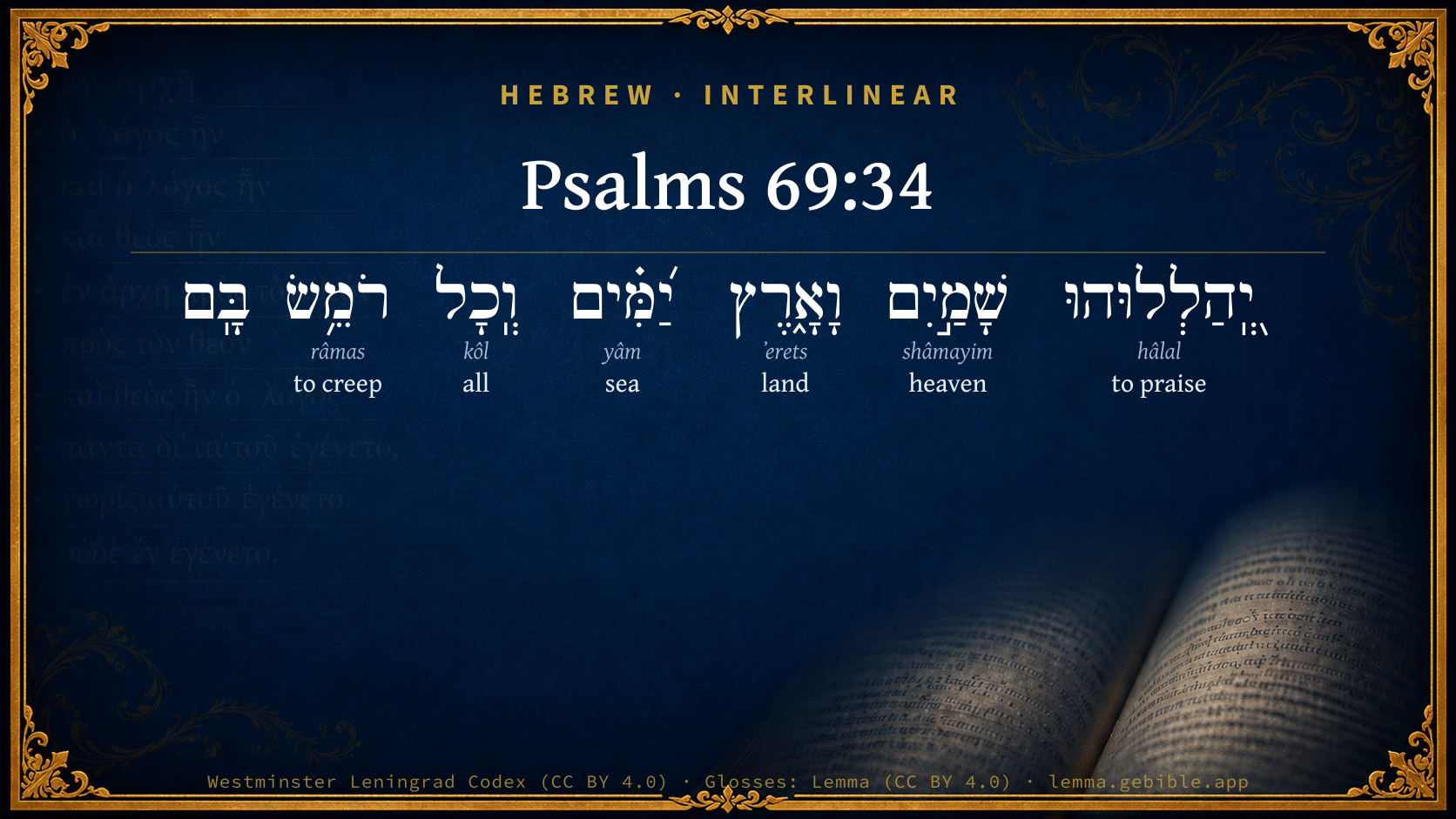
Hebrew (Westminster Leningrad Codex) Psalms 69:34 appears in the Hebrew Old Testament. The text above is from the Westminster Leningrad Codex. Each word links to its Strong’s number, a concise gloss, and parsing drawn from the Open Scriptures Hebrew Bible morphology. Click any word for its full Brown-Driver-Briggs (BDB) entry.
Download image
Cite this verse

Psalms 69:34 (World English Bible). Public Domain. Lemma interlinear Bible study tool, https://lemma.gebible.app/v/psalms/69/34.

Show BibTeX & RIS
BibTeX
RIS
English Translation
Let heaven and earth praise him; The seas, and everything that moves therein!
World English Bible · Public Domain
Download a study sheet

One document with this verse’s original text, its word-by-word gloss line, the meaning frame, cross-references with their text, attributed commentary, and full source and license credits — printable, and it pastes into notes with its structure intact.

This verse Autodidact and up

Study sheet (.html) Plain text (.txt)

A passage Seminary Student

Up to 50 verses in one chapter. A passage sheet keeps up to 6 commentary sources and 12 cross-references per verse, in the order this page ranks them, and says so on the sheet whenever that leaves anything out. Ask for a single verse and you get the Autodidact verse sheet above.

Everything on this page stays free to read, with no account — the sheet is a download of what is already on screen, not access to it.

Want to remove ads? Support Godless Engineer
Compare translations 3

The same verse in 3 English versions, stacked beneath the original-language interlinear above. Click any original word for its lexicon entry.

Each is an independent rendering of the whole verse — the interlinear is not word-aligned to these translations.

Highlighted words mark where these versions differ — a whole-verse word diff, not a word-by-word alignment.

  • World English Bible Public Domain
    Let heaven and earth praise him; The seas, and everything that moves therein!
  • King James Version Public Domain
    Let the heaven and earth praise him, the seas, and every thing that moveth therein.
  • unfoldingWord Literal Text CC BY-SA 4.0
    Let the heavens and the earth praise him, the seas and everything moving in them.

unfoldingWord Literal Text — © unfoldingWord, licensed CC BY-SA 4.0. Word-aligned USFM3 via Door43 (git.door43.org/unfoldingWord/en_ult).

Versions to compare (up to 4)

3 of 4 selected

Show all 18 translations

Every available English version of this verse, each an independent rendering of the whole verse.

  • World English Bible Public Domain
    Let heaven and earth praise him; The seas, and everything that moves therein!
  • Berean Standard Bible Public Domain
    Let heaven and earth praise Him, the seas and everything that moves in them.
  • Majority Standard Bible Public Domain
    Let heaven and earth praise Him, the seas and everything that moves in them.
  • King James Version Public Domain
    Let the heaven and earth praise him, the seas, and every thing that moveth therein.
  • American Standard Version (1901) Public Domain
    Let heaven and earth praise him, The seas, and everything that moveth therein.
  • Revised Version (1885) Public Domain
    Let heaven and earth praise him, the seas, and every thing that moveth therein.
  • Geneva Bible (1599) Public Domain
    Let heauen and earth praise him: the seas and all that moueth in them.
  • Douay-Rheims (1899) Public Domain
    For the Lord hath heard the poor: and hath not despised his prisoners.
  • Young's Literal Translation Public Domain
    The heavens and earth do praise Him, Seas, and every moving thing in them.
  • Literal Standard Version CC BY-SA 4.0
    The heavens and earth praise Him, || Seas, and every moving thing in them.
  • Unlocked Literal Bible CC BY-SA 4.0
    Let heaven and earth praise him, the seas and everything that moves in them.
  • unfoldingWord Literal Text CC BY-SA 4.0
    Let the heavens and the earth praise him, the seas and everything moving in them.
  • Darby Bible Public Domain
    Let heavens and earth praise him; the seas, and everything that moveth therein.
  • World Messianic Bible Public Domain
    Let heaven and earth praise him; the seas, and everything that moves therein!
  • Webster's Bible Public Domain
    \\69:33\\For the LORD heareth the poor, and despiseth not his prisoners.
  • Free Bible Version CC BY-SA 4.0
    Praise him heaven and earth, the seas and everything that lives in them!
  • Bible in Basic English Public Domain
    Let the heavens and the earth give praise to him, the seas, and everything moving in them.
  • JPS Tanakh (1917) Public Domain
    (69-35) Let heaven and earth praise Him, the seas, and every thing that moveth therein.

Literal Standard Version (2020), Covenant Press — licensed CC BY-SA 4.0. Text via the HelloAO Bible API (eBible.org). Unlocked Literal Bible (unfoldingWord) — licensed CC BY-SA 4.0. Text via the HelloAO Bible API (eBible.org). unfoldingWord Literal Text — © unfoldingWord, licensed CC BY-SA 4.0. Word-aligned USFM3 via Door43 (git.door43.org/unfoldingWord/en_ult). Free Bible Version, Dr. Jonathan Gallagher — licensed CC BY-SA 4.0. Text via the HelloAO Bible API (eBible.org).

Word by word

More ways to search: Search by grammar → Find every occurrence → Compare this word →

Practice this passage: Drill this verse → Learn its vocabulary →

About this verse

These counts appear in no published source. They are computed here, from the morphology-tagged text and Lemma’s own curated glosses. What Lemma adds →

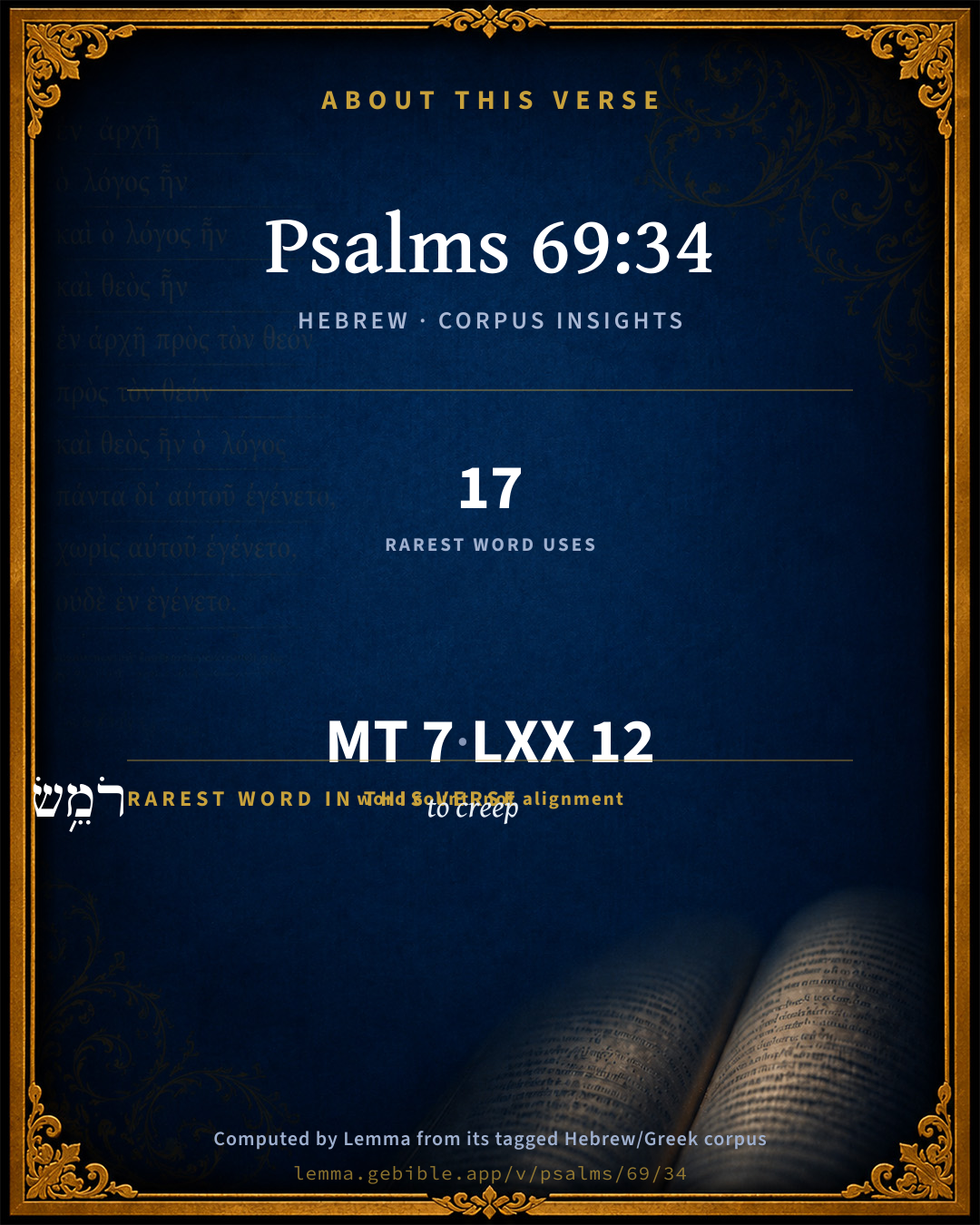
7
words
6
distinct lemmas
Wisdom
section

Notable vocabulary

The rarest word here is רֹמֵ֥שׂ to creep H7430 — appearing just 17 times in the whole Hebrew Bible.

Shared distinctive vocabulary

רֹמֵ֥שׂ to creep H7430 occurs in 17 verses of the Hebrew Bible. Also found in:

Grammatical profile

  • 2 verbs
  • 4 nouns
  • 1 preposition

Verb forms

  • יְֽ֭הַלְלוּהוּ Piel · Imperfect
  • רֹמֵ֥שׂ Qal · Participle Active

Hebrew & Septuagint length

In English translation the verse runs 13 words from the Hebrew and 16 from the Septuagint (LXX English) — closely comparable.

A rough comparison of the two English renderings, which tokenize alike — not a word-level alignment.

Word counts can differ between the Hebrew and the Greek without any difference in meaning — e.g. the Hebrew direct-object marker אֵת has no separate Greek word, and Greek often adds the article ὁ.

In the original languages it is 7 Hebrew tokens and 12 Greek tokens — but the two are counted differently (Hebrew bundles its prefixes and suffixes into one token; the Greek is in lemma form), so that isn’t a like-for-like length.

Cross-references

9

Topical passages linked to Psalms 69:34 in the Treasury of Scripture Knowledge — connected by theme and wording, ordered by reader-vote popularity; previews shown in the World English Bible.

  • Isaiah 49:13 Sing, heavens; and be joyful, earth; and break forth into singing, mountains: for Yahweh has comforted his people, and will have compassion on his afflicted.
  • Psalms 150:6 Let everything that has breath praise Yah! Praise Yah!
  • Psalms 96:11 Let the heavens be glad, and let the earth rejoice. Let the sea roar, and it's fullness!
  • Isaiah 55:12 For you shall go out with joy, and be led forth with peace: the mountains and the hills shall break forth before you into singing; and all the trees of the fields shall clap their hands.
  • Psalms 148:1–14 Praise Yah! Praise Yahweh from the heavens! Praise him in the heights!
  • Isaiah 44:22–23 I have blotted out, as a thick cloud, your transgressions, and, as a cloud, your sins: return to me; for I have redeemed you.
  • Psalms 98:7–8 Let the sea roar with its fullness; The world, and those who dwell therein.
  • Revelation 7:11–13 All the angels were standing around the throne, the elders, and the four living creatures; and they fell on their faces before his throne, and worshiped God,
  • Genesis 1:20 God said, "Let the waters swarm with swarms of living creatures, and let birds fly above the earth in the open expanse of sky."

Cross-references courtesy of OpenBible.info (CC BY 4.0).

Hebrew and Greek witnesses Masoretic Hebrew ↔ Greek Septuagint

The same verse in the two great witnesses to the Old Testament, shown verse-for-verse.

You’re reading Greek Psalm 68 (Hebrew Psalm 69). The Septuagint counts the superscription, so verse numbers can differ from the Hebrew — chapter-level alignment, not verse-by-verse. Numbering follows Rahlfs.

These are two independent witnesses, not word-aligned to each other, and the Septuagint is shown in lemma (dictionary) form.

Hebrew Psalms 69:34 Masoretic · Westminster Leningrad Codex

יְֽ֭הַלְלוּהוּ שָׁמַ֣יִם וָאָ֑רֶץ יַ֝מִּ֗ים וְֽכָל רֹמֵ֥שׂ בָּֽם

Let heaven and earth praise him; The seas, and everything that moves therein!

World English Bible · Public Domain

Greek LXX Greek Psalm 68:34 Septuagint · lemma form

ὅτι εἰςἀκούω ὁ πένης ὁ κύριος καί ὁ πεδάω αὐτός οὐ ἐκοὐδενόω

Let the heavens and the earth raise him, the sea, and all things moving in them.

LXX2012 (modern English Septuagint) · Public Domain

Hebrew: Westminster Leningrad Codex (CC BY 4.0). Greek: Septuagint (public domain); English from LXX2012 (modern English Septuagint) (Public Domain). How the Septuagint differs from the Hebrew →

Commentary

Notes on Psalms 69:34 from classic Christian and Jewish commentators (each source and its license shown beneath its notes). The classic Christian expositions comment on the surrounding passage and are grouped to its opening verse, so a note may address several verses; the Jewish commentaries on the Tanakh (Rashi and others) are per-verse, so they appear only where the commentator wrote on this verse.

Lemma curates 59 commentaries, every one of them public domain or Creative Commons licensed, each selected and text-cleaned for this edition rather than reprinted as found. About our sources →

Trapp's Complete Commentary

John Trapp

Psa 69:34 Let the heaven and earth praise him, the seas, and every thing that moveth therein.

Ver. 34. Let the heaven and earth praise him] As they do in their kind; and have good cause so to do for their restoration by Christ, Rom 8:21.

John Trapp, A Commentary or Exposition upon All the Books of the Old and New Testament (1647–1656) — public domain. Text from a community e-Sword module.

The Biblical Illustrator

Joseph S. Exell

Psa_69:34

Let the heaven and earth praise Him, the seas, and everything that moveth therein.

The creation praising God

I. On account of what He is in Himself. God is good; intrinsically excellent. His nature is composed of all possible perfections. God is love, wisdom, intelligence, goodness, truth, righteousness, mercy.

II. On account of what He is in His relations.

1. To all, He stands in the relation of Creator, Sustainer, and Benefactor.

2. To us, whom He has redeemed, by the sacrificial death of His only begotten Son, Jesus Christ, He stands in the relation of a Father and Saviour.

III. On account of what He has accomplished. The works of God excel the works of all others. They are, Creation--He made all things; Providence--He cares for and governs all things; Redemption--it was God that raised apostate humanity from the ruins of the fall. No works can compete with these. And on their account God will be praised throughout eternity, by an intelligent and redeemed universe.

IV. On account of His wonderful gifts. Life, reason, mind, subjects for thought, Jesus Christ, the Holy Bible, the ministry of reconciliation, the Holy Spirit, the comforts and consolations of religion, and a hope--resting firmly and securely upon the atonement of Calvary--of heaven, when this temporary introductory life shall have passed away.

V. On account of His grand discoveries. Man builds a rightful claim to the admiration, praise, and gratitude of mankind, by the discoveries he makes, and the facts he brings to light. What has God made known? That there is an eternal world; that men are immortal; that noble and abundant provisions have been made for our happiness during the ever-revolving cycles of an eternity to come; the way in which we, and all mankind, may be prepared for the full and unending fruition of the bliss He has prepared for us. (Isaac Evans.)

.

Psa_70:1-5

The Biblical Illustrator, edited by Joseph S. Exell (c. 1880s–1900s) — public domain. Text from a community e-Sword module.

Joseph Benson's Commentary

Psa 69:34-36. Let the heaven and earth praise him — Let angels and men, the visible and invisible world, and all creatures contained therein, join together to celebrate him with their highest praises; for “the mercies of God in Christ are such, that they cannot worthily be praised by any thing less than a universal chorus of the whole old and new creation; and what should such a chorus celebrate but those mercies by which all things have been made, preserved, and redeemed.” — Horne. For God will save Zion — The city of Zion, or Jerusalem; and his church and people, which are frequently expressed by that title, and the salvation and edification of which were the consequence of the sufferings and resurrection of Christ. He will save Zion, the holy mountain, where his ordinances are administered, and his service performed. He will save all that are sanctified and set apart for him, all that employ themselves in his worship, and all those over whom the once suffering, but now exalted, Saviour reigns, for he is the king set upon the holy hill of Zion. He will do great things for the gospel-church; in which let all, who wish well to it, rejoice. For, 1st, It shall be peopled and inhabited. There shall be added to it such as shall be saved. The cities of Judah shall be built — Which is to be understood figuratively, as well as literally; particular churches shall be formed, and incorporated according to the gospel model, that there may be a remnant to dwell there, and have it in possession — To enjoy the privileges conferred upon it, and to pay the tributes and services required from it. 2d, It shall be perpetuated and inherited. Christianity was not to be res unius ætatis, an affair of one age; no, the seed of his servants shall inherit it — God will secure and raise up for himself a seed to serve him, and they shall inherit the privileges of their fathers. The land of promise shall never be lost for want of heirs; for God can out of stones raise up children to Abraham, and will do it rather than the entail shall be cut off. David shall never want a man to stand before him. The Redeemer shall see his seed, and prolong his days in them, till the mystery of God shall be finished and Christ’s mystical body be completed.

Joseph Benson's Commentary on the Old and New Testaments (1811–1818) — public domain. Text from a community e-Sword module.

J. A. Alexander on Psalms

Joseph Addison Alexander

35. (Psa 69:34). Let heaven and earth praise him, seas and everything creeping in them, i.e. moving with an animal or vital motion. In the particular mercy experienced by himself he sees a pledge of gifts deserving and demanding universal praise.

Joseph Addison Alexander, The Psalms Translated and Explained (1850) — public domain. Text from a community e-Sword module.

Tyndale Open Study Notes

Tyndale Open Resources

69:34-36 The psalmist prays for Zion, offering a new petition from a new circumstance. He applies the prayer (69:1-33) to the desperate condition of Judah (see 51:18-19).

Tyndale Open Study Notes — © Tyndale Open Resources, licensed CC BY-SA 4.0. Text via the HelloAO Bible API.

Jamieson, Fausset & Brown

Robert Jamieson, A. R. Fausset & David Brown

The call on the universe for praise is well sustained by the prediction of the perpetual and extended blessings which shall come upon the covenant-people of God. Though, as usual, the imagery is taken from terms used of Palestine, the whole tenor of the context indicates that the spiritual privileges and blessings of the Church are meant.

Next: Psalms Chapter 71

Jamieson, Fausset & Brown — Commentary Critical and Explanatory on the Whole Bible (1871) — public domain (CC PDM 1.0). Text via the HelloAO Bible API.

Adam Clarke's Commentary

Verse 34. Let the heaven and earth praise him] The psalmist has the fullest confidence that God will turn their captivity, and therefore calls upon all creatures to magnify him for his mercy.

Adam Clarke's Commentary on the Bible (1810–1826) — public domain. Text from a community e-Sword/MySword module.

John Calvin's Commentaries

34. Let the heavens and the earth praise him. From this we may conclude with the greater certainty, that, as I have touched upon above, David in the whole of this psalm spake in the name of the whole Church; for he now transfers to the Church what he had spoken in particular concerning himself. In calling upon the elements, which are destitute of thought or understanding, to praise God, he speaks hyperbolically, and by this manner of expression, he would teach us that we are not animated with sufficient earnestness of heart in celebrating the praises of God, the infinitude of which overpasses the whole world, unless we rise above our own understandings. But what above all kindled this ardor in the heart of David was his concern for the preservation of the Church. Moreover, there is no doubt that by the Spirit of prophecy he comprehended the whole of that period during which God would have the kingdom and priesthood continued among the ancient people of Israel. Yet he begins at the restoration of a new state of things, which by his means was suddenly brought about upon the death of Saul, when a melancholy devastation threatened at once the utter destruction of the worship of God, and the desolation of the whole country. He says, in the first place, that Zion shall be saved, because God would defend the place where he had chosen to be called upon, and would not suffer the worship which he himself had appointed to be abolished. In the next place, from the ark of the covenant and the sanctuary, he represents the divine blessing as extending to the whole land; for religion was the foundation upon which the happiness of the people rested. He farther teaches, that this change to the better would not be of short continuance; but that the people would be always preserved safe through the constant and enduring protection of God: And they shall dwell there, and possess it by inheritance. He therefore intimates, that the promise which God had so often made in the law, That they should inherit that land forever, was truly confirmed by the commencement of his reign. He contrasts tranquil and settled abode with a mere temporary residence; as if he had said, Now that the sacred throne is erected, the time is come in which the children of Abraham will enjoy the rest which has been promised to them, without fear of being removed from it.

John Calvin's Commentaries (1540-1563) — public domain. Text from the Calvin Translation Society English edition (1840s-50s) via the Christian Classics Ethereal Library (ccel.org). Calvin's coverage is partial (roughly two-thirds of the Bible); uncommented books and verses are honest gaps, never fabricated. The 19th-century editor's footnotes and remarks are omitted so the notes are faithfully Calvin's own voice.

The Cambridge Bible for Schools and Colleges

gen. ed. J. J. S. Perowne

34. All creation is summoned to join in a chorus of praise to God for the redemption of Zion, for it is an event of universal significance. Cp. Isa_44:23.

The Cambridge Bible for Schools and Colleges (gen. ed. J. J. S. Perowne; Cambridge University Press, 1878–1918) — public domain. Text from a community e-Sword module.

John Gill's Exposition

Let the heaven and earth praise him,.... As those, by a prosopopoeia, are often called upon to do, to express the greatness of the favour enjoyed, and to excite those that are possessed of it to greater joy and thankfulness; see Psa 96:11; or the inhabitants of the heavens and earth may be meant, as the angels of heaven; and so the Targum interprets it; who, as they praised the Lord at the incarnation of Christ, Luk 2:14; so doubtless they did at his ascension, when he was seen and accompanied by them, Ti1 3:16, Psa 68:17; and also the spirits of just men made perfect in heaven, who were there when Christ was received into it; and the inhabitants of the earth, as the Targum also paraphrases it; of the continent, particularly the Roman empire, when the Gospel was sent thither, which brought the good news of an incarnate, suffering, risen, ascended, and exalted Saviour;

the seas, and everything that moveth therein; the inhabitants of the isles in the seas, such as ours of Great Britain and Ireland, who waited for the doctrine of the Messiah, and to whom he calls to listen to what he says; and which is a sufficient reason for praise and thanksgiving in them; even in as many as have spiritual life and motion, who are quickened, influenced, and moved by the Spirit of God; see Isa 42:4.

John Gill's Exposition of the Whole Bible (1746–1763) — public domain (CC PDM 1.0). Text via the HelloAO Bible API.

Albert Barnes' Notes on the Bible

Let the heaven and earth praise him - All things; all above and all below.

The seas - The waters - the oceans. This is in accordance with what often occurs in the Scriptures, when all things, animate and inanimate, are called on to praise God. Compare Psa 148:1-14.

And everything that moveth therein - Margin, as in Hebrew, “creepeth.” Compare the notes at Psa 8:8. See also the notes at Isa 55:12.

Albert Barnes' Notes on the Bible (1834–1885) — public domain. Text from a community e-Sword/MySword module.

Matthew Poole's English Annotations

The heaven and earth; either,

1. Angels and men. Or rather,

2. The heaven and earth themselves, as in the next branch,

the seas, and every thing that moveth therein: all which by a usual figure he invites to praise God, as he doth elsewhere, because they all give men occasion to praise God.

Matthew Poole's English Annotations on the Holy Bible (1683–1685) — public domain. Text from a community e-Sword/MySword module.

The Treasury of David

Charles H. Spurgeon

Ver. 34. Let the heaven and earth praise him, the seas, and every thing that moveth therein. The doxology of a glowing heart. The writer had fathomed the deeps, and had ascended to the heights; and, therefore, calls on the whole range of creation to bless the Lord. Our Well Beloved here excites us all to grateful adoration: who among us will hold back? God's love to Christ argues good to all forms of life; the exaltation of the Head brings good to the members, and to all in the least connected with him. Inasmuch as the creation itself also is by Christ's work to be delivered from bondage, let all that have life and motion magnify the Lord. Glory be unto thee, O Lord, for the sure and all including pledge of our Surety's triumph; we see in this the exaltation of all thy poor and sorrowful ones, and our heart is glad.

None.

Ver. 34. The sea, etc. How God is, should be, and shall be praised by the sea.

Psalms 69:35*

Charles H. Spurgeon's The Treasury of David (1869–1885) — public domain. Psalms only. Text from a community e-Sword/MySword module.

The Pulpit Commentary

Let the heaven and earth praise him, the seas, and everything that moveth therein. (comp. Psa_96:11) As Job calls on heaven and earth to sympathize with him in his distress, (Job_16:18, Job_16:19) so David would have them to partake in his joy at his deliverance.

The Pulpit Commentary (1880–1919), ed. H.D.M. Spence-Jones & Joseph S. Exell — public domain. Text from a community e-Sword module.

unfoldingWord translationNotes

Door43 World Missions Community

Let heaven and earth praise him ... the seas

Here heaven and earth and the seas are spoken of as if they are people who are able to praise God. (See: Personification)

the seas and everything that moves in them

It is implied that "Let ... praise him" should be understood here. AT: "let he seas and everything that moves in them praise him" (See: Ellipsis)

God will save Zion

Here "Zion" refers to the people in Zion. AT: "God will save the people of Zion" (See: Metonymy)

have it as a possession

The word "it" refers to the land of Judah.

who love his name

Here "name" refers to God himself. AT: "who love God" (See: Metonymy)

translationWords

heaven

earth

praise

save

Zion

Judah

possess

servant

descend

inherit

love

name

life

unfoldingWord translationNotes — © Distant Shores Media and the Door43 World Missions Community, licensed CC BY-SA 4.0. Source: git.door43.org/Door43/en_tn.

Lesson kit

Teaching starters — assembled from the data on this page, not authored interpretation. Every prompt links to the verse data it draws on. Edit before teaching.

Psalms, in the Wisdom, opens this verse with 7 words (6 distinct Hebrew lemmas). Its most distinctive word is râmas (“to creep”). A historical commentator’s framing appears above. Read the whole chapter for the surrounding context.

Discussion questions

  1. How does “to creep” (râmas) shape what this verse is saying?
  2. Genesis 1:21 shares the word «to creep» with this verse. How do the two illuminate each other?
  3. The translations on this page render this verse differently — a whole-verse word diff, not a word-by-word alignment. What might account for the different wordings?
  4. The verb «יְֽ֭הַלְלוּהוּ» is Piel Imperfect. How does its form color the action?
  5. Reading how Trapp's Complete Commentary and The Biblical Illustrator read this verse, where do the two commentators agree and where do they part?

Things to notice

Reading settings

Reading text

Shown beneath each verse's original-language words.

Old Testament
Old Testament edition

Read the OT as the Masoretic Hebrew (MT) or the Greek Septuagint (LXX).

English shown for the Greek Septuagint (in the Hebrew ↔ Greek comparison).

Comparing translations? Open the Compare panel on any verse page to stack up to four side by side.