Psalms 104:25

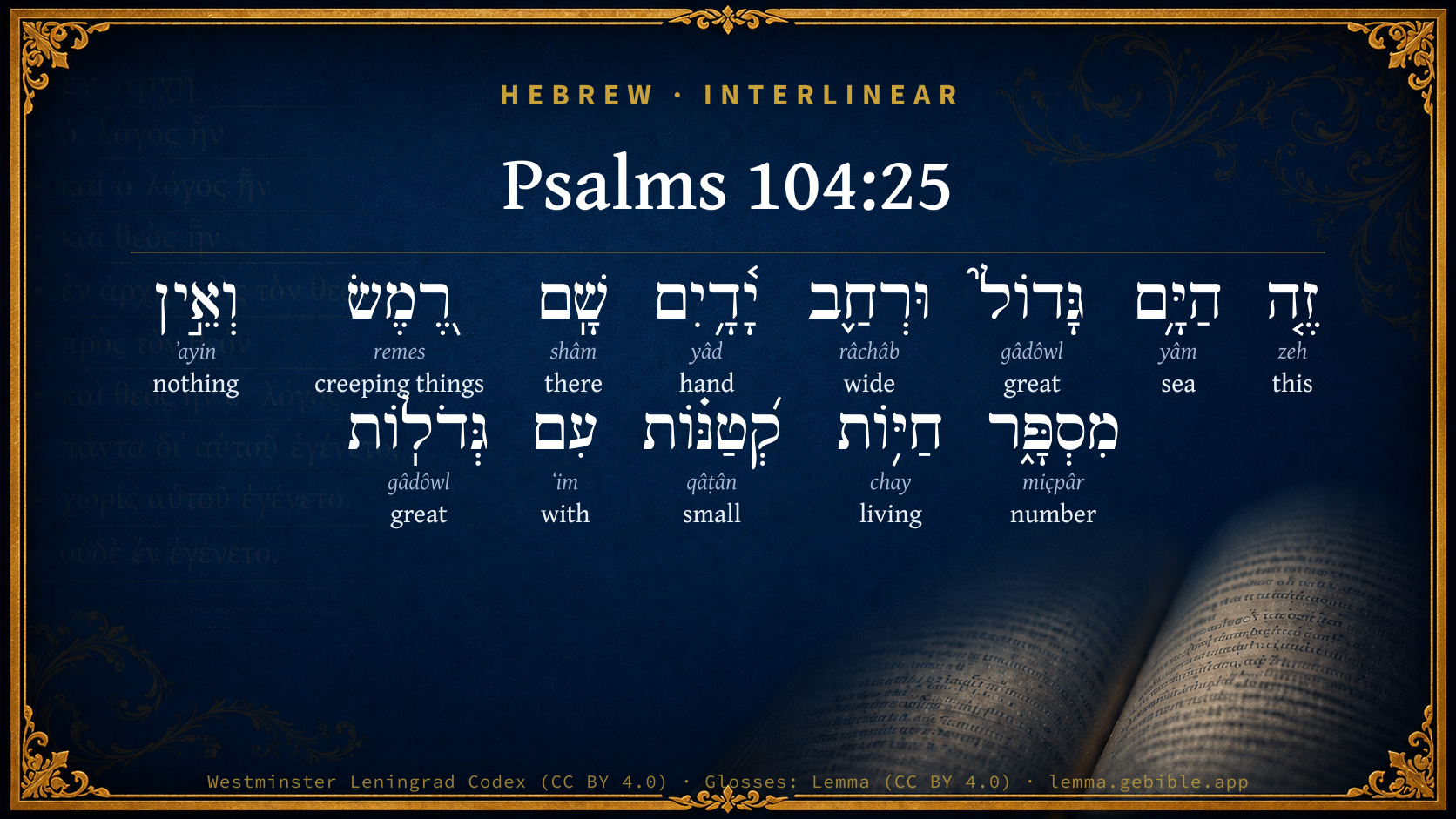
Hebrew (Westminster Leningrad Codex) Psalms 104:25 appears in the Hebrew Old Testament. The text above is from the Westminster Leningrad Codex. Each word links to its Strong’s number, a concise gloss, and parsing drawn from the Open Scriptures Hebrew Bible morphology. Click any word for its full Brown-Driver-Briggs (BDB) entry.
Download image
Cite this verse

Psalms 104:25 (World English Bible). Public Domain. Lemma interlinear Bible study tool, https://lemma.gebible.app/v/psalms/104/25.

Show BibTeX & RIS
BibTeX
RIS
English Translation
There is the sea, great and wide, In which are innumerable living things, Both small and large animals.
World English Bible · Public Domain
Download a study sheet

One document with this verse’s original text, its word-by-word gloss line, the meaning frame, cross-references with their text, attributed commentary, and full source and license credits — printable, and it pastes into notes with its structure intact.

This verse Autodidact and up

Study sheet (.html) Plain text (.txt)

A passage Seminary Student

Up to 50 verses in one chapter. A passage sheet keeps up to 6 commentary sources and 12 cross-references per verse, in the order this page ranks them, and says so on the sheet whenever that leaves anything out. Ask for a single verse and you get the Autodidact verse sheet above.

Everything on this page stays free to read, with no account — the sheet is a download of what is already on screen, not access to it.

Want to remove ads? Support Godless Engineer
Compare translations 3

The same verse in 3 English versions, stacked beneath the original-language interlinear above. Click any original word for its lexicon entry.

Each is an independent rendering of the whole verse — the interlinear is not word-aligned to these translations.

Highlighted words mark where these versions differ — a whole-verse word diff, not a word-by-word alignment.

  • World English Bible Public Domain
    There is the sea, great and wide, In which are innumerable living things, Both small and large animals.
  • King James Version Public Domain
    So is this great and wide sea, wherein are things creeping innumerable, both small and great beasts.
  • unfoldingWord Literal Text CC BY-SA 4.0
    There the sea, great and broad of hands; creeping things there, and there is no number, living things, small with great.

unfoldingWord Literal Text — © unfoldingWord, licensed CC BY-SA 4.0. Word-aligned USFM3 via Door43 (git.door43.org/unfoldingWord/en_ult).

Versions to compare (up to 4)

3 of 4 selected

Show all 18 translations

Every available English version of this verse, each an independent rendering of the whole verse.

  • World English Bible Public Domain
    There is the sea, great and wide, In which are innumerable living things, Both small and large animals.
  • Berean Standard Bible Public Domain
    Here is the sea, vast and wide, teeming with creatures beyond number, living things both great and small.
  • Majority Standard Bible Public Domain
    Here is the sea, vast and wide, teeming with creatures beyond number, living things both great and small.
  • King James Version Public Domain
    So is this great and wide sea, wherein are things creeping innumerable, both small and great beasts.
  • American Standard Version (1901) Public Domain
    Yonder is the sea, great and wide, Wherein are things creeping innumerable, Both small and great beasts.
  • Revised Version (1885) Public Domain
    Yonder is the sea, great and wide, wherein are things creeping innumerable, both small and great beasts.
  • Geneva Bible (1599) Public Domain
    So is this sea great and wide: for therein are things creeping innumerable, both small beastes and great.
  • Douay-Rheims (1899) Public Domain
    So is this great sea, which stretcheth wide its arms: there are creeping things without number: Creatures little and great.
  • Young's Literal Translation Public Domain
    This, the sea, great and broad of sides, There `are' moving things -- innumerable, Living creatures -- small with great.
  • Literal Standard Version CC BY-SA 4.0
    This, the sea, great and broad of sides, || There [are] moving things—innumerable, || Living creatures—small with great.
  • Unlocked Literal Bible CC BY-SA 4.0
    Over there is the sea, deep and wide, teeming with innumerable creatures, both small and great.
  • unfoldingWord Literal Text CC BY-SA 4.0
    There the sea, great and broad of hands; creeping things there, and there is no number, living things, small with great.
  • Darby Bible Public Domain
    Yonder is the great and wide sea: therein are moving things innumerable, living creatures small and great.
  • World Messianic Bible Public Domain
    There is the sea, great and wide, in which are innumerable living things, both small and large animals.
  • Webster's Bible Public Domain
    So is this great and wide sea, in which are creeping animals innumerable, both small and great beasts.
  • Free Bible Version CC BY-SA 4.0
    Consider the sea, deep and wide, full of all kinds of living things, large and small.
  • Bible in Basic English Public Domain
    There is the great, wide sea, where there are living things, great and small, more than may be numbered.
  • JPS Tanakh (1917) Public Domain
    Yonder sea, great and wide, therein are creeping things innumerable, living creatures, both small and great.

Literal Standard Version (2020), Covenant Press — licensed CC BY-SA 4.0. Text via the HelloAO Bible API (eBible.org). Unlocked Literal Bible (unfoldingWord) — licensed CC BY-SA 4.0. Text via the HelloAO Bible API (eBible.org). unfoldingWord Literal Text — © unfoldingWord, licensed CC BY-SA 4.0. Word-aligned USFM3 via Door43 (git.door43.org/unfoldingWord/en_ult). Free Bible Version, Dr. Jonathan Gallagher — licensed CC BY-SA 4.0. Text via the HelloAO Bible API (eBible.org).

Word by word

More ways to search: Search by grammar → Find every occurrence → Compare this word →

Practice this passage: Drill this verse → Learn its vocabulary →

רֶ֭מֶשׂ
remes
H7431
“creeping things”
Noun, Common, Masculine, Singular, Absolute
Part of Speech
Noun
Type
Common
Gender
Masculine
Number
Singular
State
Absolute
Full BDB Definition

Origin: from H7430

TWOT: 2177a

creeping things, moving things, creeping organism - creeping things - gliding things (of sea animals) - moving things (of all animals)
  1. זֶ֤ה zeh H2088 “this” Pronoun, Demonstrative, Masculine, Singular
  2. הַיָּ֥ם yâm H3220 “the · sea” Particle, Definite Article + Noun, Common, Masculine, Singular, Absolute
  3. גָּדוֹל֮ gâdôwl H1419 “great” Adjective, Adjective, Masculine, Singular, Absolute
  4. וּרְחַ֪ב râchâb H7342 “and · wide of” Conjunction + Adjective, Adjective, Masculine, Singular, Construct
  5. יָ֫דָ֥יִם yâd H3027 “hands” Noun, Common, Both, Dual, Absolute
  6. שָֽׁם shâm H8033 “there” Adverb
  7. וְאֵ֣ין ʼayin H369 “and · nothing” Conjunction + Particle, Negative
  8. מִסְפָּ֑ר miçpâr H4557 “number” Noun, Common, Masculine, Singular, Absolute
  9. חַיּ֥וֹת chay H2416 “living things” Noun, Common, Feminine, Plural, Absolute
  10. קְ֝טַנּ֗וֹת qâṭân H6996 “small” Adjective, Adjective, Feminine, Plural, Absolute
  11. עִם ʻim H5973 “with” Preposition
  12. גְּדֹלֽוֹת gâdôwl H1419 “great” Adjective, Adjective, Feminine, Plural, Absolute

About this verse

These counts appear in no published source. They are computed here, from the morphology-tagged text and Lemma’s own curated glosses. What Lemma adds →

13
words
12
distinct lemmas
Wisdom
section

Notable vocabulary

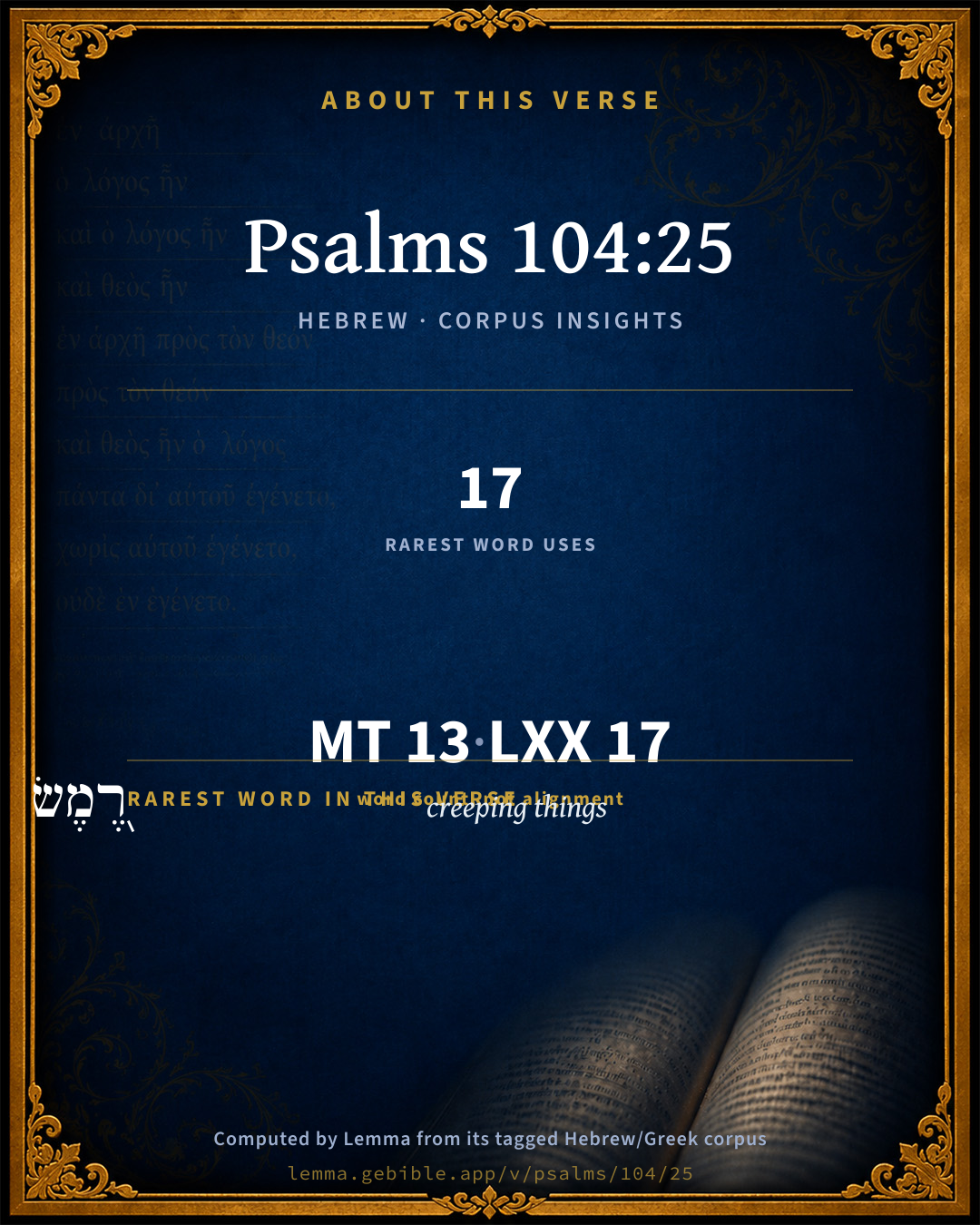
The rarest word here is רֶ֭מֶשׂ creeping things H7431 — appearing just 17 times in the whole Hebrew Bible.

Shared distinctive vocabulary

רֶ֭מֶשׂ creeping things H7431 occurs in 17 verses of the Hebrew Bible. Also found in:

Grammatical profile

  • 5 nouns
  • 4 adjectives
  • 1 pronoun
  • 1 preposition
  • 1 adverb
  • 1 particle

Repetition

A word recurs within this verse — often emphatic in Hebrew:

  • גָּדוֹל֮ great H1419 ×2

Hebrew & Septuagint length

In English translation the verse runs 18 words from the Hebrew and 16 from the Septuagint (LXX English) — closely comparable.

A rough comparison of the two English renderings, which tokenize alike — not a word-level alignment.

Word counts can differ between the Hebrew and the Greek without any difference in meaning — e.g. the Hebrew direct-object marker אֵת has no separate Greek word, and Greek often adds the article ὁ.

In the original languages it is 13 Hebrew tokens and 17 Greek tokens — but the two are counted differently (Hebrew bundles its prefixes and suffixes into one token; the Greek is in lemma form), so that isn’t a like-for-like length.

Cross-references

8

Topical passages linked to Psalms 104:25 in the Treasury of Scripture Knowledge — connected by theme and wording, ordered by reader-vote popularity; previews shown in the World English Bible.

  • Psalms 69:34 Let heaven and earth praise him; The seas, and everything that moves therein!
  • Psalms 95:4–5 In his hand are the deep places of the earth. The heights of the mountains are also his.
  • Genesis 1:28 God blessed them. God said to them, "Be fruitful, multiply, fill the earth, and subdue it. Have dominion over the fish of the sea, over the birds of the sky, and over every living thing that moves on the earth."
  • Acts 28:5 However he shook off the creature into the fire, and wasn't harmed.
  • Genesis 1:20–22 God said, "Let the waters swarm with swarms of living creatures, and let birds fly above the earth in the open expanse of sky."
  • Genesis 3:1 Now the serpent was more subtle than any animal of the field which Yahweh God had made. He said to the woman, "Yes, has God said, 'You shall not eat of any tree of the garden?'"
  • Deuteronomy 33:14–16 For the precious things of the fruits of the sun, For the precious things of the growth of the moons,
  • Deuteronomy 33:19 They shall call the peoples to the mountain; There shall they offer sacrifices of righteousness: For they shall suck the abundance of the seas, The hidden treasures of the sand.

Cross-references courtesy of OpenBible.info (CC BY 4.0).

Hebrew and Greek witnesses Masoretic Hebrew ↔ Greek Septuagint

The same verse in the two great witnesses to the Old Testament, shown verse-for-verse.

You’re reading Greek Psalm 103 (Hebrew Psalm 104). The Septuagint counts the superscription, so verse numbers can differ from the Hebrew — chapter-level alignment, not verse-by-verse. Numbering follows Rahlfs.

These are two independent witnesses, not word-aligned to each other, and the Septuagint is shown in lemma (dictionary) form.

Hebrew Psalms 104:25 Masoretic · Westminster Leningrad Codex

זֶ֤ה הַיָּ֥ם גָּדוֹל֮ וּרְחַ֪ב יָ֫דָ֥יִם שָֽׁם רֶ֭מֶשׂ וְאֵ֣ין מִסְפָּ֑ר חַיּ֥וֹת קְ֝טַנּ֗וֹת עִם גְּדֹלֽוֹת

There is the sea, great and wide, In which are innumerable living things, Both small and large animals.

World English Bible · Public Domain

Greek LXX Greek Psalm 103:25 Septuagint · lemma form

οὗτος ὁ θάλασσα ὁ μέγας καί εὐρύχωρος ἐκεῖ ἑρπετόν ὅς οὐ εἰμί ἀριθμός ζῷον μικρός μετά μέγας

So is this great and wide sea: there are things creeping innumerable, small animals and great.

LXX2012 (modern English Septuagint) · Public Domain

Hebrew: Westminster Leningrad Codex (CC BY 4.0). Greek: Septuagint (public domain); English from LXX2012 (modern English Septuagint) (Public Domain). How the Septuagint differs from the Hebrew →

Commentary

Notes on Psalms 104:25 from classic Christian and Jewish commentators (each source and its license shown beneath its notes). The classic Christian expositions comment on the surrounding passage and are grouped to its opening verse, so a note may address several verses; the Jewish commentaries on the Tanakh (Rashi and others) are per-verse, so they appear only where the commentator wrote on this verse.

Lemma curates 59 commentaries, every one of them public domain or Creative Commons licensed, each selected and text-cleaned for this edition rather than reprinted as found. About our sources →

Trapp's Complete Commentary

John Trapp

Psa 104:25 [So is] this great and wide sea, wherein [are] things creeping innumerable, both small and great beasts.

Ver. 25. So is this great and wide sea] Latum manibus, id est sinubus; yet not so great and wide as man’s heart, wherein is not only that leviathan, some special foul lusts, but creeping things innumerable, crawling bugs and baggage vermin.

Wherein are creeping things innumerable] Far more, and of more kinds, than there are on earth.

John Trapp, A Commentary or Exposition upon All the Books of the Old and New Testament (1647–1656) — public domain. Text from a community e-Sword module.

The Biblical Illustrator

Joseph S. Exell

Psa_104:25

So is this great and wide sea, wherein are things creeping innumerable.

The seas inhabitants

Since the psalmists days our knowledge of the grandeur of the seas, and of their marvellous fulness of life, has been vastly extended. The discovery of the Atlantic and Pacific Oceans made the Mediterranean, that seemed to him a great and wide sea, a little inland lake. Modern science has explored all the waters of the earth, and revealed to us the wonderful forms that exist even at the most enormous depths in the sunless abysses. The last great Challenger Expedition round the globe brought home treasures of knowledge, and opened up new fields of speculation, which have engaged the profound interest of naturalists ever since. Recent years have made us almost as familiar with the productions of the deep as with those of the dry land, and have taught us that there is no field so rich in illustrations of the Divine wisdom and power as the great and wide sea. Fishes as a class partake of the grace of the waters. They are adapted to its motions. They are moulded by its requirements. A ship is built to suit the conditions of its home on the mighty deep, and is therefore the most compact and well ordered of mans works. And so a fish has the most exquisite adaptation and concentration. Fishes are in the sea what birds are in the air, amongst the most elegant of Gods creatures. They have similar beauty of colour and shape, and exhibit the same wonderful provisions and contrivances of Divine skill. (H. Macmillan, D.D.)

Life in ocean depths

It used to be an axiom that there was no life in the sea beyond a certain limit of a few hundred feet. It was learnedly and conclusively demonstrated that pressure and absence of light, and I know not what beside, made life at greater depths impossible. It was proved that in such conditions creatures could not live. And then, when that was settled, the Challenger put down her dredge five miles, and brought up healthy and good-sized living things with eyes in their heads, from that enormous depth. So, then the savant had to ask, how can there be life? instead of asserting there cannot be; and, no doubt, the answer will be forthcoming some day. We have all been too much accustomed to draw arbitrary limits to the diffusion of the life of Christ among men. Let us rather rejoice when we see forms of beauty, which bear the mark of His hand, drawn from depths that we deemed waste, and thankfully confess that the bounds of our expectation, and the framework of our institutions, do not confine the breadth of His working, nor the sweep of His grace. (A. Maclaren, D.D.)

The Biblical Illustrator, edited by Joseph S. Exell (c. 1880s–1900s) — public domain. Text from a community e-Sword module.

J. A. Alexander on Psalms

Joseph Addison Alexander

25. (Psa 104:25) Here is the sea, great and wide, on all hands; there are moving things and without number, small animals with great. The exclamation or reflection in the preceding verse affords a transition to the survey of other parts of the creation, not included in the catalogue before recited, yet no less striking in themselvess, and as proofs or illustrations of the Maker's wisdom. Such is the sea, or here, for instance, is the sea, are the phrases which would probably be used in our idiom, to introduce the first example. The same thing was probably intended by the Hebrew phrase, this (is) the sea, as if the speaker at the same time pointed to it. See above, on Psa 104:8. Wide of both hands is another idiomatic phrase used also by Moses (Gen 34:21), and Isaiah (Isa 33:21). It obviously means stretching out in all directions. The sense of hand as thus used, is the same as in the English phrase on all hands, and is probably derived from the use of the right and left hand to distinguish position or direction. Moving things is here used to translate a single Hebrew word the cognate noun of the verb employed in ver. 20(Psa 104:20) to denote animal motion. It is applied to marine animals, as here in Gen 1:9, Psa 69:34. The use of the word beasts, in the common version of the last clause, is not consistent with its modern usage, which restricts it to terrestrial quadrupeds.

Joseph Addison Alexander, The Psalms Translated and Explained (1850) — public domain. Text from a community e-Sword module.

Tyndale Open Study Notes

Tyndale Open Resources

104:25 The ocean, . . . teeming with life of every kind (see Gen 1:20-21), exemplifies the Lord’s creative activities.

Tyndale Open Study Notes — © Tyndale Open Resources, licensed CC BY-SA 4.0. Text via the HelloAO Bible API.

Adam Clarke's Commentary

Verse 25. This great and wide sea] The original is very emphatic: זה הים גדול ורחב ידים zeh haiyam gadol urechab yadayim, "This very sea, great and extensive of hands." Its waters, like arms, encompassing all the terrene parts of the globe. I suppose the psalmist was within sight of the Mediterranean when he wrote these words.

Adam Clarke's Commentary on the Bible (1810–1826) — public domain. Text from a community e-Sword/MySword module.

John Calvin's Commentaries

25. Great is this sea, and wide in extent After having treated of the evidences which the earth affords of the glory of God, the prophet goes down into the sea, and teaches us that it is a new mirror in which may be beheld the divine power and wisdom. Although the sea were not inhabited by fishes, yet the mere view of its vastness would excite our wonder, especially when at one time it swells with the winds and tempests, while at another it is calm and unruffled. Again, although navigation is an art which has been acquired by the skill of men, yet it depends on the providence of God, who has granted to men a passage through the mighty deep. But the abundance and variety of fishes enhance in no small degree the glory of God in the sea. Of these the Psalmist celebrates especially the leviathan or the whale because this animal, though there were no more, presents to our view a sufficient, yea, more than a sufficient, proof of the dreadful power of God, and for the same reason, we have a lengthened account of it in the book of Job. As its movements not only throw the sea into great agitation, but also strike with alarm the hearts of men, the prophet, by the word sport, intimates that these its movements are only sport in respect of God; as if he had said, The sea is given to the leviathans, as a field in which to exercise themselves.

John Calvin's Commentaries (1540-1563) — public domain. Text from the Calvin Translation Society English edition (1840s-50s) via the Christian Classics Ethereal Library (ccel.org). Calvin's coverage is partial (roughly two-thirds of the Bible); uncommented books and verses are honest gaps, never fabricated. The 19th-century editor's footnotes and remarks are omitted so the notes are faithfully Calvin's own voice.

Ellicott's Commentary for English Readers

(25) So is . . .—Better, Yonder is the sea great and broad. For a moment the poet, “lost in wonder, love and praise,” has forgotten his model, the Mosaic account of creation. But suddenly, as his eye catches sight of the sea—we imagine him on some hill-top, commanding on the one hand the range of Lebanon, on the other the Mediterranean—the words recur to him, “Let the waters bring forth abundantly,” &c

Creeping.—See Psa_104:20. Perhaps here, “swarming.”

A Bible Commentary for English Readers, edited by Charles John Ellicott (1878–1897) — public domain. Text from a community e-Sword module.

The Cambridge Bible for Schools and Colleges

gen. ed. J. J. S. Perowne

25. So is this great and wide sea] R.V. rightly, Yonder is the sea, great and wide. It would almost seem as if the sea lay stretched before the Psalmist’s gaze as he composed his poem. Dean Stanley has pointed out that all the natural features of the Psalm are in sight from the cedar grove of Lebanon (Sermons in the East, p. 217).

things creeping] Or, things moving; cp. Gen_1:21; Psa_69:34. The word (used in Psa_104:20 of the stealthy movement of animals in quest of their prey) is not limited to reptiles properly so called. It may refer either to land animals or water animals, or may include both.

both small and great beasts] Living creatures, both small and great.

The Cambridge Bible for Schools and Colleges (gen. ed. J. J. S. Perowne; Cambridge University Press, 1878–1918) — public domain. Text from a community e-Sword module.

John Gill's Exposition

So is this great and wide sea,.... One of the great and manifold works of God, made in his wisdom, and full of his riches and possessions, as the earth is; this is that collection of waters which God called seas, Gen 1:10 and is, as Kimchi observes, great in length, and wide and spacious in breadth; or "broad of hands" (i), as in the original; or spacious in borders, as the Targum; it washing the several parts of the continent, and encompassing and embracing the whole earth with both arms as it were. Nor is it unusual with other writers to call the sea the great sea (k), and to speak of an arm or arms of the sea (l), as we do. Isidore says (m), the great sea is that which flows out of the ocean from the west, and goes to the south, and then to the north, called so in comparison of other seas that are less, and is the Mediterranean sea, This is an emblem of the world, which may be compared to the sea for the multitude of nations and people in it, as numerous as the waves of the sea; for the temper of the inhabitants of it, being like the troubled sea, restless and uneasy, casting up the mire of dirt and sin; and for the instability of it, and the fluctuating state and condition of all things in it.

Wherein are things creeping innumerable; so that it seems there are reptiles in the water as well as on land; and indeed every creature without feet, and that goes upon its belly, in the element where it is, whether earth or water, is a creeping thing; of these swimming or creeping things the number is exceeding great, especially of the latter sort; fishes increasing much more than the beasts of the earth. Their species are innumerable; so their kinds or sorts are reckoned up by some one hundred and forty four (n), by others one hundred and fifty three (o), and by others one hundred and seventy six (p); the Malabarians reckon, up 900,000 fishes, and 1,100,000 creeping things (q). These are an emblem of the common people of the world, which are innumerable; see Hab 1:14.

Both small and great beasts; for there are creatures in the seas which answer to those on the dry land, both of the lesser and greater sort, as sea lions, sea horses, sea cows, sea hogs, &c. these may represent the rulers and governors of the world, supreme and subordinate; it is no unusual thing for great monarchies, and persons of great power and authority, to be signified by beasts rising out of the sea, Dan 7:3.

(i) "latum manibus", Montanus; "spatiosum manibus", V. L. "amplum manibus", Vatablus. (k) Virgil. Aeneid. 5. Lucretius, l. 6. (l) "Veluti par divexum in mare brachium transitum tentaturus", Liv. Hist. l. 44. c. 35. "Nec brachia longos" &c. Ovid. Metamorph. l. 1. Fab. 1. v. 13, 14. (m) Origin. l. 13. c. 16. (n) Origin. l. 12. c. 6. (o) Oppianus in Halienticis. Vid. Hieron. in Ezek. 47. fol. 260. (p) Plin. Nat. Hist. l. 32. c. 11. (q) Scheuchzer. Physic. Sacr. vol. 4. p. 963.

John Gill's Exposition of the Whole Bible (1746–1763) — public domain (CC PDM 1.0). Text via the HelloAO Bible API.

Albert Barnes' Notes on the Bible

So is this great and wide sea ... - Our translation here does not quite express the beauty and the force of the original; “This sea! Great and broad of hands! There is the creeping thing - and there is no number; animals - the little with the great.” The reference here is, undoubtedly to the Mediterranean Sea, which not improbably was in sight when the psalm was composed - as it is in sight not only along the coast, but from many of the elevations in Palestine. The phrase “wide of hands” applied to the sea, means that it seems to stretch out in all directions. Compare the notes at Isa 33:21. The “creeping things” refer to the variety of inhabitants of the deep that glide along as if they crept. See the notes at Psa 104:20. The word “beasts” refers to any of the inhabitants of the deep, and the idea is that there is an endless variety “there.” This reflection cannot but impress itself on the mind of anyone when looking on the ocean: What a countless number, and what a vast variety of inhabitants are there in these waters - all created by God; all provided for by his bounty!

Albert Barnes' Notes on the Bible (1834–1885) — public domain. Text from a community e-Sword/MySword module.

Matthew Poole's English Annotations

Creeping: this word is common to all creatures that move without feet, touching with their belly the element in which they move, whether they creep upon the earth or swim in the sea.

Matthew Poole's English Annotations on the Holy Bible (1683–1685) — public domain. Text from a community e-Sword/MySword module.

The Treasury of David

Charles H. Spurgeon

Ver. 25. So is this great and wide sea. He gives an instance of the immense number and variety of Jehovah's works by pointing to the sea. "Look, "saith he, "at yonder ocean, stretching itself on both hands and embracing so many lands, it too swarms with animal life, and in its deeps lie treasures beyond all counting. The heathen made the sea a different province from the land, and gave the command thereof to Neptune, but we know of a surety that Jehovah rules the waves."

Wherein, are things creeping innumerable, both small and great beasts; read moving things and animals small arid great, and you have the true sense. The number of minute forms of animal life is indeed beyond all reckoning: when a single phosphorescent wave may bear millions of infusoria, and around a fragment of rock armies of microscopic beings may gather, we renounce all idea of applying arithmetic to such a case. The sea in many regions appears to be all alive, as if every drop were a world. Nor are these tiny creatures the only tenants of the sea, for it contains gigantic mammals which exceed in bulk those which range the land, and a vast host of huge fishes which wander among the waves, and hide in the caverns of the sea as the tiger lurks in the jungle, or the lion roams the plain. Truly, O Lord, thou makest the sea to be as rich in the works of thy hands as the land itself.

Ver. 25. Things innumerable. The waters teem with more life than the land. Beneath a surface less varied than that of the continents, the sea enfolds in its bosom an exuberance of life, of which no other region of the globe can afford the faintest idea. Its life extends from the poles to the equator, from east to west. Everywhere the sea is peopled; everywhere, down to its unfathomable depths, live and sport creatures suited to the locality. In every spot of its vast expanse the naturalist finds instruction, and the philosopher meditation, while the very varieties of life tend to impress upon our souls a feeling of gratitude to the Creator of the universe. Yes, the shores of the ocean and its depths, its plains and its mountains, its valleys and its precipices, even its debris, are enlivened and beautified by thousands of living beings. There are the solitary or sociable plants, upright or pendant, stretching in prairies, grouped in oases, or growing in immense forests. These plants give a cover to and feed millions of animals which creep, run, swim, fly, burrow in the soil, attach themselves to roots, lodge in the crevices, or build for themselves shelters, which seek or fly from one another, which pursue or fight each other, which caress each other with affection or devour each other without pity. Charles Darwin truly says that the terrestrial forests do not contain anything like the number of animals as those of the sea. The ocean, which is for man the element of death, is for myriads of animals a home of life and health. There is joy in its waves, there is happiness upon its shores, and heavenly blue everywhere. Moquin Tandon, in "The World of the Sea", Translated and enlarged by H. Martin Hart, 1869.

Ver. 25. Both small and great beasts.

The sounds and seas, each creek and bay,

With fry innumerable swarm, and shoals

Of fish that with their fins and shining scales

Glide under the green wave, in shoals that oft

Bank the mid sea; part single, or with mate,

Graze the seaweed their pasture, and through groves

Of coral stray; or sporting with quick glance,

Show to the sun their waved coats drop it with gold;

Or, in their pearly shells at ease, attend

Moist nutriment; or under rocks their food

In jointed armour watch: on smooth the seal

And bended dolphins play: part huge of bulk

Wallowing unwieldy, enormous in their gait,

Tempest the ocean: there leviathan,

Hugest of living creatures, on the deep

Stretched like a promontory sleeps or swims,

And seems a moving land; and at his gills

Draws in, and at his trunk spouts out, a sea. John Milton.

Psalms 104:26*

Charles H. Spurgeon's The Treasury of David (1869–1885) — public domain. Psalms only. Text from a community e-Sword/MySword module.

Whedon's Commentary on the Bible

Daniel D. Whedon

25. This great and wide sea— “The words,” says Delitzsch, “properly signify that sea, yonder sea.” In speaking of it the psalmist advances to the fifth day’s work, (Gen_1:20-22,) and views it as a world of living creatures, and as a path of commerce.

Creeping—Moving or gliding.

Beasts—Living creatures.

Daniel D. Whedon (gen. ed.), Commentary on the Old and New Testaments (1874–1909) — public domain. Text from a community e-Sword module.

The Pulpit Commentary

So is this great and wide sea; rather, yonder sea too (is thy work), so great and wide stretching. Wherein are things creeping (rather, moving things) innumerable. The abundant life of the sea, even in its depths, is the admiration of all naturalists. Tens of thousands of microscopic shells have been brought to light by the dredger"s labours almost everywhere. Both small and great beasts. Microscopic shellfish on the one hand; seals, walruses, sharks, whales, on the other.

Vers. 25, 26. The psalm of creation: the fifth day.

The corresponding verses to these are in Gen_1:20-23, and they tell of the creation of the inhabitants of the sea and of the air the fish who, by means of fins, navigate the sea; and the birds who, by means of wings, navigate the air. But as it is in this psalm, so it is in Genesis the creation of the terrestrial forms of animal life follow on that of the other forms, all of which are to be crowned by God"s highest work, the creation of man, which is the especial work of the sixth day. Let us, therefore, consider these different forms of animal life, all of which were to be made subject to man. They are in three groups.

I THOSE OF THE SEA.

1. The sea, in the Scriptures, is continually taken as the symbol of that which is turbulent, tumultuous, restless, violent. (Psa_65:7) And so the sea answers in our nature to those passions in man which are so like the sea. Oh, what shipwrecks they have caused! what widespread ruin and devastation! But when God recreates our nature, then even these strong and seemingly ungovernable passions shall be made to further his glory. Men wonder now that God has formed them with such wild, unruly tendencies. But we forget that these are for our discipline and spiritual education. They are given us to subdue and conquer, not that they should subdue us. And when we do conquer them, great is our reward. The wild, turbulent sea has been subdued by man, for see, "there go the ships;" man has made it his obedient servant, and it perpetually fulfils his will. And so shall it be with that part of our nature which is like the sea for turbulence. Passion wisely controlled, whether it be love, or anger, or ambition, shall bless, and not curse, as now, for want of such control, they too often do.

2. Look at the fruitfulness of the sea. The infinitely abundant and varied life it sustains, from the great sea-monsters who play therein, down to the minutest insect which makes there its home.

3. And the sea has been termed the life blood of the land. " What do we not owe to it? And so, when God regenerates our nature, our passions, transformed into holy energies and Christ-like zeal, shall be for the glory of God and the good of our fellow men.

II THE AIR. The sky, the firmament of heaven, so lofty, glorious, beautiful, may stand as the symbol of the imagination, that high endowment of the human soul. How often that has been made the home of that which is evil, unclean, and hateful to God! But, as at the first, this also, when regenerated, shall glorify God. The thought that soars, the love that sings, the heart made pure, shall each avail itself of this fair firmament, and "on wings, as eagles," shall mount aloft to God.

III THE EARTH. The new earth type of the renewed nature. We are told of the creatures that were formed. They tell, according to Scripture usage, of the dispositions and character of the regenerate nature: service, wisdom, strength. So we interpret the cattle, the serpent, the beast of the forest. S.C.

The Pulpit Commentary (1880–1919), ed. H.D.M. Spence-Jones & Joseph S. Exell — public domain. Text from a community e-Sword module.

John Wesley's Explanatory Notes

Creeping - This word is common to all creatures that move without feet.

John Wesley, Explanatory Notes Upon the Whole Bible (1754–1765) — public domain. Text via the GEBible commentary corpus.

unfoldingWord translationNotes

Door43 World Missions Community

deep and wide

"it is very deep and very wide." The depth and width of the sea emphasizes how large it is. (See: Doublet)

teeming with innumerable creatures

"having in them more creatures than anyone could count"

innumerable

more than anyone can count

both small and great

This means creatures of all sizes. (See: Merism)

The ships travel there

"The ships travel on the sea"

translationWords

creature

Leviathan

unfoldingWord translationNotes — © Distant Shores Media and the Door43 World Missions Community, licensed CC BY-SA 4.0. Source: git.door43.org/Door43/en_tn.

Rashi

Rabbi Shlomo Yitzchaki (Rashi)

and wide Heb. ורחב ידים. Wide of place, large in French, broad.

Rashi on the Tanakh — English translations: “The Judaica Press complete Tanach with Rashi, translated by A. J. Rosenberg” (CC BY 4.0); “Pentateuch with Rashi's commentary by M. Rosenbaum and A.M. Silbermann, 1929-1934” (public domain); “The Metsudah Tanach series, Lakewood, N.J” (CC BY 4.0); and “The Book of Joshua, Metsudah Publications, 1997” (CC BY 4.0). Text via Sefaria.

Lesson kit

Teaching starters — assembled from the data on this page, not authored interpretation. Every prompt links to the verse data it draws on. Edit before teaching.

Psalms, in the Wisdom, opens this verse with 13 words (12 distinct Hebrew lemmas). Its most distinctive word is remes (“creeping things”). A historical commentator’s framing appears above. Read the whole chapter for the surrounding context.

Discussion questions

  1. The word remes carries the sense “creeping things.” How does it shape the verse?
  2. Genesis 1:24 shares the word «creeping things» with this verse. How do the two illuminate each other?
  3. “great” occurs 2× in this one verse. What is the effect of the repetition?
  4. The translations on this page render this verse differently — a whole-verse word diff, not a word-by-word alignment. What might account for the different wordings?
  5. Reading how Trapp's Complete Commentary and The Biblical Illustrator read this verse, where do the two commentators agree and where do they part?

Things to notice

Reading settings

Reading text

Shown beneath each verse's original-language words.

Old Testament
Old Testament edition

Read the OT as the Masoretic Hebrew (MT) or the Greek Septuagint (LXX).

English shown for the Greek Septuagint (in the Hebrew ↔ Greek comparison).

Comparing translations? Open the Compare panel on any verse page to stack up to four side by side.