Joshua 15:12

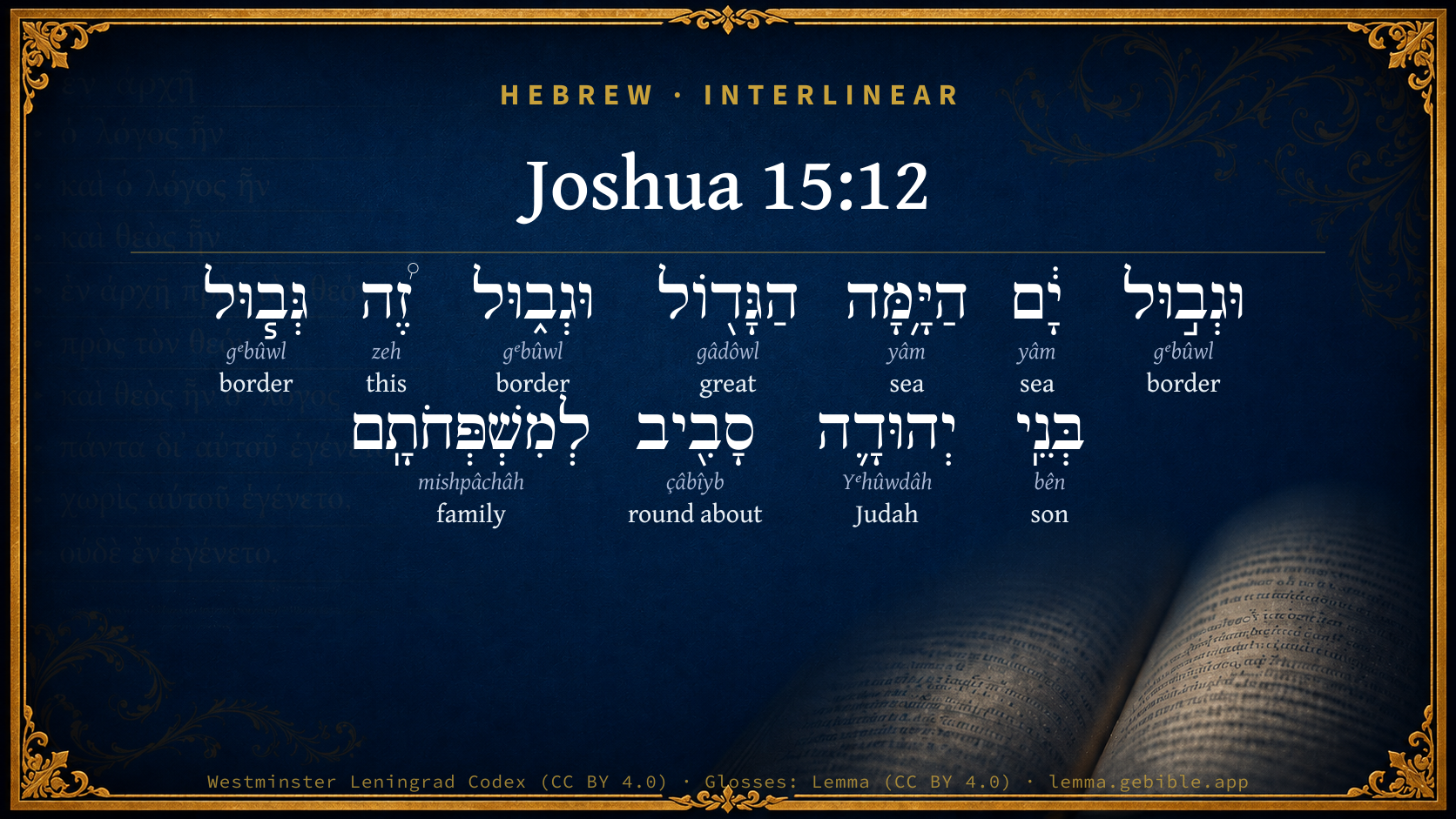
Hebrew (Westminster Leningrad Codex) Joshua 15:12 appears in the Hebrew Old Testament. The text above is from the Westminster Leningrad Codex. Each word links to its Strong’s number, a concise gloss, and parsing drawn from the Open Scriptures Hebrew Bible morphology. Click any word for its full Brown-Driver-Briggs (BDB) entry.
Download image
Cite this verse

Joshua 15:12 (World English Bible). Public Domain. Lemma interlinear Bible study tool, https://lemma.gebible.app/v/joshua/15/12.

Show BibTeX & RIS
BibTeX
RIS
English Translation
The west border was to the great sea, and the border [of it]. This is the border of the children of Judah round about according to their families.
World English Bible · Public Domain
Download a study sheet

One document with this verse’s original text, its word-by-word gloss line, the meaning frame, cross-references with their text, attributed commentary, and full source and license credits — printable, and it pastes into notes with its structure intact.

This verse Autodidact and up

Study sheet (.html) Plain text (.txt)

A passage Seminary Student

Up to 50 verses in one chapter. A passage sheet keeps up to 6 commentary sources and 12 cross-references per verse, in the order this page ranks them, and says so on the sheet whenever that leaves anything out. Ask for a single verse and you get the Autodidact verse sheet above.

Everything on this page stays free to read, with no account — the sheet is a download of what is already on screen, not access to it.

Want to remove ads? Support Godless Engineer
Compare translations 3

The same verse in 3 English versions, stacked beneath the original-language interlinear above. Click any original word for its lexicon entry.

Each is an independent rendering of the whole verse — the interlinear is not word-aligned to these translations.

Highlighted words mark where these versions differ — a whole-verse word diff, not a word-by-word alignment.

  • World English Bible Public Domain
    The west border was to the great sea, and the border [of it]. This is the border of the children of Judah round about according to their families.
  • King James Version Public Domain
    And the west border was to the great sea, and the coast thereof. This is the coast of the children of Judah round about according to their families.
  • unfoldingWord Literal Text CC BY-SA 4.0
    And the border of the west the Great Sea and the border. This the border of the sons of Judah all around, according to their clans.

unfoldingWord Literal Text — © unfoldingWord, licensed CC BY-SA 4.0. Word-aligned USFM3 via Door43 (git.door43.org/unfoldingWord/en_ult).

Versions to compare (up to 4)

3 of 4 selected

Show all 18 translations

Every available English version of this verse, each an independent rendering of the whole verse.

  • World English Bible Public Domain
    The west border was to the great sea, and the border [of it]. This is the border of the children of Judah round about according to their families.
  • Berean Standard Bible Public Domain
    And the western border was the coastline of the Great Sea. These are the boundaries around the clans of the descendants of Judah.
  • Majority Standard Bible Public Domain
    And the western border was the coastline of the Great Sea. These are the boundaries around the clans of the descendants of Judah.
  • King James Version Public Domain
    And the west border was to the great sea, and the coast thereof. This is the coast of the children of Judah round about according to their families.
  • American Standard Version (1901) Public Domain
    And the west border was to the great sea, and the border `thereof'. This is the border of the children of Judah round about according to their families.
  • Revised Version (1885) Public Domain
    And the west border was to the great sea, and the border thereof. This is the border of the children of Judah round about according to their families.
  • Geneva Bible (1599) Public Domain
    And the Westborder is to the great Sea: so this border shalbe the bounds of the children of Iudah round about, according to their families.
  • Douay-Rheims (1899) Public Domain
    These are the borders round about of the children of Juda in their kindreds.
  • Young's Literal Translation Public Domain
    And the west border `is' to the great sea, and `its' border; this `is' the border of the sons of Judah round about for their families.
  • Literal Standard Version CC BY-SA 4.0
    And the west border [is] to the Great Sea, and [its] border; this [is] the border of the sons of Judah all around for their families.
  • Unlocked Literal Bible CC BY-SA 4.0
    The western boundary was the Great Sea and its coastline. This is the border around the tribe of Judah, clan by clan.
  • unfoldingWord Literal Text CC BY-SA 4.0
    And the border of the west the Great Sea and the border. This the border of the sons of Judah all around, according to their clans.
  • Darby Bible Public Domain
    -- And the west border is the great sea and [its] coast. This is the border of the children of Judah round about, according to their families.
  • World Messianic Bible Public Domain
    The west border was to the shore of the great sea. This is the border of the children of Judah according to their families.
  • Webster's Bible Public Domain
    And the west border was to the great sea, and its coast: this is the border of the children of Judah round about, according to their families.
  • Free Bible Version CC BY-SA 4.0
    The western boundary was the coastline of the Great Sea. These were the boundaries around the tribe of Judah, by families.
  • Bible in Basic English Public Domain
    And the limit on the west is the edge of the Great Sea. This is the line going round the land marked out for the children of Judah, by their families.
  • JPS Tanakh (1917) Public Domain
    And as for the west border, the Great Sea was the border thereof. This is the border of the children of Judah round about according to their families.

Literal Standard Version (2020), Covenant Press — licensed CC BY-SA 4.0. Text via the HelloAO Bible API (eBible.org). Unlocked Literal Bible (unfoldingWord) — licensed CC BY-SA 4.0. Text via the HelloAO Bible API (eBible.org). unfoldingWord Literal Text — © unfoldingWord, licensed CC BY-SA 4.0. Word-aligned USFM3 via Door43 (git.door43.org/unfoldingWord/en_ult). Free Bible Version, Dr. Jonathan Gallagher — licensed CC BY-SA 4.0. Text via the HelloAO Bible API (eBible.org).

Word by word

More ways to search: Search by grammar → Find every occurrence → Compare this word →

Practice this passage: Drill this verse → Learn its vocabulary →

וּגְב֣וּל
gᵉbûwl
H1366
“and · border of”
Conjunction + Noun, Common, Masculine, Singular, Construct
Part of Speech
Conjunction + Noun
Type
Common
Gender
Masculine
Number
Singular
State
Construct
Full BDB Definition

Origin: from H1379

TWOT: 307a

border, territory - border - territory (enclosed within boundary) - region, territory (of darkness) (figuratively)
  1. יָ֔ם yâm H3220 “sea” Noun, Common, Masculine, Singular, Absolute
  2. הַיָּ֥מָּה yâm H3220 “the · sea · toward” Particle, Definite Article + Noun, Common, Masculine, Singular, Absolute + Suffix, Demonstrative
  3. הַגָּד֖וֹל gâdôwl H1419 “the · great” Particle, Definite Article + Adjective, Adjective, Masculine, Singular, Absolute
  4. וּגְב֑וּל gᵉbûwl H1366 “and · border” Conjunction + Noun, Common, Masculine, Singular, Absolute
  5. זֶ֠ה zeh H2088 “this” Pronoun, Demonstrative, Masculine, Singular
  6. גְּב֧וּל gᵉbûwl H1366 “border of” Noun, Common, Masculine, Singular, Construct
  7. בְּנֵֽי bên H1121 “sons of” Noun, Common, Masculine, Plural, Construct
  8. יְהוּדָ֛ה Yᵉhûwdâh H3063 “Judah” Noun, Proper
  9. סָבִ֖יב çâbîyb H5439 “round about” Noun, Common, Both, Singular, Absolute
  10. לְמִשְׁפְּחֹתָֽם mishpâchâh H4940 “to/for · families · their” Preposition + Noun, Common, Feminine, Plural, Construct + Suffix, Personal, 3rd Person, Masculine, Plural

About this verse

These counts appear in no published source. They are computed here, from the morphology-tagged text and Lemma’s own curated glosses. What Lemma adds →

11
words
8
distinct lemmas
Historical
section

Grammatical profile

  • 9 nouns
  • 1 adjective
  • 1 pronoun

Repetition

Words recur within this verse — often emphatic in Hebrew:

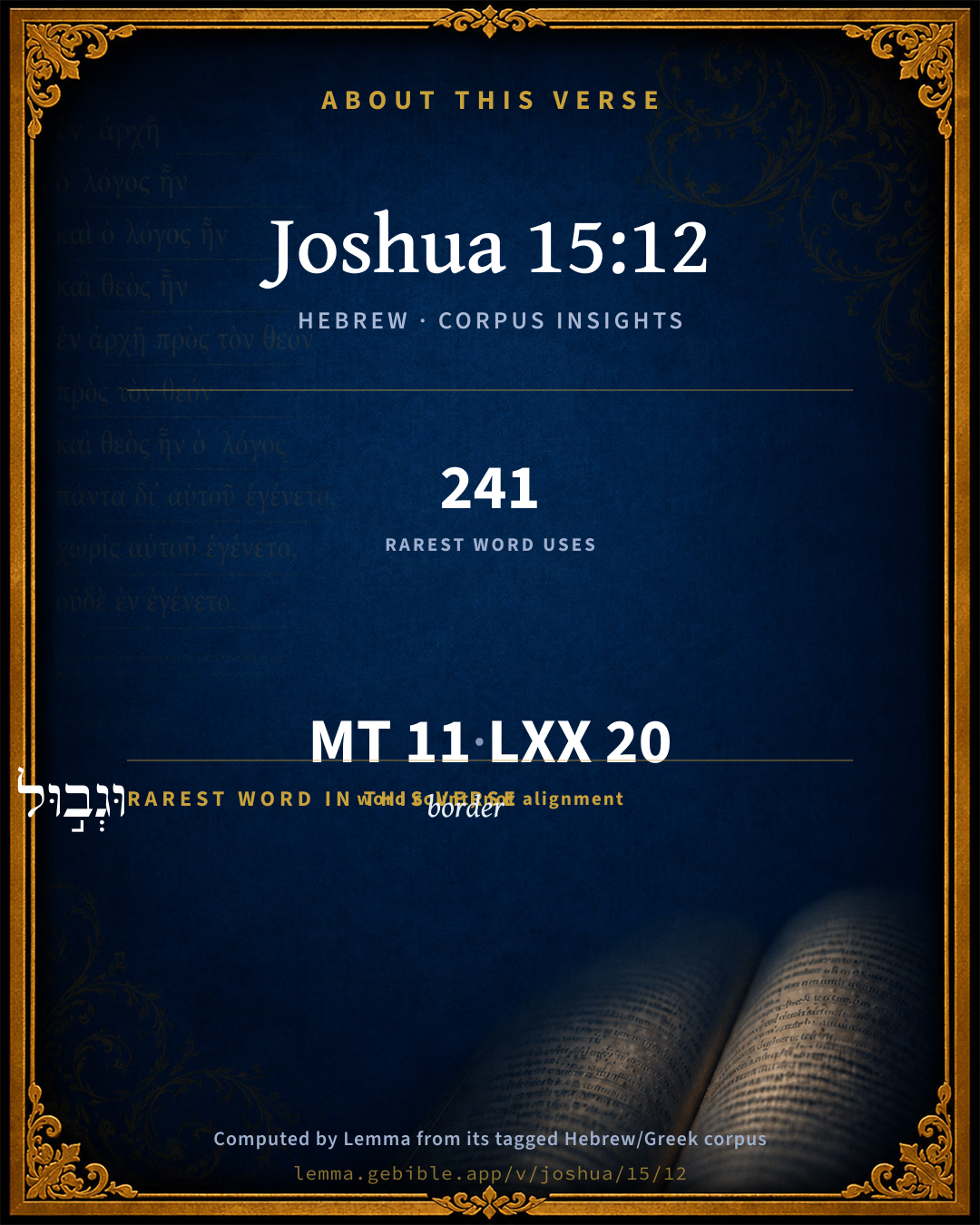
  • וּגְב֣וּל border H1366 ×3
  • יָ֔ם sea H3220 ×2

Hebrew & Septuagint length

In English translation the verse runs 28 words from the Hebrew and 15 from the Septuagint (LXX English) — the Septuagint runs noticeably shorter here. See the side-by-side →

A rough comparison of the two English renderings, which tokenize alike — not a word-level alignment.

Word counts can differ between the Hebrew and the Greek without any difference in meaning — e.g. the Hebrew direct-object marker אֵת has no separate Greek word, and Greek often adds the article ὁ.

In the original languages it is 11 Hebrew tokens and 20 Greek tokens — but the two are counted differently (Hebrew bundles its prefixes and suffixes into one token; the Greek is in lemma form), so that isn’t a like-for-like length.

Cross-references

4

Topical passages linked to Joshua 15:12 in the Treasury of Scripture Knowledge — connected by theme and wording, ordered by reader-vote popularity; previews shown in the World English Bible.

  • Ezekiel 47:20 The west side shall be the great sea, from the [south] border as far as over against the entrance of Hamath. This is the west side.
  • Numbers 34:6–7 For the western border, you shall have the great sea and the border [of it]: this shall be your west border.
  • Joshua 15:47 Ashdod, its towns and its villages; Gaza, its towns and its villages; to the brook of Egypt, and the great sea, and the border [of it].
  • Deuteronomy 11:24 Every place whereon the sole of your foot shall tread shall be yours: from the wilderness, and Lebanon, from the river, the river Euphrates, even to the hinder sea shall be your border.

Cross-references courtesy of OpenBible.info (CC BY 4.0).

Hebrew and Greek witnesses Masoretic Hebrew ↔ Greek Septuagint

The same verse in the two great witnesses to the Old Testament, shown verse-for-verse.

Here the Septuagint runs noticeably shorter than the Hebrew — LXX2012 (modern English Septuagint) 15 words vs World English Bible 28. A rough length comparison of the two English translations, not a word-level alignment — read both below.

These are two independent witnesses, not word-aligned to each other, and the Septuagint is shown in lemma (dictionary) form.

Hebrew Joshua 15:12 Masoretic · Westminster Leningrad Codex

וּגְב֣וּל יָ֔ם הַיָּ֥מָּה הַגָּד֖וֹל וּגְב֑וּל זֶ֠ה גְּב֧וּל בְּנֵֽי יְהוּדָ֛ה סָבִ֖יב לְמִשְׁפְּחֹתָֽם

The west border was to the great sea, and the border [of it]. This is the border of the children of Judah round about according to their families.

World English Bible · Public Domain

Greek LXX Joshua 15:12 Septuagint · lemma form

καί ὁ ὅριον αὐτός ἀπό θάλασσα ὁ θάλασσα ὁ μέγας ὁρίζω οὗτος ὁ ὅριον υἱός ιουδα κύκλος κατά δῆμος αὐτός

These are the borders of the children of Juda round about according to their families.

LXX2012 (modern English Septuagint) · Public Domain

Hebrew: Westminster Leningrad Codex (CC BY 4.0). Greek: Septuagint (public domain); English from LXX2012 (modern English Septuagint) (Public Domain). How the Septuagint differs from the Hebrew →

Targum (Aramaic paraphrase)

1

The Targum is the ancient Jewish Aramaic paraphrase of the Hebrew Scriptures — an interpretive translation, not the Hebrew text itself. Onkelos (literal) and Pseudo-Jonathan (expansive) render the Torah, and Jonathan the Prophets. Coverage is partial: where no permissively-licensed English translation exists for a verse, only the Aramaic is shown. This is verse-level text, not a word-by-word alignment to the Hebrew.

  1. Targum Jonathan Prophets (Joshua–Malachi)
    וּתְחוּם מַעַרְבָא יַמָא רַבָּא וּתְחוּמָא דֵין תְּחוּם בְּנֵי יְהוּדָה סְחוֹר סְחוֹר לְזַרְעֲיַתְהוֹן:

    (no public-domain English translation for this verse)

    Targum Jonathan — Aramaic: “Mikraot Gedolot” (public domain). English: “Sefaria Community Translation” (CC0 1.0 (public-domain dedication)); “London "Chaldee Paraphrase," 1871” (public domain). Text via Sefaria.

Commentary

Notes on Joshua 15:12 from classic Christian and Jewish commentators (each source and its license shown beneath its notes). The classic Christian expositions comment on the surrounding passage and are grouped to its opening verse, so a note may address several verses; the Jewish commentaries on the Tanakh (Rashi and others) are per-verse, so they appear only where the commentator wrote on this verse.

Lemma curates 59 commentaries, every one of them public domain or Creative Commons licensed, each selected and text-cleaned for this edition rather than reprinted as found. About our sources →

Trapp's Complete Commentary

John Trapp

Jos 15:12 And the west border [was] to the great sea, and the coast [thereof]. This [is] the coast of the children of Judah round about according to their families.

Ver. 12. The great sea,] i.e., The midland sea, great in comparison of the lakes of Palestine, called also seas.

John Trapp, A Commentary or Exposition upon All the Books of the Old and New Testament (1647–1656) — public domain. Text from a community e-Sword module.

Joseph Benson's Commentary

Jos 15:12. This is the coast of the children of Judah, round about according to their families — That is, thus the lot was bounded on all sides in the first draught of it. Which being afterward found too large, it was contracted into a narrower compass, that more room might be made for the tribe of Simeon, who had part of this lot consigned to them; as some other places were added out of it to the tribes of Benjamin and Dan, as will afterward appear.

Joseph Benson's Commentary on the Old and New Testaments (1811–1818) — public domain. Text from a community e-Sword module.

Tyndale Open Study Notes

Tyndale Open Resources

15:12 These were the boundaries of Judah when the settlement process began. Later, the tribes of Simeon and Dan received their allotments from some of Judah’s southern and western territories, and within a few decades the Philistines came from the Greek islands, settling all the southern coastal plain allotted to Judah (see study note on 13:2).

Tyndale Open Study Notes — © Tyndale Open Resources, licensed CC BY-SA 4.0. Text via the HelloAO Bible API.

Adam Clarke's Commentary

Verse 12. The great sea] The Mediterranean.

Adam Clarke's Commentary on the Bible (1810–1826) — public domain. Text from a community e-Sword/MySword module.

The Cambridge Bible for Schools and Colleges

gen. ed. J. J. S. Perowne

12. the west border] was formed by the Mediterranean Sea.

to the great sea] From Jabneel the boundary continued to the Mediterranean Sea along the Wady es Surah.

and the coast thereof] or borders thereof; see above, ch. Jos_13:23; Jos_13:27, and comp. Num_34:6.

The Cambridge Bible for Schools and Colleges (gen. ed. J. J. S. Perowne; Cambridge University Press, 1878–1918) — public domain. Text from a community e-Sword module.

John Gill's Exposition

And the west border was to the great sea, and the coast thereof,.... The western border of the tribe of Judah went along by the Mediterranean sea, which lay west to the land of Canaan; and this border reached from Jabneel to the river of Egypt, where the southern border ended, Jos 15:4,

this is the coast of the children of Judah round about according to their families; but being too large, some part of it was afterwards given to Simeon, and some particular cities of it were given to Dan and Benjamin: it was bounded on the west by the tribes of Simeon and Dan towards the Mediterranean sea, and by the tribe of Benjamin on the north, and by the wilderness of Paran on the south, and by the dead sea and Jordan on the east.

John Gill's Exposition of the Whole Bible (1746–1763) — public domain (CC PDM 1.0). Text via the HelloAO Bible API.

Whedon's Commentary on the Bible

Daniel D. Whedon

12. To the great sea and the coast — That is, the coast of the Mediterranean from Jebneel southward formed Judah’s western boundary.

The writer, having now given the boundaries of Judah, is about to give a list of the cities within these bounds. But before proceeding to do so he enters a brief account of Caleb’s conquest of his portion, which Joshua had allotted him. See Jos_14:6-15. As Caleb’s possession included the most important city and central seat of the whole tribe of Judah, it is natural that the fact of its conquest should be recorded here.

As Jos_15:13-19 are nearly identical with Jdg_1:10-20, some have supposed that this passage in Joshua was copied from that in Judges; and others, on the contrary, maintain that the passage in Judges was taken from this. Keil, however, urges that both passages were drawn from one common source, a document older than either the Book of Joshua or that of Judges.]

Daniel D. Whedon (gen. ed.), Commentary on the Old and New Testaments (1874–1909) — public domain. Text from a community e-Sword module.

The Pulpit Commentary

And the coast thereof See Jos_13:23.

The Pulpit Commentary (1880–1919), ed. H.D.M. Spence-Jones & Joseph S. Exell — public domain. Text from a community e-Sword module.

Lesson kit

Teaching starters — assembled from the data on this page, not authored interpretation. Every prompt links to the verse data it draws on. Edit before teaching.

Joshua, in the Historical, opens this verse with 11 words (8 distinct Hebrew lemmas). Its most distinctive word is gᵉbûwl (“border”). The Greek Septuagint runs shorter here. A historical commentator’s framing appears above. Read the whole chapter for the surrounding context.

Discussion questions

  1. The word gᵉbûwl carries the sense “border.” How does it shape the verse?
  2. How does Ezekiel 47:20, which shares this passage’s theme, read alongside this verse?
  3. What does the repetition of “border” (3× in this one verse) do in this verse?
  4. The Septuagint runs shorter here than the Hebrew. What might account for the difference?
  5. These translations render this verse differently; the difference is in the English rendering, not the original. What questions does that raise?
  6. Compare how Trapp's Complete Commentary and Joseph Benson's Commentary read this verse. Where do they agree or differ?

Things to notice

Reading settings

Reading text

Shown beneath each verse's original-language words.

Old Testament
Old Testament edition

Read the OT as the Masoretic Hebrew (MT) or the Greek Septuagint (LXX).

English shown for the Greek Septuagint (in the Hebrew ↔ Greek comparison).

Comparing translations? Open the Compare panel on any verse page to stack up to four side by side.