
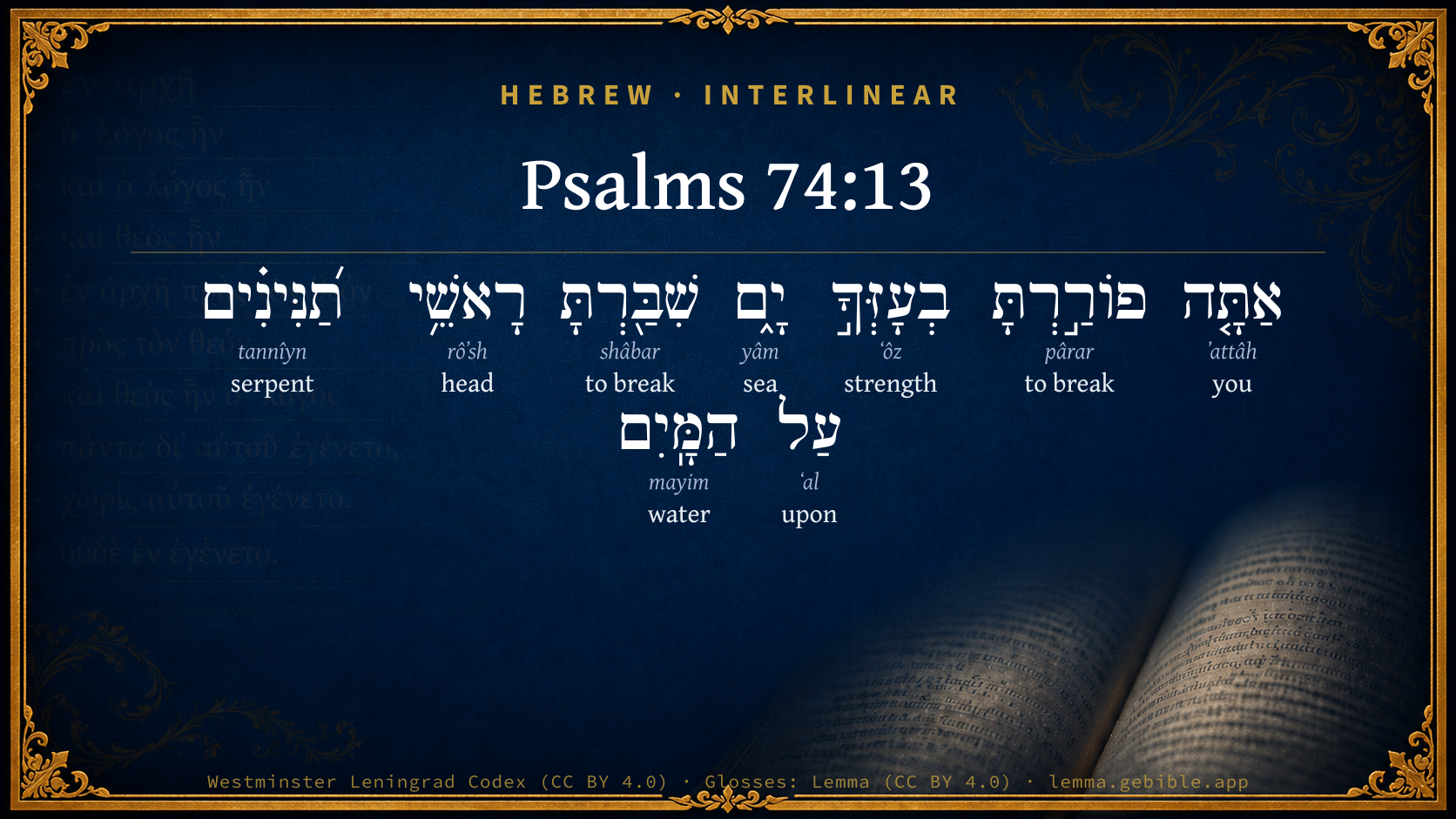
Psalms 74:13

Hebrew (Westminster Leningrad Codex) Psalms 74:13 appears in the Hebrew Old Testament. The text above is from the Westminster Leningrad Codex. Each word links to its Strong’s number, a concise gloss, and parsing drawn from the Open Scriptures Hebrew Bible morphology. Click any word for its full Brown-Driver-Briggs (BDB) entry.
Download image
Cite this verse

Psalms 74:13 (World English Bible). Public Domain. Lemma interlinear Bible study tool, https://lemma.gebible.app/v/psalms/74/13.

Show BibTeX & RIS
BibTeX
RIS
English Translation
You divided the sea by your strength. You broke the heads of the sea monsters in the waters.
World English Bible · Public Domain
Download a study sheet

One document with this verse’s original text, its word-by-word gloss line, the meaning frame, cross-references with their text, attributed commentary, and full source and license credits — printable, and it pastes into notes with its structure intact.

This verse Autodidact and up

Study sheet (.html) Plain text (.txt)

A passage Seminary Student

Up to 50 verses in one chapter. A passage sheet keeps up to 6 commentary sources and 12 cross-references per verse, in the order this page ranks them, and says so on the sheet whenever that leaves anything out. Ask for a single verse and you get the Autodidact verse sheet above.

Everything on this page stays free to read, with no account — the sheet is a download of what is already on screen, not access to it.

Want to remove ads? Support Godless Engineer
Compare translations 3

The same verse in 3 English versions, stacked beneath the original-language interlinear above. Click any original word for its lexicon entry.

Each is an independent rendering of the whole verse — the interlinear is not word-aligned to these translations.

Highlighted words mark where these versions differ — a whole-verse word diff, not a word-by-word alignment.

  • World English Bible Public Domain
    You divided the sea by your strength. You broke the heads of the sea monsters in the waters.
  • King James Version Public Domain
    Thou didst divide the sea by thy strength: thou brakest the heads of the dragons in the waters.
  • unfoldingWord Literal Text CC BY-SA 4.0
    You, you divided the sea by your strength; you broke the heads of the sea monsters in the waters.

unfoldingWord Literal Text — © unfoldingWord, licensed CC BY-SA 4.0. Word-aligned USFM3 via Door43 (git.door43.org/unfoldingWord/en_ult).

Versions to compare (up to 4)

3 of 4 selected

Show all 18 translations

Every available English version of this verse, each an independent rendering of the whole verse.

  • World English Bible Public Domain
    You divided the sea by your strength. You broke the heads of the sea monsters in the waters.
  • Berean Standard Bible Public Domain
    You divided the sea by Your strength; You smashed the heads of the dragons of the sea;
  • Majority Standard Bible Public Domain
    You divided the sea by Your strength; You smashed the heads of the dragons of the sea;
  • King James Version Public Domain
    Thou didst divide the sea by thy strength: thou brakest the heads of the dragons in the waters.
  • American Standard Version (1901) Public Domain
    Thou didst divide the sea by thy strength: Thou brakest the heads of the sea-monsters in the waters.
  • Revised Version (1885) Public Domain
    Thou didst divide the sea by thy strength: thou brakest the heads of the dragons in the waters.
  • Geneva Bible (1599) Public Domain
    Thou didest deuide the sea by thy power: thou brakest the heads of the dragons in the waters.
  • Douay-Rheims (1899) Public Domain
    Thou by thy strength didst make the sea firm: thou didst crush the heads of the dragons in the waters.
  • Young's Literal Translation Public Domain
    Thou hast broken by Thy strength a sea-`monster', Thou hast shivered Heads of dragons by the waters,
  • Literal Standard Version CC BY-SA 4.0
    You have divided [the] sea by Your strength, || You have shattered heads of dragons by the waters,
  • Unlocked Literal Bible CC BY-SA 4.0
    You divided the sea by your strength; you smashed the heads of the sea monsters in the waters.
  • unfoldingWord Literal Text CC BY-SA 4.0
    You, you divided the sea by your strength; you broke the heads of the sea monsters in the waters.
  • Darby Bible Public Domain
    *Thou* didst divide the sea by thy strength; thou didst break the heads of the monsters on the waters:
  • World Messianic Bible Public Domain
    You divided the sea by your strength. You broke the heads of the sea monsters in the waters.
  • Webster's Bible Public Domain
    Thou didst divide the sea by thy strength: thou didst break the heads of the dragons in the waters.
  • Free Bible Version CC BY-SA 4.0
    You were the one who split apart the sea by your strength; you broke the heads of the sea monsters.
  • Bible in Basic English Public Domain
    The sea was parted in two by your strength; the heads of the great sea-beasts were broken.
  • JPS Tanakh (1917) Public Domain
    Thou didst break the sea in pieces by Thy strength; Thou didst shatter the heads of the sea-monsters in the waters.

Literal Standard Version (2020), Covenant Press — licensed CC BY-SA 4.0. Text via the HelloAO Bible API (eBible.org). Unlocked Literal Bible (unfoldingWord) — licensed CC BY-SA 4.0. Text via the HelloAO Bible API (eBible.org). unfoldingWord Literal Text — © unfoldingWord, licensed CC BY-SA 4.0. Word-aligned USFM3 via Door43 (git.door43.org/unfoldingWord/en_ult). Free Bible Version, Dr. Jonathan Gallagher — licensed CC BY-SA 4.0. Text via the HelloAO Bible API (eBible.org).

Word by word

More ways to search: Search by grammar → Find every occurrence → Compare this word →

Practice this passage: Drill this verse → Learn its vocabulary →

About this verse

These counts appear in no published source. They are computed here, from the morphology-tagged text and Lemma’s own curated glosses. What Lemma adds →

9
words
9
distinct lemmas
Wisdom
section

Shared distinctive vocabulary

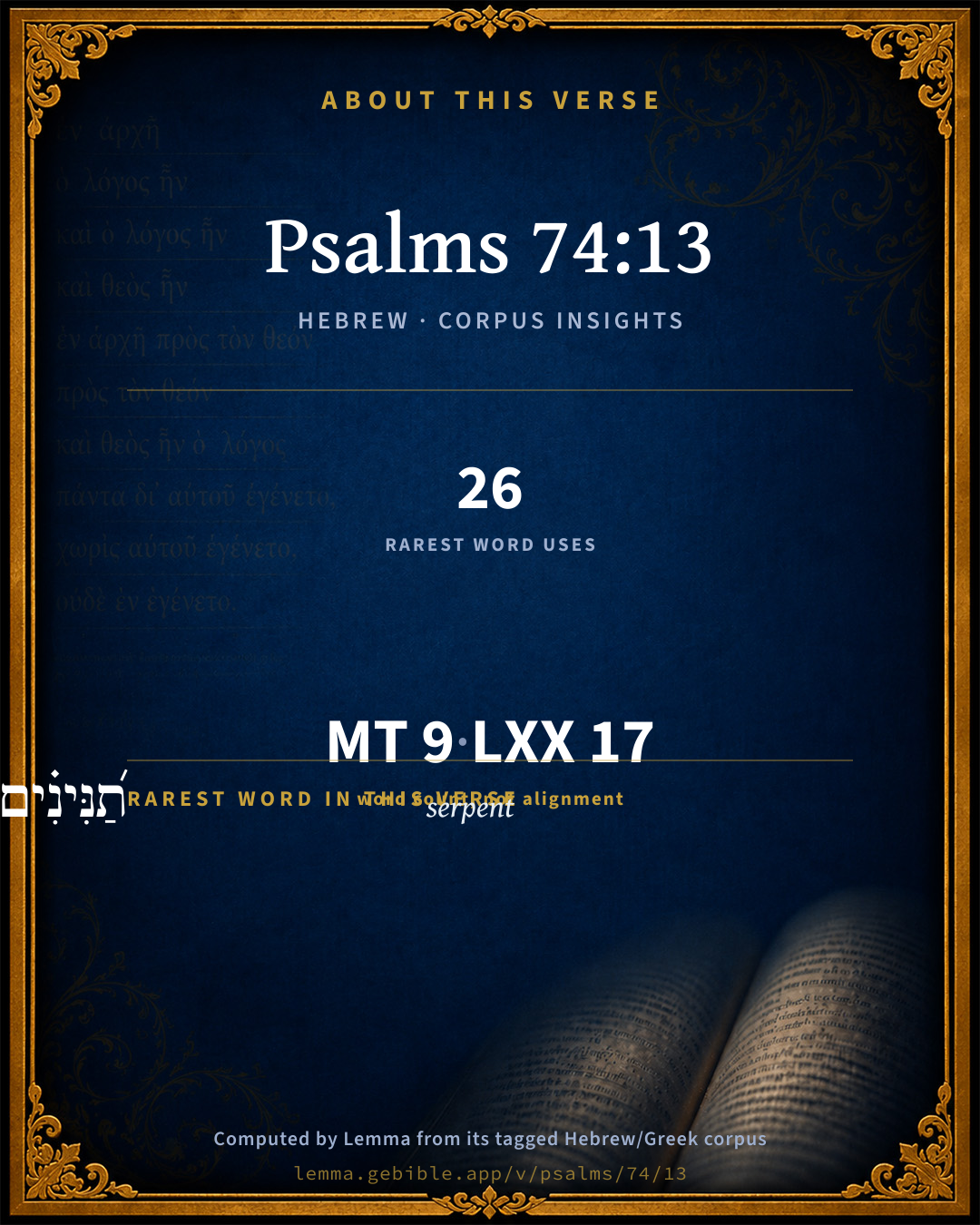
תַ֝נִּינִ֗ים serpent H8577 occurs in 26 verses of the Hebrew Bible. Also found in:

Grammatical profile

  • 2 verbs
  • 5 nouns
  • 1 pronoun
  • 1 preposition

Verb forms

  • פוֹרַ֣רְתָּ Poel · Perfect
  • שִׁבַּ֖רְתָּ Piel · Perfect

Hebrew & Septuagint length

In English translation the verse runs 18 words from the Hebrew and 21 from the Septuagint (LXX English) — closely comparable.

A rough comparison of the two English renderings, which tokenize alike — not a word-level alignment.

Word counts can differ between the Hebrew and the Greek without any difference in meaning — e.g. the Hebrew direct-object marker אֵת has no separate Greek word, and Greek often adds the article ὁ.

In the original languages it is 9 Hebrew tokens and 17 Greek tokens — but the two are counted differently (Hebrew bundles its prefixes and suffixes into one token; the Greek is in lemma form), so that isn’t a like-for-like length.

Cross-references

11

Topical passages linked to Psalms 74:13 in the Treasury of Scripture Knowledge — connected by theme and wording, ordered by reader-vote popularity; previews shown in the World English Bible.

  • Exodus 14:21 Moses stretched out his hand over the sea, and Yahweh caused the sea to go back by a strong east wind all the night, and made the sea dry land, and the waters were divided.
  • Psalms 78:13 He split the sea, and caused them to pass through; He made the waters stand as a heap.
  • Isaiah 51:9–10 Awake, awake, put on strength, arm of Yahweh; awake, as in the days of old, the generations of ancient times. Isn't it you who did cut Rahab in pieces, who pierced the monster?
  • Ezekiel 29:3 speak, and say, Thus says the Lord Yahweh: Behold, I am against you, Pharaoh king of Egypt, the great monster that lies in the midst of his rivers, that has said, My river is my own, and I have made it for myself.
  • Ezekiel 32:2 Son of man, take up a lamentation over Pharaoh king of Egypt, and tell him, You were likened to a young lion of the nations: yet are you as a monster in the seas; and you did break forth with your rivers, and troubled the waters with your feet, and fouled their rivers.
  • Exodus 14:28 The waters returned, and covered the chariots and the horsemen, even all Pharaoh's army that went in after them into the sea. There remained not so much as one of them.
  • Nehemiah 9:11 You divided the sea before them, so that they went through the midst of the sea on the dry land; and their pursuers you did cast into the depths, as a stone into the mighty waters.
  • Psalms 66:6 He turned the sea into dry land. They went through the river on foot. There, we rejoiced in him.
  • Psalms 106:8–9 Nevertheless he saved them for his name's sake, That he might make his mighty power known.
  • Psalms 136:13–18 To him who divided the Red Sea apart; For his loving kindness endures forever;
  • Isaiah 11:15–16 Yahweh will utterly destroy the tongue of the Egyptian sea; and with his scorching wind will he wave his hand over the River, and will strike it into seven streams, and cause men to march over in sandals.

Cross-references courtesy of OpenBible.info (CC BY 4.0).

Hebrew and Greek witnesses Masoretic Hebrew ↔ Greek Septuagint

The same verse in the two great witnesses to the Old Testament, shown verse-for-verse.

You’re reading Greek Psalm 73 (Hebrew Psalm 74). The Septuagint counts the superscription, so verse numbers can differ from the Hebrew — chapter-level alignment, not verse-by-verse. Numbering follows Rahlfs.

These are two independent witnesses, not word-aligned to each other, and the Septuagint is shown in lemma (dictionary) form.

Hebrew Psalms 74:13 Masoretic · Westminster Leningrad Codex

אַתָּ֤ה פוֹרַ֣רְתָּ בְעָזְּךָ֣ יָ֑ם שִׁבַּ֖רְתָּ רָאשֵׁ֥י תַ֝נִּינִ֗ים עַל הַמָּֽיִם

You divided the sea by your strength. You broke the heads of the sea monsters in the waters.

World English Bible · Public Domain

Greek LXX Greek Psalm 73:13 Septuagint · lemma form

σύ κραταιόω ἐν ὁ δύναμις σύ ὁ θάλασσα σύ συντρίβω ὁ κεφαλή ὁ δράκων ἐπί ὁ ὕδωρ

You did establish the sea, in your might, you did break to pieces the heads of the dragons in the water.

LXX2012 (modern English Septuagint) · Public Domain

On this verse, Ellicott's Commentary for English Readers discusses the Septuagint’s reading. Read the note in Commentary ↓

Hebrew: Westminster Leningrad Codex (CC BY 4.0). Greek: Septuagint (public domain); English from LXX2012 (modern English Septuagint) (Public Domain). How the Septuagint differs from the Hebrew →

Commentary

Notes on Psalms 74:13 from classic Christian and Jewish commentators (each source and its license shown beneath its notes). The classic Christian expositions comment on the surrounding passage and are grouped to its opening verse, so a note may address several verses; the Jewish commentaries on the Tanakh (Rashi and others) are per-verse, so they appear only where the commentator wrote on this verse.

Lemma curates 59 commentaries, every one of them public domain or Creative Commons licensed, each selected and text-cleaned for this edition rather than reprinted as found. About our sources →

The Cambridge Bible for Schools and Colleges

gen. ed. J. J. S. Perowne

13. Thou] Psa_74:13-15; Psa_74:17 all begin with an emphatic Thou; Psa_74:16 with Thine. It is Thou and none other, Who didst and doest all these things. The Asaphite Psalms are full of references to the Exodus.

by thy strength] Cp. Psa_77:14; Exo_15:13. The dragons or sea monsters, and leviathan, either the crocodile or some vague mythological monster, are symbolical of Egypt. Cp. Isa_27:1; Isa_51:9; Eze_29:3.

in the waters] Lit. upon the waters, the symbolical monsters being imagined as floating upon the surface of the water. The reference of course is to the destruction of Pharaoh’s army in the Red Sea.

The Cambridge Bible for Schools and Colleges (gen. ed. J. J. S. Perowne; Cambridge University Press, 1878–1918) — public domain. Text from a community e-Sword module.

Trapp's Complete Commentary

John Trapp

Psa 74:13 Thou didst divide the sea by thy strength: thou brakest the heads of the dragons in the waters.

Ver. 13. Thou didst divide the sea, &c.] "Thou" in this and the following verses is emphatic and exclusive, q.d. thou, and none but thou.

Thou brakest the heads of the dragons] Or crocodiles. So he calleth Pharaoh’s chieftains, who were Satan’s swordmen, and with him had their heads broke at the Red Sea.

John Trapp, A Commentary or Exposition upon All the Books of the Old and New Testament (1647–1656) — public domain. Text from a community e-Sword module.

Joseph Benson's Commentary

Psa 74:13-14. Thou didst divide the sea, &c. — “The first part of this verse alludes to that marvellous act of omnipotence which divided the Red sea for Israel to pass over; the second part to the return of its waves upon the heads of the Egyptians, who, like so many sea-monsters, opening their mouths to devour the people of God, were overwhelmed, and perished in the mighty waters.” — Horne. Thou brakest the heads of the dragons — The crocodiles, meaning Pharaoh’s mighty men, who were like these beasts in strength and cruelty. Thou brakest the heads — That is, the head of Pharaoh himself. He says heads, because of the several princes who were and acted under his influence. Dr. Waterland renders the first word, which we translate dragons, crocodiles, and the latter, the crocodile, meaning Pharaoh. And gavest him, &c., to the people inhabiting the wilderness — Hebrew, לעם לציים, legnam letziim, populo desertorum, locorum, (Buxtorf,) to the people of desert places. The Seventy render it, λαοις

τοις Αιθιοψι, to the Ethiopian people. Poole, Horne, and some other commentators, suppose that ravenous birds and beasts of the desert, and not men, are here intended; and that the sense of the clause is, that the bodies of Pharaoh and his captains were thrown on shore by the sea, and so became food for the wild beasts of the neighbouring deserts. We find the same word ציים, used for wild beasts haunting the deserts, Isa 13:21; Isa 34:14.

Joseph Benson's Commentary on the Old and New Testaments (1811–1818) — public domain. Text from a community e-Sword module.

Whedon's Commentary on the Bible

Daniel D. Whedon

13. Thou didst divide the sea—He begins with the deliverance from Egypt. Could their deliverance now from Babylon be greater? Could not the same God even now restore them? Psa_74:13-15 are a historical review of God’s providence; Psa_74:16-17, of his providence and power in nature.

Thou brakest the heads of the dragons—Or, crocodiles, the symbol of Egypt. Isa_51:9; Eze_29:3.

In the waters—Hebrew, upon the waters; in allusion to those river and sea monsters who lie with their heads exposed above water. See Psa_74:14

Daniel D. Whedon (gen. ed.), Commentary on the Old and New Testaments (1874–1909) — public domain. Text from a community e-Sword module.

J. A. Alexander on Psalms

Joseph Addison Alexander

Psa 74:13. Thou hast burst, with thy strength, the sea; thou hast broken the heads of dragons on the water. The word translated dragons is applied to the largest class of aquatic animals. Some suppose these to be here emblematic of Egypt and other hostile powers, as in Eze 29:3-4, Isa 51:9-10. Others, with more probability, explain the verse as a description of God's power over nature, and particularly over the sea, as specially maniested in the passage of the Red Sea. The dragons or sea-monsters are then added merely to complete the picture. As if he had said, "Thou hast subdued and crushed the sea, and its most terrible inhabitants." This is described as taking place, not in or under the waters, the abode of the sea-monsters, but on the surface, where the contest becomes visible. The pronoun at the beginning is emphatic: "it is thou that hast done all this, and not another."

Joseph Addison Alexander, The Psalms Translated and Explained (1850) — public domain. Text from a community e-Sword module.

Geneva Bible (1599)

Geneva Bible translators

To wit, Pharaoh’s army.

Geneva Bible (1599) marginal notes — public domain. Text via Bolls.life.

Adam Clarke's Commentary

Verse 13. Thou didst divide the sea] When our fathers came from Egypt.

Thou brakest the heads of the dragons in the waters.] Pharaoh, his captains, and all his hosts were drowned in the Red Sea, when attempting to pursue them.

Adam Clarke's Commentary on the Bible (1810–1826) — public domain. Text from a community e-Sword/MySword module.

John Calvin's Commentaries

13. Thou hast divided the sea by thy power. The prophet now collects together certain kinds of deliverances highly worthy of remembrance; all of them, however, belonging to the first deliverance by which God emancipated his people from the tyranny of Egypt. We will find him afterwards descending to the general commendation of the goodness of God which is diffused through the whole world. Thus from the special grace which God vouchsafes to his Church, he passes on to speak of the good-will which he displays towards all mankind. In the first place, he says, Thou hast divided, or cleaved, the sea. Some think that the following clause is subjoined as an effect of what is stated in the first clause, — God, by drying up the sea, having caused the whales and other great fishes to die. I am, however, of opinion, that it is to be taken metaphorically for Pharaoh and his army; this mode of expression being very common among the prophets, especially when they speak of the Egyptians, whose country was washed by a sea abounding with fish, and divided by the Nile. Pharaoh is, therefore, not improperly termed Leviathan, on account of the advantages of the sea possessed by his country, and because, in reigning over that land with great splendor, he might be compared to a whale moving up and down at its ease in the midst of the waters of the mighty ocean. As God put forth his power at that time for the deliverance of the people, to assure the Church that he would always be her protector and the guardian of her welfare, the encouragement afforded by this example ought not to be limited exclusively to one age. It is, therefore, with good reason applied to the descendants of that ancient race, that they might improve it as a means of confirming and establishing their faith. The prophet does not here recount all the miracles which God had wrought at the departure of the people from the land of Egypt; but in adverting to some of them, he comprehends by the figure synecdoche, all that Moses has narrated concerning them at greater length. When he says that leviathan was given for food to the Israelites, and that even in the wilderness, there is a beautiful allusion to the destruction of Pharaoh and his host. It is as if he had said, that then a bountiful provision of victuals was laid up for the nourishment of the people; for when their enemies were destroyed, the quiet and security which the people in consequence enjoyed served, so to speak, as food to prolong their life. By the wilderness, is not meant the countries lying on the sea coast, though they are dry and barren, but the deserts at a great distance from the sea. The same subject is prosecuted in the following verse, where it is declared, that the fountain was cleaved or divided, that is, it was so when God caused a stream of water to gush from the rock to supply the wants of the people. Finally, it is added, that mighty rivers were dried up, an event which happened when God caused the waters of the Jordan to turn back to make a way for his people to pass over. Some would have the Hebrew word איתן, ethan, which signifies mighty, to be a proper name, as if the correct translation were rivers of Ethan; but this interpretation is altogether without foundation.

John Calvin's Commentaries (1540-1563) — public domain. Text from the Calvin Translation Society English edition (1840s-50s) via the Christian Classics Ethereal Library (ccel.org). Calvin's coverage is partial (roughly two-thirds of the Bible); uncommented books and verses are honest gaps, never fabricated. The 19th-century editor's footnotes and remarks are omitted so the notes are faithfully Calvin's own voice.

Ellicott's Commentary for English Readers

(13) Thou.—Verse after verse this emphatic pronoun recurs, as if challenging the Divine Being to contradict.

Divide.—Literally, break up.

Dragons.—Hebrew, tannînîm, not to be confounded with tannîm (Psa_44:19, where see Note). It is the plural of tannín, which always indicates some aquatic monster. In Gen_1:21 it is translated whale, so here by Symmachus. The LXX. (comp. Vulgate) have rendered this word and leviathan (in the next verse) by δράκων, and, indeed, the parallelism indicates monsters of a similar, if not the same, kind. About leviathan the minute and faithful description of the crocodile in Job 41 does not leave a doubt, and therefore we conclude that the tannin, here as in Eze_29:3; Eze_32:2 (margin), Isa_27:1; Isa_51:9 (where it is also, as here, joined with leviathan), an emblem of Egypt, was some great saurian, perhaps the alligator. The derivation from a root implying extend, favours this explanation. (Tristram, Nat. Hist. of the Bible, pp. 260, 261.) Besides its abundance, another fact leading to the crocodile becoming an emblem of Egypt, was the adoration paid to it. (See Herod., ii. 69.)

In the waters.—Literally, on the waters.

A Bible Commentary for English Readers, edited by Charles John Ellicott (1878–1897) — public domain. Text from a community e-Sword module.

John Gill's Exposition

Thou breakest the heads of leviathan in pieces,.... A large fish, generally thought to be the whale, by some the crocodile, described in Job 41:1 to which the king of Egypt or Babylon is compared, Isa 27:1 and so the Romish antichrist in one of his characters is represented as a sea beast with many heads, which will all be broken in pieces in due time, Rev 13:1, as here is one "leviathan" with heads in the plural number. Aben Ezra thinks the word is wanting, and may be supplied thus, "thou hast broken the heads of every leviathan"; it may be interpreted as before of Pharaoh and his chief men; so the Targum,

"thou hast broken the heads of the mighty men of Pharaoh:''

and gavest him to be meat to the people inhabiting the wilderness; either to the wild beasts, called "tziim", the word here used, Isa 13:21 and may be called a people, as the ants and coneys are, Pro 30:25, to whom the dead bodies of Pharaoh and his host, drowned in the Red sea, were given for food, when they were cast upon the shore, where the Israelites saw them dead, Exo 14:28, or to the "Ichthyophagy", a sort of people that dwelt by the Red sea, and lived on fishes; and so the Egyptians became their food, they living upon the fish which devoured their bodies, at least some of them: the Septuagint, Vulgate Latin, Ethiopic, and Arabic versions, render it, "to the people", the Ethiopians; who, it seems, living upon the borders of Egypt, took this opportunity, when Pharaoh and his host were drowned, and seized upon their country; but others refer it to the people of Israel themselves, as the Targum,

"thou hast given them for destruction to the people of the house of Israel, and their bodies to the dragons;''

and so Jarchi,

"thou hast given his mammon or riches to the people of Israel, to feed their companies and armies;''

and Kimchi interprets it of the spoil of the sea which the Israelites took from them; and they may be truly called the people inhabiting the wilderness, since they were in one forty years; so the Romish "leviathan", or antichristian whore, will be given to the Christian kings, who will hate her, eat her flesh, and burn her with fire; and to the Christian church, which now is in the wilderness, where it is nourished for a time and times, and half a time.

John Gill's Exposition of the Whole Bible (1746–1763) — public domain (CC PDM 1.0). Text via the HelloAO Bible API.

Albert Barnes' Notes on the Bible

Thou didst divide the sea by thy strength - Margin, as in Hebrew, “break.” That is, he had by his power “broken up” the strength of the sea so that it offered no resistance to their passing through it. The allusion is evidently to the passage through the Red Sea, Exo 14:21.

Thou brakest the heads of the dragons - Margin, “whales.” On the meaning of the word used here - תנין tannı̂yn - see the notes at Isa 13:22; notes at Job 30:29. It refers here, undoubtedly, to crocodiles or sea monsters. The language here is used to denote the absolute power of God as manifested over the sea when the people of Israel passed through it. It was as if by slaying all the mighty monsters of the deep that would have resisted their passage, he had made their transit entirely safe.

In the waters - That reside in the waters of the sea.

Albert Barnes' Notes on the Bible (1834–1885) — public domain. Text from a community e-Sword/MySword module.

Matthew Poole's English Annotations

The dragons; or, the crocodiles. He means Pharaoh and all his mighty men, who were like these beasts in strength and cruelty.

The waters, to wit, of the sea, where they were drowned.

Matthew Poole's English Annotations on the Holy Bible (1683–1685) — public domain. Text from a community e-Sword/MySword module.

The Treasury of David

Charles H. Spurgeon

Ver. 13. Thou didst divide the sea by thy strength. Infinite power split the Red Sea in twain. Israel delighted to rehearse this famous act of the Lord.

Thou brakest the heads of the dragons in the waters. Monsters long accustomed to the deep found themselves left high and dry. Huge things of the sea cave and the coral grot were deprived of their vital element, and left with crushed heads upon the dry channel bed. There, too, that old dragon Pharaoh was utterly broken, and Egypt herself had the head of her power and pomp broken with an almighty blow. Even thus is that old dragon broken by him who came to bruise the serpent's head, and the sea of wrath no longer rolls before us; we pass through it dry shod. Our faith as to the present is revived by glad memories of the past.

Ver. 13. Thou didst divide the sea. Thou, O Lord, didst make firm the flowing sea, that there might be a way for our fathers to pass over, and in those very waters through which thou didst lead thy ransomed, thou didst utterly overthrow the hosts of Egypt, who were like dragons for ferocity, as they sought to devour thy people. Jansenius.

None.

Psalms 74:14*

Charles H. Spurgeon's The Treasury of David (1869–1885) — public domain. Psalms only. Text from a community e-Sword/MySword module.

The Pulpit Commentary

Thou didst divide the sea by thy strength. A clear reference to Exo_14:21. (comp. Psa_77:16 Psa_78:13 Psa_106:9) Thou brakest the heads of the dragons in the waters. The dragon (tannim) is frequently used as a symbol of Egyptian power. (see Isa_51:9 Eze_29:3 Eze_32:2) The allusion here is to the destruction of Pharaoh"s host in the waters of the Red Sea. (Exo_14:27-30 Exo_15:4)

The Pulpit Commentary (1880–1919), ed. H.D.M. Spence-Jones & Joseph S. Exell — public domain. Text from a community e-Sword module.

John Wesley's Explanatory Notes

Dragons - He means Pharaoh and his mighty men.

John Wesley, Explanatory Notes Upon the Whole Bible (1754–1765) — public domain. Text via the GEBible commentary corpus.

Rashi

Rabbi Shlomo Yitzchaki (Rashi)

the beads of the sea monsters They are the Egyptians, who are called sea monsters, as it is said (Ezek. 29:3): “the great sea monster, etc.”

Rashi on the Tanakh — English translations: “The Judaica Press complete Tanach with Rashi, translated by A. J. Rosenberg” (CC BY 4.0); “Pentateuch with Rashi's commentary by M. Rosenbaum and A.M. Silbermann, 1929-1934” (public domain); “The Metsudah Tanach series, Lakewood, N.J” (CC BY 4.0); and “The Book of Joshua, Metsudah Publications, 1997” (CC BY 4.0). Text via Sefaria.

Lesson kit

Teaching starters — assembled from the data on this page, not authored interpretation. Every prompt links to the verse data it draws on. Edit before teaching.

Psalms, in the Wisdom, opens this verse with 9 words (9 distinct Hebrew lemmas). Its most distinctive word is tannîyn (“serpent”). A historical commentator’s framing appears above. Read the whole chapter for the surrounding context.

Discussion questions

  1. The word tannîyn carries the sense “serpent.” How does it shape the verse?
  2. How does Genesis 1:21, which shares the word «serpent», read alongside this verse?
  3. The translations on this page render this verse differently — a whole-verse word diff, not a word-by-word alignment. What might account for the different wordings?
  4. «פוֹרַ֣רְתָּ» is a Poel Perfect verb. How does that grammatical form shape the action described?
  5. Compare how The Cambridge Bible for Schools and Colleges and Trapp's Complete Commentary read this verse. Where do they agree or differ?

Things to notice

Reading settings

Reading text

Shown beneath each verse's original-language words.

Old Testament
Old Testament edition

Read the OT as the Masoretic Hebrew (MT) or the Greek Septuagint (LXX).

English shown for the Greek Septuagint (in the Hebrew ↔ Greek comparison).

Comparing translations? Open the Compare panel on any verse page to stack up to four side by side.