
Joshua 1:4

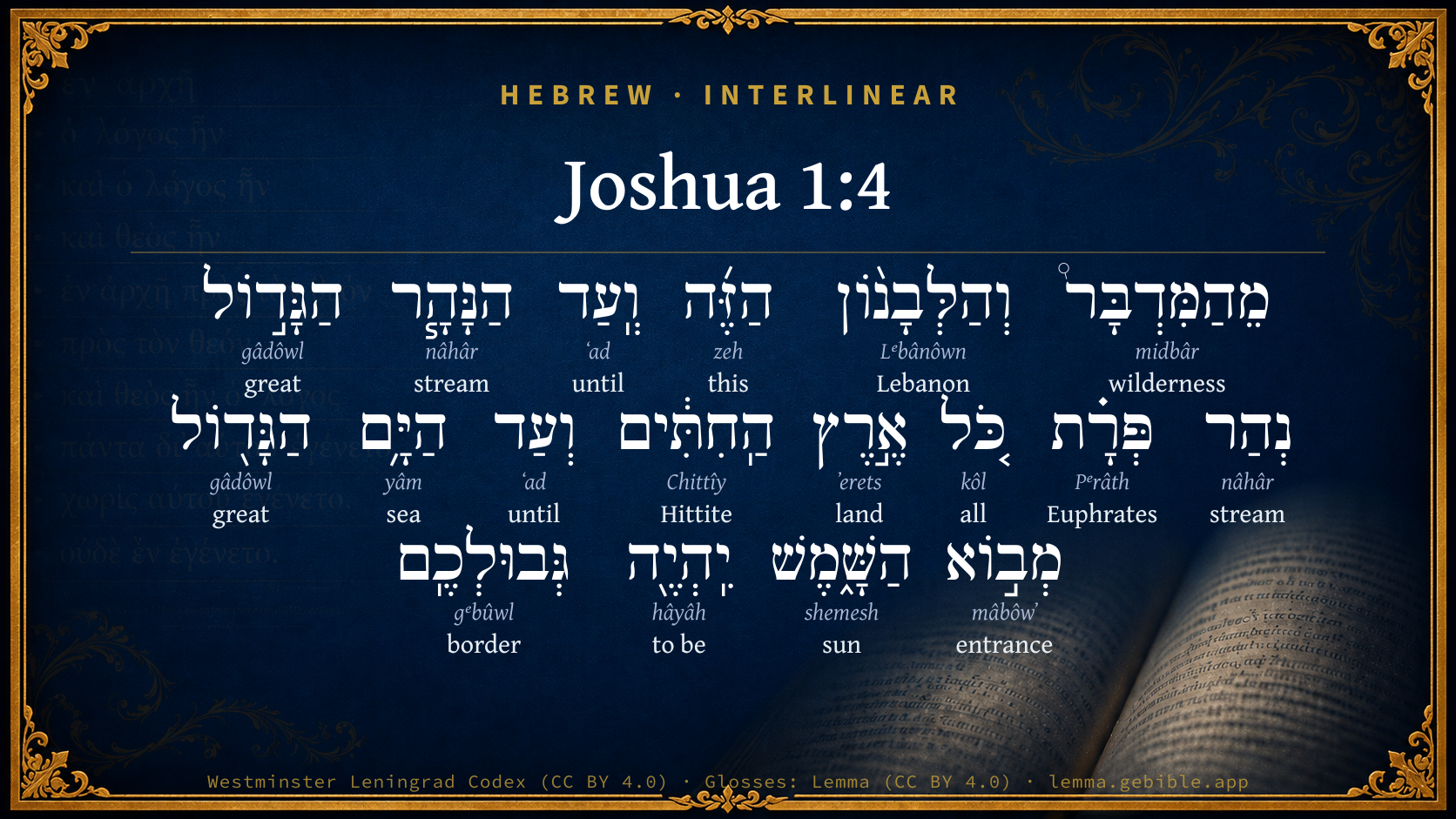
Hebrew (Westminster Leningrad Codex) Joshua 1:4 appears in the Hebrew Old Testament. The text above is from the Westminster Leningrad Codex. Each word links to its Strong’s number, a concise gloss, and parsing drawn from the Open Scriptures Hebrew Bible morphology. Click any word for its full Brown-Driver-Briggs (BDB) entry.
Download image
Cite this verse

Joshua 1:4 (World English Bible). Public Domain. Lemma interlinear Bible study tool, https://lemma.gebible.app/v/joshua/1/4.

Show BibTeX & RIS
BibTeX
RIS
English Translation
From the wilderness, and this Lebanon, even to the great river, the river Euphrates, all the land of the Hittites, and to the great sea toward the going down of the sun, shall be your border.
World English Bible · Public Domain
Download a study sheet

One document with this verse’s original text, its word-by-word gloss line, the meaning frame, cross-references with their text, attributed commentary, and full source and license credits — printable, and it pastes into notes with its structure intact.

This verse Autodidact and up

Study sheet (.html) Plain text (.txt)

A passage Seminary Student

Up to 50 verses in one chapter. A passage sheet keeps up to 6 commentary sources and 12 cross-references per verse, in the order this page ranks them, and says so on the sheet whenever that leaves anything out. Ask for a single verse and you get the Autodidact verse sheet above.

Everything on this page stays free to read, with no account — the sheet is a download of what is already on screen, not access to it.

Want to remove ads? Support Godless Engineer
Compare translations 3

The same verse in 3 English versions, stacked beneath the original-language interlinear above. Click any original word for its lexicon entry.

Each is an independent rendering of the whole verse — the interlinear is not word-aligned to these translations.

Highlighted words mark where these versions differ — a whole-verse word diff, not a word-by-word alignment.

  • World English Bible Public Domain
    From the wilderness, and this Lebanon, even to the great river, the river Euphrates, all the land of the Hittites, and to the great sea toward the going down of the sun, shall be your border.
  • King James Version Public Domain
    From the wilderness and this Lebanon even unto the great river, the river Euphrates, all the land of the Hittites, and unto the great sea toward the going down of the sun, shall be your coast.
  • unfoldingWord Literal Text CC BY-SA 4.0
    From the wilderness and this Lebanon and unto the Great River, the Euphrates River, all of the land of the Hittites, and unto the Great Sea, from the going of the sun, will be your territory.

unfoldingWord Literal Text — © unfoldingWord, licensed CC BY-SA 4.0. Word-aligned USFM3 via Door43 (git.door43.org/unfoldingWord/en_ult).

Versions to compare (up to 4)

3 of 4 selected

Show all 18 translations

Every available English version of this verse, each an independent rendering of the whole verse.

  • World English Bible Public Domain
    From the wilderness, and this Lebanon, even to the great river, the river Euphrates, all the land of the Hittites, and to the great sea toward the going down of the sun, shall be your border.
  • Berean Standard Bible Public Domain
    Your territory shall extend from the wilderness and Lebanon to the great River Euphrates—all the land of the Hittites—and west as far as the Great Sea.
  • Majority Standard Bible Public Domain
    Your territory shall extend from the wilderness and Lebanon to the great River Euphrates—all the land of the Hittites—and west as far as the Great Sea.
  • King James Version Public Domain
    From the wilderness and this Lebanon even unto the great river, the river Euphrates, all the land of the Hittites, and unto the great sea toward the going down of the sun, shall be your coast.
  • American Standard Version (1901) Public Domain
    From the wilderness, and this Lebanon, even unto the great river, the river Euphrates, all the land of the Hittites, and unto the great sea toward the going down of the sun, shall be your border.
  • Revised Version (1885) Public Domain
    From the wilderness, and this Lebanon, even unto the great river, the river Euphrates, all the land of the Hittites, and unto the great sea toward the going down of the sun, shall be your border.
  • Geneva Bible (1599) Public Domain
    From the wildernesse and this Lebanon euen vnto the great riuer, the riuer Perath: all the land of the Hittites, euen vnto the great Sea towarde the going downe of the sunne, shalbe your coast.
  • Douay-Rheims (1899) Public Domain
    From the desert and from Libanus unto the great river Euphrates, all the land of the Hethites unto the great sea toward the going; down of the sun, shall be your border.
  • Young's Literal Translation Public Domain
    From this wilderness and Lebanon, and unto the great river, the river Phrath, all the land of the Hittites, and unto the great Sea -- the going in of the sun -- is your border.
  • Literal Standard Version CC BY-SA 4.0
    From this wilderness and Lebanon, and to the great river, the Euphrates River, all the land of the Hittites, and to the Great Sea—the going in of the sun—is your border.
  • Unlocked Literal Bible CC BY-SA 4.0
    From the wilderness and Lebanon, as far as the great river, the Euphrates, all the land of the Hittites, and to the Great Sea, where the sun goes down, will be your land.
  • unfoldingWord Literal Text CC BY-SA 4.0
    From the wilderness and this Lebanon and unto the Great River, the Euphrates River, all of the land of the Hittites, and unto the Great Sea, from the going of the sun, will be your territory.
  • Darby Bible Public Domain
    From the wilderness and this Lebanon to the great river, the river Euphrates, the whole land of the Hittites, to the great sea, toward the going down of the sun, shall be your border.
  • World Messianic Bible Public Domain
    From the wilderness and this Lebanon even to the great river, the river Euphrates, all the land of the Hittites, and to the great sea toward the going down of the sun, shall be your border.
  • Webster's Bible Public Domain
    From the wilderness and this Lebanon even to the great river, the river Euphrates, all the land of the Hittites, and to the great sea towards the setting of the sun, shall be your border.
  • Free Bible Version CC BY-SA 4.0
    from the desert to Lebanon, and on up to the River Euphrates; all the land of the Hittites, and to the shore of the Mediterranean Sea to the west. This will be your territory.
  • Bible in Basic English Public Domain
    From the waste land and this mountain Lebanon, as far as the great river, the river Euphrates, and all the land of the Hittites to the Great Sea, in the west, will be your country.
  • JPS Tanakh (1917) Public Domain
    From the wilderness, and this Lebanon, even unto the great river, the river Euphrates, all the land of the Hittites, and unto the Great Sea toward the going down of the sun, shall be your border.

Literal Standard Version (2020), Covenant Press — licensed CC BY-SA 4.0. Text via the HelloAO Bible API (eBible.org). Unlocked Literal Bible (unfoldingWord) — licensed CC BY-SA 4.0. Text via the HelloAO Bible API (eBible.org). unfoldingWord Literal Text — © unfoldingWord, licensed CC BY-SA 4.0. Word-aligned USFM3 via Door43 (git.door43.org/unfoldingWord/en_ult). Free Bible Version, Dr. Jonathan Gallagher — licensed CC BY-SA 4.0. Text via the HelloAO Bible API (eBible.org).

Word by word

More ways to search: Search by grammar → Find every occurrence → Compare this word →

Practice this passage: Drill this verse → Learn its vocabulary →

פְּרָ֗ת
Pᵉrâth
H6578
“Euphrates”
Noun, Proper
Part of Speech
Noun
Type
Proper
Full BDB Definition

Origin: from an unused root meaning to break forth

TWOT: None

Euphrates = "fruitfulness" - the largest and longest river of western Asia; rises from two chief sources in the Armenian mountains and flows into the Persian Gulf
  1. מֵהַמִּדְבָּר֩ midbâr H4057 “from · the · wilderness” Preposition + Particle, Definite Article + Noun, Common, Masculine, Singular, Absolute
  2. וְהַלְּבָנ֨וֹן Lᵉbânôwn H3844 “and · the · Lebanon” Conjunction + Particle, Definite Article + Noun, Proper
  3. הַזֶּ֜ה zeh H2088 “the · this” Particle, Definite Article + Pronoun, Demonstrative, Masculine, Singular
  4. וְֽעַד ʻad H5704 “and · until” Conjunction + Preposition
  5. הַנָּהָ֧ר nâhâr H5104 “the · stream” Particle, Definite Article + Noun, Common, Masculine, Singular, Absolute
  6. הַגָּד֣וֹל gâdôwl H1419 “the · great” Particle, Definite Article + Adjective, Adjective, Masculine, Singular, Absolute
  7. נְהַר nâhâr H5104 “stream of” Noun, Common, Masculine, Singular, Construct
  8. כֹּ֚ל kôl H3605 “all of” Noun, Common, Masculine, Singular, Construct
  9. אֶ֣רֶץ ʼerets H776 “land of” Noun, Common, Both, Singular, Construct
  10. הַֽחִתִּ֔ים Chittîy H2850 “the · Hittites” Particle, Definite Article + Noun, Gentilic, Masculine, Plural, Absolute
  11. וְעַד ʻad H5704 “and · until” Conjunction + Preposition
  12. הַיָּ֥ם yâm H3220 “the · sea” Particle, Definite Article + Noun, Common, Masculine, Singular, Absolute
  13. הַגָּד֖וֹל gâdôwl H1419 “the · great” Particle, Definite Article + Adjective, Adjective, Masculine, Singular, Absolute
  14. מְב֣וֹא mâbôwʼ H3996 “entrance of” Noun, Common, Masculine, Singular, Construct
  15. הַשָּׁ֑מֶשׁ shemesh H8121 “the · sun” Particle, Definite Article + Noun, Common, Both, Singular, Absolute
  16. יִֽהְיֶ֖ה hâyâh H1961 “to be” Verb, Qal, Imperfect, 3rd Person, Masculine, Singular
  17. גְּבוּלְכֶֽם gᵉbûwl H1366 “border · your” Noun, Common, Masculine, Singular, Construct + Suffix, Personal, 2nd Person, Masculine, Plural

About this verse

These counts appear in no published source. They are computed here, from the morphology-tagged text and Lemma’s own curated glosses. What Lemma adds →

18
words
15
distinct lemmas
Historical
section

Notable vocabulary

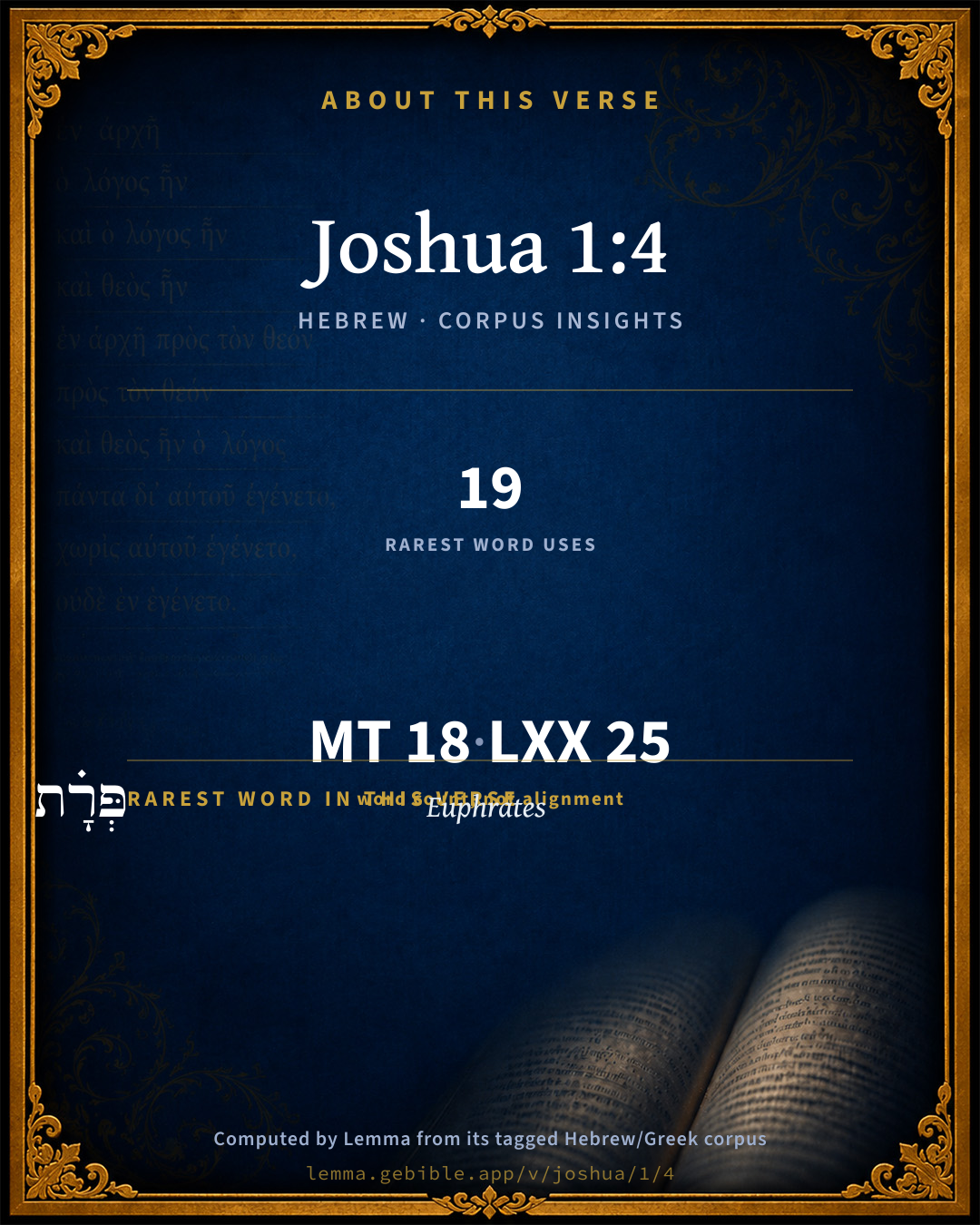
The rarest word here is פְּרָ֗ת Euphrates H6578 — appearing just 19 times in the whole Hebrew Bible.

Shared distinctive vocabulary

פְּרָ֗ת Euphrates H6578 occurs in 19 verses of the Hebrew Bible. Also found in:

Grammatical profile

  • 1 verb
  • 12 nouns
  • 2 adjectives
  • 1 pronoun
  • 2 prepositions

Verb forms

  • יִֽהְיֶ֖ה Qal · Imperfect

Repetition

Words recur within this verse — often emphatic in Hebrew:

  • וְֽעַד until H5704 ×2
  • הַנָּהָ֧ר stream H5104 ×2
  • הַגָּד֣וֹל great H1419 ×2

Hebrew & Septuagint length

In English translation the verse runs 36 words from the Hebrew and 32 from the Septuagint (LXX English) — closely comparable.

A rough comparison of the two English renderings, which tokenize alike — not a word-level alignment.

Word counts can differ between the Hebrew and the Greek without any difference in meaning — e.g. the Hebrew direct-object marker אֵת has no separate Greek word, and Greek often adds the article ὁ.

In the original languages it is 18 Hebrew tokens and 25 Greek tokens — but the two are counted differently (Hebrew bundles its prefixes and suffixes into one token; the Greek is in lemma form), so that isn’t a like-for-like length.

Cross-references

8

Topical passages linked to Joshua 1:4 in the Treasury of Scripture Knowledge — connected by theme and wording, ordered by reader-vote popularity; previews shown in the World English Bible.

  • Exodus 23:31 I will set your border from the Red Sea even to the sea of the Philistines, and from the wilderness to the River; for I will deliver the inhabitants of the land into your hand, and you shall drive them out before you.
  • Genesis 15:18–21 In that day Yahweh made a covenant with Abram, saying, "To your seed have I given this land, from the river of Egypt to the great river, the river Euphrates:
  • Numbers 34:2–18 Command the children of Israel, and tell them, When you come into the land of Canaan (this is the land that shall fall to you for an inheritance, even the land of Canaan according to the borders of it),
  • Deuteronomy 1:7 turn you, and take your journey, and go to the hill-country of the Amorites, and to all [the places] near thereunto, in the Arabah, in the hill-country, and in the lowland, and in the South, and by the sea-shore, the land of the Canaanites, and Lebanon, as far as the great river, the river Euphrates.
  • Deuteronomy 3:25 Please let me go over and see the good land that is beyond the Jordan, that goodly mountain, and Lebanon.
  • Deuteronomy 11:24 Every place whereon the sole of your foot shall tread shall be yours: from the wilderness, and Lebanon, from the river, the river Euphrates, even to the hinder sea shall be your border.
  • 1 Chronicles 5:9 and eastward he lived even to the entrance of the wilderness from the river Euphrates, because their cattle were multiplied in the land of Gilead.
  • 1 Chronicles 18:3 David struck Hadarezer king of Zobah to Hamath, as he went to establish his dominion by the river Euphrates.

Cross-references courtesy of OpenBible.info (CC BY 4.0).

Hebrew and Greek witnesses Masoretic Hebrew ↔ Greek Septuagint

The same verse in the two great witnesses to the Old Testament, shown verse-for-verse.

These are two independent witnesses, not word-aligned to each other, and the Septuagint is shown in lemma (dictionary) form.

Hebrew Joshua 1:4 Masoretic · Westminster Leningrad Codex

מֵהַמִּדְבָּר֩ וְהַלְּבָנ֨וֹן הַזֶּ֜ה וְֽעַד הַנָּהָ֧ר הַגָּד֣וֹל נְהַר פְּרָ֗ת כֹּ֚ל אֶ֣רֶץ הַֽחִתִּ֔ים וְעַד הַיָּ֥ם הַגָּד֖וֹל מְב֣וֹא הַשָּׁ֑מֶשׁ יִֽהְיֶ֖ה גְּבוּלְכֶֽם

From the wilderness, and this Lebanon, even to the great river, the river Euphrates, all the land of the Hittites, and to the great sea toward the going down of the sun, shall be your border.

World English Bible · Public Domain

Greek LXX Joshua 1:4 Septuagint · lemma form

ὁ ἔρημος καί ὁ ἀντιλίβανος ἕως ὁ ποταμός ὁ μέγας ποταμός εὐφράτης καί ἕως ὁ θάλασσα ὁ ἔσχατος ἀπό ἥλιος δυσμή εἰμί ὁ ὅριον σύ

The wilderness and Antilibanus, as far as the great river, the river Euphrates, and as far as the extremity of the sea; your coasts shall be from the setting of the sun.

LXX2012 (modern English Septuagint) · Public Domain

Hebrew: Westminster Leningrad Codex (CC BY 4.0). Greek: Septuagint (public domain); English from LXX2012 (modern English Septuagint) (Public Domain). How the Septuagint differs from the Hebrew →

Targum (Aramaic paraphrase)

1

The Targum is the ancient Jewish Aramaic paraphrase of the Hebrew Scriptures — an interpretive translation, not the Hebrew text itself. Onkelos (literal) and Pseudo-Jonathan (expansive) render the Torah, and Jonathan the Prophets. Coverage is partial: where no permissively-licensed English translation exists for a verse, only the Aramaic is shown. This is verse-level text, not a word-by-word alignment to the Hebrew.

  1. Targum Jonathan Prophets (Joshua–Malachi)
    מִמַדְבְּרָא וּלְבָנוֹנָא הָדֵין וְעַד נַהֲרָא רַבָּא נַהֲרָא דִפְרָת כֹּל אַרַע חִתָּאֵי וְעַד יַמָא רַבָּא מַעֲלָנֵי שִׁמְשָׁא יְהֵא תְחוּמְכוֹן:

    (no public-domain English translation for this verse)

    Targum Jonathan — Aramaic: “Mikraot Gedolot” (public domain). English: “Sefaria Community Translation” (CC0 1.0 (public-domain dedication)); “London "Chaldee Paraphrase," 1871” (public domain). Text via Sefaria.

Commentary

Notes on Joshua 1:4 from classic Christian and Jewish commentators (each source and its license shown beneath its notes). The classic Christian expositions comment on the surrounding passage and are grouped to its opening verse, so a note may address several verses; the Jewish commentaries on the Tanakh (Rashi and others) are per-verse, so they appear only where the commentator wrote on this verse.

Lemma curates 59 commentaries, every one of them public domain or Creative Commons licensed, each selected and text-cleaned for this edition rather than reprinted as found. About our sources →

Trapp's Complete Commentary

John Trapp

Jos 1:4 From the wilderness and this Lebanon even unto the great river, the river Euphrates, all the land of the Hittites, and unto the great sea toward the going down of the sun, shall be your coast.

Ver. 4. From the wilderness.] Here we have the topography of the promised land, as it hath the wilderness of Arabia on the south, Mount Lebanon on the north, the Mediterranean Sea on the west, and Euphrates on the east.

All the land of the Hittites.] Those sturdiest of all the Canaanites.

John Trapp, A Commentary or Exposition upon All the Books of the Old and New Testament (1647–1656) — public domain. Text from a community e-Sword module.

Tyndale Open Study Notes

Tyndale Open Resources

1:4 Ancient Israel’s southernmost settlement was in the Negev, in the vicinity of Beersheba (15:28). Israel’s northernmost tribes settled in portions of the Lebanon mountains, which made them neighbors of the Sidonians. • The Hittites were one of the subgroups that made up Canaan’s population (see study note on 3:10).

Tyndale Open Study Notes — © Tyndale Open Resources, licensed CC BY-SA 4.0. Text via the HelloAO Bible API.

Geneva Bible (1599)

Geneva Bible translators

Of Zin, called Kadesh and Paran.

Or, Euphrates.

Meaning, the whole land of Canaan.

Called Mediterranean.

Geneva Bible (1599) marginal notes — public domain. Text via Bolls.life.

Jamieson, Fausset & Brown

Robert Jamieson, A. R. Fausset & David Brown

all the land of the Hittites--These occupied the southern extremities and were the dominant tribe of Canaan. Their superior power and the extent of their dominions are attested by the mention of them under the name of Khita, on the Assyrian inscriptions, and still more frequently on the Egyptian inscriptions of the eighteenth and nineteenth Dynasties. What life and encouragement must have been imparted to Joshua by the assurance that his people, who had been overwhelmed with fear of that gigantic race, were to possess "all the land of the Hittites"!

Jamieson, Fausset & Brown — Commentary Critical and Explanatory on the Whole Bible (1871) — public domain (CC PDM 1.0). Text via the HelloAO Bible API.

Adam Clarke's Commentary

Verse 4. From the wilderness and this Lebanon] Joshua appears to be standing with his face towards the promised land, and pointing out the different places, or their situation, with his hand, THIS Lebanon, c. The utmost of their limits should be from the desert of Arabia Petraea on the SOUTH to Lebanon on the NORTH: and from the Euphrates on the EAST to the Mediterranean Sea on the WEST. The Israelites did not possess the full extent of this grant till the days of David. See 2Sa 8:3, c., and 2Ch 9:26.

Land of the Hittites] These are generally reputed to have been the most hardy and warlike of all the Canaanitish nations and as they occupied the mountainous countries on the south of the land of Canaan, it is natural to suppose that they would be the most difficult to subdue, and on this account, it is supposed, God particularly specifies these: "Ye shall subdue and possess even all the land of the Hittites," but it is probable that under this one term all the other nations are included, as it is certain they are in other places under the term Amorites.

Great sea: The Mediterranean, called great in respect of the lakes in the land of Judea, such as the sea of Gennesareth, or the sea of Tiberias, and the Dead Sea, which were comparatively small lakes; but the Hebrews gave the name of sea, ים yam, to every large collection of waters.

Adam Clarke's Commentary on the Bible (1810–1826) — public domain. Text from a community e-Sword/MySword module.

John Calvin's Commentaries

4. From the wilderness and this Lebanon, etc How the truth and fulfillment of this promise surmounted all the obstacles interposed by the wickedness of the people, though they did not obtain immediate possession of the whole territory, I have explained in the Argument. For although God had unfolded the inestimable treasures of his beneficence by constituting them lords of the country, it did not follow that their misconduct was not to be chastised. Nay, there behooved to be a fulfillment of the threatening which Moses had denounced, viz., that if the nations doomed to destruction were not destroyed, they would prove thorns and stings in their eyes and sides. But as the promise was by no means broken or rendered void by the delay of forty years, during which they were led wandering through the desert, so the entire possession, though long suspended, proved the faithfulness of the decree by which it had been adjudged.

The people had it in their power to obtain possession of the prescribed boundaries in due time; they declined to do so. For this they deserved to have been expelled altogether. But the divine indulgence granted them an extent of territory sufficient for their commodious habitation; and although it had been foretold that, in just punishment, the residue of the nations whom they spared would prove pernicious to them, still, they suffered no molestation, unless when they provoked the Divine anger by their perfidy and almost continual defection: for as often as their affairs became prosperous, they turned aside to wantonness. Still, owing to the wonderful goodness of God, when oppressed by the violence of the enemy, and, as it were, thrust down to the grave, they continued to live in death; and not only so, but every now and then deliverers arose, and, contrary to all hope, retrieved them from ruin.

The Great Sea means the Mediterranean, and to it the land of the Hittites forms the opposite boundary; in the same way Lebanon is opposed to the Euphrates; but it must be observed that under Lebanon the desert is comprehended, as appears from another passage.

John Calvin's Commentaries (1540-1563) — public domain. Text from the Calvin Translation Society English edition (1840s-50s) via the Christian Classics Ethereal Library (ccel.org). Calvin's coverage is partial (roughly two-thirds of the Bible); uncommented books and verses are honest gaps, never fabricated. The 19th-century editor's footnotes and remarks are omitted so the notes are faithfully Calvin's own voice.

Ellicott's Commentary for English Readers

(4) All the land of the Hittites.—The name Hittites may be used here to represent all the Canaanites; but it seems better to understand the land of the Hittites of the northern districts in which Hamath and Carchemish were situated—between Palestine proper and the Euphrates; but compare Note on Jdg_1:26.

A Bible Commentary for English Readers, edited by Charles John Ellicott (1878–1897) — public domain. Text from a community e-Sword module.

The Cambridge Bible for Schools and Colleges

gen. ed. J. J. S. Perowne

4. From the wilderness] For the boundaries of the Land of Promise compare (a) Gen_15:18-21; (b) Exo_23:31; (c) Num_34:1-12; (d) Deu_11:24. They were to be, on the South, the desert of El-Tíh; on the North, Mount Lebanon; on the East, the Euphrates; on the West, the Mediterranean Sea.

this Lebanon] Compare also Jos_1:2, “this Jordan,” and Deu_3:25. The river was visible and lay close at hand; the Lebanon range (= “the white Mountain”) could be discerned, though at a great distance.

the great river] “The great flood Eufrates,” Wyclif. This is the term (comp. Gen_2:14; Gen_15:18) most frequently used in the Bible for the Euphrates, a word of Aryan origin, denoting “the good and abounding river,” the largest, the longest, and by far the most important of the rivers of Western Asia.

the land of the Hittites] This nation was descended from Cheth (A. V. “Heth”), the second son of Canaan. We first meet with them in Gen_23:3-5, when Abraham bought from “the children of Heth” the field and the cave of Machpelah. On their relation to the other nations of Canaan see below. They are here put for the Canaanites generally.

The Cambridge Bible for Schools and Colleges (gen. ed. J. J. S. Perowne; Cambridge University Press, 1878–1918) — public domain. Text from a community e-Sword module.

John Gill's Exposition

From the wilderness,.... The wilderness of Kadesh and Sin, on the border of Edom; in the southeast corner, as Jarchi says, see Num 34:3,

and this Lebanon; which though on the other side Jordan, and at a considerable distance, being the northern border of the land towards Syria, might be seen afar off; or it is expressed, because it was a well known place, as Kimchi remarks:

even unto the great river, the river Euphrates; which was the eastern border of the land, and to which it reached in the times of Solomon, whose dominion extended thither, Kg1 4:21; according to Jarchi, this was its breadth from south to north:

all the land of the Hittites: who, though only one of the seven nations of Canaan, are put for the rest, and the rather mentioned, because, as their name signifies, they were very formidable and terrible; among them dwelt the Anakim, and they themselves were very warlike and populous; or they are taken notice of particularly here, because they dwelt in the western part of the land described by them, so Kimchi thinks; according to Jarchi, this was its length from east to west:

and unto the great sea: the Mediterranean sea, which was the western border of the land of Canaan, called great, in comparison of the sea of Tiberias, and the salt sea, which were in it:

toward the going down of the sun, shall be your coast; the western coast; see Gill on Deu 11:24; this will be more fully verified in Christ, when his kingdom is from sea to sea, Psa 72:8.

John Gill's Exposition of the Whole Bible (1746–1763) — public domain (CC PDM 1.0). Text via the HelloAO Bible API.

Albert Barnes' Notes on the Bible

Lebanon is spoken of as “this Lebanon,” because visible from the neighborhood in which Israel was encamped. (Compare Deu 3:8-9.) “The wilderness” of the text is the Desert of Arabia, which forms the southern, as Lebanon does the northern, limit of the promised land. The boundaries on the east and west are likewise indicated; and the intervening territory is described generally as “all the land of the Hittites.” The Hittites are properly the inhabitants of northern Canaan and Phoenicia (see Exo 3:8 note), but the name appears to be used here for the Canaanites in general, as in 1Ki 10:29. On the boundaries of the promised land compare Deu 11:24; Gen 15:18.

Albert Barnes' Notes on the Bible (1834–1885) — public domain. Text from a community e-Sword/MySword module.

Haydock's Catholic Bible Commentary

Hethites, the most formidable of the nations of Chanaan. (Masius)

George Leo Haydock (1774–1849), Haydock's Catholic Family Bible and Commentary, 1859 edition — public domain. Excludes Psalms (Douay-Rheims chapter numbering differs from Protestant) and Deuterocanonical books (Catholic canon only).

Matthew Poole's English Annotations

This Lebanon; this emphatically, as being the most eminent mountain in Syria, and the northern border of the land: or this which is within my view; as if the Lord appeared to him in the form of a man, and pointed to it.

Of the Hittites, i.e. of the Canaanites, who elsewhere are all called Amorites, as Gen 15:16, and here Hittites, by a synecdoche; the Hittites being the most considerable and formidable of all, as may appear from Num 13:33; 14:1; 2Ki 7:6; and many of them being of the race of the giants, dwelling about Hebron. See Gen 25:9,10; 26:34; 27:46.

The great sea; the midland sea, great in itself, and especially compared with those lesser collections of waters, which the Jews called seas.

Object. The Israelites never possessed all this land.

Answ. 1. That was from their own sloth and cowardice, and disobedience to God, and breach of those conditions upon which this promise was suspended. See Jdg 2:20.

2. This land was not all to be possessed by them at once, but by degrees, as their numbers and necessities increased; but Canaan being fully sufficient for them, and many of the Israelites being from time to time either cut off or carried captive for their sins, there was never any need of enlarging their possessions.

3. Though their possessions extended not to Euphrates, yet their dominion did, and all those lands were tributary to them in David’s and Solomon’s time.

Matthew Poole's English Annotations on the Holy Bible (1683–1685) — public domain. Text from a community e-Sword/MySword module.

Whedon's Commentary on the Bible

Daniel D. Whedon

4. The wilderness — This word is especially applied to that desert of Arabia Petraea in which the Israelites sojourned under Moses. It stretches from Mount Sinai northward between the two branches of the Red Sea to the Dead Sea, Palestine, and the Mediterranean. Its eastern boundary is Arabia Deserta and Arabia Felix; its western, Egypt and the western arm of the Red Sea. It is a rolling desert, covered generally with loose gravel and stones, and everywhere furrowed and torn with torrents. Says Dr. Robinson, “A more frightful desert it had hardly been our lot to behold. Through the deep gorge on the eastern side, extending from the Gulf of Akaba to the Dead Sea, there is every indication that the Jordan once flowed before the great convulsion which depressed the Dead Sea.”

This Lebanon — A double range of mountains, with a valley called Coele (hollow) Syria between, constituting the eastern limit of Phenicia and the northern limit of Palestine. The eastern spur, called Anti-Lebanon, terminates on the south in Mount Hermon, and was visible from Shittim. Hence the expression this Lebanon, like this Jordan in Jos_1:2, because, though at a distance, it could be pointed out as a definite landmark. The name, which signifies white, is derived from the white appearance caused both by the limestone rocks and the snows. The height is about ten thousand feet. (See note on Hermon Jos_11:3.)

The Hittites — Or children of Heth. A tribe of Canaanites living in Abraham’s time in Hebron and its vicinity, in the southern part of the Land of Promise. As they had been an especial terror to the twelve spies, or to the craven ten, whose report disheartened the people, they are here mentioned by name, and put for the whole body of the Canaanites — Ye shall possess the land of even the dreaded Hittites. This designation of Canaan as “the land of the Hittites” occurs in the Bible only in this passage, though frequently used in the Egyptian records of Rameses II., in which Cheta or Chita appears to denote the whole country of lower and middle Syria.

The Euphrates — “The great river” of western Asia, one thousand four hundred miles in length, is mentioned in connection with the garden of Eden, (Gen_2:14,) and throughout the Scripture history is often mentioned with this adjective.

Great sea — The Mediterranean, called great in comparison with the small inland bodies of water, such as Genesareth and the Dead Sea.

Your coast — Your boundaries. These included a larger territory than the Hebrews ever possessed, except for a short time during the reigns of David and Solomon. The breadth from Lebanon on the north to the desert on the south is one hundred and forty miles; the length from the Mediterranean to the Euphrates is about four hundred miles, making an area of fifty-six thousand square miles, equal to the States of New York and Vermont. But Canaan proper, or Palestine, was only one hundred and forty miles by forty — an area smaller than the State of New Jersey. Jehovah devised liberal things for his people, but they failed through unbelief and cowardice to come into immediate possession of the munificent gift.

Daniel D. Whedon (gen. ed.), Commentary on the Old and New Testaments (1874–1909) — public domain. Text from a community e-Sword module.

The Pulpit Commentary

From the wilderness and this Lebanon. The words suppose a line to be drawn from the desert of Arabia on the south and the range of Lebanon on the north, to the River Euphrates on the one hand and the Mediterranean Sea on the other, including the land of the Hittites. (see 1Ki_4:24 2Ch_9:26) Tiphsah, the later Thapsacus, was far north of the utmost limits of Palestine, and almost in the latitude of Antioch. Azzah is generally termed Gaza in our version. See note on Jos_11:22. The land of the Hittites here (Keil) seems to be taken for the land of Canaan in general, (see 1Ki_10:29 2Ki_7:6 Eze_16:3) but extending far beyond their border, and including Syria, Moab, Ammon, the land of Bashan, and part of Arabia. This was never actually in the hand of the Israelites save during the reigns of David and Solomon, when these regions were either tributary to them, or had been actually reduced under their immediate sway. "The promise," says Theodoret, "was not undefined, but if ye shall keep my commandments and ordinances". (Deu_11:22, Deu_11:23) But they, inasmuch as they immediately transgressed the law, did not obtain the perfect promises. The Divine Apostles, on the contrary, not only conquered those places on which they set their foot, but even those in which their all wise writings were read; and the land that was before a desert they displayed as a Divine Paradise." This Lebanon. This expression is no doubt used because Lebanon was visible from the spot where Joshua was standing. There is nothing surprising in this. We learn from travellers that its range, which there is no doubt included that of Anti-Lebanon, with its lofty peak Hermon, the highest point in Palestine, is visible from all parts of the Holy Land, even from the depths of the Jordan valley near the Dead Sea. Dr. Thomson ("Land and the Book," p, 2) says that it is visible from Cyprus. Canon Tristram ("Land of Israel," p. 609) tells how he had seen Hermon from Type, Sidon, Carmel, Gerizim, from the neighbourhood of Jerusalem, from Gilead, from Nebo, and from the Dead Sea. The name Lebanon, derived from bl to be white, like the Arabic lebanon, milk, is supposed by Robinson to have been given from the whitish colour of the chalk or limestone rock (so Conder, "Handbook," p. 206). But it is at least equally probable that it derives its name, like Mont Blanc in Savoy, from its snowy peaks. Hermon is still called by the Arabs Jebel-el-Thelj, or "the snowy peak." The Jordan, the river of Palestine par excellence, derived its copious and ever-flowing streams, so essential in that "thirsty land," from the Anti-Lebanon range. "Abana and Pharpar, rivers of Damascus," as well as the Orontes, and the Litany or Leontes, derive their waters from the same source (see Tristram, "Land of Israel," chap. 25.; Thomson, "Land and the Book," pp. 172, 173). We have a vivid description of the region of Lebanon and the adjacent range of Anti-Lebanon and Hermon, in the spring, at the time of the melting of the snows, in the 42nd Psalm. There David, recalling to mind his sojourn in the "land of the Jordan," and of Hermon, speaks of the "deep calling unto deep," of the noise of the cataracts as they dashed from rock to rock and foamed along the mountain sides; and he describes his sorrows as overwhelming him by their number and magnitude, just as the multitudinous torrents that rose in that snowy region threatened to engulf the unwary traveller in their onward sweep. The far-famed cedars of Lebanon are indigenous to this region, and to it alone, but the climatic changes which Palestine has undergone have reduced their number largely, and comparatively few specimens now remain, in a wild condition, of that noble tree, once the pride of the dwellers in the land. "We cannot study all the passages in the Old Testament which refer to the cedar, without feeling certain that in ancient times it was a far more conspicuous feature in the landscape than it is now" (Tristram, "Land of Israel," p. 631). The great river, the river Euphrates. Das grosse Wasser Phrath (Luther). The Hebrew name is as Luther gives it. The Greeks added the euphonic syllable at the commencement, according to those who assign to the word a Semitic derivation. Others, however, derive it from an Aryan source, and regard it as equivalent to "the flowing river." This mighty stream, especially after its junction with the Tigris, far transcended in size any other with which the Israelites were acquainted. The plains of Mesopotamia, even as far as Nineveh and Babylon, were destined to have been occupied by the Jewish race, had not their impiety and rebellion prevented; and the world empire obtained by Nineveh and Babylon might, and had they been obedient would, have been theirs. All the land of the Hittites. The Hittites, or Chittites, seem to have been the most considerable of the tribes which inhabited Canaan. We find them in possession of Hebron in the time of Abraham, (Ge 23) but their more usual dwelling place was in the valley. They appear from the narrative above quoted to have been a peaceable people. We have records of them in Egyptian and Assyrian inscriptions. Thus we hear of the Khita in the inscriptions of Rameses II, who reigned between 1383 and 1322, B.C.; that is, about the time of Deborah and Barak ("Records of the Past," 2:67-78; 4:25-32). They were the inhabitants, however, of a region further to the northward, beyond the borders of the Holy Land, on the banks of the Orontes. So a Mohar, or scribe, of Rameses II, in an account of a tour in Palestine, in which he mentions Kirjath Anab, Achsaph, Megiddo, and the land of Hamath, describes Khita as to the north, bordering on this latter territory ("Records of the Past," 2:106). The various translators of the Assyrian inscriptions of Assur-bani-pal, Tiglath Pileser, Shalmaneser, and Sennacherib recognise the Hittites in the people mentioned as dwelling to the north of Palestine (ibid. 3:52; 5:21, 32, 33; 7:61), though Ewald thinks that the Khatta there mentioned must be sought still further north. Prof. Sayce, in a recent lecture, regards the Hittites as having occupied a large portion of Asia Minor, and as having had great influence upon early Greek art, and adds, "Till within the last few years the Bible alone has preserved the name of a people who must have had almost as great an influence on human history as Assyria or Egypt." Shahnaneser mentions the kings of the Hittites, just as they are mentioned in the later narratives of Kings and Chronicles. (see note on Jos_3:10) Unto the great sea. As the Euphrates was the greatest river, the Mediterranean was the greatest sea, known to the Jews. Unlike the race they displaced, the Canaanites or, to call them by a title by which they are better known to profane history, the Phoenicians the Jews were no sailors. It may have been even before the conquest of Canaan under Joshua that the Phoenician fleets sailed out beyond the pillars of Hercules, and brought back tin from the British isles. For Canaan, or Phoenicia, was a powerful and civilised country when conquered by the Jews. But whether it were before this period that Britain was discovered, or whether the fleets of Tyre and Sidon first sailed thither at a later period, to the Jews the Mediterranean still remained the great sea. They knew nothing of the vaster ocean into which it flowed. It seems strange that, with the example of Tyre and Sidon before them, the Israelites should have been so indifferent to navigation. Even in the time of David, it was Hiram"s ships that brought him his treasures and building materials. The later navies of Solomon and Jehoshaphat did but coast along the Red Sea and the Persian Gulf to Ophir, which has been identified with India, or more probably with Arabia.

The Pulpit Commentary (1880–1919), ed. H.D.M. Spence-Jones & Joseph S. Exell — public domain. Text from a community e-Sword module.

John Wesley's Explanatory Notes

This Lebanon - Emphatically, as being the most eminent mountain in Syria, and the northern border of the land: or this which is within thy view. Hittites - Of the Canaanites, who elsewhere are all called Amorites; (Gen. xv, 16) and here Hittites, the Hittites being the most considerable and formidable of all. The greater - The midland sea, great in itself, and especially compared with those lesser collections of waters, which the Jews called seas. "But the Israelites never possessed all this land." I answer:

1. That was from their own sloth and cowardice, and disobedience to God, and breach of those conditions upon which this promise was suspended:

2. Though their possessions extended not to Euphrates, yet their dominion did, and all those lands were tributary to them in David's and Solomon's time.

John Wesley, Explanatory Notes Upon the Whole Bible (1754–1765) — public domain. Text via the GEBible commentary corpus.

Keil & Delitzsch

C. F. Keil & F. Delitzsch

The boundaries of the land are given as in Deu 11:24, with the simple difference in form, that the boundary line from the desert (of Arabia) and Lebanon, i.e., from the southern and northern extremity, is drawn first of all towards the east to the great river, the Euphrates, and then towards the west to "the great sea, toward the going down of the sun," i.e., the Mediterranean; and then between these two termini ad quem the more precise definition is inserted, "all the land of the Hittites;" whereas in Deuteronomy the southern, northern, and eastern boundaries are placed in antithesis to the western boundary, and the more precise definition of the country to be taken is given by an enumeration of the different tribes that were to be destroyed by the Israelites (Deu 11:23). On the oratorical character of these descriptions, see at Gen 15:18. The demonstrative pronoun "this," in connection with Lebanon, may be explained from the fact that Lebanon, or at all events Anti-libanus, was visible from the Israelitish camp. The expression "the Hittites" (see at Gen 10:15) is used here in a broader sense for Canaanites in general, as in Kg1 10:29; Kg2 7:6; Eze 16:3. The promise in Jos 1:5 is adopted from Deu 11:25, where it was made to the whole nation, and specially transferred to Joshua; and Jos 1:5 is repeated from Deu 31:8, as compared with Jos 1:6.

Keil & Delitzsch — Biblical Commentary on the Old Testament (1861–1891) — public domain (CC PDM 1.0). Text via the HelloAO Bible API. (Old Testament only.)

unfoldingWord translationNotes

Door43 World Missions Community

General Information:

Yahweh continues speaking to Joshua.

your land

The word "your" refers to the tribes of Israel and not only Joshua. (See: Forms of You)

to stand before you

In verse 5 the words "you" and "your" refer to Joshua. (See: Forms of You)

I will not abandon you or leave you

The words "abandon" and "leave" mean basically the same thing. Yahweh combines them to emphasize that he will not do these things. AT: "I will certainly stay with you always" (See: Doublet and Double Negatives)

translationWords

desert

Lebanon

Euphrates River

Hittite

the sea

unfoldingWord translationNotes — © Distant Shores Media and the Door43 World Missions Community, licensed CC BY-SA 4.0. Source: git.door43.org/Door43/en_tn.

Rashi

Rabbi Shlomo Yitzchaki (Rashi)

From the wilderness and this Lebanon. The wilderness refers to the wilderness of Kodeish, the wilderness of Tzin, which was adjacient to Edom which was to the south east, the direction from which they entered the land, as it is said: And behold we are in Kodeish. How do we know that it was southeast? It is said: ‘Your southern flank will be from the Tzin wilderness along Edom.’

To the great river, the Euphrates river. This refers to its width from south to north.

This includes all the land of the Chitim.

To the Great Sea [westward]. This refers to its length from east to west.

Rashi on the Tanakh — English translations: “The Judaica Press complete Tanach with Rashi, translated by A. J. Rosenberg” (CC BY 4.0); “Pentateuch with Rashi's commentary by M. Rosenbaum and A.M. Silbermann, 1929-1934” (public domain); “The Metsudah Tanach series, Lakewood, N.J” (CC BY 4.0); and “The Book of Joshua, Metsudah Publications, 1997” (CC BY 4.0). Text via Sefaria.

Lesson kit

Teaching starters — assembled from the data on this page, not authored interpretation. Every prompt links to the verse data it draws on. Edit before teaching.

Joshua, in the Historical, opens this verse with 18 words (15 distinct Hebrew lemmas). Its most distinctive word is Pᵉrâth (“Euphrates”). A historical commentator’s framing appears above. Read the whole chapter for the surrounding context.

Discussion questions

  1. The word Pᵉrâth carries the sense “Euphrates.” How does it shape the verse?
  2. How does Genesis 2:14, which shares the word «Euphrates», read alongside this verse?
  3. What does the repetition of “until” (2× in this one verse) do in this verse?
  4. These translations render this verse differently. What is at stake in choosing one wording over another?
  5. «יִֽהְיֶ֖ה» is a Qal Imperfect verb. How does that grammatical form shape the action described?
  6. Compare how Trapp's Complete Commentary and Tyndale Open Study Notes read this verse. Where do they agree or differ?

Things to notice

Reading settings

Reading text

Shown beneath each verse's original-language words.

Old Testament
Old Testament edition

Read the OT as the Masoretic Hebrew (MT) or the Greek Septuagint (LXX).

English shown for the Greek Septuagint (in the Hebrew ↔ Greek comparison).

Comparing translations? Open the Compare panel on any verse page to stack up to four side by side.