
Psalms 107:3

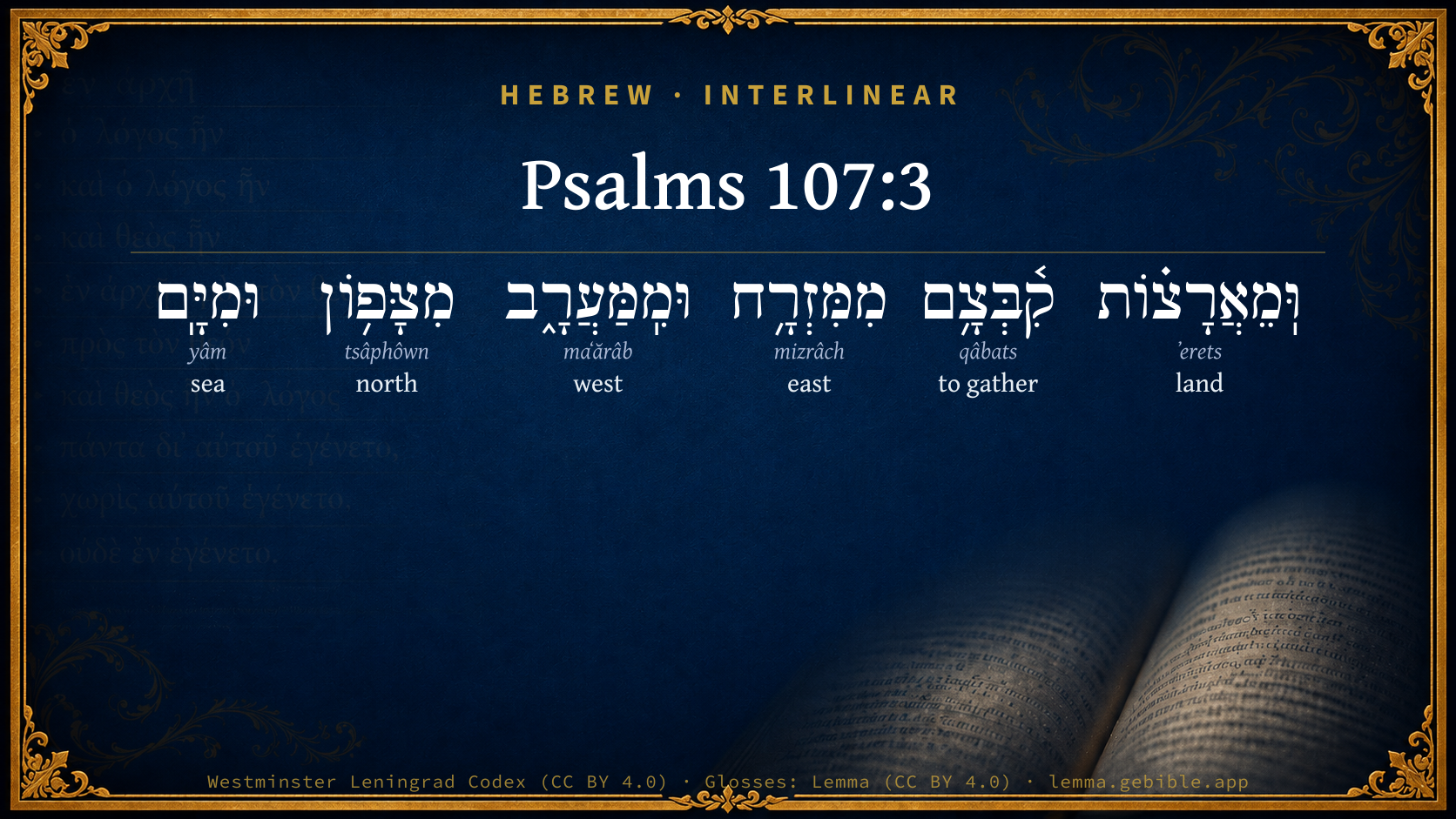
Hebrew (Westminster Leningrad Codex) Psalms 107:3 appears in the Hebrew Old Testament. The text above is from the Westminster Leningrad Codex. Each word links to its Strong’s number, a concise gloss, and parsing drawn from the Open Scriptures Hebrew Bible morphology. Click any word for its full Brown-Driver-Briggs (BDB) entry.
Download image
Cite this verse

Psalms 107:3 (World English Bible). Public Domain. Lemma interlinear Bible study tool, https://lemma.gebible.app/v/psalms/107/3.

Show BibTeX & RIS
BibTeX
RIS
English Translation
And gathered out of the lands, From the east and from the west, From the north and from the south.
World English Bible · Public Domain
Download a study sheet

One document with this verse’s original text, its word-by-word gloss line, the meaning frame, cross-references with their text, attributed commentary, and full source and license credits — printable, and it pastes into notes with its structure intact.

This verse Autodidact and up

Study sheet (.html) Plain text (.txt)

A passage Seminary Student

Up to 50 verses in one chapter. A passage sheet keeps up to 6 commentary sources and 12 cross-references per verse, in the order this page ranks them, and says so on the sheet whenever that leaves anything out. Ask for a single verse and you get the Autodidact verse sheet above.

Everything on this page stays free to read, with no account — the sheet is a download of what is already on screen, not access to it.

Want to remove ads? Support Godless Engineer
Compare translations 3

The same verse in 3 English versions, stacked beneath the original-language interlinear above. Click any original word for its lexicon entry.

Each is an independent rendering of the whole verse — the interlinear is not word-aligned to these translations.

Highlighted words mark where these versions differ — a whole-verse word diff, not a word-by-word alignment.

  • World English Bible Public Domain
    And gathered out of the lands, From the east and from the west, From the north and from the south.
  • King James Version Public Domain
    And gathered them out of the lands, from the east, and from the west, from the north, and from the south.
  • unfoldingWord Literal Text CC BY-SA 4.0
    And he has gathered them from lands, from the sunrise and from the evening, from the north and from the sea.

unfoldingWord Literal Text — © unfoldingWord, licensed CC BY-SA 4.0. Word-aligned USFM3 via Door43 (git.door43.org/unfoldingWord/en_ult).

Versions to compare (up to 4)

3 of 4 selected

Show all 18 translations

Every available English version of this verse, each an independent rendering of the whole verse.

  • World English Bible Public Domain
    And gathered out of the lands, From the east and from the west, From the north and from the south.
  • Berean Standard Bible Public Domain
    and gathered from the lands, from east and west, from north and south.
  • Majority Standard Bible Public Domain
    and gathered from the lands, from east and west, from north and south.
  • King James Version Public Domain
    And gathered them out of the lands, from the east, and from the west, from the north, and from the south.
  • American Standard Version (1901) Public Domain
    And gathered out of the lands, From the east and from the west, From the north and from the south.
  • Revised Version (1885) Public Domain
    And gathered them out of the lands, from the east and from the west, from the north and from the south.
  • Geneva Bible (1599) Public Domain
    And gathered them out of the lands, from the East and from the West, from the North and from the South.
  • Douay-Rheims (1899) Public Domain
    From the rising and the setting of the sun, from the north and from the sea.
  • Young's Literal Translation Public Domain
    And from the lands hath gathered them, From east and from west, From north, and from the sea.
  • Literal Standard Version CC BY-SA 4.0
    And has gathered them from the lands, || From east and from west, || From north, and from the sea.
  • Unlocked Literal Bible CC BY-SA 4.0
    He has gathered them out of foreign lands, from the east and from the west, from the north and from the south.
  • unfoldingWord Literal Text CC BY-SA 4.0
    And he has gathered them from lands, from the sunrise and from the evening, from the north and from the sea.
  • Darby Bible Public Domain
    And gathered out of the countries, from the east and from the west, from the north and from the sea.
  • World Messianic Bible Public Domain
    and gathered out of the lands, from the east and from the west, from the north and from the south.
  • Webster's Bible Public Domain
    And gathered them out of the lands, from the east, and from the west, from the north, and from the south.
  • Free Bible Version CC BY-SA 4.0
    He has gathered them together from distant lands, from the east and the west, the north and the south.
  • Bible in Basic English Public Domain
    Making them come together out of all the lands, from the east and from the west, from the north and from the south.
  • JPS Tanakh (1917) Public Domain
    And gathered them out of the lands, from the east and from the west, from the north and from the sea.

Literal Standard Version (2020), Covenant Press — licensed CC BY-SA 4.0. Text via the HelloAO Bible API (eBible.org). Unlocked Literal Bible (unfoldingWord) — licensed CC BY-SA 4.0. Text via the HelloAO Bible API (eBible.org). unfoldingWord Literal Text — © unfoldingWord, licensed CC BY-SA 4.0. Word-aligned USFM3 via Door43 (git.door43.org/unfoldingWord/en_ult). Free Bible Version, Dr. Jonathan Gallagher — licensed CC BY-SA 4.0. Text via the HelloAO Bible API (eBible.org).

Word by word

More ways to search: Search by grammar → Find every occurrence → Compare this word →

Practice this passage: Drill this verse → Learn its vocabulary →

About this verse

These counts appear in no published source. They are computed here, from the morphology-tagged text and Lemma’s own curated glosses. What Lemma adds →

6
words
6
distinct lemmas
Wisdom
section

Notable vocabulary

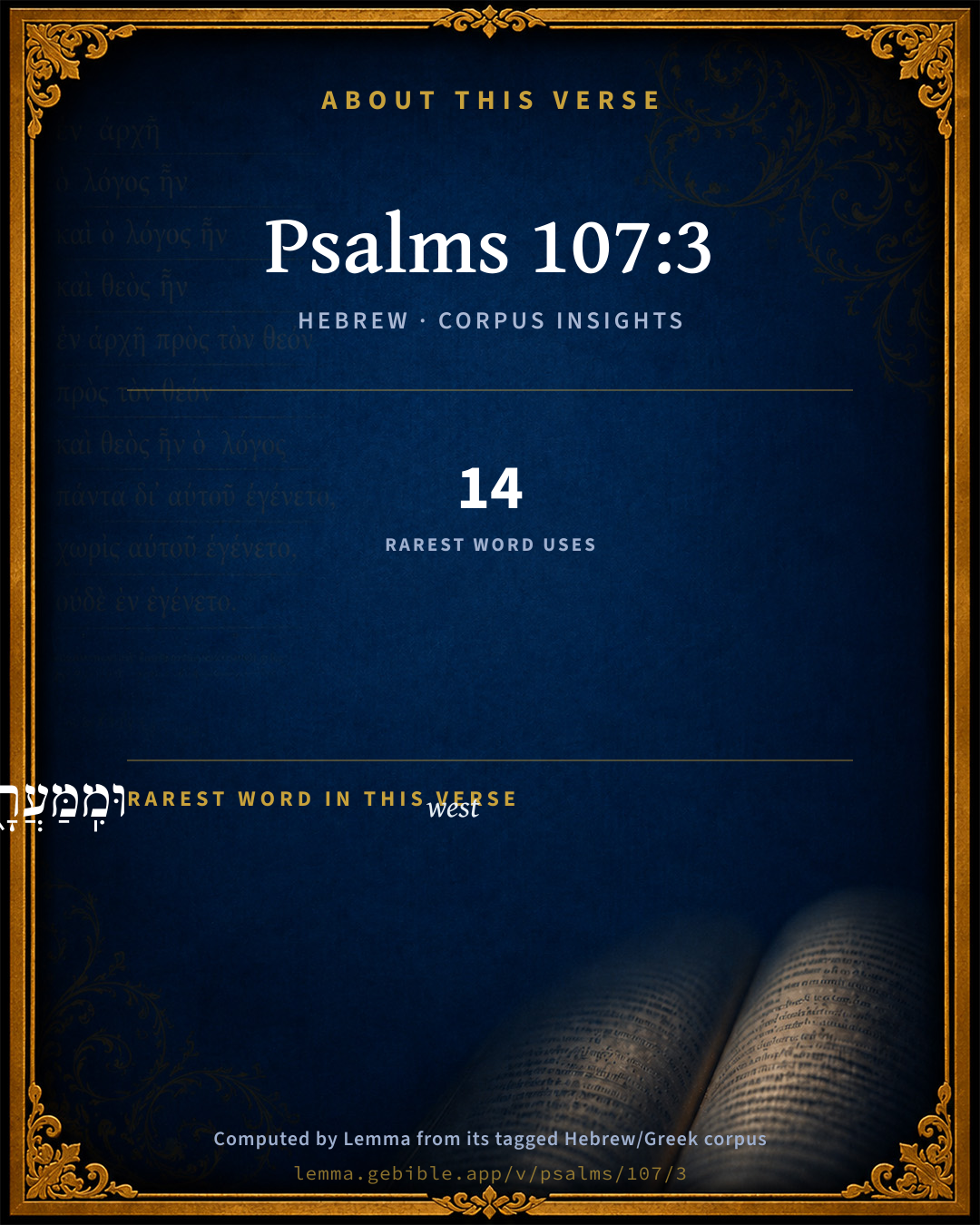
The rarest word here is וּמִֽמַּעֲרָ֑ב west H4628 — appearing just 14 times in the whole Hebrew Bible.

Shared distinctive vocabulary

וּמִֽמַּעֲרָ֑ב west H4628 occurs in 14 verses of the Hebrew Bible. Also found in:

Grammatical profile

  • 1 verb
  • 5 nouns

Verb forms

  • קִ֫בְּצָ֥ם Piel · Perfect

Hebrew & Septuagint length

In English translation the verse runs 20 words from the Hebrew and 16 from the Septuagint (LXX English) — closely comparable.

A rough comparison of the two English renderings, which tokenize alike — not a word-level alignment.

Word counts can differ between the Hebrew and the Greek without any difference in meaning — e.g. the Hebrew direct-object marker אֵת has no separate Greek word, and Greek often adds the article ὁ.

Cross-references

13

Topical passages linked to Psalms 107:3 in the Treasury of Scripture Knowledge — connected by theme and wording, ordered by reader-vote popularity; previews shown in the World English Bible.

  • Psalms 106:47 Save us, Yahweh, our God, Gather us from among the nations, To give thanks to your holy name, To triumph in your praise!
  • Isaiah 43:5–6 Don't be afraid; for I am with you: I will bring your seed from the east, and gather you from the west;
  • Jeremiah 29:14 I will be found by you, says Yahweh, and I will turn again your captivity, and I will gather you from all the nations, and from all the places where I have driven you, says Yahweh; and I will bring you again to the place from where I caused you to be carried away captive.
  • Revelation 5:9 They sang a new song, saying, "You are worthy to take the book, And to open its seals: For you were killed, And bought us for God with your blood, Out of every tribe, language, people, and nation,
  • Deuteronomy 30:3 that then Yahweh your God will turn your captivity, and have compassion on you, and will return and gather you from all the peoples, where Yahweh your God has scattered you.
  • Jeremiah 31:8 Behold, I will bring them from the north country, and gather them from the uttermost parts of the earth, [and] with them the blind and the lame, the woman with child and her who travails with child together: a great company shall they return here.
  • Jeremiah 31:10 Hear the word of Yahweh, you nations, and declare it in the isles afar off; and say, He who scattered Israel will gather him, and keep him, as shepherd does his flock.
  • Ezekiel 36:24 For I will take you from among the nations, and gather you out of all the countries, and will bring you into your own land.
  • Ezekiel 39:27 when I have brought them back from the peoples, and gathered them out of their enemies' lands, and am sanctified in them in the sight of many nations.
  • Isaiah 11:11–16 It shall happen in that day, that the Lord will set his hand again the second time to recover the remnant of his people, who shall remain, from Assyria, and from Egypt, and from Pathros, and from Cush, and from Elam, and from Shinar, and from Hamath, and from the islands of the sea.
  • Isaiah 49:12 Behold, these shall come from far; and, behold, these from the north and from the west; and these from the land of Sinim.
  • Isaiah 56:8 The Lord Yahweh, who gathers the outcasts of Israel, says, Yet will I gather [others] to him, besides his own who are gathered.
  • Ezekiel 20:34 and I will bring you out from the peoples, and will gather you out of the countries in which you are scattered, with a mighty hand, and with an outstretched arm, and with wrath poured out;

Cross-references courtesy of OpenBible.info (CC BY 4.0).

Hebrew and Greek witnesses Masoretic Hebrew ↔ Greek Septuagint

The same verse in the two great witnesses to the Old Testament, shown verse-for-verse.

You’re reading Greek Psalm 106 (Hebrew Psalm 107). The Septuagint counts the superscription, so verse numbers can differ from the Hebrew — chapter-level alignment, not verse-by-verse. Numbering follows Rahlfs.

These are two independent witnesses, not word-aligned to each other, and the Septuagint is shown in lemma (dictionary) form.

Hebrew Psalms 107:3 Masoretic · Westminster Leningrad Codex

וּֽמֵאֲרָצ֗וֹת קִ֫בְּצָ֥ם מִמִּזְרָ֥ח וּמִֽמַּעֲרָ֑ב מִצָּפ֥וֹן וּמִיָּֽם

And gathered out of the lands, From the east and from the west, From the north and from the south.

World English Bible · Public Domain

Greek LXX Greek Psalm 106:3 Septuagint · lemma form

ἐκ ὁ χώρα συνἄγω αὐτός ἀπό ἀνατολή καί δυσμή καί βορέας καί θάλασσα

and gathered them out of the countries, from the east, and west, and north, and south.

LXX2012 (modern English Septuagint) · Public Domain

On this verse, The Pulpit Commentary discusses the Septuagint’s reading. Read the note in Commentary ↓

Hebrew: Westminster Leningrad Codex (CC BY 4.0). Greek: Septuagint (public domain); English from LXX2012 (modern English Septuagint) (Public Domain). How the Septuagint differs from the Hebrew →

Commentary

Notes on Psalms 107:3 from classic Christian and Jewish commentators (each source and its license shown beneath its notes). The classic Christian expositions comment on the surrounding passage and are grouped to its opening verse, so a note may address several verses; the Jewish commentaries on the Tanakh (Rashi and others) are per-verse, so they appear only where the commentator wrote on this verse.

Lemma curates 59 commentaries, every one of them public domain or Creative Commons licensed, each selected and text-cleaned for this edition rather than reprinted as found. About our sources →

Trapp's Complete Commentary

John Trapp

Psa 107:3 And gathered them out of the lands, from the east, and from the west, from the north, and from the south.

Ver. 3. And gathered them out of the lands] He beginneth with wayfaring men and exiles, because, according to Tyrtaeus, Non exul curae dicitur esse Deo.

And from the south] Heb. from the sea, that is, as the Chaldee expoundeth it, from the southern sea, called the Red Sea.

John Trapp, A Commentary or Exposition upon All the Books of the Old and New Testament (1647–1656) — public domain. Text from a community e-Sword module.

J. A. Alexander on Psalms

Joseph Addison Alexander

3. (Psa 107:3) And from the lands has gathered them, from the east and from the west, from the north and from the sea. The Babylonish exile is continually spoken of as a dispersion, either because it is considered as including other minor deportations, or because the migration of the great mass of the people into Babylonia was unavoidably accompanied, followed, or preceded, by a less extensive and more scattering migration of many individuals and families to other quarters. On the false assumption of a perfect parallelism as indispensable, some have supposed that sea is here put for the south. But this is not the only case in which the enumeration of the cardinal points is complete only in number. See Isa 49:12, and compare Isa 43:5-6; Isa 56:8. The mention of the sea instead of the south may perhaps have reference to the prophecy in Deu 28:68. The verse before us records the answer to the prayer in Psa 106:47, and thus affords another indication, that the writer of the later composition had the earlier in his eye, and wrote with some intention to illustrate or complete it.

Joseph Addison Alexander, The Psalms Translated and Explained (1850) — public domain. Text from a community e-Sword module.

Tyndale Open Study Notes

Tyndale Open Resources

107:3 exiles: People came from all nations where the people of Israel and Judah had been scattered.

Tyndale Open Study Notes — © Tyndale Open Resources, licensed CC BY-SA 4.0. Text via the HelloAO Bible API.

Geneva Bible (1599)

Geneva Bible translators

Or, from the sea: meaning the red sea, which is on the South part of the land.

Geneva Bible (1599) marginal notes — public domain. Text via Bolls.life.

Adam Clarke's Commentary

Verse 3. And gathered them out of the lands] Though many Jews returned into Jerusalem from various parts of the world, under the reigns of Darius Hystaspes, Artaxerxes, and Alexander the Great; yet this prophecy has its completion only under the Gospel, when all the ends of the earth hear the salvation of God.

Adam Clarke's Commentary on the Bible (1810–1826) — public domain. Text from a community e-Sword/MySword module.

Ellicott's Commentary for English Readers

(3) Gathered them.—The usual prophetic word for the Restoration. (See references in margin, and with the verse comp. Isa_49:12.)

From the south.—See margin. The sea here can hardly be any sea but the Mediterranean, and therefore ought, according to general use (see Gen_12:8, &c), to stand for the west. But as this makes the enumeration of the points of the compass imperfect, several emendations have been proposed, the best of which is yamin (the “right hand,” and so “south”) for yam.

Or is the text right, and instead of looking for a complete compass, ought we to connect this general statement with the four tableaux of misery presently painted, and so take “out of the sea” literally in reference to Psa_107:23-30?

A Bible Commentary for English Readers, edited by Charles John Ellicott (1878–1897) — public domain. Text from a community e-Sword module.

The Cambridge Bible for Schools and Colleges

gen. ed. J. J. S. Perowne

3. gathered them out of the lands] In accordance with many a prophetic promise (Jer_32:37; Eze_20:34; &c.); cp. the prayer of Psa_106:47.

from the east &c.] “From the four quarters of the earth,” Isa_11:12; Isa_43:5-6. Israelites from many lands doubtless returned to join the newly-founded community in Jerusalem.

from the south] Heb. from the sea, which according to general usage means the west. The Targ. explains it to mean ‘the southern sea,’ the Arabian gulf or the Indian ocean; possibly it may denote the southern part of the Mediterranean, washing the shore of Egypt: but on the whole it seems most probable that the Psalmist borrowed the phrase “from the north and from the sea” from Isa_49:12, and does not strictly enumerate the points of the compass. ‘The sea’ or ‘west’ there denotes the islands and coasts of the Mediterranean (Isa_11:11). A slight change of the text, yâmîn for yâm, would give the usual word for south (Psa_89:12), but the text is supported by the Versions.

The Cambridge Bible for Schools and Colleges (gen. ed. J. J. S. Perowne; Cambridge University Press, 1878–1918) — public domain. Text from a community e-Sword module.

John Gill's Exposition

They wandered in the wilderness in a solitary way,.... Not the people of Israel, as the Targum. These seem not to be particularly intended, whatever allusion there may be to their passage through the wilderness to Canaan's land; but rather, in general, travellers through waste places, especially the wild deserts of Arabia; where the wind blowing the sand, covers the roads with it, so that frequently travellers lose their way, and wander about, till directed to it by one providence or another. Some compare this with the case of the Old Testament saints, mentioned in Heb 11:37 others with the church in the wilderness, and the witnesses prophesying in sackcloth, Rev 11:2. But it is certain that the redeemed and gathered are here meant; and this fitly describes their case, before and at effectual calling: they are in the wilderness of the people, Eze 20:35, from whence they are gathered; are in a state of error and ignorance; are like straying sheep, gone out of the right way; and are as lost sheep, they have lost their way; and though there may be many ways that present unto them, and which they think bid fair to be the right way; yet the true way of peace, life, and salvation by Christ, they know not, while in a state of nature and unregeneracy; and when they come to be effectually called, they see themselves to be in a bewildered state and condition.

They found no city to dwell in; nor even to call at or lodge in, for miles together; which is the case of travellers in some parts, particularly in the deserts of Arabia. Spiritual travellers find no settlement, rest, peace, joy, and comfort, but in Christ; nor any indeed in this world, and the things of it; here they have no continuing city, Heb 13:14.

John Gill's Exposition of the Whole Bible (1746–1763) — public domain (CC PDM 1.0). Text via the HelloAO Bible API.

Albert Barnes' Notes on the Bible

And gathered them out of the lands - The countries where they were scattered. In the times of the captivity the people were not all taken to one place, or did not all abide in one place. In the long exile - of seventy years - in Babylon, they would naturally be much scattered in the different provinces; and the attempt to collect them together, to restore them again to their native land, might be attended with much difficulty.

From the east ... - From all quarters; from the places where they were scattered abroad. That is, one taking his position in Babylon would see them dispersed from that place as a center into all the surrounding country.

And from the south - Margin, as in Hebrew, “from the sea.” In general, in the Old Testament, the word “sea” is used for the west, because the western boundary of the land of Palestine was the Mediterranean Sea. Compare Psa 139:9. But the supposed position of the speaker here is “Babylon,” and on that account the south might be fitly designated by the word “sea;” as, on the south of Babylon, the Persian Gulf and the Indian Ocean would be soon reached.

Albert Barnes' Notes on the Bible (1834–1885) — public domain. Text from a community e-Sword/MySword module.

Matthew Poole's English Annotations

Bringing them into their own land, out of the several quarters of the world into which they had been carried.

From the south, Heb. from the sea; which in Scripture commonly notes the west, because the great midland sea was on the west of Canaan; but here, as it appears from the opposition of this to the

north, it notes the south, so called from the Red Sea, which was on the south, and which is sometimes called the sea, simply and without addition, as Psa 72:8; 114:3.

Matthew Poole's English Annotations on the Holy Bible (1683–1685) — public domain. Text from a community e-Sword/MySword module.

The Treasury of David

Charles H. Spurgeon

Ver. 3. And gathered them out of the lands, from the east, and from the west, from the north, and from the south. Gathering follows upon redeeming. The captives of old were restored to their own land from every quarter of the earth, and even from beyond the sea; for the word translated south is really the sea. No matter what divides, the Lord will gather his own into one body, and first on earth by "one Lord, one faith, and one baptism", and then in heaven by one common bliss they shall be known to be the one people of the One God. What a glorious Shepherd must, he be who thus collects the blood bought flock from the remotest regions, guides them through countless perils, and at last makes them to lie down in the green pastures of Paradise. Some have wandered one way and some another they have all left Immanuel's land and strayed as far as they could, and great are the grace and power by which they are all collected into one flock by the Lord Jesus. With one heart and voice let the redeemed praise the Lord who gathers them into one.

Ver. 3. And gathered. If anything can inspire us with gratitude, this motive should prevail, because we cannot but feel the force of it, as it reminds us of that misery from which we in particular were redeemed. The Gentiles had wandered from God, and were so lost and bewildered in the mazes of error and superstition, that nothing but the almighty love of our Lord Jesus could have gathered them together into one church. William Romaine.

Ver. 3. Gathered them. The Syriac gives as the title of this psalm: God collects the Jews out of captivity, and brings them back out of Babylon the only begotten Son of God also, Jesus Christ, collects the nations from the four corners of the world, by calling upon man to be baptized. E.W. Hengstenberg.

Ver. 3. From the west. The mention of the west leads the psalmist's thoughts to Egypt; and the remembrance of the bondage and labours of the ancestors of the Israelites in Egypt, coupled with the description in a previous psalm (Ps 105:17) of the imprisonment of Joseph. Joseph Francis Thrupp.

Ver. 3. The ingathering of the chosen.

1. All wandered.

2. Their ways different.

3. All observed of the Lord.

4. All brought to Jesus as to one centre. Note ways, and times of gathering.

Psalms 107:4*

Charles H. Spurgeon's The Treasury of David (1869–1885) — public domain. Psalms only. Text from a community e-Sword/MySword module.

Whedon's Commentary on the Bible

Daniel D. Whedon

3. East… west… north… south—That is, from all points, whithersoever the seed of Israel had been scattered. The Hebrew here rendered “south” is sea, but being used in an enumeration of the cardinal points of the compass must mean “south.” It may be understood of the southeast coast of the Mediterranean, or of the Red sea, either of which, being southwesterly from Palestine, and a boundary line of Egypt, might denote the latter, to which the eastern wars had scattered many of the Jews. See Jeremiah 43, 44; Isa_43:5-6; Isa_49:12.Verses 4-9 comprise the first strophic division, with Psa_107:6; Psa_107:8 as the double refrain. These give life and dramatic effect to the musical performance. Psa_107:4-6 are a glance at their wilderness life under Moses; perhaps, also, at the privations of the first caravan of returning exiles under Zerubbabel, (Ezr_2:64; Ezr_2:67,) and afterward of the second, under Ezra. See Ezr_7:8

Daniel D. Whedon (gen. ed.), Commentary on the Old and New Testaments (1874–1909) — public domain. Text from a community e-Sword module.

The Pulpit Commentary

And gathered them out of the lands (compare the prayer of Psa_106:47; and for the expression, "the lands" i.e. the foreign countries see Psa_106:27 Ezr_9:1) From the east, and from the west, from the north, and from the south. The present Hebrew text has "from the sea" and so the LXX, apo yalasshv but it is thought that probably is a corruption of ymiYmi (Cheyne), which would mean "from the south."

The Pulpit Commentary (1880–1919), ed. H.D.M. Spence-Jones & Joseph S. Exell — public domain. Text from a community e-Sword module.

John Wesley's Explanatory Notes

Gathered - Into their own land.

John Wesley, Explanatory Notes Upon the Whole Bible (1754–1765) — public domain. Text via the GEBible commentary corpus.

Lesson kit

Teaching starters — assembled from the data on this page, not authored interpretation. Every prompt links to the verse data it draws on. Edit before teaching.

Psalms, in the Wisdom, opens this verse with 6 words (6 distinct Hebrew lemmas). Its most distinctive word is maʻărâb (“west”). A historical commentator’s framing appears above. Read the whole chapter for the surrounding context.

Discussion questions

  1. How does “west” (maʻărâb) shape what this verse is saying?
  2. How does 1 Chronicles 7:28, which shares the word «west», read alongside this verse?
  3. These translations render this verse differently. What is at stake in choosing one wording over another?
  4. «קִ֫בְּצָ֥ם» is a Piel Perfect verb. How does that grammatical form shape the action described?
  5. Compare how Trapp's Complete Commentary and J. A. Alexander on Psalms read this verse. Where do they agree or differ?

Things to notice

Reading settings

Reading text

Shown beneath each verse's original-language words.

Old Testament
Old Testament edition

Read the OT as the Masoretic Hebrew (MT) or the Greek Septuagint (LXX).

English shown for the Greek Septuagint (in the Hebrew ↔ Greek comparison).

Comparing translations? Open the Compare panel on any verse page to stack up to four side by side.