
Joshua 15:2

Hebrew (Westminster Leningrad Codex) Joshua 15:2 appears in the Hebrew Old Testament. The text above is from the Westminster Leningrad Codex. Each word links to its Strong’s number, a concise gloss, and parsing drawn from the Open Scriptures Hebrew Bible morphology. Click any word for its full Brown-Driver-Briggs (BDB) entry.
Download image
Cite this verse

Joshua 15:2 (World English Bible). Public Domain. Lemma interlinear Bible study tool, https://lemma.gebible.app/v/joshua/15/2.

Show BibTeX & RIS
BibTeX
RIS
English Translation
Their south border was from the uttermost part of the Salt Sea, from the bay that looks southward;
World English Bible · Public Domain
Download a study sheet

One document with this verse’s original text, its word-by-word gloss line, the meaning frame, cross-references with their text, attributed commentary, and full source and license credits — printable, and it pastes into notes with its structure intact.

This verse Autodidact and up

Study sheet (.html) Plain text (.txt)

A passage Seminary Student

Up to 50 verses in one chapter. A passage sheet keeps up to 6 commentary sources and 12 cross-references per verse, in the order this page ranks them, and says so on the sheet whenever that leaves anything out. Ask for a single verse and you get the Autodidact verse sheet above.

Everything on this page stays free to read, with no account — the sheet is a download of what is already on screen, not access to it.

Want to remove ads? Support Godless Engineer
Compare translations 3

The same verse in 3 English versions, stacked beneath the original-language interlinear above. Click any original word for its lexicon entry.

Each is an independent rendering of the whole verse — the interlinear is not word-aligned to these translations.

Highlighted words mark where these versions differ — a whole-verse word diff, not a word-by-word alignment.

  • World English Bible Public Domain
    Their south border was from the uttermost part of the Salt Sea, from the bay that looks southward;
  • King James Version Public Domain
    And their south border was from the shore of the salt sea, from the bay that looketh southward:
  • unfoldingWord Literal Text CC BY-SA 4.0
    And the border of the south for them was from the end of the Sea of Salt, from the tongue turning southward.

unfoldingWord Literal Text — © unfoldingWord, licensed CC BY-SA 4.0. Word-aligned USFM3 via Door43 (git.door43.org/unfoldingWord/en_ult).

Versions to compare (up to 4)

3 of 4 selected

Show all 18 translations

Every available English version of this verse, each an independent rendering of the whole verse.

  • World English Bible Public Domain
    Their south border was from the uttermost part of the Salt Sea, from the bay that looks southward;
  • Berean Standard Bible Public Domain
    Their southern border started at the bay on the southern tip of the Salt Sea,
  • Majority Standard Bible Public Domain
    Their southern border started at the bay on the southern tip of the Salt Sea,
  • King James Version Public Domain
    And their south border was from the shore of the salt sea, from the bay that looketh southward:
  • American Standard Version (1901) Public Domain
    And their south border was from the uttermost part of the Salt Sea, from the bay that looketh southward;
  • Revised Version (1885) Public Domain
    And their south border was from the uttermost part of the Salt Sea, from the bay that looked southward:
  • Geneva Bible (1599) Public Domain
    And their South border was the salt Sea coast, from the point that looketh Southward.
  • Douay-Rheims (1899) Public Domain
    Its beginning was from the top of the most salt sea, and from the bay thereof, that looketh to the south.
  • Young's Literal Translation Public Domain
    and to them the south border is at the extremity of the salt sea, from the bay which is looking southward;
  • Literal Standard Version CC BY-SA 4.0
    and to them the south border is at the extremity of the Salt Sea, from the bay which is looking southward;
  • Unlocked Literal Bible CC BY-SA 4.0
    Their border on the south ran from the end of the Salt Sea, from the bay that faces to the south.
  • unfoldingWord Literal Text CC BY-SA 4.0
    And the border of the south for them was from the end of the Sea of Salt, from the tongue turning southward.
  • Darby Bible Public Domain
    And their southern border was from the end of the salt sea, from the tongue that turns southward;
  • World Messianic Bible Public Domain
    Their south border was from the uttermost part of the Salt Sea, from the bay that looks southward;
  • Webster's Bible Public Domain
    And their south border was from the shore of the salt-sea, from the bay that looketh southward:
  • Free Bible Version CC BY-SA 4.0
    Their boundary began at the end of the Salt Sea—the bay that faces south—
  • Bible in Basic English Public Domain
    Their south limit was from the farthest part of the Salt Sea, from the inlet looking to the south:
  • JPS Tanakh (1917) Public Domain
    And their south border was from the uttermost part of the Salt Sea, from the bay that looked southward.

Literal Standard Version (2020), Covenant Press — licensed CC BY-SA 4.0. Text via the HelloAO Bible API (eBible.org). Unlocked Literal Bible (unfoldingWord) — licensed CC BY-SA 4.0. Text via the HelloAO Bible API (eBible.org). unfoldingWord Literal Text — © unfoldingWord, licensed CC BY-SA 4.0. Word-aligned USFM3 via Door43 (git.door43.org/unfoldingWord/en_ult). Free Bible Version, Dr. Jonathan Gallagher — licensed CC BY-SA 4.0. Text via the HelloAO Bible API (eBible.org).

Word by word

More ways to search: Search by grammar → Find every occurrence → Compare this word →

Practice this passage: Drill this verse → Learn its vocabulary →

הַמֶּ֑לַח
melach
H4417
“the · salt”
Particle, Definite Article + Noun, Common, Masculine, Singular, Absolute
Part of Speech
Particle + Noun
Type
Common
Gender
Masculine
Number
Singular
State
Absolute
Full BDB Definition

Origin: from H4414

TWOT: 1197a

salt
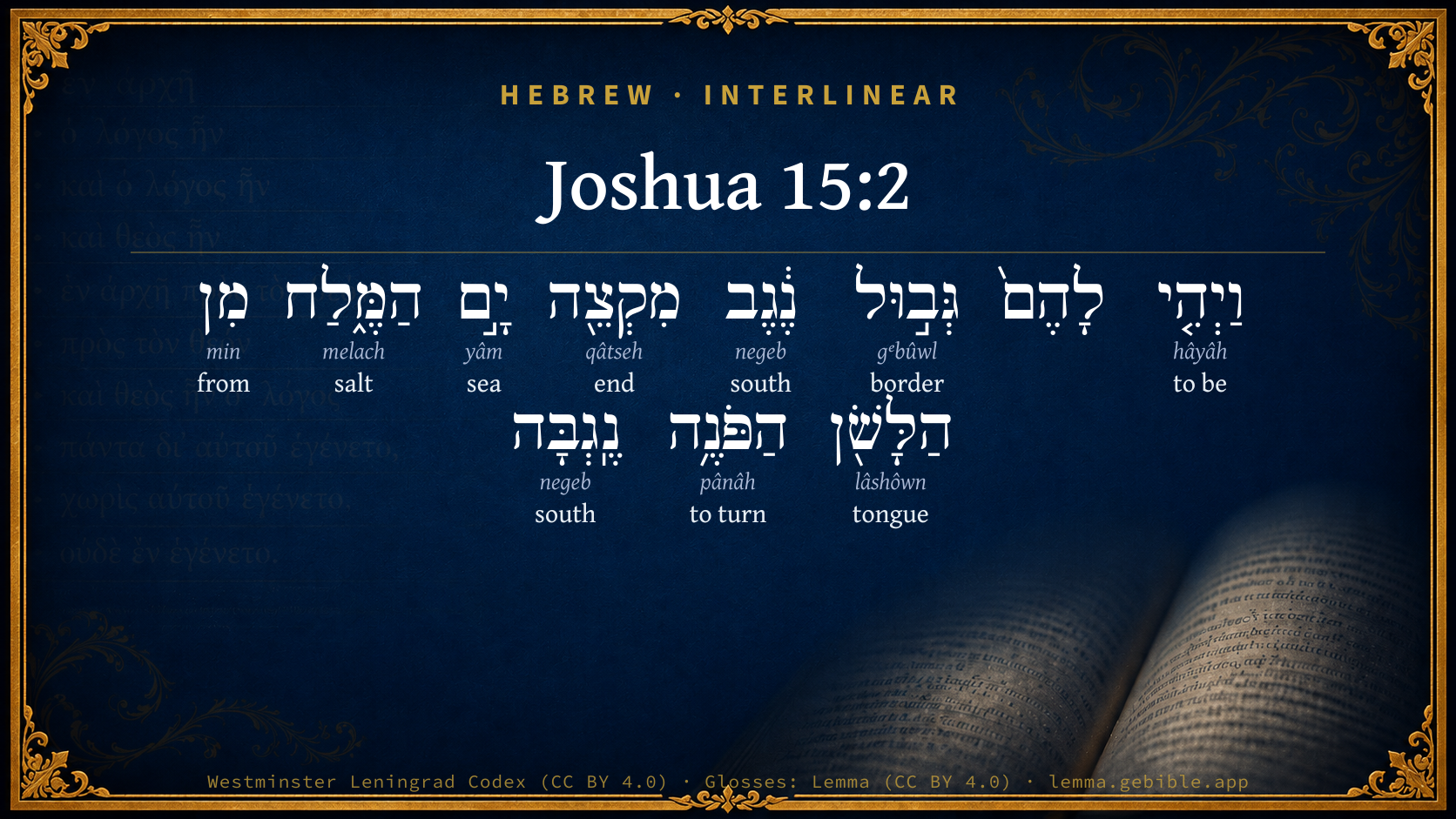
  1. וַיְהִ֤י hâyâh H1961 “and · to be” Conjunction + Verb, Qal, Sequential Imperfect, 3rd Person, Masculine, Singular
  2. גְּב֣וּל gᵉbûwl H1366 “border of” Noun, Common, Masculine, Singular, Construct
  3. נֶ֔גֶב negeb H5045 “south” Noun, Common, Masculine, Singular, Absolute
  4. מִקְצֵ֖ה qâtseh H7097 “from · end of” Preposition + Noun, Common, Both, Singular, Construct
  5. יָ֣ם yâm H3220 “sea of” Noun, Common, Masculine, Singular, Construct
  6. מִן min H4480 “from” Preposition
  7. הַלָּשֹׁ֖ן lâshôwn H3956 “the · tongue” Particle, Definite Article + Noun, Common, Both, Singular, Absolute
  8. הַפֹּנֶ֥ה pânâh H6437 “the · turning” Particle, Definite Article + Verb, Qal, Participle Active, Masculine, Singular, Absolute
  9. נֶֽגְבָּה negeb H5045 “south · toward” Noun, Common, Masculine, Singular, Absolute + Suffix, Demonstrative

About this verse

These counts appear in no published source. They are computed here, from the morphology-tagged text and Lemma’s own curated glosses. What Lemma adds →

11
words
9
distinct lemmas
Historical
section

Shared distinctive vocabulary

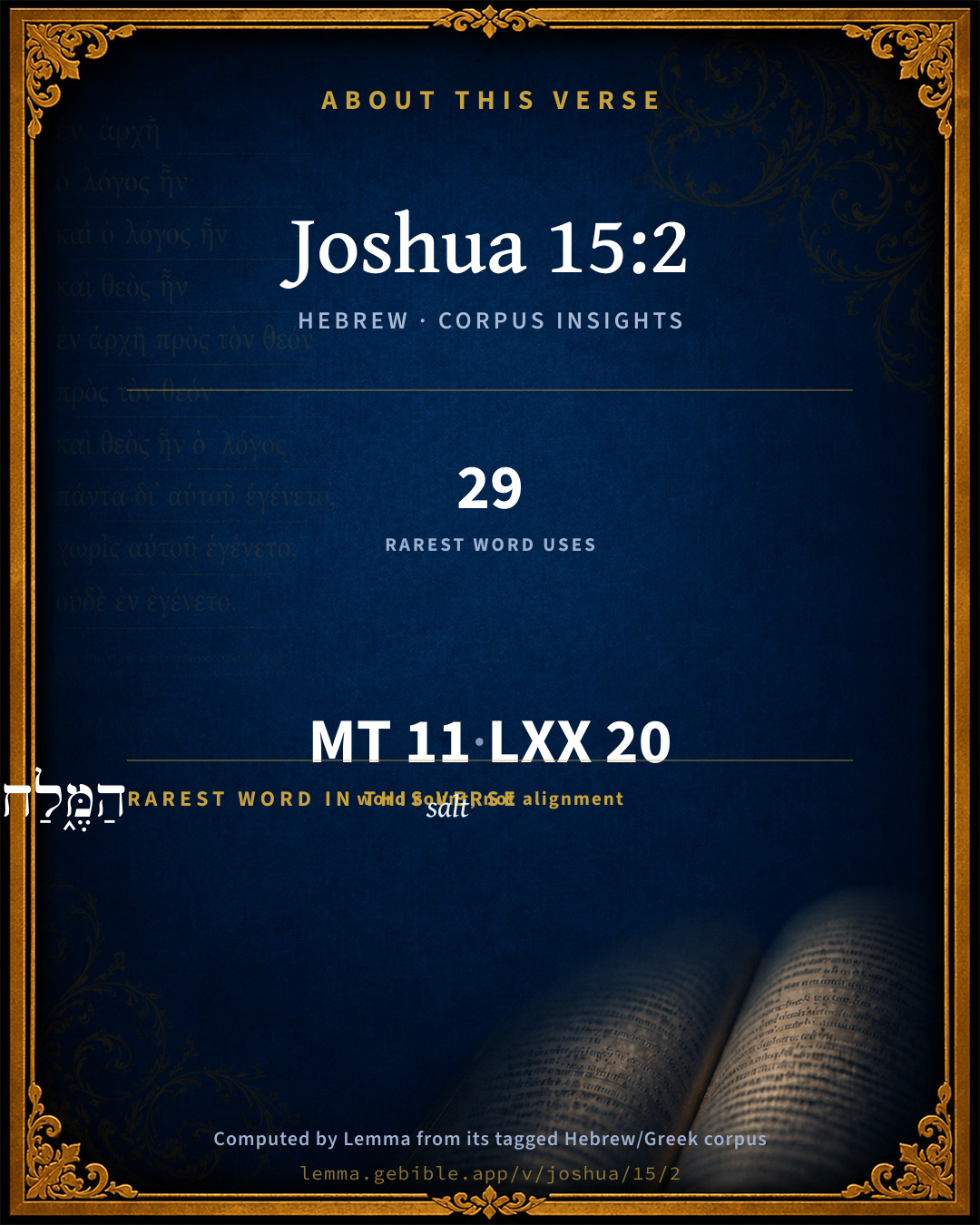
הַמֶּ֑לַח salt H4417 occurs in 26 verses of the Hebrew Bible. Also found in:

Grammatical profile

  • 2 verbs
  • 7 nouns
  • 2 prepositions

Verb forms

  • וַיְהִ֤י Qal · Sequential Imperfect
  • הַפֹּנֶ֥ה Qal · Participle Active

Repetition

A word recurs within this verse — often emphatic in Hebrew:

  • נֶ֔גֶב south H5045 ×2

Hebrew & Septuagint length

In English translation the verse runs 18 words from the Hebrew and 23 from the Septuagint (LXX English) — closely comparable.

A rough comparison of the two English renderings, which tokenize alike — not a word-level alignment.

Word counts can differ between the Hebrew and the Greek without any difference in meaning — e.g. the Hebrew direct-object marker אֵת has no separate Greek word, and Greek often adds the article ὁ.

In the original languages it is 11 Hebrew tokens and 20 Greek tokens — but the two are counted differently (Hebrew bundles its prefixes and suffixes into one token; the Greek is in lemma form), so that isn’t a like-for-like length.

Cross-references

6

Topical passages linked to Joshua 15:2 in the Treasury of Scripture Knowledge — connected by theme and wording, ordered by reader-vote popularity; previews shown in the World English Bible.

  • Genesis 14:3 All these joined together in the valley of Siddim (the same is the Salt Sea).
  • Isaiah 11:15 Yahweh will utterly destroy the tongue of the Egyptian sea; and with his scorching wind will he wave his hand over the River, and will strike it into seven streams, and cause men to march over in sandals.
  • Ezekiel 47:8 Then said he to me, These waters issue forth toward the eastern region, and shall go down into the Arabah; and they shall go toward the sea; into the sea [shall the waters go] which were made to issue forth; and the waters shall be healed.
  • Numbers 34:3 then your south quarter shall be from the wilderness of Zin along by the side of Edom, and your south border shall be from the end of the Salt Sea eastward;
  • Joshua 3:16 that the waters which came down from above stood, and rose up in one heap, a great way off, at Adam, the city that is beside Zarethan; and those that went down toward the sea of the Arabah, even the Salt Sea, were wholly cut off: and the people passed over right against Jericho.
  • Ezekiel 47:18 The east side, between Hauran and Damascus and Gilead, and the land of Israel, shall be the Jordan; from the [north] border to the east sea shall you measure. This is the east side.

Cross-references courtesy of OpenBible.info (CC BY 4.0).

Hebrew and Greek witnesses Masoretic Hebrew ↔ Greek Septuagint

The same verse in the two great witnesses to the Old Testament, shown verse-for-verse.

These are two independent witnesses, not word-aligned to each other, and the Septuagint is shown in lemma (dictionary) form.

Hebrew Joshua 15:2 Masoretic · Westminster Leningrad Codex

וַיְהִ֤י לָהֶם֙ גְּב֣וּל נֶ֔גֶב מִקְצֵ֖ה יָ֣ם הַמֶּ֑לַח מִן הַלָּשֹׁ֖ן הַפֹּנֶ֥ה נֶֽגְבָּה

Their south border was from the uttermost part of the Salt Sea, from the bay that looks southward;

World English Bible · Public Domain

Greek LXX Joshua 15:2 Septuagint · lemma form

καί γίγνομαι αὐτός ὁ ὅριον ἀπό λίψ ἕως μέρος ὁ θάλασσα ὁ ἁλυκός ἀπό ὁ λοφιά ὁ φέρω ἐπί λίψ

And their borders were from the south as far as a part of the salt sea from the high country that extends southward.

LXX2012 (modern English Septuagint) · Public Domain

On this verse, The Pulpit Commentary discusses the Septuagint’s reading. Read the note in Commentary ↓

Hebrew: Westminster Leningrad Codex (CC BY 4.0). Greek: Septuagint (public domain); English from LXX2012 (modern English Septuagint) (Public Domain). How the Septuagint differs from the Hebrew →

Targum (Aramaic paraphrase)

1

The Targum is the ancient Jewish Aramaic paraphrase of the Hebrew Scriptures — an interpretive translation, not the Hebrew text itself. Onkelos (literal) and Pseudo-Jonathan (expansive) render the Torah, and Jonathan the Prophets. Coverage is partial: where no permissively-licensed English translation exists for a verse, only the Aramaic is shown. This is verse-level text, not a word-by-word alignment to the Hebrew.

  1. Targum Jonathan Prophets (Joshua–Malachi)
    וַהֲוָה לְהוֹן תְּחוּם דָרוֹמָא מִסְיָפֵי יַמָא דְמִלְחָא מִן כֵּיפָא דְמִתְפְּנֵי לְדָרוֹמָא:

    (no public-domain English translation for this verse)

    Targum Jonathan — Aramaic: “Mikraot Gedolot” (public domain). English: “Sefaria Community Translation” (CC0 1.0 (public-domain dedication)); “London "Chaldee Paraphrase," 1871” (public domain). Text via Sefaria.

Commentary

Notes on Joshua 15:2 from classic Christian and Jewish commentators (each source and its license shown beneath its notes). The classic Christian expositions comment on the surrounding passage and are grouped to its opening verse, so a note may address several verses; the Jewish commentaries on the Tanakh (Rashi and others) are per-verse, so they appear only where the commentator wrote on this verse.

Lemma curates 59 commentaries, every one of them public domain or Creative Commons licensed, each selected and text-cleaned for this edition rather than reprinted as found. About our sources →

Trapp's Complete Commentary

John Trapp

Jos 15:2 And their south border was from the shore of the salt sea, from the bay that looketh southward:

Ver. 2. And their south border.] See Num 34:2. Where God doth, as it were, draw a map of Canaan, and showeth the bounds of it on every side.

From the bay that looketh southward.] Heb., From the tongue: some render it from the promontory running out into the sea, in form of a tongue.

John Trapp, A Commentary or Exposition upon All the Books of the Old and New Testament (1647–1656) — public domain. Text from a community e-Sword module.

Joseph Benson's Commentary

Jos 15:2. The bay that looketh southward — Hebrew, the tongue; either a creek or arm of that sea, or a promontory, which by learned authors is sometimes called a tongue. Every sea is salt, but this had an extraordinary saltness, the effect of that fire and brimstone which destroyed Sodom and Gomorrah.

Joseph Benson's Commentary on the Old and New Testaments (1811–1818) — public domain. Text from a community e-Sword module.

Tyndale Open Study Notes

Tyndale Open Resources

15:2-4 Judah’s southern boundary extended well into the desert of the Negev, which had little if any settled population throughout the Old Testament period.

Tyndale Open Study Notes — © Tyndale Open Resources, licensed CC BY-SA 4.0. Text via the HelloAO Bible API.

Geneva Bible (1599)

Geneva Bible translators

The Hebrew word signifieth tongue, whereby is meant either the arm of the Sea that cometh into the land, or a rock, or cape that goeth into the Sea.

Geneva Bible (1599) marginal notes — public domain. Text via Bolls.life.

Jamieson, Fausset & Brown

Robert Jamieson, A. R. Fausset & David Brown

the bay--Hebrew, "tongue." It pushes its waters out in this form to a great distance [ROBINSON].

Jamieson, Fausset & Brown — Commentary Critical and Explanatory on the Whole Bible (1871) — public domain (CC PDM 1.0). Text via the HelloAO Bible API.

Adam Clarke's Commentary

Verse 2. From the bay that looketh southward] These were the southern limits of the tribe of Judah, which commenced at the extremity of the lake Asphaltites or Dead Sea, and terminated at Sihor or the river of Egypt, and Mediterranean Sea; though some think it extended to the Nile.

Adam Clarke's Commentary on the Bible (1810–1826) — public domain. Text from a community e-Sword/MySword module.

Ellicott's Commentary for English Readers

(2) Their south border.—The southern boundary of Judah is thus described by Conder (Bible Handbook, p. 257):—“The south boundary of Judah is described from east to west, and became afterwards that of Simeon (see Jos_19:1). Although the points mentioned along the border are not all certainly known, there is no doubt that the great mountain wall which extends from the Dead Sea to the water-shed south of Rehoboth (Er-Ruheibeh) formed the natural and recognised boundary of Palestine, while the river of Egypt (Jos_15:4) is generally supposed to be the present Wâdy-el’-Arish, the northern boundary between Syria and Egypt. The north branch of this valley ( Wâdy-el-Abiad) rises near ‘Abdeh (Ebodah), south of Rehoboth, and thus carries on the boundary from the mountain rampart. A new identification of importance may be here mentioned, namely, Hezron (Jos_15:3), the next point to Kadesh-barnea on the west side. Kadesh has been shown to lie probably in the neighbourhood of Wâdy-el-Yemen, and immediately west of that valley is the mountain called Hadîreh, a name radically identical with Hezron.”

A Bible Commentary for English Readers, edited by Charles John Ellicott (1878–1897) — public domain. Text from a community e-Sword module.

The Cambridge Bible for Schools and Colleges

gen. ed. J. J. S. Perowne

2. And their south border] The general account of the position of the tribe of Judah is followed by a more particular description of its boundaries. And first the southern boundary is described.

from the shore] The southern border of Canaan has already been described in Num_34:3-5. It is here given in still greater detail. It commenced (a) from the “shore (or end) of the Salt Sea,” or more exactly, the tongue which turneth southward (see margin), “fro the tonge of it that biholdith to the south,” Wyclif. By this “tongue” is meant the southern portion of the Dead Sea reaching from the peninsula, which runs at a great distance from the Sea on the west of Karah, and extends quite to the south point at the so-called Salt-hill and Salt-Marsh.” Keil. “We were now in the most desolate and dreary corner of that desolate shore, without one trace of vegetable life, not even a stray salsola, or salicornia, to relieve the flat sand beds. The sand and loam of the shore was deep and heavy; our horses sank at each step above the fetlocks, and not until we were wet through, could we return to the Salt Mountains on our right.… The whole ridge (of the mountain) is of pure rock-salt, perhaps 200 feet high, and covered by a layer of chalky marl and natron, about 50 or 60 feet thick.… The salt deposit is similar in its nature and geological position to the salt rocks of Cheshire, and the new red sandstone of England.” Tristram’s Land of Moab, pp. 39, 40, 41.

The Cambridge Bible for Schools and Colleges (gen. ed. J. J. S. Perowne; Cambridge University Press, 1878–1918) — public domain. Text from a community e-Sword module.

John Gill's Exposition

And their south border was from the shore of the salt sea,.... Sometimes called the dead sea, the sea of Sodom, and the lake Asphaltites, which, as Jarchi observes, was southeast of the land of Israel:

from the bay that looketh southward; or the "tongue", as the Hebrew, which the Targum and Kimchi interpret of a rock or promontory, the point that ran out into the sea, looking to the southeast.

John Gill's Exposition of the Whole Bible (1746–1763) — public domain (CC PDM 1.0). Text via the HelloAO Bible API.

Haydock's Catholic Bible Commentary

Bay, (lingua,) tongue. Chaldean, "a promontory," or rather a gulf. (Calmet)

George Leo Haydock (1774–1849), Haydock's Catholic Family Bible and Commentary, 1859 edition — public domain. Excludes Psalms (Douay-Rheims chapter numbering differs from Protestant) and Deuterocanonical books (Catholic canon only).

Matthew Poole's English Annotations

The bay, Heb. the tongue; by which he understands either a creek or arm of that sea; or a promontory, which by learned authors is sometimes called a tongue; it is not material to know which of these it was.

Matthew Poole's English Annotations on the Holy Bible (1683–1685) — public domain. Text from a community e-Sword/MySword module.

Whedon's Commentary on the Bible

Daniel D. Whedon

2. Their south border seems to have fetched a curve or semicircle from the south end of the Dead Sea, sweeping far round by the wilderness of Zin, and thence northwesterly to the Mediterranean.

Salt sea — Now commonly called the Dead Sea, and supposed to cover the ancient vale of Siddim and the destroyed cities of Sodom and Gomorrah. See on Gen_14:3; Gen_19:25.

The bay that looketh southward — Literally, the tongue that turneth southward. The southernmost portion of the Dead Sea somewhat resembles a tongue in shape. Compare Isa_11:15.]

Daniel D. Whedon (gen. ed.), Commentary on the Old and New Testaments (1874–1909) — public domain. Text from a community e-Sword module.

The Pulpit Commentary

The shore of the salt sea. Literally, the extremity, i.e. , the south extremity. From the bay. Literally, tongue (so margin). The LXX translates by lofia , ridge. The whole southern portion of the sea is cut off from the rest by a peninsula near Kerak, the ancient Kit of Moab. It is called the Lisan. Whoever was the writer of the Book of Joshua, these details prove him to have had an accurate acquaintance with the geography of Palestine. He was no priestly inventor of fables attached to the temple at Jerusalem. Canon Tristram gives a vivid description of the neighbourhood in his "Land of Israel," Jos 15. The ridge of Jebel Usdum one large mass of rock salt on the west of this "tongue" of water, the salt marsh of the Sebkha on the southwest, with its treeless waste a plant or a leaf could be seen save just under the hills and its mirage like that of Sahara, the barren outline of the Lisan itself, to the eastward rising to an elevation of from five to six hundred feet, and the fertile oasis of the Ghor-es-Safieh at the southern extremity of the Dead Sea, give a unique character to this remarkable region.

The Pulpit Commentary (1880–1919), ed. H.D.M. Spence-Jones & Joseph S. Exell — public domain. Text from a community e-Sword module.

John Wesley's Explanatory Notes

The bay - Hebrew. the tongue: either a creek or arm of that sea; or a promontory, which by learned authors is sometimes called a tongue. Every sea is salt, but this had an extraordinary saltness, the effect of that fire and brimstone which destroyed Sodom and Gomorrah: the ruins of which lie buried at the bottom of this dead water, which never was moved itself by any tides, nor had any living thing in it.

John Wesley, Explanatory Notes Upon the Whole Bible (1754–1765) — public domain. Text via the GEBible commentary corpus.

Rashi

Rabbi Shlomo Yitzchaki (Rashi)

And their southern border was. Referring to the southern border of Yehudah.

From the end of the Salt (Dead) Sea. Referring to the southeastern corner of Eretz Yisroel as stated in Parshas אֵלֶה מַסְעֵי

From the bay—of the sea.

Rashi on the Tanakh — English translations: “The Judaica Press complete Tanach with Rashi, translated by A. J. Rosenberg” (CC BY 4.0); “Pentateuch with Rashi's commentary by M. Rosenbaum and A.M. Silbermann, 1929-1934” (public domain); “The Metsudah Tanach series, Lakewood, N.J” (CC BY 4.0); and “The Book of Joshua, Metsudah Publications, 1997” (CC BY 4.0). Text via Sefaria.

Lesson kit

Teaching starters — assembled from the data on this page, not authored interpretation. Every prompt links to the verse data it draws on. Edit before teaching.

Joshua, in the Historical, opens this verse with 11 words (9 distinct Hebrew lemmas). Its most distinctive word is melach (“salt”). A historical commentator’s framing appears above. Read the whole chapter for the surrounding context.

Discussion questions

  1. How does “salt” (melach) shape what this verse is saying?
  2. Genesis 14:3 shares the word «salt» with this verse. How do the two illuminate each other?
  3. “south” occurs 2× in this one verse. What is the effect of the repetition?
  4. These translations render this verse differently; the difference is in the English rendering, not the original. What questions does that raise?
  5. The verb «וַיְהִ֤י» is Qal Sequential Imperfect. How does its form color the action?
  6. Reading how Trapp's Complete Commentary and Joseph Benson's Commentary read this verse, where do the two commentators agree and where do they part?

Things to notice

Reading settings

Reading text

Shown beneath each verse's original-language words.

Old Testament
Old Testament edition

Read the OT as the Masoretic Hebrew (MT) or the Greek Septuagint (LXX).

English shown for the Greek Septuagint (in the Hebrew ↔ Greek comparison).

Comparing translations? Open the Compare panel on any verse page to stack up to four side by side.