
Numbers 13:29

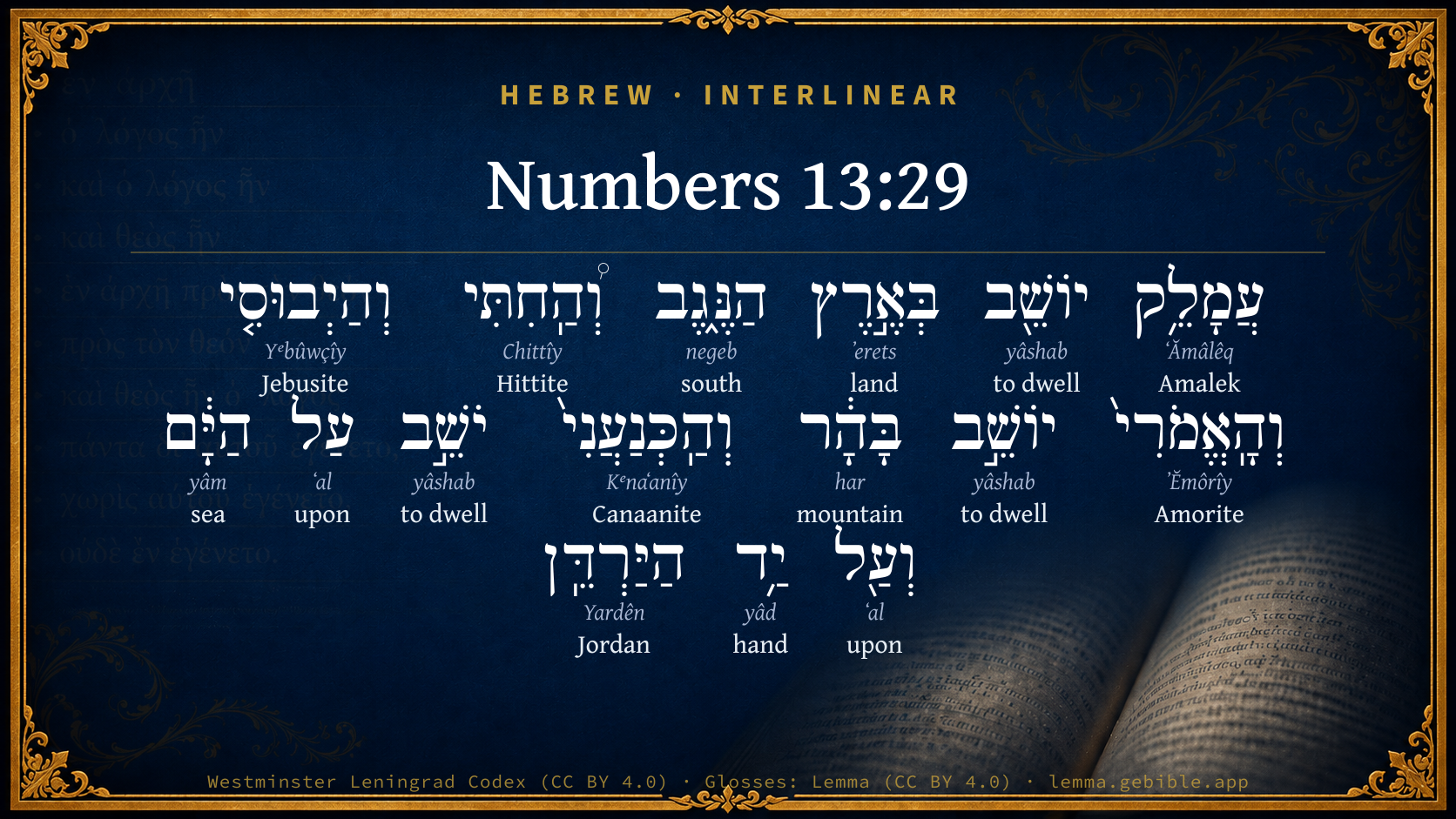
Hebrew (Westminster Leningrad Codex) Numbers 13:29 appears in the Hebrew Old Testament. The text above is from the Westminster Leningrad Codex. Each word links to its Strong’s number, a concise gloss, and parsing drawn from the Open Scriptures Hebrew Bible morphology. Click any word for its full Brown-Driver-Briggs (BDB) entry.
Download image
Cite this verse

Numbers 13:29 (World English Bible). Public Domain. Lemma interlinear Bible study tool, https://lemma.gebible.app/v/numbers/13/29.

Show BibTeX & RIS
BibTeX
RIS
English Translation
Amalek dwells in the land of the South: and the Hittite, and the Jebusite, and the Amorite, dwell in the hill-country; and the Canaanite dwells by the sea, and along by the side of the Jordan.
World English Bible · Public Domain
Download a study sheet

One document with this verse’s original text, its word-by-word gloss line, the meaning frame, cross-references with their text, attributed commentary, and full source and license credits — printable, and it pastes into notes with its structure intact.

This verse Autodidact and up

Study sheet (.html) Plain text (.txt)

A passage Seminary Student

Up to 50 verses in one chapter. A passage sheet keeps up to 6 commentary sources and 12 cross-references per verse, in the order this page ranks them, and says so on the sheet whenever that leaves anything out. Ask for a single verse and you get the Autodidact verse sheet above.

Everything on this page stays free to read, with no account — the sheet is a download of what is already on screen, not access to it.

Want to remove ads? Support Godless Engineer
Compare translations 3

The same verse in 3 English versions, stacked beneath the original-language interlinear above. Click any original word for its lexicon entry.

Each is an independent rendering of the whole verse — the interlinear is not word-aligned to these translations.

Highlighted words mark where these versions differ — a whole-verse word diff, not a word-by-word alignment.

  • World English Bible Public Domain
    Amalek dwells in the land of the South: and the Hittite, and the Jebusite, and the Amorite, dwell in the hill-country; and the Canaanite dwells by the sea, and along by the side of the Jordan.
  • King James Version Public Domain
    The Amalekites dwell in the land of the south: and the Hittites, and the Jebusites, and the Amorites, dwell in the mountains: and the Canaanites dwell by the sea, and by the coast of Jordan.
  • unfoldingWord Literal Text CC BY-SA 4.0
    Amalek is dwelling in the land of the Negev, and the Hittite and the Jebusite and the Amorite is dwelling in the hill country, and the Canaanite is dwelling upon the sea and upon the hand of the Jordan.”

unfoldingWord Literal Text — © unfoldingWord, licensed CC BY-SA 4.0. Word-aligned USFM3 via Door43 (git.door43.org/unfoldingWord/en_ult).

Versions to compare (up to 4)

3 of 4 selected

Show all 18 translations

Every available English version of this verse, each an independent rendering of the whole verse.

  • World English Bible Public Domain
    Amalek dwells in the land of the South: and the Hittite, and the Jebusite, and the Amorite, dwell in the hill-country; and the Canaanite dwells by the sea, and along by the side of the Jordan.
  • Berean Standard Bible Public Domain
    The Amalekites live in the land of the Negev; the Hittites, Jebusites, and Amorites live in the hill country; and the Canaanites live by the sea and along the Jordan.”
  • Majority Standard Bible Public Domain
    The Amalekites live in the land of the Negev; the Hittites, Jebusites, and Amorites live in the hill country; and the Canaanites live by the sea and along the Jordan.”
  • King James Version Public Domain
    The Amalekites dwell in the land of the south: and the Hittites, and the Jebusites, and the Amorites, dwell in the mountains: and the Canaanites dwell by the sea, and by the coast of Jordan.
  • American Standard Version (1901) Public Domain
    Amalek dwelleth in the land of the South: and the Hittite, and the Jebusite, and the Amorite, dwell in the hill-country; and the Canaanite dwelleth by the sea, and along by the side of the Jordan.
  • Revised Version (1885) Public Domain
    Amalek dwelleth in the land of the South: and the Hittite, and the Jebusite, and the Amorite, dwell in the mountains: and the Canaanite dwelleth by the sea, and along by the side of Jordan.
  • Geneva Bible (1599) Public Domain
    Neuerthelesse the people be strong that dwell in the land, and the cities are walled and exceeding great: and moreouer, we sawe the sonnes of Anak there.
  • Douay-Rheims (1899) Public Domain
    But it hath very strong inhabitants, and the cities are great and walled. We saw there the race of Enac.
  • Young's Literal Translation Public Domain
    Amalek is dwelling in the land of the south, and the Hittite, and the Jebusite, and the Amorite is dwelling in the hill country, and the Canaanite is dwelling by the sea, and by the side of the Jordan.'
  • Literal Standard Version CC BY-SA 4.0
    Amalek is dwelling in the land of the south, and the Hittite, and the Jebusite, and the Amorite are dwelling in the hill country, and the Canaanite is dwelling by the sea, and by the side of the Jordan.”
  • Unlocked Literal Bible CC BY-SA 4.0
    The Amalekites live in the Negev. The Hittites, Jebusites, and Amorites have their homes in the hill country. The Canaanites live by the sea and along the Jordan River.”
  • unfoldingWord Literal Text CC BY-SA 4.0
    Amalek is dwelling in the land of the Negev, and the Hittite and the Jebusite and the Amorite is dwelling in the hill country, and the Canaanite is dwelling upon the sea and upon the hand of the Jordan.”
  • Darby Bible Public Domain
    Amalek dwells in the land of the south; and the Hittites, and the Jebusites, and the Amorites dwell in the hill-country; and the Canaanites dwell by the sea, and by the side of the Jordan.
  • World Messianic Bible Public Domain
    Amalek dwells in the land of the South. The Hittite, the Jebusite, and the Amorite dwell in the hill country. The Canaanite dwells by the sea, and along the side of the Jordan.”
  • Webster's Bible Public Domain
    The Amalekites dwell in the land of the south: and the Hittites, and the Jebusites, and the Amorites, dwell in the mountains: and the Canaanites dwell by the sea, and by the coast of Jordan.
  • Free Bible Version CC BY-SA 4.0
    The Amalekites live in the Negev. The Hittites, Jebusites, and the Amorites live in the hill country. The Canaanites live on the sea coast and also beside the Jordan.”
  • Bible in Basic English Public Domain
    And the Amalekites are in the South; and the Hittites and the Jebusites and the Amorites are living in the hill-country; and the Canaanites by the sea and by the side of Jordan.
  • JPS Tanakh (1917) Public Domain
    Amalek dwelleth in the land of the South; and the Hittite, and the Jebusite, and the Amorite, dwell in the mountains; and the Canaanite dwelleth by the sea, and along by the side of the Jordan.'

Literal Standard Version (2020), Covenant Press — licensed CC BY-SA 4.0. Text via the HelloAO Bible API (eBible.org). Unlocked Literal Bible (unfoldingWord) — licensed CC BY-SA 4.0. Text via the HelloAO Bible API (eBible.org). unfoldingWord Literal Text — © unfoldingWord, licensed CC BY-SA 4.0. Word-aligned USFM3 via Door43 (git.door43.org/unfoldingWord/en_ult). Free Bible Version, Dr. Jonathan Gallagher — licensed CC BY-SA 4.0. Text via the HelloAO Bible API (eBible.org).

Word by word

More ways to search: Search by grammar → Find every occurrence → Compare this word →

Practice this passage: Drill this verse → Learn its vocabulary →

עֲמָלֵ֥ק
ʻĂmâlêq
H6002
“Amalek”
Noun, Proper
Part of Speech
Noun
Type
Proper
Full BDB Definition

Origin: probably of foreign origin

TWOT: None

Amalek = "dweller in a valley" - son of Eliphaz by his concubine Timnah, grandson of Esau, and progenitor of a tribe of people in southern Canaan - descendants of Amalek
  1. יוֹשֵׁ֖ב yâshab H3427 “dwelling” Verb, Qal, Participle Active, Masculine, Singular, Absolute
  2. בְּאֶ֣רֶץ ʼerets H776 “in/at · land of” Preposition + Noun, Common, Both, Singular, Construct
  3. הַנֶּ֑גֶב negeb H5045 “the · south” Particle, Definite Article + Noun, Common, Masculine, Singular, Absolute
  4. וְ֠הַֽחִתִּי Chittîy H2850 “and · the · Hittite” Conjunction + Particle, Definite Article + Noun, Gentilic, Masculine, Singular, Absolute
  5. וְהַיְבוּסִ֤י Yᵉbûwçîy H2983 “and · the · Jebusite” Conjunction + Particle, Definite Article + Noun, Gentilic, Masculine, Singular, Absolute
  6. וְהָֽאֱמֹרִי֙ ʼĔmôrîy H567 “and · the · Amorite” Conjunction + Particle, Definite Article + Noun, Gentilic, Masculine, Singular, Absolute
  7. יוֹשֵׁ֣ב yâshab H3427 “dwelling” Verb, Qal, Participle Active, Masculine, Singular, Absolute
  8. בָּהָ֔ר har H2022 “in/at the · mountain” Preposition, Determined + Noun, Common, Masculine, Singular, Absolute
  9. וְהַֽכְּנַעֲנִי֙ Kᵉnaʻanîy H3669 “and · the · Canaanite” Conjunction + Particle, Definite Article + Noun, Gentilic, Masculine, Singular, Absolute
  10. יֹשֵׁ֣ב yâshab H3427 “dwelling” Verb, Qal, Participle Active, Masculine, Singular, Absolute
  11. עַל ʻal H5921 “upon” Preposition
  12. הַיָּ֔ם yâm H3220 “the · sea” Particle, Definite Article + Noun, Common, Masculine, Singular, Absolute
  13. וְעַ֖ל ʻal H5921 “and · upon” Conjunction + Preposition
  14. יַ֥ד yâd H3027 “hand of” Noun, Common, Both, Singular, Construct
  15. הַיַּרְדֵּֽן Yardên H3383 “the · Jordan” Particle, Definite Article + Noun, Proper

About this verse

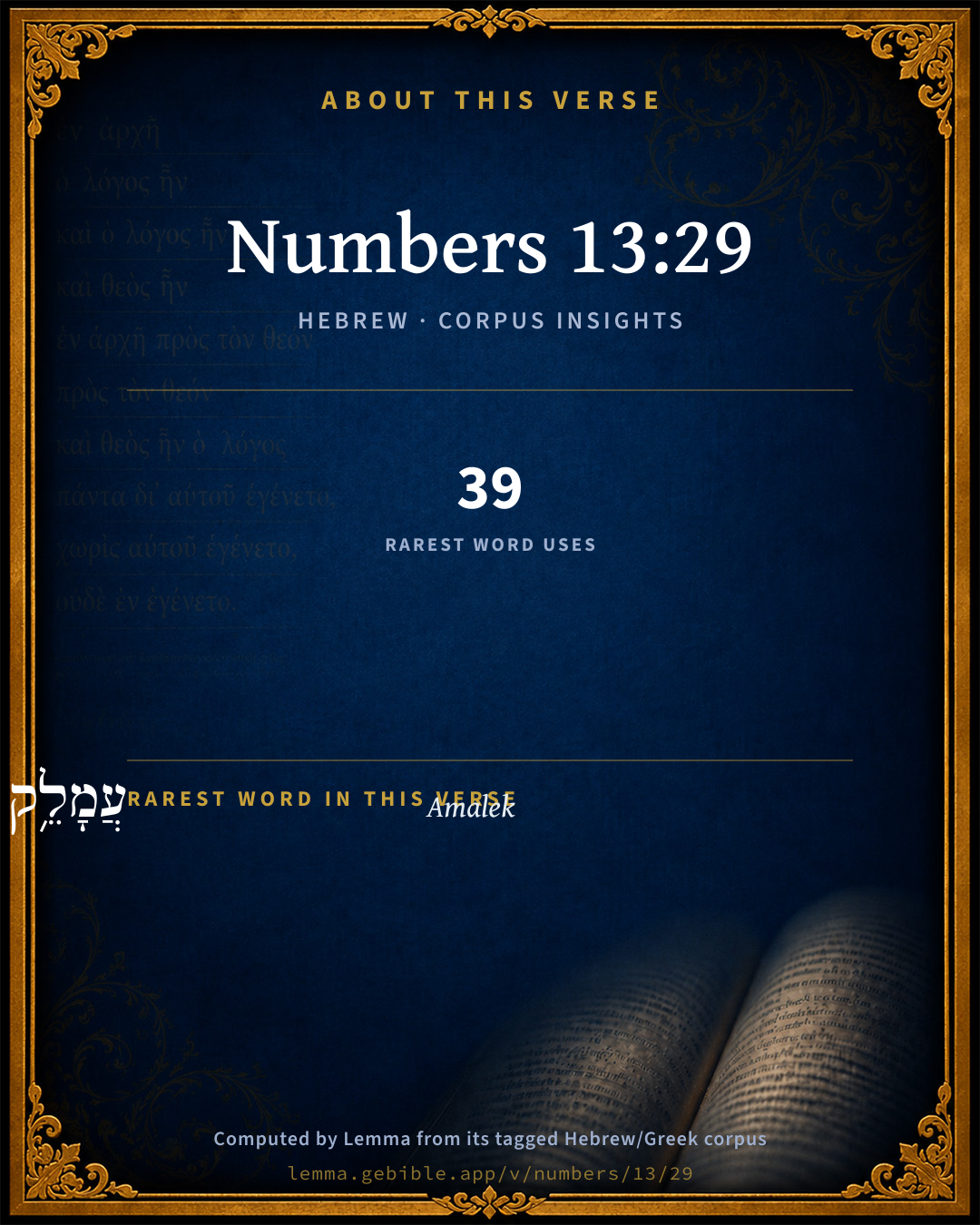
These counts appear in no published source. They are computed here, from the morphology-tagged text and Lemma’s own curated glosses. What Lemma adds →

16
words
13
distinct lemmas
Pentateuch
section

Shared distinctive vocabulary

עֲמָלֵ֥ק Amalek H6002 occurs in 37 verses of the Hebrew Bible. Also found in:

Grammatical profile

  • 3 verbs
  • 11 nouns
  • 2 prepositions

Verb forms

  • יוֹשֵׁ֖ב Qal · Participle Active
  • יוֹשֵׁ֣ב Qal · Participle Active
  • יֹשֵׁ֣ב Qal · Participle Active

Repetition

Words recur within this verse — often emphatic in Hebrew:

  • יוֹשֵׁ֖ב to dwell H3427 ×3
  • עַל upon H5921 ×2

Hebrew & Septuagint length

In English translation the verse runs 36 words from the Hebrew and 26 from the Septuagint (LXX English) — closely comparable.

A rough comparison of the two English renderings, which tokenize alike — not a word-level alignment.

Word counts can differ between the Hebrew and the Greek without any difference in meaning — e.g. the Hebrew direct-object marker אֵת has no separate Greek word, and Greek often adds the article ὁ.

Cross-references

14

Topical passages linked to Numbers 13:29 in the Treasury of Scripture Knowledge — connected by theme and wording, ordered by reader-vote popularity; previews shown in the World English Bible.

  • Numbers 14:43 For there the Amalekite and the Canaanite are before you, and you shall fall by the sword: because you are turned back from following Yahweh, therefore Yahweh will not be with you.
  • Judges 6:3 So it was, when Israel had sown, that the Midianites came up, and the Amalekites, and the children of the east; they came up against them;
  • Genesis 14:7 They returned, and came to En-mishpat (the same is Kadesh), and struck all the country of the Amalekites, and also the Amorites, that lived in Hazazon Tamar.
  • Genesis 15:19–21 the Kenites, the Kenizzites, the Kadmonites,
  • Exodus 3:8 I have come down to deliver them out of the hand of the Egyptians, and to bring them up out of that land to a good and large land, to a land flowing with milk and honey; to the place of the Canaanite, the Hittite, the Amorite, the Perizzite, the Hivite, and the Jebusite.
  • Exodus 3:17 and I have said, I will bring you up out of the affliction of Egypt to the land of the Canaanite, the Hittite, the Amorite, the Perizzite, the Hivite, and the Jebusite, to a land flowing with milk and honey."'
  • Exodus 17:8–16 Then Amalek came and fought with Israel in Rephidim.
  • Numbers 14:25 Now the Amalekite and the Canaanite dwell in the valley: tomorrow turn you, and get you into the wilderness by the way to the Red Sea.
  • Numbers 14:45 Then the Amalekite came down, and the Canaanite who lived in that mountain, and struck them and beat them down, even to Hormah.
  • Numbers 24:20 He looked at Amalek, and took up his parable, and said, Amalek was the first of the nations; But his latter end shall come to destruction.
  • 1 Samuel 14:48 He did valiantly, and struck the Amalekites, and delivered Israel out of the hands of those who despoiled them.
  • 1 Samuel 15:3–9 Now go and strike Amalek, and utterly destroy all that they have, and don't spare them; but kill both man and woman, infant and suckling, ox and sheep, camel and donkey.
  • 1 Samuel 30:1 It happened, when David and his men were come to Ziklag on the third day, that the Amalekites had made a raid on the South, and on Ziklag, and had struck Ziklag, and burned it with fire,
  • Psalms 83:7 Gebal, Ammon, and Amalek; Philistia with the inhabitants of Tyre;

Cross-references courtesy of OpenBible.info (CC BY 4.0).

Hebrew and Greek witnesses Masoretic Hebrew ↔ Greek Septuagint

The same verse in the two great witnesses to the Old Testament, shown verse-for-verse.

These are two independent witnesses, not word-aligned to each other, and the Septuagint is shown in lemma (dictionary) form.

Hebrew Numbers 13:29 Masoretic · Westminster Leningrad Codex

עֲמָלֵ֥ק יוֹשֵׁ֖ב בְּאֶ֣רֶץ הַנֶּ֑גֶב וְ֠הַֽחִתִּי וְהַיְבוּסִ֤י וְהָֽאֱמֹרִי֙ יוֹשֵׁ֣ב בָּהָ֔ר וְהַֽכְּנַעֲנִי֙ יֹשֵׁ֣ב עַל הַיָּ֔ם וְעַ֖ל יַ֥ד הַיַּרְדֵּֽן

Amalek dwells in the land of the South: and the Hittite, and the Jebusite, and the Amorite, dwell in the hill-country; and the Canaanite dwells by the sea, and along by the side of the Jordan.

World English Bible · Public Domain

Greek LXX Numbers 13:29 Septuagint · lemma form

καί αμαληκ καταοἰκέω ἐν ὁ γῆ ὁ πρός νότος καί ὁ χετταῖος καί ὁ ευαῖος καί ὁ ιεβουσαῖος καί ὁ ἀμορραῖος καταοἰκέω ἐν ὁ ὀρεινή καί ὁ χαναναῖος καταοἰκέω παρά θάλασσα καί παρά ὁ ἰορδάνην ποταμός

Only the nation that dwells upon it is bold, and they have very great and strong walled towns, and we saw there the children of Enach.

LXX2012 (modern English Septuagint) · Public Domain

Hebrew: Westminster Leningrad Codex (CC BY 4.0). Greek: Septuagint (public domain); English from LXX2012 (modern English Septuagint) (Public Domain). How the Septuagint differs from the Hebrew →

Targum (Aramaic paraphrase)

2

The Targum is the ancient Jewish Aramaic paraphrase of the Hebrew Scriptures — an interpretive translation, not the Hebrew text itself. Onkelos (literal) and Pseudo-Jonathan (expansive) render the Torah, and Jonathan the Prophets. Coverage is partial: where no permissively-licensed English translation exists for a verse, only the Aramaic is shown. This is verse-level text, not a word-by-word alignment to the Hebrew.

  1. Targum Onkelos Torah (Genesis–Deuteronomy)
    עֲמַלְקָאָה יָתֵב בַּאֲרַע דָרוֹמָא וְחִתָּאָה וִיבוּסָאָה וֶאֱמוֹרָאָה יָתֵב בְּטּוּרָא וּכְנַעֲנָאָה יָתֵב עַל יַמָא וְעַל כֵּיף יַרְדְנָא

    (no public-domain English translation for this verse)

    Targum Onkelos — Aramaic: “Onkelos Genesis” (public domain); “Onkelos Exodus” (public domain); “Onkelos Leviticus” (public domain); “Onkelos Numbers” (public domain); “Onkelos Deuteronomy” (public domain). English: “Sefaria Community Translation” (CC0 1.0 (public-domain dedication)); “J.W. Etheridge. The Targums of Onkelos and Jonathan Ben Uzziel on the Pentateuch. London: Longmans, Green, 1862” (public domain). Text via Sefaria.

  2. Targum Pseudo-Jonathan Torah (Genesis–Deuteronomy)
    עֲמַלְקָאֵי יַתְבִין בְּאַרַע דָרוֹמָא וְחִתָּאֵי וִיבוּסָאֵי וֶאֱמוֹרָאֵי יַתְבִין בְּטַוְורָא וּכְנַעֲנָאֵי יַתְבִין עַל יַמָא וְעַל תְּחוּם יוֹרְדְנָא

    The Amalekites dwell in the south, the Hittites, Jebusites, and Amorites in the mountains; but the Kenaanites dwell by the sea, and by the bank of the Jordan.

    Targum Pseudo-Jonathan — Aramaic: “Targum Jonathan on Genesis” (public domain); “Targum Jonathan on Exodus” (public domain); “Targum Jonathan on Leviticus” (public domain); “Targum Jonathan on Numbers” (public domain); “Targum Jonathan on Deuteronomy” (public domain). English: “The Targum of Jonathan ben Uzziel, trans. J. W. Etheridge, London, 1862” (public domain). Text via Sefaria.

Commentary

Notes on Numbers 13:29 from classic Christian and Jewish commentators (each source and its license shown beneath its notes). The classic Christian expositions comment on the surrounding passage and are grouped to its opening verse, so a note may address several verses; the Jewish commentaries on the Tanakh (Rashi and others) are per-verse, so they appear only where the commentator wrote on this verse.

Lemma curates 59 commentaries, every one of them public domain or Creative Commons licensed, each selected and text-cleaned for this edition rather than reprinted as found. About our sources →

Tyndale Open Study Notes

Tyndale Open Resources

13:29 The spies answer the question of 13:18. Many ethnic groups occupied ancient Canaan.

Tyndale Open Study Notes — © Tyndale Open Resources, licensed CC BY-SA 4.0. Text via the HelloAO Bible API.

Geneva Bible (1599)

Geneva Bible translators

Ahiman, Sheshai, and Talmai, whom Caleb slew afterward, Josh. 11:21, 22.

Geneva Bible (1599) marginal notes — public domain. Text via Bolls.life.

Jamieson, Fausset & Brown

Robert Jamieson, A. R. Fausset & David Brown

The Amalekites dwell in the land of the south--Their territory lay between the Dead and the Red Seas, skirting the borders of Canaan.

Hittites . . . dwell in the mountains--Their settlements were in the southern and mountainous part of Palestine (Gen 23:7).

the Canaanites dwell by the sea--The remnant of the original inhabitants, who had been dispossessed by the Philistines, were divided into two nomadic hordes--one settled eastward near the Jordan; the other westward, by the Mediterranean.

Jamieson, Fausset & Brown — Commentary Critical and Explanatory on the Whole Bible (1871) — public domain (CC PDM 1.0). Text via the HelloAO Bible API.

Ellicott's Commentary for English Readers

(29) The land of the south.—Better, of the south country, or the Negeb. See Gen_36:12, and also Num_13:17 of this Num. and Note.

The mountains.—See Gen_10:15-16, and Num_13:17 of this Num. and Note.

The Canaanites.—See Gen_10:15-18; Gen_13:7, and Notes.

A Bible Commentary for English Readers, edited by Charles John Ellicott (1878–1897) — public domain. Text from a community e-Sword module.

The Cambridge Bible for Schools and Colleges

gen. ed. J. J. S. Perowne

29. Apparently a parenthesis by the narrator or compiler, enumerating the inhabitants who occupied respectively (1) the Negeb, (2) the central hills of Palestine and (3) the western coast-lands, and the Jordan valley. See on Num_14:25.

The Cambridge Bible for Schools and Colleges (gen. ed. J. J. S. Perowne; Cambridge University Press, 1878–1918) — public domain. Text from a community e-Sword module.

Albert Barnes' Notes on the Bible

The Amalekites - See Num 14:25 note.

The Canaanites - i. e. those of the Phoenician race: the word is here used in its narrow sense: compare Gen 10:15-18 note.

Albert Barnes' Notes on the Bible (1834–1885) — public domain. Text from a community e-Sword/MySword module.

Matthew Poole's English Annotations

The south, where we are to enter the land; and they who were so eager and fierce against us that they came into the wilderness to fight with us, will without doubt oppose us when we come close by their land, and are about to settle in their neighbourhood, the rather, to revenge themselves for their former loss and shame received by us. Therefore they mention them, though they were no Canaanites.

In the mountains, i.e. in the mountainous country in the south-east part of the land; so that you cannot enter there without great difficulty, both because of the noted strength and valour of those people, and because of the advantage they have from the mountains.

By the sea; not the midland sea, which is commonly understood by that expression, but the Salt or Dead Sea, as appears,

1. Because it is that sea which is next to Jordan, as here follows.

2. Because the Canaanites dwelt principally in those parts, and not near the midland sea. So these guard the entrance on the east side, as the others do on the south.

Matthew Poole's English Annotations on the Holy Bible (1683–1685) — public domain. Text from a community e-Sword/MySword module.

Whedon's Commentary on the Bible

Daniel D. Whedon

29. Amalekites — See Exo_17:8, note. This strong nomadic tribe occupied the Negeb, or south part of Canaan, and they encountered Israel in the battle of Rephidim, near Sinai.

Hittites — Or children of Heth. See Jos_1:4; Jos_3:10, notes. One of the points at which modern Oriental research has done much to verify the historical accuracy of the Bible narrative is in the disclosure of the prominence of the Hittite empire in the olden time. Until recently the Hittites were known to the world only in the Bible record. Now they are recognised as one of the great world-powers in their day. The fullest compendium of facts bearing on this point is The Empire of the Hittites, by the Revelation Dr. William Wright, one of the secretaries of the British and Foreign Bible Society.

Jebusites — These occupied Jerusalem and vicinity. Jos_3:10, note.

Amorites — these were the most formidable. See Jos_3:10, note.

In the mountains — These are in the north-east of Et Tih, about seventy miles long and from forty to fifty broad, extending northward to near Beer-sheba. See Deu_1:20, note.

Canaanites — The term is here used in its narrow meaning of Lowlanders. See Jos_3:10, note.

Daniel D. Whedon (gen. ed.), Commentary on the Old and New Testaments (1874–1909) — public domain. Text from a community e-Sword module.

The Pulpit Commentary

The Amalekites. These descendants of Esau (see on Gen_36:12) formed wild roving bands, which (like the Bedouins of the present day) infested rather than inhabited the whole country between Judaea and Egypt, including the Negeb. They are not numbered among the inhabitants of Canaan proper. The Canaanites dwell by the sea, and by the coast of Jordan. It is not easy to say in what sense the word "Canaanites" is used here. At one time it is the name of one tribe amongst many, all descended from Canaan, the son of Ham, which dwelt in the land of promise; at another time it is apparently synonymous with "Amorites," or rather includes both them and the allied tribes. (cf. e.g., Jud_1:9) It is possible, though far from certain, that "Canaanites" in this place may mean "Phoenicians," since Sidon was the first-born of Canaan, (Gen_10:15) and the northern portion of the maritime plain was certainly in their possession, and probably the upper part of the Ghor, or coast of Jordan. It would appear that the Philistines had not at this time made themselves masters of the plain, although they dwelt in some parts of it. (see on Exo_13:17)

The Pulpit Commentary (1880–1919), ed. H.D.M. Spence-Jones & Joseph S. Exell — public domain. Text from a community e-Sword module.

John Wesley's Explanatory Notes

The Amalekites in the south - Where we are to enter the land, and they who were so fierce against us that they came into the wilderness to fight with us, will, without doubt, oppose us when we come close by their land, the rather, to revenge themselves for their former loss. Therefore they mention them, though they were not Canaanites. In the mountains -In the mountainous country, in the southeast part of the land, so that you cannot enter there without great difficulty, both because of the noted strength and valour of those people, and because of the advantage they have from the mountains. By the sea - Not the mid-land sea, which is commonly understood by that expression, but the salt or dead sea, as appears,

1. Because it is that sea which is next to Jordan,

2. Because the Canaanites dwelt principally in those parts, and not near the mid-land sea. So these guard the entrance on the east- side, as the others do on the south.

John Wesley, Explanatory Notes Upon the Whole Bible (1754–1765) — public domain. Text via the GEBible commentary corpus.

Rashi

Rabbi Shlomo Yitzchaki (Rashi)

עמלק יושב וגו׳ THE AMALEKITES ABIDE [IN THE LAND OF THE SOUTH] — Because they had already been “burnt” by Amalek, the spies mentioned him first in order to terrify them (cf. Midrash Tanchuma, Sh'lach 9).

ועל ידי הירדן AND BY THE יד OF THE JORDAN — יד means what it literally implies: beside the Jordan. They meant: the Canaanites live on the bank of the Jordan and therefore you will be unable to cross it.

Rashi on the Tanakh — English translations: “The Judaica Press complete Tanach with Rashi, translated by A. J. Rosenberg” (CC BY 4.0); “Pentateuch with Rashi's commentary by M. Rosenbaum and A.M. Silbermann, 1929-1934” (public domain); “The Metsudah Tanach series, Lakewood, N.J” (CC BY 4.0); and “The Book of Joshua, Metsudah Publications, 1997” (CC BY 4.0). Text via Sefaria.

Ramban (Nachmanides)

Rabbi Moshe ben Nachman (Ramban / Nachmanides)

They also said, Amalek dwelleth in the land of the south by which they intended to allege that there was no direction from which they could enter the Land, as all [its inhabitants] are strong men, for Amalek dwells in the south, and the Canaanite in the west and in the east, and the Amorite in the mountains. Thus they reported that which they had been sent [to find out], in such a way as to discourage the people’s confidence by means of allusion [and not openly], because they were afraid of Moses and Aaron. Thus they gave an answer to all that Moses commanded them [to ascertain], except for his statement [that they were to see] whether they are few or many, to which they gave no reply at all, nor did they report back [whether it is] good. This is because they intended to tell the people afterwards by way of an evil report, it is a Land that eateth up the inhabitants thereof, [thus implying] that its people are few but very strong. Now the people understood their intention and so all the congregation which was present began to murmur, this being the sense of the expression, And Caleb stilled the people, for he silenced them and said, We should go up at once, for we are well able to overcome it, meaning: “It is true that the people are strong, but we shall be stronger than them and their fortified cities.” Therefore Caleb said lah [“it” — we are well able to overcome ‘it,’ the word ‘it’ referring to the Land, and including the people and their fortifications]. Then the spies spoke up again, explaining their words clearly, and said, We are not able to go up against the people, for they are stronger than we, meaning: “Even if the people came out unto us into the field we are not able to contest them in battle, and we surely cannot capture any of their great and fortified cities.” For the meaning of the expression to go up ‘against the people’ is similar to [what Goliath said]: choose you a man for you, and let him come down to me, which is an expression for those fighting in battle formation.

Ramban (Nachmanides) on the Tanakh — English translation: “Commentary on the Torah by Ramban (Nachmanides). Translated and annotated by Charles B. Chavel. New York, Shilo Pub. House, 1971-1976” (CC BY 4.0). Text via Sefaria.

Lesson kit

Teaching starters — assembled from the data on this page, not authored interpretation. Every prompt links to the verse data it draws on. Edit before teaching.

Numbers, in the Pentateuch, opens this verse with 16 words (13 distinct Hebrew lemmas). Its most distinctive word is ʻĂmâlêq (“Amalek”). A historical commentator’s framing appears above. Read the whole chapter for the surrounding context.

Discussion questions

  1. The word ʻĂmâlêq carries the sense “Amalek.” How does it shape the verse?
  2. How does Genesis 36:12, which shares the word «Amalek», read alongside this verse?
  3. What does the repetition of “to dwell” (3× in this one verse) do in this verse?
  4. These translations render this verse differently. What is at stake in choosing one wording over another?
  5. «יוֹשֵׁ֖ב» is a Qal Participle Active verb. How does that grammatical form shape the action described?
  6. Compare how Tyndale Open Study Notes and Geneva Bible (1599) read this verse. Where do they agree or differ?

Things to notice

Reading settings

Reading text

Shown beneath each verse's original-language words.

Old Testament
Old Testament edition

Read the OT as the Masoretic Hebrew (MT) or the Greek Septuagint (LXX).

English shown for the Greek Septuagint (in the Hebrew ↔ Greek comparison).

Comparing translations? Open the Compare panel on any verse page to stack up to four side by side.