
Exodus 15:10

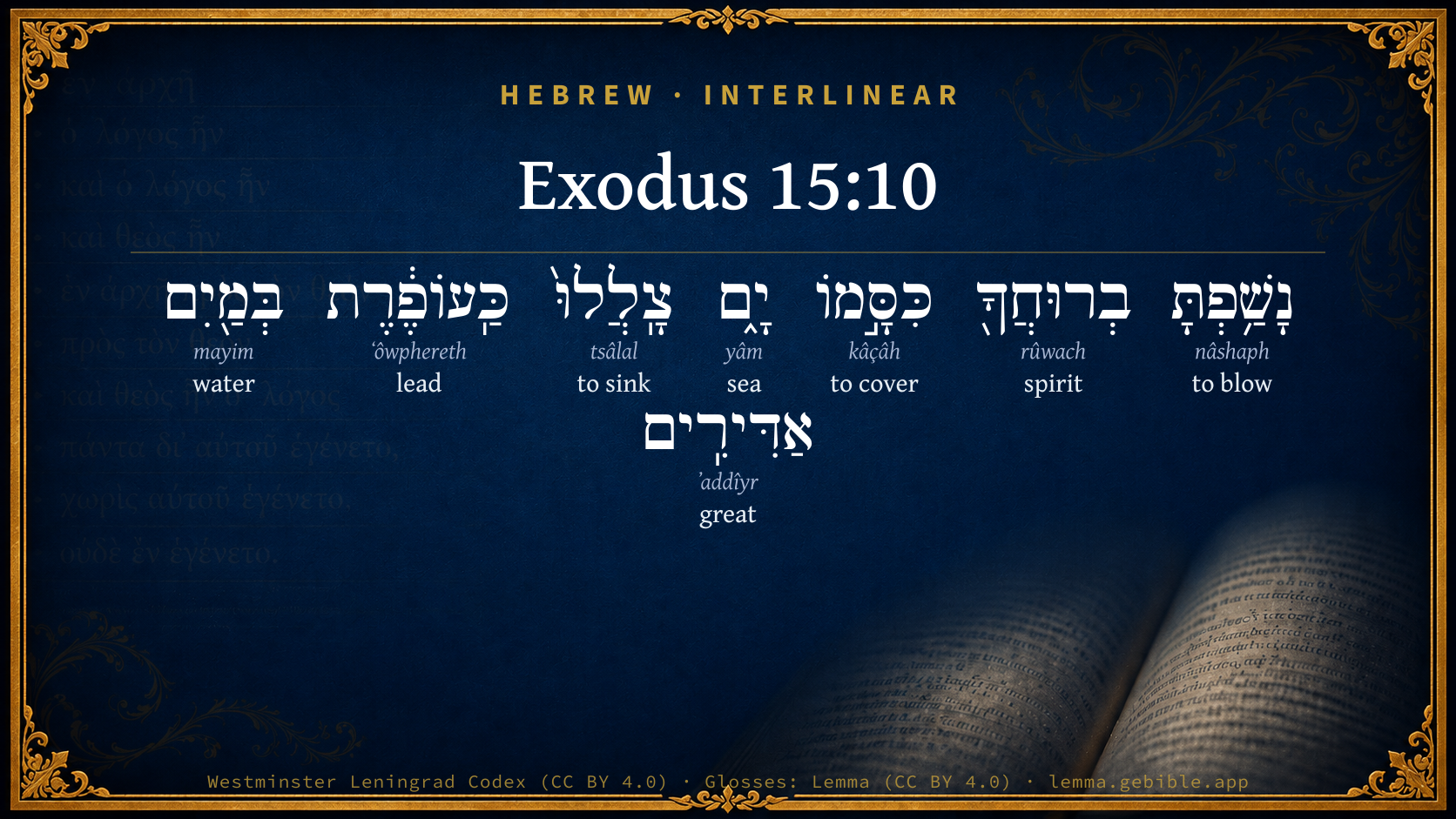
Hebrew (Westminster Leningrad Codex) Exodus 15:10 appears in the Hebrew Old Testament. The text above is from the Westminster Leningrad Codex. Each word links to its Strong’s number, a concise gloss, and parsing drawn from the Open Scriptures Hebrew Bible morphology. Click any word for its full Brown-Driver-Briggs (BDB) entry.
Download image
Cite this verse

Exodus 15:10 (World English Bible). Public Domain. Lemma interlinear Bible study tool, https://lemma.gebible.app/v/exodus/15/10.

Show BibTeX & RIS
BibTeX
RIS
English Translation
You blew with your wind. The sea covered them. They sank like lead in the mighty waters.
World English Bible · Public Domain
Highlights
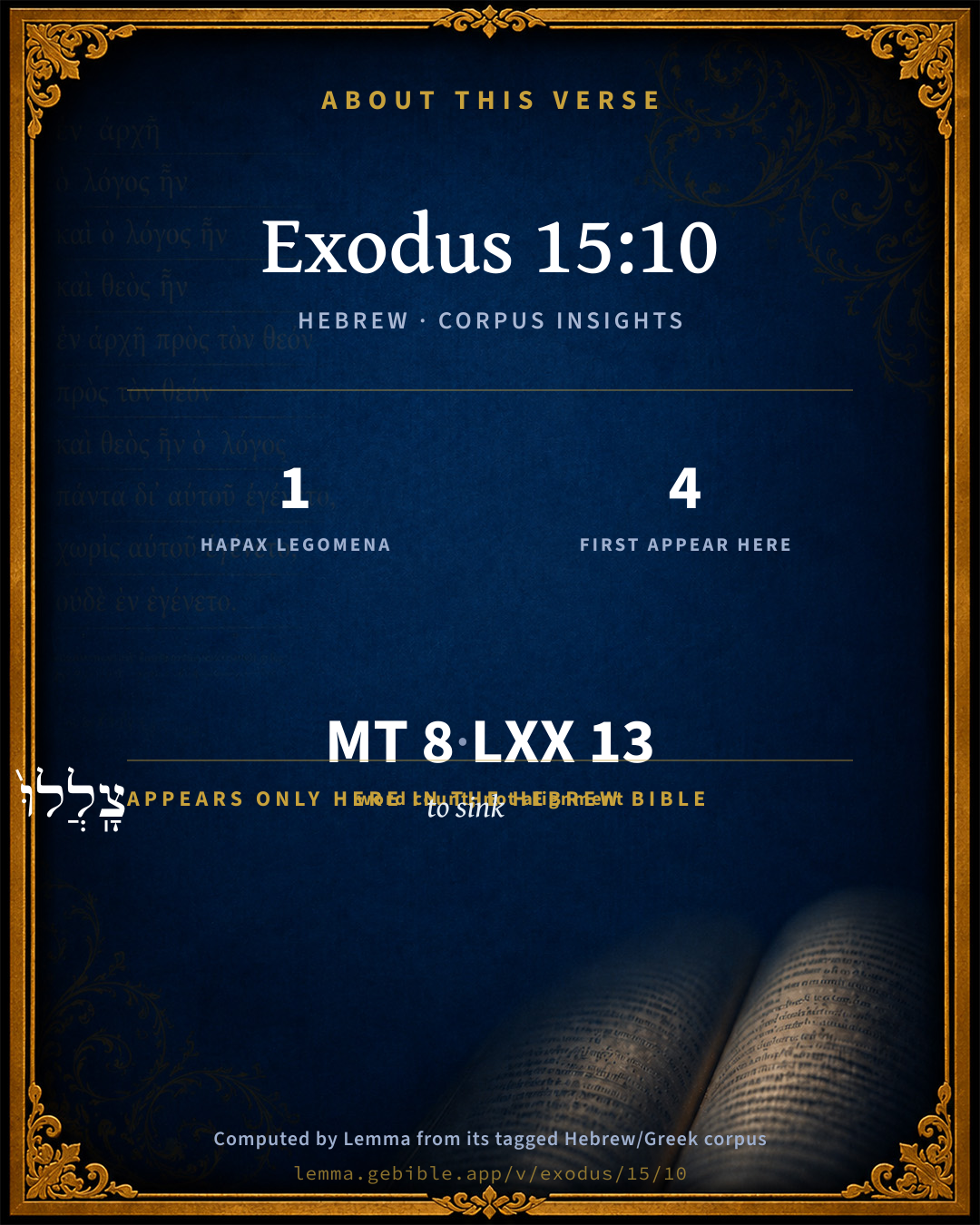
  • 1 hapax legomenon — only here in the Hebrew Bible
  • 4 first appearances in the Hebrew Bible
Full analysis ↓
Download a study sheet

One document with this verse’s original text, its word-by-word gloss line, the meaning frame, cross-references with their text, attributed commentary, and full source and license credits — printable, and it pastes into notes with its structure intact.

This verse Autodidact and up

Study sheet (.html) Plain text (.txt)

A passage Seminary Student

Up to 50 verses in one chapter. A passage sheet keeps up to 6 commentary sources and 12 cross-references per verse, in the order this page ranks them, and says so on the sheet whenever that leaves anything out. Ask for a single verse and you get the Autodidact verse sheet above.

Everything on this page stays free to read, with no account — the sheet is a download of what is already on screen, not access to it.

Want to remove ads? Support Godless Engineer
Compare translations 3

The same verse in 3 English versions, stacked beneath the original-language interlinear above. Click any original word for its lexicon entry.

Each is an independent rendering of the whole verse — the interlinear is not word-aligned to these translations.

Highlighted words mark where these versions differ — a whole-verse word diff, not a word-by-word alignment.

  • World English Bible Public Domain
    You blew with your wind. The sea covered them. They sank like lead in the mighty waters.
  • King James Version Public Domain
    Thou didst blow with thy wind, the sea covered them: they sank as lead in the mighty waters.
  • unfoldingWord Literal Text CC BY-SA 4.0
    You blew with your wind; the sea covered them; they sank like lead in the majestic waters.

unfoldingWord Literal Text — © unfoldingWord, licensed CC BY-SA 4.0. Word-aligned USFM3 via Door43 (git.door43.org/unfoldingWord/en_ult).

Versions to compare (up to 4)

3 of 4 selected

Show all 18 translations

Every available English version of this verse, each an independent rendering of the whole verse.

  • World English Bible Public Domain
    You blew with your wind. The sea covered them. They sank like lead in the mighty waters.
  • Berean Standard Bible Public Domain
    But You blew with Your breath, and the sea covered them. They sank like lead in the mighty waters.
  • Majority Standard Bible Public Domain
    But You blew with Your breath, and the sea covered them. They sank like lead in the mighty waters.
  • King James Version Public Domain
    Thou didst blow with thy wind, the sea covered them: they sank as lead in the mighty waters.
  • American Standard Version (1901) Public Domain
    Thou didst blow with thy wind, the sea covered them: They sank as lead in the mighty waters.
  • Revised Version (1885) Public Domain
    Thou didst blow with thy wind, the sea covered them: They sank as lead in the mighty waters.
  • Geneva Bible (1599) Public Domain
    Thou blewest with thy winde, the Sea couered them, they sanke as leade in the mightie waters.
  • Douay-Rheims (1899) Public Domain
    Thy wind blew and the sea covered them: they sunk as lead in the mighty waters.
  • Young's Literal Translation Public Domain
    Thou hast blown with Thy wind The sea hath covered them; They sank as lead in mighty waters.
  • Literal Standard Version CC BY-SA 4.0
    You have blown with Your wind || The sea has covered them; They sank as lead in mighty waters.
  • Unlocked Literal Bible CC BY-SA 4.0
    But you blew with your wind, and the sea covered them; they sank like lead in the mighty waters.
  • unfoldingWord Literal Text CC BY-SA 4.0
    You blew with your wind; the sea covered them; they sank like lead in the majestic waters.
  • Darby Bible Public Domain
    Thou didst blow with thy breath, the sea covered them; They sank as lead in the mighty waters.
  • World Messianic Bible Public Domain
    You blew with your wind. The sea covered them. They sank like lead in the mighty waters.
  • Webster's Bible Public Domain
    Thou didst blow with thy wind, the sea covered them: they sunk as lead in the mighty waters.
  • Free Bible Version CC BY-SA 4.0
    But you blew with your breath and the sea swept over them. They sank down like lead in the swirling waters.
  • Bible in Basic English Public Domain
    You sent your wind and the sea came over them: they went down like lead into the great waters.
  • JPS Tanakh (1917) Public Domain
    Thou didst blow with Thy wind, the sea covered them; they sank as lead in the mighty waters.

Literal Standard Version (2020), Covenant Press — licensed CC BY-SA 4.0. Text via the HelloAO Bible API (eBible.org). Unlocked Literal Bible (unfoldingWord) — licensed CC BY-SA 4.0. Text via the HelloAO Bible API (eBible.org). unfoldingWord Literal Text — © unfoldingWord, licensed CC BY-SA 4.0. Word-aligned USFM3 via Door43 (git.door43.org/unfoldingWord/en_ult). Free Bible Version, Dr. Jonathan Gallagher — licensed CC BY-SA 4.0. Text via the HelloAO Bible API (eBible.org).

Word by word

More ways to search: Search by grammar → Find every occurrence → Compare this word →

Practice this passage: Drill this verse → Learn its vocabulary →

About this verse

These counts appear in no published source. They are computed here, from the morphology-tagged text and Lemma’s own curated glosses. What Lemma adds →

8
words
8
distinct lemmas
Pentateuch
section

Notable vocabulary

1 hapax legomenon — a word that appears only here in the entire Hebrew Bible:

  • צָֽלֲלוּ֙ to sink H6749

First appearance in Scripture

These words make their first canonical appearance in the Hebrew Bible here:

  • נָשַׁ֥פְתָּ to blow H5398
  • צָֽלֲלוּ֙ to sink H6749
  • כַּֽעוֹפֶ֔רֶת lead H5777
  • אַדִּירִֽים great H117

Shared distinctive vocabulary

נָשַׁ֥פְתָּ to blow H5398 occurs in 2 verses of the Hebrew Bible. Also found in:

Grammatical profile

  • 3 verbs
  • 4 nouns
  • 1 adjective

Verb forms

  • נָשַׁ֥פְתָּ Qal · Perfect
  • כִּסָּ֣מוֹ Piel · Perfect
  • צָֽלֲלוּ֙ Qal · Perfect

Hebrew & Septuagint length

In English translation the verse runs 17 words from the Hebrew and 17 from the Septuagint (LXX English) — the same length.

A rough comparison of the two English renderings, which tokenize alike — not a word-level alignment.

Word counts can differ between the Hebrew and the Greek without any difference in meaning — e.g. the Hebrew direct-object marker אֵת has no separate Greek word, and Greek often adds the article ὁ.

In the original languages it is 8 Hebrew tokens and 13 Greek tokens — but the two are counted differently (Hebrew bundles its prefixes and suffixes into one token; the Greek is in lemma form), so that isn’t a like-for-like length.

Cross-references

12

Topical passages linked to Exodus 15:10 in the Treasury of Scripture Knowledge — connected by theme and wording, ordered by reader-vote popularity; previews shown in the World English Bible.

  • Exodus 14:21 Moses stretched out his hand over the sea, and Yahweh caused the sea to go back by a strong east wind all the night, and made the sea dry land, and the waters were divided.
  • Exodus 15:5 The deeps cover them. They went down into the depths like a stone.
  • Deuteronomy 11:4 and what he did to the army of Egypt, to their horses, and to their chariots; how he made the water of the Red Sea to overflow them as they pursued after you, and how Yahweh has destroyed them to this day;
  • Isaiah 11:15 Yahweh will utterly destroy the tongue of the Egyptian sea; and with his scorching wind will he wave his hand over the River, and will strike it into seven streams, and cause men to march over in sandals.
  • Matthew 8:27 The men marveled, saying, "What kind of man is this, that even the wind and the sea obey him?"
  • Genesis 8:1 God remembered Noah, all the animals, and all the cattle that were with him in the ark; and God made a wind to pass over the earth. The waters subsided.
  • Exodus 14:27–28 Moses stretched out his hand over the sea, and the sea returned to its strength when the morning appeared; and the Egyptians fled against it. Yahweh overthrew the Egyptians in the midst of the sea.
  • Psalms 74:13–14 You divided the sea by your strength. You broke the heads of the sea monsters in the waters.
  • Psalms 135:7 Who causes the clouds to rise from the ends of the earth; Who makes lightnings with the rain; Who brings forth the wind out of his treasuries;
  • Psalms 147:18 He sends out his word, and melts them. He causes his wind to blow, and the waters flow.
  • Jeremiah 10:13 when he utters his voice, there is a tumult of waters in the heavens, and he causes the vapors to ascend from the ends of the earth; he makes lightnings for the rain, and brings forth the wind out of his treasuries.
  • Amos 4:13 For, behold, he who forms the mountains, And creates the wind, And declares to man what is his thought; Who makes the morning darkness, And treads on the high places of the Earth: Yahweh, the God of hosts, is his name."

Cross-references courtesy of OpenBible.info (CC BY 4.0).

Hebrew and Greek witnesses Masoretic Hebrew ↔ Greek Septuagint

The same verse in the two great witnesses to the Old Testament, shown verse-for-verse.

These are two independent witnesses, not word-aligned to each other, and the Septuagint is shown in lemma (dictionary) form.

Hebrew Exodus 15:10 Masoretic · Westminster Leningrad Codex

נָשַׁ֥פְתָּ בְרוּחֲךָ֖ כִּסָּ֣מוֹ יָ֑ם צָֽלֲלוּ֙ כַּֽעוֹפֶ֔רֶת בְּמַ֖יִם אַדִּירִֽים

You blew with your wind. The sea covered them. They sank like lead in the mighty waters.

World English Bible · Public Domain

Greek LXX Exodus 15:10 Septuagint · lemma form

ἀποστέλλω ὁ πνεῦμα σύ καλύπτω αὐτός θάλασσα δύω ὡσεί μόλιβος ἐν ὕδωρ σφοδρός

You sent forth your wind, the sea covered them; they sank like lead in the mighty water.

LXX2012 (modern English Septuagint) · Public Domain

On this verse, Haydock's Catholic Bible Commentary discusses the Septuagint’s reading. Read the note in Commentary ↓

Hebrew: Westminster Leningrad Codex (CC BY 4.0). Greek: Septuagint (public domain); English from LXX2012 (modern English Septuagint) (Public Domain). How the Septuagint differs from the Hebrew →

Targum (Aramaic paraphrase)

2

The Targum is the ancient Jewish Aramaic paraphrase of the Hebrew Scriptures — an interpretive translation, not the Hebrew text itself. Onkelos (literal) and Pseudo-Jonathan (expansive) render the Torah, and Jonathan the Prophets. Coverage is partial: where no permissively-licensed English translation exists for a verse, only the Aramaic is shown. This is verse-level text, not a word-by-word alignment to the Hebrew.

  1. Targum Onkelos Torah (Genesis–Deuteronomy)
    אֲמַרְתָּ בְּמֵימְרָךְ חֲפָא עֲלֵיהוֹן יַמָא אִשְׁתְּקָעוּ כַּאֲבָרָא בְּמַיִן תַּקִיפִין:

    (no public-domain English translation for this verse)

    Targum Onkelos — Aramaic: “Onkelos Genesis” (public domain); “Onkelos Exodus” (public domain); “Onkelos Leviticus” (public domain); “Onkelos Numbers” (public domain); “Onkelos Deuteronomy” (public domain). English: “Sefaria Community Translation” (CC0 1.0 (public-domain dedication)); “J.W. Etheridge. The Targums of Onkelos and Jonathan Ben Uzziel on the Pentateuch. London: Longmans, Green, 1862” (public domain). Text via Sefaria.

  2. Targum Pseudo-Jonathan Torah (Genesis–Deuteronomy)
    אָשַׁבְתְּ בְּרוּחַ מִן קֳדָמָךְ יְיָ וְכָסִין עֲלֵיהוֹן גִּירִין דְּיַמָא נַחֲתוּ וְשָׁקְעוּ הֵי כְאַבְרָא מַיָא מַמְשַׁבְּחַיָא

    Thou didst blow with the wind from before Thee, O Lord, and the waves of the sea covered them; they went down, and sank as lead in the proud waters.

    Targum Pseudo-Jonathan — Aramaic: “Targum Jonathan on Genesis” (public domain); “Targum Jonathan on Exodus” (public domain); “Targum Jonathan on Leviticus” (public domain); “Targum Jonathan on Numbers” (public domain); “Targum Jonathan on Deuteronomy” (public domain). English: “The Targum of Jonathan ben Uzziel, trans. J. W. Etheridge, London, 1862” (public domain). Text via Sefaria.

Commentary

Notes on Exodus 15:10 from classic Christian and Jewish commentators (each source and its license shown beneath its notes). The classic Christian expositions comment on the surrounding passage and are grouped to its opening verse, so a note may address several verses; the Jewish commentaries on the Tanakh (Rashi and others) are per-verse, so they appear only where the commentator wrote on this verse.

Lemma curates 59 commentaries, every one of them public domain or Creative Commons licensed, each selected and text-cleaned for this edition rather than reprinted as found. About our sources →

Trapp's Complete Commentary

John Trapp

Exo 15:10 Thou didst blow with thy wind, the sea covered them: they sank as lead in the mighty waters.

Ver. 10. Thou didst blow, &c.] Here it was that the arm of the Lord put on strength to cut Rahab, and wound the dragon. {Isa 51:9}

John Trapp, A Commentary or Exposition upon All the Books of the Old and New Testament (1647–1656) — public domain. Text from a community e-Sword module.

Joseph Benson's Commentary

Exo 15:10. Thou didst blow with thy wind, the sea covered them — What an idea does this give us of the power of God! He only blows, and he at once overwhelms a numberless multitude of forces! This is the true sublime. It is like, Let there be light, and there was light. Can any thing be greater? The sea covered them — How many ideas are included in these four words! Any other writer than one divinely inspired would have set his fancy to work, and have given us a long detail; would have exhausted the subject, or empoverished it, and tired the reader by a train of insipid and useless descriptions, and an empty pomp of words. But here God blows, the sea obeys, and the Egyptians are swallowed up! Was ever description so full, so lively, so strong, as this? There is no interval between God’s blowing and the dreadful miracle of vengeance on his enemies, and mercy to his people!

Joseph Benson's Commentary on the Old and New Testaments (1811–1818) — public domain. Text from a community e-Sword module.

Ellicott's Commentary for English Readers

(10) Thou didst blow with thy wind.—A new fact, additional to the narrative in Exodus 14, but in complete harmony with it. As a strong east (southeast) wind had driven the waters of the Bitter Lakes to the north-westward, so (it would seem) their return was aided and hastened by a wind from the opposite direction, which caused the sea to “cover” the Egyptians.

They sank as lead.—Compare Exo_15:5. To an eye-witness, it would seem, the sudden submersion and disappearance of each warrior, as the waters closed around him, was peculiarly impressive. Each seemed to be swallowed up at once, without a struggle. This would be a natural result of the heavy armour worn by the picked warriors.

In the mighty waters.—With these words the second stanza, or strophe, closes. Miriam and her maidens, it is probable, again interposed with the magnificent refrain, “Sing ye to the Lord, for he hath glorified himself gloriously; the horse and his rider hath he thrown into the sea.”

A Bible Commentary for English Readers, edited by Charles John Ellicott (1878–1897) — public domain. Text from a community e-Sword module.

The Cambridge Bible for Schools and Colleges

gen. ed. J. J. S. Perowne

10. God did but blow with His wind, and all their hopes were in a moment shattered; they sank and perished in the returning waters.

sank] The word occurs nowhere else in this sense: to judge from its derivatives, the root will have meant to whir, whiz, clang, &c.: so perhaps the idea is whizzed down, or (cf. Southey’s poem, The Inchcape Rock, l. 37, of a bell sinking) sank with a gurgling sound. The usual Heb. word for ‘sink’ is the one in v. 4b.

in the mighty waters] The adj. cognate with the ptcp. rendered glorious in vv. 6, 11. Neh_9:11 uses the more ordinary word ‘azzim (‘strong’).

The Cambridge Bible for Schools and Colleges (gen. ed. J. J. S. Perowne; Cambridge University Press, 1878–1918) — public domain. Text from a community e-Sword module.

John Gill's Exposition

Thou didst blow with thy wind,.... A strong east wind, Exo 14:22 which is the Lord Christ's, who has it in his treasury, holds it in his fists, sends it out as he pleases, and it fulfils his word and will:

the sea covered them; which stood up in an heap as a wall to let Israel pass through, and fell down with all its waves and billows with great force upon the Egyptians, and covered and drowned them:

they sunk as lead in the mighty waters; which is a very heavy metal, and, being cast into the water, sinks to the bottom at once, as did the Egyptians in the Red sea, and as Babylon the great will, and never rise more, Rev 18:21.

John Gill's Exposition of the Whole Bible (1746–1763) — public domain (CC PDM 1.0). Text via the HelloAO Bible API.

Haydock's Catholic Bible Commentary

Wind. Septuagint, "spirit," which St. Ambrose and St. Augustine understand as the Holy Ghost. (Calmet)

George Leo Haydock (1774–1849), Haydock's Catholic Family Bible and Commentary, 1859 edition — public domain. Excludes Psalms (Douay-Rheims chapter numbering differs from Protestant) and Deuterocanonical books (Catholic canon only).

Matthew Poole's English Annotations

Heb. Magnificent or honourable waters, made so by being the instrument of thy glorious work.

Matthew Poole's English Annotations on the Holy Bible (1683–1685) — public domain. Text from a community e-Sword/MySword module.

The Pulpit Commentary

Thou didst blow with thy wind. Here we have another fact not mentioned in the direct narrative, but entirely harmonising with it. The immediate cause of the return of the waters, as of their retirement, was a wind. This wind must have come from a new quarter, or its effects would not have been to bring the water back. We may reasonasbly suppose a wind to have arisen contrary to the former one, blowing from the northwest or the north, which would have driven the water of the Bitter LaMes southward, and thus produced the effect spoken of. The effect may, or may not, have been increased by the flow of the tide in the Red Sea They sank as lead. See the comment on verse 5.

The Pulpit Commentary (1880–1919), ed. H.D.M. Spence-Jones & Joseph S. Exell — public domain. Text from a community e-Sword module.

Rashi

Rabbi Shlomo Yitzchaki (Rashi)

נשפת — an expression for “blowing”. Similar is (Isaiah 40:24) “He bloweth (נשף) upon them”.

צללו means THEY SANK, they went deep, — an expression of the same root as (Psalms 69:3) מצולה “the depths”.

כעופרת LIKE LEAD: old French plomb.

Rashi on the Tanakh — English translations: “The Judaica Press complete Tanach with Rashi, translated by A. J. Rosenberg” (CC BY 4.0); “Pentateuch with Rashi's commentary by M. Rosenbaum and A.M. Silbermann, 1929-1934” (public domain); “The Metsudah Tanach series, Lakewood, N.J” (CC BY 4.0); and “The Book of Joshua, Metsudah Publications, 1997” (CC BY 4.0). Text via Sefaria.

Ramban (Nachmanides)

Rabbi Moshe ben Nachman (Ramban / Nachmanides)

NASHAPHTA’ WITH THY WIND. Rabbi Abraham ibn Ezra said that nashaphta is derived from the root nesheph (twilight), (twilight): the nesheph after sundown, and the nesheph before sunrise” (Ibn Ezra)! Here the nesheph before sunrise is referred to. for it was at twilight that He brought the wind which caused the water to return and drown the pursuers. Rashi explained it “as an expression for ‘blowing,’ similar in usage to the verse, When ‘nashaph’ (He bloweth) upon them, they wither.” Rashi has explained it well.My opinion, furthermore, is that the purport of nashaphta, [written with the letter phei], is like [that written] with a beth: Thou ‘nashavta’ (didst blow) with Thy wind. The usage of the word is similar to: Because the breath of the Eternal ‘nashva’ (bloweth) upon it;, Verse 7. ‘yasheiv’ (He bloweth) His wind, and the waters flow. These two letters — [the phei or pei and the beth] — are of similar usage, just as in the verses: ‘al gapei’ (Upon) the highest places of the city, which is like al gabei; ‘im b’gapo’ (if by himself), which is like im b’gabo. Similarly: And substance ‘yivzor’ (he shall scatter) among them; ‘bizar’ (He hath scattered) the peoples. These are expressions of pizur (scattering), [with the letter beth serving here as phei] and the kuph. In proper names, these letters also interchange, e.g., Shovach, and Shophach. And our Rabbis say in the Mishnah: “[If produce is proclaimed] hevkeir (ownerless) for the benefit of the poor [only], it is deemed hevkeir (ownerless).” for a phei, and therefore he quotes only the beginning of the Mishnah. [The word hevkeir] is like hephkeir (ownerless). From the expression, The grains ‘avshu’ (shrivel) comes the word ipush (musty). The term ben p’kua, [an animal taken alive out of the slaughtered mother’s womb], is used in place of ben b’kua, because the mother was “ripped open” and there was found in it a living offspring of nine months.In my opinion also, ‘hichpishani’ in ashes is like ‘hichbishani’ (He presses me) [or “He made me cower”] in ashes, the usage of the word being similar to: And replenish the earth, ‘v’chivshuha’ (and subdue it); ‘yichbosh’ (He will subdue) our iniquities. In the language of the Rabbis we also find: “a measure which is k’phushah,” meaning k’vushah, [a measure into which the contents have been “compressed”, and which therefore contains more than its normal measure].The purport of the verse is thus: “with Your strong and mighty wind, the waters of the sea were piled up, and when You blew the wind with which You control the sea, the sea covered them.” This is the intent of the verse, And the sea returned to its strength when the morning appeared, for He caused the wind to blow on it as He does at His strength when He ruleth the proud swelling of the sea.

TZALALU’ AS LEAD. They went down into “the depths” (m’tzoloth) of the sea as lead. Now Moses mentioned this in the Song twice: They went down into the sea like a stone, and as lead, [mentioned in the verse here], in order to emphasize that this too came upon them from the hand of G-d. There were many persons among the Egyptians who knew how to swim, and they were near dry land, and surely all those who rode on the horses could be expected to be saved since horses are accustomed to swimming in water. Similarly, those that handle the shield can save themselves in water, and here not one of them escaped! This is the meaning of the verse, And the Eternal overthrew (‘vay’na’er’) the Egyptians in the midst of the sea. He lifted them with His rough blast, and He lowered them into the sea. The usage of the word is similar to that in the verses: And the wicked ‘v’yina’aru’ (shall be shaken) out of it; And the strong shall be ‘lin’oreth’ (as tow), ‘n’oreth’ being that which is separated and falls off from the flax when it is being prepared [for spinning].

Ramban (Nachmanides) on the Tanakh — English translation: “Commentary on the Torah by Ramban (Nachmanides). Translated and annotated by Charles B. Chavel. New York, Shilo Pub. House, 1971-1976” (CC BY 4.0). Text via Sefaria.

Lesson kit

Teaching starters — assembled from the data on this page, not authored interpretation. Every prompt links to the verse data it draws on. Edit before teaching.

Exodus, in the Pentateuch, opens this verse with 8 words (8 distinct Hebrew lemmas). Its most distinctive word is tsâlal (“to sink”). A historical commentator’s framing appears above. Read the whole chapter for the surrounding context.

Discussion questions

  1. The word tsâlal carries the sense “to sink.” How does it shape the verse?
  2. 1 word here appears nowhere else in the Hebrew Bible. Why might the author reach for such rare wording?
  3. 4 words make their first appearance in Scripture here. What does this debut establish?
  4. How does Isaiah 40:24, which shares the word «to blow», read alongside this verse?
  5. The translations on this page render this verse differently — a whole-verse word diff, not a word-by-word alignment. What might account for the different wordings?
  6. «נָשַׁ֥פְתָּ» is a Qal Perfect verb. How does that grammatical form shape the action described?
  7. Compare how Trapp's Complete Commentary and Joseph Benson's Commentary read this verse. Where do they agree or differ?

Things to notice

Reading settings

Reading text

Shown beneath each verse's original-language words.

Old Testament
Old Testament edition

Read the OT as the Masoretic Hebrew (MT) or the Greek Septuagint (LXX).

English shown for the Greek Septuagint (in the Hebrew ↔ Greek comparison).

Comparing translations? Open the Compare panel on any verse page to stack up to four side by side.