
Joshua 12:3

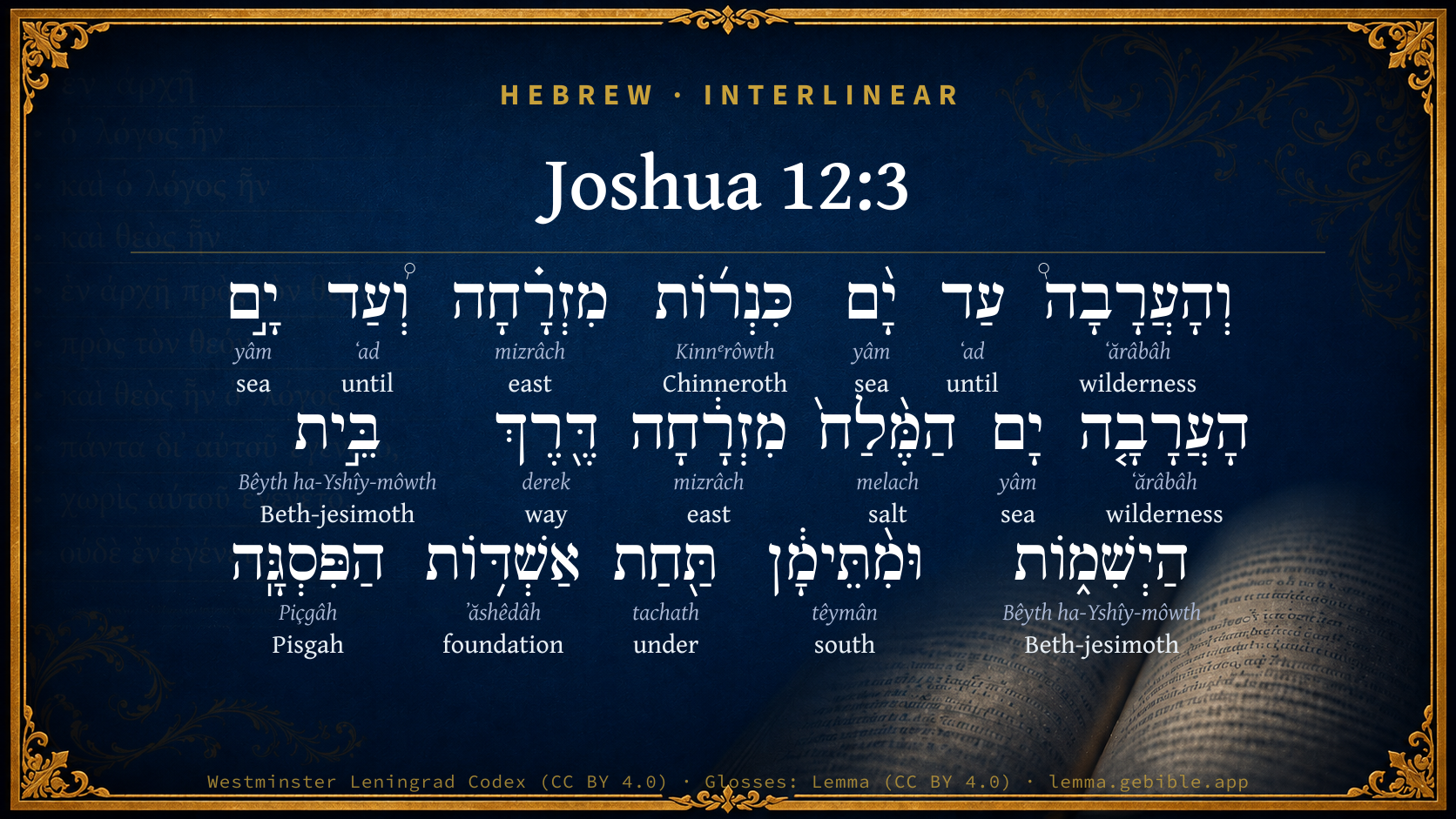
Hebrew (Westminster Leningrad Codex) Joshua 12:3 appears in the Hebrew Old Testament. The text above is from the Westminster Leningrad Codex. Each word links to its Strong’s number, a concise gloss, and parsing drawn from the Open Scriptures Hebrew Bible morphology. Click any word for its full Brown-Driver-Briggs (BDB) entry.
Download image
Cite this verse

Joshua 12:3 (World English Bible). Public Domain. Lemma interlinear Bible study tool, https://lemma.gebible.app/v/joshua/12/3.

Show BibTeX & RIS
BibTeX
RIS
English Translation
and the Arabah to the sea of Chinneroth, eastward, and to the sea of the Arabah, even the Salt Sea, eastward, the way to Beth-jeshimoth; and on the south, under the slopes of Pisgah:
World English Bible · Public Domain
Download a study sheet

One document with this verse’s original text, its word-by-word gloss line, the meaning frame, cross-references with their text, attributed commentary, and full source and license credits — printable, and it pastes into notes with its structure intact.

This verse Autodidact and up

Study sheet (.html) Plain text (.txt)

A passage Seminary Student

Up to 50 verses in one chapter. A passage sheet keeps up to 6 commentary sources and 12 cross-references per verse, in the order this page ranks them, and says so on the sheet whenever that leaves anything out. Ask for a single verse and you get the Autodidact verse sheet above.

Everything on this page stays free to read, with no account — the sheet is a download of what is already on screen, not access to it.

Want to remove ads? Support Godless Engineer
Compare translations 3

The same verse in 3 English versions, stacked beneath the original-language interlinear above. Click any original word for its lexicon entry.

Each is an independent rendering of the whole verse — the interlinear is not word-aligned to these translations.

Highlighted words mark where these versions differ — a whole-verse word diff, not a word-by-word alignment.

  • World English Bible Public Domain
    and the Arabah to the sea of Chinneroth, eastward, and to the sea of the Arabah, even the Salt Sea, eastward, the way to Beth-jeshimoth; and on the south, under the slopes of Pisgah:
  • King James Version Public Domain
    And from the plain to the sea of Chinneroth on the east, and unto the sea of the plain, even the salt sea on the east, the way to Bethjeshimoth; and from the south, under Ashdothpisgah:
  • unfoldingWord Literal Text CC BY-SA 4.0
    and the Arabah unto the Sea of Chinnereth from the sunrise and unto the Sea of the Arabah, the Sea of Salt, toward the sunrise, the way of Beth Jeshimoth and from the south below the slopes of Pisgah.

unfoldingWord Literal Text — © unfoldingWord, licensed CC BY-SA 4.0. Word-aligned USFM3 via Door43 (git.door43.org/unfoldingWord/en_ult).

Versions to compare (up to 4)

3 of 4 selected

Show all 18 translations

Every available English version of this verse, each an independent rendering of the whole verse.

  • World English Bible Public Domain
    and the Arabah to the sea of Chinneroth, eastward, and to the sea of the Arabah, even the Salt Sea, eastward, the way to Beth-jeshimoth; and on the south, under the slopes of Pisgah:
  • Berean Standard Bible Public Domain
    as well as the Arabah east of the Sea of Chinnereth to the Sea of the Arabah (the Salt Sea), eastward through Beth-jeshimoth, and southward below the slopes of Pisgah.
  • Majority Standard Bible Public Domain
    as well as the Arabah east of the Sea of Chinnereth to the Sea of the Arabah (the Salt Sea), eastward through Beth-jeshimoth, and southward below the slopes of Pisgah.
  • King James Version Public Domain
    And from the plain to the sea of Chinneroth on the east, and unto the sea of the plain, even the salt sea on the east, the way to Bethjeshimoth; and from the south, under Ashdothpisgah:
  • American Standard Version (1901) Public Domain
    and the Arabah unto the sea of Chinneroth, eastward, and unto the sea of the Arabah, even the Salt Sea, eastward, the way to Beth-jeshimoth; and on the south, under the slopes of Pisgah:
  • Revised Version (1885) Public Domain
    and the Arabah unto the sea of Chinneroth, eastward, and unto the sea of the Arabah, even the Salt Sea, eastward, the way to Beth-jeshimoth; and on the south, under the slopes of Pisgah:
  • Geneva Bible (1599) Public Domain
    And from the plaine vnto the sea of Cinneroth Eastward, and vnto the Sea of the plaine, euen the salt sea Eastward, the way to Beth-ieshimoth, and from the South vnder the springs of Pisgah.
  • Douay-Rheims (1899) Public Domain
    And from the wilderness, to the sea of Ceneroth towards the east, and to the sea of the wilderness, which is the most salt sea, on the east side by the way that leadeth to Bethsimoth: and on the south side that lieth under Asedoth, Phasga.
  • Young's Literal Translation Public Domain
    And the plain unto the sea of Chinneroth eastward, and unto the sea of the plain (the salt sea) eastward, the way to Beth-Jeshimoth, and from the south under the springs of Pisgah.
  • Literal Standard Version CC BY-SA 4.0
    and the plain to the Sea of Chinneroth eastward, and to the Sea of the Plain (the Salt Sea) eastward, the way to Beth-Jeshimoth, and from the south under the Springs of Pisgah.
  • Unlocked Literal Bible CC BY-SA 4.0
    Sihon also ruled over the Arabah to the Sea of Kinnereth, to the east, to the Sea of the Arabah (the Salt Sea) eastward, all the way to Beth Jeshimoth and southward, toward the foot of the slopes of Mount Pisgah.
  • unfoldingWord Literal Text CC BY-SA 4.0
    and the Arabah unto the Sea of Chinnereth from the sunrise and unto the Sea of the Arabah, the Sea of Salt, toward the sunrise, the way of Beth Jeshimoth and from the south below the slopes of Pisgah.
  • Darby Bible Public Domain
    and the plain as far as the sea of Chinneroth on the east, and as far as the sea of the plain, the salt sea, on the east, toward Beth-jeshimoth; and on the south, under the slopes of Pisgah;
  • World Messianic Bible Public Domain
    and the Arabah to the sea of Chinneroth, eastward, and to the sea of the Arabah, even the Salt Sea, eastward, the way to Beth Jeshimoth; and on the south, under the slopes of Pisgah:
  • Webster's Bible Public Domain
    And from the plain to the sea of Cinneroth on the east, and to the sea of the plain, even the salt sea on the east, the way to Beth-jeshimoth; and from the south, under Ashdoth-pisgah:
  • Free Bible Version CC BY-SA 4.0
    His territory also included the Jordan Valley up to the sea of Kinnereth and land to the east, and all the way down to the Salt Sea, east towards Beth-jeshimoth and south to the slopes of Pisgah.
  • Bible in Basic English Public Domain
    And the Arabah to the sea of Chinneroth, to the east, and to the sea of the Arabah, that is the Salt Sea, to the east, the way to Beth-jeshimoth; and on the south, under the slopes of Pisgah:
  • JPS Tanakh (1917) Public Domain
    and the Arabah unto the sea of Chinneroth, eastward, and unto the sea of the Arabah, even the Salt Sea, eastward, the way to Beth-jeshimoth; and on the south, under the slopes of Pisgah;

Literal Standard Version (2020), Covenant Press — licensed CC BY-SA 4.0. Text via the HelloAO Bible API (eBible.org). Unlocked Literal Bible (unfoldingWord) — licensed CC BY-SA 4.0. Text via the HelloAO Bible API (eBible.org). unfoldingWord Literal Text — © unfoldingWord, licensed CC BY-SA 4.0. Word-aligned USFM3 via Door43 (git.door43.org/unfoldingWord/en_ult). Free Bible Version, Dr. Jonathan Gallagher — licensed CC BY-SA 4.0. Text via the HelloAO Bible API (eBible.org).

Word by word

More ways to search: Search by grammar → Find every occurrence → Compare this word →

Practice this passage: Drill this verse → Learn its vocabulary →

אַשְׁדּ֥וֹת
ʼăshêdâh
H794
“foundations of”
Noun, Common, Feminine, Plural, Construct
Part of Speech
Noun
Type
Common
Gender
Feminine
Number
Plural
State
Construct
Full BDB Definition

Origin: from H793

TWOT: 174b

foundation, slope
  1. וְהָעֲרָבָה֩ ʻărâbâh H6160 “and · the · wilderness” Conjunction + Particle, Definite Article + Noun, Common, Feminine, Singular, Absolute
  2. עַד ʻad H5704 “until” Preposition
  3. יָ֨ם yâm H3220 “sea of” Noun, Common, Masculine, Singular, Construct
  4. כִּנְר֜וֹת Kinnᵉrôwth H3672 “Chinneroth” Noun, Proper
  5. מִזְרָ֗חָה mizrâch H4217 “east · toward” Noun, Common, Masculine, Singular, Absolute + Suffix, Demonstrative
  6. וְ֠עַד ʻad H5704 “and · until” Conjunction + Preposition
  7. יָ֣ם yâm H3220 “sea of” Noun, Common, Masculine, Singular, Construct
  8. הָעֲרָבָ֤ה ʻărâbâh H6160 “the · wilderness” Particle, Definite Article + Noun, Common, Feminine, Singular, Absolute
  9. יָם yâm H3220 “sea of” Noun, Common, Masculine, Singular, Construct
  10. הַמֶּ֨לַח֙ melach H4417 “the · salt” Particle, Definite Article + Noun, Common, Masculine, Singular, Absolute
  11. מִזְרָ֔חָה mizrâch H4217 “east · toward” Noun, Common, Masculine, Singular, Absolute + Suffix, Demonstrative
  12. דֶּ֖רֶךְ derek H1870 “way of” Noun, Common, Both, Singular, Construct
  13. בֵּ֣ית Bêyth ha-Yshîy-môwth H1020 “Beth-jesimoth” Noun, Proper
  14. הַיְשִׁמ֑וֹת Bêyth ha-Yshîy-môwth H1020 “Beth-jesimoth” Noun, Proper
  15. וּמִ֨תֵּימָ֔ן têymân H8486 “and · from · south” Conjunction + Preposition + Noun, Common, Feminine, Singular, Absolute
  16. תַּ֖חַת tachath H8478 “under” Preposition
  17. הַפִּסְגָּֽה Piçgâh H6449 “the · Pisgah” Particle, Definite Article + Noun, Proper

About this verse

These counts appear in no published source. They are computed here, from the morphology-tagged text and Lemma’s own curated glosses. What Lemma adds →

18
words
12
distinct lemmas
Historical
section

Notable vocabulary

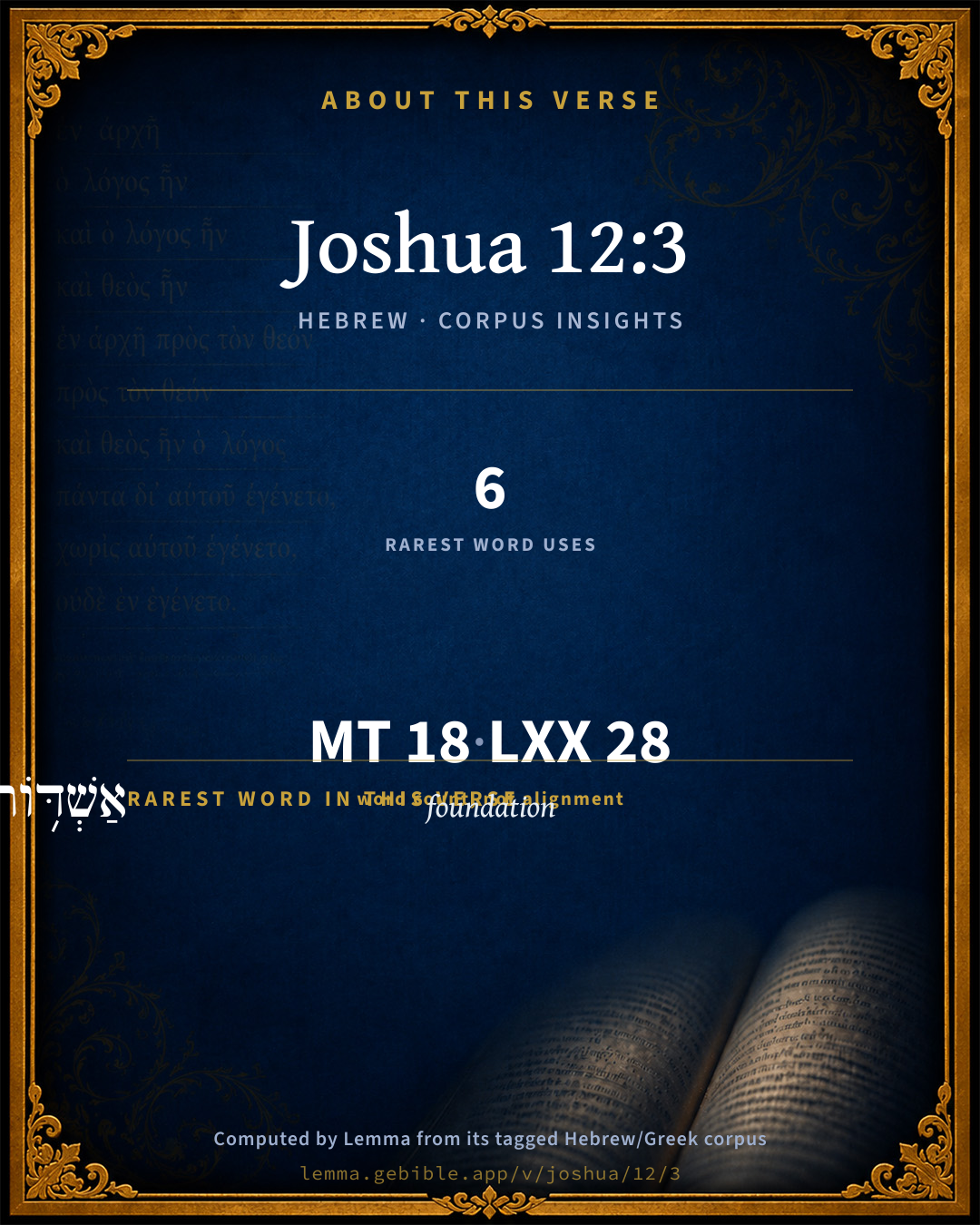
The rarest word here is אַשְׁדּ֥וֹת foundation H794 — appearing just 6 times in the whole Hebrew Bible.

Shared distinctive vocabulary

אַשְׁדּ֥וֹת foundation H794 occurs in 6 verses of the Hebrew Bible. Also found in:

Grammatical profile

  • 15 nouns
  • 3 prepositions

Repetition

Words recur within this verse — often emphatic in Hebrew:

  • יָ֨ם sea H3220 ×3
  • וְהָעֲרָבָה֩ wilderness H6160 ×2
  • עַד until H5704 ×2
  • מִזְרָ֗חָה east H4217 ×2
  • בֵּ֣ית Beth-jesimoth H1020 ×2

Hebrew & Septuagint length

In English translation the verse runs 34 words from the Hebrew and 32 from the Septuagint (LXX English) — closely comparable.

A rough comparison of the two English renderings, which tokenize alike — not a word-level alignment.

Word counts can differ between the Hebrew and the Greek without any difference in meaning — e.g. the Hebrew direct-object marker אֵת has no separate Greek word, and Greek often adds the article ὁ.

In the original languages it is 18 Hebrew tokens and 28 Greek tokens — but the two are counted differently (Hebrew bundles its prefixes and suffixes into one token; the Greek is in lemma form), so that isn’t a like-for-like length.

Cross-references

11

Topical passages linked to Joshua 12:3 in the Treasury of Scripture Knowledge — connected by theme and wording, ordered by reader-vote popularity; previews shown in the World English Bible.

  • Deuteronomy 3:17 the Arabah also, and the Jordan and the border [of it], from Chinnereth even to the sea of the Arabah, the Salt Sea, under the slopes of Pisgah eastward.
  • Joshua 11:2 and to the kings who were on the north, in the hill-country, and in the Arabah south of Chinneroth, and in the lowland, and in the heights of Dor on the west,
  • Joshua 13:20 and Beth Peor, and the slopes of Pisgah, and Beth-jeshimoth,
  • Deuteronomy 4:49 and all the Arabah beyond the Jordan eastward, even to the sea of the Arabah, under the slopes of Pisgah.
  • Genesis 14:3 All these joined together in the valley of Siddim (the same is the Salt Sea).
  • Genesis 19:25 He overthrew those cities, all the plain, all the inhabitants of the cities, and that which grew on the ground.
  • Numbers 21:20 and from Bamoth to the valley that is in the field of Moab, to the top of Pisgah, which looks down on the desert.
  • Joshua 3:16 that the waters which came down from above stood, and rose up in one heap, a great way off, at Adam, the city that is beside Zarethan; and those that went down toward the sea of the Arabah, even the Salt Sea, were wholly cut off: and the people passed over right against Jericho.
  • Joshua 15:2 Their south border was from the uttermost part of the Salt Sea, from the bay that looks southward;
  • Joshua 15:5 The east border was the Salt Sea, even to the end of the Jordan. The border of the north quarter was from the bay of the sea at the end of the Jordan;
  • John 6:1 After these things, Jesus went away to the other side of the sea of Galilee, which is also called the Sea of Tiberias.

Cross-references courtesy of OpenBible.info (CC BY 4.0).

Hebrew and Greek witnesses Masoretic Hebrew ↔ Greek Septuagint

The same verse in the two great witnesses to the Old Testament, shown verse-for-verse.

These are two independent witnesses, not word-aligned to each other, and the Septuagint is shown in lemma (dictionary) form.

Hebrew Joshua 12:3 Masoretic · Westminster Leningrad Codex

וְהָעֲרָבָה֩ עַד יָ֨ם כִּנְר֜וֹת מִזְרָ֗חָה וְ֠עַד יָ֣ם הָעֲרָבָ֤ה יָם הַמֶּ֨לַח֙ מִזְרָ֔חָה דֶּ֖רֶךְ בֵּ֣ית הַיְשִׁמ֑וֹת וּמִ֨תֵּימָ֔ן תַּ֖חַת אַשְׁדּ֥וֹת הַפִּסְגָּֽה

and the Arabah to the sea of Chinneroth, eastward, and to the sea of the Arabah, even the Salt Sea, eastward, the way to Beth-jeshimoth; and on the south, under the slopes of Pisgah:

World English Bible · Public Domain

Greek LXX Joshua 12:3 Septuagint · lemma form

καί ἀραβά ἕως ὁ θάλασσα χενερεθ κατά ἀνατολή καί ἕως ὁ θάλασσα ἀραβά θάλασσα ὁ ἅλς ἀπό ἀνατολή ὁδός ὁ κατά ασιμωθ ἀπό θαιμαν ὁ ὑπό ασηδωθ φασγα

And Araba as far as the sea of Chenereth eastward, and as far as the sea of Araba; the salt sea eastward by the way to Asimoth, from Thaeman under Asedoth Phasga.

LXX2012 (modern English Septuagint) · Public Domain

Hebrew: Westminster Leningrad Codex (CC BY 4.0). Greek: Septuagint (public domain); English from LXX2012 (modern English Septuagint) (Public Domain). How the Septuagint differs from the Hebrew →

Targum (Aramaic paraphrase)

1

The Targum is the ancient Jewish Aramaic paraphrase of the Hebrew Scriptures — an interpretive translation, not the Hebrew text itself. Onkelos (literal) and Pseudo-Jonathan (expansive) render the Torah, and Jonathan the Prophets. Coverage is partial: where no permissively-licensed English translation exists for a verse, only the Aramaic is shown. This is verse-level text, not a word-by-word alignment to the Hebrew.

  1. Targum Jonathan Prophets (Joshua–Malachi)
    וּמֵישְׁרָא עַד יַם גִינוֹסַר מַדִינְחָא וְעַד יַמָא דְמֵישְׁרָא יַמָא דְמִלְחָא מַדִינְחָא אוֹרַח בֵּית יְשִׁמוֹת וּמִדָרוֹמָא תְּחוֹת מַשְׁפַּךְ מֵרָמָתָא:

    (no public-domain English translation for this verse)

    Targum Jonathan — Aramaic: “Mikraot Gedolot” (public domain). English: “Sefaria Community Translation” (CC0 1.0 (public-domain dedication)); “London "Chaldee Paraphrase," 1871” (public domain). Text via Sefaria.

Commentary

Notes on Joshua 12:3 from classic Christian and Jewish commentators (each source and its license shown beneath its notes). The classic Christian expositions comment on the surrounding passage and are grouped to its opening verse, so a note may address several verses; the Jewish commentaries on the Tanakh (Rashi and others) are per-verse, so they appear only where the commentator wrote on this verse.

Lemma curates 59 commentaries, every one of them public domain or Creative Commons licensed, each selected and text-cleaned for this edition rather than reprinted as found. About our sources →

Trapp's Complete Commentary

John Trapp

Jos 12:3 And from the plain to the sea of Chinneroth on the east, and unto the sea of the plain, [even] the salt sea on the east, the way to Bethjeshimoth; and from the south, under Ashdothpisgah:

Ver. 3. And unto the sea of the plain, even the salt sea.] Otherwise called the Dead Sea, or Lake Asphaltites; the water whereof is so thick, saith Josephus, than an ox, having all his legs bound, will not sink into it; and so pestiferous, that fowls flying over it fall down dead.

John Trapp, A Commentary or Exposition upon All the Books of the Old and New Testament (1647–1656) — public domain. Text from a community e-Sword module.

Tyndale Open Study Notes

Tyndale Open Resources

12:3 Beth-jeshimoth was Israel’s camp in the plains of Moab (Num 33:49). • Moses had viewed the Promised Land from Pisgah (Deut 34:1).

Tyndale Open Study Notes — © Tyndale Open Resources, licensed CC BY-SA 4.0. Text via the HelloAO Bible API.

Geneva Bible (1599)

Geneva Bible translators

Or, wilderness.

Or, hillsides.

Geneva Bible (1599) marginal notes — public domain. Text via Bolls.life.

Adam Clarke's Commentary

Verse 3. The sea of Chinneroth] Or Gennesareth, the same as the lake or sea of Tiberias.

The Salt Sea on the east] ים המלח yam hammelach, which is here translated the Salt Sea, is understood by others to mean the sea of the city Melach. Where can we find any thing that can be called a salt sea on the east of the lake of Gennesareth? Some think that the lake Asphaltites, called also the Dead Sea, Sea of the Desert, Sea of Sodom, and Salt Sea, is here intended.

Beth-jeshimoth] A city near the Dead Sea in the plains of Moab.

Ashdoth-pisgah] Supposed to be a city at the foot of Mount Pisgah.

Adam Clarke's Commentary on the Bible (1810–1826) — public domain. Text from a community e-Sword/MySword module.

The Cambridge Bible for Schools and Colleges

gen. ed. J. J. S. Perowne

3. and from the plain] Rather, and the plain, the Arabah, i. e. the eastern part of the Jordan valley, as far as the Sea of Chinneroth.

the sea of Cinneroth] So called after the city of this name. See above, ch. Jos_11:2. In the New Testament it is called (a) the “Sea of Galilee” (Mat_4:18; Mat_15:29; Mar_1:16); (b) the “lake of Gennesaret” (Luk_5:1); (c) the “sea of Tiberias” (Joh_6:1; Joh_21:1); and sometimes (d) simply “the sea.”

and unto the sea of the plain] i. e. of the Arabah. While the Lake of Gennesareth forms the northern boundary of the eastern part of the Jordan valley, it is in like manner bounded on the south by the Salt Sea, i. e. the Dead Sea. Near which lay

Beth-jeshimoth] = “the House of the Wastes.” It was one of the limits of the encampment of Israel before crossing the Jordan (Num_33:48-49).

under Ashdoth-pisgah] See above, Jos_10:40.

The Cambridge Bible for Schools and Colleges (gen. ed. J. J. S. Perowne; Cambridge University Press, 1878–1918) — public domain. Text from a community e-Sword module.

John Gill's Exposition

And from the plain,.... Or rather, "and the plain", the plains of Moab, which, before possessed by the Israelites, belonged to the kingdom of Sihon; and the plains of Jordan, which reached

to the sea of Cinneroth on the east; the same with the lake of Gennesaret, and sea of Tiberias, mentioned in the New Testament, Mat 14:34,

and unto the sea of the plain; where stood the cities of the plain, Sodom, Gomorrah, &c.

even the salt sea on the east; the same with the dead sea, into which the plain the above cities stood on was converted:

the way to Bethjeshimoth; which was a place in the plains of Moab, Num 33:49,

and from the south under Ashdothpisgah; or the springs of Pisgah, which flowed from the mount of that name, Deu 3:17.

John Gill's Exposition of the Whole Bible (1746–1763) — public domain (CC PDM 1.0). Text via the HelloAO Bible API.

Haydock's Catholic Bible Commentary

Bethsimoth is ten miles from Jericho, (Eusebius) near the Dead Sea, in the plains of Moab. (Calmet) --- Phasga. Asedoth lay at the foot of this mountain, being well supplied with water. Subjacet Acedoth usque Phasga, the southern limits of Sehon’s dominions had "abundance of springs, as far as Phasga." (Haydock)

George Leo Haydock (1774–1849), Haydock's Catholic Family Bible and Commentary, 1859 edition — public domain. Excludes Psalms (Douay-Rheims chapter numbering differs from Protestant) and Deuterocanonical books (Catholic canon only).

Matthew Poole's English Annotations

To the sea of Chinneroth on the east; which words describe the situation not of the sea of Chinneroth, which was part of the western border of Sihon’s dominion, but of the plain, which is here said to lie eastward from the sea of Chinneroth, and also eastward from the Salt Sea, as it here follows. And this was indeed the situation of the plains of Moab, which are here spoken of, to wit, that they lay between the two seas, that of Chinneroth and the Salt Sea, and eastward to them both.

The sea of the plain; the Salt Sea is so called because it was a famous plain, pleasant and fruitful, before it was turned into a salt sea. From the south, or, on or towards the south.

Matthew Poole's English Annotations on the Holy Bible (1683–1685) — public domain. Text from a community e-Sword/MySword module.

Whedon's Commentary on the Bible

Daniel D. Whedon

3. [From the plain — The from here as in the previous verse, is confusing. The sense and connexion will be better seen in the following literal rendering of the Hebrew: And (Sihon ruled) the plain, as far as the sea of Chinneroth, eastward, and as far as the sea of the plain, the Salt Sea, eastward, on the way toward Beth-jeshimoth, and from the south under the ravines of Pisgah. The plain is the Jordan valley on the east side from the Dead Sea to the Sea of Galilee.] The Salt Sea is so called because of the exceeding saltness of its waters — twenty-six pounds of salt to one hundred of water; and a whole mountain ridge on its southwest shore is composed of rock salt. It is commonly called the Dead Sea because no living thing abides in its waters. It is thirteen hundred feet below the Mediterranean, and has no outlet. The Sea of Chinneroth was afterwards called the Sea of Galilee, Sea of Tiberias, and Lake of Gennesaret. See notes and cut at Mat_4:13. Beth-jeshimoth means house of desolations. It was a Moabite city in the desert at the northeastern extremity of the Dead Sea. Schwarz mentions a Beth-jisimuth as still existing in that locality, but the spot needs further examination.

Ashdoth-pisgah — The ravines of Pisgah; the gorges at the foot or on the sides of the mountain through which the torrents flow. Comp. chap. Jos_10:40, note, and Deu_3:17. The hill Pisgah was opposite Jericho, on the mountains of Abarim, but no traces of the name have been met with in modern times in that locality. See on Deu_34:1.

Daniel D. Whedon (gen. ed.), Commentary on the Old and New Testaments (1874–1909) — public domain. Text from a community e-Sword module.

The Pulpit Commentary

And from the plain. There is no "from" in the original, which here ceases to describe the territories of Sihon, but continues the account of the Israelite dominions, which included the Arabah (not the plain as in our version) up to the sea of Chinneroth. On the east; i.e. , the east of Jordan. So also below. The way to Beth-jeshimoth. (see Num_33:48, Num_33:49) There was a desert tract near the Dead Sea called Jeshimon, or the waste district. It is described by travellers as the most arid portion of the whole land. In this, Beth-jeshimoth (the house of desolations) was situated. It was south of the acacia meadows, (see note on Jos_2:1) and it formed part of the territory of Reuben. (Jos_13:20) As it lay upon Jordan, it must have been near the extreme northernmost point of the Dead Sea. We are to understand, not that Sihon"s territory extended to Beth-jeshimoth, but in that direction. Possibly some of the western Cauaanitish tribes here extended their territories across the Jordan. And from the south. The word here is not Negeb, but Teman, i.e. , the literal south, which lay on the right (ymiy) to one looking eastward. Ashdoth pisgah. For Ashdoth see Jos_10:40. Pisgah was the northernmost point of the Abarim range, of which the well-known Nebo was the chief peak. Thither Moses went up to view the land which he was not permitted to enter. There Balaam built his seven altars and essayed in vain to curse the children of Israel. There were the watchmen (Zophim) stationed to protect the land, in the days before the Israelitish invasion, from the incursions of the tribes on the other side of Jordan. (Num_23:14) The position of Pisgah has not been precisely identified, but the range extended on the eastern side of Jordan to a point nearly opposite Jericho. See Deu_34:1.

The Pulpit Commentary (1880–1919), ed. H.D.M. Spence-Jones & Joseph S. Exell — public domain. Text from a community e-Sword module.

John Wesley's Explanatory Notes

On the east - Which words describe the situation not of the sea of Cinneroth, which was part of the western border of Sihon's dominion, but of the plain, which is here said to lie eastward from the sea of Cinneroth, and also eastward from the salt sea. And this was indeed the situation of the plains of Moab, which are here spoken of; they lay between the two seas, that of Cinneroth and the salt sea, and eastward to them both. Sea of the plain - The salt sea was a famous plain, pleasant and fruitful, before it was turned into a sea.

John Wesley, Explanatory Notes Upon the Whole Bible (1754–1765) — public domain. Text via the GEBible commentary corpus.

unfoldingWord translationNotes

Door43 World Missions Community

Sea of Kinnereth

This is a place. See how you translated this in Joshua 11:2.

Beth Jeshimoth ... Mount Pisgah ... Ashtaroth ... Edrei ... Salekah

These are the names of places. (See: How to Translate Names)

Og, king of Bashan

See how you translated this man's name in Joshua 9:10.

the Rephaim ... Maacathites

These are the names of people groups. (See: How to Translate Names)

translationWords

Salt Sea

Bashan

remnant

Geshur

Gilead

unfoldingWord translationNotes — © Distant Shores Media and the Door43 World Missions Community, licensed CC BY-SA 4.0. Source: git.door43.org/Door43/en_tn.

Lesson kit

Teaching starters — assembled from the data on this page, not authored interpretation. Every prompt links to the verse data it draws on. Edit before teaching.

Joshua, in the Historical, opens this verse with 18 words (12 distinct Hebrew lemmas). Its most distinctive word is ʼăshêdâh (“foundation”). A historical commentator’s framing appears above. Read the whole chapter for the surrounding context.

Discussion questions

  1. The word ʼăshêdâh carries the sense “foundation.” How does it shape the verse?
  2. Deuteronomy 3:17 shares the word «foundation» with this verse. How do the two illuminate each other?
  3. “sea” occurs 3× in this one verse. What is the effect of the repetition?
  4. These translations render this verse differently. What is at stake in choosing one wording over another?
  5. Reading how Trapp's Complete Commentary and Tyndale Open Study Notes read this verse, where do the two commentators agree and where do they part?

Things to notice

Reading settings

Reading text

Shown beneath each verse's original-language words.

Old Testament
Old Testament edition

Read the OT as the Masoretic Hebrew (MT) or the Greek Septuagint (LXX).

English shown for the Greek Septuagint (in the Hebrew ↔ Greek comparison).

Comparing translations? Open the Compare panel on any verse page to stack up to four side by side.