
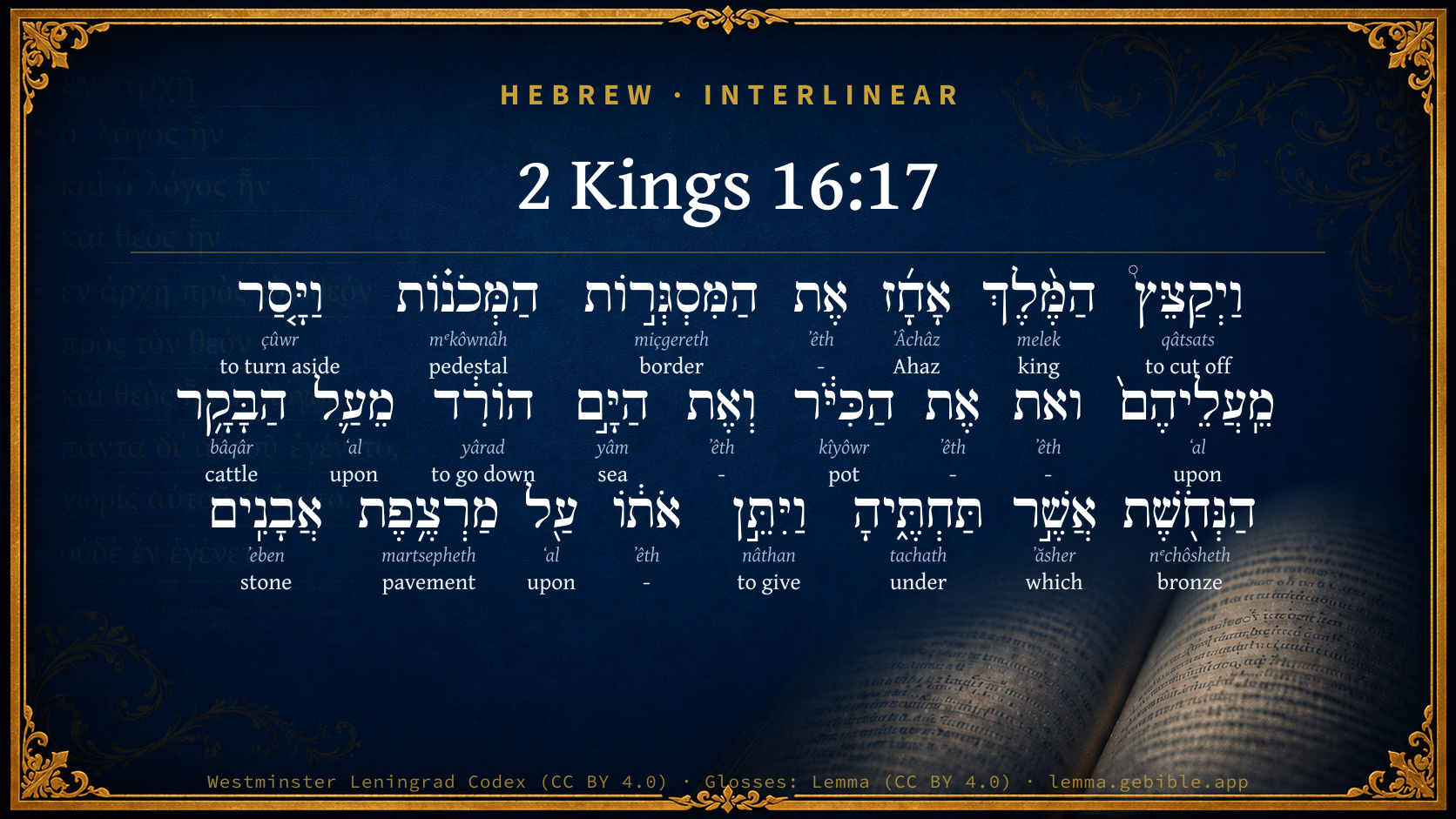
2 Kings 16:17

Hebrew (Westminster Leningrad Codex) 2 Kings 16:17 appears in the Hebrew Old Testament. The text above is from the Westminster Leningrad Codex. Each word links to its Strong’s number, a concise gloss, and parsing drawn from the Open Scriptures Hebrew Bible morphology. Click any word for its full Brown-Driver-Briggs (BDB) entry.
Download image
Cite this verse

2 Kings 16:17 (World English Bible). Public Domain. Lemma interlinear Bible study tool, https://lemma.gebible.app/v/2-kings/16/17.

Show BibTeX & RIS
BibTeX
RIS
English Translation
King Ahaz cut off the panels of the bases, and removed the basin from off them, and took down the sea from off the brazen oxen that were under it, and put it on a pavement of stone.
World English Bible · Public Domain
Highlights
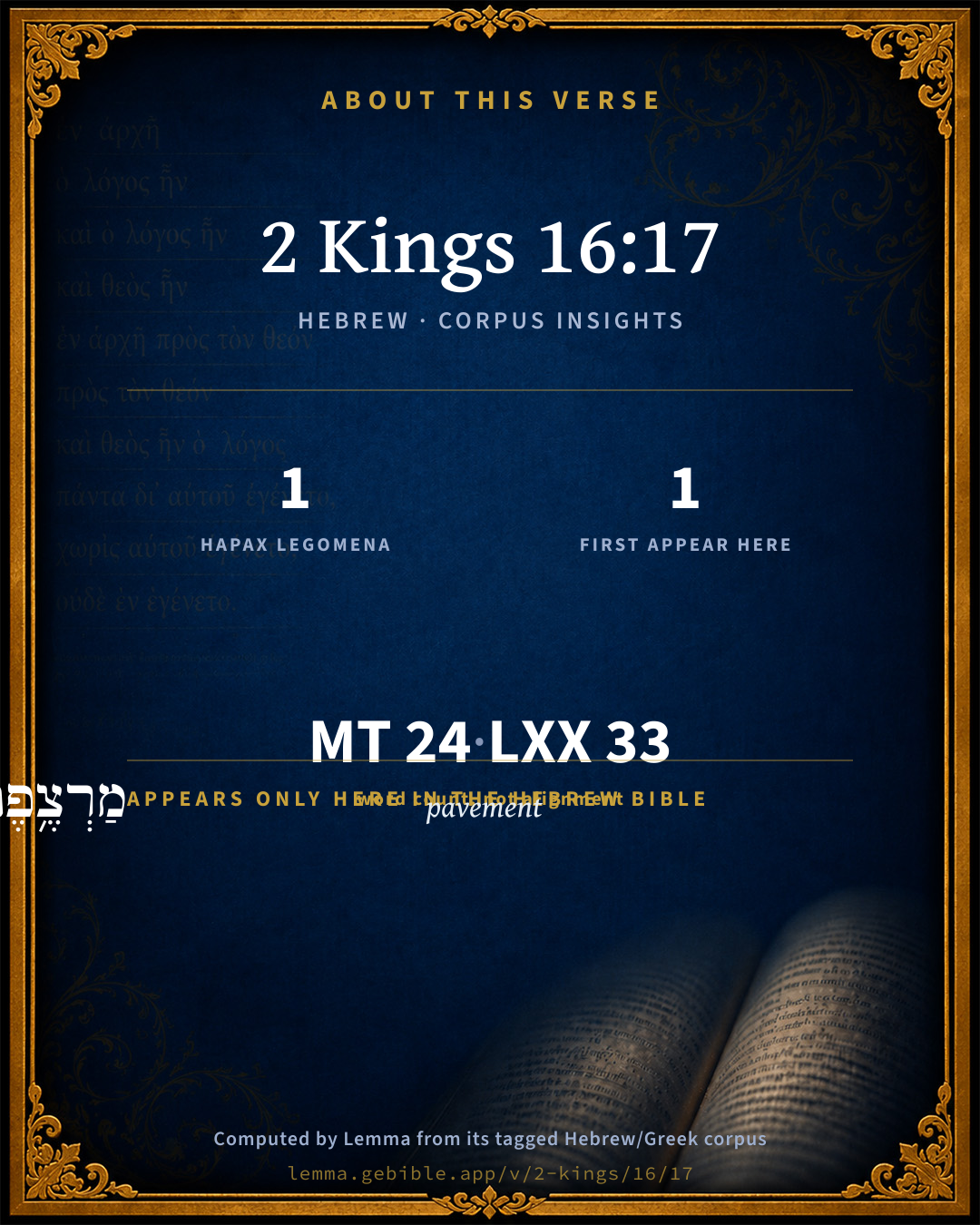
  • 1 hapax legomenon — only here in the Hebrew Bible
  • 1 first appearance in the Hebrew Bible
Full analysis ↓
Download a study sheet

One document with this verse’s original text, its word-by-word gloss line, the meaning frame, cross-references with their text, attributed commentary, and full source and license credits — printable, and it pastes into notes with its structure intact.

This verse Autodidact and up

Study sheet (.html) Plain text (.txt)

A passage Seminary Student

Up to 50 verses in one chapter. A passage sheet keeps up to 6 commentary sources and 12 cross-references per verse, in the order this page ranks them, and says so on the sheet whenever that leaves anything out. Ask for a single verse and you get the Autodidact verse sheet above.

Everything on this page stays free to read, with no account — the sheet is a download of what is already on screen, not access to it.

Want to remove ads? Support Godless Engineer
Compare translations 3

The same verse in 3 English versions, stacked beneath the original-language interlinear above. Click any original word for its lexicon entry.

Each is an independent rendering of the whole verse — the interlinear is not word-aligned to these translations.

Highlighted words mark where these versions differ — a whole-verse word diff, not a word-by-word alignment.

  • World English Bible Public Domain
    King Ahaz cut off the panels of the bases, and removed the basin from off them, and took down the sea from off the brazen oxen that were under it, and put it on a pavement of stone.
  • King James Version Public Domain
    And king Ahaz cut off the borders of the bases, and removed the laver from off them; and took down the sea from off the brazen oxen that were under it, and put it upon the pavement of stones.
  • unfoldingWord Literal Text CC BY-SA 4.0
    And King Ahaz cut off the panels of the stands, and he removed the basin from upon them, and he took down the sea from upon the oxen of bronze that beneath it and put it on a pavement of stones,

unfoldingWord Literal Text — © unfoldingWord, licensed CC BY-SA 4.0. Word-aligned USFM3 via Door43 (git.door43.org/unfoldingWord/en_ult).

Versions to compare (up to 4)

3 of 4 selected

Show all 18 translations

Every available English version of this verse, each an independent rendering of the whole verse.

  • World English Bible Public Domain
    King Ahaz cut off the panels of the bases, and removed the basin from off them, and took down the sea from off the brazen oxen that were under it, and put it on a pavement of stone.
  • Berean Standard Bible Public Domain
    King Ahaz also cut off the frames of the movable stands and removed the bronze basin from each of them. He took down the Sea from the bronze oxen that were under it and put it on a stone base.
  • Majority Standard Bible Public Domain
    King Ahaz also cut off the frames of the movable stands and removed the bronze basin from each of them. He took down the Sea from the bronze oxen that were under it and put it on a stone base.
  • King James Version Public Domain
    And king Ahaz cut off the borders of the bases, and removed the laver from off them; and took down the sea from off the brazen oxen that were under it, and put it upon the pavement of stones.
  • American Standard Version (1901) Public Domain
    And king Ahaz cut off the panels of the bases, and removed the laver from off them, and took down the sea from off the brazen oxen that were under it, and put it upon a pavement of stone.
  • Revised Version (1885) Public Domain
    And king Ahaz cut off the borders of the bases, and removed the laver from off them; and took down the sea from off the brasen oxen that were under it, and put it upon a pavement of stone.
  • Geneva Bible (1599) Public Domain
    And King Ahaz brake the borders of the bases, and tooke the caldrons from off them, and tooke downe the sea from the brasen oxen that were vnder it, and put it vpon a pauement of stones.
  • Douay-Rheims (1899) Public Domain
    And king Achaz took away the graven bases, and the laver that was upon them: and he took down the sea from the brazen oxen that held it up, and put it upon a pavement of stone.
  • Young's Literal Translation Public Domain
    And king Ahaz cutteth off the borders of the bases, and turneth aside from off them the laver, and the sea he hath taken down from off the brazen oxen that `are' under it, and putteth it on a pavement of stones.
  • Literal Standard Version CC BY-SA 4.0
    And King Ahaz cuts off the borders of the bases, and turns aside the laver from off them, and he has taken down the sea from off the bronze oxen that [are] under it, and puts it on a pavement of stones.
  • Unlocked Literal Bible CC BY-SA 4.0
    Then King Ahaz removed the panels and the basins from the portable stands; he also took down the sea from off the bronze oxen that were under it and put it on a stone pavement.
  • unfoldingWord Literal Text CC BY-SA 4.0
    And King Ahaz cut off the panels of the stands, and he removed the basin from upon them, and he took down the sea from upon the oxen of bronze that beneath it and put it on a pavement of stones,
  • Darby Bible Public Domain
    And king Ahaz cut off the panels of the bases, and removed the lavers from off them; and took down the sea from off the brazen oxen that were under it, and put it upon a stone pavement.
  • World Messianic Bible Public Domain
    King Ahaz cut off the panels of the bases, and removed the basin from off them, and took down the sea from off the bronze oxen that were under it, and put it on a pavement of stone.
  • Webster's Bible Public Domain
    And king Ahaz cut off the borders of the bases, and removed the laver from off them; and took down the sea from off the brazen oxen that were under it, and put it upon a pavement of stones.
  • Free Bible Version CC BY-SA 4.0
    King Ahaz also removed the frames of the movable carts, and also took out the bronze basin from each of them. He removed the Sea from the bronze bulls it rested on and placed it on a stone pedestal.
  • Bible in Basic English Public Domain
    And King Ahaz took off the sides of the wheeled bases, and took down the great water-vessel from off the brass oxen which were under it and put it on a floor of stone.
  • JPS Tanakh (1917) Public Domain
    And king Ahaz cut off the borders of the bases, and removed the laver from off them; and took down the sea from off the brazen oxen that were under it, and put it upon a pavement of stone.

Literal Standard Version (2020), Covenant Press — licensed CC BY-SA 4.0. Text via the HelloAO Bible API (eBible.org). Unlocked Literal Bible (unfoldingWord) — licensed CC BY-SA 4.0. Text via the HelloAO Bible API (eBible.org). unfoldingWord Literal Text — © unfoldingWord, licensed CC BY-SA 4.0. Word-aligned USFM3 via Door43 (git.door43.org/unfoldingWord/en_ult). Free Bible Version, Dr. Jonathan Gallagher — licensed CC BY-SA 4.0. Text via the HelloAO Bible API (eBible.org).

Word by word

More ways to search: Search by grammar → Find every occurrence → Compare this word →

Practice this passage: Drill this verse → Learn its vocabulary →

מַרְצֶ֥פֶת
martsepheth
H4837
“pavement of”
Noun, Common, Feminine, Singular, Construct
Part of Speech
Noun
Type
Common
Gender
Feminine
Number
Singular
State
Construct
Full BDB Definition

Origin: from H7528

TWOT: 2210b

pavement
  1. וַיְקַצֵּץ֩ qâtsats H7112 “and · to cut off” Conjunction + Verb, Piel, Sequential Imperfect, 3rd Person, Masculine, Singular
  2. הַמֶּ֨לֶךְ melek H4428 “the · king” Particle, Definite Article + Noun, Common, Masculine, Singular, Absolute
  3. אָחָ֜ז ʼÂchâz H271 “Ahaz” Noun, Proper
  4. אֶת ʼêth H853 “-” Particle, Direct Object
  5. הַמִּסְגְּר֣וֹת miçgereth H4526 “the · borders” Particle, Definite Article + Noun, Common, Feminine, Plural, Absolute
  6. הַמְּכֹנ֗וֹת mᵉkôwnâh H4350 “the · pedestals” Particle, Definite Article + Noun, Common, Feminine, Plural, Absolute
  7. וַיָּ֤סַר çûwr H5493 “and · to turn aside” Conjunction + Verb, Hiphil, Sequential Imperfect, 3rd Person, Masculine, Singular
  8. מֵֽעֲלֵיהֶם֙ ʻal H5921 “from · upon · them” Preposition + Preposition + Suffix, Personal, 3rd Person, Masculine, Plural
  9. ואת ʼêth H853 “and · -” Conjunction + Particle, Direct Object
  10. אֶת ʼêth H853 “-” Particle, Direct Object
  11. הַכִּיֹּ֔ר kîyôwr H3595 “the · pot” Particle, Definite Article + Noun, Common, Masculine, Singular, Absolute
  12. וְאֶת ʼêth H853 “and · -” Conjunction + Particle, Direct Object
  13. הַיָּ֣ם yâm H3220 “the · sea” Particle, Definite Article + Noun, Common, Masculine, Singular, Absolute
  14. הוֹרִ֔ד yârad H3381 “to go down” Verb, Hiphil, Perfect, 3rd Person, Masculine, Singular
  15. מֵעַ֛ל ʻal H5921 “from · upon” Preposition + Preposition
  16. הַבָּקָ֥ר bâqâr H1241 “the · cattle” Particle, Definite Article + Noun, Common, Both, Singular, Absolute
  17. הַנְּחֹ֖שֶׁת nᵉchôsheth H5178 “the · bronze” Particle, Definite Article + Noun, Common, Feminine, Singular, Absolute
  18. אֲשֶׁ֣ר ʼăsher H834 “which” Particle, Relative
  19. תַּחְתֶּ֑יהָ tachath H8478 “under · her” Preposition + Suffix, Personal, 3rd Person, Feminine, Singular
  20. וַיִּתֵּ֣ן nâthan H5414 “and · to give” Conjunction + Verb, Qal, Sequential Imperfect, 3rd Person, Masculine, Singular
  21. אֹת֔וֹ ʼêth H853 “- · him” Particle, Direct Object + Suffix, Personal, 3rd Person, Masculine, Singular
  22. עַ֖ל ʻal H5921 “upon” Preposition
  23. אֲבָנִֽים ʼeben H68 “stones” Noun, Common, Feminine, Plural, Absolute

About this verse

These counts appear in no published source. They are computed here, from the morphology-tagged text and Lemma’s own curated glosses. What Lemma adds →

24
words
18
distinct lemmas
Historical
section

Notable vocabulary

1 hapax legomenon — a word that appears only here in the entire Hebrew Bible:

  • מַרְצֶ֥פֶת pavement H4837

First appearance in Scripture

This word makes its first canonical appearance in the Hebrew Bible here:

  • מַרְצֶ֥פֶת pavement H4837

Shared distinctive vocabulary

וַיְקַצֵּץ֩ to cut off H7112 occurs in 14 verses of the Hebrew Bible. Also found in:

Grammatical profile

  • 4 verbs
  • 10 nouns
  • 4 prepositions
  • 6 particles

Verb forms

  • וַיְקַצֵּץ֩ Piel · Sequential Imperfect
  • וַיָּ֤סַר Hiphil · Sequential Imperfect
  • הוֹרִ֔ד Hiphil · Perfect
  • וַיִּתֵּ֣ן Qal · Sequential Imperfect

Repetition

A word recurs within this verse — often emphatic in Hebrew:

  • מֵֽעֲלֵיהֶם֙ upon H5921 ×3

Hebrew & Septuagint length

In English translation the verse runs 38 words from the Hebrew and 38 from the Septuagint (LXX English) — the same length.

A rough comparison of the two English renderings, which tokenize alike — not a word-level alignment.

Word counts can differ between the Hebrew and the Greek without any difference in meaning — e.g. the Hebrew direct-object marker אֵת has no separate Greek word, and Greek often adds the article ὁ.

In the original languages it is 24 Hebrew tokens and 33 Greek tokens — but the two are counted differently (Hebrew bundles its prefixes and suffixes into one token; the Greek is in lemma form), so that isn’t a like-for-like length.

Cross-references

6

Topical passages linked to 2 Kings 16:17 in the Treasury of Scripture Knowledge — connected by theme and wording, ordered by reader-vote popularity; previews shown in the World English Bible.

  • 1 Kings 7:23–39 He made the molten sea of ten cubits from brim to brim, round in compass, and the height of it was five cubits; and a line of thirty cubits compassed it round about.
  • 2 Kings 25:13–16 The pillars of brass that were in the house of Yahweh, and the bases and the brazen sea that were in the house of Yahweh, did the Chaldeans break in pieces, and carried the brass of them to Babylon.
  • 2 Chronicles 4:14–15 He made also the bases, and the basins made he on the bases;
  • 2 Chronicles 28:24 Ahaz gathered together the vessels of the house of God, and cut in pieces the vessels of the house of God, and shut up the doors of the house of Yahweh; and he made him altars in every corner of Jerusalem.
  • 2 Chronicles 29:19 Moreover all the vessels, which king Ahaz in his reign did cast away when he trespassed, have we prepared and sanctified; and, behold, they are before the altar of Yahweh.
  • Jeremiah 52:20 The two pillars, the one sea, and the twelve brazen bulls that were under the bases, which king Solomon had made for the house of Yahweh. The brass of all these vessels was without weight.

Cross-references courtesy of OpenBible.info (CC BY 4.0).

Hebrew and Greek witnesses Masoretic Hebrew ↔ Greek Septuagint

The same verse in the two great witnesses to the Old Testament, shown verse-for-verse.

These are two independent witnesses, not word-aligned to each other, and the Septuagint is shown in lemma (dictionary) form.

Hebrew 2 Kings 16:17 Masoretic · Westminster Leningrad Codex

וַיְקַצֵּץ֩ הַמֶּ֨לֶךְ אָחָ֜ז אֶת הַמִּסְגְּר֣וֹת הַמְּכֹנ֗וֹת וַיָּ֤סַר מֵֽעֲלֵיהֶם֙ ואת אֶת הַכִּיֹּ֔ר וְאֶת הַיָּ֣ם הוֹרִ֔ד מֵעַ֛ל הַבָּקָ֥ר הַנְּחֹ֖שֶׁת אֲשֶׁ֣ר תַּחְתֶּ֑יהָ וַיִּתֵּ֣ן אֹת֔וֹ עַ֖ל מַרְצֶ֥פֶת אֲבָנִֽים

King Ahaz cut off the panels of the bases, and removed the basin from off them, and took down the sea from off the brazen oxen that were under it, and put it on a pavement of stone.

World English Bible · Public Domain

Greek LXX 2 Kings 16:17 Septuagint · lemma form

καί συνκόπτω ὁ βασιλεύς αχαζ ὁ σύγκλεισμα ὁ μεχωνωθ καί μετααἴρω ἀπό αὐτός ὁ λουτήρ καί ὁ θάλασσα κατααἱρέω ἀπό ὁ βοῦς ὁ χαλκοῦς ὁ ὑποκάτω αὐτός καί δίδωμι αὐτός ἐπί βάσις λίθινος

And king Achaz cut off the borders of the bases, and removed the laver from off them, and took down the sea from the brazen oxen that were under it, and set it upon a base of stone.

LXX2012 (modern English Septuagint) · Public Domain

On this verse, Keil & Delitzsch discusses the Septuagint’s reading. Read the note in Commentary ↓

Hebrew: Westminster Leningrad Codex (CC BY 4.0). Greek: Septuagint (public domain); English from LXX2012 (modern English Septuagint) (Public Domain). How the Septuagint differs from the Hebrew →

Targum (Aramaic paraphrase)

1

The Targum is the ancient Jewish Aramaic paraphrase of the Hebrew Scriptures — an interpretive translation, not the Hebrew text itself. Onkelos (literal) and Pseudo-Jonathan (expansive) render the Torah, and Jonathan the Prophets. Coverage is partial: where no permissively-licensed English translation exists for a verse, only the Aramaic is shown. This is verse-level text, not a word-by-word alignment to the Hebrew.

  1. Targum Jonathan Prophets (Joshua–Malachi)
    וְקַצִיץ מַלְכָּא אָחָז יַת גְדַנְפֵי בְסִיסַיָא וְאַעְדֵי מִנְהוֹן יַת כִּיוֹרָא וְיַת יַמָא אָחֵית מֵעַל תּוֹרַיָא דִנְחָשָׁא דִתְחוֹתוֹהִי וִיהַב יָתֵיהּ עַל רִצְפַּת אַבְנַיָא:

    (no public-domain English translation for this verse)

    Targum Jonathan — Aramaic: “Mikraot Gedolot” (public domain). English: “Sefaria Community Translation” (CC0 1.0 (public-domain dedication)); “London "Chaldee Paraphrase," 1871” (public domain). Text via Sefaria.

Commentary

Notes on 2 Kings 16:17 from classic Christian and Jewish commentators (each source and its license shown beneath its notes). The classic Christian expositions comment on the surrounding passage and are grouped to its opening verse, so a note may address several verses; the Jewish commentaries on the Tanakh (Rashi and others) are per-verse, so they appear only where the commentator wrote on this verse.

Lemma curates 59 commentaries, every one of them public domain or Creative Commons licensed, each selected and text-cleaned for this edition rather than reprinted as found. About our sources →

Matthew Henry's Commentary

Here is, I. Ahaz abusing the temple, not the building itself, but some of the furniture of it. 1. He defaced the bases on which the lavers were set (Kg1 7:28, Kg1 7:29) and took down the molten sea, Kg2 16:17. These the priests used for washing; against them therefore he seems to have had a particular spite. It is one of the greatest prejudices that can be done to religion to obstruct the purifying of the priests, the Lord's ministers. 2. He removed the covert for the sabbath, erected either in honour of the sabbath or for the conveniency of the priests, when, on the sabbath, they officiated in greater numbers than on other days. Whatever it was, it should seem that in removing it he intended to put a contempt upon the sabbath, and so to open as wide an inlet as any to all manner of impiety. 3. The king's entry, which led to the house of the Lord, for the convenience of the royal family (perhaps that ascent which Solomon had made, and which the queen of Sheba admired, Kg1 10:5), he turned another way, to show that he did not intend to frequent the house of the Lord any more. This he did for the king of Assyria, to oblige him, who perhaps returned his visit, and found fault with this entry, as an inconvenience and disparagement to his palace. When those that have had a ready passage to the house of the Lord, to please their neighbours, turn it another way, they are going down the hill apace towards their ruin.

II. Ahaz resigning his life in the midst of his days, at thirty-six years of age (Kg2 16:19) and leaving his kingdom to a better man, Hezekiah his son (Kg2 16:20), who proved as much a friend to the temple as he had been an enemy to it. Perhaps this very son he had made to pass through the fire, and thereby dedicated him to Moloch; but God, by his grace, snatched him as a brand out of the burning.

Matthew Henry's Commentary on the Whole Bible (1708–1710) — public domain (CC PDM 1.0). Text via the HelloAO Bible API.

Jamieson, Fausset & Brown

Robert Jamieson, A. R. Fausset & David Brown

HE SPOILS THE TEMPLE. (Kg2 16:17-19)

cut off the borders of the bases, &c.--It is thought that he did this to use the elaborate sculpture in adorning his palace.

Jamieson, Fausset & Brown — Commentary Critical and Explanatory on the Whole Bible (1871) — public domain (CC PDM 1.0). Text via the HelloAO Bible API.

Trapp's Complete Commentary

John Trapp

2Ki 16:17 And king Ahaz cut off the borders of the bases, and removed the laver from off them; and took down the sea from off the brasen oxen that [were] under it, and put it upon a pavement of stones.

Ver. 17. And king Ahaz cut off the borders.] He took away both the ornaments and instruments of the true religion.

John Trapp, A Commentary or Exposition upon All the Books of the Old and New Testament (1647–1656) — public domain. Text from a community e-Sword module.

Joseph Benson's Commentary

2Ki 16:17. Ahaz cut off the borders of the bases, and took down the sea from off the brazen oxen, &c. — Probably that he might dispose of them, or of the brass of them, in some other way; perhaps that he might turn them into money, either by casting them into such pieces as were current, or by selling them as they were.

Joseph Benson's Commentary on the Old and New Testaments (1811–1818) — public domain. Text from a community e-Sword module.

Keil & Delitzsch

C. F. Keil & F. Delitzsch

Ahaz also laid his hand upon the other costly vessels of the court of the temple. He broke off the panels of the Solomonian stands, which were ornamented with artistic carving, and removed the basins from the stands, and took the brazen sea from the brazen oxen upon which they stood, and placed it upon a stone pavement. The ו before את־הכּיּר can only have crept into the text through a copyist's error, and the singular must be taken distributively: he removed from them (the stands) every single basin. אבנים מרצפת (without the article) is not the stone pavement of the court of the temple, but a pedestal made of stones (βάσις λιθίνη, lxx) for the brazen sea. The reason why, or the object with which Ahaz mutilated these sacred vessels, is not given. The opinion expressed by Ewald, Thenius, and others, that Ahaz made a present to Tiglath-pileser with the artistically wrought panels of the stands, the basins, and the oxen of the brazen sea, is not only improbable in itself, since you would naturally suppose that if Ahaz had wished to make a "valuable and very welcome present" to the Assyrian king, he would have chosen some perfect stands with their basins for this purpose, and not merely the panels and basins; but it has not the smallest support in the biblical text, - on the contrary, it has the context against it. For, in the first place, if the objects named had been sent to Tiglath-pileser, this would certainly have been mentioned, as well as the sending of the temple and palace treasures. And, again, the mutilation of these vessels is placed between the erection of the new altar which was constructed after the Damascene model, and other measures which Ahaz adopted as a protection against the king of Assyria (Kg2 16:18). Now if Ahaz, on his return from visiting Tiglath-pileser at Damascus, had thought it necessary to send another valuable present to that king in order to secure his permanent friendship, he would hardly have adopted the measures described in the next verse.

Kg2 16:18

"The covered Sabbath-stand, which they had built in the house (temple), and the outer entrance of the king he turned (i.e., removed) into the house of Jehovah before the king of Assyria." השּׁבּת מיסך (Keri מוּסך, from סכך, to cover) is no doubt a covered place, stand or hall in the court of the temple, to be used by the king whenever he visited the temple with his retinue on the Sabbath or on feast-days; and "the outer entrance of the king" is probably the special ascent into the temple for the king mentioned in Kg1 10:5. In what the removal of it consisted it is impossible to determine, from the want of information as to its original character. According to Ewald (Gesch. iii. p. 621) and Thenius, יהוה בּית הסב means, "he altered (these places), i.e., he robbed them of their ornaments, in the house of Jehovah." This is quite arbitrary. For even if יהוה בּית could mean "in the house of Jehovah" in this connection, הסב does not mean to disfigure, and still less "to deprive of ornaments." In Kg2 23:34 and Kg2 24:17 it signifies to alter the name, not to disfigure it. Again, אשּׁוּר מלך מפּני, "for fear of the king of Assyria," cannot mean, in this connection, "to make presents to the king of Assyria." And with this explanation, which is grammatically impossible, the inference drawn from it, namely, that Ahaz sent the ornaments of the king's stand and king's ascent to the king of Assyria along with the vessels mentioned in Kg2 16:17, also falls to the ground. If the alterations which Ahaz made in the stands and the brazen sea had any close connection with his relation to Tiglath-pileser, which cannot be proved, Ahaz must have been impelled by fear to make them, not that he might send them as presents to him, but that he might hide them from him if he came to Jerusalem, to which Ch2 28:20-21 seems to refer. It is also perfectly conceivable, as Zllich (Die Cherubimwagen, p. 56) conjectures, that Ahaz merely broke off the panels from the stands and removed the oxen from the brazen sea, that he might use these artistic works to decorate some other place, possibly his palace. - Whether these artistic works were restored or not at the time of Hezekiah's reformation or in that of Josiah, we have no accounts to show. All that can be gathered from Kg2 25:13-14; Jer 52:17, and Jer 27:19, is, that the stands and the brazen sea were still in existence in the time of Nebuchadnezzar, and that on the destruction of Jerusalem by the Chaldaeans they were broken in pieces and carried away to Babylonia as brass. The brazen oxen are also specially mentioned in Jer 52:20, which is not the case in the parallel passage Kg2 25:13; though this does not warrant the conclusion that they were no longer in existence at that time.

Keil & Delitzsch — Biblical Commentary on the Old Testament (1861–1891) — public domain (CC PDM 1.0). Text via the HelloAO Bible API. (Old Testament only.)

Tyndale Open Study Notes

Tyndale Open Resources

16:17-18 Because the side panels and basins from the . . . water carts and the Sea were made of bronze (see 1 Kgs 7:25-40), Ahaz might have used them to pay tribute or for some other project. • In deference: Apparently at the request of the king of Assyria, Ahaz removed the canopy that led to the inner court as well as to the king’s private entrance to the Temple. Judah paid a heavy price in loss of freedom because of Ahaz’s trust in the Assyrian king’s military intervention on their behalf (2 Kgs 16:7-8, 10).

Tyndale Open Study Notes — © Tyndale Open Resources, licensed CC BY-SA 4.0. Text via the HelloAO Bible API.

Ellicott's Commentary for English Readers

(17, 18) And king Ahaz cut off.—The key to the right understanding of these verses is given in the last words of 2Ki_16:18. Ahaz spoiled the Temple of its ornamental work, not out of wanton malice, but from dire necessity. He had to provide a present for the king of Assyria. Thus these verses are really a continuation of the first statement of 2Ki_16:10. They inform us how Ahaz managed not to appear empty-handed at Damascus. (So Thenius.) Prof. R. Smith says: “Ahaz, whose treasures had been exhausted by his first tribute, was soon driven by the repeated demands of his masters to strip the Temple even of its ancient bronze-work and other fixed ornaments. The incidental mention of this fact in a fragment of the history of the Temple incorporated in the Book of Kings is sufficient evidence of the straits to which the kingdom of Judah was reduced.”

Borders of the bases.—See 1Ki_7:28. Thenius thinks Ahaz replaced them with unadorned plates, and set the laver up in a different fashion; but the text does not say so. (Comp., however, 2Ki_25:13; 2Ki_25:16; Jer_52:17.)

The brasen oxen.—These were ultimately carried off by the Babylonians (Jer_52:20).

A pavement of stones—i.e., a pedestal or foundation of stonework: ἐπὶ βάσιν λιθίνην (LXX.).

A Bible Commentary for English Readers, edited by Charles John Ellicott (1878–1897) — public domain. Text from a community e-Sword module.

The Cambridge Bible for Schools and Colleges

gen. ed. J. J. S. Perowne

17. Ahaz cut off the borders of the bases] For a description of these bases, which were moveable stands to carry the lavers used for the sacrifices, see 1Ki_7:27-39. The borders were of highly wrought ornamental work, made by Hiram of Tyre for king Solomon.

removed the laver from off them] i.e. From each of them. There were ten bases, with a laver on the top of each one.

and took down the sea from off the brasen oxen] This sea was also the work of Hiram. See 1Ki_7:23-26. It was supported by twelve oxen, three looking each way, and standing with their tails beneath the huge vessel. Ahaz took these beautiful castings away and allowed the sea to rest upon stone supports. As all these acts are in the next verse said to be done ‘because of the king of Assyria’ we may suppose that Tiglath-pileser was disposed to ask for the beautiful things which he saw, and as it was not in Ahaz’s power to say him nay, the king removed these treasures that the Assyrian monarch might not see and ask for them.

The Cambridge Bible for Schools and Colleges (gen. ed. J. J. S. Perowne; Cambridge University Press, 1878–1918) — public domain. Text from a community e-Sword module.

John Gill's Exposition

Now the rest of the acts of Ahaz which he did, are they not written in the book of the chronicles of the kings of Judah? Some others are written in the canonical book of Chronicles, Ch2 28:1 and were, it is highly probable, in the annals of the kings of Judah, now lost.

2 Kings 16:20

John Gill's Exposition of the Whole Bible (1746–1763) — public domain (CC PDM 1.0). Text via the HelloAO Bible API.

Albert Barnes' Notes on the Bible

See the marginal references. The acts recorded here, were probably not mere wanton acts of mutilation, but steps in the conversion of these sacred objects to other uses, as to the ornamentation of a palace or of an idol temple. The bases, the oxen, and the sea were not destroyed - they remained at Jerusalem until its final capture Jer 52:17, Jer 52:20. Probably they were restored to their original uses by Hezekiah 2Ch 29:19.

A pavement of stones - Probably a pavement made expressly, for the stones of the court seem to have been covered with a planking of cedar 1Ki 6:36; 1Ki 7:12.

Albert Barnes' Notes on the Bible (1834–1885) — public domain. Text from a community e-Sword/MySword module.

Haydock's Catholic Bible Commentary

Stone, all out of avarice, (Haydock) and contempt of the Lord, who chastized him. (Menochius) --- He took away the plates of brass, c., from the doors, (Calmet) which Ezechias was forced to replace, (Haydock) afterwards to take down for the Assyrians, chap. xviii. 16. (Calmet)

George Leo Haydock (1774–1849), Haydock's Catholic Family Bible and Commentary, 1859 edition — public domain. Excludes Psalms (Douay-Rheims chapter numbering differs from Protestant) and Deuterocanonical books (Catholic canon only).

Matthew Poole's English Annotations

Which he did, either to express his contempt of them, or to render them inconvenient for the uses to which they had been designed; or to dispose of them, or of the brass of them, in some other place and way, as best suited with his fancy; or for the king of Assyria as it follows in the next verse.

Matthew Poole's English Annotations on the Holy Bible (1683–1685) — public domain. Text from a community e-Sword/MySword module.

Whedon's Commentary on the Bible

Daniel D. Whedon

17. Borders of the bases… laver… sea… brazen oxen — See notes and cuts at 1Ki_7:23-39. On his object in removing these precious things, see next verse.

A pavement of stones — A structure or pedestal made of stones; less costly and attractive than the brazen oxen.

Daniel D. Whedon (gen. ed.), Commentary on the Old and New Testaments (1874–1909) — public domain. Text from a community e-Sword module.

The Pulpit Commentary

And King Ahaz cut off the borders of the bases. By "the bases" are probably meant the stands of the ten brazen layers, which Hiram the Tyrian artificer made for Solomon, and which Solomon placed outside the temple, five on either side of the entrance. (1Ki_7:39) The "borders of the bases" seem to have consisted of ornamental panels, on which were carved, in relief, figures of lions, oxen, and cherubim, (1Ki_7:29) The object of Ahaz in these mutilations may have been merely destructive, as we find Egyptian kings, after a change of religion, mutilating the tablets, and erasing the inscriptions put up in honor of those gods who had ceased to be in favor with them. Or, possibly, he may, as Keil supposes, have wished to transfer the ornamental carvings to some other edifice, e.g. an idolatrous temple or a palace. And removed the laver from off them removed, i.e. , from each base "the laver" which stood upon itand took down the sea from off the brazen oxen that were under it. (On Solomon"s "molten sea," or great laver, and the twelve oxen which supported it, comp. 1Ki_7:23-26, and Jer_52:20) The "sea" was probably removed from off the backs of the oxen, in order that they might be made use of, as ornaments, elsewhere. And put it upon a pavement of stones; rather, upon a pedestal of stone (ejpisin liqinhn, LXX).

The Pulpit Commentary (1880–1919), ed. H.D.M. Spence-Jones & Joseph S. Exell — public domain. Text from a community e-Sword module.

unfoldingWord translationNotes

Door43 World Missions Community

the portable stands

"the movable stands" or "the carts." These stands had wheels on them so they could be moved around.

he also took down the sea

"he also removed the large bowl." The "sea" was a huge basin or water bowl that was made of bronze.

because of the king of Assyria

Why they did this can be stated explicitly. AT: "to please the king of Assyria" (See: Assumed Knowledge and Implicit Information)

translationWords

cow

Sabbath

temple

unfoldingWord translationNotes — © Distant Shores Media and the Door43 World Missions Community, licensed CC BY-SA 4.0. Source: git.door43.org/Door43/en_tn.

Rashi

Rabbi Shlomo Yitzchaki (Rashi)

The frames of the bases. The rows upon which the bases were made, as it is stated, ”The bases were made in the following manner: They had frames … ”

Rashi on the Tanakh — English translations: “The Judaica Press complete Tanach with Rashi, translated by A. J. Rosenberg” (CC BY 4.0); “Pentateuch with Rashi's commentary by M. Rosenbaum and A.M. Silbermann, 1929-1934” (public domain); “The Metsudah Tanach series, Lakewood, N.J” (CC BY 4.0); and “The Book of Joshua, Metsudah Publications, 1997” (CC BY 4.0). Text via Sefaria.

Lesson kit

Teaching starters — assembled from the data on this page, not authored interpretation. Every prompt links to the verse data it draws on. Edit before teaching.

2 Kings, in the Historical, opens this verse with 24 words (18 distinct Hebrew lemmas). Its most distinctive word is martsepheth (“pavement”). A historical commentator’s framing appears above. Read the whole chapter for the surrounding context.

Discussion questions

  1. How does “pavement” (martsepheth) shape what this verse is saying?
  2. 1 word here appears nowhere else in the Hebrew Bible. Why might the author reach for such rare wording?
  3. This is the first place “pavement” appears in Scripture (first appears here). What does its debut here establish?
  4. How does Exodus 39:3, which shares the word «to cut off», read alongside this verse?
  5. What does the repetition of “upon” (3× in this one verse) do in this verse?
  6. These translations render this verse differently; the difference is in the English rendering, not the original. What questions does that raise?
  7. «וַיְקַצֵּץ֩» is a Piel Sequential Imperfect verb. How does that grammatical form shape the action described?
  8. Compare how Matthew Henry's Commentary and Jamieson, Fausset & Brown read this verse. Where do they agree or differ?

Things to notice

  • 1 word in this verse appears nowhere else in the Hebrew Bible.
  • 1 word makes its first canonical appearance in Scripture here.
  • This verse counts 24 Hebrew ↔ 33 Greek words.
  • These translations choose different wording for 13 words in this verse.
  • “upon” occurs 3× in this single verse.

Reading settings

Reading text

Shown beneath each verse's original-language words.

Old Testament
Old Testament edition

Read the OT as the Masoretic Hebrew (MT) or the Greek Septuagint (LXX).

English shown for the Greek Septuagint (in the Hebrew ↔ Greek comparison).

Comparing translations? Open the Compare panel on any verse page to stack up to four side by side.