
Joshua 15:8

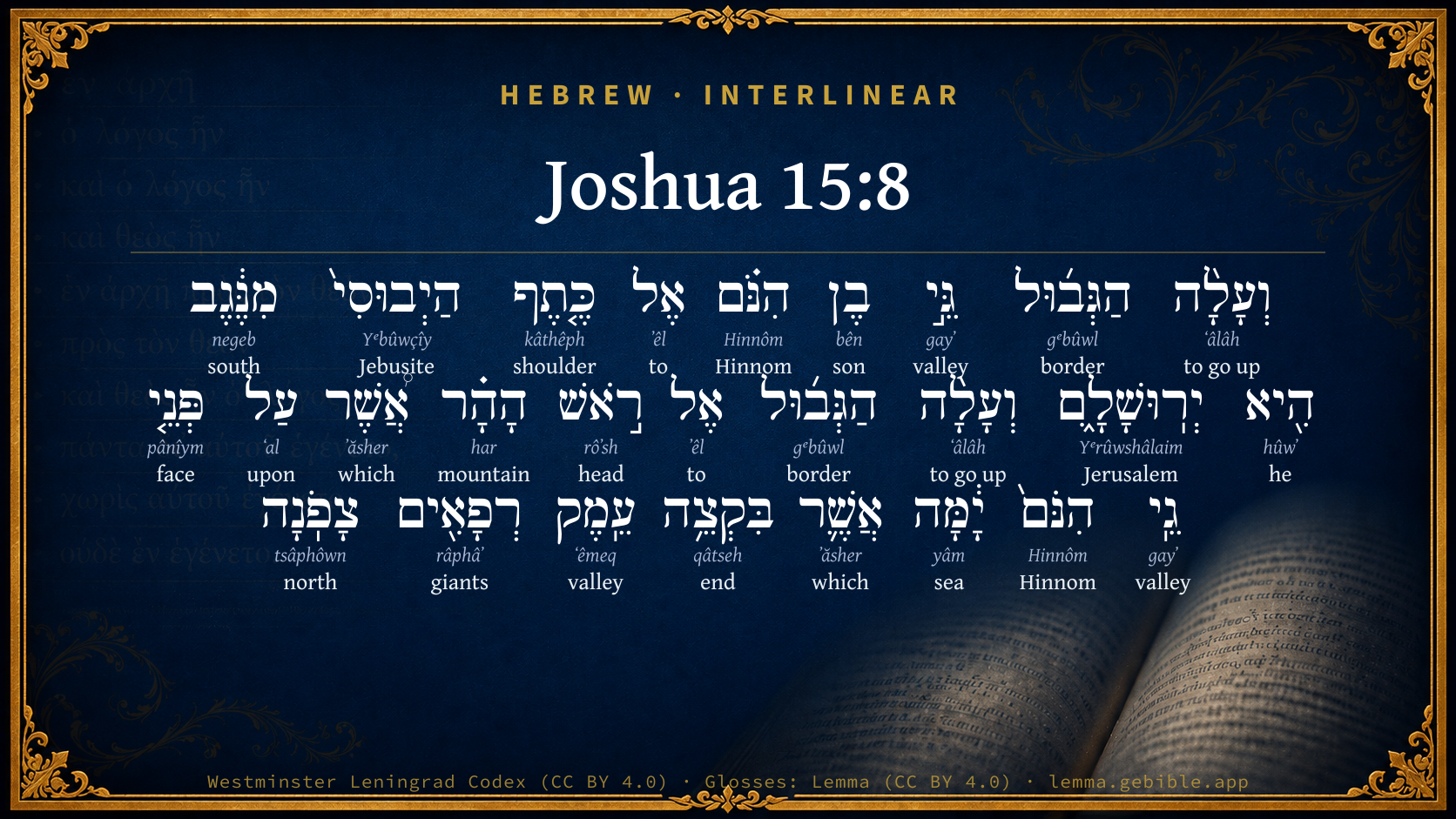
Hebrew (Westminster Leningrad Codex) Joshua 15:8 appears in the Hebrew Old Testament. The text above is from the Westminster Leningrad Codex. Each word links to its Strong’s number, a concise gloss, and parsing drawn from the Open Scriptures Hebrew Bible morphology. Click any word for its full Brown-Driver-Briggs (BDB) entry.
Download image
Cite this verse

Joshua 15:8 (World English Bible). Public Domain. Lemma interlinear Bible study tool, https://lemma.gebible.app/v/joshua/15/8.

Show BibTeX & RIS
BibTeX
RIS
English Translation
and the border went up by the valley of the son of Hinnom to the side of the Jebusite southward (the same is Jerusalem); and the border went up to the top of the mountain that lies before the valley of Hinnom westward, which is at the uttermost part of the valley of Rephaim northward;
World English Bible · Public Domain
Highlights
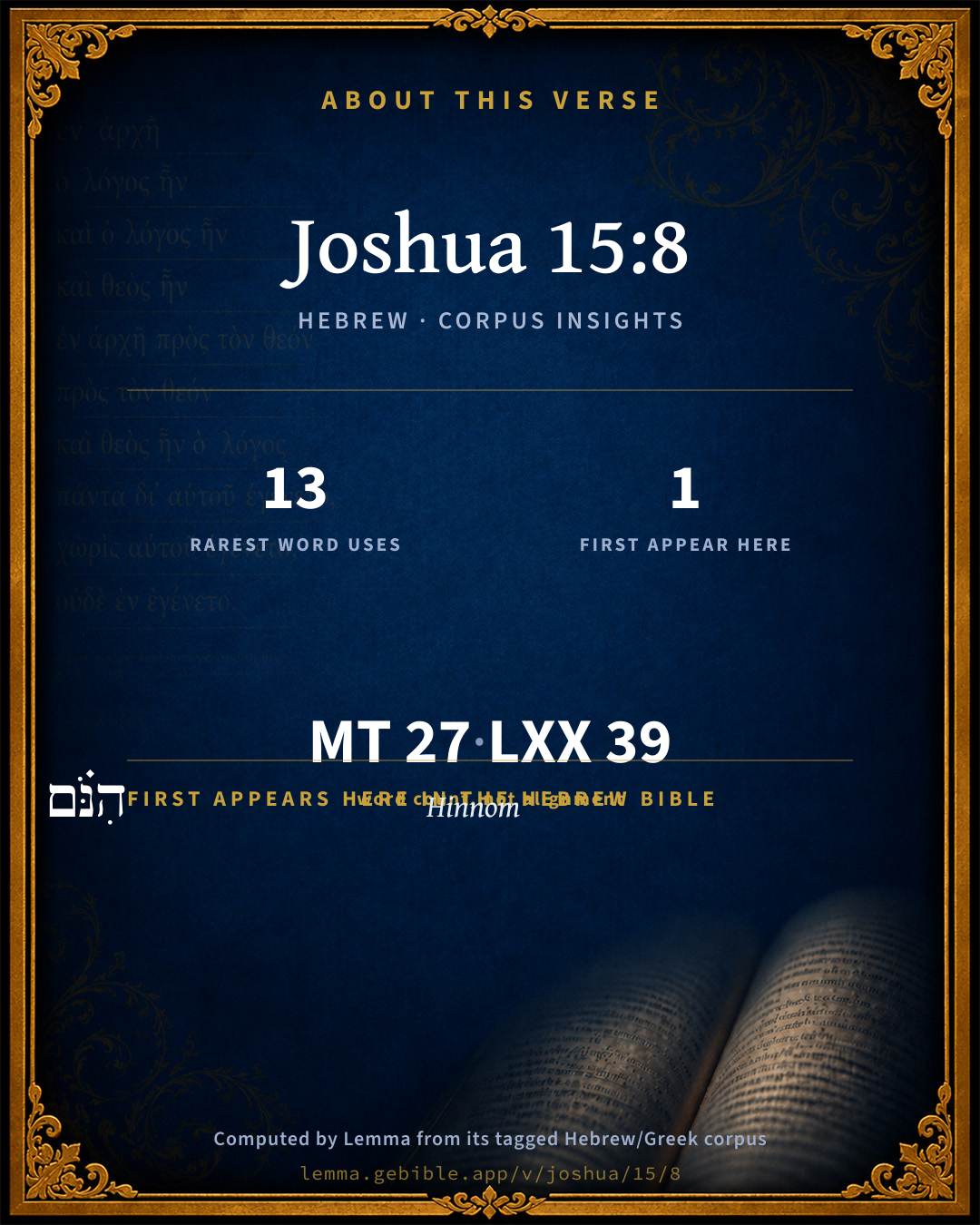
  • 1 first appearance in the Hebrew Bible
Full analysis ↓
Download a study sheet

One document with this verse’s original text, its word-by-word gloss line, the meaning frame, cross-references with their text, attributed commentary, and full source and license credits — printable, and it pastes into notes with its structure intact.

This verse Autodidact and up

Study sheet (.html) Plain text (.txt)

A passage Seminary Student

Up to 50 verses in one chapter. A passage sheet keeps up to 6 commentary sources and 12 cross-references per verse, in the order this page ranks them, and says so on the sheet whenever that leaves anything out. Ask for a single verse and you get the Autodidact verse sheet above.

Everything on this page stays free to read, with no account — the sheet is a download of what is already on screen, not access to it.

Want to remove ads? Support Godless Engineer
Compare translations 3

The same verse in 3 English versions, stacked beneath the original-language interlinear above. Click any original word for its lexicon entry.

Each is an independent rendering of the whole verse — the interlinear is not word-aligned to these translations.

Highlighted words mark where these versions differ — a whole-verse word diff, not a word-by-word alignment.

  • World English Bible Public Domain
    and the border went up by the valley of the son of Hinnom to the side of the Jebusite southward (the same is Jerusalem); and the border went up to the top of the mountain that lies before the valley of Hinnom westward, which is at the uttermost part of the valley of Rephaim northward;
  • King James Version Public Domain
    And the border went up by the valley of the son of Hinnom unto the south side of the Jebusite; the same is Jerusalem: and the border went up to the top of the mountain that lieth before the valley of Hinnom westward, which is at the end of the valley of the giants northward:
  • unfoldingWord Literal Text CC BY-SA 4.0
    And the border went up the valley of Ben Hinnom to the shoulder of the Jebusite from the south (it is Jerusalem). And the border went up to the head of the hill that on the face of the valley of Hinnom, seaward, which at the end of the valley of the Raphaites northward.

unfoldingWord Literal Text — © unfoldingWord, licensed CC BY-SA 4.0. Word-aligned USFM3 via Door43 (git.door43.org/unfoldingWord/en_ult).

Versions to compare (up to 4)

3 of 4 selected

Show all 18 translations

Every available English version of this verse, each an independent rendering of the whole verse.

  • World English Bible Public Domain
    and the border went up by the valley of the son of Hinnom to the side of the Jebusite southward (the same is Jerusalem); and the border went up to the top of the mountain that lies before the valley of Hinnom westward, which is at the uttermost part of the valley of Rephaim northward;
  • Berean Standard Bible Public Domain
    From there the border went up the Valley of Hinnom along the southern slope of the Jebusites (that is, Jerusalem) and ascended to the top of the hill that faces the Valley of Hinnom on the west, at the northern end of the Valley of Rephaim.
  • Majority Standard Bible Public Domain
    From there the border went up the Valley of Ben-hinnom along the southern slope of the Jebusites (that is, Jerusalem) and ascended to the top of the hill that faces the Valley of Hinnom on the west, at the northern end of the Valley of Rephaim.
  • King James Version Public Domain
    And the border went up by the valley of the son of Hinnom unto the south side of the Jebusite; the same is Jerusalem: and the border went up to the top of the mountain that lieth before the valley of Hinnom westward, which is at the end of the valley of the giants northward:
  • American Standard Version (1901) Public Domain
    and the border went up by the valley of the son of Hinnom unto the side of the Jebusite southward (the same is Jerusalem); and the border went up to the top of the mountain that lieth before the valley of Hinnom westward, which is at the uttermost part of the vale of Rephaim northward;
  • Revised Version (1885) Public Domain
    and the border went up by the valley of the son of Hinnom unto the side of the Jebusite southward (the same is Jerusalem): and the border went up to the top of the mountain that lieth before the valley of Hinnom westward, which is at the uttermost part of the vale of Rephaim northward:
  • Geneva Bible (1599) Public Domain
    Then this border goeth vp to the valley of the sonne of Hinnom; on the Southside of the Iebusites: the same is Ierusalem. also this border goeth vp to the top of the mountaine that lyeth before the valley of Hinnom Westward, which is by the end of the valley of ye gyants Northward.
  • Douay-Rheims (1899) Public Domain
    And it goeth up by the valley of the son of Ennom on the side of the Jebusite towards the south, the same is Jerusalem: and thence ascending to the top of the mountain, which is over against Geennom to the west in the end of the valley of Raphaim, northward.
  • Young's Literal Translation Public Domain
    and the border hath gone up the valley of the son of Hinnom, unto the side of the Jebusite on the south (it `is' Jerusalem), and the border hath gone up unto the top of the hill-country which `is' on the front of the valley of Hinnom westward, which `is' in the extremity of the valley of the Rephaim northward;
  • Literal Standard Version CC BY-SA 4.0
    and the border has gone up the Valley of the Son of Hinnom, to the side of the Jebusite on the south (it [is] Jerusalem), and the border has gone up to the top of the hill-country which [is] on the front of the Valley of Hinnom westward, which [is] in the extremity of the Valley of the Rephaim northward;
  • Unlocked Literal Bible CC BY-SA 4.0
    Then the border went up the Valley of Ben Hinnom to the south side of the Jebusite city (that is, Jerusalem). Then it went up to the top of the hill that lies over the Valley of Hinnom, on the west, which is at the northern end of the Valley of Rephaim.
  • unfoldingWord Literal Text CC BY-SA 4.0
    And the border went up the valley of Ben Hinnom to the shoulder of the Jebusite from the south (it is Jerusalem). And the border went up to the head of the hill that on the face of the valley of Hinnom, seaward, which at the end of the valley of the Raphaites northward.
  • Darby Bible Public Domain
    and the border went up to the valley of the son of Hinnom, toward the south side of the Jebusite, that is, Jerusalem; and the border went up to the top of the mountain that is before the valley of Hinnom westward, which is at the end of the valley of Rephaim northward;
  • World Messianic Bible Public Domain
    The border went up by the valley of the son of Hinnom to the side of the Jebusite (also called Jerusalem) southward; and the border went up to the top of the mountain that lies before the valley of Hinnom westward, which is at the farthest part of the valley of Rephaim northward.
  • Webster's Bible Public Domain
    And the border went up by the valley of the son of Hinnom, to the south side of the Jebusite; the same is Jerusalem: and the border went up to the top of the mountain that lieth before the valley of Hinnom westward, which is at the end of the valley of the giants northward:
  • Free Bible Version CC BY-SA 4.0
    The boundary then went through the valley of Ben-hinnom, along the southern slopes of the Jebusites (that is Jerusalem), then on up to the top of the mountain overlooking the valley of Hinnom right up to the northern end of the valley of Rephaim.
  • Bible in Basic English Public Domain
    Then the line goes up by the valley of the son of Hinnom to the south side of the Jebusite (which is Jerusalem): then up to the top of the mountain in front of the valley of Hinnom to the west, which is at the farthest point of the valley of Rephaim on the north:
  • JPS Tanakh (1917) Public Domain
    And the border went up by the Valley of the son of Hinnom unto the side of the Jebusite southward — the same is Jerusalem — and the border went up to the top of the mountain that lieth before the Valley of Hinnom westward, which is at the uttermost part of the vale of Rephaim northward.

Literal Standard Version (2020), Covenant Press — licensed CC BY-SA 4.0. Text via the HelloAO Bible API (eBible.org). Unlocked Literal Bible (unfoldingWord) — licensed CC BY-SA 4.0. Text via the HelloAO Bible API (eBible.org). unfoldingWord Literal Text — © unfoldingWord, licensed CC BY-SA 4.0. Word-aligned USFM3 via Door43 (git.door43.org/unfoldingWord/en_ult). Free Bible Version, Dr. Jonathan Gallagher — licensed CC BY-SA 4.0. Text via the HelloAO Bible API (eBible.org).

Word by word

More ways to search: Search by grammar → Find every occurrence → Compare this word →

Practice this passage: Drill this verse → Learn its vocabulary →

הִנֹּ֗ם
Hinnôm
H2011
“Hinnom”
Noun, Proper
Part of Speech
Noun
Type
Proper
Full BDB Definition

Origin: probably of foreign origin

TWOT: None

Hinnom = "lamentation" - a valley (deep and narrow ravine) with steep, rocky sides located southwest of Jerusalem, separating Mount Zion to the north from the hill of evil counsel' and the sloping rocky plateau of the 'plain of Rephaim' to the south
  1. וְעָלָ֨ה ʻâlâh H5927 “and · to go up” Conjunction + Verb, Qal, Perfect, 3rd Person, Masculine, Singular
  2. הַגְּב֜וּל gᵉbûwl H1366 “the · border” Particle, Definite Article + Noun, Common, Masculine, Singular, Absolute
  3. גֵּ֣י gayʼ H1516 “valley of” Noun, Common, Both, Singular, Construct
  4. בֶן bên H1121 “son of” Noun, Common, Masculine, Singular, Construct
  5. אֶל ʼêl H413 “to” Preposition
  6. כֶּ֤תֶף kâthêph H3802 “shoulder of” Noun, Common, Feminine, Singular, Construct
  7. הַיְבוּסִי֙ Yᵉbûwçîy H2983 “the · Jebusite” Particle, Definite Article + Noun, Gentilic, Masculine, Singular, Absolute
  8. מִנֶּ֔גֶב negeb H5045 “from · south” Preposition + Noun, Common, Masculine, Singular, Absolute
  9. הִ֖יא hûwʼ H1931 “he” Pronoun, Personal, 3rd Person, Feminine, Singular
  10. יְרֽוּשָׁלִָ֑ם Yᵉrûwshâlaim H3389 “Jerusalem” Noun, Proper
  11. וְעָלָ֨ה ʻâlâh H5927 “and · to go up” Conjunction + Verb, Qal, Perfect, 3rd Person, Masculine, Singular
  12. הַגְּב֜וּל gᵉbûwl H1366 “the · border” Particle, Definite Article + Noun, Common, Masculine, Singular, Absolute
  13. אֶל ʼêl H413 “to” Preposition
  14. רֹ֣אשׁ rôʼsh H7218 “head of” Noun, Common, Masculine, Singular, Construct
  15. הָהָ֗ר har H2022 “the · mountain” Particle, Definite Article + Noun, Common, Masculine, Singular, Absolute
  16. אֲ֠שֶׁר ʼăsher H834 “which” Particle, Relative
  17. עַל ʻal H5921 “upon” Preposition
  18. פְּנֵ֤י pânîym H6440 “face(s) of” Noun, Common, Both, Plural, Construct
  19. גֵֽי gayʼ H1516 “valley of” Noun, Common, Both, Singular, Construct
  20. הִנֹּם֙ Hinnôm H2011 “Hinnom” Noun, Proper
  21. יָ֔מָּה yâm H3220 “sea · toward” Noun, Common, Masculine, Singular, Absolute + Suffix, Demonstrative
  22. אֲשֶׁ֛ר ʼăsher H834 “which” Particle, Relative
  23. בִּקְצֵ֥ה qâtseh H7097 “in/at · end of” Preposition + Noun, Common, Both, Singular, Construct
  24. עֵֽמֶק ʻêmeq H6010 “valley of” Noun, Common, Masculine, Singular, Construct
  25. רְפָאִ֖ים râphâʼ H7497 “giants” Noun, Proper
  26. צָפֹֽנָה tsâphôwn H6828 “north · toward” Noun, Common, Feminine, Singular, Absolute + Suffix, Demonstrative

About this verse

These counts appear in no published source. They are computed here, from the morphology-tagged text and Lemma’s own curated glosses. What Lemma adds →

27
words
21
distinct lemmas
Historical
section

Notable vocabulary

The rarest word here is הִנֹּ֗ם Hinnom H2011 — appearing just 13 times in the whole Hebrew Bible.

First appearance in Scripture

This word makes its first canonical appearance in the Hebrew Bible here:

  • הִנֹּ֗ם Hinnom H2011

Shared distinctive vocabulary

הִנֹּ֗ם Hinnom H2011 occurs in 11 verses of the Hebrew Bible. Also found in:

Grammatical profile

  • 2 verbs
  • 19 nouns
  • 1 pronoun
  • 3 prepositions
  • 2 particles

Verb forms

  • וְעָלָ֨ה Qal · Perfect
  • וְעָלָ֨ה Qal · Perfect

Repetition

Words recur within this verse — often emphatic in Hebrew:

  • וְעָלָ֨ה to go up H5927 ×2
  • הַגְּב֜וּל border H1366 ×2
  • גֵּ֣י valley H1516 ×2
  • הִנֹּ֗ם Hinnom H2011 ×2
  • אֶל to H413 ×2
  • אֲ֠שֶׁר which H834 ×2

Hebrew & Septuagint length

In English translation the verse runs 55 words from the Hebrew and 47 from the Septuagint (LXX English) — closely comparable.

A rough comparison of the two English renderings, which tokenize alike — not a word-level alignment.

Word counts can differ between the Hebrew and the Greek without any difference in meaning — e.g. the Hebrew direct-object marker אֵת has no separate Greek word, and Greek often adds the article ὁ.

In the original languages it is 27 Hebrew tokens and 39 Greek tokens — but the two are counted differently (Hebrew bundles its prefixes and suffixes into one token; the Greek is in lemma form), so that isn’t a like-for-like length.

Cross-references

15

Topical passages linked to Joshua 15:8 in the Treasury of Scripture Knowledge — connected by theme and wording, ordered by reader-vote popularity; previews shown in the World English Bible.

  • Joshua 18:16 and the border went down to the uttermost part of the mountain that lies before the valley of the son of Hinnom, which is in the valley of Rephaim northward; and it went down to the valley of Hinnom, to the side of the Jebusite southward, and went down to En Rogel;
  • Joshua 15:63 As for the Jebusites, the inhabitants of Jerusalem, the children of Judah couldn't drive them out: but the Jebusites dwell with the children of Judah at Jerusalem to this day.
  • Joshua 18:28 and Zelah, Eleph, and the Jebusite (the same is Jerusalem), Gibeath, [and] Kiriath; fourteen cities with their villages. This is the inheritance of the children of Benjamin according to their families.
  • Judges 19:10 But the man wouldn't stay that night, but he rose up and departed, and came over against Jebus (the same is Jerusalem): and there were with him a couple of donkeys saddled; his concubine also was with him.
  • Judges 1:21 The children of Benjamin did not drive out the Jebusites who inhabited Jerusalem; but the Jebusites dwell with the children of Benjamin in Jerusalem to this day.
  • 2 Kings 23:10 He defiled Topheth, which is in the valley of the children of Hinnom, that no man might make his son or his daughter to pass through the fire to Molech.
  • Judges 1:8 The children of Judah fought against Jerusalem, and took it, and struck it with the edge of the sword, and set the city on fire.
  • 2 Samuel 5:18 Now the Philistines had come and spread themselves in the valley of Rephaim.
  • 2 Samuel 5:22 The Philistines came up yet again, and spread themselves in the valley of Rephaim.
  • 2 Chronicles 28:3 Moreover he burnt incense in the valley of the son of Hinnom, and burnt his children in the fire, according to the abominations of the nations whom Yahweh cast out before the children of Israel.
  • Isaiah 17:5 It shall be as when the harvester gathers the standing grain, and his arm reaps the ears; yes, it shall be as when one gleans ears in the valley of Rephaim.
  • Jeremiah 7:31–32 They have built the high places of Topheth, which is in the valley of the son of Hinnom, to burn their sons and their daughters in the fire; which I didn't command, neither came it into my mind.
  • Jeremiah 19:2 and go forth to the valley of the son of Hinnom, which is by the entry of the gate Harsith, and proclaim there the words that I shall tell you;
  • Jeremiah 19:6 therefore, behold, the days come, says Yahweh, that this place shall no more be called Topheth, nor The valley of the son of Hinnom, but The valley of Slaughter.
  • Jeremiah 19:14 Then came Jeremiah from Topheth, where Yahweh had sent him to prophesy; and he stood in the court of Yahweh's house, and said to all the people:

Cross-references courtesy of OpenBible.info (CC BY 4.0).

Hebrew and Greek witnesses Masoretic Hebrew ↔ Greek Septuagint

The same verse in the two great witnesses to the Old Testament, shown verse-for-verse.

These are two independent witnesses, not word-aligned to each other, and the Septuagint is shown in lemma (dictionary) form.

Hebrew Joshua 15:8 Masoretic · Westminster Leningrad Codex

וְעָלָ֨ה הַגְּב֜וּל גֵּ֣י בֶן הִנֹּ֗ם אֶל כֶּ֤תֶף הַיְבוּסִי֙ מִנֶּ֔גֶב הִ֖יא יְרֽוּשָׁלִָ֑ם וְעָלָ֨ה הַגְּב֜וּל אֶל רֹ֣אשׁ הָהָ֗ר אֲ֠שֶׁר עַל פְּנֵ֤י גֵֽי הִנֹּם֙ יָ֔מָּה אֲשֶׁ֛ר בִּקְצֵ֥ה עֵֽמֶק רְפָאִ֖ים צָפֹֽנָה

and the border went up by the valley of the son of Hinnom to the side of the Jebusite southward (the same is Jerusalem); and the border went up to the top of the mountain that lies before the valley of Hinnom westward, which is at the uttermost part of the valley of Rephaim northward;

World English Bible · Public Domain

Greek LXX Joshua 15:8 Septuagint · lemma form

καί ἀναβαίνω ὁ ὅριον εἰς φάραγξ ονομ ἐπί νῶτον ιεβους ἀπό λίψ οὗτος εἰμί ἰερουσαλήμ καί δια ἐκβάλλω ὁ ὅριον ἐπί κορυφή ὄρος ὅς εἰμί κατά πρόσωπον φάραγξ ονομ πρός θάλασσα ὅς εἰμί ἐκ μέρος γῆ ραφαϊν ἐπί βορέας

And the borders go up to the valley of Ennom, behind Jebus southward; this is Jerusalem: and the borders terminate at the top of the mountain, which is before the valley of Ennom toward the sea, which is by the side of the land of Raphain northward.

LXX2012 (modern English Septuagint) · Public Domain

Hebrew: Westminster Leningrad Codex (CC BY 4.0). Greek: Septuagint (public domain); English from LXX2012 (modern English Septuagint) (Public Domain). How the Septuagint differs from the Hebrew →

Targum (Aramaic paraphrase)

1

The Targum is the ancient Jewish Aramaic paraphrase of the Hebrew Scriptures — an interpretive translation, not the Hebrew text itself. Onkelos (literal) and Pseudo-Jonathan (expansive) render the Torah, and Jonathan the Prophets. Coverage is partial: where no permissively-licensed English translation exists for a verse, only the Aramaic is shown. This is verse-level text, not a word-by-word alignment to the Hebrew.

  1. Targum Jonathan Prophets (Joshua–Malachi)
    וְסָלֵיק תְּחוּמָא לְחֵילַת בַּר הִנֹם דִלְעִיבַּר יְבוּס מִדָרוֹמָא הִיא יְרוּשְׁלֵם וְסָלֵק תְּחוּמָא לְרֵישׁ טוּרָא דְעַל אַפֵּי חֵילַת הִנֹם מַעַרְבָא דְבִּסְיָפֵי מֵישַׁר גִבָּרַיָא צִפּוּנָא:

    (no public-domain English translation for this verse)

    Targum Jonathan — Aramaic: “Mikraot Gedolot” (public domain). English: “Sefaria Community Translation” (CC0 1.0 (public-domain dedication)); “London "Chaldee Paraphrase," 1871” (public domain). Text via Sefaria.

Commentary

Notes on Joshua 15:8 from classic Christian and Jewish commentators (each source and its license shown beneath its notes). The classic Christian expositions comment on the surrounding passage and are grouped to its opening verse, so a note may address several verses; the Jewish commentaries on the Tanakh (Rashi and others) are per-verse, so they appear only where the commentator wrote on this verse.

Lemma curates 59 commentaries, every one of them public domain or Creative Commons licensed, each selected and text-cleaned for this edition rather than reprinted as found. About our sources →

Trapp's Complete Commentary

John Trapp

Jos 15:8 And the border went up by the valley of the son of Hinnom unto the south side of the Jebusite; the same [is] Jerusalem: and the border went up to the top of the mountain that [lieth] before the valley of Hinnom westward, which [is] at the end of the valley of the giants northward:

Ver. 8. By the valley of the son of Hinnon.] Where with barbarous cruelty they sacrificed their children to Moloch, or Saturn. {2Ki 23:11} Hence Gehenna for hell.

The same is Jerusalem.] Anciently Jebus, {Jdg 19:11} afterwards Jerusalem; not quasi ιερον σολυμων vel σολομωντος, as Hegesippus dreameth, but of Jireh, {Gen 22:14} "he will provide," and Shalom, "peace." The Hebrew here and elsewhere writeth it in the dual form, as it were the double Jerusalem, the higher and the lower town, from which the apostle gathereth an allegory. {Gal 4:15}

John Trapp, A Commentary or Exposition upon All the Books of the Old and New Testament (1647–1656) — public domain. Text from a community e-Sword module.

Tyndale Open Study Notes

Tyndale Open Resources

15:8 The valley of Ben-Hinnom marked Judah’s northern border. Jerusalem occupied a ridge rising northward from the lower end of this valley within the tribe of Benjamin’s territory. Neither tribe occupied Jerusalem, so when David captured it, it became the royal city of his dynasty rather than just another tribal city.

Tyndale Open Study Notes — © Tyndale Open Resources, licensed CC BY-SA 4.0. Text via the HelloAO Bible API.

Geneva Bible (1599)

Geneva Bible translators

Hebrew, Rephaim.

Geneva Bible (1599) marginal notes — public domain. Text via Bolls.life.

Adam Clarke's Commentary

Verse 8. The valley of the son of Hinnom] Who Hinnom was is not known, nor why this was called his valley. It was situated on the east of Jerusalem; and is often mentioned in Scripture. The image of the idol Molech appears to have been set up there; and there the idolatrous Israelites caused their sons and daughters to pass through the fire in honour of that demon, 2Kg 23:10. It was also called Tophet, see Jer 7:32. When King Josiah removed the image of this idol from this valley, it appears to have been held in such universal execration, that it became the general receptacle of all the filth and impurities which were carried out of Jerusalem; and it is supposed that continual fires were there kept up, to consume those impurities and prevent infection. From the Hebrew words גי בן הנם gei ben Hinnom, the valley of the son of Hinnom, and by contraction, גי הנם gei Hinnom, the valley of Hinnom, came the Γεεννα, Gehenna of the New Testament, called also Γεεννα του πυρος, the Gehenna of fire, which is the emblem of hell, or the place of the damned. See Mt 5:22; Mt 5:29-30; Mt 10:28; Mt 18:9, c.

In the East it is common to add the name of the father to that of the son, e.g., "This land belongs to Goborka the son of Kake Prusada." But this addition is not made till after the father's death. This custom prevailed also in the west. It is common among the aborigines of both Ireland and Wales.

The same is Jerusalem] This city was formerly called Jebus a part of it was in the tribe of Benjamin; Zion, called its citadel, was in the tribe of Judah.

The valley of the giants] Of the Rephaim. See the notes on Ge 6:4; Ge 14:5; De 2:7; De 2:11.

On this subject, a very intelligent clergyman favours me with his opinion in the following terms: -

"The boundary between Judah and Benjamin went up from the valley of Hinnom on the east to the top of the hill southward, leaving Jebusi (or Jerusalem) to the northwest adjoining to Benjamin. This mount (Jebusi) lay between the two tribes, which the Jebusites possessed till the time of David. At the 63d verse here, Jos 15:63 it is said Judah could not drive out these people; and in Jdg 1:21, the same is said of the Benjamites. Each tribe might have attacked them at various times. There were various mounts or tops to these hills. Mount Zion and Moriah, where the temple stood, was in the tribe of Judah; Ps 78:68-69; Ps 87:2.

"In De 33:12 it is said of Benjamin, the Lord shall dwell by him, i.e., near him, or beside his borders, between his shoulders; the line might be circular between the two hills or tops so as in part to encompass Mount Zion in the tribe of Judah, on which the temple stood. Benjamin's gate, (mentioned Jer 37:12-13; Jer 38:7), was the gate leading out of the city, into the tribe of Benjamin. So the gate of Ephraim, (2Kg 14:13), was a gate which led towards the tribe of Ephraim. We give names to roads, &c., in the same way now.

"Mount Calvary, (which was on the outside of the gate), seems to have been in the tribe of Benjamin. Query. Whether Calvary or Golgotha was so called from skulls being scattered about there, (as say some), or rather from the figure of the rock being shaped like a man's skull, with one face of it nearly perpendicular? I incline to this latter opinion. I believe the Jews did not suffer human bones, even of malefactors, to lie about." - J. C.

Adam Clarke's Commentary on the Bible (1810–1826) — public domain. Text from a community e-Sword/MySword module.

The Cambridge Bible for Schools and Colleges

gen. ed. J. J. S. Perowne

8. and the border went up] From En-rogel the border went up into the valley of the son of Hinnom, on the south side of the Jebusite, that is Jerusalem. The direction accordingly runs S. S. W. of Jerusalem, where the valley mentioned lies. Nothing is known of this Hinnom. Possibly he was some ancient hero, who had encamped here, and from whom it was called “Ge-Ben-Hinnom,” “the Ravine of the son of Hinnom,” whence came “Ge-Hinnom,” and so “Gehenna.” It is a deep retired glen, shut in by rugged cliffs, with the bleak mountain-sides rising over all. Here (a) Solomon erected high places for Moloch (1Ki_11:7), and (b) in the times of Ahaz and Manasseh it became notorious as the scene of the barbarous rites of that deity and of Chemosh, when the idolatrous inhabitants of Jerusalem cast their sons and daughters into the red-hot arms of a monster idol of brass placed at the opening of the ravine (2Ki_16:3; 2Ch_28:3; Jer_7:31). To put an end to these abominations the place was polluted by Josiah, who spread over it human bones and other corruptions (2Ki_23:10; 2Ki_23:13-14), from which time it seems to have become the common cesspool of the city. These inhuman rites and subsequent ceremonial defilement caused the later Jews to regard it with horror and detestation, and they applied the name given to the valley to the place of torment.

the same is Jerusalem] As Bethel was in earlier times called Luz (Gen_28:19), and Bethlehem was called Ephrath (Gen_35:16; Mic_5:2), so Jerusalem was called Jebus (Jdg_19:11; 1Ch_11:4). It is interpreted by some to mean a place “dry” or “down-trodden like a threshingfloor,” which is thought to prove it must have been the south-western hill.

went up to the top of the mountain] From the ravine of Hinnom the border now ascended to the top of the mountain that lieth before the valley of Hinnom westward, which is at the end of “the Valley of Giants northward.” The “Valley of the Giants” was “the Valley of Rephaim,” an ancient settlement of this giant tribe, from which sprang Og king of Basan, possibly after they were driven from their original seats by Chedorlaomer (Gen_14:5). It was a “valley-plain,” extending in a S.W. direction from Jerusalem to Mar Elias, spacious enough to serve as a camp for an army. Here (a) David twice encountered the Philistines and inflicted a destruction upon them so signal that it gave the place a new name, Baal-perazim = “the plain of Bursts” or “Destructions” (2Sa_5:17-20). Here (b) too it was in all probability that the incident of the water of Bethlehem occurred (2Sa_23:13).

the mountain] here alluded to was the slight “rock-ridge” which on the north constitutes the boundary of the valley of Hinnom.

The Cambridge Bible for Schools and Colleges (gen. ed. J. J. S. Perowne; Cambridge University Press, 1878–1918) — public domain. Text from a community e-Sword module.

John Gill's Exposition

And the border went up by the valley of the son of Hinnom,.... Which belonged to a man of that name formerly; and was near Jerusalem, placed by Jerom (l) to the east of it; but Reland (m) rather thinks it is to the south. It was infamous for the sacrifices of children to Moloch in it, by burning them, or causing them to pass through fire: hence, in allusion to it, hell fire is often in the New Testament called "Geenna", Mat 5:22 Luk 12:5; this border from the salt sea, and from Jordan, is all along said to "go up", because from hence to Jerusalem was an ascent, that lying on higher ground:

unto the south side of the Jebusite; of the place the Jebusite inhabited:

the same is Jerusalem; which was formerly called Jebus, from the inhabitants of it; yea, Jebusi, as here, and so may intend not the inhabitants, but the place, see Jos 18:28; and here the Jebusites lived, at least in some part of it, until the time of David, Sa2 5:6,

and the border went up to the top of the mountain that lieth before the valley of Hinnom westward: which is generally supposed to be the mount Moriah:

which is at the end of the valley of the giants, northward: the valley of Rephaim, as it is called Sa2 5:18, and here Mount Moriah, as it was to the west of the valley of Hinnom, it was to the north of the valley of Rephaim; which valley, as Josephus (n) says, was not far from Jerusalem, twenty furlongs from it. Some late travellers (o) tell us it lies in the way from Jerusalem to Bethlehem, and is not above two hours' ride from the former. From this account it appears, as Jarchi remarks, that Jerusalem was not within the line, and was not in the border of Judah, but of Benjamin, which tribe lay to the north of Judah: it seems indeed to have been one part of it in the tribe of Judah, and the other in the tribe of Benjamin; though the Jews frequently say it did not belong to either tribe.

(l) De loc. Heb. fol. 91. B. (m) Palest. lllustrat. tom. 1. p. 253. (n) Antiqu. l. 7. c. 4. sect. 1. & 12. 4. (o) Egmont and Heyman's Travels, vol. 1. p. 370.

John Gill's Exposition of the Whole Bible (1746–1763) — public domain (CC PDM 1.0). Text via the HelloAO Bible API.

Albert Barnes' Notes on the Bible

The valley of the son of Hinnom - This valley begins on the west of Jerusalem at the road to Joppa, and turning southeastward round the foot of Mount Zion joins the deeper valley of Kedron on the south of the city. It was in this ravine, more particularly at Tophet in the more wild and precipitous part of it toward the east, that the later kings of Judah offered the sacrifices of children to Moloch (2Ch 28:3; 2Ch 33:6, etc.). After these places had been defiled by Josiah, Tophet and the whole valley of Hinnom were held in abomination by the Jews, and the name of the latter was used to denote the place of eternal torment Mat 5:22. The Greek term Gehenna (γεέννα geenna) is in fact formed from the Hebrew הנם גיא gay' hı̂nnôm, “valley of Hinnom.” Hinnom is regarded either as the name of some ancient hero, or as an appellative ( “groaning” or “moaning”), bestowed on the spot because of the cries of the victims here offered to Moloch, and of the drums with which those cries were drowned.

The valley of the giants - Rather “the plain of Rephaim.” This plain, named after an ancient and gigantic tribe of the land Gen 14:5, lies southwestward of Jerusalem, and is terminated by a slight rocky ridge forming the brow of the valley of Hinnom. The valley is fertile Isa 17:5 and broad, and has been on more than one occasion the camping ground for armies operating against Jerusalem 2Sa 5:18, 2Sa 5:22; 2Sa 23:13.

Albert Barnes' Notes on the Bible (1834–1885) — public domain. Text from a community e-Sword/MySword module.

Haydock's Catholic Bible Commentary

Ennom. Hebrew, Ge-ben-Hinnom, or simply Ge-ennom, whence Gehanan has probably been formed. In this vale, children were immolated to Moloc: the beating of drums, to hinder their lamentations from being heard, caused it perhaps to be called Tophet. It was to the east of Jerusalem, (Calmet) inclining to the south. (Haydock) --- Northward. The valley extends south to Bethlehem. (Josephus, [Antiquities?] vii. 10.) Her David gained a great victory, 2 Kings v. 23. (Calmet) --- Woods. This explanation is added by St. Jerome. (Haydock) --- The ark remained at this city for some time, 1 Kings xv. 6. It was 10 miles north of Jerusalem.

George Leo Haydock (1774–1849), Haydock's Catholic Family Bible and Commentary, 1859 edition — public domain. Excludes Psalms (Douay-Rheims chapter numbering differs from Protestant) and Deuterocanonical books (Catholic canon only).

Matthew Poole's English Annotations

The border went up; properly, for the line went from Jordan and the Salt Sea, to the higher grounds nigh Jerusalem; and therefore the line is said to go down, Jos 18:16, because there it takes a contrary course, and goes downwards to Jordan and the sea.

Hinnom; a very pleasant place, but afterwards made infamous, 2Ki 23:10.

Of the Jebusite, i.e. of the city of the Jebusites, which was anciently called Jebusi, Jos 18:28; Jdg 19:10.

The same is Jerusalem: it may seem hence, and from Deu 33:12; Jos 18:28; Jdg 1:21, that Jerusalem, properly, or at least principally, belonged to Benjamin; and yet it is ascribed to Judah also here, Jos 15:63, and elsewhere, either because a part of the city was allotted to Judah; or because the Benjamites needed or desired the help and conjunction of this powerful tribe of Judah, for the getting and keeping of this most important place. And when the Benjamites had in vain attempted to drive out the Jebusites, this work was at last done by the tribe of Judah, who therefore had an interest in it by the right of war; as Ziklag, which belonged to the tribe of Simeon, being gotten from the Philistines by David, was adjoined by him to his tribe of Judah, 1Sa 27:6.

Matthew Poole's English Annotations on the Holy Bible (1683–1685) — public domain. Text from a community e-Sword/MySword module.

Whedon's Commentary on the Bible

Daniel D. Whedon

8. Valley of the son of Hinnom — A long-standing and almost unanimous opinion of all explorers of the Holy Land identifies this valley with the deep and narrow ravine that bounds Jerusalem on the west and south. But Capt. Warren, of the Palestine Exploration Company, is convinced that the Hinnom is identical with the Kedron Valley, which is on the east of Jerusalem. In Jer_19:2, the valley is said to be “by the entry of the east gate,” but there the Hebrew is the Charsuth, or Potter’s Gate, and the precise meaning is by no means clear. But Robinson (Bib. Res., vol. i, p.

269) says that several Arabic writers of the twelfth century call the Kedron valley Jehennam. According to Capt. Warren the border of Judah and Benjamin ran over the southern slope of the mount of Olives, “across from the rock Zoheleth in Siloam to the Virgin’s Fount, thence up the Kedron until nearly opposite the south-southeast angle of the noble sanctuary, where it crossed over the hill of Moriah at the southern side of the temple, thence up the Tyropoean Valley to the Jaffa Gate, and so on to Lifta.” But this needs confirmation, and ill agrees with what follows.

South side of the Jebusite — That is, the boundary line ran south of Jerusalem, the city of the Jebusite. The Jebusite citadel, which was taken by David and called the stronghold of Zion, (2Sa_5:7,) is commonly supposed to have been on the modern Zion; but Capt. Warren’s topography places the boundary on the north side of the modern Zion.

The mountain that lieth before the valley of Hin-nom westward — This most naturally indicates the eminence west of Jerusalem which forms the western side or wall of the upper part of what is now commonly called the Valley of Hinnom. The brow of this hill, according to Robinson, is a rocky ridge.

Which is at the end of the valley of the giants northward — This is obscure. What is at the end of the valley? and is this point north of the valley, or the valley north of the point in question? We take the meaning to be, that the mountain (just mentioned) is at the northern end of the Valley of the Giants. The valley of the giants, or of Rephaim, is usually identified with the upland plain to the southwest of Jerusalem. “This plain,” says Robinson, “is broad, and descends gradually towards the southwest until it contracts in that direction into a deeper and narrower valley, called lower down Wady el-Werd, which unites further on with Wady Ahmed, and finds its way to the western plain.” So it is sufficiently enclosed with hills to be called a valley, (emek,) and no other valley or plain so well answers the Scripture notices as this. Here the Philistines encamped when they came to war with David. 2Sa_5:18.]

Daniel D. Whedon (gen. ed.), Commentary on the Old and New Testaments (1874–1909) — public domain. Text from a community e-Sword module.

The Pulpit Commentary

The south side of the Jebusite. Literally, the shoulder of the Jebusite from (or on) the south. (see 1Ki_6:8 1Ki_7:39, margin) Thus Jerusalem lay to the north of the border, in the tribe of Benjamin. The same is Jerusalem. Formerly called Jebus, from the Jebusites who dwelt there. (Jud_1:19:11 1Ch_11:4) The city lay on the borders of Judah and Benjamin. (see note on Jos_10:1) The valley of the giants. Hebrew, Rephaim. (see Jos_12:4) The word here translated valley is qme. In the former part it is yge (see note on last verse). The word here used signifies originally depth, and is applied to wide valleys embosomed among lofty hills. Such were the valley of Elah; (1Sa_17:2, 1Sa_17:19) the King"s Dale; (Gen_14:17 2Sa_18:18) the valley of Siddim, (Gen_14:3) of Jezreel. (Jud_1:6:33) "The word Emek shows that this was neither a winter torrent nor a narrow, dry ravine, and it is best identified with its traditional site, the shallow basin west of the watershed south of Jerusalem, now called el Bukei"a" (Conder). We read of this valley in 2Sa_5:18, 2Sa_5:22. From these passages we may gather a confirmation of the view above expressed, that the valley here meant is an open valley, since only in such a valley could the Philistine army take up a position. It gradually narrows towards the southwest. On the south it extends as far as Bethlehem. The range of mountains which lie to the west of the valley of Hinnom from the northern boundary of the plain or valley of Rephaim.

The Pulpit Commentary (1880–1919), ed. H.D.M. Spence-Jones & Joseph S. Exell — public domain. Text from a community e-Sword module.

John Wesley's Explanatory Notes

Went up - Properly; for the line went from Jordan and the salt sea, to the higher grounds nigh Jerusalem; and therefore the line is said to go down, chap. xviii, 16, because there it takes a contrary course, and goes downward to Jordan and the sea. Valley of Hinnom - A very pleasant place, but afterward made infamous. Of the Jebusites - Of the city of the Jebusites, which was anciently called Jebussi. Jerusalem - It may seem hence, that Jerusalem properly, or at least principally, belonged to Benjamin; and yet it is ascribed to Judah also; either because a part of the city was allotted to Judah; or because the Benjamites desired the help and conjunction of this powerful tribe of Judah, for the getting and keeping of this most important place. And when the Benjamites had in vain attempted to drive out the Jebusites, this work was at last done by the tribe of Judah, who therefore had an interest in it by the right of war; as Ziglag which belonged to the tribe of Simeon, being gotten from the Philistines by David, was joined by him to his tribe of Judah, 1 Sam. xxvii, 6.

John Wesley, Explanatory Notes Upon the Whole Bible (1754–1765) — public domain. Text via the GEBible commentary corpus.

Rashi

Rabbi Shlomo Yitzchaki (Rashi)

The boundary went up to the valley of Ben-hinom. It continued going up somewhat until it reached Ein-itim and from there on it descends. This is what our Rabbis, of blessed memory, said in the chapter of שְׁחִיטַת קָדְשִׁים: They considered building [the Beis Ha Mikdosh] in Ein-itim which is a bit higher than Yerushalayim. higher than Yerushalayim, but they said, “There is nothing more pleasing about the ox than his shoulders.

To the southern side of the Yevusi. Yerushalayim is outside the boundary line, and is not in the boundary of Yehudah, but within the boundary of Binyomin which is to the north of Yehudah.

Rashi on the Tanakh — English translations: “The Judaica Press complete Tanach with Rashi, translated by A. J. Rosenberg” (CC BY 4.0); “Pentateuch with Rashi's commentary by M. Rosenbaum and A.M. Silbermann, 1929-1934” (public domain); “The Metsudah Tanach series, Lakewood, N.J” (CC BY 4.0); and “The Book of Joshua, Metsudah Publications, 1997” (CC BY 4.0). Text via Sefaria.

Lesson kit

Teaching starters — assembled from the data on this page, not authored interpretation. Every prompt links to the verse data it draws on. Edit before teaching.

Joshua, in the Historical, opens this verse with 27 words (21 distinct Hebrew lemmas). Its most distinctive word is Hinnôm (“Hinnom”). A historical commentator’s framing appears above. Read the whole chapter for the surrounding context.

Discussion questions

  1. How does “Hinnom” (Hinnôm) shape what this verse is saying?
  2. The word “Hinnom” first appears here in Scripture. What is being introduced at this debut?
  3. Joshua 18:16 shares the word «Hinnom» with this verse. How do the two illuminate each other?
  4. “to go up” occurs 2× in this one verse. What is the effect of the repetition?
  5. The translations on this page render this verse differently — a whole-verse word diff, not a word-by-word alignment. What might account for the different wordings?
  6. The verb «וְעָלָ֨ה» is Qal Perfect. How does its form color the action?
  7. Reading how Trapp's Complete Commentary and Tyndale Open Study Notes read this verse, where do the two commentators agree and where do they part?

Things to notice

Reading settings

Reading text

Shown beneath each verse's original-language words.

Old Testament
Old Testament edition

Read the OT as the Masoretic Hebrew (MT) or the Greek Septuagint (LXX).

English shown for the Greek Septuagint (in the Hebrew ↔ Greek comparison).

Comparing translations? Open the Compare panel on any verse page to stack up to four side by side.